The horizon is not so far as we can see, but as far as we can imagine

Month: April 2026

Trump Really Messes Up Smart People

Smart people can’t handle Trump. He say something, or does something. On the face, it seems stupid, so they go into pattern matching over-drive, looking for a reason.

You see it with the “they’re attacking Iran to screw up China’s access to oil and because America has so much oil and natural gas now.”

Well, yes, but the US is near peak unconventional oil and natural gas, production will soon start declining and the collateral damage from the Iran war is so severe it’s going to send the US into a recession so severe it’ll look like a depression, because it isn’t just about oil, it’s about fertilizer and helium and supply chains being completely wiped out.

It might be that this is Trump’s “plan” and it’s just a stupid plan, but if that was it, he’d have drawn back when it became clear that the attempt to replace the Iranian government with a compliant one, a la, Venezuela, had failed.

Or we have this:

I’ve been following Marins for a while, and she’s a smart gal. But that’s the problem. Smart people look for patterns, and assume people have goals that make sense to them.

Trump doesn’t have goals like that. You just have to listen to his word salad speech. He’s incoherent, almost certainly suffering from dementia, and to the extent he has goals they are goals like “feel good” and “have people praise me” and ‘never be seen to lose.” I dislike psychoanalyzing public figures, but he’s almost certainly a narcissist

Smart people can’t handle this. There’s got to be a smart plan hidden somewhere in the word salad.

Sometimes there is, but it’s never Trump’s plan, it’s the plan of someone who has some influence over him. But that doesn’t matter, however smart that plan is, Trump will fuck it up, because Trump will never leave someone else alone to execute, he’ll always interfere. There’s a smart plan for tariffs, for example, but that was not going to happen with Trump deciding tariffs on the fly and depending on which foreign leader he was upset with that day, nor with him insisting on undoing all the industrial policy Biden’s people (not Biden, but his people, because he would leave them alone to execute in many cases) had put in place.

Trump’s just an old, sick, stupid man with dementia and so evil that Jeffrey Epstein, of all people, wrote:

“recall ive told you ,, I have met some very bad people ,, none as bad as trump. not one decent cell in his body.. so yes- dangerous.”

There is no clever plan. There never was one. There never will be one. Trump has morally neutral virtues, or did, like the ability to manipulate people, a certain type of charisma and before his decline, massive amounts of energy. The primary difference between the first Trump term and the second is that his health has declined severely and his dementia is far more advanced.

But coherent plans? No. Trump, even when he was much younger and healthier, managed to drive a casino into bankruptcy.

A casino.

There is no plan and no, not even the deep state can carry out a coherent plan thru Trump. Even Netanyahu, who has him by the short-and-hairys, only has partial control, and certainly not day to day operational control.

If some random stranger talked like Trump you’d assume he was mentally damaged and you’d be right. His being President doesn’t change that.

Everyone reads these article for free, but the site and Ian take money to run. If you value the writing here and can, please subscribe or donate.

Monday Morning Econ Blues

~by Sean Paul Kelley

The looming financial crisis and the news that keeps emerging is getting so bad that it’s growing harder for me to set aside my rage and discuss it coherently.

But I’m going to try.

I’ll continue to use the framework of the credit cycle, as I hope y’all have been able to digest it. That said there are some events that are happening outside of a normal cycle, not unpredictable, but defintely wild cards and spoilers; chief among them would be the closure of the Straits of Hormuz and its cascading effects on the by-products from gasoline refining. This will lead to a commodity price spike everywhere.

I noted nearly two weeks ago, The end of this credit cycle is going to include the following macro events: a credit crisis, a housing crisis, an energy shock, with the potential for . . . famine on a biblical scale [in the developing world], at least one Too Big To Fail failing, as Lehman Bros and AIG did in 2008, and the AI bubble bust.

We are very deep into phase 2 of the credit cycle. We are closer to the end than we are the beginning.

By way of not so new but newly disclosed developments FDIC insured banks are exposed to private credit and/or equity to the tune of $1.4 trillion.

That makes up 11% of total FDIC insured bank lending. This is why I call private credit, shadow credit. And that shadow credit is money that you, dear taxpayer, are on the hook for when the excrement hits the fan.

Moreover, the private credit/equity crisis is much, much worse than I initially thought. I went full Alice down the rabbit hole this weekend. Never in my wildest dreams might I envision the inept deployment of so much capital in so many catastrophically stupid ways.

Here’s that canary, Blue Owl, I’ve been talking about. It’s getting worse for them. Much, much worse: there is a term for 41% redemption demands: a run on the mother-fucking bank. Blue Owl–as I have mentioned many times before–is linked at the hip with Oracle and its hyperscaling of datacenters. Oracle is trying to back door a Federal backstop, justifying it as a necessary AI upgrade to Fed databases, which is bullshit, but it might work.

Fun fact: all planned data-centers for 2026 are either delayed or cancelled. But we’ll get to that later.

The real problem right now is the dilemma, of which I already spoke, facing central bankers from the ECB, Japan and the Fed. I’ll spell it out again.

First, they are facing an inflationary energy shock. They are staring at commodity prices rising coupled with higher inflation expectations from consumers. Inflation is likely to jump. This places enormous pressure on central bankers to tighten credit by raising interest rates.

On the other side of the dilemma is the growing realization, at least I hope they are aware, of just how bad a credit crisis we’re waltzing into.

Housing is in free-fall, too.

The employment numbers are a joke. Sure, the BLS reported 178,000 non-farm payroll jobs added in March. Unemployment fell a bit as well. Except, the way the BLS calculates unemployment is a farce. Consider that 400,000 people exited the labor force during the same month. How does that translate into job growth? (Hint: it doesn’t.)

Unemployment is calculated using U3, meaning people who are actively seeking work and have done so in the past four weeks. A more meaningful, but politically inexpedient measure is U6. U6 “includes U-3, plus discouraged workers, those marginally attached to the workforce, and people working part-time who want full-time work.”

See where I’m going with this?

At the same time BLS was championing these great numbers, they issued an under-the-table revision of the February numbers downwards -133,000. Yup, you read that correctly. Add all the downward revisions over the last two years and employment numbers have cratered downwards to the tune of millions.

Millions.

All this data gives the Fed a bad case of whiplash: raise rates in fear of inflation or lower them, anticipating a credit crisis?

Should I stay or should I go?

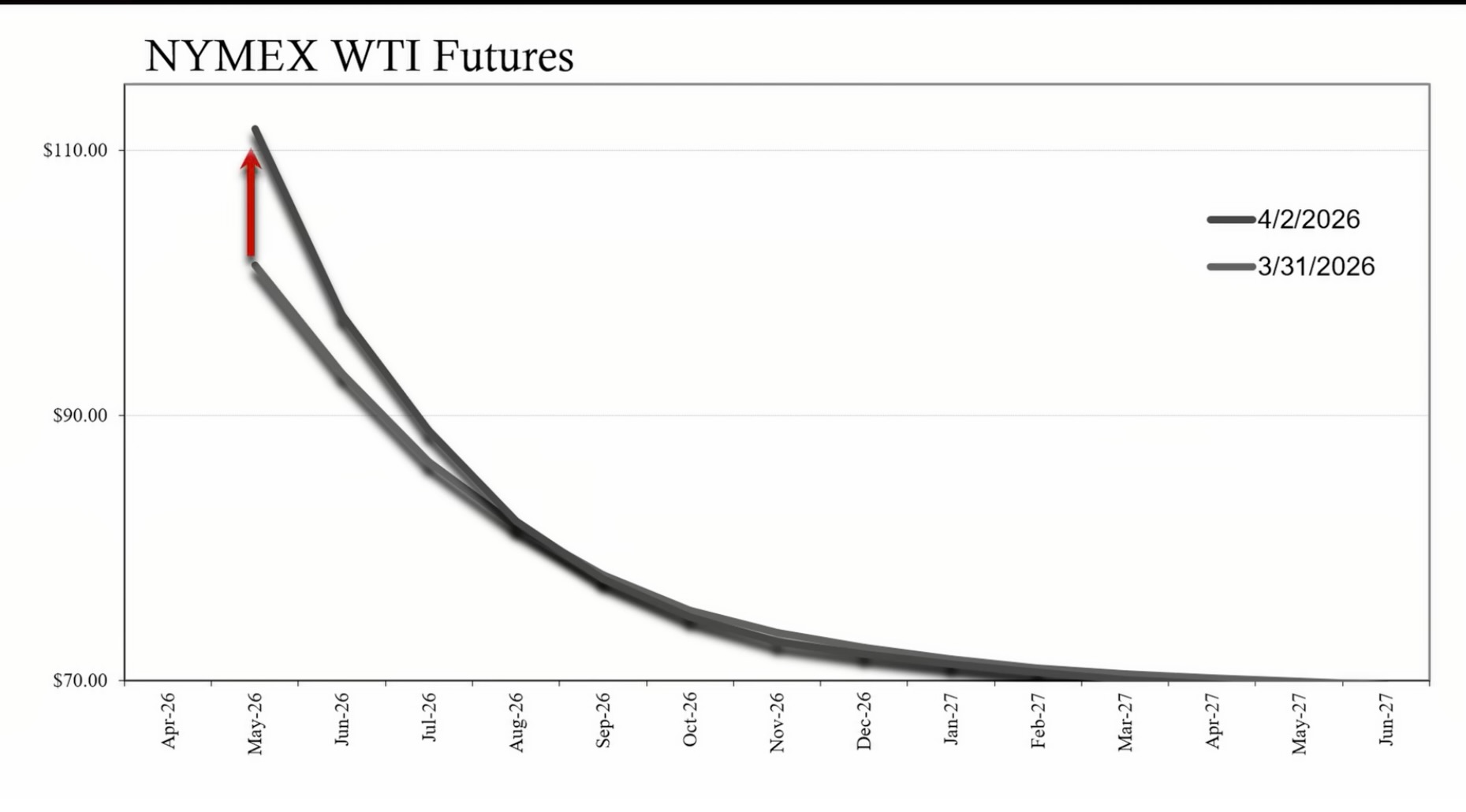
Here’s the kicker that magnifies this dilemma: the signal WTI long-term futures (and treasuries and TIPS) are giving off. Take a look at this chart of WTI:

You can clearly see the near term spike. That’s the inflationary pressure central bankers are worrying about. Brent Crude is even uglier at $140. So, at present WTI is at $111 for April 2026 contracts. But take a look at the futures a year later. The chart doesn’t go that low, but the futures are priced at below $60 a barrel. That’s a $51 spread.

WTI long term futures are predicting serious oil demand destruction over the next 12-months and longer.

What, say you, is demand destruction?

Demand destruction happens when shrinking economic activity across the board globally reduces the need for energy. US Treasuries and TIPS are signaling identical developments.

Shorter version: less economic activity globally means less demand for oil. But my bet is that central bankers will raise rates at first, only to realize the trap they fell into.

Anyone want to take the over/under?

So what does this all mean? Well, EndGameMacro succinctly describes how bad it will probably get:Unemployment rises roughly 5.5 points to a peak near 10%, equities fall roughly 55% to 58%, home prices drop about 30%, and commercial real estate takes a 39% to 40% hit.

Personally, I think it’ll get worse. The size of the private equity/credit catastrophe has me questioning whether the Fed can really backstop a crisis this time around, especially when you add the massively irresponsible budget just proposed by Trump.

Finally, a quick word on AI: this post just confirmed my hunch that the AI craze is nothing more than a huge ponzi-scheme and will never truly amound to a hill of beans. Here is a taste of the post:

So it is with great regret that I announce that the next person to talk about rolling out AI is going to receive a complimentary chiropractic adjustment in the style of Dr. Bourne, i.e, I am going to fucking break your neck. I am truly, deeply, sorry.

Give it a read. You’ll enjoy it and learn a lot.

What’s it all mean?

Easy, our elites are strip-mining our economy while we’re too busy fucking around on Tik-Tok to care.

Week-end Wrap – Political Economy – April 05, 2026

Week-end Wrap – Political Economy – April 05, 2026

by Tony Wikrent

A German Journalist’s ‘Civil Death’

Patrick Lawrence, March 31, 2026 [via defenddemocracy.press]

… With the seizure of his spouse’s bank accounts last Friday, Dogru and his family now face what amounts to a starvation blockade of the kind the Trump regime (not to change the subject) currently imposes on Cuba and Israel imposes on Gaza.

This story reads like something out of Dostoyevsky or Kafka, I have to say. We are talking about a family of five going hungry in the capital of the Federal Republic of Germany as punishment for… what?… for seeing with his eyes open, for thinking about what he sees, then commenting on what he sees?

I would love to suggest various ways readers could support the Dogru family, but there are none. Were someone to donate so much as a loaf of bread to help sustain them the German authorities would count it a criminal offense punishable by a prison term of up to several years.


Strategic Political Economy

Why we need rationing, now

Richard Murphy, April 02, 2026 [Funding the Future]

The UK is in a war economy, and most people don’t realise it yet. The Middle East conflict has already cut global oil supplies by around 20% and gas supplies by roughly 30%. With approximately half of all UK food imported, and global fertiliser supplies under severe pressure, the shortages hitting our shelves and energy bills are only the beginning.

Markets cannot solve this. When supply collapses, markets ration by income and those with money survive; those without do not. That is not a policy choice. That is a failure of government. The energy crisis and emerging food shortages demand an active UK state response.

Drawing on Lord Keynes’s approach at the start of World War II, and John Kenneth Galbraith’s wartime work in the United States, this video argues that the only credible response to this supply chain crisis is a combination of government-led rationing and a serious redesign of the tax system.

It means government intervention in the economy at a scale not seen since the 1940s.

The alternative is leaving resource allocation to the market, which will transfer wealth upward, destroy social cohesion, and risk public unrest. That is not how to manage a war economy. That is a policy choice to let the poor bear the cost of a crisis they did not create.

[TW: Interesting! Can the consequences of Trumpanyahu war be used to drive a regime change of political economy away from neoliberalism? We must try….. ]

Not Getting It Together 

Aurelien, via Naked Capitalism 04-01-2025]

…It’s not so much that numbers can be confused with reality, as that reality in the end is nothing but numbers, and decisions are made and workers rewarded without any kind of real-world check. Everything is possible, therefore, because ultimately everything is numbers.

The modern political class, increasingly dominated by those who have worked in finance, or its close relative management consultancy, therefore largely consist of people with little experience of the real world. Over the last forty years, unsurprisingly, this way of thinking and working, combining symbolic manipulation of numbers and the ticking of symbolic boxes, has become the default in government, and even the military and diplomacy. So the emphasis now is not on the capability to do things and achieve actual objectives, but on the skills of making the numbers look right, and proving that you have carried out the correct steps in the correct order. That is all the system knows how to do….

…It is the nature of a crisis that most attention is focused on transitory daily issues, such that the big picture, if there ever was one, disappears from view. I know from personal experience that in a crisis every long and exhausting day is overwhelmed with meetings, telephone calls, video-conferences, unexpected news or initiatives, requests for interviews, media statements, questions in parliament … the list goes on and on. For those like me who had the temerity to ask what the point of all this was, and about longer-term objectives and plans, the response was typically “we’ll worry about that later.” And quite soon, of course, it’s later, and the system realises that it has no idea how it got to where it is, especially because it actually wanted to be somewhere else. But by then it’s too late.

So the real problem is not so much that the left brain dominates, as that the two modes of thinking are never brought together. This means that quite a lot of left-brain work can go on effectively on auto-pilot, because it develops a life of its own. Thus, ideas for using US ground troops in Iran can rapidly be developed at a technical level, with force composition and generation, potential targets, entry points, logistic resupply, ISR etc, all without the questions of “why are we doing this?” or “what do we hope to achieve?” ever being posed. But of course the output of such activities can be easily expressed in whizzo graphics and AI generated simulations, and it provides the planners with something to do….

Thus, statements of faith in an ultimate Ukrainian victory, or of a future “Free Palestine,” or of the inevitable defeat of Iran, have to be seen, even more than most political statements, as symbolic and metaphorical. They are not deduced from the facts of the situation, nor do there have to be actual processes capable of making them happen. They are battle-cries, slogans for chanting, descriptions of fantasies and in certain cases nightmares. The problem arises when the extreme right-brain thinking that has always characterised politics, exacerbated by the ignorance of modern politicians about real life, collides with the extreme left-brain culture of our modern world as exemplified in government systems, without any transmission mechanism to enable them to work together….

The greatest challenge, as often, is intellectual. Our masters will have to recognise that chains of consequence and causality do actually exist, that Father Christmas is a right-brain myth, and that there are hard limits on what can actually be done, and hard requirements about what needs to be done, and neither can be circumvented with words. In particular, they need to abandon the delusion that only finance matters, and that numbers on paper represent the underlying reality of the world. (Not even Pythagoras would have suggested that you can eat numbers.) This is most obvious in the endless, earnest discussion of what the Iran War will do to “the price of oil.” In a few cases, pundits even realise that “the price of oil” might affect the prices of other things as well. But from their point of view, “price” and “oil” are two different concepts. The idea that there might just not be enough oil, and that that lack may have practical consequences other than price doesn’t get much of an airing. After all, surely if the price goes up, new suppliers will come forward? That’s how the market works, isn’t it? Isn’t it? The idea that the world will soon lose some of its supply of oil-based products, and that this is a hard limit that cannot be got round, has only just begun to register, and, to the extent that it has, pundits appear to believe that we can substitute, say, solar power for oil, and all will be well. Can you use solar power to make fertiliser? Indeed, can you make solar panels at all without oil-based products?

…I doubt if any western country is now equipped, organisationally or even intellectually, to handle problems caused by scarcity of food. Western states now enjoy little absolute food security—a problem I discussed in some detail last year—but our governments are far from even beginning to grasp the nature of the problem, let alone its implications. Ah well, it will be said, people eat too much and anyway too much food is thrown away. Indeed, but that’s not the answer….

As it happens, there is a lot of experience of what happens in situations of severe shortage, and the answer is that the rich buy what they want, the poor buy what they can, and organised crime steps in to put those with money in touch with those with things to sell. The capacity of western states has been radically reduced over the last couple of generations, even as the power of organised crime has grown. We can imagine what shortages of basic medicines would do, and who might wind up controlling their retail sale. In reality, attempts by government to control the availability of everyday necessities will lead nowhere and arouse public opposition. The Internet will have a field day: it will be worse than Covid. This shortage of food doesn’t really exist you see, it’s just the Davos brigade trying to kill off as many people as it can, this time by hunger….

Trump’s planning war crimes

Richard Murphy, April 02, 2026 [Funding the Future]

Donald Trump has signalled his intention to attack Iran’s civilian infrastructure, power stations and desalination plants, and that is a war crime under international law. The law is unambiguous: military gain does not justify targeting civilian populations and the infrastructure they depend upon, and pre-announcing an attack does not reduce culpability. This is the reality of the Iran war that the world urgently needs to confront….

…There is a deeper ideological logic at work here, which is neoliberalismNeoliberal economics reduces human beings to units in a system, economic cogs with conditional worth. When civilians are treated as expendable targets in a war in Iran, that is not aberration. That is the neoliberal system working as designed.

Margaret Thatcher applied the same logic to UK communities in the 1980s, treating unemployment and social harm as acceptable costs of economic policy. Trump’s Iran policy is the modern expression of that same ideology, now directed at Iranian civilians on a far grander and more lethal scale. The mindset is identical; the human cost is simply larger.

The collapse of moral constraint we are witnessing in the US-Iran conflict is a systemic danger. Neoliberalism, combined with distorted justification, is overriding both international law and basic humanity…

Never doubt that dangerous ideas are a threat to humankind

Richard Murphy, March 31, 2026 [Funding the Future]

…This is the consequence of neoliberal thinking. When, as that philosophy does, you reduce people to being cogs in a machine, those cogs become expendable. Margaret Thatcher treated people in this way when managing the UK economy with supreme indifference to its population in the 1980s. Donald Trump is treating the people of Iran in this way when managing his maniacal war agenda in the 2020s. There is a difference in the scale of the contempt shown, but the indifference to human suffering that underpinned both courses of action is similar.

The fact is that the courses of action required to fulfil the neoliberal agenda of ever-increasing the wealth of a few in society at cost to many have been presumed by all those who subscribe to this ideology as justification for their contempt for their fellow human beings, and as an excuse for the suffering that their ideology has caused to billions around the world….

Trump’s assault on 2026 Election

Trump Will Not Accept the 2026 Results. These Are the Legal Weapons to Force Certification

W. A. Lawrence, Mar 29, 2026 [Glass Empires]

Trump is not attempting to win the election. Trump is attempting to establish the outcome as settled before certification, because a public that accepts inevitability becomes far easier to override.

Since January 2025, actions to expand federal control of election administration have moved from proposal into execution. Courts have blocked portions on constitutional grounds. Legal countermeasures stand ready. Effective use requires speed, coordination, and sustained pressure applied before administrative strain.

American elections transfer governing authority through a statutory and constitutional process requiring convergence of canvassing, certification, judicial review, and final recognition within fixed time limits….

Stage one is voter roll disruption before the election. The SAVE America Act forces all 211 million registered voters to re register in person with documentary proof of citizenship before November, generating mass eligibility disputes designed to overwhelm certification administrators at the moment deadlines permit no unresolved claims.

A parallel draft executive order carries identical provisions for unilateral imposition under a declared national emergency if the Senate fails to act. Trump confirmed the fallback, stating the requirements will govern the midterms whether approved by Congress or imposed by executive authority….

Trump signs executive order creating national voter list, restricting mail-in voting

[Associated Press, via Drop Site Daily: April 1, 2026

President Donald Trump signed an executive order Tuesday directing the Department of Homeland Security and Social Security Administration to create a national list of verified eligible voters and seeking to bar the U.S. Postal Service from sending absentee ballots to those not on state-approved lists. Voting law experts say the move unconstitutionally usurps states’ authority to run elections. Federal funding could be withheld from states that do not comply.

Nearly Two Dozen Democratic States Hit Trump With Elections Lawsuit

Finn Hartnett, April 3, 2026 [The New Republic]

Officials from 23 different states (and the District of Columbia) are taking Donald Trump to court over a brazenly unconstitutional executive order that looks to limit Americans’ voting rights.

The executive order, signed on Tuesday, banned the U.S. Postal Service from delivering mail-in ballots to anyone not on a preapproved list compiled by the USPS itself. Trump and his cronies like to claim mail-in voting is rife with fraud—despite a lack of evidence and the fact that the president likes to vote by mail himself. But the executive order’s solution to this is sketchy at best. Why, and how, does the USPS get to choose who can vote by mail?

Perhaps even more insidious is another section of the executive order, which calls on the federal government to compile its own list of voters in each state, which will then be sent to states 60 days before each federal election—presumably along with a bunch of threats that they better not find anyone who doesn’t match their list voting….

Letters from an American, March 31, 2026

Heather Cox Richardson, Apr 01, 2026

…Trump is ordering the Department of Homeland Security (DHS) to work with the Social Security Administration to create a list of verified U.S. citizens who are eligible to vote in each state. The order directs the U.S. Postal Service to send mail-in ballots only to voters on the list, and to mark each ballot with its own unique barcode. It threatens any states refusing to cooperate with the order with a loss of federal funding and directs Attorney General Pam Bondi to investigate anyone wrongfully distributing mail-in ballots. Aaron Reichlin-Melnick of the American Immigration Council notes that “there is no such thing as a federal list of citizens. It does not exist.”

“This is unconstitutional on its face,” election law expert David Becker told Yunior Rivas of Democracy Docket. “The Constitution clearly gives the president no power over elections….

State Dems must stop ICE from stealing the midterms

Cory Doctorow, March 31, 2026 [Pluralistic]

Writing for Jacobin, Eric Blanc points out that Democrats don’t have to sit by passively while Trump – who repeatedly promised that if you voted for him in 2024, “you won’t have to vote anymore” – steals an election:

https://jacobin.com/2026/03/ice-trump-election-theft-laws/

…On March 13, the New Mexico state legislature passed a law banning armed federal officials from showing their fascist asses anywhere within 50 feet of a polling place or ballot drop-box:

https://www.koat.com/article/new-mexico-prohibits-armed-agents-voting-sites/70729595

Other blue states like “California, Connecticut, Pennsylvania, Rhode Island, Virginia, and Washington” are contemplating similar laws.

It’s a start, but as Blanc says, what the fuck are the other blue statehouses waiting for? This is a white-hot, hair-on-fire emergency. There isn’t a moment to spare. This should be on the agenda for every union, at every demonstration, at every DSA and Democratic Club meeting. As Blanc says, if we wait until November to find out what Trump is going to do, it’ll be too late. The time to act is now.

Open Thread

Use to discuss topics unrelated to recent posts.

The Illusion of a Revolutionary Moment

As the blowback resulting from Trump’s foolhardy attack on Iran begin to directly impact Americans, it’s natural to hope for substantive, positive political change in the U.S. of A.

Polls show Trump hemorrhaging support from all quarters, even among his base.

Polls show the Democratic leadership is deeply unpopular, even with a majority of Democratic voters.

In Maine, polls show sitting Governor Janet Mills is getting crushed by Graham Platner heading into the June 9th primary vote which will determine the Democratic nominee for U.S. Senate.

Platner has already survived a brutal oppo dump that dropped just as Mills (backed by Senate Minority Leader Chuck Schumer) entered the race last fall, including getting caught with a nazi tattoo on his chest.

Platner’s rhetoric is getting remarkably leftist, even using the old Coal Miner’s Union song “Which Side Are You On” in a campaign ad.

And the average price of gasoline in the US has only just hit $4/gallon.

Just wait until it’s $6/gallon nationally and $10/gallon in California.

And wait until more than 45% of the American public figures out that Trump’s War on Iran is not only “not going well”, but that the empire has already suffered a crushing, permanent blow.

This is all happening in a context of economic collapse that was well underway before Trump’s February 28th attack.

In review, we’ve got:

  1. Looming US military defeat
  2. Looming economic crash
  3. Trump and the MAGA movement bleeding out
  4. A rotten, unpopular Dem leadership class hated by all sides

Seems like a recipe for political turmoil, maybe even serious political change, right?

Right.

Yes. This part is obvious.

The not-so-obvious part is this: who will fill the looming political vacuum?

The answer is simple, if not obvious: the political void will be filled by those who are most prepared to seize the moment, and possibly just seize power.

The MAGA forces that brought Trump to power are the most to blame for his disastrous reign.

The Christian Zionists who latched onto MAGA (and took it over) have made their play and it is ending disastrously in West Asia. They could only have emerged as a force in a completely degenerate United States built on delusion and propaganda.

Their day is done.

So, who else?

The Techbros, as the biggest winners to emerge in the neo-liberal era, intend to conquer and dominate the coming era.

They’ve had the most cash and are used to running rings around incumbent powers.

They’ve planned feverishly for the coming opportunity and have massive resources to back their play.

Except they’ve sunk it all on a bet on Large Language Models aka AI which is seemingly on the verge of imploding disastrously (at least from a financial and economic perspective).

Should we join Whitney Webb and Taylor Lorenz in warning against the Techbros?

How scared should we be of the idiot who wasted $83 billion on “the Metaverse”?

Thought much about being “de-banked“? Might want to consider it before “hitting the streets” or just doing journalism.

Americans think it can’t happen here? Well just avoid Ohio and you’ll be fine….for now.

How To Read More

I see a lot of discussions about how to read more. Most of them are of the flavor of “I know broccoli and liver are good for me, but I hate how they taste, how do I eat more?”

This leads to people who are proud they read a book a month, or maybe a week, numbers that make actual readers, who often read a book a day, laugh. By the time I was ten, I was reading about fifteen books a week. (I know because I know what the library lending limits were.) I didn’t do it because it was good for me, I did it for fun.

Even in non fiction, find something you’ll enjoy reading. Love knights and chivalry? Plenty of books. Food or cooking? Same.  Seashells? Music? Math? Hunting? Anime? Weird esoteric shit like the different breeds of sheep or the history of whale hunting? Whatever it is, there are books on it. Probably many books, even for niche interests.

Then there’s fiction. I read fiction because I enjoy a break from being Ian and/or living in this particular world. That’s why I read a lot of science fiction and fantasy, but I read all genres, even some romance novels. The Regency romance novels of Georgette Heyer are often both funny and touching and you’ll learn a lot about Regency England without even realizing it, for example. (Try “The Corinthian” or “Friday’s Child” and stay away from her historical novels.)

The people who do a lot of anything either love doing it, or they’re doing it for money. (The ideal is both, but paid book reviewers are largely a thing of the past.)

If you want to be a better writer, read books by authors whose style you admire. Read the first time for fun, then re-read analytically, then write pastiches. Read a scene, put the book down and see if you can write the same scene the same way without looking.

Once you’ve done that with a few authors, try to write the a scene more than once, in each style. You can do the same with non fiction. It’s really hard to write like Machiavelli, for example. It sounds simple when you read it, but… no.

More instrumental advice. From 2018 to Covid, I wanted to get back into reading more as I’d gotten out of the habit. So I went to a coffee shop in a bookstore and didn’t take any screens except an e-reader. I’d sit and read for hours.

If you’re screen addicted, you may need to enforce some “no screen” time or set your phone so it only alerts you if key people call like your wife and ask them not to call unless it’s an emergency. Once Covid started up I read less, but I had the habit/enjoyment back.

Well, I never really lost the enjoyment. I still enjoyed it, but the dopamine twitch reflex of social media and so on had become an issue, not as fun overall, but it’s more immediate.

Reading books has a different “brain feel” than reading short form let alone social media. You just need to get a taste for it. It’s sort of stretchy — you get entire full stories or entire world models in ways articles can’t give you, let alone some social post or video.

That, I find, sparks a lot more ideas for me, and I LOVE the feeling of new ideas. Barbara Hambly once called it the the “cold clear ecstasy of intellectual discovery” and while I won’t say it’s the best feeling, it’s unique. Books really help get that.

If you want to read more: reduce your screen addiction and read books you’ll enjoy. Don’t treat it like forcing down liver and broccoli. Have fun.

Everyone reads these article for free, but the site and Ian take money to run. If you value the writing here and can, please subscribe or donate.

When Does Money Matter?

The core reason for America and Europe’s decline (and, in a way, Japan’s) was the belief by our elites that money was the only thing which mattered.

Money is the ability command resources from anyone who will, or must, sell. People who need to sell their labor or starve—Marx’s famous “whip of hunger.” Countries who must sell to get your money because you either make them militarily (see Venezuela right now and Iraq, both of which must sell their oil in US dollars and let the US treasury keep the money on account for them, then decide what they can spend it on, plus, of course the entire colonial era); or because they need to buy what you have.

For a long time the West had a monopoly on much of what you had to have: medicines, engines, planes, cars, tractors, fertilizer and so on. The Petrodollar was about having a monopoly on oil and all its products: gasoline, diesel, bunker fuel, jet fuel, plastics and fertilizer again. If you wanted electricity, well the equipment to make it came from the West too. If you wanted advanced weapons — the West, especially after the fall of the USSR.

During the early post war period you had options: you could get most of this from the West or the Soviets. But starting in the 70s, the USSR went into decline and then it fell, and the West was the only option.

Back to American elites: since everyone had to buy in dollars, and because they needed to get so much from the West, also had to sell in dollars, well having dollars was all that mattered. The more dollars, the more power.

What the elites forgot, thanks to complete retards like Francis Fukuyama, and sheer stupidity and greed was that smarter people than them had arranged the system this way: that it was contingent on the West having what everyone else needed, and having the military whip-hand.

Japan, poor fuckers, built an incredible industrial base and was pushing on taking the industrial lead. American leaders in the 80s, not having been taken over by complete retards made the Japanese sign the Plaza Accords, in which they would give that tech to America, open factories in the West and so on: give up their momentum, because it matters where you build.

As I’ve said many times, the tech lead follows the manufacturing floor: this is the LAW. Japan wasn’t strong enough to tell the US to go to hell. So they spent the last 4 decades in slow decline. This wasn’t primarily because of their big crash, though that was mishandled, but because they were no longer allowed to continue their industrial and technological snowball.

But by the 90s the last smart competent American elites were dead or retired, and the triumphalism over the fall of the USSR made them think, a la Fukuyama, that their system was superior, their shit didn’t stink, and they’d be on top forever. Everyone would have their system, and everyone would just keep buying and selling in dollars no matter what: it no longer mattered where things were made.

The key moment was when Clinton let China into the World Trade Organization (WTO) with developing world status. Western financiers (they weren’t capitalists, capitalists aren’t so stupid) looked at how cheap Chinese labor was and how willing they were to pollute and let workers get maimed, and they salivated. (And yes, lack of worker protections was part of it. One of my friends, in the 90s, visited a battery factory where the batteries were made by hand. Batteries are basically full of acid. Think it thru.)

So they sent industry to China and told themselves “well, we do the design here. That’s what matters.”

The Chinese leadership nodded, smiled and among themselves said, I’m sure, “what a bunch of suckers. Thank God they’re such idiots.”

And in learning to make all these things the Chinese learned the design and so on, and in time took the manufacturing lead. Then about 20 years later they took the tech lead decisively. Even three years ago American sanctions worried them. 

(In 2023) Xi Jinping warned that U.S.-led technology restrictions posed “unprecedented severe challenges” to China’s development.

Today:

Han Wenxiu, the senior official overseeing day-to-day operations at the Central Commission for Financial and Economic Affairs (CCFEA) — the Party’s top economic policymaking body — told the China Development Forum (CDF):

“After years of effort, China’s indigenous innovation capacity has passed a critical inflection point, making it difficult for external forces to derail our development”

As for overcapacity, the Chinese are no longer apologizing for it or dancing around it. They say our companies are uncompetitive and that’s our problem.

The bet seems to be that most countries, or trading blocs, won’t get their acts together enough to materially push back against China’s export juggernaut.

  • Even the U.S. tariffs on Chinese goods — unprecedented in recent history — have only succeed in diverting low-value manufactures (think toys, textiles, and fast fashion) away from the U.S. and toward new markets.
  • They’ve had less impact on higher-value exports to the U.S. — either because those goods were never sold there at scale (i.e. NEVs) or were exempt from the tariff regime anyway (i.e. smartphones and medical equipment).

To put it simply, the world needs what China has and can’t make it themselves. If they can make it themselves, well, it’s much cheaper coming from China and how many Western countries are willing to take a big hit to re-start their industries, and are competent enough to pull it off? (My approximate count is zero.)

And that, folks, is the end of the Western order. No one needs to buy from us any more. They’d still like to sell to us, sure, but they don’t need to because they don’t need dollars. If it’s something they need they can get it from China or, to a lesser extent Russia, India and so on. We don’t have a monopoly on anything that matters any more: the last real one was chip manufacturing, but the Chinese are catching up fast and confident that in a few years they’ll be there. In the meantime, they can make all but the most advanced chips and those are the ones that go in almost all manufactured good: the most advanced stuff is only useful for things like AI, and China’s find its way around that.

Now we come to Iran. Iran is showing that a fairly modest kit: missiles and drones, is sufficient to keep the US navy and air force far away and make any attack prohibitively expensive in men and material. Plus everyone knows that expensive US military gear needs Chinese supplies: the West doesn’t have the full kit any more, the Chinese can and in some case have, cut the West off any time they want. All those expensive radars the Iranians blew up? Well it’s not the cost (that’s irrelevant) it’s that they require materials on the Chinese have. They get rebuilt if the Chinese let America and there’s basically nothing the US can do about that.

Keynes famously said “anything we can do, we can afford.” The corollary, as I’ve written before is that it doesn’t matter how much money you have, anything you can’t do you can’t afford—or rather you can’t afford it if the people who can do it won’t sell it to you.

America had a great thing going, for America and for its allies. But American elites got stupid and didn’t understand the actual structure upholding their power. They though it was innate to a superior system and superior people, not a structure built by very smart and ruthless people over a period of about a hundred and fifty years: a structure that required maintaining.

And so, it’s over. It’s just over and anyone who tells you otherwise has zero idea what they’re talking about.

And everyone else is realizing this. Let’s take Australia, run by ‘tards even stupider than America. Twenty years ago, they had eight refineries. Now they have two. They’re running out of diesel and even if they could get crude oil (certainly not impossible, though hard) it doesn’t matter, because they can’t refine it.

This lesson should have been learned during the Covid Pandemic when the West restricted medical supplies and the logistics system stopped delivering enough international goods.

Anything really important: fuel, machinery required to maintain your infrastructure, food, medicine, etc… is something that you should be able to make yourself. If you truly can’t, you must have huge stockpiles. I would never want a country to have stockpiles less than three years of medicines, food, parts for important machinery like the electrical grid, and fuel.

None of us do.

Anyway, the structure of Western dominance is now dismantled, by Westerners. Perhaps the Chinese could have industrialized fully without us, but it would have taken a lot longer and as long as we had our own industry and tech stack, it would have just meant a cold war situation with two blocs and, absent de-industrialization, perhaps the West could have held its own, though China is innately stronger than the USSR ever was, especially with Russia as an ally.

We did this to ourselves, or our elites did, because of sheer stupidity and arrogance. Don’t underestimate how bad this will be. I’m in the “better China as hegemon than America” crowd. I think they’ll kill a lot less people. But be clear, they are going to be a hegemon, at least in industrial terms and this is going to mean a serious standard of living drop in much of the West. Europe will get hit the hardest (especially Britain) but everyone’s going to get hit hard. A few of us may make the switch over to the hegemon on favorable terms. Canada and Australia have the best chance of doing this being large countries with tons of resources and relatively small populations, but it’s not a sure thing.

Dominance and prosperity are both structural. They are always created by competent leaders and populations and when their successors become complacent they are always lost.

That’s where we are.

Everyone reads these article for free, but the site and Ian take money to run. If you value the writing here and can, please subscribe or donate.


Page 4 of 4

Powered by WordPress & Theme by Anders Norén