The horizon is not so far as we can see, but as far as we can imagine

Category: Oil Page 1 of 7

Saturday Morning Grab Bag Of Baddies and Goodies

~by Sean Paul Kelley

I’ll begin, as usual, with the economy. JP Morgan lays odds for a global recession at 60% now. Causes? According to JPMorgan it’s threefold: the conflict in Iran, the tariffs and AI. But JP Morgan is forgetting another huge variable, the private credit/shadow credit unwind happening in real time. Blackrock halted redemptions from its flagship debt fund to the tune of $1.2bn. Blackrock to investors: fuck off. Blackrock’s fuckery marks the third private credit shop in the last three months to shut investor redemptions down: first Blue Owl, then Blackstone and now Blackrock. 

As Dario intones ruefully, “Mark my words, the damage to the financial system the private credit space will cause will be greater by many orders of magnitude than the one subprime caused in 2008.” I’m pretty well convinced he’s right. That said, the political will to backstop another financial crisis has not eroded totally, so the emerging credit crunch will be the last one backstopped by the Fed and/or Congress. 

Another variable JP Morgan doesn’t address is the most recent (un)employment numbers. If the first reported, non-revised numbers of a -92,000 jobs is any indication, once the numbers are revised, February’s numbers are likely to resemble a catastrophe. 

On the ugly, catastrophe side of things, Dubai has only ten days of fresh food remaining if the Straits remain closed. I suppose they can eat dates, no? 

Also of note, The Reptile, aka Peter Thiel (yes, it’s a real anagram, google it if you donnae believe me!), dumped 2 million shares of Palantir. It’s a bright flashing red light, a semaphore both unmistakable and of serious consequence, when top execs dump shares of the corps they run. They are cashing out, leaving the equity collapse in the hands of suckers, ermm, retail investors, widows and orphans-like. 

If you want a fuller understanding of the logic logic behind Iran’s attacks on the region’s infrastructure, read here. Speaking of oil, one can’t fix stupid. Shorting oil in this kind of risk environment is nucking futs.

Maintaining our focus on petroleum for a bit longer, I have to note, if oil breaks bad to the north, past say $120, the resulting global recession will have deleterious effects on commodities, especially gold and silver. But more gold than silver, as the silver supply-demand equation has been so structurally out of whack for so long, the recession would have to be almost depression-like to impose enough demand destruction for the price to sink below the mid $70s.

Sticking with petrol it appears the Euros might come a begging to Czar Pootie-poot for gas and oil the longer the Straits remain inaccesible. Apparently Czar Vladimir has already hinted the Euros can, in Russian, “пошел нахуй.” I’m sure you can suss the meaning out of that one. If true, this volte face by the Euros is staggering in its hyprocrisy and implications. But it is far from surprising. Anyone with a halfway decent brain on their head could have seen this ugly denouement coming a mile away. Wait, a kilometer and some change. Yeah, ‘Muricans can do metric!

In genuinely good news, Indonesia has enacted a total and complete ban on the riding of elephants. When I traveled in South East Asia I refused to ride any elephants, they are too sensitive emotionally and very much deserving of my respect. As I note on X: 

This is supremely welcome humane news. The limbic system in elephants is so extensive and well developed it creates “profound emotional intelligence, long-term memory, and social bonds [in elephants.] [Their] brain structure allows for intense empathy, mourning, [and] social cohesion,” making them closer to humans in social development than any other class of animals than primates and ceteceans.

Check out the photo of an elephant getting frisky with me. Suprised me to no end, you can see it in my face. This news makes me smile and happy. Somewhere somebody is doing something right. Faith in humanity remains unrestored, but a credit has been added to the depleted account of faith, nonetheless. One of my finest memories is seeing a herd of wild elephants emerging out of the bush about sixty miles south of Mysore, India in 2009. Wild effing elephants. How cool is that? Portions of my life have been truly charmed and I’m grateful.

Speaking of memories, I was only five years old when Nadia Comaneci stuck 7 perfecf tens at the 1976 Summer Olympics in Montreal, but even then I knew I was witnessing something very special. My view hasn’t changed in 50 years. And her performance is as elegant and perfect as it was then.

How about some music on this fine March Saturday morning? I’ll note in brief the quiet but powerful resurgence of political and human vitality to American music. As I post regarding Tyler Childers:

Tyler Childers’ song, “White House Road”, written in 2017, paints a generalized portrait of American misfortune and hardship, but uses the patois of the Appalachian South in particular to stoke the emotions of the listener. And it’s why Childer’s imagery works no matter where you live in the US-hell, it’s almost Dickensian and could be anywhere. The tune’s poignance is just that brutally authentic and powerfully magnetic.

Don’t, for a second, confuse this with C&W. It ain’t that. This is threadbare roots Americana. If this doesn’t stir your heart, you don’t have one. 

The raw explosive emotion of Childer’s lyricism propels a simple 3-chord song (E-D-A) across the ragged, tragic and increasingly impoverished tableau of a decomposing America. Childers tells an old rural story, but ‘makes it new’ as Ezra Pound frequently exhorted young writers and poets. Indeed, there is a touch of Chris Whitley’s muse to this song.
 
Childers voice is a beacon of distress, masquerading as joy, “a damn good feeling to run these roads.” He sings.”Get me drinkin’ that moonshine/Get me higher than the grocery bill/Take my troubles to the highwall/Throw’em in the river and get your fill.”

His distress is amplified by his vocal register; and his range acts like the kinetic tension in an unsprung faucet, Schrodinger-like: at once blowing in a soft mountain drawl, only to tornado-up into a raspy hard emotional sucker punch landing on your solar-plexus and leaving you breathless. 
 
Tyler is proof that there are only two types of music: good music and bad music.
 
I dare you to listen and not stomp your feet.

More to the point, Jack White has single-handedly reinvented and fused Delta blues, Chicago blues and rock music right back into political and cultural relevance. One example is the global adoption of his anthemic Seven Nation Army.

His appearance on SNL in 2020 is another solid proof of concept.

Honorable mention goes to the Stone Foxes and their fantastic and criminally underrated retelling of the death of Delta Blues legend Robert Johnson, “I killed Robert Johnson.” The song is 15 years old. So what, it’s aged well.

While you’re at it, this lovely morning, check out this music here and rock out to this and this. The last two are representitive of a new breed of American rock bands. You won’t hear ’em on the radio, but rock is alive. And that’s a good thing, like this cover of Dancing in the Street, by the Struts.

Who ever talks about modern dance, or takes an interest in it ought give this video a solid once over: the choreogrpahy on display is a stuning blend of traditonal renaissance era galliard or volta, early Appalachian line dancing and urban American break dance, yeah, break dancing, for a tune straight out of my Scotch-Irish heritage

While you’re at it, check out this Ryan Adams cover of the Iron Maiden classic, Wasted Years.

Last one, I promise, this Band of Heathens song, “Hanging Tree,” eeriely echoes old-timey Protestant hymns sung by a choir, except it’s about infideltiy and damn near a murder ballad. It’s about 15 years old, as well, but it has aged like a fine Irish whiskey. Lastly, I have rarely in life coveted anything. And I use the word ‘covet’ purposefully. But that Dobro he’s playing in the video: me want one something fierce. But I’m left handed and those cost upwards of $1500. Ouch!

More if it happens. Maybe.

Nota bene: Apparently Kuwait Oil has declared force majeure on oil sales. That’s not confirmed, but plausible and bad news if true. As one commenter in the X thread linked wryly noted, “You know shit has hit the fan when you have to start using French terms.”

LMFAO.

There Is Stupid and Then There Is Superhuman Stupid

~by Sean Paul Kelley

How about we review Cipollla’s Five Rules of Human Stupidity? 

One: Everyone always and inevitably underestimates the number of stupid people in circulation.

Two: The probability that a person is stupid is independent of any other characteristic of that person.

Three: A stupid person is a person who causes losses to another person or group of people when he or she does not benefit and may even suffer losses.

Four: Non-stupid people always underestimate the destructive power of stupid individuals.

Five: A stupid person is the most dangerous type of person.

Rumors persist on Wall Street for a second day, natch, for a day and a bit cause it’s early yet. But the rumors are several institutional investors, read hedge funds or investment banks like Morgan or Goldman, are desperate to unload large naked shorts on oil futures.

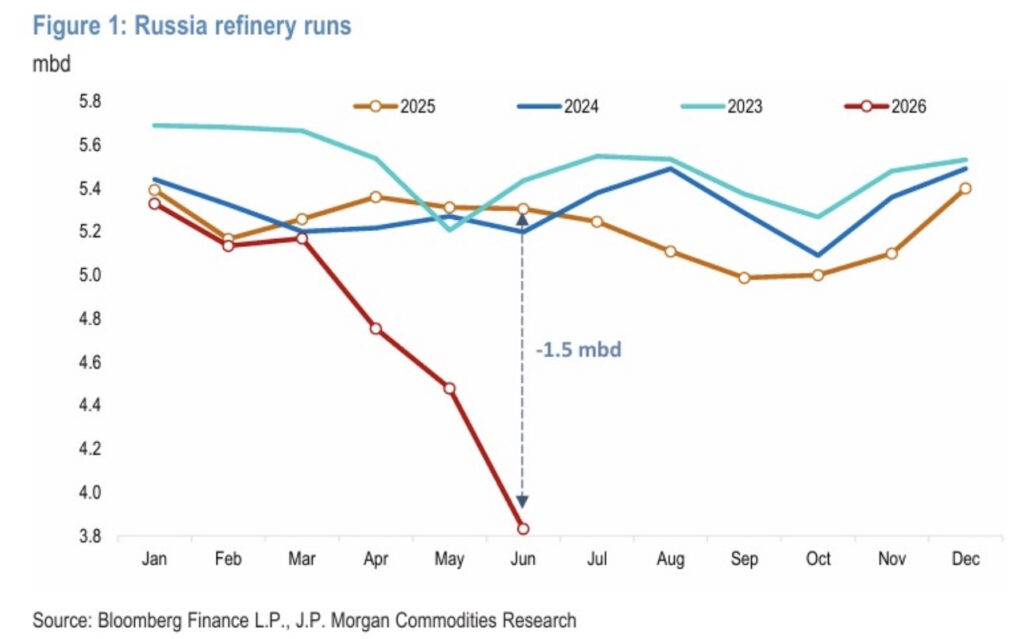
WTI has risen from $58 to $77 in less than 30 days. Brent has spiked in a similar fashion. Urals Crude is trading between $57-$65, higher than just a few weeks ago when it traded between $45-$50.

Today is the day I cease underestimating just how stupid, stupid can get. It’s like “killing the chicken to scare the monkeys” levels of stupid have taken over. 


Four Randon Econonic, Political, Geopolitical and Scientific Musings

First economic: The US dollar is down 5% over the last six months against a basket of currencies. And over the past year, it’s lost 9.6%. The biggest winner against a dollar has been the euro which has gone up 13% however, which truly is a win for Europe because it makes their natural gas imports from the US less expensive. But their natural gas imports are still a poison chalice. Expect the dollar to continue its slide, perhaps precipitously at some point in the New Year.

There were large moves out of US equities in the spring confirming the adage “sell in May and go away.” What September will look like is anyone’s guess, especially as Israel is more than likely to start the second phase of its war against Iran? Or October—that worst of months for Wall Street? What happens if Iran closes the Straits of Hormuz and oil goes above 100 dollars a barrel? That would be great for oil producers, but it would be terrible for markets across the globe, even China, possibly leading to a worldwide recession, especially with Chinese growth being somewhere between 4% and 5% at present.

Regardless of what happens in September or October—both always being bad month’s economically for the US economy, America’s bond market and the value of the dollar will continue its downward trajectory because America’s lenders are now demanding gold for loans instead of treasuries. This smells to me like the beginning of the end of dollar hegemony.

It makes me wonder what kind of “store of value” the BRICS will adopt to support their currency? Will it be a basket of their currencies? Will it be backed by gold and petroleum? That would be truly hard-core, because it would mean we were in for a long era of tight money. Our entire lives, actually, the entire history has been based on easy money. And as you know money creation is only possible when using a fiat currency.

There are many ways to imagine what they’ll do. Maybe blockchain? Who really knows? But there are other commodities that do have a store value, silver among them, maybe even rare earths and others they could use. It certainly is an interesting time to live.

Second domestic political: Niall Ferguson in his interview by Charlie Rose posted a week ago on the Internet was asked about Trump‘s challenges of outright ignoring the constitution with the following question: are we the Roman Republic, is this or are we witnessing the collapse of the constitutional order like the Roman republic. Rose asks if Trump is Augustus. He clearly is not. I would say that Trump is more like Marius and the Kennedys were more like the brothers Gracchi. In fact, I made this argument on a graduate school paper that I got a very good grade on, but in which my professor seriously disagreed with my analogies. Regardless I would say that we are at the beginning of the end of our constitutional order, and that we are looking down the barrel of Caesarism. It’s on the way. Maybe two years, maybe four years but it’s coming. Will it be a general? Will it be a politician? Those are questions we simply can’t answer. But as Ian Welsh has consistently predicted America is heading for a collapse, be it constitutional or economic or both it’s gonna happen and there isn’t anything anyone of us can do about it. Besides, Ferguson, while whip-smart, is kind of a tool.

Third is about some weaknessess the SCO currently must contend with if they are to become the anti-NATO military block. Here they are in no particular order of importance: One, the nations that make up the SCO are too diverse and often times their interests do not align with everyone in the SCO. For example, China and India have serious border issues. Pakistan and India have serious issues in Kashmir. Those are just two examples of several potential conflicts between members of a block, supposedly to oppose NATO. The issues between Pakistan and India make the intra-NATO issues between Greece and Turkey look like a family arguement on Thanksgiving.

Second, as the former director general of Russian international affairs Council said in a recent interview, “ the mandate of the SCO is too general.” The SCO can focus on security, development, or terrorism. Not all three.

Third, China is by far the most powerful member of the SCO and that creates a dangerous asymmetry in the organization. Much like the United States dominated NATO for so long and skewed it’s purpose after the Cold War for its own unfathomable means.

Fourth: This essay on the relative merits of “Superradiance,”.  Is well worth the three minutes it will take to read, plus it is comprehensible to the layman. The essay describes Superradiance as “a collective quantum optical effect in which a group of emitters, such as atoms or molecules, emit light in a highly coherent and amplified manner.  In the context of mammalian neural systems, superradiance occurs when a group of neurons collectively emit photons, resulting in a stronger and more coherent signal compared to individual neuron emissions. This coordinated emission of photons across vast networks of microtubules within neurons could potentially achieve the long-range coherence necessary for the emergence of consciousness.”

The essay stands as a correction of sorts to Sir Roger Penrose’s “Orchestrated objective reduction (Orch OR)” theory of human consciousness, which Wikipedia describes thusly: Orch Or “is a controversial theory postulating that consciousness originates at the quantum level inside neurons (rather than being a product of neural connections).” In short, says Penrose, “Consciousness does not collapse the wave function; instead it is the collapse of the wave function that produces consciousness.”

One thing we do know is that consciouness is decidely not computational and most likely occurs in the quantum realm.

As you can tell, I dig this kind of stuff.

If you’ve read this far, and you’ve read some of my articles and most if not all of Ian’s, then you might wish to Subscribe or donate. Ian has written over 3,500 posts, and the site, and Ian, need the money to keep the shop running. So please, consider it.

Ending Resource Separatism in Alberta and Canada

Alberta is a province in Canada with a lot of oil and a moderate but not yet dangerous separatism problem that polls a little below 30%. That’s far less than needed to win a referendum, but enough to support an insurrection or a large campaign of civil disobedience. It’s also a sufficient level of support for America to take advantage of in one of their patented color revolutions.

Though the level is higher than in the past, it’s nowhere near new. Growing up in the 70s and 80s in British Columbia I remember the anger.

Because there’s a lot of resentment in Alberta and out West in general it also gums up the works politically: the Premier of Alberta has been truculent and unwilling to join in on national efforts to resist Trump’s trade war, for example.

Alberta has oil. Lots of it. Most of it is crap, tar sands oil. It is because of Alberta oil that Canada has a trade surplus with America, in fact, we have a goods and services deficit.

Like all resource rich areas Alberta lives from boom to boom, and the good jobs are in the resource sector. At one time that resource sector was heavily taxed, but that’s far in the past and it is now heavily subsidized. So anything that seems to hurt the resource sector which the Federal government does, like environmental regulations or even renewable energy initiatives is resented. A lot of Albertans identify with oil company interests.

So, this issue needs to be dealt with. Its legs need to be cut out from under it.

The approach which will work is simple enough.

The federal government should either nationalize the oil industry or tax it at high levels when oil prices are high and take the money and just give checks to people in resource rich areas. (Not just Alberta, but also Saskatchewan in particular.)

Put 50% of profits or taxes into a sovereign development fund which invests in new non-resource businesses in resource areas in proportion to the income it receives from them (because resources always run out and one doesn’t want the West to turn into the Maritimes economically), and simply cut checks for the other 50% directly to people who live in the areas.

Make it so that the people of Alberta, Saskatchewan and other resource rich areas see the federal government as the one responsible for their prosperity and personal income, not oil barons.

Of course there are more steps which should be taken, but this is the first and fundamental one: reverse the underlying issue.

If you’ve read this far, and you read a lot of this site’s articles, you might wish to Subscribe or donate. The site has over over 3,500 posts, and the site, and Ian, take money to run.

JOIN OUR NEWSLETTER
And get new posts emailed to you once a day.

EU Delusion on Sanctions and Europe’s Future

While the EU was considering more sanctions against Iran because it attacked Israel in retaliation for Israel bombing its embassy, Russia is sending Iran:

Meanwhile America is threatening China that if they don’t stop sending Russia “dual use” goods, the US will slap on more sanctions.

Boo hoo.

Let us remember the results of chip sanctions. China now owns the legacy part of the industry, and is making progress western “experts” said would take decades in years. Huawei has recovered from the sanctions and created its own OS. It is now a massive electric vehicle manufacturer in addition to everything else. BYD will soon become the largest EV manufacturer in the world, eclipsing Tesla. Something about its cars being cheaper, and Tesla gave up on building a cheap version of their cars. Maybe Tesla will survive because the US keeps all Chinese EVs out, but my guess is that if Musk stays CEO, Tesla’s best possible future is as a luxury EV manufacturer. Their “Cyber Truck” is a disaster.

Iran has built a formidable military with hypersonic missiles while under sanctions, sanctions which started at the same time the Islamic Republic was created. But now, what I’m sure happens, is that China sells Russia goods and Russia trans-ships them to Iran. That hasn’t undone the sanctions completely, but as the world moves away from using the dollar as the medium of trade and routes around US, EU and anglosphere banks, the effects of the sanctions will continue to diminish.

There’s very little that Iran needs (though still some) that China and Russia don’t make. And anything sold to Russia by, say, India, can also make its way to Iran. Cutting Russia off almost entirely gives it no reason to play by Western rules, and it doesn’t.

This is especially true now that America has taken Russian reserves and will be giving them to Ukraine. Anyone who trusts the US with their money who isn’t a complete ally, or satrapy, is a fool. There’s a reason why money used to be frozen before, but not actually taken. There’s a big difference between the two.

But let’s move back to Europe. This article from FT is to the point, German gas prices are two-thirds higher, structurally, than they were before the Ukraine war.

That’s after prices dropped massively. The simple fact is that US natural gas costs a lot more. Russia was selling Europe and Germany oil and gas for bargain prices. Russia’s still willing to sell, but Europe has its head up its ass.

The recent history of European industry is simple. When the Euro came into effect, it raised everyone’s prices except Germany’s, pretty much. Industry in all of Europe except Germany was badly damaged (this was especially bad in Italy which was more of an industrial power than most realized.) Germany, in effect, received a subsidy: the Euro was worth less than the German Mark.

Germany has (had) a lot of heavy industry: a lot of energy intensive industry. To get energy for this, Germany got cheap, below market Russia oil and natural gas. Russia got bulk sales of one of the few things it had to sell and Germany kept its industry competitive.

Those days are over, essentially permanently.

And the problem is that Germany’s dominance was in legacy heavy industry and automobiles. They aren’t creating a lot of new tech and science. They don’t have large new industries developing. They don’t have scale costs like China does. They relied on being very efficient and already dominating industries.

But those industries are leaving. A lot of them are going to America, the actual company facilities, but the production is, effectively, also moving to China and other countries.

I know I’m a bit of a stuck record on this (do youngs understand that simile?) but Europe is walking into its decline with its leaders acting as if it’s no big deal, indeed as if they are, to use my father’s crude insult still “King shit of turd island.” Sanctioning Iran, lecturing Africans and acting as if they are superior in every way: the only truly civilized people in the world.

Even as they do, the foundations of their prosperity, their “garden” are eroding out from under them at the speed of soil blowing away during the Dust Bowl.

They’re insane. Completely detached from reality, and some of the stupidest elites in the world, even exceeding America’s very high bar.

The Sun always sets. European leaders seem determined to make it set as soon as possible.

You get what you support. If you like my writing, please SUBSCRIBE OR DONATE

One Relatively Bloodless Way To End The Genocide In Gaza

I’ve mentioned before the possibility of military defeat, but there’s a better way.

Simply have OPEC do another oil embargo to the West and its enablers until the situation is resolved, with a two-state or one state solution and significant restitution. Yeah, the US and Canada produce a surplus, but it’s not enough of a surplus to support all their allies.

And if all OPEC members don’t agree, it really doesn’t matter. Russia, Saudi Arabia, Iran, Iraq and the Gulf States are enough. Since Russia’s already already under various sanctions…


That would, of course, require Saudi Arabia and the Gulf States to do more than cry crocodile tears about the Palestinians, and actually do something, which is unlikely. But it’s worth remembering that it is possible and putting it on the table.

Besides, the lion should show its teeth occasionally anyway.


Donors and subscribers make it possible for me to write, so if you value my writing, please DONATE or SUBSCRIBE

German Dependence On China

So, the German central banks noted that 29% of German companies import essential parts and materials from China.

Multiple industries. Germany, much like the US, but even more so, let China pick up, among other things, much of the tool making industry, especially those related to auto manufacture.


Ouch.

When you consider this is an absolute terms and not relative, it’s even worse.

This comes on top of anti-Russia sanctions and the sabotage of the Nord Stream pipelines cutting off Germany’s access to cheap energy.

Germany is a relatively small country without a lot of natural resources. To be wealthy it needs to produce high value goods, and to do that it needs inexpensive inputs for its industries, or it needs to have much higher industrial productivity than everyone else.

Outsourcing so much of the supply chain for its manufacturers was an understandable mistake: it made those inputs cheaper.

But if you’re a small country without a lot of resources, you have to keep your supply chains and trading relationships stable. German leaders at the start of the Ukraine war expressed the most doubts about massive sanctions and they were right.

Germany is, as predicted at the time, in real trouble. Their model had flaws, and was a mean one, impoverishing and de-industrializing other EU nations, so there’s a certain irony to EU consensus Russia policy now screwing them over, but at this point if Germany goes down it’ll take the entire EU’s economy with it.

Germany cannot afford to follow the US into a cold trade war with China.

Moreover, this is a demonstration of something simple: what is good for Western EU countries and what most Eastern EU countries want (anti-Russia policies and NATO expansion) are two different things. Germany needs good relations with cheap resource suppliers and the only practical one was Russia.

It’s all very well to say, as many have, that this is the price of standing up for “freedom”, but if Germany goes down, so does the EU.

Likewise, what is “good” for the US, is not good for most European countries, and especially not good for Germany. (Ironically, Macron is the only major EU leader to be honest about this.)

The EU, if it continues on this course, will be reduced to an even weaker American satrapy than it was is the cold war period, and one with a lot worse living conditions.

China’s moving up the value chain. Sanctions against China, rather than slowing this down are speeding it up. Correct industrial policy would have been to negotiate with China about what industries or segments of industry each country is going to specialize in.

Incorrect policy is to have a cold war against both your cheapest energy supplier and the country that is now the world’s manufacturing floor.

Damn near suicidal policy, in fact.

Europeans need to get thru their heads that the European/American near monopoly on tech and high productivity is broken and that Europe, in particular, is coasting on legacy industry, without a great number of natural advantages. It was a backwater for most of history, and is reverting. The job of European leaders is to keep that reversion from happening for as long as possible and to slow down whatever reversion occurs.

Now, it could be that full commitment to a “US and Europe+Anglo countries” trade block, with full re-shoring would be a viable policy, if aggressively pursued, but that’s not what’s happening, the US is, instead, taking advantage of EU and German weakness to grab up high energy cost industries.

As for Europe’s elites, they should remember that owning overseas resources is dangerous. Britain’s “hidden empire” — its overseas investments, was a huge part of its strength, and essentially liquidated in WWI. Germany’s chemical patents and electrical patents were broken by the Allies in WWI and they didn’t reinstate them after the war was over.

Anything you own in another country doesn’t really belong to you unless you have the troops and willingness to occupy that country and the ability to then administer the country.

Germany in specific, and Europe in general, if they don’t change their policies and their commitment to being American satrapies, are on the path to ruin.

(Oh, and as I said at the time, most of the Eastern European countries should never have been let into either NATO or the EU. They offer little but vulnerability; are economic soaks, and have interests contrary to those of Western European countries. The only way they could have been absorbed effectively was if the EU decided to become a real federal nation with former countries reduced to provinces at most, and in most cases divided into multiple provinces.)


Folks, it’s your donations and subscriptions which make it possible for me to keep writing (since I need to eat and pay rent and the cost of both have skyrocketed) so please (if you aren’t struggling) DONATE or SUBSCRIBE.


Britain’s Bare Produce Shelves

The Daily Mail had an article on this, and it’s worth reading.

A dig down in this reveals two main factors (the Daily Mail was pro-Brexit and discounts that factor).

First, increases in energy prices.

Tony Montalbano, a director of Green Acre Salads in Roydon, Essex, typically produces a million kilograms of baby cucumbers a year, but his glasshouses were empty last month.

He delayed growing his crops to avoid rocketing winter fuel bills of up to £500,000 a month. He expects his production to be cut by up to half this year.

‘It’s sad and frustrating but I can’t afford to grow,’ he said. ‘I must make a profit. If I don’t, there’s no point in me going on. Lots of growers are closing their doors and selling up.’

Jack Ward, chief executive of the British Growers Association, added: ‘Up and down the country, we’ve got empty glasshouses. People who would grow two or three crops of cucumbers a year may cut that to just one, because they want to avoid using more expensive energy.’

Eggs are also being rationed as farmers cannot afford the costs of keeping laying hens warm in energy-guzzling sheds.

Second, crop failures due to poor weather (aka. climate change) in Spain and Morocco have had a big effect, as Britain imports a lot from them.

Now, the thing about energy prices is that they have been raised far more than fuel prices have. The UK system has producers of energy, suppliers (the people who run electricity lines and ship fuel to retail customers) and the retail customers of energy.

Let’s take oil:

Unveiling its latest results, Shell said the price of the barrels of oil it sells rose from $62.53 a year ago to $101.42. Gas prices rose from $4.31 to $13.85 per thousand standard cubic feet over the same period.

So, their costs increased about 62%, and they about tripled the prices they charge.

In electricity, there is a price cap. The companies are not allowed to earn more than thirty-five pounds more than they sell the electricity to households. That cap, however, only applies to households, it doesn’t apply to business. So on the business side, they’ve been massively raising prices.

Thus the empty green (glass) houses, which grow far more than just cucumbers. Likewise vertical farms have been hit hard. If you want produce during the non-harvest season you have to buy from other countries or you have to grow in controlled environments. Add in climate fluctuations from climate change and high energy prices making it impossible to make a profit growing produce and you have shortages.

Price increases from Russia, in other words, are only an excuse to raise prices, not the reason for most of the price increase.

The solutions have been discussed even by the mainstream press: either re-nationalize the energy sector or put in a windfall profit tax so they don’t get to keep excess profits. And it’s worth noting that many energy companies did go under due to increased costs when they were regulated to be unable to pass them on. Some companies made way more than their increased costs, while others went under.

In the post-war liberal era private utilities were highly regulated, but a cornerstone of proper regulation was that they would always make a decent profit: enough for proper maintenance, which had to be done (remember all the fires in California because the privately owned utility won’t maintain power lines and poles), and to expand capacity as necessary. Utility stocks were “widow and orphan stocks” because they would make the same every year. Genuine price increases were passed on, but profits could not either rise or fall.

So, if you want to keep them private the best way isn’t so much a windfall tax, which is a response to a crisis, but proper regulation. Or you can just make them public again.

Energy prices in France have risen far less than in Britain for the simple reason that France owns its own generators and grid.

The other obvious factor is that if you have a cap on households for political reasons (they vote) you need a cap on the costs to farmers and to industry. But if you’re going to put all these caps in place, it’s better to just move to proper regulation, and a flat cap makes little sense, it should always be in percentage terms. When prices went up 60%, someone has to pay that. That either means end-users, or it means the government subsidizes. Those subsidies could be broad, if the increase is expected to not last long, or they could be targeted at specific industries and people with low income.

While generally means targeted subsidies are a bad idea, there are specific cases where they make sense, and this is one of them.

Anyway, Britain doesn’t have bare produce shelves “because of Russia” it has bare produce shelves because energy companies gouged the customers they could gouge using Russia as an excuse and because the government refused to step in and ensure prices which allow the “free” market to work properly, because there is no free market and never has been, and it always requires intervention to keep it working.


The results of the work I do, like this article, are free, but food isn’t, so if you value my work, please DONATE or SUBSCRIBE.

Page 1 of 7

Powered by WordPress & Theme by Anders Norén