The horizon is not so far as we can see, but as far as we can imagine

Category: Leadership Page 1 of 5

Different Times And Places Are Different

One of the failures of imagination I see most often is the inability to understand that things were, actually, different in the past and that they are different in other places.

I live in Canada. In the West. Our leaders are all functionally psychopaths. They’re all corrupt and they all lie like they breathe. They have zero interest in anything but making their donors happy, and have spent over 50 years destroying the egalitarian society built by FDR and his successors, in order to give more money to the rich.

Many people think this is universal behaviour. It isn’t.

Different places and times are different.

Someone like Trump could not have become president even 30 years ago. Impossible.

These days the children of elites don’t fight in wars. In WWI and WWII they did, even FDRs sons went to war and the carnage in the British ruling class in WWI was epic because they personally lead the charges right into machine guns.

Different times are different.

Right into the early 90s it was possible to walk into almost every government and private building in Canada. No security guard would stop you. Not just walk into, take the elevator to pretty much any floor. You might have trouble getting to a few people, because they had secretarial or receptionist gates, but you could definitely get right up to that receptionist and if you insisted you could walk right past her.

Oh, and you could go into almost every building and use the bathroom.

I remember when there were no food banks because they weren’t needed.

For decades inequality decreased, not increased. This was a choice and the political elites were mostly onside with it. Even a lot of business elites were (though definitely not all.) When John Kenneth Galbraith investigated why corporate leaders in the 60s didn’t earn more he came to the conclusion it was cultural: they didn’t believe in paying more and anyone who tried was shut down hard by that consensus.

Even small things can be very different. We go on and on about female breasts and attractiveness, but traditional Japanese society did not find breasts sexy, and bound them tight: they associated them with child raising. They even didn’t like bright white smiles, this was considered “showing your bones” and disgusting, so women often blackened their teeth.

Anthropological studies show that in hunter-gatherer bands leadership is often chosen from people who are slow to anger and not aggressive. When testosterone was studied carefully, it turned out that high-normal testosterone isn’t actually about violence, it’s about status behaviour. Put a male with high T in a society that favors hugging and being empathetic and that doesn’t like aggressiveness and suddenly they’re the big huggers and empathizers.

Chinese leadership is not the same was Western leadership. They have different goals, incentives and values. They don’t act or think like us. This is also true of Russian leadership.

All of these things are contingent: they change over time based on circumstances. People have biology, but they also have vast amounts of conditioning based on what their society is like which forms their personalities. Leaders are chosen and promoted in different ways, emphasizing different morals and personalities at different times. Western leaders right now are mostly soulless psychopaths, but that hasn’t always been the case and even when it was, the morally neutral virtues they valued were different. (Courage, for example. Think what you want of 19th century British elites. They were scum. They were not cowards and intensely shamed cowards and people who didn’t do their duty.)

Humans are always humans, but the details change with the society and the time. If you over-generalize from your own time and experience you will make serious mistakes when you try and understand outside your time and society. This often becomes clear to people as they get older: I can assure you that the culture and the type of person was quite different back in the 70s and even 80s from now. I remember people who grew up in the Great Depression and they were not like Boomers, let alone like Zoomers. Nor would they have put up with someone like Trump.

Time change. People change. Different places are different and produce different types of people.

This shouldn’t need saying, but it is evident that it does.


What I write here is for the benefit of everyone, but alas, I live in capitalism and I, and the site, take money to keep running. If you value the writing here and can, please subscribe or donate.

Lack of Fear of Death

Back in 93 I spent 3 months in hospital. It was… beyond bad.

But it had one great advantage. I lost my fear of death.

I don’t know what happens after death (though as someone whose done ludicrous amounts of spiritual work I have strong suspicions) but even if it’s “that’s it, it’s over” I don’t fear it because I know that bad shit, beyond most people’s imaginations, can happen while you’re alive. Death can becomes one’s best friend.

Westerners fear death greatly. They say stupid things like it being your job to make the other person die for their country.

Sure. Obviously killing them and not dying is preferable in most cases.

But being willing to die for your beliefs, whatever they are, is also incredibly powerful. You’d think so-called Christian countries would understand the power of martyrdom.

Shi’a society is remarkably based around this. Iman Hussein refused to acknowledge the Umayyad caliph Yazid I, whom they considered corrupt. He went into battle knowing he would lose and indeed he did. He did the right thing even though it cost him his life.

And what that has lead to, in the modern era, is organizations like the Iranian government and Hezbollah. Sure, they’d rather not die, but they know there are worse things than death, like living on your knees or crawling on your belly. Martyrdom is celebrated. It helps, of course, that they believe there’s a heaven waiting, but so do many religions whose followers are far less willing to die for their beliefs. (Most Christians aren’t any more.)

You see Iranian leaders say things like death is preferable to living in an unjust world. Almost every single senior leader of Iran from before the war was killed in the first part of the war. I believe only two survived.

And it didn’t make a difference, except that it strengthened hard-liners who wanted to fight.

Western leaders are, as a group, cowards. This wasn’t always the case: in WWII elites fought or sent their children to war. Many of the died. In WWI the cream of Britain’s elite youngsters died in the trenches, often leading suicidal charges.

But our modern leaders like Trump are cowards. They never fought in war and they don’t send their kids to war. They aren’t willing to die.

Further they lead societies where they are hurting the majority of the population. Western leaders think they are special because the people who work for them fundamentally don’t want to. There is no sense of mission, despite all the MBA bullshit trying to create purpose and meaning in corporations.

Everyone knows that the only thing Western leaders believe in is making the rich (themselves, usually) richer. So to get a western organization to work requires extreme incentives: greed for the rulership class, the whip of hunger and homelessness for the peons.

Western leaders thus consider themselves special, because they need to force people to do what they want and without their constant threats and incentives their organizations would fall apart. No one works for a bank or private equity because they believe in anything other than getting rich, or at the lower level, they believe in not winding up homeless.

So Western leaders are, in fact, important: they’re leading their societies in directions that are bad for most people, and that takes an immense amount of cunning and work.

Further there isn’t a deep bench. Because no one believes in the mission who isn’t near the top. Why would they? It doesn’t benefit them, and there’s nothing uplifting about “mint more billionaires”.

This is not to say that all Iranians are true believers or support the government. But the people in the military and government, do believe in the “mission”. They are the metaphorical children of Iman Hussein. They do not fear death.

Hezbollah is the same, but more so: if you’re a Hezbollah member, odds are you believe strongly and you know that Israel only left Lebanon last time because you forced them to.

And if you get killed, someone else replaces you who believes. There’s a deep bench, right from the top to the soldiers and bureaucrats (and remember, Hezbollah runs clinics, picks up garbage and even provides pensions. It’s a government within Lebanon.)

Western leaders can’t wrap their heads around this. They’d do anything to save their own lives and they don’t understand people who would rather die than give up their beliefs. They don’t understand the people who then replace the dead and continue the fight.

If Iranian leaders feared death, the war would be over. They would have cut the sort of deal Delcy Rodriguez did in Venezeula “yes master, I’ll do whatever you say if you leave me at the top of a society I no longer run. Just don’t kill or kidnap me, please.”

Greedy coward.

That won’t happen in Iran. There’s no one in the leadership with enough support to pull it off, if there’s anyone at all who would consider it.

Sometimes to serve your cause, to remain true to your beliefs, you have to be willing to die. Americans knew that once. The West knew it once. Christians knew it once.

Today? The leadership of the West are substantially all cowards.

The truth is that if you will do anything to avoid dying, you’re a slave to anyone who can credibly threaten you with death.

Iranians and Hezbollah members refuse to be slaves.

What I write here is for the benefit of everyone, but alas, I live in capitalism and I, and the site, take money to keep running. If you value the writing here and can, please subscribe or donate.

Friday Morning Highlights and Lowlifes

~by Sean Paul Kelley

Couple of random notes this Friday morning, mostly economics related, some silver news and my personal reaction to portions of the discusssion in Ian’s “Is Virtue An Advantage Or Disadvantage For Societies?” post.

First, econonomics. It looks more and more like we are heading into a 2008-style credit crisis/crunch.

Don’t believe me? Well, the FED flooded the US banking system with $18.5 billion to ease liquidity concerns during the week of Feb. 17 because cockroaches be busting out of just about every private equity/credit shop present. And we all know, if you just don’t turn on the lights, you don’t see roaches.

These kind of economic events don’t do what you think they are going to do. Many people assume any economic crisis in the US will lead to a rapid dollar hegemony collapse. But as I explain, the dollar will actually get stronger:

“[W]hen the credit crunch gets a full head of steam it won’t lead to reserve status collapse of the dollar. It will, counter-intuitively, but inexorably pump the dollar higher and stronger as NYC becomes a 2008-like Black Hole for cash allocated dollars world wide desperate to fill potential insolvency holes in banks and shadow-banks/private equity credit boutiques . . . . “

That’s what happened in 2008. As I conclude, “Dollar reserve collpase will be a result of national insolvency, not a global credit-crisis/crunch.”

Basically what End Game Macro is saying in this post is the following: the economy grew little to naught post-COVID to present. It basically did what equity markets sometimes do: trade sideways for years, decades even. For example, after the 2008 Financial Crisis the S&P 500 traded sideways for four years until it broke out in late 2012, early 2013. That’w what the US economy has done since 2020: move sideways, although Biden-inspired over-immigration skewed the growth numbers, as End Game Macro notes:

“From 2021 to 2024 the U.S. saw over 11 million arrivals, more than 3 million in 2023, and net migration around 2.4 million per year in 2021 to 2023. That can lift GDP and payrolls while masking weaker per capita momentum. As the surge cools, the masking fades.”

I’m not being anti-immigrant here, I’m just stating the facts. As Trump dug his heels in and unleashed his ICE goons, the econ surge faded, and fast. End Game Macro also notes, a lá 2008 that system-wide credit stress is popping up whack-a-mole like in almost every category:

“As of February 2026 serious delinquency is flashing late cycle strain. Auto loans 5.2 percent, credit cards 12.7 percent, student loans 9.6 percent 90+ days past due with estimates as high as 16.3 percent turning delinquent late 2025, and FHA delinquency 11.52 percent. Job quality also reflects strain.”

And I’m not even going to touch on the downward revisions to US employment except to say we’ve not gained a single job, but actually lost millions. The BLS hints at the size of the disaster in jobs “recovery.”

Last econ note: big move in India just confirms my thesis/argument/assertion that the combined wealth of the West is undergoing a multi-decade transfer back to the East:

“For decades, the price of silver in India—the “diamond hands” of the silver world—was dictated by a small group in London and USA. Indian ETFs used the London Bullion Market Association (LBMA) prices, which often had nothing to do with the actual physical demand on the ground in India.

The Move:

On February 26, 2026, SEBI officially announced that starting April 1, 2026, Indian mutual funds and ETFs will no longer rely solely on London’s “AM fixing” prices. Instead, valuation will be based on polled spot prices from recognized domestic exchanges like the MCX.”

That’s one serious high hard one to the Comex and LBMA! This is a big fucking deal.

Next up: war in the Ukraine.

I’ve repeatedly argued that the Ukraine has lost all any and all possibility of regaining strategic initiative, and this reinforces it, way wickedly:

As I have noted ad nauseam for months now: the #Ukraine has lost any chance to sieze the initiative on the battlefield. All the #AFU can do is ineffectively counter-attack like a punch-drunk boxer. Trading lives for time will not work out for #Zelensky in the end and the end is coming sooner than he thinks.

On that note, the Red Cross confirms the Ukrainian to Russian KIA ratio. And it is bloody awful: 34/1. People often tell me that my belief in realism in foreign affairs is deeply immoral. Fuck that shit. International liberal hegemony is 100% at fault for all the deaths in the Ukraine. All. Of. Them. The denizens of Davos are uttely complicit.

In another grim note: Russia is in the initial stages of attacking The Big Banana. For the first time artillery shells are falling down with impunity on the city of Kramatorsk, like rain does on an average Portland Wednesday.

In regards to the conversation on Virtue and especially regarding the 800,000,000 number of Chinese lifted out of poverty. Well, Ian is correct. I did the numbers here back in September.

As regards Chinese leaders being better or worse than those in the West, especially the US: Ian, again is correct. The best way to view the argument is by winnowing it down to two prepositions. The Western view of liberty has its origins in peasant upward mobility in the aftermath of the Black Death and the clash of classes. Ergo: in the West we have the freedom “of” speech, assembly, bear arms, etc. . The Chinese view of liberty derives its origins from a long exigetical tradition of the origins and limits of dignity. In essences, the Chinese see liberty as freedom “from” poverty, warlordism, chaos, illness, crime, rapine, etc. . .  Both views are valid. Both views are limited. But at present the Chinese view of liberty is more effective in increasing the common good than that of the West.

On the posssible, now looking more probable, war with Iran, the US has ordered the evacuation of its embassy in Israel. I don’t know what could make it more obvious, you?

More as it happens.

And more happens. This comment by Ray Dalio reminds me when I was a young broker I read Robert Rubin’s memoirs, In an Uncertain World, and took to heart many of his investment rules, going so far as to write many down on old fashioned white catalog cards–this was before the internet, btw! and memorize what I wrote down. Don’t judge me. I was young and dumb.

Love Rubin or hate him, like James Carville said, when I get resurrected I want to come back as thet bond market. Rubin knew how to invest and make consistent returns. So did Barton Biggs, long time chief investment strategist at my alma mater, Morgan Stanley. Those two men shaped my view of economics, markets and political economy more than anyone or anything else. And yes, I read Jesse Livermore’s memoirs. They did little for me precisely because at his heart Livemore was un-disciplined. And discipline is key to making money.

If you take your own advice you’ll do well. If you’re like me and stayed retarded longer than markets remained illogical, well, you’re fucked. If I’d taken my own advice I’d have a small fortune like a handful of former clients do to this day.

One of my key rules: if you want to get rich, speculate in the stock market, but if you want to be truly wealthy, invest in bonds. In other words, the real wealth, massive cash-flow comes from debt service. That’s just an ugly reality humanity has yet to escape.

Another rule to live by: if an investment goes more than 15% against you, cash out. You can recover from a 15% loss, but a 25% or 30% or even 50%? Not a chance in hell. Ever.

Last rule: if you double your money in an investment, sell half of your gain and let the rest ride. I guarantee you’ll never lose a dime on that investment if you follow that rule.

One last comment on Rubin: he was a ‘careful contrarian’ and being a contrarian has served me very, very well. It’s a painful and lonely place to occupy at times so be prepared to man up. In the end recognize when you feel the least amount of risk is the precise moment of the most risk, the instant before you lose your ass.

Maybe more, maybe not. Time dictates all.

So the muse is a fickle-bitch. This analysis of the transcripts of the Trump-Xi phone calls is brutally and hysterically accurate:

This time it’s particularly funny because the Chinese transcript (fmprc.gov.cn/eng/xw/zyxw/20) has Xi telling Trump: “It is always right to do a good thing, however small, and always wrong to do a bad thing, however small.” This proverb might not sound like much but it’s actually extremely meaningful when you understand the reference.

The reference comes from the Romance of the Three Kingdoms, China’s Illiad and Odyssey plus the Aeneid and a smattering of Dante’s Inferno for good measure. It’s indicative of how urbane and historically literate the Chinese are. And a clear notice that China is what historians, anthropologists and others of such ilk refer to as a “high context” culture: 

China is a High Context culture, a communicated message has different layers of meaning, While America as majority of the West is Low Context. The other culture/language that is High Context is Arabic. To understand the spoken words one need to be deeply rooted in its culture, its history and religious tradition.

Spoken like a true scholar and humble student.

I want the last word. Heh! But seriously, silver trading at the Comex closes the day sharply higher, firmly walking through a wall of resistance at $92, ending the day at $93.06, up 7%. A very bullish closing price for silver. Silver bugs should sleep happy tonight.


The Amount Of Contempt Elites Have For Public Intelligence Is Breathtaking

The latest episode is an attempt to suggest Epstein was working for Russia:

This is ridiculous. Epstein was close friends with the Israeli Prime Ministers. Ghislaine Maxwell’s father Robert Maxwell might have been Israel’s most important spy. Israel’s fingerprints are all over the Epstein files, and there are almost no significant ties to Russia. There’s one email where Epstein tries to coach Trump on how to deal with Putin, and some trafficking ties, though more to Ukraine than to Russia, but they are dwarfed by Israeli ties.

Source

Elites think we’re morons. But hey, why not? I mean the “Trump is a Russian asset” lie worked (he massively increased sanctions on Russia). They lied over 80% of the time about Corbyn, including ridiculous anti-semitism smears, and it worked. They lied about WMD in Iraq, and Iraq ties to 9/11 and it worked. They lied about mass baby murders by Hamas and it worked. They lied about Gazan hospitals being Hamas bases and it worked.

They’re completely used to a plurality to a majority of the population believing their lies, so why not this time?

Are they right? Can they tell us the moon is made of blue cheese and get us to believe it? Perhaps so.

This is one of the reasons why, when I talk about war crimes tribunals I always include the media, who lied and lied and lied to enable genocide, child killing, rape and war. The media is almost entirely captured, certainly every corporate media outlet is little more than a source of propaganda. Truth only peaks out when one part of the elite disagrees with another part of the elite, but if the elites are united, as they were against Corbyn and are for mass murder of mostly children in Gaza, well, the media salutes and falls in line.

As I have said many times, the only way to fix the West and especially America is wholesale replacements of the elites and all their courtiers. No one with a conscience works at the top levels, because if someone has a conscience they can’t do the job.

They all have to go, and to ensure there’s no repeat, most of them need to be tried for their crimes, have everything they have beyond basic subsistence taken from them (they’re why so many people are homeless) and be thrown into prison.

This is is also a matter of simple self-respect from the rest of us. Enough pretending these people aren’t psychopaths who would kill or impoverish anyone if it would earn them a single bent nickel or, in many cases, even if it wouldn’t, because it’s how they get their rocks off.

It’s them or us, and so far it’s mostly been us.

This site is only viable due to reader donations. If you value it and can, please subscribe or donate.

America’s Leaders In Waiting Have Identified Themselves

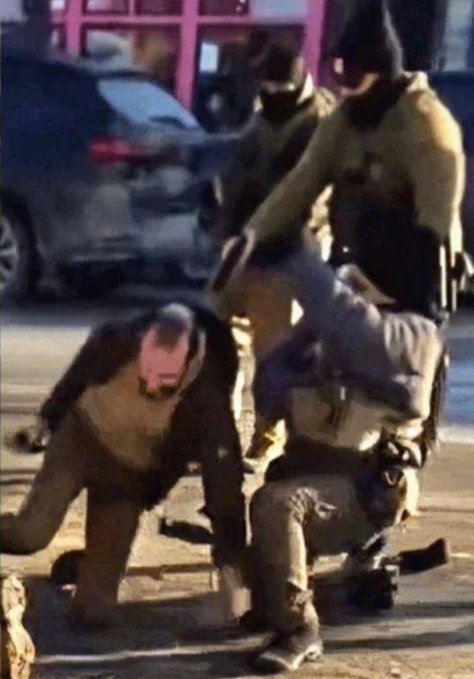
This was the situation when they fired:

Right hand holding his phone. Left hand on the ground. Zero threat to anyone. His gun, holstered, which he never went for, had been removed by an agent.

This is an execution. The Agent has not been positively identified (though there’s a possible ID floating around), and was immediately removed from Minneapolis. The ICE agents attempted to keep local police from the scene.

This is the best summary I’ve read:

an ICE agent physically assaults an annoying woman who is whistling at him to antagonize him, Pretti steps between the officer and the woman to protect her, Pretti is the restrained by 5 officers on his hands and knees, one of the officers notices he is armed and yells “gun,” an ICE officer disarms Pretti and while running away accidentally discharges the weapon, then another ICE agent reacts to the negligent discharge by shooting Pretti in the back multiple times while he is on his hands and knees.

No one has been charged, I can’t tell if there’s any investigation into the shooting: there certainly isn’t a federal one, and the local governor and mayor appear to be wimping out: going thru the motions without any attention of charging anyone.

This isn’t the first ICE execution, and who knows how many have occurred that weren’t filmed. Then there are all the people dying in detention, where they routinely keep 80 people in a cell, lights on all the time and beat people who ask for medical aid.

One of the ICE agents applauded when Pretti was killed. When Renee Good was killed the agent who shot her called her a “fucking bitch” and refused to let a doctor help her.

Police in the US are almost always bad. The job attracts authoritarians who like the idea of being able to push people around, but even the minimal safeguards were let loose on ICE and the Border Patrol—they took the job because they like being able to hurt people without even the remotest possibility they might be held accountable.

This is part of a larger pattern. The Trump administration ignores about a third of all court orders against it. Just ignores them. The rule of law has completely broken down in America at the elite and enforcer levels. It was already mostly broken, but there was a final red line: elites smarter than Trump weren’t willing to obviously ignore courts. Perhaps important people might ignore Congressional subpoenas, but Congress wouldn’t actually institute contempt against them, so the facade remained.

Now law is gone entirely. The first, second and fourth amendments are in tatters. Habeas Corpus is dead, ICE and the BP just routinely ignore it. This a common law protection, centuries old. (In the UK they’re making it illegal for jurors to not convict people if the judge disagrees, ending jury nullification.)

Civil liberties seem like “nice to have”, and so does the rule of law, but they aren’t. Without them a society can’t function. That whole “high trust” thing goes away, and no one trusts anyone else. The economy grinds to a halt and civil society collapses.

The silver lining here, the hope, is that Minnessotans have come together to resist this. Thousands of people, not just protesting, but feeding those who can’t leave their houses, helping legally, and putting their bodies on the line. There are good people left in the US, but what they need to recognize is that fixing this requires replacing almost every member of the current elite: Walz has failed, Congress has failed, business has mostly been supine to trump as have universities. Everyone who’s in a position of power, whose duty and responsibility it is to resist has either failed or not even tried.

What needs to be done is to note the ones who tried or resigned rather than engage in illegality and immorality. Go after everyone else, replace them and if they actively engaged in evil, convict them and send them to prison. Put the people who did resist back in, not just politicians but prosecutors and judges and city councillors and so on, and then fill the rest of the ranks with people who went out on the streets in Minnesota and elsewhere and put their bodies in the way of evil, or who otherwise meaningfully resisted.

These are the people who proved themselves. When the brownshirts came,  they are the ones who stood up. We now know who is actually moral, who is actually brave and who can actually be trusted when the chips down. This is the new leadership cadre, if Americans are wise.

Not saying this will be done, but these are the slivers of hope. The Brownshirts came.They were resisted. Those who actually resisted proved themselves.

Those should be your leaders. Anyone who failed should be out or in prison.


This site is only viable due to reader donations. If you value it and can, please subscribe or donate.

Western Leadership Is The Most Worthless In My Life

Which is saying something,  because worthless has been in charge of the West for generations. There are no leaders in charge of any major Western country who aren’t functionally morons.

Europe is run by utter idiots who want war with Russia, refuse to acknowledge that Ukraine is losing, are actively speeding up their loss of industry and imagine they can bully China and think America was their friend before Trump.

Trump is the stupidest president of my lifetime. No one else even comes close. Reagan with Alzheimers was better. Congress is a sewer of morons. Every major American politician, even AOC and Bernie, are functionally psychopaths. (Yes, both Bernie and AOC have repeatedly voted to send more money and weapons to Israel.)

Britain’s Starmer is the stupidest PM of my lifetimes and stunningly incompetent and evil. Yes, his job is to make rich people richer and suck off Netanyahu, but a competent pol would do that without destroying Labour as a party.

Macron has accomplished nothing for France except to make it weaker and its citizens poorer. Germany’s government is presiding over the destruction of a German industrial base that is 150 years old and one of the greatest in the world: the very foundation of Germany’s power and affluence.

Australia is acting as if America is more important to them than China with a military buildup, which is insane since Australia’s future is with China, or it has no future. Japan is antagonizing China, again, insane, without a serious plan. Either make nice or try and get nukes, there are no other paths.

Everyone is destroying free speech to symp for a genocide. Everyone is immiserating their own populations, setting up serious future political instability.

The US is all-in on AI, spending trillions it does not have, driving up energy prices, and creating a larger more concentrated bubble than the real-estate bubble which caused the 2008 crash. If AI is everything they say, it will utterly destroy the US economy by replacing 30% of workers, and if it isn’t, it’ll never pay back all the resources spent. Plus China will win the AI race anyway, since no one with sense will pay for a proprietary model when Chinese open source models are about as good and mean you can’t suddenly be hit with a massive price increase or rate restrictions.

Politicians are either ignoring climate change and doubling down on fossil fuels (which are more expensive than solar) or using climate change as an excuse to immiserate their own people.

Britain is destroying their own farmers.

Meanwhile morons are constantly whining about fertility rates when humanity is in population overshoot so severe that it is causing the second fastest great extinction in Earth’s history. Most countries would be better off with fewer people, but because they don’t know how to stabilize an economy whose population isn’t always growing leaders and their intellectual dupes are panicking.

Only China is handling this with some grace, but they’re not Western. They’re trying to increase fertility somewhat but have accepted there will be population decreases and are moving hard on robotics to care for an aging population and reduce the need for workers.

There isn’t a single major challenge that the West is facing that our leaders are not actively making worse, not better. Not a single one. It’s extraordinary. Even Nixon managed to sign Clean Air and Water Act and to pivot on China. Reagan reduced nuclear weapons. Clinton made everything worse long-term, but was able to manage the economy during his Presidency, at least, so that it felt good to ordinary people, including pushing oil prices under $20/barrel. George Bush Sr. managed the collapse of the USSR with grace. Biden had good anti-trust policy and half decent industrial policy. Trump has done nothing good of significance. Nothing. Even when he has a good idea (tariffs, reduction in H1-B Visas) he fucks it up completely because he can’t execute and has the attention span of a coked up flea.

This reminds me of the Weimar Republic or the late Roman Empire. Most things can be fixed in principle: in theory. Nothing can be fixed in practice because leadership is beyond corrupt and incompetent, high on their own wealth and convinced they are the masters of universe and that reality is what they want it to be.

Prepare, if you’re in the West. By all means feel free to keep working at the politics, but don’t count on it. Instead prepare as individuals and groups. Government isn’t going to save you, not in the West. Your leaders are the number one danger to you, more than any outsider, “terrorist” or “foreign enemy.” Treat them as such, and protect yourselves from them.

We just spent a couple thousand getting the site and email subscriptions working properly. If you value this site and can, please subscribe or donate.

Politicians V.S. Serial Killers: Introducing The Serial Killer Count

One of the themes of this blog is that, with some exceptions, the people who are most dangerous are politicians. Since rich people own politicians, indirectly, they are included.

We’ve been, as a society, obsessed with serial killers for some time. They are seen, by many, as the ultimate evil. The average serial killer is responsible for about six deaths.

The Iraq war killed about half a million people (we don’t really know, since we didn’t count, but the post-fact estimates are credible.) That means George W. Bush, as the primary driver of the Iraq War, was the equivalent of over eighty-three thousand serial killers.

If we want to spread out the blame, US and UK politician who were for the war were the equivalent of over 83,000 serial killers.

The high end estimate of active serial killers in America is 2,000 active killers.

Recently I did a bit of research into the effect of Clinton’s “Welfare Reform” bill, in which he cut access to Welfare significantly. Interestingly, it’s really impossible to tell how many people the bill killed or made homeless (which is a delayed death sentence).

We don’t count.

But I’m guessing Bill’s serial killer number is pretty high. Let’s ignore how many Americans he killed. Iraq sanctions killed somewhere between 200K to a million people, with Madeleine Albright famously saying that if 500K children had been killed, it was worth it.

Even 200K suggests a serial killer count of over 33,000.

Obama’s policies deliberately helped banks steal (foreclose) American homes (steal is the correct terminology, they used documents with fake information and signatures.)  Once again, we don’t really know how many people had their homes taken, but 750K were included in a single class action suit, so that’s the lower bound estimate. I wonder how many of those became homeless or died as a result? Again, we don’t know, but it’s bound to be a lot of people. There’s no possibility that it doesn’t massively increase Obama’s “serial killer count.”

Yesterday we discussed prosecuting those who have enabled the Gaza genocide. Of course there’s plenty of blame to go around, but assuming a death count of half a million, which is going to be a low end estimate, we’ve got a serial killer count of over 83K.

Don’t worry about serial killers. They kill hardly anyone.

Politicians, at the behest of their owners, on the other hand, now they have bloody, bloody hands.


***

If you’ve read this far, and you read a lot of this site’s articles, you might wish to Subscribe or donate. The site has over over 3,500 posts, and the site, and Ian, take money to run.


How Leadership Worked In the Early & Middle Roman Republic

When a lot of people talk about Rome, they’re thinking of the Empire and when they write about Rome, they’re writing about the decline and fall. But I’ve always been more interested in creation of new things and how they ran when they were running well. To be sure, knowing how a system eventually failed is important, but not if we don’t understand how it ran well in the first place.

The Republic actually had four different elected assemblies and voting groups (the Senate was not, strictly speaking, elected.) By the middle Republic three were still important.

Tthe Centuriata (organized by military centuries based on wealth, since wealthier citizens could afford better equipment) elected Consuls and Praetors, who had Imperium (the right to lead troops), voted on war and peace and served as a court for serious crimes. It was dominated by the richer classes.

The Tributa, was based on tribes (geographical organizations.) Because all voting took place in Rome, urban tribes had oversized power in it. It voted on legislation proposed by magistrates and the Tributa (the electorate itself) voted to select lower magistrates like Quaestors and Aediles.

Finally there was the Concilium Plebis. This body excluded Patricians and was organized by Tribes. It elected Tribunes of the People. Their powers varied over time, but at certain points they were arguably the most powerful officials in Rome. Tribunes could veto bills from other bodies and the Plebis could pass laws binding on all citizens. Tribunes were meant to be available to any Roman citizen at any time. They couldn’t even close or lock the doors of their homes.

Then, of course, there was the Senate. In the early years Senators were largely appointed by Consuls. A little later by Censors (officials responsible for running a population census and for public morals, elected every five years for a one year term.) In time it became customary for officials elected as Quaestors or Aediles to be enrolled almost automatically. As a practical matter, the Senate was controlled by powerful and rich families. At first those were mostly Patrician, but in time various powerful Plebeian families broke in.

The important leaders in the Republic were magistrates. They held court, they knew law, and in the case of officials with Imperium, they lead armies.

Except for the Tribunes, Censors and Aediles, election to office required following the Cursus Honorum.

The lowest office was Questor. You had to be 30 and the duties were administrative. You might oversee the treasury, serve as an aide to a governor or consul, or otherwise oversee financial or administrative duties.

Aediles were not part of the Cursus, but as time went by you were unlikely to be elected to senior office if you hadn’t served as an Aedile, in part because they were responsible for the games: gladiatorial contests and races. In addition they were responsible for overseeing Rome’s infrastructure: roads, temples, markets, building standards and so on.

Praetors had to be 39 years old minimum and presided over courts (were judges), governed provinces and had the right to command troops.

Finally there was the Consulship. There were two consuls at a time, they had full Imperium, presided over assemblies and acted as judges for the most important cases.

In addition, it was rare for anyone to be elected to any office higher than Qaestor without military service.

Now that we have some idea of the structure, let’s break down why it worked so well for so long.

Experience with How Government Actually Works. Because of the cursus honorum and the de-facto requirement to serve as Aedile and to have military experience, government officials actually knew how the state worked from roads and treasury to law to military affairs. They understood the nuts and bolts of government operations. Compare this to most of our politicians, who don’t know how cities are actually constructed, how the law works, how real world markets actually act and so on.

Since a state that can’t win wars risks stopping being a state, having military experience is important. Moreover it meant that civilian officials understood the military and could expect respect from the military and control it. (Until the late Republic, anyway.)

Officials were pretty much all lawyers. Yes, I know the jokes, but if your job is to create laws, knowing the law seems like a good thing, eh? And since they served as judges as well as usually acting as private lawyers (for which they could officially not accept fees) they knew how laws were actually working in the community.

Praetors serving as Governors, once Rome had provinces, meant that before they became Consul, they had also run a large principality. Again, they had experience in an executive role before being put into the supreme executive role.

Skin In the Game. Rome’s greatest military loss was probably at the battle of Cannae, when Hannibal essentially wiped out an entire Roman Army of 86,000 men. Here’s the interesting thing: one third of Senate was wiped out. Proportional losses among the most important people in Rome were far higher than among the plebs. This is the opposite of how our society now runs, where the powerful don’t serve in the military and if they do, aren’t on the front lines.

Clientage System. Everyone in Rome was part of a system of client/patron relations. Think of it as a chain. You might have a few clients, but have a patron who had many clients, and that patron might have a patron as well. Patrons had a duty to help their clients, and clients had the same duty to their patrons, including the expectation to do battle on their patrons behalf. Clients would go to court with their patrons and cheer for them. When their patrons held office, clients would assist. The patrons would help clients with business affairs, give them gifts and in general take care of them.

This means that everyone in Roman society was connected thru formal chains from almost the very bottom (slaves weren’t clients, but freed slaves automatically became clients of their ex-owner) to the very top of society. Loyalty to clients was important, because clients were a patron’s power base, including their most reliable voters. As for clients, well, powerful patronage is always useful. The powerful in Rome could not be disconnected from everyone else, or they wouldn’t be powerful.

Truly Divided Government. America’s founders tried to imitate the Roman Republic, but one of Rome’s great advantages is that the government was truly divided. The Tribunes and the Plebs truly were opposed to the Senatorial class much of the time. They truly did stop their legislation often. All thru the design of government, there were checks and balances, even at the top. There were two consuls so that neither of them could rule impeded, for example.

When necessary a dictator could be appointed, but constitutional dictatorships were specific to a problem. Usually a war or administrative issue. They were used, in effect, to solve a specific problem and once it was resolved the dictatorship was over.

Limited War Making Power. Only a few officials could lead troops: Praetors, governors (ex-Praetors, usually), Consuls and Dictators. The troops themselves were raised from the general population for specific wars and disbanded once the war was over. There were few professional soldiers, it was a citizen army. Until the late Republic it was unthinkable for Roman armies to turn on Rome and that happened because a professional army with soldiers often under arms for decades was formed. The soldiers became more loyal to their generals (who rewarded them with loot and rapine) than to Rome. But during the Early and Middle Republic the military was an appendage of society, not apart from it.

No Troops in Rome and no Police. There was no enforcer class within Rome itself. In fact to be under arms in Rome was a huge crime. A general and his troops could not be in Rome, whether armed or not, at the same time. Romans had law, but until you were convicted of a crime almost nothing could be done to you. There were effectively no prisons and no cops. In the later Republic this lead to the rise of gangs and rather a lot of violence, but it worked for a long time and kept Romans free.

A requirement for generosity. If you were rich, you were expected to give to the community. Bridges, roads, temples, libraries, monuments, theaters and so on were all built by rich Romans. In fact, election to office during the Early and Middle Republic wasn’t based on promises of “what I’ll do when elected” it was based on “this is what I’ve already done. I deserve office.” Not just giving, but military service, acting as patron, defending citizens as a lawyer and so on.

Leaders Were Held Responsible. Suing Roman officials after they left office was common. If you misused your office, any citizen could take you to court. Penalties were no joke, including banishment and even death. During office many Roman officials were above the law, sacrosanct, but offices were rarely for more than a year, and a year is not a long time.

Summarizing Remarks:

Republican Roman leadership was effective for so long because Roman leaders were forced to actually learn how government and the military worked. They were given significant power for brief periods, usually a year, and were held responsible afterwards. They were part of chains of clientage which reached from the top to the bottom of society and unable to be unaware of the condition of other Romans. They were expected to contribute their wealth to society, to help their clients and to be generous. They were trained in law and familiar with how law operated because almost all served as lawyers and magistrates. And they served in the military and could expect, as at Cannae, to suffer if the military was incompetently led.

Competence, responsibility, generosity and deep ties to the community.

Of course this system had its flaws, even very serious ones, and as all systems do it eventually broke down. But it was also remarkably successful for centuries.

And, in the context of our larger discussion of leaders being different types of people in different societies and different times, Roman leaders were very different from ours. Oh, sure, they were ambitious, leaders almost always are. And they needed to be elected. But in most ways they had little in common with our politicians and CEOs.

The question is “in what ways were they worse or better”, perhaps. If I had to pick one point, it would definitely be the Curusus Honorum. A lot of our leadership issues, both private and public, would be lessened if our leaders had been responsible for the nuts and bolts of running government and society, and actually understood how it worked.

There’s a lot to be said for the government version of “starting in the mailroom.” Do our politicans even understand how the postal system works or how roads are paved?

***

If you’ve read this far, and you read a lot of this site’s articles, you might wish to Subscribe or donate. The site has over over 3,500 posts, and the site, and Ian, take money to run.

Page 1 of 5

Powered by WordPress & Theme by Anders Norén