
I want to spend more time writing about the baseline assumptions of our political economy.
One of the worst is that people have to work to get resources. “If you don’t work, you don’t eat”.
This made sense at one time, when famines were common, food and resources were scarce and predatory nobles and priests took most of the surplus. There wasn’t a lot of space for people who didn’t work.
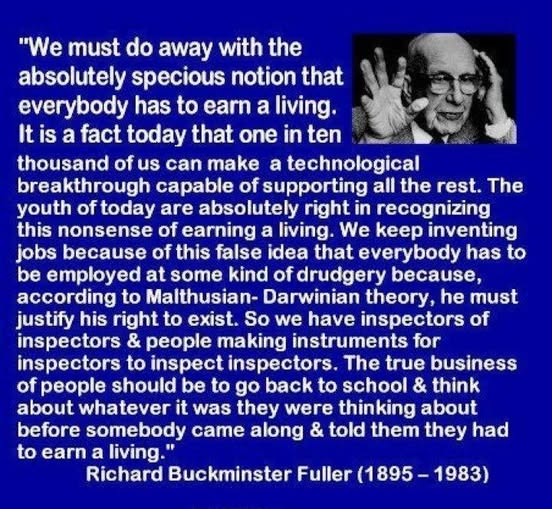
But it doesn’t make sense now. Buckminster Fuller most famously said it:
The fact is that we have more than enough of everything basic, or could easily make it. Food, housing (there are less homeless people in the western world than empty homes), basic electronics, health care, etc, etc…
We waste vast amounts of resources, and we make people work at jobs that either produce nothing or are actually a negative.
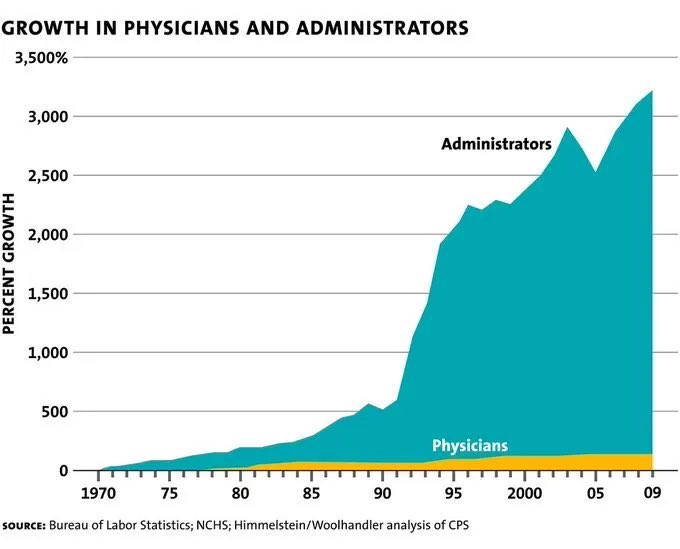
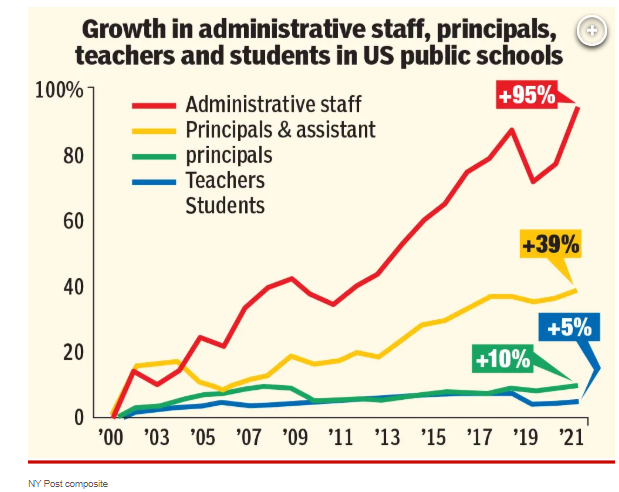
Most of those administrators spend their time denying care, not providing it. About a third should become technicians, nurses, orderlies and doctors, the rest aren’t needed at all. The same chart exists for schools:
And while not quite as bad, for universities:
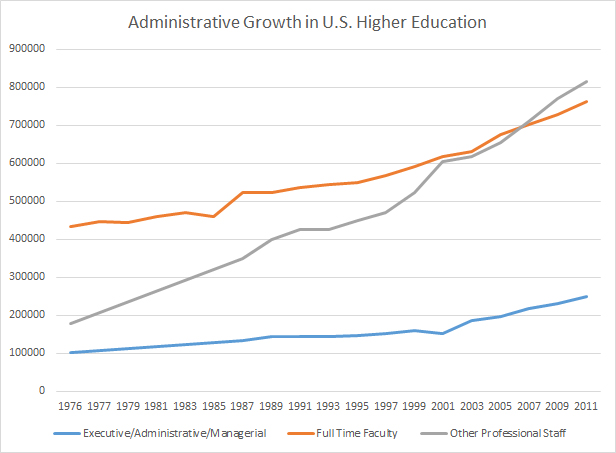
The vast majority of all of this is sheer waste, but it’s also a waste of human lives. These people aren’t doing anything necessary, but they are forced to spend their lives doing meaningless “work”.
At least much of this administrative bloat is just wasteful. People working shadow banking, Private Equity and Wall Street make their money buy rolling up companies, loading them up with debt, laying people off, raising prices and then causing bankruptcy of firms which were actually profitable, who provided real work and products at reasonable prices.
They are actively damaging. It would be more than worth it to forbid such people from working at all and pay then low six figures to stop hurting other people.
Same thing goes with most prison guards and police, who do not reduce crime, but do increase incarceration.
The truth is that at least half of jobs shouldn’t exist. They either aren’t necessary, or they’re actively harmful. It would be better just give people money.
None of this is to deny that there is work which needs to be done. But a vast switch from administration and financial industries and dochebags selling internet ads into actual productive enterprises would produce a far better economy. Even so, all our advances in production mean that we genuinely do or can produce far more than we need. So just give people enough money to live a good life, reduce the standard work week to three days, and let people who want to contribute work at jobs which make the world better, not worse, and which aren’t makework.
We can’t even imagine a world where we don’t force people to spend their entire lives doing things they wouldn’t do if they weren’t scared of starvation and homelessness. We can’t conceive of a world where we don’t create goods designed to wear out, and instead create long lasting appliances and computers and roads and cars and high speed rail and so on: goods designed to last. We need profit, so we produce vast amounts of crap we only need because of of that “need” for profit.
This insanity has caused global warming, mass extinctions and vast amounts of needless unhappiness, bad health and lives wasted doing meaningless or harmful work.
We need a better way, and the first step is to end the idea that if you don’t work you shouldn’t have a home, food and a decent life.
More on this in the future.
Feral Finster
“When the rich rob the poor, it’s called business. When the poor fight back, it’s called violence.” — Mark Twain
“We have to keep them poor, otherwise they won’t want to work!” – me, paraphrasing some 18th Century english lady
Oakchair
All those people –particularly in a materialistic* culture– are doing something extremely necessary. They are proving they are worthy.
*I’m referring to materialism in the spiritual sense.
spud
capitalism steals your life. when the U.K. lost its empire, we saw a explosion of innovations from the common people. i called it the british invasion of music and movies.
instead of investing in free trade slavery, those investments ended up back home which helped to create massive innovations, from people who were held back by free trade.
get rid of the stock market, and all markets that popped up around it. co-ops only, no outside ownership.
agreed on the three day work week and a stiff social safety net. if someone wants extra work or income, the government can have lots of work with infrastructure.
so called law enforcement, are nothing more than leeches and parasites. we should pattern law enforcement like the chinese do. they have men with guns when needed. but for the most part, they stay in their barracks till needed, otherwise the police are true public servants.
cc
It seems unlikely that we’ll see a better way here in the West, because the West is based on exploitation of others, and has been for hundreds of years. Perhaps we’ll witness a better way elsewhere in our lifetimes, but that will only be possible after that elsewhere has managed to fully secure itself against the predations of the West.
> “When the rich rob the poor, it’s called business. When the poor fight back, it’s called violence.” — Mark Twain
When the West exploits the Rest, it’s called the “rules-based international order”. When the Rest tries to resist this exploitation, and then is forced to fight back, it’s called “terrorism”, “narco-terrorism”, or “unprovoked full-scale invasion.”
Imagine what Mark Twain would say if he were observing the world today …
mago
I went my own way, and I’ve always paid.
Years passed into old age, owning nothing with nothing to hold on to while fading away
Every morning’s dawn leading to sunset’s fading, and I’ve lost my way.
Never cared or wanted to gain success and paid all along the way.
It’s too late now; the time has passed.
Nothing left to do but fade away. . .
Bob
I enjoy speculating in the company of normies, which thankfully is pretty rare outside of business hours, that society could function splendidly with no one working more than 10 hours per week.
Unfortunately, what I’m saying is so ridiculous that no one wants to jump on the conversation. The majority of people are just so well programmed that the thought of having so many hours a week available to pursue such odious things as spending time with the kids, learning practical and creative skills, cultivating social networks and whatever else, is too painful to cogitate on.
In conjunction with lowering the number of hours worked, rescuing the children from schools would make everything better with little cost in material but the psychic expense is too high to contemplate. (That’s not an invitation for people to atop learning, quite the opposite.)
Anyhoo, I think that trying to perpetuate the idea that most jobs are pointless at best and often downright harmful and that no one should be working more than ten hours (unless they really love what they do?) is revolutionary. But it’s also a futile task because of our embedded beliefs.
What to do, what to do?
TM
There is so much real, vital work to do but we have no clear method for the people that can evaluate what needs doing (usually people local to or affected by the issue) to get access to the people with the power to actually fund and direct resources. National level politicians want to centralise as much as they can in their own hands, so that they can be lobbied by the wealthy, whilst demuring responsibility within their local municipalities as beneath their notice.
Steve Ruis
Re “One of the worst is that people have to work to get resources. “If you don’t work, you don’t eat”.”
This is a major part of the scam being run by the elites (mostly Republicans). Requiring society to be “pay as you go” and then fighting against minimum wages and living wages and labor unions creates a workforce which is precarious. Such “workers” are much easier to manage than those who can get a better position at the drop of a hat and aren’t desperate for health care, rent, and food money.
Adam Eran
You’re making David Graeber’s “Bullshit Jobs” point.
Bullweather
Not saying you’re wrong, but genuinely curious… I don’t know if you’ve read The Expanse novels (worth a read if you haven’t. Great popcorn chewing hard-scifi). Anyway, at some point we get a boots-on-the-ground perspective of the Earth. 30 billion people. The majority of which live on Basic. The people who live on Basic whittle their lives away listlessly drugging and fucking.
So my question is, what do you see as the risks of just paying people out? The novelists layout a boom in overpopulation and purposelessness.
Jan Wiklund
My objection has nothing to do with morals. It’s just that I think the proposition unsustainable. People who actually work wouldn’t like to support people who don’t.
Of course there are exceptions to this; anybody could be temporarily out of work, or too ill to work, so I guess most people wouldn’t object to supporting them.
But I really think most people would be rather angry at folks who refuse working just because they like and demand others to support them. There was a movement of voluntarily jobless people, mostly youth, in Denmark in the late 70s who thought that they should be provided for by the state so they would have time to play. Of course, they got nowhere.
Some limits there must be, otherwise a system can’t survive.
TacJack
At the heart of Meadows, Meadows, and Randers 1970 book “Limits to Growth” was the mindless depletion of natural resources the banality of corporate jobs.
Twenty five years later, Jeremy Rifkin wrote “The End of Work.”
Both books were elegant and correct in their assessment of productivity and work.
55 and 31 years past their press dates, we in the West are no closer to resolving the paradox of our time, enormous productivity that is accelerating the destruction of our natural work.
My long in the tooth answer is twofold. One, we humans must learn what “enough” actually means. Two, we must reduce the number of people on this planet.
Finally, a “bonus” answer: let’s end these endless arguments about who has the best imaginary friend. Borrowing from Don Henley, “They ain’t here and they ain’t coming!”, so let’s get over ourselves and be our best selves.
Soredemos
@Bullweather
That whole element is one of the weakest aspects of those books. Irs a cure high-concept for the Earth faction that is actually quite braindead upon closer examination. A giant strawman.
Basic income systems have been tried before, and what happens is businesses raise prices to soak up the guaranteed income. Youd need accompanying legislation and regulation to prevent this from happening.
And people will doubtless bristle at this, but most people benefit from having some job to do at least few hours a day to build the rest of their schedules around. The key is to have meaningful work with meaningful and non-excessive hours, which could likely be easily produced for everyone.
Kitten
This is the best thing you’ve written, in my humble opinion.
Purple Library Guy
Cut out planned obsolescence, fast fashion, and things deliberately made to die shortly after the warranty runs out, and we’d probably only need to make a quarter as much stuff. Cut the financial sector to the percentage of the economy it was at before say 1970, and it could be a quarter its size . . . and on top of that, it should actually need far fewer workers than back then because computers REALLY make doing finance a lot easier. It’s amazing how many jobs it would be fine to skip if we didn’t start from the idea that nobody should be able to survive without working 40+ hours a week.
Oakchair
The people who live on Basic whittle their lives away…
The novelists layout a boom in overpopulation and purposelessness.
——-
How is that different from the current state of affairs?
StewartM
Steve Ruis
Requiring society to be “pay as you go” and then fighting against minimum wages and living wages and labor unions creates a workforce which is precarious. Such “workers” are much easier to manage than those who can get a better position at the drop of a hat and aren’t desperate for health care, rent, and food money.
I would argue it was the wisdom of the New Deal to recognize that the short-term goals of capitalists push against their own long-term interests: they all want low labor costs for *themselves*, but they also want customers with money who buy their stuff. Just like they want to slash costs on products and services to make them crappier and more fail-prone, but want happy customers. Everywhere, everytime, the short-term interests of capitalism collide with the long-term interests of capitalists, and in this Reagan-Rand-Frịedman environment the greediest, most short-sighted, “death bet” caculations always win out.
The hated New Deal regulations was an attempt to shut down such manipulations that did not actually add any value to the economy. By clamping down the short-term paper manipulation route, it fostered a development of real products and services. I remembered the old-timers at my company saying it was good that the company had businesses that synced out of cycle with one another (i.e., when one was down the other would likely be up) insuring (like in a personal investment portfolio) that the company would likely always have a sufficient revenue stream regardless of business conditions. In R&D, we didn’t starve the support services;, the saying was “we won’t let a support services nickel hold up a R&D dollar”. We kept adequate inventory; if you were doing an experiment and a piece of equipment broke, you probably could find it in corporate stores, or get it in quickly. Have a computer die? No problem, we kept a store of spare computers that could be quickly dropped in. And my company, nestled in a small town in Appalachia, bragged how we never had a layoff–we would give people “lack of work days” (unpaid vacation, as it were) instead in bad economic times, with everyone getting one per month before anyone getting two, and so-forth. But with “lack of work” days you still kept your benefits and the pay was good enough that with some belt-tightening people could survive. Plus, we gave good bonuses, large enough back then for the median worker in average-to-good years to actually go out and buy a low-end new car after taxes.
The the Jack Welch “geniuses” of Wall Street moved in. They told us that we should offload or shut-down industries that weren’t making 10 % profit or more (some of our businesses didn’t make that all the time, but as I said, their profits would typically go UP in bad economic times to offset losses elsewhere). They told us to “save money” by slashing support services, so that now R&D dollars WERE held up by lack of support say from IT, from shops, or from analytical services. They told us to “slash inventory”, so if your computer died, tough luck, you’d have to wait a week to get another shipped in and then you’d have to re-install of the specialized software on it yourself, which often took a whole day.
And of course, these geniuses told us “you don’t have enough personnel turnover” so we started to have layoffs, and started to fire people more, and so followed the lovely spectacle unheard of at my company but already elsewhere in the US, of top managers cutting 10-15 % of the workforce then giving themselves huge bonuses. Typically, the older and more experienced workers were targeted (though Legal kept an eye on the personnel laid off so that it would shield against lawsuits so that the layoffs would disproportionately hit some groups far more than others).
Lastly, the “new style” Jack Welsh management, while cutting costs on essential things, kept upgrading their own life experiences—the very nice building for upper management (I went there in the 1990s) soon wasn’t good enough, so they moved to a bigger, nicer building c. 2000s but even that wasn’t grandiose enough for them, so about 10 years ago they spend an estimated 1 BILLION dollars on a new palace for themselves. Meanwhile, in the QC labs analysts and operators were struggling to keep 15- and 20-year old instruments running and we were making some of our most profitable materials in old 1930s-era buildings. Ah, but there was “no money” to upgrade stuff like THAT.
The old New Deal system wasn’t perfect, by far. But it was wise enough to recognize that unregulated capitalism quickly fixates on short-term “wins” at the cost of future real prosperity. The thing is, even the capitalist class sees this and sometimes says it: Elon Musk (who I consider a prime example of the Dunning-Kruger effect) is now on record on how “AI might destroy us all”:
https://www.facebook.com/yahoofinance/posts/elon-musk-says-that-ai-could-kill-us-all/1330377178957057/
However, I doubt very much that Musk would end up favoring something like Ian has suggested (“Universal high income”, not universal paltry income) but come quarterly report time, Musk and all the capitalist class no matter what their misgivings become good capitalist lemming and go running off the cliff together for short-term shareholder value.
jrs
I think a lot of people don’t do well psychologically not working at all. They think they will, but they don’t. Of course this is complicated by not having money if one doesn’t work in this society. Of course it is! But even without that, people can easily get lost, fall between the emotional cracks.
But working part time, yes I actually believe that could work. 5 or 6 hour days or 3 day weekends every week. It could work. And people would almost certainly be better off for it.
different clue
Between the objections raised by Jan Wiklund and Soredemos, I can see calling for ” Full Underemployment for Everyone”.
And then also tax-funded Public Survival programs . . . perhaps CanadaCare for every American and Basic Survival Housing for everyone who would settle for Basic and other things like that.
And Newer-Deal type progressive and then hyper-progressive taxation to prevent the re-emergence of Vast Private Fortunes . . . if we could get the current Vast Private Fortunes burned all the way back down to non-threatening size.
Ian Welsh
I’ve actually written articles about how to implement a guaranteed annual income, and yes, the most important thing is various methods related to controling prices. These policies aren’t all that complicated, the question is political, not one of knowing how to do it.
different clue
Here is a metapolitical cartoon about people who superciliously sneer at other people who suggest improvements to things. I haven’t been able to find this image for over a year, but someone found it and brought it to reddit.
https://www.reddit.com/r/PeterExplainsTheJoke/comments/1t06xbq/petah/
different clue
And dropping into the comment thread of the reddit image-post just above, I learn for the first time that the image just above is the last panel of a four panel metapolitical comic called ” Mister Gotcha”.
Here is the link to the whole 4-panel comic.
https://thenib.com/mister-gotcha/