
The horizon is not so far as we can see, but as far as we can imagine

Category: The Future Is Chinese

The New Cold War Intensifies

We all know about American sanctions. They are enforced by removing people from the US/EU banking system, and the SWIFT transfer network.

Because this system was used by almost everyone for international transfers, the US could forbid trade between third parties: “you can’t buy or sell from Russia/Iran/whoever because we’ll cut you off from our system.”

American law only applies in America. If Russia and Nigeria want to trade something, that should have nothing to do with the US and it should have no say. But it has and entire countries have been devastated by it.

China’s had enough:

This week a Singaporean shipping company received a hefty fine in China, the fine was just short of 5 million RMB. What happened was, they had refused to fulfill a shipment from Shanghai to Panama and returned the goods because the Hong Kong shipper was included on a U.S. sanctions list. I hope you heard that, a Singaporean shipping company, nothing to do with the USA, refused a shipment that was sent from Shanghai, in China, to Panama in Central America, of products that were being shipped by a HK company that is sanctioned.

Had the goods been going to the USA, then this would not have been illegal, because the goods, or the company shipping them are sanctioned there and Chinese domestic law can’t change that.

However, the Shanghai Maritime Court ruled this as a breach of contract, China has not sanctioned this company, the US had nothing to do with the product, the shipping or the destination so, based on Article 12 of the new Anti-Foreign Sanctions Law, the court ordered compensation for the loss of over RMB 4.99 million plus interest. It went on to the Supreme People’s Court which subsequently listed it as a typical case, stating it was the first judicial judgment confirming the mandatory applicability of the law.

What this means, if it continues, and the supreme court of China’s language indicates that it will, is that you’ll be forced to choose: you can either obey US sanctions, in which case you can’t do business with China, or you can obey Chinese law and that means you won’t be able to do business with America or its vassals.

It took China a long time to do this. Only recently did China decide that the US can no longer stop its technological and industrial progress: China is ahead in almost all techs, and in the few it’s behind in it doesn’t feel it must have US goods. China forcing even AI companies to use domestic chips was a tell.

Last decade I predicted that a likely outcome of the rise of China and America’s fall was a new cold war. There’s an entire topic category “New Cold War”.

And here we are, with it reaching the serious stage.

The bottom line is that while China is happy to sell to the US and wants to keep doing so, it no longer absolutely needs to. Nor does it need parts from the US. It’s the West that needs tech transfers from China.

And there’s no upside to helping the US other than sales because everything that makes the US stronger is used to hurt China or its friends. Notice that BRICS includes two countries currently at war with the West: Russia and China, America is trying to flip Brazil back to the hard right, and Trump is constantly sanctioning South Africa.

Helping America, if you’re China, is as stupid as it gets given America has clearly treated China as an enemy and is assaulting China’s friends.

In the last cold war Russia was the weaker side, economically, from the start to the end. In this war China is stronger in every way that matters: militarily, industrially and technologically. It also has a larger population.

The smart money is “always bet on the stronger side”. Sure sometimes they lose. But not often. And the West is now the weaker side.

Welcome to the end of the European centuries. We had one hell of a run, but our leaders pissed it away. Let us hope that China is a kinder hegemon than Europe or America ever were.


What I write here is for the benefit of everyone, but alas, I live in capitalism and I, and the site, take money to keep running. If you value the writing here and can, please subscribe or donate.
Understand China’s Plan To Become A Full Socialist State

“The banks, as we know, are centres of modern economic life, the principal nerve centres of the whole capitalist economic system.”

–Vladmir Lenin

Deng had four principles for his changes to Chinese Communism:

  • Upholding the socialist road (or socialist path).
  • Upholding the people’s democratic dictatorship (originally often referred to as the dictatorship of the proletariat; the phrasing was later standardized as “people’s democratic dictatorship”).
  • Upholding the leadership of the Communist Party of China (CCP).
  • Upholding Marxism-Leninism and Mao Zedong Thought.

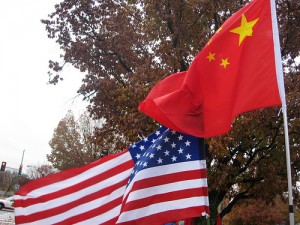
    Chinese and American flags flying together

In Marxist thought the capitalist industrial stage is necessary before the final condition of a state completely controlled by the workers, without class.

This is because a significant surplus is required for everyone to have a good life, and it’s capitalist industrialism which creates that.

You can easily create a heavy industrial state in a command economy: both the Soviets and the Chinese under Mao did so. What they could not do was create a state with a lot of consumer goods.

Mao created the pre-conditions: heavy industry, basic infrastructure, and an educated people.

But notice the principles are all “stay socialist and stay in charge.”

The major banks in China are state controlled. The banks that aren’t state controlled are under strong supervision, and in most cases have party members in leadership positions.

Banks (and various shadow banks in the West) are the main way firms get money. If the banks won’t loan, your business won’t happen or won’t survive. If they will loan to you at preferential rates because you are doing what the Party wants, usually based on the five year plan, then you’ll have a good chance of success.

When I wrote my article on principles for running a left wing government I included taking control of the banks and taking control of media as absolute, immediate, necessities.

China has kept control of both.

This issue became especially urgent after the fall of the USSR and the CPC spent a LOT of time studying why the Soviet Union fell.

But despite Deng’s principles what was happening before Xi was the corruption of the CPC and its mingling with the new capitalist rich: after all, if as a party official you helped a firm, they could kick back to you and you’d get rich. Do enough of this and you could become obscenely rich.

This imperiled all four of Deng’s principles, as decision making around loans and regulation was increasingly made not in alignment with the CPC’s goals, but to make people rich. (One example is the massive housing bubble which Xi has since popped.) This is not the issue the Soviets had specifically, but is related: people with power no longer really believed in Communism or put the Party’s power first. (Gorbachev deliberately removed power from the party.)

When Xi took charge his first and most important programs was anti-corruption. At the time I cynically assumed it was a way of taking out his enemies, and that he would tolerate corruption for his faction.

I was, mostly, wrong. Xi’s anti-corruption is real. He’s a sincere Communist who wants to keep the CPC genuinely in charge and not let it be corrupted.

The goal is simple enough: stay in charge, make China vastly prosperous and transition to full socialism. Markets are useful for this, but must be kept under control or they will take control of the party, and capitalists aren’t going to be committed socialists.

Xi, in this light, is just an extension of Deng: actually making Deng work. Deng’s policies caused rapid technological advance and improved light industry massively, but the principles were not actually being enforced.

Xi enforces them. Not just anti-corruption but changes in how the party recruits and trains and promotes, all intended to keep the CPC on the path to socialism.

Will they succeed? Well the transition will come, if it does, with the next leader, most likely. Xi is putting his successor in a good position. AI and robotics are being directed towards physical activities, there are dark factories with no workers, and so on.

Genuine socialism means people shouldn’t have to work a lot if they don’t want to, and should still live a good life. AI and automation, done properly, offers that possibility.

Of course huge problems around distribution and production remain and will have to be figured out. If China stays the course they’re trying to create something which has never existed: something genuinely new. Westerner’s might call it “fully automated luxury communism” though I don’t know if it’ll get that far.

But the ducks are in a row: massive productive capacity, ways to reduce the amount of workers needed, and keeping control of politics and the economy.

This is the plan. No one knows if it will succeed, but it’s not a stupid plan or one that will obviously fail, IF China can deal with resource depletion, ecological collapse and global warming (all of which it is doing more to mitigate than any other country, though it’s far from perfect.)

China is the future. It’s success or failure will determine what political/economic models are considered usable and successful. The age of liberal democracy is near its end.

What I write here is for the benefit of everyone, but alas, I live in capitalism and I, and the site, take money to keep running. If you value the writing here and can, please subscribe or donate.

America’s Losing the AI Race Hard

Amazing stuff, and sooner than even I expected. China’s Kimi is now about equal to GPT and Claude:

For the first time, a Chinese model Kimi K3 has taken on the Frontend Code Arena and is scoring at or near the frontier on other benchmarks.

And the majors are noticing:

Meanwhile Trump is talking about banning Chinese AI. 

Alternatively, the smart lads at Open AI have a regulatory plan:

I would guess that the Trump Administration will at some point realize that their best strategy here would be to create large amounts of regulatory risk around the use of open-weight Chinese models. You don’t need to “ban open source” (one of the dumber motifs of AI policy discussion). You just need to direct every agency to issue soft law that creates FUD. “A Federal Reserve Advisory Bulletin found that there may be backdoors in Chinese AI models.” It needn’t be that well justified. You just create enough regulatory risk that every regulated enterprise backs off. You probably don’t want to create so much regulatory risk that you scare off the hyperscalers from serving Chinese models; this will just drive startups to sketchier providers. There’s a happy middle ground here. I’d assume they will do some version of this.

Even more fun, the Feds want to approve all AI releases and not allow everyone the full models.

The Trump administration has taken new steps to assert more control over the rollout of future artificial intelligence model releases by dictating which companies and entities are allowed access to the latest frontier models, two people familiar with the matter told CNBC…

….

This week, the administration launched its own program, dubbed “Gold Eagle,” aimed at collaborating with the private sector to find and fix cyber vulnerabilities.

The so-called clearinghouse would put the White House in charge of greenlighting which companies can access new AI models, according to a person familiar with the matter, who spoke on condition of anonymity in order to discuss information that is not public.

China is going to eat America’s lunch on this. If they ban Chinese AI (harder than it seems, given it’s open source) all that means is writing off the rest of the world. And since American models are handicapped, smaller American companies will be stuck with worse AI.

Since Chinese AI is far cheaper, as well, I’d expect American companies to set up subsidiaries overseas to use it, rather than be stuck with American AI.

The entire situation is a complete clusterfuck. Major companies have taken on serious debt in order to build data centers which have a lifecycle of five to seven years, and often less (since new generations of GPUs are much better.)  But the Chinese product is cheaper, open source, lacks nearly as much sovereign risk and I’ll bet multiple models will soon be about as good as Anthropic and OpenAI’s.

Where’s the business case that spending all these trillions of dollars is going to produce enough revenue from US AI to pay for all of it?

There isn’t one. It doesn’t exist.

And that means that, at least in America, this is an AI bubble. All bubbles burst and this will not be an exception. If the government bails them out it will be the last major US bailout.

This is also very likely one of the last major tech revolutions which will start in the US (which it did.) Going forward they China will produce the vast majority of them.

This is the endgame. The turning point where China obtains not just the industrial base but the absolutely undisputed tech lead. From now on China will like America in the 1950s — it’s where almost everything new is created, the dynamic center of the world, and soon people will be competing to move there, because everyone knows it is the future.


What I write here is for the benefit of everyone, but alas, I live in capitalism and I, and the site, take money to keep running. If you value the writing here and can, please subscribe or donate.


China Thinks Ahead To Reduce Its Reliance On Petroleum

Near the start of the war I noted that the real issue with petroleum shortages wasn’t gasoline, it was diesel, bunker fuel (ships) and jet fuel.

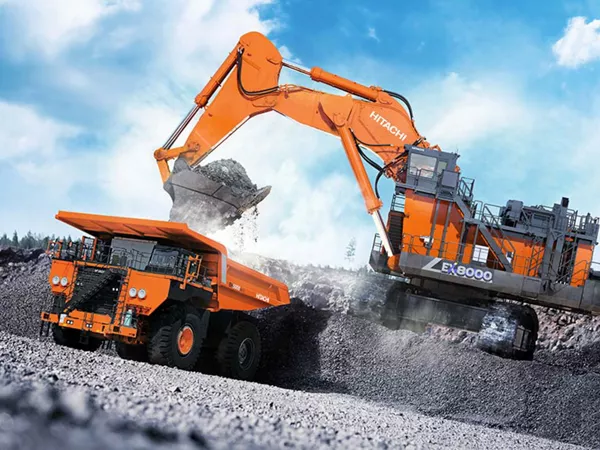
Diesel is, despite what many say, feasible to get off of: even some of the massive machines used for mining are already being switched over, and China is moving hard on electric freight trucking.

Hitachi Electric Excavator

But large freighters and super tankers are a lot harder. Electric can work for coastal freighters, but it doesn’t work for long haul shipping because you need constant recharging.

Enter Green Ammonia. This is part of China’s push on hydrogen tech. It’s currently more expensive than bunker fuel, but projections show it might hit parity by 2030, at least for the Chinese, since they’re scaling it hard. It’s made from hydrogen extracted from water, and nitrogen extracted from air, and it has zero emissions (though that’s not what this about.)

What’s important here is that if your shipping fleet uses Green Ammonia, it doesn’t matter if the supply of hydrocarbons is cut. It can still move. China’s been buying up ports all over the world, refueling can occur at them, and it works almost as well as bunker fuel, so you can make long trips across the Atlantic or Pacific if needed. (Indeed, if it’ll reach price parity by 2030, we can assume it will be cheaper by 2035, given the Chinese record on scaling.)

That means the only major vulnerability left is jet fuel, and I’m aware of no real substitues that can scale in the immediate term, though there are efforts underway. Fundamentally, however, air shipping is far less important than ocean shipping, and air travel is a luxury good. Nice to have, but not necessary to have. Jet fuel is important, strategically, for the military.

The point here is that China thinks ahead. They look at strategic vulnerabilities and they do something. This is, in part, about de-carbonization, of course, but strategically it’s a movement towards more self-reliance and less vulnerability. It also emphasizes that hydrocarbons are a wasting asset. You cannot, long term, base your economy on them. You must find a replacement if they’re your main source of foreign exchange.

The world’s changing, and in part it is changing because China is changing it. The great tech revolution of the last 40 years was telecom/chip based, but the fundamental blocks of our society remained hydrocarbon engine based. It’s China, more than anyone else, who is moving as fast as it can to an electrified economy that is not reliant on hydrocarbons, a change in the economic engine which has run our societies since the 40s or so. (The switchover from a coal/steam based economy started much earlier but took a long time.)

China makes the future, the rest of us fight over the bones of the past.

Everyone reads these article for free, but the site and Ian take money to run. If you value the writing here and can, please subscribe or donate.

Powered by WordPress & Theme by Anders Norén