
“The banks, as we know, are centres of modern economic life, the principal nerve centres of the whole capitalist economic system.”
–Vladmir Lenin
Deng had four principles for his changes to Chinese Communism:
- Upholding the socialist road (or socialist path).
- Upholding the people’s democratic dictatorship (originally often referred to as the dictatorship of the proletariat; the phrasing was later standardized as “people’s democratic dictatorship”).
- Upholding the leadership of the Communist Party of China (CCP).
- Upholding Marxism-Leninism and Mao Zedong Thought.
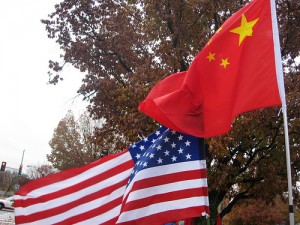
Chinese and American flags flying together
In Marxist thought the capitalist industrial stage is necessary before the final condition of a state completely controlled by the workers, without class.
This is because a significant surplus is required for everyone to have a good life, and it’s capitalist industrialism which creates that.
You can easily create a heavy industrial state in a command economy: both the Soviets and the Chinese under Mao did so. What they could not do was create a state with a lot of consumer goods.
Mao created the pre-conditions: heavy industry, basic infrastructure, and an educated people.
But notice the principles are all “stay socialist and stay in charge.”
The major banks in China are state controlled. The banks that aren’t state controlled are under strong supervision, and in most cases have party members in leadership positions.
Banks (and various shadow banks in the West) are the main way firms get money. If the banks won’t loan, your business won’t happen or won’t survive. If they will loan to you at preferential rates because you are doing what the Party wants, usually based on the five year plan, then you’ll have a good chance of success.
When I wrote my article on principles for running a left wing government I included taking control of the banks and taking control of media as absolute, immediate, necessities.
China has kept control of both.
This issue became especially urgent after the fall of the USSR and the CPC spent a LOT of time studying why the Soviet Union fell.
But despite Deng’s principles what was happening before Xi was the corruption of the CPC and its mingling with the new capitalist rich: after all, if as a party official you helped a firm, they could kick back to you and you’d get rich. Do enough of this and you could become obscenely rich.
This imperiled all four of Deng’s principles, as decision making around loans and regulation was increasingly made not in alignment with the CPC’s goals, but to make people rich. (One example is the massive housing bubble which Xi has since popped.) This is not the issue the Soviets had specifically, but is related: people with power no longer really believed in Communism or put the Party’s power first. (Gorbachev deliberately removed power from the party.)
When Xi took charge his first and most important programs was anti-corruption. At the time I cynically assumed it was a way of taking out his enemies, and that he would tolerate corruption for his faction.
I was, mostly, wrong. Xi’s anti-corruption is real. He’s a sincere Communist who wants to keep the CPC genuinely in charge and not let it be corrupted.
The goal is simple enough: stay in charge, make China vastly prosperous and transition to full socialism. Markets are useful for this, but must be kept under control or they will take control of the party, and capitalists aren’t going to be committed socialists.
Xi, in this light, is just an extension of Deng: actually making Deng work. Deng’s policies caused rapid technological advance and improved light industry massively, but the principles were not actually being enforced.
Xi enforces them. Not just anti-corruption but changes in how the party recruits and trains and promotes, all intended to keep the CPC on the path to socialism.
Will they succeed? Well the transition will come, if it does, with the next leader, most likely. Xi is putting his successor in a good position. AI and robotics are being directed towards physical activities, there are dark factories with no workers, and so on.
Genuine socialism means people shouldn’t have to work a lot if they don’t want to, and should still live a good life. AI and automation, done properly, offers that possibility.
Of course huge problems around distribution and production remain and will have to be figured out. If China stays the course they’re trying to create something which has never existed: something genuinely new. Westerner’s might call it “fully automated luxury communism” though I don’t know if it’ll get that far.
But the ducks are in a row: massive productive capacity, ways to reduce the amount of workers needed, and keeping control of politics and the economy.
This is the plan. No one knows if it will succeed, but it’s not a stupid plan or one that will obviously fail, IF China can deal with resource depletion, ecological collapse and global warming (all of which it is doing more to mitigate than any other country, though it’s far from perfect.)
China is the future. It’s success or failure will determine what political/economic models are considered usable and successful. The age of liberal democracy is near its end.
What I write here is for the benefit of everyone, but alas, I live in capitalism and I, and the site, take money to keep running. If you value the writing here and can, please subscribe or donate.
spud
the bill clinton of the soviet union, let the millionaires boom. i knew it was over.
Yes, during Gorbachev’s time, particularly through his perestroika reforms, some individuals began to accumulate significant wealth, leading to the emergence of the first Russian oligarchs. This period allowed limited private enterprise, which laid the groundwork for a new business class.
Wikipedia
Emergence of Wealth During Gorbachev’s Era
Perestroika and Economic Changes
Mikhail Gorbachev introduced perestroika (economic restructuring) in the mid-1980s.
This policy allowed for limited private enterprise, which was a significant shift from the previous centrally planned economy.
Entrepreneurs began to exploit loopholes in the system, leading to the rise of a new business class.
Rise of the First Oligarchs
The economic liberalization during Gorbachev’s tenure laid the groundwork for the emergence of the first Russian oligarchs.
Individuals like Boris Berezovsky became prominent figures, accumulating significant wealth during this period.
The transition from a state-controlled economy to a market-oriented one enabled some individuals to become millionaires.
Summary of Wealth Accumulation
Aspect Details
Policy Perestroika (economic restructuring)
Time Period Mid-1980s to early 1990s
Key Figures Boris Berezovsky and other early oligarchs
Economic Impact Allowed for limited private enterprise
Outcome Emergence of the first Russian millionaires
During Gorbachev’s time, the changes in economic policy indeed led to the rise of individuals who became millionaires, marking the beginning of a new economic class in Russia.
Wikipedia
————–
gorbachevs reforms, just made things worse, just like bill clinton.
Perestroika aimed to restructure the Soviet economy by introducing market-like reforms and granting ministries and enterprises more autonomy, but it worsened shortages and created economic instability, leading to falling output and repressed inflation by 1990. Wealth distribution remained highly unequal under central planning, and perestroika’s partial reforms failed to establish a functioning market economy or reduce disparities.
niskanencenter.org Wikipedia
The emergence of Russian oligarchs after Gorbachev led to significant wealth concentration among a small elite, which influenced Russian politics and economics, often undermining democratic processes. This oligarchic class became intertwined with state power, shaping policies and contributing to systemic corruption that persists in Russia today.
Encyclopedia Britannica Wikipedia
Feral Finster
@Spud:
L.I. Brezhnev’s “stability in cadres” remark was probably necessary at the time, but it made it clear that membership in the CPSU was now first and foremost, a career move. The party became increasingly staffed, not by ideological communists like M.A. Suslov, men who had passed through several fires in the quest to build socialism, but by opportunists who saw membership in the CPSU as simply a qualification you had to get on the way upwards.
Naturally, such men looked wistfully towards the West, as you didn’t need to be an economic mastermind to see that the pickings were better there, especially if you were an opportunist with his eye on the main chance, and they looked to Soviet assets and wanted them for themselves, no middle man or need to share any part of the spoils with the muzhiks.
bruce wilder
I wish I had the time and language skills to gain a deeper appreciation of Chinese policy economics. It would be interesting even to see how a Chinese University teaches Econ 101.
The critical aspect of China’s economic development since Deng, practically, has been its relations with the “Western” global economy. They adapted their own economy to imitate the West in some respects and to assume a symbiotic relation in others. To do that effectively, they had to develop an understanding of how the 1st World economy worked that was, I assume, quite sophisticated. I wonder how explicit that understanding became in academic writing. How does a Chinese economist understand money and banking, multinational enterprise, business management, economic development, business cycles, monetary policy and central banking?
They certainly didn’t “do everything right”. China engineered a fantastic rate of household savings to undergird rapid investment growth and are now struggling to find ways to take those social habits apart as the need for investment subsides. Their “housing bubble” had a lot to do with the households trying to find somewhere to park their accumulated savings and the political problem of deflating that bubble has to encounter not just dissatisfied property developers and their bankers but also household savers without good options. Very different from the American problem circa 2008 of corrupt banksters subverting the New Deal institutions that made the 30-year mortgage possible.
Economics discourse in the U.S., as we all know, is about obscuring how the economy works behind sloganeering about “free markets” and other such rubbish. When the development of the modern industrial economy took off in 1860s in the Second Industrial Revolution, academic economics underwent its “Marginal Revolution”. The latter was an exercise in ignoring in real time every emerging functional feature of the former, supplemented by rationalizing its morality as just and beneficent. Thus, we got various ideologies of a “market economy” to paper over an economy of money and bureaucracy. Karl Marx, it should be acknowledged, was leading at the same time a movement of contradictory ideas, in trying to both penetrate the mysteries of capitalism and promise a different brand of utopian possibilities.
That was then, this is now. Without knowing the details, I seriously doubt that the Chinese are drawing much insight from the pages of Das Kapital. But, they clearly have a pragmatist’s sufficient knowledge of how global capitalism works in the 21st century to both imitate it effectively and to benefit from its decadence.
Jan Wiklund
I would call Xi and the CPC “industrial confucians”. The confucian principles kept Old China flourishing for a few generations, after which corruption set in. It had to, since all control is vested in few hands (like with the “philosophical absolute king”). The fewer that control, the easier they may steal.
Inerestingly, Xi seems to be aware of this. At least according to the French entrepreneur Arnaud Bertrand, who lives in China and came across a collection of Xi internal party speeches translated into English under the title The Governance of China. See here his review: https://www.bjreview.com/Opinion/Governance/202606/t20260629_800440660.html:
“Party self-reform is something he says is a “great endeavor” put in place “since the 18th CPC National Congress in 2012,” so it’s clear it is part of Xi Jinping thought. Xi became the top leader of the CPC in 2012.
Interestingly, and this will also undoubtedly surprise foreign readers, he lists oversight by “other political parties, the judiciary, the public, and the media” as part of the system of self-reform, all part of a “constructive and mutually reinforcing interaction between supervision by self and by others.” Many foreigners always assume that the CPC abhors external scrutiny and here you have Xi himself telling the Party leadership that it’s not just useful, something they must “readily accept,” but historically decisive—an essential component of one of only two answers, across millennia of Chinese history, to the question that brought down every Chinese dynasty in history.
That, overall, is Xi’s answer to the question of legitimacy: self-cultivation itself. Not self-cultivation as a path to legitimacy, but self-cultivation as legitimacy.”
The question is if Xi succeed, and achieves something like the powerful bureaucracy supervised by parliamentary bodies like in Sweden about 1809-ca1900, or if the party bosses turn against him as they turned against Gorbachev in the Soviet Union. Nobody seriously wants oversight.
cc
“people’s democratic dictatorship” / “keeping control of politics and the economy”
Another way of putting it is keeping “We, the people” in charge of government and the economy, which means keeping plutocracy out. Hence, the first word in the country’s name (PRC) is “People’s”.
Here in The West – because of plutocracy – we have thorough corruption of the ideals of capitalism, just as we have thorough corruption of the ideals of democracy.
Thus we have the US stock markets making yet new record highs every day, even as the US is being revealed to be de-industrialized, and to no longer have the relative power it once it had. The US-Israeli sneak attack against Iran during pretend negotiations this year has turned out to be the USA’s “Suez Moment.” Its “Waterloo.” Its vaunted military power has been shown to be a “paper tiger”, and its vaunted economic power is also based on paper, with endless printing of the US dollar. The world is still giving away their resources and hard work to the West for these bits of IOU, but how much longer will they?
Thus we go through the motions of elections, but do not have real democracy (“government for the people, by the people”). What we have instead is plutocracy: government of the 0.1% for the 0.1.%, with the current Trump administration being the prime example right now (government of the 0.01% for the 0.01%).
The US stock market is no longer an accurate measure or driver of value in the real economy. It’s a complete Ponzi scheme, dependent on the greater fool theory, a casino. Society’s money, efforts, and resources get misdirected toward unproductive bubbles.
I’ve seen it said that Trump apparently managed to bankrupt an actual casino. Now he’s overseeing the bankruptcy of the casino that is the US (a process that started long before his presidency and will continue after it.)
p.s. @Ian small typo in the first acronym (one “CCP” vs the four “CPC” you have throughout the rest of the article)
Dan Kelly
Is it more accurate at this point to say that China sits atop the global machine or that it is the most powerful entity within said machine?
China is not – can not – pursue its plan to become a full socialist state without engaging with the world.
China currently ‘makes’ oodles of money from the US and the west because the price differential is so large.
China cannot continue its plans without these profits and in order to wean itself off its dependence on western markets it has to feed new or developing markets which provide much less ‘profit per item’ let’s say….thus these markets themselves must be large and continue to grow etc.
Internally, China might be said to be practicing some sort of hybird state capitalism-market socialism…or vice versa if you don’t want to put the word capital first even though China obviously has no problems whatsoever with ‘capital’ and producing many of its own very very rich ‘social-capitalists’ as a mechanism with which to pursue its own ends.
China doesn’t have the extensive military footprint that the US-NATO et al do around the world but China’s business and financial dealings with ‘the developing world’ are not win-win rather they are China dominates with its own people and/or cheap guest workers etc.
‘Regardless of framing by West (and we’ve seen how fluid that framing can be) or Russia’s “equality” mantras, neither are objective regarding global governance as both hold power positions on UNSC and neither want that basic architectural power dissolved.
Currently, as has been for last 100o years, Imperialism and might makes right is the action, not words, of the day.
The good vs evil… “socialism” vs “democracy” vs “communism” vs “capitalism” are all word salad nonsense to hide power centers.’
https://www.moonofalabama.org/2026/08/blinding-morality-in-international-relations.html#comment-1394253
This is every bit as true of China.
I think we get hung up on the ‘isms’ too much.
somecomputerguy
The Chinese have socialized credit.
The New Deal State effectively did the same, but left ownership in private hands, which was it’s downfall.
Could this be all it takes to defang capitalism?
Bob
Oh, good lord, techno optimism is not encouraging.
different clue
Here is a prompt for possible artisandustrial optimism from China . . . from the oddlysatisfying subbredit . . . Teapot quality comparison ending in laminar flow.
https://www.reddit.com/r/oddlysatisfying/comments/1vghe13/teapot_quality_comparison_ending_in_laminar_flow/
Clearly someone there understands “laminar flow”. Where else might these principles be applied beyond just teapots?
different clue
And here is a commentary on the psycho-political picture in America today . . .
from the PeterExplainsTheJoke subreddit . . . “Peter what does babies having food have to do with communism?”
https://www.reddit.com/r/PeterExplainsTheJoke/comments/1vghjjy/peter_what_does_babies_having_food_have_to_do/
The Revolution of Falling Expectations will hit America hard. Well . . . even harder.
mago
Yeah, Bob.
I share in your despair.
spud
Feral Finster:
i always thought that when it came down to choices gorbachev or this fellow, the soviets did a massive blunder choosing a traitor.
Yegor Kuzmich Ligachev was known for his role as Secretary for Agriculture in the Soviet Union, where he was recognized for his effective administration and contributions to the region’s economy during his political career. He served in various high-ranking positions, including overseeing agricultural policies, which were significant during the period of perestroika.
Wikipedia Encyclopedia Britannica
Overview of Yegor Ligachev’s Agricultural Role
Yegor Kuzmich Ligachev played a significant role in the agricultural sector during his political career in the Soviet Union. His contributions were particularly notable during the period of perestroika, where he held various high-ranking positions.
Key Positions Held
Position Duration Responsibilities
Secretary for Agriculture 1988 – 1990 Oversaw agricultural policies
Head of the Organizational-Party Work Dept. 1983 – 1985 Managed party organization and policies
First Secretary of the Tomsk Regional Committee 1965 – 1983 Led regional agricultural initiatives
Contributions to Agriculture
Effective Administration: Ligachev was recognized for his effective management and modern administrative methods, which contributed to the economic development of the Tomsk region.
Advocacy for Agricultural Policies: As Secretary for Agriculture, he was responsible for implementing policies that aimed to improve agricultural productivity during a time of significant reform in the Soviet Union.
Political Influence: Ligachev’s position allowed him to influence agricultural policies at a national level, particularly during the transition period of perestroika, where he advocated for a more conservative approach to reforms.
Ligachev’s legacy in agriculture is marked by his efforts to balance reform with the preservation of established party structures, reflecting his complex role in Soviet politics.
Wikipedia Encyclopedia
Yegor Kuzmich Ligachev was known for his role in the anti-alcohol campaign and his advocacy for a more conservative approach to agricultural policies during his time in the Soviet Union. He served as secretary of the Central Committee with responsibilities in agriculture, where he aimed to preserve the established order of the Communist Party’s agricultural practices.
Encyclopedia Encyclopedia Britannica
Yegor Kuzmich Ligachev’s administration was marked by a conservative approach to economic reforms, advocating for the preservation of the Communist Party’s established order during the perestroika period. His influence waned as he opposed more radical reforms, which ultimately limited the effectiveness of economic restructuring efforts in the Soviet Union.
Encyclopedia Britannica Encyclopedia
Yegor Kuzmich Ligachev faced resistance to conservative reforms within Gorbachev’s administration and criticism for opposing rapid liberalization during perestroika in agriculture.
Wikipedia Encyclopedia
different clue
And once again, the image . . . the whole point of the link . . . was removed by the moderator.
Is it bad luck? Is it a curse? What?
Ian Welsh
If by moderator you mean me, no I didn’t. May be an automatic security thing.
different clue
@Ian Welsh,
No, I meant the moderator of the subreddit itself where the picture was posted. I see various subreddits sometimes host the most interesting pictures-with-a-point, and I offer them here, and then as soon as I circle back to look at them again; they have been removed by the subreddit’s own moderator.
Perhaps I should call them ” subredditators” to avoid being confusing in my terminology-of-ascription.
In fact, if it happens again that’s exactly what I will call the person who removed it from herm’s subreddit between my offering it here and my circling back to look at it again myself. I shall call him/her the subredditator. As in . . . ” Once again, a picture has been taken down by the subredditator”.
Jessica
文章写得很好。说实话,我们都需要学一些普通话
Jessica
At this point in time, the largest obstacle for China pursuing the path you describe is that its whole system is built to maximize production and lacks the ability to shift to more consumption. Until this changes, China will need to export at volumes that will generate increasing resistance from its export targets.
Folks who understand the Chinese economy have been pointing out the need for this shift since the start of the Global Financial Crash in 2007. And for that same period of time, folks who understand Chinese politics have said that this will not happen. So far, they have been correct.
Note that Japan reached a similar point in 1985. All the talk then was about naijukakudai (internal demand expansion). Japan has yet to manage that task and instead has stagnated for decades. (Though Japanese have told me that the country is actually more pleasant to live in now than it was in the Japan as Number One days of the early 1980s.)
A blog called Dragonometry claims that the reason China has not made the necessary shift is that continued expansion of production can be administered and controlled through the Party and the technocracy. Set targets. Promote those who achieve them. But a more consumption-centered economy is much harder to measure in numbers, and therefore harder to administer through a bureaucracy that attempts to maintain central control. Figuring out a system of administration and coordination that puts all those productive forces to work for everyone in China is no simple tasks. Western models would unleash consumption and also unleash concentration of wealth and power, which the Chinese are wisely trying to avoid.
It may well be that this task requires shifting a significant portion of power away from the current meritocratic technocratic bureaucracy. That has to be a scary notion of China’s leaders.
I hope China finds a solution. A world with a huge China of luxury communism would be a better one than the one we have now or the one we seem to be heading towards.
Bob
@mago
🤘
Feral Finster
@Spud:
The rot had set in long before M.S. Gorbachev.
Oakchair
A sure sign someone is infected with materialist “spirituality” is the automatically assumption that China’s problem is that they don’t “consume enough”.
Materialism and consumerism here in the west has made everyone happy, healthy, and fulfilled in their lives.
Think of all those poor Chinese people who aren’t sitting in front of a screen all day being told what they need to buy to achieve happiness. Jesus weeps that they only go to a mall once a month. Imagine the misery of not getting new furniture and cars every 5 years and new cloths every 2 years!
Hell is NOT working a meaningless job you hate to buy shit you don’t need.
StewartM
Feral Finster
The rot had set in long before M.S. Gorbachev.
Yes, and Spud is leaving out one B. Yeltsin in the story, who did a LOT more to bring about the post-Soviet dystopia than Gorbachev, including the breakup of the USSR itself. Just like he slams Clinton for extending Reagan but says nary a word about Reagan.
I start the demise of the USSR with Stalin, myself, for both killing off the people who most believed in the system via his purges (leading to the ‘elite betrayal’ seen under Yeltsin decades later) and also agricultural collectivization, which seems not to have worked anywhere it’s been tried (the financial squeeze the Soviet Union found itself in under pre-Gorbachev is directly related to its inability to feed itself). In some ways, libertarians and communists mirror each other in being uber-bound by ideology rather than by results. If you want really “scientific socialism” you go with what empirically works.
spud
Feral Finster:
yet there was a chance to reverse the rot.
StewartM:
it took a democrat to initiate the republican agenda.
it was clinton that struck down the new deal/fair deal/Gatt/great society. carter and reagan wanted to, they could not get it done. but clinton got it done way beyond the republicans wildest dreams.
we are in a second robber baron era, only clinton made it world wide. if you broke it, you own it.
just look at carter and reagan as the pea brains that they were. but look at clinton in a totally different light, he knew what he was doing, and he believed in what he was doing.
the worse type of ideologue, a fascist.
spud
StewartM:
(the financial squeeze the Soviet Union found itself in under pre-Gorbachev is directly related to its inability to feed itself).
also ligachev made agriculture work.
yawn,
Food insecurity affects millions of Americans, including those who are employed and middle class, primarily due to insufficient financial resources to purchase food. Despite the U.S. producing more food than needed, many individuals and families struggle to access adequate nutrition.
Wikipedia foodsystemprimer.org
Overview of Food Insecurity in America
Food insecurity is a significant issue in the United States, affecting millions of individuals and families. Despite the country producing more food than necessary for domestic consumption, many Americans struggle to access adequate nutrition.
Causes of Food Insecurity
Financial Constraints: Many households, including those with employed adults, face challenges in affording food due to low wages or unexpected expenses.
Neighborhood Deprivation: Areas with limited access to grocery stores and fresh produce contribute to food insecurity.
Health Issues: Chronic diseases and health-related costs can further strain financial resources, making it difficult for families to prioritize food.
Impact on Communities
Food insecurity is not limited to low-income families; it also affects middle-class households. The reliance on food banks has been linked to rising health issues, such as obesity and diabetes, due to the consumption of highly processed foods often available at these facilities.
Statistics on Food Insecurity
Year Percentage of Food Insecure Households
2023 13.5%
2019 Over 40% of undergraduate students
The paradox of hunger in a food-abundant nation highlights the complexities of food insecurity in America. Addressing this issue requires a multifaceted approach, focusing on economic stability, access to nutritious food, and community support systems.
Wikipedia feedingamerica.org
Food insecurity in America is primarily driven by financial barriers such as low wages, unemployment, and high living costs, which limit people’s ability to afford nutritious food. Systemic factors like neighborhood deprivation, lack of transportation, and historical discrimination also contribute to persistent disparities in food access.
Office of Disease Prevention and Health Promotion feedingamerica.org
Food production in America is highly efficient, with the agricultural sector increasing crop and livestock production significantly while only slightly increasing greenhouse gas emissions. In contrast, food distribution is less efficient, as farmers receive only 15 cents of every retail dollar spent on food, with the rest going to various costs beyond the farm gate.
fb.org wri.org
different clue
@spud,
Your comment about food problems and prospects and situations here in America deserves a better response than I have the time to give it right now. Maybe later I will.
Or if someone else can, they hopefully will.
There is the Big Macro Problem of “America feeding itself” overall.
There are the Little Micro Problems of “Americans feeding themselves and/or eachother” in millions of little spot-focus situations and details.
Both levels deserve addressment.
different clue
I will say this: any “middle-class” household which finds itself Food Insecure isn’t really “middle-class” anymore. It is part of the New Poor, whether it wishes to believe that or not.
A Lower Class Majority Party won’t get anywhere until the members of the Lower Class Majority in this country get over their shame and embarrassment at their own Lower Class Status and Reality.
” Say it Loud! I’m Poor and I’m Proud!”
spud
different clue:
no matter what you do with agriculture, it comes down to can the people afford it. so in the soviet union they could, it was not efficient at times, but it was also, and still is impacted severely by the environment.
—-
Russian agriculture is significantly limited by environmental factors, including extreme temperatures, low summer precipitation, and a small percentage of arable land, which is only about 7% of the country’s total area. Additionally, regions like Siberia face challenges such as permafrost and a short growing season, impacting agricultural productivity.
Wikipedia climatechangepost.com
—-
so ligachev made it more efficient under the soviet system, but even when it was not, they still could feed themselves unless the environment interfered.
—-
Collective agriculture in Russia today operates primarily through large agricultural enterprises and cooperatives rather than the Soviet-era kolkhozes, and Russia has become a major global wheat exporter, with surpluses driven by modernized farms and state support.
Wikipedia Encyclopedia Britannica
——-
then look at america, there is absolutely no excuse for so many starving. under the soviet system, they at least tried to alleviate the problem.
—–
Hunger in the U.S. is primarily caused by some Americans having insufficient money to buy food, despite the country producing far more food than needed for domestic consumption. This situation is exacerbated by factors like neighborhood deprivation and agricultural policies that favor cheaper, processed foods over healthier options.
Wikipedia
Overview of Hunger in the U.S.
Despite the United States producing more food than necessary for domestic consumption, many Americans face hunger. This paradox arises primarily from financial constraints that prevent individuals from purchasing adequate food.
Causes of Hunger
Economic Factors
Insufficient Income: Many households lack the financial resources to buy food, leading to food insecurity.
Poverty: A significant number of food-insecure individuals live in poverty, which limits their access to nutritious food.
Neighborhood Deprivation
Food Deserts: Areas with limited access to affordable and nutritious food contribute to hunger. Residents may rely on convenience stores that offer mostly processed foods.
Food Mirages: Some neighborhoods may have grocery stores, but prices are too high for low-income families, making healthy food inaccessible.
Agricultural Policies
Subsidization of Crops: U.S. agricultural policies heavily subsidize crops like corn and soybeans, which leads to a surplus of cheap, processed foods. This makes healthier options like fruits and vegetables more expensive and less available.
Health Implications
The reliance on inexpensive, processed foods has led to health issues such as obesity and diabetes among food-insecure populations. Many individuals face the dual challenge of being undernourished while also struggling with weight-related health problems.
The issue of hunger in the U.S. is complex, rooted in economic, social, and policy-related factors. Addressing these challenges requires a multifaceted approach that includes improving access to affordable, nutritious food and reforming agricultural policies.
Wikipedia frac.org
TSC
China may well be the future, but will that future be socialist?
One of the necessary characteristics of socialism is a relatively equal distribution of income. The USSR, in its heyday (1965-1975), had a Gini coefficient of about 0.22-0.25. Contemporary China is nowhere near this equal. China’s Gini coefficient is 0.36, close to America’s (0.38). China is much more unequal than the OECD average (Gini of 0.32). The best candidates for being socialist, from the standpoint of inequality, are a few of the former socialist states of Eastern Europe: Slovakia (0.22), Slovenia (about 0.24), Czechia and Belarus (about 0.25), and possibly Belgium (0.25-0.26).
Importantly, according to China’s own statistics, inequality has not meaningfully changed during Xi’s 14 years in power. So I really doubt that he is building a socialist China.
different clue
I remember reading somewhere that Mr. Xi and allied CPC thinkers are quite Orthodox Marxists . . . and Marx said you had to have a fully developed Capitalist Class exploiting a fully developed Proletariat Class to begin with before you could finally overthrow the Capitalist Class in favor of the One Final Class Proletariat Dictatorship. You have to have the expropriators before you can expropriate the expropriators. So maybe the current CPC is taking China through the Great Private Capital Buildup in order to have something to socialize eventually.
That’s just a vague guess, to be sure.