
The neoliberal era, which is dying but not yet dead, has been extremely tiresome for anyone with an IQ higher than a tomato, and even a scintilla of intellectual honesty.
Witness the current German chancellor, Merz, intent on doubling down on the same policies which have failed to work for generations:
“With 450 million consumers, we are already larger than the United States. We must break free from what is holding us back. We are being slowed down by labor costs, energy prices, taxes, and social contributions. We must push through reforms, and overcome resistance.”
My bolding, of course.
So, let’s demolish this. We’ll start with productivity versus corporate tax rates:
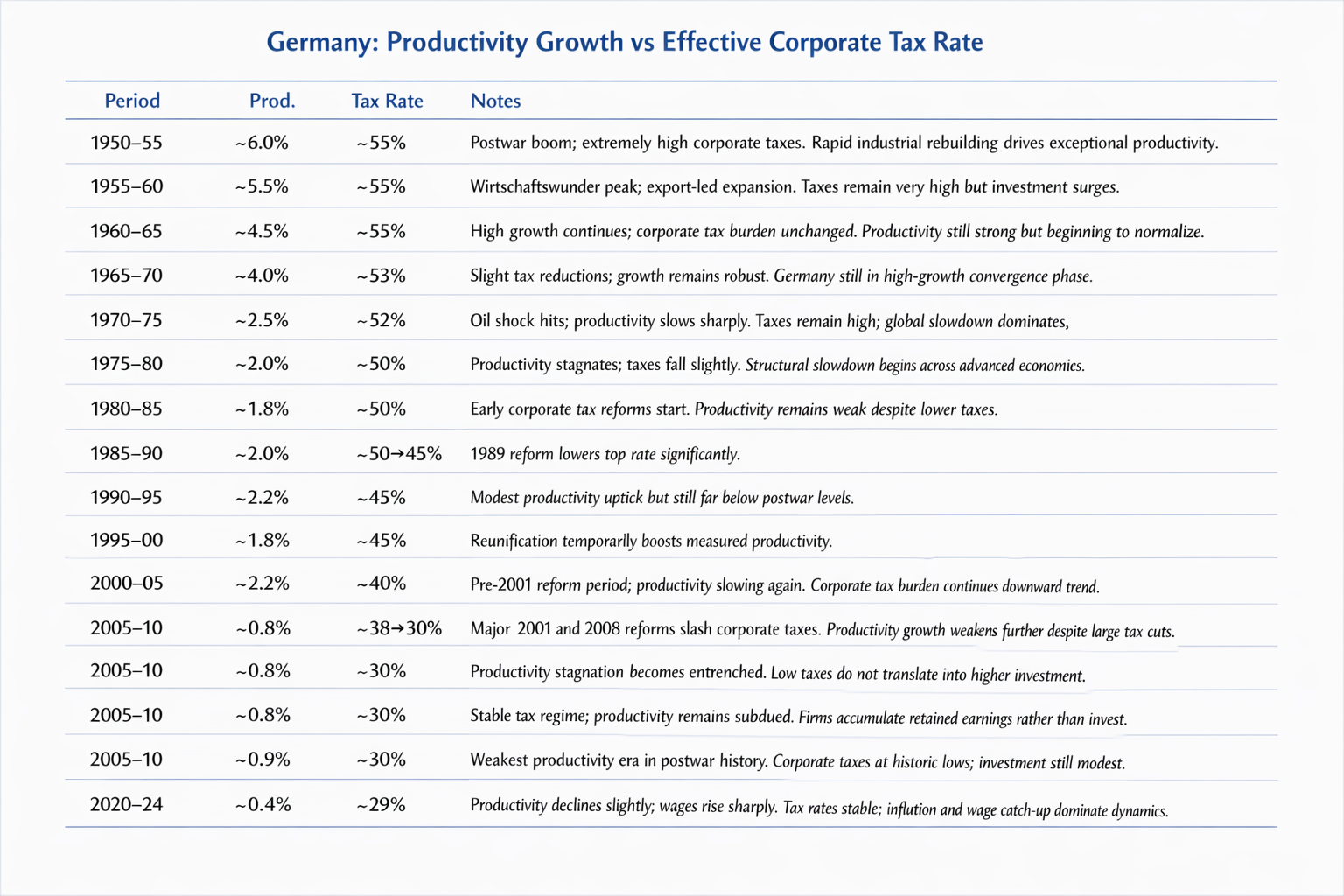
So, the lower the tax rate, the lower the productivity increase (and thus competitiveness.) This is correlation, not causation, but it does clearly indicate that lowering corporate tax rates doesn’t automatically increase productivity. Looking that this table, you’d assume the opposite.
What actually matters is how much of profits are kept inside the company and used for investment in the business. High tax rates on non retained earnings, combined with high tax rates on dividends and executive income encourage firms to reinvest rather than disburse. The neoliberal story is exactly wrong: high tax rates on corporations and high progressive taxes on income and wealth encourage growth. You want ordinary people to pay to lower taxes, so they buy products, and you want high income people to pay high taxes so they don’t take wealth out of the companies they own and run, but rather insist those companies re-invest.
Now let’s look at wages:
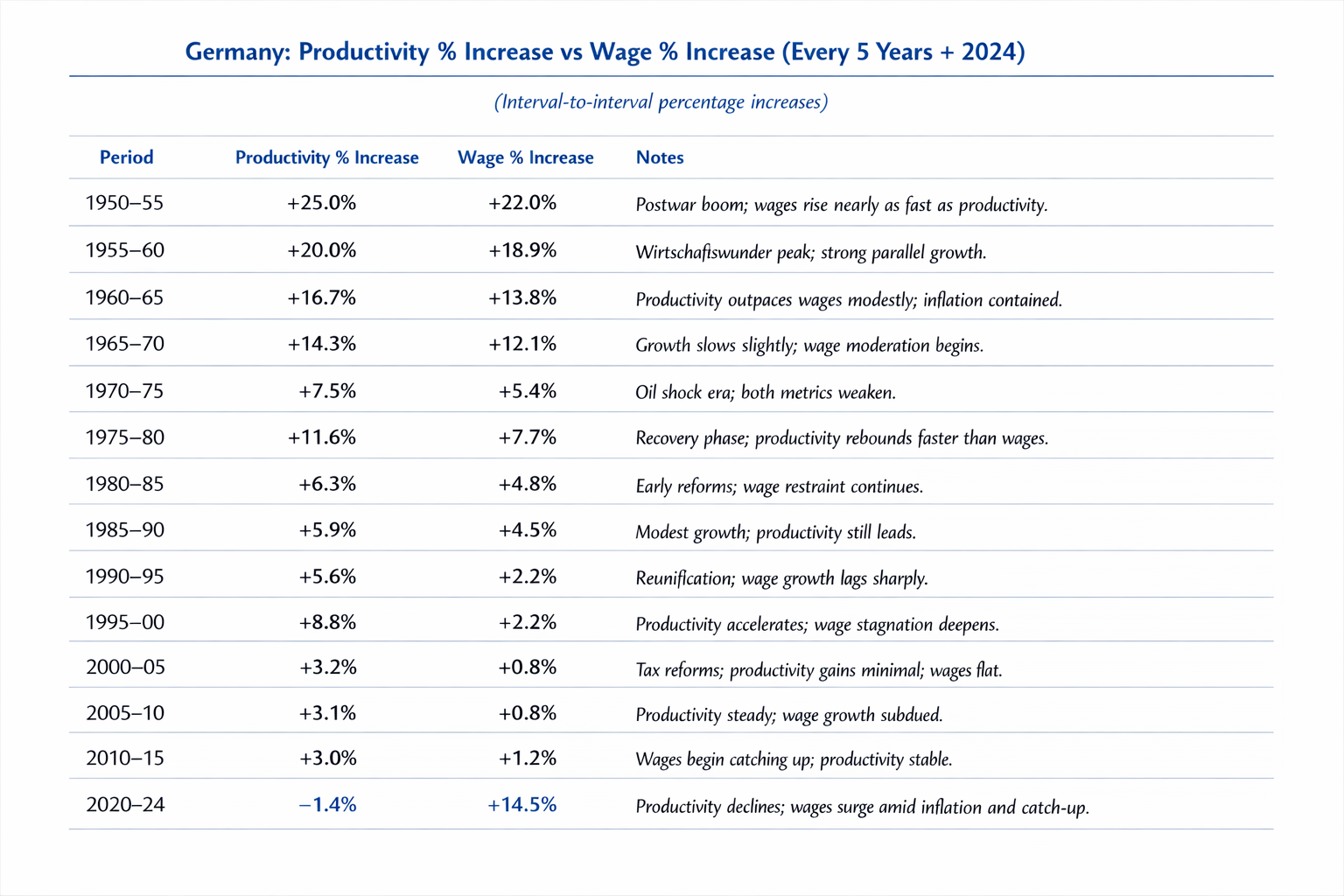 There are some ups and downs, but generally speaking during the earlier periods wages increase at a higher percentage of productivity.
Now there are two important recent breakpoints. First is the tax changes of 2000: you’ll notice that wage increases and productivity increases from 2000 to 2020 are abysmal. Corporate tax rates were dropped from 40% to 25%: if neoliberalism worked, then reduced taxes should have led to more investment, instead it lead to more stock buybacks and more executive compensation, in part, because at the same tiem they changed tax laws in ways that made stock buybacks and stock options for executives far less taxed.
So the freed up money, instead of going to reinvestment, went to shareholders and executives.
They also made it so that investments in other countries, not Germany, were taxed less than investment in Germany.
I want to say that the sheer stupid is breathtaking, but of course, this wasn’t done to improve Germany productivity and ordinary people’s wages, it was done to make the rich in Germany even richer.
The actual strategy which works, if anyone cares, is high corporate taxation, with tax relief if money is spent inside Germany to improve a company’s productivity: if it’s actually reinvested.
So the tax changes of 2000 hurt productivity and hurt wages and made Germany’s rich even richer. Quelle surprise.
Now let’s take a look at what happened post 2020 – a radical change. This is German de-industrialization. There’s a massive inflation shock, both from increased energy prices due the Ukraine war and pipeline destruction, plus inflation from Covid and corporate price gouging. Wages rise because they have to: after years of slowing wage increases, Germans need enough money to pay for housing and food. Corporations have to pay more or people won’t work.
Productivity actually DROPS. This is the energy shock that has caused so much German industry to relocate out of the country or to shut down entirely. It’s not just that China has advantages, it’s that Germany shot itself itself in the foot going along with anti-Russian energy sanctions and not fixing the pipelines.
Merz is in a panic. His actual constituents, Germany’s rich (he doesn’t give a damn about ordinary people) are in trouble. So his idea is to reduce taxes and force down wages.
Never improved Germany’s economy in the past, of course, quite the opposite.
So what will happen if he reduces corporate taxes? They’ll move industry out of the country faster because he hasn’t dealt with energy prices. (He mentions them, but he has no plan.) Reducing individual taxes might allow for decreased wages, or at least decreased wage increases, but if German companies aren’t competitive with Chinese companies, any extra consumer spending from reduced taxes will flood out of the country, and in the long term reduced wages means less potential domestic income.
Again:
Germany companies won’t invest more in Germany, they’ll invest more outside of Germany, including in China, if taxes are reduced without any legal changes to force reinvestment in Germany.
The actual solution is to force reinvestment in Germany thru tax changes that make foreign investment less profitable, and targeted tariffs, subsidies and industrial policy to make German goods more competitive.
Oh, and to end the Ukraine war, fix the pipelines and get energy costs down, though that may no longer be possible, as Putin has indicated Russia is no longer interested in long term energy deals with a Europe who hates Russia.
There is no cheap source of hydrocarbons any more and that situation is just going to get worse, even leaving aside the shock from the Iranian war. So Germany’s ultra-double-fucked. They need to figure out how to build nuclear fast and cheap and double down on renewables, primarily solar and perhaps tidal (the exact opposite of what right wing fools want.)
There’s no easy way out. Reducing taxes without restructuring taxes to force domestic investment will accelerate de-industrialization. Lower taxes on individuals might help lower wages somewhat, but will damage the German state’s fiscal ability at a time when massive public investment in energy is required.
Neoliberalism failed to do anything but make the rich, richer. If Merz happened to want to actually rescue Germany from de-industrialization he’d have to raise corporate taxes and change taxation and compensation rules to force reinvestment in Germany, while massively increasing public spending on energy. Any corporation which won’t reinvest needs to be taxed into the ground, and that money should be used for the energy build-out.
Taxes on the rich, including a wealth tax, should be increased. (No, they aren’t leaving the country in large numbers. Where would they go? China won’t take them if they can’t bring their money with them, and maybe not even then. America is no longer attractive, and the rest of Europe is doing badly too.)
In general, laws need to force Germany corporations and rich to invest in Germany, and make it so they can’t move their resources out of Germany. (Or perhaps not out of Europe.) None of this is ideologically, and thus politically, possible.
Merz won’t fix anything. Instead he’ll make everything worse. If the German hard right gets in power they might cut a deal with Russia, and that would help somewhat, but they won’t fix anything fundamental either.
A complete revision in economic ideology, of the same magnitude as the New Deal is required, and Merz and the opposition parties are incapable of that.
Germany, and Europe, will continue an inexorable decline.
Everyone reads these article for free, but the site and Ian take money to run. If you value the writing here and can, please subscribe or donate.