The horizon is not so far as we can see, but as far as we can imagine

Tag: 1 Page 1 of 3

Joe Biden’s Three Genocides in Four Years: Ukraine Part 3

UPDATED: 13:37 GDT I added stuff about the “51 former intelligence officials” and the MSM eating crow about the laptop being confirmed to be real.

Russia’s “unprovoked” invasion of Ukraine didn’t just happen. It was a passion project many years in the making.

And no one was more passionate about provoking war with Russia than Joe Biden.

Now that we’ve got the virulently anti-Russian prime minister of Poland, Donald Tusk, telling his parliament that Ukrainian casualties are currently 27,000 a month, it’s not time to let up on old Joe and the rancid ghost of Democratic administrations past.

In part 1 of this mini-series within a series (the prequel covered COVID, we’ll wrap with Gaza), I covered the post-Cold War years when Joe Biden ran point in the US Senate under the Clinton and Bush 2 administrations.

In part 2, I covered Joe’s misleadership role as Vice President up to the success of the Maidan Coup in 2014.

And this bad boy is going to finish out Biden’s term as VP, during which his portfolio included a nearly free hand in Ukraine because Obama was busy hanging out with Jay Z or some shit.

It’s too bad, because Obama seems to have been one of the few decision-makers in his administration with anything approaching a clear-eyed view of the situation.

I covered the Iran War update at Naked Capitalism today. Read it here.

Obama Said No to Arming Ukraine

In early 2016, Obama was quoted by The Atlantic Monthly’s Jeffrey Goldberg in a piece entitled “The Obama Doctrine”:

Obama’s theory here is simple: Ukraine is a core Russian interest but not an American one, so Russia will always be able to maintain escalatory dominance there.

“The fact is that Ukraine, which is a non-nato country, is going to be vulnerable to military domination by Russia no matter what we do,” (Obama) said.

I asked Obama whether his position on Ukraine was realistic or fatalistic.

“It’s realistic,” he said. “But this is an example of where we have to be very clear about what our core interests are and what we are willing to go to war for. And at the end of the day, there’s always going to be some ambiguity.”

…
“There is no evidence in modern American foreign policy that that’s how people respond. People respond based on what their imperatives are, and if it’s really important to somebody, and it’s not that important to us, they know that, and we know that,” (Obama) said. “There are ways to deter, but it requires you to be very clear ahead of time about what is worth going to war for and what is not. Now, if there is somebody in this town that would claim that we would consider going to war with Russia over Crimea and eastern Ukraine, they should speak up and be very clear about it. The idea that talking tough or engaging in some military action that is tangential to that particular area is somehow going to influence the decision making of Russia or China is contrary to all the evidence we have seen over the last 50 years.”

Obama said this having said no to a joint Brookings, Atlantic Council, and Chicago Council demand that the US arm Ukraine to the tune of $1bn a year for three years.

I realize that’s chicken feed compared to the vast sums Biden would pour into the Ukrainian black hole, but it was big money in its day. Back before RussiaGate when most Americans agreed with Obama’s 2012 remark that “the 1980s called, they want their foreign policy back” in response to Mitt Romney declaring Russia “our foreign policy challenge”

Despite presiding over the beginning of the Ukrainian Civil War from 2014 on, Obama’s term was seen as time wasted by true freedom-loving patriots like The Atlantic Council’s Adrian Karatnycky, who wrote the following for Foreign Policy in 2023:

Obama’s Russia policy, including his embrace of the doctrine of Kremlin escalation dominance, has continued to shape U.S. policy during the Trump and Biden administrations. Although Donald Trump behaved badly toward Ukraine by trying to enlist Kyiv in his efforts to weaken presidential rival Joe Biden, he greenlighted the shipment of Javelin anti-tank weapons in 2017 and 2019. Nonetheless, years of fierce debate merely over sending Javelins stifled discussion of other weapons needed by Ukraine, including air and missile defense, battle tanks, fighter jets, and long-range missiles. These could have made Ukraine more secure before 2022, and some of them are still not in Ukraine’s arsenal today.

To his credit, Biden advocated arming Ukraine with defensive weapons when he was vice president under Obama. But when he became president himself, Biden brought many of the architects of Obama’s timid approach to Russia back into the government. As a result of their influence, from the moment in the fall of 2021 when the U.S. government knew Putin was planning to invade to the start of the invasion on Feb. 24, 2022, the United States lost a crucial window in which to provide Ukraine significant new weapons and the training to use them. Instead of much-needed howitzers, tanks, multiple-launch rocket systems (such as HIMARS), and heavy ordnance, Washington doled out modest assistance enabling not much more than partisan resistance.

But that’s enough about what Biden couldn’t do as Obama’s VP; let’s look at what he and the policies he backed did do to land Ukraine and the EU in deep doo-doo.

If It’s 2014, That Must Be Crimea Seceding

There’s no way to discuss the events of 2014 without taking a bracing dip into the Black Sea waters surrounding that most strategic of peninsulas, Crimea.

Yeah, yeah, the official Western narrative is that Crimea voted to secede from Ukraine under military pressure from Putin in a patently rigged vote.

And it does seem to be true that the Crimean parliament voted 61-3 to hold the referendum after the building was taken over by unmarked troops.

But I’ve got to point out that Maidan company commander Volodymyr Parasuk bragged after the 328-0 vote in the Rada to remove Yanukovych and install the Maidan government that “our people simply came up to the Verkhovna Rada and detained the deputies, so that they would sit and work and not run off anywhere”.

This followed Parasuk’s threats from the main stage of Maidan of an armed assault on the presidential administration and the Rada that preceded Yanukovych fleeing Kyiv the night before the vote.

I’ll also quote Canadian-Ukrainian scholar Ivan Katchanovski (remember him from last time when a 2025 Ukrainian court confirmed his version of who shot who in the Maidan) who wrote about that 328-0 Rada vote (he also claims that videos of the session show about 262 deputies present for the vote):

“Many others voted under threat of violence by the far-right group of Maidan snipers, the Maidan Self-Defense, and a mob which surrounded the parliament. The commander of the far-right-linked Maidan company of snipers admitted that his group impelled, by force, deputies from the Yanukovych Party of Regions to vote for his removal.”

Anywho, I’m not going to argue about whether or not shenanigans happened in the Crimean vote that followed, but I will point out that Crimea was the only autonomous republic in Ukraine with its own parliament, its own Council of Ministers, and its own constitution, adopted 21 October 1998 and approved by the Rada. It even had its own president until 1995, when Kyiv abolished both the presidency and the Crimean constitution.

I’ll also point out that as of 2001, the last census of Crimea taken, the population was 58.3% ethnic Russian, 24.3% Ukrainian, 12% Crimean Tatar — and 77% Russian-speaking (that’s not including the port city of Sevastopol, which was 71.6% Russian, 22.4% Ukrainian in that same census).

How do you think that overwhelming Russian-speaking majority felt about the new Maidan government’s immediate revocation of the use of Russian as an official language?

The last polling I’ve been able to find of Crimeans shows that in May 2013 — 9 months before the events of February 2014 — 53% of them wanted autonomy and 29% wanted to join Russia.

Do you think those numbers held following the violence in Maidan and the fall of Yanukovych, the President backed most strongly by Russian speakers in Eastern Ukraine?

But, the main point to make about Crimea is that the Russian Black Sea Fleet was already there and had been since 1783.

No Russian leader, even drunk Yeltsin, would have voluntarily surrendered the country’s only warm-water port.

That’s like asking Team America to give up the naval base at Guantanamo Bay.

Enough about that; let’s get to the fun part: Hunter Biden and Burisma, laptop included!

Hunter in Kyiv: A Four-Year Fappening

https://www.instagram.com/p/C9GKlTIyCwR/

The fun mostly happened at a Ukrainian gas company called Burisma, founded under noble circumstances when Yanukovych’s ecology minister, Mykola Zlochevsky, granted gas licenses to companies he owned.

I am not a linguist, but I suspect Ukrainian has more words for “self-dealing” than Inuit has for “snow.”

Whatever you may have to say about Zlochevsky’s ethics, he’s a nimble and flexible politician, and he promptly gave two Burisma board seats to two principles of the storied American natural gas powerhouse….Rosemont Seneca Partners.
Follow and support my work at NatWilsonTurner.com.

Once Again Orientals/Chinese/Whoever Are Not Innately Superior People

This excerpt commenting on China’s accomplishments needs pushback:

The Orientals ( SE and Far East Asia+ China) are a superior people: far more inventive, very hard working, system and procedures driven.

No.

If Orientals were innately superior people they wouldn’t have spent centuries being curb stomped, essentially at will, by Europeans.

Europeans were not innately superior either, they happened, for solid historical reasons, to have had a technological revolution which made them superior at war and later at production for a while. That is all.

No one is innately superior.

Some societies are superior to their competitors for a time. The Roman Republic (not so much the Empire, which was unable to expand significantly and keep those expansions. Before them the Greeks (everyone seems to forget the Hellenic world.) Before them various Mesoptomians and the Egyptians (who still have the all the time record for an enduring multi-millenial civilization, and during that time probably thought they were the bestest of the best, then got conquered repeatedly and forcefully had their own civilization and religion taken from them and replaced with Islam.)

Before China took the lead in the East, India was . Then China had a great run, but got its faced pushed in three times over 2,500 years–Mongols, Manchu and Europeans.

No one is innately superior. Under the right circumstances any society can rise to a dominant position. Then they will lose it when the conditions that gave rise to it end, often due to their own foolishness.

Every culture where people start thinking they are innately superior will commit atrocities at whatever scale they are capable of. The moment a culture thinks they are the best and that it is innate, they look down on everyone else and see them as non-human.

If you want to see what this looks like, go find a list of the British Empire’s atrocities. Or Amerca’s. Or the Mongols. Or most Mesopotamian kingdoms.

Or go watch some videos of what the people who think “God Chose us!’ are doing right now: all the mass murder, rape and torture, which an especial enjoyment of child murder.

Your society may be superior in some ways, for a time. This will always end, it is never innate and it always dependent on contingent circumstances.

If you think it is innate not only will you become monsters, but you will lose your superiority sooner than if you understand it is a result of historical contingencies and not something you don’t have to work hard and wisely to keep.


What I write here is for the benefit of everyone, but alas, I live in capitalism and I, and the site, take money to keep running. If you value the writing here and can, please subscribe or donate.

America’s Losing the AI Race Hard

Amazing stuff, and sooner than even I expected. China’s Kimi is now about equal to GPT and Claude:

For the first time, a Chinese model Kimi K3 has taken on the Frontend Code Arena and is scoring at or near the frontier on other benchmarks.

And the majors are noticing:

Meanwhile Trump is talking about banning Chinese AI. 

Alternatively, the smart lads at Open AI have a regulatory plan:

I would guess that the Trump Administration will at some point realize that their best strategy here would be to create large amounts of regulatory risk around the use of open-weight Chinese models. You don’t need to “ban open source” (one of the dumber motifs of AI policy discussion). You just need to direct every agency to issue soft law that creates FUD. “A Federal Reserve Advisory Bulletin found that there may be backdoors in Chinese AI models.” It needn’t be that well justified. You just create enough regulatory risk that every regulated enterprise backs off. You probably don’t want to create so much regulatory risk that you scare off the hyperscalers from serving Chinese models; this will just drive startups to sketchier providers. There’s a happy middle ground here. I’d assume they will do some version of this.

Even more fun, the Feds want to approve all AI releases and not allow everyone the full models.

The Trump administration has taken new steps to assert more control over the rollout of future artificial intelligence model releases by dictating which companies and entities are allowed access to the latest frontier models, two people familiar with the matter told CNBC…

….

This week, the administration launched its own program, dubbed “Gold Eagle,” aimed at collaborating with the private sector to find and fix cyber vulnerabilities.

The so-called clearinghouse would put the White House in charge of greenlighting which companies can access new AI models, according to a person familiar with the matter, who spoke on condition of anonymity in order to discuss information that is not public.

China is going to eat America’s lunch on this. If they ban Chinese AI (harder than it seems, given it’s open source) all that means is writing off the rest of the world. And since American models are handicapped, smaller American companies will be stuck with worse AI.

Since Chinese AI is far cheaper, as well, I’d expect American companies to set up subsidiaries overseas to use it, rather than be stuck with American AI.

The entire situation is a complete clusterfuck. Major companies have taken on serious debt in order to build data centers which have a lifecycle of five to seven years, and often less (since new generations of GPUs are much better.)  But the Chinese product is cheaper, open source, lacks nearly as much sovereign risk and I’ll bet multiple models will soon be about as good as Anthropic and OpenAI’s.

Where’s the business case that spending all these trillions of dollars is going to produce enough revenue from US AI to pay for all of it?

There isn’t one. It doesn’t exist.

And that means that, at least in America, this is an AI bubble. All bubbles burst and this will not be an exception. If the government bails them out it will be the last major US bailout.

This is also very likely one of the last major tech revolutions which will start in the US (which it did.) Going forward they China will produce the vast majority of them.

This is the endgame. The turning point where China obtains not just the industrial base but the absolutely undisputed tech lead. From now on China will like America in the 1950s — it’s where almost everything new is created, the dynamic center of the world, and soon people will be competing to move there, because everyone knows it is the future.


What I write here is for the benefit of everyone, but alas, I live in capitalism and I, and the site, take money to keep running. If you value the writing here and can, please subscribe or donate.


Israel, Nukes and Armageddon For Real

~by Sean Paul Kelley

I planned on writing a post about how the Russians were the ultimate winners of the Iran War, what with all that petroleum and natural gas they have. Truly, the Russian’s have got God by the balls (Как бога за яйца поймал).Windfall after windfall is accreting in an economy that is supposed to be in the doldrums. The reverse is true: Trump’s witless pursuit of war against Iran is effecting the collapse of the entire global economic order, except those nations trading with, well, you guessed it: Russia. I can’t fathom right now. How does one convey the stupendous amount of boomerangishness happening? It’s like karma grew a pair of balls and teabagged the entire Western order.

That said, I failed to write the post. Instead I got profoundly distracted by Col. Larry Wilkerson’s disturbing prediction that Israel will more than likely use up to 15 nukes on Iran to settle the conflict. Watch the video yourself. It’s a mercifully brief 7:03 minutes of terror. It’s the stuff of nightmares. I ain’t kidding. I’m dumbfounded. Dismayed because he makes a plausible case for Israel’s use of nukes.

If Israel opts for nukes the entire calculus of war changes. Nukes virtually guarantee the inclusion of other great powers in the war. I’ve taken to joking lately that we’re watching Armageddon. I didn’t mean literally, but now? I’m really at a lack for words.

We’re all going to die.

Afterthought : Before we all perish in flames, some more shitty news: sales of newly built houses fell a full 17.6% nationwide. In the Northeast it was a rout: down 44%. Adding insult to injury, McDonald’s, Pepsi and Dollar Tree are all racing to the bottom by reducing prices. Not goody, vewwy baddy.

Afterthought : The spread between home-sellers and home-buyers in San Antonio, my town, has widened to an astonishing 114%. That’s absolute brutality to home-builders. So, the end of this credit cycle is going to include the following macro events: housing crash, credit crisis, energy shock and at least one Too Big To Fail will fail, just as Lehman Bros and AIG did in 2008. Oh, and the AI bubble will unravel. Wow, that’s almost a perfect storm.

Week-end Wrap – Political Economy – December 07, 2025

by Tony Wikrent


Trump not violating any law

‘He who saves his Country does not violate any Law’

Trump Stuns By Saying ‘I Don’t Know’ When Asked Directly NBC’s Kristen Welker ‘Don’t You Need to Uphold the Constitution?’

Joe DePaolo, May 4th, 2025 [mediaite.com]

A Hard Truth About the DC Shooting 

Corbin Trent and America’s Undoing [via Naked Capitalism 12-02-2025] Important.

Trump’s Kill List, Brought To You By Obama And Cheney

David Sirota, December 02, 2025 [The Lever]

More than a decade ago, I asked a question that seemed fit for a Black Mirror episode: Who cannot be put on a president’s extrajudicial kill list?

Only that query wasn’t something out of a dystopian sci-fi series. It was in response to some real-world news: In the name of fighting terrorism, President Barack Obama had asserted the power to order executions without a judge, jury, or trial.

At the time, some of us were concerned that the power would be abused both by Obama’s administration (which extrajudicially executed three U.S. citizens) and by future presidents. Those concerns intensified after a federal court rubber-stamped Obama’s kill list, and after Obama’s spokesman brushed off the drone killing of an American teenager by saying he “should have [had] a far more responsible father.”

Fast forward to today, and the fears expressed more than a decade ago seem justified as President Donald Trump and Secretary of Defense Pete Hegseth order extrajudicial murders on the high seas in the name of fighting the drug war (all while Trump pardons a drug trafficker convicted in a court of law).

Fears grow inside military over illegal orders after Hegseth authorized follow-up boat strike 

[The Hill, via Naked Capitalism 12-02-2025]

Chinese Companies Compete For Market Share & That’s Why Starbucks Is Toast

Starbucks sells expensive sugared drinks, and some of them have coffee in them. It’s been very profitable and despite some declines, remains so. The CEO was paid about $96 million last year. He was brought in to “turn Starbucks around”, and his main moves have been towards returning Starbucks to its roots as a “third place”, which is to say, somewhere other than work or home where people spend time.
That’s a good idea, actually, because if all Starbucks sells is expensive drinks, which most people pick up, then it’s a lousy value proposition for consumers, especially for the mass of consumers who are seeing a lot of inflation and effectively decreasing wages. The average drink at Starbucks probably comes in around $5 and it’s easy to spend $7, and that’s just on the drink.

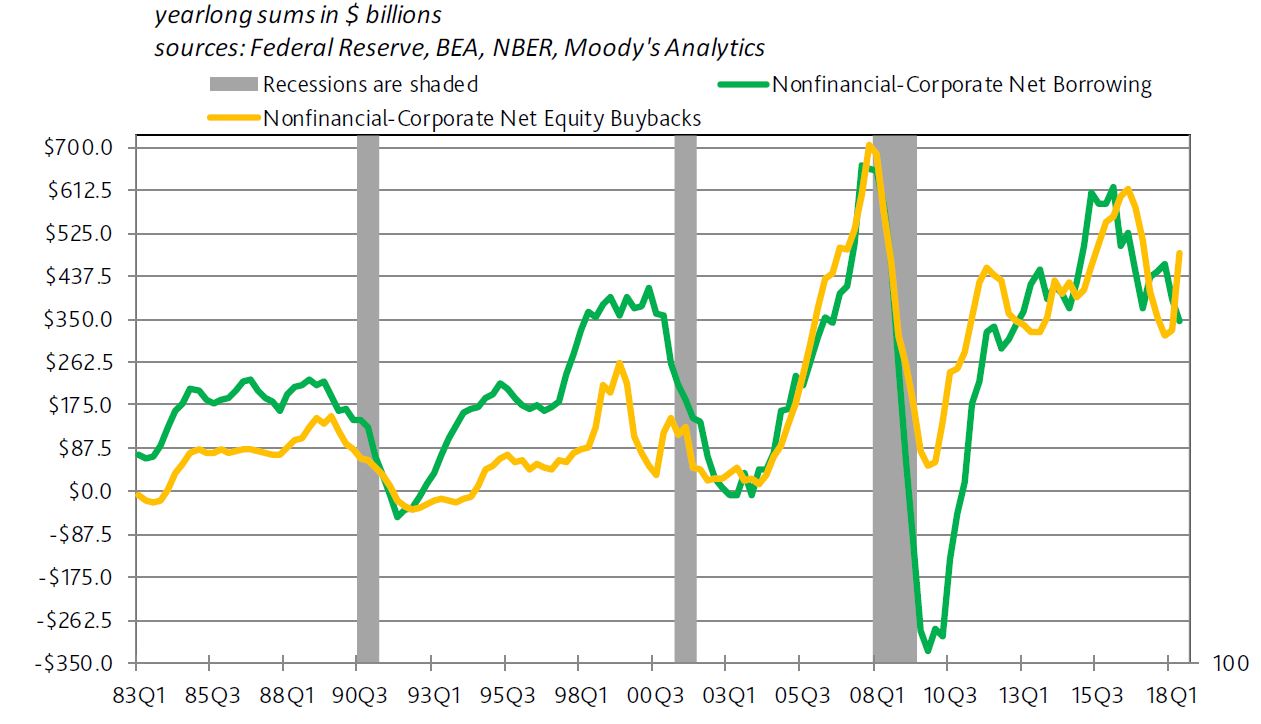
Now here’s the issue: American companies are most interested in profits. They want to make large net profits and pay their executives well, which they do by giving them stock options and in most cases juicing share prices by spending massive amounts on stock buybacks.


American companies are in the business of making whoever controls them rich. Sometimes they’re willing to make a long play and compete for market share, but generally ONLY if they think there’s a possibility of achieving a monopoly or oligopoly position. So there was tons of money for Uber & Lyft, because investors knew that in the end, they’d be able to reap monopoly profits, which they now are.

But in markets where there doesn’t seem to be that possibility, corporations are much less willing to compete aggressively for market share by beating the competitor on price. They prefer to compete in other ways: the third place, for example, or a product that is perceived as better and effectively “price clump”. If an upstart tries to break into an established industry they may briefly drop prices to keep them out, but that’s as far as they’ll go.

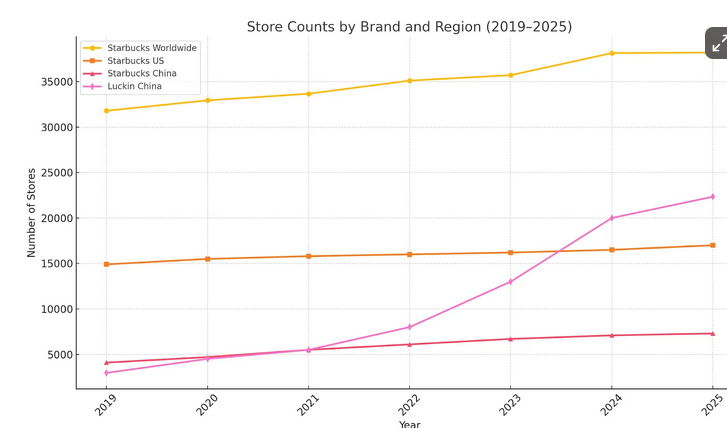
Now here’s the problem, Chinese companies compete aggressively for market share based on price. Starbucks used to be the player in the Chinese coffee house market. Then they had their coffee drunk by an upstart named Luckin. Luckin is opening about 10x as many stores as Starbucks. It has 16,000 stores to Starbucks 7,000, and its drinks, which include fancy ones, are about 30% cheaper. Starbucks definitely makes more per store, but Luckin makes more gross. There’s no “third place” about Luckin, they’re kiosks, you order your drink, usually thru your phone (which offers constant discounts) and pick it up.

Because they have massive scale, their unit costs are low, and they benefit from the usual “no one can beat the Chinese at scale” advantage. (Though Starbucks could have done the same, they just wanted to be a more luxury brand and get the extra profits.)

Gadallion goes into this in detail, if you want the nitty gritty, but this chart shows the speed of Luckin’s growth.


Now Luckin has come to America. The drinks are cheaper and Starbucks does a lot of pick up business. If you’re just going to pick up a drink, why not go to the cheaper alternative, assuming the drinks are about as good? And unlike China, American consumers are squeezed big time. (China’s 2nd and 3rd tier city consumers are doing well, Beijing and Shanghai consumers are currently under pressure from the housing bubble being smashed, but should recover in the next year or two.)

For now Starbucks has more stores worldwide than Luckin. But their unit costs are higher even now. If Luckin keeps expanding, and especially expanding in the US and S.E. Asia, Luckin’s unit costs are likely to keep decreasing.

It’s hard to see how this doesn’t end badly for Starbucks, unless they get Congress or Trump to intervene. There’s momentum with Starbucks: people are used to going there and keep doing so. But if there’s something cheaper, that’s about as good?

If they compete on price, they lose a lot of their profit margins and investors are already squealing about the minor drops they’ve recently experienced. If they don’t compete on price, Americans who are price sensitive and don’t need “the third place” move to them, and they lose massive amounts of volume. There’s certainly a niche and a fairly large one for “buy a drink and stay at the coffee shop to enjoy it”, and I suspect it’s pretty profitable, but it’s smaller than what Starbucks is right now, and what’s to stop Luckin, after it wins the price sensitive customers from opening “Luckin Luxury Cafes” or somesuch, offering actual premium drinks and comfy chairs and tables and laptop charging, and using their unit cost advantage to out compete the “third place” Starbucks?

This is a specific case of a general rule: Chinese companies want scale and compete on price. They’re like American businesses in the 50s and 60s. They offer value and they aren’t trying to maximize profits by maximizing prices, because they’re used to an economy which has actual price competition.

I used to spend a lot of time in Starbucks, because they had stores in book shops, and I’d buy a coffee and read books for a few hours every day. I’d still be interested in that sort of thing and I have some emotional fondness for Starbucks because of what are, for me, good memories.

But it’s hard to be sanguine about their future. The third place stuff is fine, but if they want to survive, they’d better start competing on price while they still have a size advantage.

Most US companies are in a far worse situation: they’re already smaller than their Chinese equivalents. They can’t compete on price, it’s not possible, because they don’t have scale economies and can’t get them. As China catches up in quality and in many industries surpasses, they’re toast unless protected from Chinese competition, usually by law, geography or trade barriers. Businesses which aren’t, however, are about to experience what other countries experiences when Coke and McDonalds, in the 80s and 90s, came to town, or manufacturers experienced in the 50s and 60s before the rise of Japan.

Developing countries, with lower costs, have an ironic advantage when it comes to survival of many businesses. But high profit, high cost countries like America and most European ones?

Toast.

***

I appreciate everyone who donates or subscribes to keep this site (and Ian) running. Readership is up over 40% this year, and I’m very grateful. If you want to help the blog, please share the articles you like and if you can afford it, and like the content, please Subscribe or donate.

Interregnum of Unreality 2008-???

By Nat Wilson Turner

I would like to propose that the United States and associated English language information sphere remain in what I call The Interregnum of Unreality, which I posit kicked off in 2008.

It’s tempting to declare us in a new regime, given Trump’s re-election and seeming consolidation of power, which has seen him bring the Silicon Valley companies and much of the MSM onside.

But I think it’s more useful to think of Trump’s second term as merely a change in management for the pre-existing apparatus of control, which seeks total information dominance via traditional and social media.

Until the pillars of American power (the dollar as reserve currency and the perception of American military primacy) fall, the Interegnum continues.

Symptoms include this and this.

And monsters flourish in interregnums. It was the interregnum between the Russian defeats of 1904 and the final fall of Nicolas II in 1917 that produced Rasputin after all.

Until or unless the United States openly goes through the financial crash, market crash, and admits we are back in recession (or Depression), The Interregnum of Unreality will continue.

The Interregnum of Unreality kicked off when Obama’s administration and Bernanke’s Fed elected to keep the markets and economy going via massive Quantitative Easing rather than structural reform of the markets that failed under Bush and Obama.

It was paired with a change in geostrategic tactics. No new boots on the ground invasions, although the Iraq and Afghanistan occupancies were maintained as long as possible.

Instead, Obama preferred no-fingerprints regime changes (Egypt, Tunisia, Ukraine, etc) or proxy wars  (Syria, Ukraine). He also happily accepted the Nobel Peace Prize for essentially not being GW Bush, even while continuing and expanding on many of Bush’s worst policies (surveillance, drones, etc).

A new era will also require the undeniable end of the United States’ pretense to be the global military hyperpower, capable of facing China, Russia, and Iran simultaneously while brutally dominating the Western Hemisphere.

Obama inaugurated a style of total information dominance completely removed from actual policies or outcomes. He built on the media strategies pioneered for John F. Kennedy: slick TV and print media packages with Obama as the inspiring figurehead.

They initially ran wild with social media, unleashing it on the Arab world in 2011 and rapidly realizing more control was required.

After Trump’s election win in 2016, Obama and the Democrats moved to set up a Silicon Valley censorship regime, sending RussiaGate ringleader Mark Warner to Twitter and other companies to let them know that if Adam Schiff wanted an account removed it would be removed.

The “Resistance” to Trump in his first term included much genuine grassroots opposition but was headed by resistance from the Deep State, the MSM, and the online monopolies.

Biden attempted to expand on the total information control, but since he was as charisma-challenged as Obama was blessed and the wheels came off of so many of his policies mid-term, the Democrats lost control of the machine along with their credibility.

Biden was Benedict to Obama’s John Paul 2.

The MSM and Silicon Valley have moved into Trump’s camp (or been bought and destroyed by Trump’s backers like CBS News).

I suspect one of the reasons for our Interregnum of Unreality is caution on the part of America’s major ops who don’t want to provoke a suicidal attack from the dying eagle.

The Interregnum of Unreality (2008-?) is one in which The Empire can suffer enormous, humiliating defeats in what is basically the WW3 preseason, but it cannot be openly, undeniably revealed to the populace of the US that we are no longer the world’s dominant military power.

It’s why pausing the 12 Day War was so critical. It was essential for everyone to temporarily de-escalate things before someone got nuked.

Now Bibi’s Qatar attack is another instance of possibly self-destructive overreach. Poor Ukraine is losing out on the narrative control as it’s slowly strangled by the Russian python, which has little interest in conquering territory and every interest in drawing the UAF into bloody battles that are slowly but surely demilitarizing Ukraine, their stated goal in the SMO.

In the aftermath of Charlie Kirk’s assassination, we’re seeing the Trump administration moving to expand its power ala the post 9/11 frenzy which produced the Patriot Act, mass surveillance, the Afghan and Iraq wars.

But because someone like Kash Patel has nothing like the control of the apparatus of state power that say, John Ashcroft enjoyed in 2002, we’re seeing a kind of keystone cops clampdown so far.

ICE is similarly limited to self-defeating debacles despite the much more capable Stephen Miller essentially having the funding to rebuild it from the ground up.

I argued at NakedCapitalism that this clampdown might not go according to plan, but I expect things to blunder along until one or both bubbles (economic or military) pop.

Autarky Sure Looks Good

So, Trump has decided to raise tariffs on India to 50% (who knows if he actually will), over their imports of Russian oil. Meanwhile:

Senators Lindsey Graham, a South Carolina Republican, and Connecticut Democrat Richard Blumenthal are the lead sponsors of a bipartisan bill which would impose primary and secondary sanctions against Russia and entities supporting Putin’s aggression if Moscow does not engage in peace talks or undermines Ukraine’s sovereignty.

The bill includes imposing 500-percent tariffs on imported goods from countries that buy Russian oil, gas, uranium and other products.

At this point all smart nations and blocs should be doing their best to reduce vulnerability to the US, to route around it and to move towards as much autarky as possible.

It’s notable that while China remains a huge trading power, the economic priority over the last eight years has been making all major industrial stacks domestic: ending their need for industrial goods from other countries and reducing their need for imports of resources. Where that’s not possible, they have shifted to reliable partners like Russia and Iran and various other nations in Asia, Africa and South America.

John Maynard Keynes was of the opinion that anything a country needed, it should make or grow at home if at all feasible. Price arguments are largely ludicrous, because if you don’t have vast exposure to trade or need to buy important goods overseas and you don’t allow significant currency movements outside your border, prices are largely a domestic matter. That is to say, they are a matter of policy. Government actions largely determine the price of goods and services produced in the country IF the country is capable of producing those goods and services itself.

Or, again, as Keynes said, “anything we can do, we can afford.” (The corollary is that anything you can’t do, you can’t afford.)

Trade dependency is foolish. It may be necessary in some cases, and certain policy choices require it, like export driven industrialization. But once you’ve got an industrial base, it becomes a choice.

If a country produces everything it needs, including reasonable luxuries, questions of employment become ludicrous. Just reduce working hours to 30 hours a week, or even 20, or institute an annual income. The idea that resources must be distributed thru jobs is, again, ludicrous. Once a society produces enough why not increase leisure? Why not encourage citizens to do art, write, study or even sun-bathe? Most people don’t have jobs they’d keep doing if they were independently wealthy. There is NO virtue to work that is not actually needed.

A trade structure which creates a vast web of interdependency doesn’t decrease the likelihood of war. The Europeans found that out in WWI: the pre-Great War world had vast amounts of trade, and it was argued that war between the Great Powers was obsolete: they would all lose massively. It was true that they’d all lose massively, and they still went to war.

All that too much interdependence does is restrain nation decision making ability, and, in democratic countries, the ability of politicians to actually do what their constituents want. (They often don’t consider this a bug, mind you. It’s nice to be able to say “we have to reduce taxes on rich people and corporations to be competitive”.)

Free trade is a bad idea for any country that isn’t postage stamp sized. If you can’t make it yourself, learn how. Trade for what you can’t grow or dig up yourself, and actually need. Eat seasonally.

This doesn’t mean “no trade”, it simply means managed trade and an emphasis on making as much as you can yourself.

Certainly no country which can avoid it should need to import food, and likewise and deep need to import energy is a huge weakness which can easily be used against you and which can lead to war. (This is the proximate cause of Japan attacking the US in WWII: America cut Japan off from oil, and they had to have it.)

This also leads back to our previous discussions on population levels and birth rates. A China with 1.4 billion people needs more imports than one with 600 billion people. An American with 150 million people is far freer than one with over 300 million.

As for defense, well, all real countries should have nukes and advanced missiles. It’s that simple. If you do, you’re a real country. If you don’t, you aren’t and are subject to easy blackmail by any great power.

Moving towards autarky is a worthwhile goal. In most cases it will never be achieved and full autarky is rarely a good idea, but getting close is.

(See also, “Ricardo’s Caveat”, because economists are wrong about comparative advantage in free capital flow systems.)


If you’ve read this far, and you read a lot of this site’s articles, you might wish to Subscribe or donate. The site has over over 3,500 posts, and the site, and Ian, take money to run.

JOIN OUR NEWSLETTER
And get new posts emailed to you once a day.

Page 1 of 3

Powered by WordPress & Theme by Anders Norén