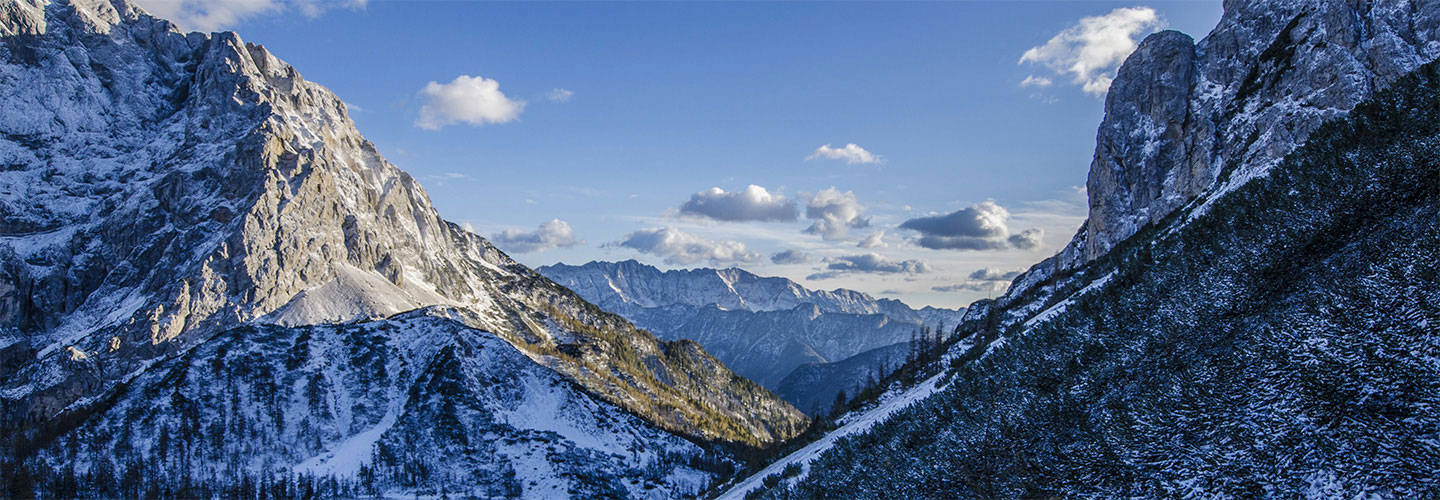
The horizon is not so far as we can see, but as far as we can imagine

Author: Sean Paul Kelley Page 7 of 13

'89-'93 BA History, Houston
'95-'07 Morgan Stanley, Associate Vice President
'99-'02 MS International Relations and Economic Development, Saint Mary's University
'07-'13 International Software Sales Manager, Singapore
'13-'16 MA, History, Thesis on Ancient Silk Road City of Merv, UTSA
Kelley lives in San Antonio, Texas.

“How Can You Not Be Romantic About Baseball?”

Fans of the Dodgers and fans of the Yankees–that would be me–know we are witnessing two of the greatest young men to ever play the game of baseball. But do the rest of you realize this? How rare and special this moment is? As we gouge out each others eyeballs over politics, let’s take a simple moment to celebrate two outstanding young men. Sound okay to you?

First I start with Aaron Judge, now entering the prime of his career, in a non-steroid era has already broken many outstanding records. In 2017 he became the first rookie to hit 50+ home runs in a season. He is the fastest player in MLB history to hit 300 home runs. And the fastest to hit and 350 home runs. He also broke Roger Maris’s single-season home run record of 62, without steroids. Personally, I believe that Barry Bonds, Mark McGuire and Sammy Sosa should all have an asterisk by their names and the footnote about it should be in all caps.

Judge is only one of four players, those players include Babe Ruth, Mark Maguire and Sammy Sosa, with four seasons of 50+ home runs. His rookie year, as I already wrote, he hit 50+. In 2022 he slammed in 62 home runs. He rocketed 58 home runs in 2024. And so far in 2025 he’s slugged in 51, counting tonight.

I’m a Yankees fan, but I also love baseball. I played the game from T-ball at 6 years-old well into high school. I never thought I’d see Godzilla in America but damn if he is not out on the West Coast right now. You do know I am talking about Dodger’s pitcher and hitter Shohei Ohtani, right? Simple fact: he’s probably the most amazing player we’ll ever see play the game. He’s just that fantastic. He electrifies crowd’s the way Michael Jordan did back in the day–and I saw MJ play several times.

Not since Babe Ruth has a hitter been such a dominant pitcher. That’s more than 100 years. Otani is simply unreal. This season alone he’s hurled 58 strikeouts and slugged in more than 50 home runs. No one has ever done that.

Last season, he hit more than 50 home, runs and stole more than 50 bases. That’s never been done. He’s created two new two clubs, one of which no baseball player will ever enter again. That was last season when he stole 50 bases and hit 50+ home runs. Judge, at 6’7″, 282 lbs., is an amazing hitter but simply doesn’t have the speed to steal bases like Otani, at 6’3″ 210 lbs., does.

Ohtani has something else Judge does not: a wicked pitching arm. He’s had 100 career starts on the mound in MLB and slugs like the Babe. He threw five no hit innings a few nights ago and yesterday threw 6 scoreless innings with 8 strikeouts. Unreal.

The only reason I post this is because I think that any baseball fan who’s reading this ought to take a silent moment of gratitude for the fact that we are witnessing two players unlike any we have ever seen in the game before. And also recognize that Shohei Ohtani is singular and unique, and we will never ever see his like play the game of baseball again.

To paraphrase, it’s just damn hard not to be romantic about baseball.

P.S. I’d be remiss, nay, negligent, if I failed to add The Big Dumper’s 60 home run season this year. We are truly witnessing baseball’s Golden Age. Only one non-Yankee in the American League has hit 60 homers in one season: Cal Raleigh, aka The Big Dumper.

If you’ve read this far, and you’ve read some of my articles and most if not all of Ian’s, then you might wish to Subscribe or donate. Ian has written over 3,500 posts, and the site, and Ian, need the money to keep the shop running. So please, consider it.

First Time Ever: Himalayas Breached By Monsoons

~by Sean Paul Kelley

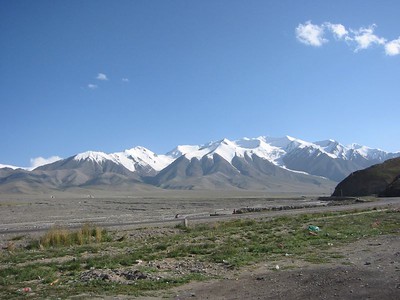
The Kunlunshan is the Chinese equivalent of the Front Range of the Rockies in Colorado, except they are much higher.

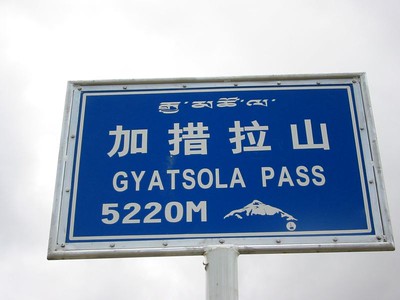
From time immemorial, even before humanity began writing, the Himalayas were never recorded as breached by a monsoon. During my trip across Central Asia in 2003 I traveled from Golmud, China to Lhasa, the provincial capital of Tibet–the moment we entered the Kunlunshan we were never lower than 10,000 feet (3,048 meters). On the second  leg of my trip from Lhasa to Nepal along the Friendship Highway I was never lower than 12,000 feet (3,657), often as high as 14,000 feet (4,267 meters). I passed through three passes of 5,000 meters (16,402 feet), higher than every mountain in the lower 48 states and less than 3,000 feet lower than the highest in Canada. In other words, Tibet is one serious rain shadow.

As I said, within the time humanity has kept records, both written and oral, this has never happened: a minimum of 4,925 years and a maximum of 50,000. Those 50,000 years include exactly zero notices of the monsoon breaching the Himalayas. This is a profound silence. Especially when considering the many verbal and written notices of a great flood across multiple pre-literate cultures. The monsoon actions that occurred in the last several weeks are a unique, unprecedented occurrence, although knowing what I know of rivers debouching out of the Central Asian mountain ranges, I will concede that the Great Flood myth could be based on a Monsoon breach. That said, Tibetan verbal and written traditions are eerily silent.

What exactly happened, then? The short answer comes from Climovo:

“This year scientists say the monsoon winds breached the Himalayan climate barrier and pushed moisture into Tibet. Experts at the Wadia Institute report (ETV Bharat) and analysis in Zee News show satellite images and weather maps that point to an unusual northward flow of monsoon moisture in 2025.”

So how did this happen? What climate changes caused it? I quote Climovo again:

“Two weather systems came together: the summer monsoon and a strong band of western disturbances. When they met over the mountains, the air was pushed and twisted in ways that let moisture ride over or through lower passes. Satellite analysis cited by the Wadia Institute and discussed in news coverage shows the plume of moisture reaching north of the ridge—something scientists call a breach of the Himalayan shield.”

What are Western disturbances? As Wikipedia notes:

“Western disturbances originate in the Mediterranean region in the Mediterranean Sea. A high-pressure area over Ukraine and neighbourhood consolidates, causing the intrusion of cold air from polar regions towards an area of relatively warmer air with high moisture. This generates favorable conditions for cyclogenesis in the upper atmosphere, which promotes the formation of an eastward-moving extratropical depression. Traveling at speeds up to 12 m/s (43 km/h; 27 mph), the disturbance moves towards the Indian subcontinent until the Himalayas inhibits its development, upon which the depression rapidly weakens. The western disturbances are embedded in the mid-latitude subtropical westerly jet stream.”

How many disturbances are we talking about? ZeeNews reports there were up to “[n]ineteen disturbances . . . five each in June, July and August and three more in early September.”

What’s even more odd is that “[t]hese weather systems are usually winter phenomena. (Emphasis added, spk.) They bring rain and snow to north India and the Himalayas in colder months. This year, they collided with the monsoon’s moist currents, pushing them further north [earlier].”

5220 meters of dusty road in Tibet on the way to Nepal.

I’d also note that there was a substantial drought in the Pontic Steppe of the Ukraine and Russia this year, leading to a lesser wheat crop. Drought is often caused by prolonged high pressure systems, at least here in Texas.

What are the results of this unique monsoon?

The torrential rainfall, says Reuters, is responsible for “killing 880 in Pakistan over the season while in India, nearly 150 people have lost their lives in August alone.

Moreso, in “India Punjab, 37 people have died since the start of August and the rain has destroyed crops across tens of thousands of hectares.” The destruction of crops, obviously has a knock-on effect of famine. Even worse, in Pakistan’s Punjab “1.8 million people have been evacuated in recent weeks after floodwaters submerged nearly 3,900 villages.”

There is much more damage to come, as it is August and the high Himalayan rivers are running at above capacity. Many rivers in Pakistan and India–Punjap, after all, means the ‘Land of Five Waters–expect flooding and more chaos as a result. More agriculture ruined. More famine. More suicides in the Indian countryside.  It’s simply devastating.

I’d also add that, because of the northward pressure on the monsoon, South India, like Tamil Nadu, the entire Deccan, and the Western Ghats got 48% less rain than usual from the monsoon season. More catastrophes soon to happen there.

Please check the links and this video (seriously, you need to watch this video–why? Because the comments are mostly coming from India and reporting in on the reality of the situaiton) if you want to more fully understand the rare, almost unique occurrence that happened this year. It’s just another data point, right? Not really,  it’s a serious anomaly that ought to rouse an immediate sense of urgency to act. Dangerous climate anomalies accelerate, continuing to pile up, higher and higher–no pun intended.

How many more until we act? My answer: serious hardcore sustained intense climate actions in the United States. Only then.

Hope it isn’t too late.

If you’ve read this far, and you’ve read some of my articles and most if not all of Ian’s, then you might wish to Subscribe or donate. Ian has written over 3,500 posts, and the site, and Ian, need the money to keep the shop running. So please, consider it.

Bad Faith and Criminality

~by Sean Paul Kelley

In the aftermath of the 1905 Russo-Japanese War, US president Teddy Roosevelt brought together negotiators from Russia and Japan to hammer out a peace. This was the first time the US was ever seen as an ‘honest broker’ in international relations. In 1919 President Wilson sailed to Paris with his 14 Points doing his level best to get the Europeans to negotiate an honorable peace. The wily Europeans outfoxed the rigid and moralizing Southerner in just about all the negotiations. Nevertheless, the US retained the aura of ‘honest broker’ until this century. I can’t say exactly when we lost it—probably when Colin Powell lied to the UN in testimony before the Second Iraqi War—but lost it we did. Somewhere in there we lost the aura of exceptional power we possessed by pissing away a metric shit-ton (yes, an American who can do metric!) of blood and treasure in the sands of Iraq and mountains of Afghanistan—and with that loss, we shot whatever credibility we retained right in the foot. But those, shall I say, are different discussions for a different day.

Lost auras being the one thing—at least we still got a chakra, right? (Ugly and poisoned though it may be.) It’s the second thing that grates the teeth at night: an everlasting chronicle of bullshit deeply eroding any sense of diplomatic norms that’s transfigured us into OG rogue nation. So, grab some popcorn, rewind the Wayback Machine and head back to 2014 cause I got a whopper to tell you.

It’s late summer of 2014 and a brushfire war is simmering between Russia and the Ukraine. The US and its European allies are eager to see the Ukraine join NATO. They bring Russia and the Ukraine together and pretty much force feed them the Minsk Accords. Then, over the course of the next eight years the NATO allies string the Russians along encouraging the Ukraine in its ever persistent demands to renegotiate the Minsk Accords.

Nota bene: yes, I write it as the Ukraine. I know the Ukrainians desire their benighted lot to be call Ukraine.

Do I care?

Not one iota.

It was always called the Ukraine—I mean, the Russians use the partitive genitive (don’t ask) when describing the Ukraine as a nation—and it will ever thus be called the Ukraine.

Now, it took the Russians—rarely gullible—a long time to figure out our stunning acts of “bad faith.” But “bad faith” it was. The US and its European allies had no intention of ever compelling the Ukraine to live up to its international agreements with Russia. They were only ever playing for time, waiting for the day they could present Ukrainian membership in NATO as a fait accompli, hoping for a démarche, a dénouement. Damned if we got war in its place.

But the forever-war nation ain’t gonna let a little war-war stop it, no, no, no! Once America sets a precedent it’s game on, bitches! So, in late May-early June 2025 the US negotiated directly with Iranian diplomats signaling that no military action was imminent. While negotiations were held, the US and Israel agreed on America logistical support for an Israeli attack on Iran. A week after Israel launched its first strikes against Iranian nuclear sites, the United States followed suit. Not only is this acting in “bad faith” it’s outright deceit, a line no nation should ever cross in the conduct of negotiations. It’s one thing to bring two sets of instructions to negotiations, one always needs a fall-back position. But deceit? WTF?

Twice then, the US has acted in “bad faith.” It’s at number three when the wise recognize a pattern, three also being proof of outright illegality in the conduct of international affairs, at least according to international and domestic law. So, there is that, you know?

Domestic law, you ask? How so?

“Young grasshopper,” says Master Po, “sit and I will tell you.” (Anyone who gets the reference wins a cookie.)

Treaties signed by the United States and ratified by the Senate are, in accordance with the 1920 Supreme Court ruling Missouri v Holland, the supreme law of the land.

Skeptical-like, you query, “what treaty did we violate, Sean Paul?”

Easy, the 1961 Vienna Convention on Diplomatic Relations. This treaty enshrined, in international and domestic law, a norm of diplomacy dating back 575 years to the city-state of Milan and its then ruler Francesco Sforza—a norm, or custom only violated three or four times in the last century it’s so sacred. So basic, so important is the principle of the personal sanctity of the negotiator, aka the diplomat, that it is respected by every nation on the goddamned planet.

It is the singular, fundamental law of diplomacy from which spring all the other elements of reciprocity evident in the conduct of international relations. And in typical American fashion, just days ago, we nuked that norm into oblivion when we in concert with Qatar and Israel arranged for an attack on credentialed Hamas negotiators.

I don’t have anything else to add except a few questions. Why would any nation enter into negotiations with us ever again? Who would be that stupid and reckless? And what, if anything, can ever be done to regain international trust? What I’ve detailed are fundamentally outrageous betrayals of diplomatic norms, norms developed over 500 years ago and used for centuries.

It’s not rocket sceince. Hell, it ain’t even algebra. Christ, it’s more basic than fractions. It should be easy to comprehend. And the behavior is so fucking counter-productive I would expect even the stupid to fathom.

I would be wrong.

P.S. And consequences,those things be bad, like ju-ju bee tree bad shit. Didnae take long, aye?

P.P.S. Oh, and by the way, this leads directly to the massive diversification away from petrodollar settlements, which gets us a fuckton closer to the end of the dollar as global reserve currency. That’s going to be one serious painful adjustment for Americans to make, domestic production notwithstanding.

If you’ve read this far, and you’ve read some of my articles and most if not all of Ian’s, then you might wish to Subscribe or donate. Ian has written over 3,500 posts, and the site, and Ian, need the money to keep the shop running. So please, consider it.

Unconditional Surrender Grant

I always wondered where the term ‘unconditional surrender’ came from during World War II. After reading a biography of U.S. Grant as an undergraduate in the early 90s I learned. When attacking Fts. Henry and Donelson on the Tennessee and Cumberland Rivers, respectively, when the commaders of the Confederate forts requested terms Grant replied,  “No terms except an unconditional and immediate surrender,” which earned him the sobriquet ‘Unconditional Surrender’ Grant–at least until the aftermath of the bloodbath at Shiloh.

Why do I bring this up? I just completed the Ron Chernow biography of Grant. As a work of popular history it’s good; however, Geoffrey Perret’s biography is much more rigorous and drips with historical sensibility. Still, credit to Chernow for a related reason: his biogrpahy led to a docu-drama miniseries about Grant. I cannot recommend this series enough. It’s also had the knock on effect of launching a much needed reappraisal of the man, the general and the president. Also, know this: I’m a born Southerner, native Texan. The Confederates were traitors. Grant and Sherman gave them what they deserved.

The “Lost Cause” revisionist history movement at the turn of the 20th century reframed the Civil War from a war to end slavery into a war about states rights. Moreover it did grievous damage to Grant’s reputation as a general and president and elevated Lee to divine heights. Both balderdash, mind you. But, the damage was done. Grant was the better general. He was a genius who conceived of operations and strategy two orders of magnitude greater than Lee. And, well, you know, there would be no 14th and 15th Amendments without a Grant presidency.  So, read Chernow’s book or watch the series.

Both will learn you some good knowledge.

If you’ve read this far, and you’ve read some of my articles and most if not all of Ian’s, then you might wish to Subscribe or donate. Ian has written over 3,500 posts, and the site, and Ian, need the money to keep the shop running. So please, consider it.

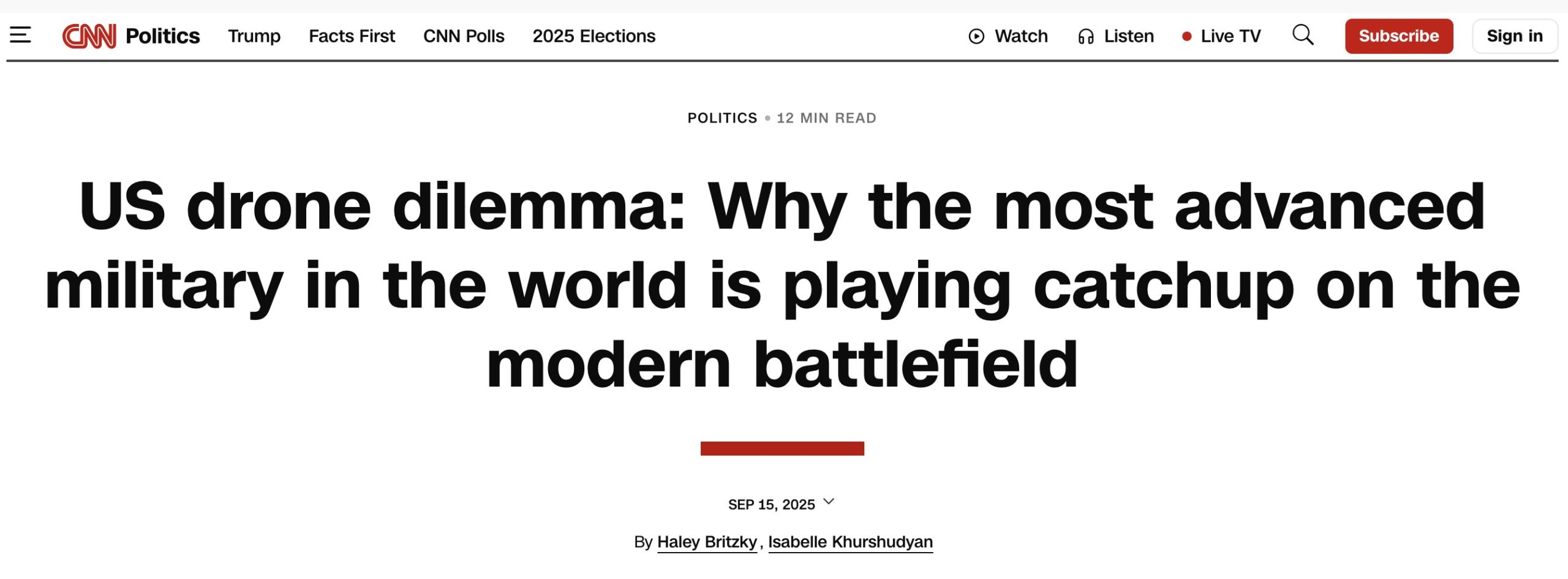
Care To Tell Me What Is Wrong With This Headline?

Screenshot

Link to article here. 

If you’ve read this far, and you’ve read some of my articles and most if not all of Ian’s, then you might wish to Subscribe or donate. Ian has written over 3,500 posts, and the site, and Ian, need the money to keep the shop running. So please, consider it.

Euro Proposal For A No Fly Zone in the Ukraine: the Consequences

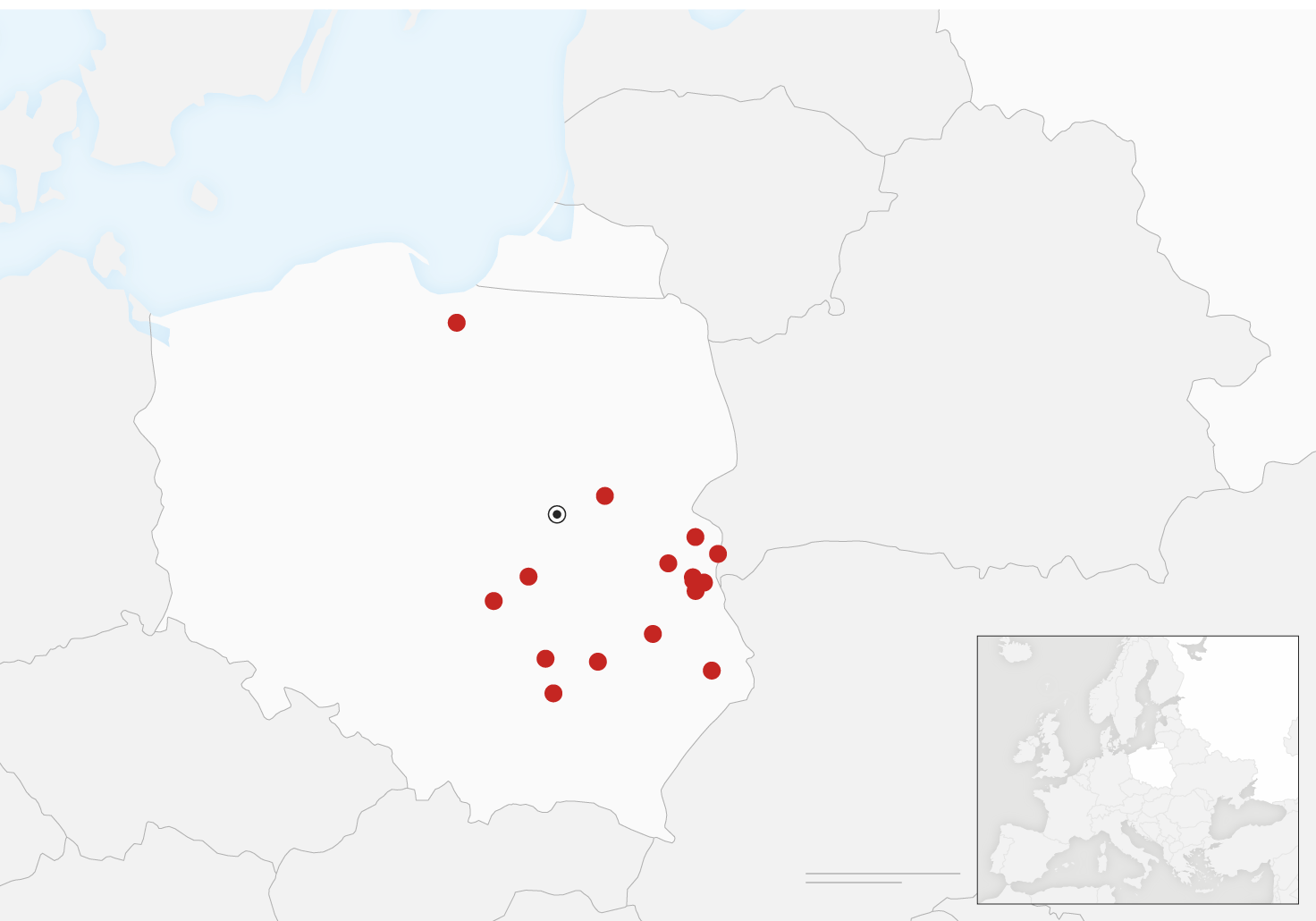
In the aftermath of several errant Russia drones crashing into Poland, said nation’s foreign minister, Radoslaw Sikorski, invoked Article 4 of NATO, and whilst giving an interview to a German paper, called for  “a limited, NATO/EU-run no-fly buffer for drones nearing alliance airspace.

Dmitri Medvedev, the former president of the Russiann Federation while speaking at a Russian Security Council meeting on Moday said that “Russia would consider NATO forces protecting Ukrainian airspace as a declaration of war. . . .

Russia, it should be added, asserted that “that “no targets on the territory of Poland were planned for destruction,” and that the drones it used in Ukraine have a flight range of no more than 700 kilometers (435 miles).” I would add the Russian first deputy Permanent Representative  to the UN made a very good point in an interview this morning. He asked simply, “cui bono?”

Cui bono notwithstanding, a lot remains open for interpreation, especially without the evidence being reported on seriously and assiduously. (Which won’t happen in the West.) That said, the number of drones that landed or were shot down in Poland is troubling. Look at this map for a better idea of what worries me. I’ve heard several explanations, from Ukrainian spoofing and EW warfare, to a false flag operation. Spoofing, EW warfare, cui bono or false flag–any others?–really doesn’t matter. It is simply bad ju-ju for all parties concerned.

Regardless of what really happened, are we absolutely insane?

Have our diplomats and leaders lost all touch with reality? If we declare and attempt to enforce a No-Fly Zone over the Ukraine we are declaring war on the Russian Federation. Declaring war on a nuclear power that could absorb a full force first strike by the USA much better than we could absorb their very robust response is as stupid as someone with brains for dynamite who cannot blow the wax out of their ears if their brains exploded.

Thank heavens for the brothers Lieven, one, Dominic, is an historian of empire, the other, whom I will quote below, is foreign policy analyst that writes frequently for the site Responsible Statecraft. Anatol is an adult in a childish firmament of foreign policy know-nothings, like Kaja Kallas. As one Russian observer said about her: she is critically undereducated. But back to Anatol, as he writes on the drones falling in Poland: “We should remember that during the Cold War, there were a number of far more serious violations of air space by both sides, some of them leading to NATO planes being shot down and American and British airmen killed. These incidents led not to threats of war, but careful attempts to de-escalate tensions and develop ways to avoid such clashes.” What a mature idea. I wish we had more adults in the room, so to speak.

The whole Ukraine debacle has only unravelled our power faster than if adults were running our foreign policy. And a No Fly Zone over the Ukraine is the height of childish, bat-shit crazy ideas. But then, we have not had an adult running our foreign policy since George Schultz left foggy bottom on January 20, 1989. I take that back, the last adult to manage our foreign policy was James A. Baker, who left foggy bottom on August 23, 1992. It has been unipolar willy nilly serially destroying nation after nation ever since.

It has got to stop. I just fear how it ultimately will stop.

If you’ve read this far, and you’ve read some of my articles and most if not all of Ian’s, then you might wish to Subscribe or donate. Ian has written over 3,500 posts, and the site, and Ian, need the money to keep the shop running. So please, consider it.

Four Randon Econonic, Political, Geopolitical and Scientific Musings

First economic: The US dollar is down 5% over the last six months against a basket of currencies. And over the past year, it’s lost 9.6%. The biggest winner against a dollar has been the euro which has gone up 13% however, which truly is a win for Europe because it makes their natural gas imports from the US less expensive. But their natural gas imports are still a poison chalice. Expect the dollar to continue its slide, perhaps precipitously at some point in the New Year.

There were large moves out of US equities in the spring confirming the adage “sell in May and go away.” What September will look like is anyone’s guess, especially as Israel is more than likely to start the second phase of its war against Iran? Or October—that worst of months for Wall Street? What happens if Iran closes the Straits of Hormuz and oil goes above 100 dollars a barrel? That would be great for oil producers, but it would be terrible for markets across the globe, even China, possibly leading to a worldwide recession, especially with Chinese growth being somewhere between 4% and 5% at present.

Regardless of what happens in September or October—both always being bad month’s economically for the US economy, America’s bond market and the value of the dollar will continue its downward trajectory because America’s lenders are now demanding gold for loans instead of treasuries. This smells to me like the beginning of the end of dollar hegemony.

It makes me wonder what kind of “store of value” the BRICS will adopt to support their currency? Will it be a basket of their currencies? Will it be backed by gold and petroleum? That would be truly hard-core, because it would mean we were in for a long era of tight money. Our entire lives, actually, the entire history has been based on easy money. And as you know money creation is only possible when using a fiat currency.

There are many ways to imagine what they’ll do. Maybe blockchain? Who really knows? But there are other commodities that do have a store value, silver among them, maybe even rare earths and others they could use. It certainly is an interesting time to live.

Second domestic political: Niall Ferguson in his interview by Charlie Rose posted a week ago on the Internet was asked about Trump‘s challenges of outright ignoring the constitution with the following question: are we the Roman Republic, is this or are we witnessing the collapse of the constitutional order like the Roman republic. Rose asks if Trump is Augustus. He clearly is not. I would say that Trump is more like Marius and the Kennedys were more like the brothers Gracchi. In fact, I made this argument on a graduate school paper that I got a very good grade on, but in which my professor seriously disagreed with my analogies. Regardless I would say that we are at the beginning of the end of our constitutional order, and that we are looking down the barrel of Caesarism. It’s on the way. Maybe two years, maybe four years but it’s coming. Will it be a general? Will it be a politician? Those are questions we simply can’t answer. But as Ian Welsh has consistently predicted America is heading for a collapse, be it constitutional or economic or both it’s gonna happen and there isn’t anything anyone of us can do about it. Besides, Ferguson, while whip-smart, is kind of a tool.

Third is about some weaknessess the SCO currently must contend with if they are to become the anti-NATO military block. Here they are in no particular order of importance: One, the nations that make up the SCO are too diverse and often times their interests do not align with everyone in the SCO. For example, China and India have serious border issues. Pakistan and India have serious issues in Kashmir. Those are just two examples of several potential conflicts between members of a block, supposedly to oppose NATO. The issues between Pakistan and India make the intra-NATO issues between Greece and Turkey look like a family arguement on Thanksgiving.

Second, as the former director general of Russian international affairs Council said in a recent interview, “ the mandate of the SCO is too general.” The SCO can focus on security, development, or terrorism. Not all three.

Third, China is by far the most powerful member of the SCO and that creates a dangerous asymmetry in the organization. Much like the United States dominated NATO for so long and skewed it’s purpose after the Cold War for its own unfathomable means.

Fourth: This essay on the relative merits of “Superradiance,”.  Is well worth the three minutes it will take to read, plus it is comprehensible to the layman. The essay describes Superradiance as “a collective quantum optical effect in which a group of emitters, such as atoms or molecules, emit light in a highly coherent and amplified manner.  In the context of mammalian neural systems, superradiance occurs when a group of neurons collectively emit photons, resulting in a stronger and more coherent signal compared to individual neuron emissions. This coordinated emission of photons across vast networks of microtubules within neurons could potentially achieve the long-range coherence necessary for the emergence of consciousness.”

The essay stands as a correction of sorts to Sir Roger Penrose’s “Orchestrated objective reduction (Orch OR)” theory of human consciousness, which Wikipedia describes thusly: Orch Or “is a controversial theory postulating that consciousness originates at the quantum level inside neurons (rather than being a product of neural connections).” In short, says Penrose, “Consciousness does not collapse the wave function; instead it is the collapse of the wave function that produces consciousness.”

One thing we do know is that consciouness is decidely not computational and most likely occurs in the quantum realm.

As you can tell, I dig this kind of stuff.

If you’ve read this far, and you’ve read some of my articles and most if not all of Ian’s, then you might wish to Subscribe or donate. Ian has written over 3,500 posts, and the site, and Ian, need the money to keep the shop running. So please, consider it.

Come and See: A Belarussian and Russian Film On The Partisan War In 1943

I just watched the first half of иди и смотри, in English, “Come and See.”  I had to stop. It was just too much. It’s not like the first 25 minutes of Saving Private Ryan, it is random, crazy, evil violence committed on peasants who are not really supporting the partisans.

This rarely happens to me, but on minute I smiled, the next I wanted to wretch, and the next I got misty eyed.  I’m attemping to watch it in the original Russian but it is hard because it is in essence peasant Russian and their accents are pretty damned hard to unpack at times so sometimes I have to rewind and turn the subtitles back on.

I was told by a dear Russian friend–who lives in Russia–that Come and See captures the wanton brutality of war in its essentially random nature.

I can not say yet as I reccoment this film from 1987–that was damn near shitcanned by Soviet censors and I can understand why. It is harsh, beautiful, tender, cruel and arbitrary in equal measures. If you have the stomach, go ahead but be warned.

More when I finish.

If you have seen it, please share.

If you’ve read this far, and you’ve read some of my articles and most if not all of Ian’s, then you might wish to Subscribe or donate. Ian has written over 3,500 posts, and the site, and Ian, need the money to keep the shop running. So please, consider it.

Page 7 of 13

Powered by WordPress & Theme by Anders Norén