Use to discuss topics unrelated to recent posts.
Author: Ian Welsh Page 121 of 437
A couple years ago I read “The Dawn of Eurasia” by Bruno Macaes. Macaes was a member of Portuguese government, very neoliberal and fairly awful while in office, but his book proved quite insightful in most areas outside of Russia, where what seems to be fear and contempt for Russia distorts his vision. (I thought this when I read it before the Ukraine invasion.)
He’s most worth reading about Europe and the EU, and one example and one passage particularly struck me at the time.
This is the formula for accepting immigrants during the refugee crisis.
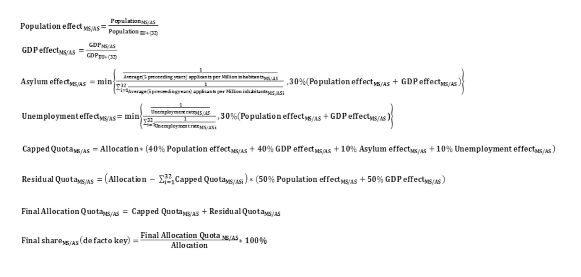
Macaes writes:
I was reading the account of the meeting in my office when it suddenly hit me. The European Union is not meant to make political decisions. What it tries to do is develop a system of rules to be applied more or less autonomously to a highly complex political and social reality. Once in place, these rules can be left to operate without human intervention. Of course, the system will need regular and periodic maintenance, much like a robot needs repair, but the point is to create a system of rules that can work on their own. We have entered the end of history in the sense that the repetitive and routine application of a system of rules will have replaced human decision.
Maçães, Bruno. The Dawn of Eurasia (p. 228). Penguin Books Ltd. Kindle Edition.
Weber famously called bureaucratization an iron cage: rule by rules and not people, everyone in the same circumstance was supposed to be treated the same, and who the bureaucrat was didn’t matter: once the rules (in modern terms, the algo) had been set up, the human was just a piece of machinery.
It’s for this reason that technocrats love computers and algorithms so much; they make it almost impossible for ordinary humans to override the rules.
Many years ago I moved from Ontario to BC. My Ontario health care coverage was ended. I applied for BC coverage, but then, unexpectedly, I returned to Ontario. I had no coverage. I went to the provincial health office in person, told the person at the desk, they summoned their boss and it was explained to me that there was a six month wait, but they would fix it.
How? The only way was to finangle the system so it thought I had never stopped having Ontario coverage. There was no human discretion, just a flaw in the system which allowed them to do something they really shouldn’t have done. (This is over 30 years ago now, which is why I feel free to mention it.)
If they hadn’t, I’d have had no coverage anywhere in Canada and I was extremely sick and needed health care right away. (Which is probably why they did jiggle the system.)
The idea of bureaucratization was a good one: previous to that offices had been filled by people with a great deal of latitude, which many of them abused to help their friends and family and to enrich themselves. Even when they didn’t abuse the office, they were inconsistent, and no one knew what the rules really were and thus couldn’t plan. As Weber points out repeatedly, you need calculable law and administration to allow modern capitalism. Decisions don’t necessarily have to be good, but they do have to be consistent, or you can’t plan and one unexpected decision can destroy your business.
We moderns will note that the promise of bureaucratization hasn’t really worked out: it’s been subverted. The rules are made and somehow they always favor the rich.
The law, in its majestic equality, forbids the rich as well as the poor to sleep under bridges, to beg in the streets, and to steal bread.
—Anatole France
Now, the law has always favored the rich, but the idea of bureaucracy combined with democracy was that it would do less of that. In some time periods it did, and does, but in most all it did was change the type of rich it favored, moving from aristocrats and clergy, to oligarchs.
The EU, however, firmly believes in bureaucratization, as Macaes notes. It is what is good. The rules exist, they are followed, humans intervene only to set up the rules and occasionally tweak them, but otherwise it’s a big machine algo, and it runs like that. If it hurts or harms someone, so be it, it is fair, because the rules are being followed.
Macaes has a lovely little anecdote about Brexit and immigration which highlights the issues:
I particularly remember a conversation in Manchester with Ed Llewellyn, David Cameron’s chief of staff, where we tested different ways to reduce immigration numbers, some of them quite feasible. This was during the renegotiation process leading up to the referendum. Llewellyn seemed hopeful for a moment, but then shook his head: ‘These are ways to reduce the numbers. What we need are ways to increase the feeling of control.’
Maçães, Bruno. The Dawn of Eurasia (pp. 231-232). Penguin Books Ltd. Kindle Edition.
What the Brits wanted, in other words, was to have humans regularly making decisions, rather than one algo set up by a committee making the decisions, even if the algo was more favorable to them. Basically, can the Prime Minister or the Home Secretary decide how many immigrants come in? No? Then forget it.
It seems to me that the algo-ing of government, the bureaucratization, is a good thing up to a point: people should be treated about the same in the same circumstances. But as a practical matter, bureaucratization, the iron cage, is used to elude responsibility. “The algo did it!” or, “That’s what the law says!”
Every algo was created by people, and while there are sometimes unforseen effects, what the algo does is the responsibility of people. If it is producing injustice, or poverty, or massive inequality those who created it, or those who are letting it run are responsible.
The more you hard-code an algo, and take people out of its implementation, or create systems which force people to become machines unable to make exceptions, the more the dead hand of the past rules the future, and the more that the few people at the top rule everyone else. When middle and low level bureaucrats can’t actually make decisions, injustice inevitably occurs because virtually ever law or algo has blind spots: events and circumstances it did not and cannot deal with.
The evil of three strikes laws and mandatory sentencing, for example, was meant to prevent the evil of judges using their judgment to let people people off if there were mitigating circumstances. Sometimes that discretion was misused, and it would be a big story, but even more often there would be a case of someone’s third crime being stealing a bicycle or a banana.
The ultimate problem is that there’s no getting away from the fact that humans have to make decisions about humans lives. Even if we wound up in a Wall-E world, served by machines, those machines’ initial programing would have been created by humans.
The principles that exceptions need to be made and that humans need to have some control, and that over-bureaucratization removes low and middle level control don’t change the idea that people should be treated equally in the same circumstances. Provincial laws didn’t intend for any Canadian to not be covered by some provincial health care plan; the algo; the rules, had a gap, and a low level bureaucrat could make it work, at least back in the early 90s (today, who knows?)
The same is true at higher levels. There is no escape from human judgment. Attempts to bind everyone with trade deals which are immune to popular sovereignty; with treaties, and to have secret courts and central banks and so on, are all ways to try to avoid responsibility for results.
The problem with our societies is that elites aren’t held responsible for the harm they cause, nor, by and large for any good they do. We have elections without being democratic, because the feedback systems are broken.
All that has happened with bureaucratization, is that the rich still get taken care of, and the poor still get fucked, and it’s done in a way that seems “fair”.
“The algo said” is just a modern version of the “the law says” and it’s just a way to disempower almost everyone while making sure power and money are concentrated at the top.
Any algo or law which doesn’t allow for human discretion to override the algo, with a review mechanism for people who do it often, will do more evil and prove more anti-democratic than even venal spoils systems, which at least don’t pretend that office-holders and other powerful people don’t make decisions and aren’t responsible for their results.
As long time readers know, Randall Collins is a sociologist I admire.
One of his books is Macrohistory: Essays In Sociology of the Long Run. The second chapter is a theory of the rise and fall of empires. It’s this theory which Collins used to predict the collapse of the USSR in advance.
Principle 1: Size and resource advantage favors expansion. Expansion and resource advantage includes satrapies and alliances. So Canada’s resources are America’s and so are Europe’s and Japan’s and Australia’s and so on. Athen’s “allies” resources were Athens’, etc…
Principle 2: Geopolitical or “marchland” advantage favors expansion. This means you want to be on the edge, in the corner of the map. Think Rome, on the edge of the Greek world. Russia on the edge of Europe and, indeed, America on the edge, and having no real enemies nearby.
All seven unifiers were from marchland, the central states always lost.
The history of Europe in the 20th century was war between central powers (and the old marchland, Britain), leading to exhaustion and then conquest by the two European marchland states, dividing Europe between Russia and the US. Americans had massive garrisons and overthrew governments who tried to resist them in Europe; they were occupiers just as were the Soviets.
The advantage here is the classical one of corner positions: you don’t have enemies on every side. Russia became a great power largely by having gunpowder weapons and expanding against people who didn’t, while having to defend only one border against European nations. America, likewise, but with very little real risk from advanced nations once the revolution was gone (Canada was too sparsely populated, and Mexico/Spain were in radical decline.)
Principle 3: Interior states tend to fragment when not conquered by marchland states. Collins gives examples, “this happened in China during several interdynastic periods, in Kievan Russia, in the Balkans after the decline of the Ottoman and Austrian Empires, and when the medieval Holy Roman Empire fragmented in the kleinstaaterei of Germany and Italy. Fragmentation occurs because interior states become militarily weakened states incapable of controlling secessions.
Basically, you’ve got potential allies and enemies on every side, and you tend towards balance of power politics and defensive postures. Even though central states tend to be on rich land, needing to defend against so many possible enemies leads to exhaustion, and they can’t handle revolts. Alternatively, though Collins doesn’t mention it, you can have self-disarmament in a successful balance of power regime, such as happened in the EU and if someone decides to take advantage of it, it may be too late to rearm.
Principle 4: Cumulative processes bring periodic long-term simplificiations, with massive arms races and showdown wars between a few contenders.
The first three rules lead to a couple large states becoming powerful (or putting them into alliances that amount to the same thing, as with Athens and the USA), then those two powers have a showdown. Sometimes it’s two marchlands who have conquered central areas (as with the USSR and America), sometimes it’s a peripheral state versus a central state which has conquered other central states (Britain v. Germany or Britain v. France), and sometimes to it’s a marchland just conquering the center as with the Mongols and China (though the Mongols conquered the Arab/Muslim center as well.)
These periods generally have huge arms races and buildups, which may or may not go to a showdown war. The US and USSR did not have their showdown war, but Athens and Sparta did. The competition, even if it doesn’t go to war can lead to both parties essentially losing, as with Germany and Britain in the two world wars. Britain’s “victory” was the loss of their empire and almost all their power and slow long term decline from that point as a manufacturing power, winding up a financialized satrapy of the real winner, the US.
The collapse of Britain, France and Germany allowed the US and the USSR to expand into what amounted to a vacuum.
Principle 5: Overextension brings resource strain and state disintegration.
Collins writes “the further military power is projected from the home base, the higher the costs.”
It’s this that made Paul Kennedy in his “Rise and Fall of the Great Powers” think that the US was due to collapse. He was right, but what he didn’t see was that the USSR was under even more resource pressure, and had a smaller resource base. Remember that Nixon going to China turned Russia’s eastern border into a real worry, and they had to move large numbers of troops there and keep them ready for a potential war. Combined with the Warsaw pact and allies having less resources and people than the US, NATO and other allies and Russia was under more resource strain than the US with its widespread bases.
The odd thing here, as Kennedy showed, that empires expand and get more resources, but the cost of getting the resources expands faster than the resources gained.
Though Collins doesn’t discuss it here I’d say there are other processes. Empires tend to ship their production to the provinces. They financialize. They have inflated real-estate and other prices which drives out real production (Spain and the treasure fleets is the extreme example, but it can clearly be seen in 20th century America and 19th century England, and I bet it was visible in Periclean Athens.)
Concluding Remarks
These are the five principles of Collins basic geopolitical model. They were used to predict the collapse of the USSR, in advance, and they backfit quite nicely onto a large number of civilizations’ history.
One might wish to extend this to the current situation, evaluating China and its junior partner Russia in their conflict against the West. Who has the size and resource advantage (resources in the modern world include manufacturing capacity and tech). Which has more of a marchland advantage? (Remember, if the US feels it has to defend something, the mainland advantage only partially applies, and then there’s the question of hypersonic missiles and so on.)
I don’t see an interior state fragmentation process going on that matters, but maybe I’m missing it?
Is there an arms race going on? Will it lead to a direct war? Who will use less of their resources to maintain that arms race while remaining militarily viable?
Who is more in overextension? The US and allies or China and Russia?
I may write an article on this, but I think most readers can work thru it themselves and will find it more valuable to do so than to read me doing it.
By Marcus Gardner (not by Ian)
There was a time in my life when I believed with certainty that I was going to raise my child in a small village of other parents, single people, elders, and children. The toddlers would look up to the older boys and girls, and they to the teenagers, and they to the young singles, and so on and so forth. The kids would mostly watch each other, learning in the daily ebb and flow of successes and failures, play and conflict, that is – from my observation and experience – a far richer learning environment than any human-created institution. And, because these kids would be at home in their community nearly 24/7, they’d see what their parents did – woodwork, gardening, harvesting, fishing, and hunting wild foods, fixing technology, auto repair, counseling one another, and raising their children – these kids would naturally gravitate to what their role is, and not just in the sense of what they wanted to “be” when they grew up, but who they “are.”
Today, my wife and I are raising a toddler as nuclear parents and are trying, with no little effort, to put off sending her to school. We’re looking for the right community, or at the very least, the right kind of free school/forest kindergarten that won’t break our little girl’s spirit. While we, ourselves, try not to break her spirit, which is pretty fucking hard if you’ve ever spent much of your day with a toddler, day after day. My moral compass with regard to children is rock solid, but I can still understand how tempting it must seem – especially when you haven’t had the right training and experience – to result to shaming, to indoctrination, and, ultimately, to institutionalizing your kid, all under the guise of “it’s for their own good.” When it’s really just your own cope.
I saw a quote in Reddit the other day saying something to the effect that children are the largest oppressed class. Their concerns are not taken seriously. They’re given no meaningful way to contribute. And they get shuffled between institutions, kept occupied with busy work. I couldn’t agree more.
What I learned from all my time with kids is that you’ve got to trust them. They can’t really help but tell the truth (even if they’re lying.) Children, especially young children, don’t have the artifice that we adults have. They’re not satisfied to simply rationalize their hurt and pain – they actually want to stop it, quell it. So I listen to them, and extend myself not just beyond my own assumptions and personal convenience, but beyond our culture’s. Because this culture was not designed for the needs of children (nor for the real needs of adults, of course.) And to hear a child – to really hear them – I’ve got to question this whole crazy superstructure that we’re trying to cram our lives into.
So when my two year old daughter is giving us hell, or just being a pain in the butt and I can’t get x, y, or z done, I ask myself: why is this happening? Because, despite the “wisdom” of my baby-boomer parents (“let her cry it out,” “put her in a crib in the other room,” “teach her manners,” “stop nursing already”) I actually trust this little girl more than anyone else. She’s telling me something’s wrong.
Is it because we’re too isolated right now? Does she need more older kids to show her how to do things? People she wants to follow around and copy, instead of her parents correcting her, yet again? Does she need my wife and I to be have more integrated lives, rather than juggling work schedules and “blowing off steam” and/or working on our own projects, (projects we hide from our daughter so she doesn’t mess them up?) Does she need something more real than another day in the house with her books and toys, or another playdate at a playground designed to keep her busy?
And it’s hard. Because of course she needs all of those things, and we fall short in so many ways, even though we do, at least, take her seriously. But our abilities to trust and include her as much as possible is limited, because we’re largely nuclear, isolated individuals. Our lack of a real social support net leaves a lot out.
When I think of sending my daughter to school, either so my wife and I can have more “adult time” to get work and get stuff done, or so our daughter can get more time around other kids, or simply to get away from needing to deal with her, I’m terrified at how fast the change might happen.
Right now, with the acceptance and love she receives from my wife and I, she’s maybe half full. Maybe a bit less, as she went through chemotherapy and was given a potentially lifelong disability as a result of spinal surgery at 1.5 years old.
But take her away from mom and dad’s acceptance, put her in a room (or even outside,) watched over by another adult as that adult tries to corral another ten kids. I know what it’s like; I was a Montessori pre-school teacher for a while. With so many same aged peers, the power struggles will quickly ensued, and, despite however well-intentioned the teachers are, a pecking order will be established. Even if (and that’s a big if) the teacher doesn’t resort to shame, the children, in their desperate situations, will. And many if not most of them will have become adept at shame even at the tender age of pre-school.
Tell her it’s going to be like this for fifteen years.
How long would it take to empty the bottle of my daughter’s soul in this way? Six months? A year? And how long until it’s filled with the fuming poison of shame, competition, needing to be “good” to be loved – by teacher, by friends, by Instagram?
How long – and I’m not just finger-pointing at school here, but at our whole cultural package – until she’s a Molotov cocktail? Because without an engendering community to grow up in, to get to know herself in, to get to know healthy relationship within, how could she ever become anything else? Long before she throws her graduation hat in the air, she’ll have learned – with the help of her school, her peers, experts, and the media – that to be a good participant in our zero sum society she not only has to win, but she has to learn to manage the pain. Being “good” only means that you’re good at procuring something to sooth the poison inside you. That’s the goal: functional addiction. Inner Pepto Bismol. And all the better if you can multitask and make noise about how you’re the one with the answers to other people’s and/or the world’s problems, while ignoring and medicating your own.
And despite our hand wringing about gun control, mental health, or how we’re giving our kids the “right” values, some of these Molotov cocktails run low on their Pepto Bismol. When they look around, they see everyone clamoring for the limelight, to make a statement, to be known and seen and given a place, and they think: “Better to be an anti-hero than a nobody.” But their poison and emptiness is the same as yours and mine.
Some time back I read a book called The Foundations of Early Modern Europe, 1460-1559. One thread I picked out as particularly clear was their explanation of the effects of gunpowder.
The first bit is what as known as pike and shot. Early gunpowder weapons were slow and inaccurate. But late medieval pike units had already changed warfare: not only could they withstand charges from knights, but they figured out how to charge themselves. Still, they weren’t as fast as knights, and there were ways to deal with them.
Pike and shot was the innovation that broke knights completely: early firearms would blow right through armor, and pikemen could protect the arquebusiers. Pike and shot units slaughtered knights.
The second issue is that gunpowder, or rather artillery, made medieval castles obsolete. Artillery enabled the conquest of both Normandy and Constantinople.
Thirdly, gunpowder at the beginning was very expensive. It “royalized” warfare, nobles couldn’t afford it, kings could, and they used it to destroy the independence of the feudal nobility: knights weren’t the dominant arm any more, castles couldn’t withstand sieges, and nobles couldn’t afford to upgrade their men to the new armaments in enough numbers.
The irony here is that gunpowder also “proletariatized” warfare: peasants could use guns just fine, without much training and pike work, while skilled, didn’t require the training of a knight. It was said that to truly train as a knight you had to start as a child, but a gunner or pikeman could be trained in a few months.
The result of all of this was larger armies, the breaking of the independent feudal nobility as independent military forces, and thus centralization. The full on absolutism monarchs like Louis the XIV “l’estat c’est moi” came later, but it’s this early process of gunpowder breaking the feudal nobility which allowed them to centralize power and turn the nobility into court aristocrats.
The loss of the nobles true source of power and their reduction into aristocrats (whose influence relies far more on their relation to the monarch than their own power) allowed for the rise of the early bourgeoisie. Feudal nobles had power because they had military force, and power trumped money, but as they lost that and as armies became much more expensive, money became a source of power all its own. Kings needed a lot of it to field the new armies, and the bourgeoisie had it. As a result a lot of bourgeoisie became nobles themselves, since owning land still had much more prestige than being a merchant, but over time it led to power moving away from the nobles, now an aristocratic courtier class, and to those with the money and that led rather directly to events like the English civil war and, later, the French revolution.
For those kings in-between, gunpowder must have seemed like a godsend: allowing them to break the troublesome nobles and centralize power, but it was a devil’s deal for them. The old feudal system was reasonably stable because knights were the decisive military arm, and knights and nobility were wrapped up together.
Once it was the king alone, surrounded by courtiers who had no real power themselves, but were parasites on the court, the days of Kings, too, were numbered.
I was born in 1968, the year Wallerstein calls one of “world revolution”. It was a revolution that both failed and succeeded: women and minorities got more rights, often a lot more, but the end result was an oligarchy, where most people were equal in their lack of power, and where every year saw ordinary people becoming poorer, no matter what the official statistics claimed.
The 70s were the heyday of environmental possibility: everyone understood the stakes, and it seemed for a time that we would act.
President Carter famously put solar panels on the White House, and President Reagan famously had them removed.
And really, that was that. A lot of people fought, and fought hard, to stop environmental collapse and climate change, but really it was all over when Reagan and Thatcher took power and neoliberalism came to the fore. The ideology simply did not, could not and would not care about something so far in the future when there were rich people to make richer.
The larger point is that climate change is baked in. It’s going to happen, it’s going to be very bad. Numbers are hard, but I expect billions of climate refugees over the next 60 years, at least a billion dead, and probably more, and the collapse of multiple countries into anarchy and warlordism while most of the rest become poorer.
There are those who call this “doomerism”, but it’s simply a matter of facing the facts as they are. We are increasing drilling for oil and gas, not decreasing it. Animals and plants are still dying off; the Amazon is almost certainly past the tipping point for viability and is now producing more CO2 than it stores, while everyone know the Great Barrier Reef is doomed. In India we have ground temperatures in the 50s and 60s in May and the government has made it illegal to export grain.
There’s no stopping this. We will only act decisively when it is far too late. The glaciers will be doomed, etc, etc.
So, the question is what to do?
The answer is to stop pretending it isn’t going to happen and to prepare for it. We know there will be less water. We know there will be more heat. We know that weather will be more extreme, with more and more powerful storms and more rain in many places. We know that there will be marine inundations in low lying coastal cities. We know that we will lose our commercial fisheries. We know that far fewer areas will be suitable for agriculture and that most of those will be less fertile than they are today.
And so on.
We need to prepare for this. Start building the seawalls and the desalinization plants and so on.
Those who are concerned with the political future should understand that what will matter is who survives and how well. If a group you approve of survives disproportionately well, in both numbers and quality, they will have power in the world to come.
It’s no longer about some version of “save everyone”, it’s about “who will be saved, and how well will they be saved.”
You are going to have to make decisions: you are going to have to choose who you want to help live and maybe even prosper, and who you’re washing your hands of; who you’re going to let die, or maybe even give a shove. (I’m in favor of giving our elites a shove when the time comes, we don’t need the psychopath faction around.)
For a long time we’ve lived in a world where if we gave a damn we could have easily fed and housed everyone and given them healthcare. We didn’t, since psychopaths run our societies, but we could have and it would have cost nothing noticeable except to people who want others scared.
Soon this will no longer be true globally, and then it will be true in almost all countries, even ones considered rich today.
We talk a lot about what individuals can do, and what groups can do, but we rarely talk about groups. It is at the group level that most individuals can have the most influence: perhaps by creating communes or agrarian societies, perhaps thru churches, perhaps through other organizations like monasteries. Individuals, really, are always weak, but groups can be strong.
Look for those groups to join, or consider joining with others to create them. This is where your greatest point of leverage can be found and it’s where you can contribute most to changing the shape of the future to a better one.
We’re going to go thru hell, that’s now a given. But how will we treat each other while in Hell? And what societies will come into being at the other end?
I actually appreciate this, from the HSBC AM Global Head of Responsible Investing, Stuart Kirk:
“At a big bank like ours, what do people think the average loan length is?” he asked. “It is six years. What happens to the planet in year seven is actually irrelevant to our loan book. For coal, what happens in year seven is actually irrelevant.”
That’s honesty. People in the financial industry are trained to follow the incentives. Their bonuses (most of their income for seniors) are based on financial results and internal power in the company. The more they make, the more they can give themselves.
To expect people whose entire careers are based on following financial incentives to not follow financial incentives is insane. While I’m generally down on incentives for control of behaviour, these are folks who are hyper-optimized for them. They don’t know any other way to operate, and if individuals were to try they would be replaced by people who do follow them.
This is why I’m a radical: I believe we need change from the roots. You can’t get a man or woman trained like Kirk to act any other way than he is acting.
Oh sure, you can try and change the incentives, and you should, but better is to create a system; a society, where financial return isn’t the most important thing. If it isn’t environmentally appropriate there should be a hard stop, an absolute ban. It should be unthinkable and anyone who does it should never be allowed to have any power ever again.
A capitalist system can’t do this. It simply cannot. It cannot “think” far enough ahead, because people are mortal, and they figure they can avoid the damage. In the run up to 2008 there was a saying on wall street, IBG, YBG—”I’ll be gone, you’ll be gone.” In other words “we’ll both get the rewards and we won’t be here when the shit hits the fan.” (And if we are, well, we’ll still keep most of the money we made with this shitty fraudulent deal.)
Kirk’s a product of very close to a pure Skinner-box environment, trained to obey his conditioning till there’s little left but that conditioning. Oh, he has rationalizations, you can and should read them, but at the end of the day, he’s following the rewards.
People tend to do the right thing if they are mostly disinterested better than if you’re manipulating them with rewards and punishments. We don’t believe that, because we’re all warped. The warping started in school with grades, or perhaps with our parents and it continues till many of us know no other way of living.
But if we continue like this, we’ll burn the planet down. Oh, humanity will probably survive, but at the end, we’ll have genocided half the species on earth and reduced Earth’s carrying capacity massively. There’ll be less good agricultural land, few rivers with less water, most aquifers will be drained and poisoned, and large parts of the world where humans live now will be effectively uninhabitable for months every year.
That’s insanity, but it happens after six years and hey, if you’ve made enough money, you figure you and your kids will be able to live in one of the remaining good places.