
The horizon is not so far as we can see, but as far as we can imagine

Author: Ian Welsh Page 120 of 437

Lithuania, Kaliningrad, and NATO Article Five

As you may have heard, Lithuania has cut off much of the land supply to Kalingrad, a former German city held by Russia, but which has no land connection to Russia.
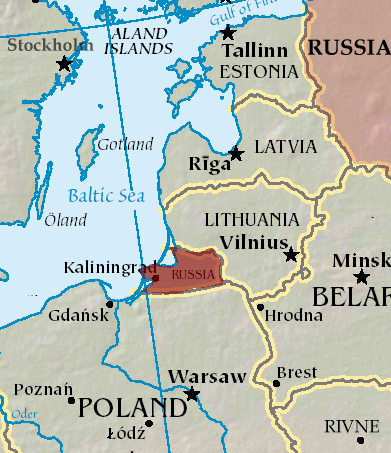
Lithuania has applied EU sanctions to the transit of goods to Kaliningrad. Russia says this is a blockade and in violation of an agreement from 2002 to allow transit between the Russian mainland and Kaliningrad. Sanctions apparently amount to about 50 percent of shipments, and Lithuania has also closed its airspace to Russia. Because the Baltic freezes during the winter, resupplying Kaliningrad will become particularly difficult in a few months.

The Russian official response has been fairly measured — they consider it a violation and are studying how to retaliate.

The simplest retaliations are not easy; while the EU as a whole relies in Russian energy, Lithuania itself is relatively energy self-sufficient.

I would suggest that the solution, as Lithuania says it is just implementing EU sanctions, is to simply shut off energy to the EU as a whole for a while and see what happens.

But there’s something else here that needs comment: Lithuania is part of NATO.

I believed, when Lithuania joined NATO, that it shouldn’t have been let in. Lithuania has an army of about 20K. It’s not Ukraine, with Europe’s largest army (and still losing), it could be overrun in days. Lithuania feels free to provoke Russia because of NATO Article 5.

But let’s look at exactly what Article 5 says:

The Parties agree that an armed attack against one or more of them . . . shall be considered an attack against them all and consequently they agree that, if such an armed attack occurs, each of them, in exer­cise of the right of indi­vidual or collect­ive self-defence recog­nised by Article 51 of the Charter of the United Nations, will assist the Party or Parties so attacked by taking . . . such action as it deems neces­sary, includ­ing the use of armed force, to restore and main­tain the secur­ity of the North Atlantic area.

You’ll notice that this isn’t actually an automatic declaration of war. Each country in NATO will decide what to do.

As I’ve said in the past, if Russia attacks Lithuania, I feel we should go to war.

But the analogy right now is that someone who is too weak to fight is poking someone dangerous because they have friends who can fight.

Are we really willing to risk WWIII and nuclear armageddon so that Lithuania or the EU can provoke Russia?

Lithuanian politicians seem to think that Article 5 is automatic: It isn’t, and they need to remember that. The same is true of the EU as a whole, whose military cannot defeat Russia without aid from the US and Turkey.

How sure are they that the US will answer the call?

Should the US answer the call? Are you personally willing to die so that Lithuania and the EU can poke Russia? (A Russian ex-general recently noted that, if war breaks out, the UK will cease to exist, so this question isn’t really just for Americans.)

I suggest that EU and Lithuanian politicians and citizens should think this over carefully. Turkey, I virtually guarantee, will not join such a war, and those who depend on the US have often found out that it cannot be trusted when the stakes are high.

I doubt this situation will lead to war, but each provocation and escalation, from either side, increases the odds, and we’re playing a very high stakes game here — given how many nuclear weapons both sides have.

Perhaps we should think carefully about for whom we are actually willing to die, about who we’re willing to defend if the cost is that almost everyone we know, including our family and friends, stands a good chance of dying.

Because if WWIII happens, whichever side starts losing, will use nuclear weapons.

You can’t automatically bow down to threats and never be willing to fight, or those who are willing to use violence can make you do anything they want, but there’s a difference between standing up for yourself and provoking a fight.

The EU, NATO and the Baltic states need to think very carefully about this difference.

DONATE OR SUBSCRIBE

Open Thread

Use comments to discuss topics unrelated to recent posts.

Ukraine KIA 500-1,000 a Day

And that’s what Ukraine is willing to admit to.

Up to 1,000 Ukrainian soldiers are being killed or wounded each day in the Donbas region of eastern Ukraine, with 200 to 500 killed on average and many more wounded, a top Ukrainian official said on Wednesday.

In the initial attack, Russia took heavy casualties. They didn’t expect the Ukrainians to really fight, don’t seem to have taken into account the amount of fortifications built in the East since 2014 and were very sparing with artillery and air power. Since then, however, they have engaged in grinding attrition warfare. They have air superiority, more missiles, and far more artillery. They also have far more reserves, and their supply lines aren’t interdicted by hostile air forces, so they easily rotate units in and out of the front.

The result of this is that Ukraine is now taking much higher casualties than Russia and will have a higher killed/injured ratio as well. If they’re willing to admit up to 1K a day, I’m betting it’s at least double that.

Russia is advancing slowly, but they are taking ground, and they seem in no rush. Once they conquer Donbas and Luhansk, the question is whether their primary pivot is to Odessa or to Kharkiv. (I’d say taking Odessa does more harm to Ukraine, as Russia could then easily close off Ukraine’s entire coast, but Russia may want Kharkiv more.)

The other thing to bear in mind is that once Donbas and Luhansk are conquered, most of the rest of Ukraine is not nearly as heavily fortified, except in the sense that all cities are natural fortifications, and that Ukraine is essentially a flat open plain. Advances may speed up a fair bit, though the post Cold-war Russian army (as with most armies) isn’t really suited to breakthroughs and blitzkrieg warfare, as like other modern armies it is organized around brigades which don’t really have the mass and men necessary.

As I have long noted, barring an economic/logistical collapse which seems extremely unlikely, there was never any way that Russia was going to lose the conventional stage of any war with Ukraine. They have a far larger military, and it’s not, actually, crap.

The decision of when to stop the Ukraine war is Putin’s. If he is seen to lose the war, he will lose power and almost certainly wind up dead along with his family, so he won’t end the war until he has a victory, and, as he controls the more powerful military force, he can choose to win.

The longer Ukraine puts off making peace, the worse the terms are likely to be.

As for a guerilla war, my guess is that Russia will take parts that are primarily Russian, and anyone who is pro-Ukraine will be encouraged or forced to leave. Nasty ethnic cleansing, but it is one of the ways you break insurgencies. (They may not even have to do very much, though, considering how many have fled the war. Just don’t let them come back if they aren’t pro-Russian.)

The longer-term consequences are harder to forsee beyond the obvious stuff like Russia now being a junior Chinese ally and Europe now being a much firmer US satrapy. There’ll be a famine, there’s going to be a recession (caused as much by the political and central bank response as the war and sanctions), and so on. Europe won’t recognize whatever Russia takes, and there’ll be a festering sore, probably for decades.

But, bottom line, Russia is winning and will keep winning. The only thing that could change that would be direct entry by NATO, and that would probably lead to nuclear war.

DONATE OR SUBSCRIBE

From 2010: The Unvarnished Truth About the US

Twelve years ago, I wrote this post. I don’t see anything since then has changed to make it wrong, and I think it’s worth reading still — especially for those who weren’t with me 12 years ago.


I’ve been meaning to write this post for some time, and in light of yesterday’s Supreme Court decision allowing unlimited corporate money into the political system, I think it’s time.

Yesterday’s decision makes the US a soft fascist state. Roosevelt’s definition of fascism was control of government by corporate interests. Unlimited money means that private interests can dump billions into elections if they choose. Given that the government can, will, and has rewarded them with trillions, as in the bailouts, or is thinking about doing so in HCR, by forcing millions of Americans to buy their products, the return on investment is so good that I would argue that corporations have a fiduciary duty to their shareholders to buy out government – after all, if you pay a million to get a billion, or a billion to get a trillion, that’s far far better returns than are available anywhere else.

And no politician, no political party, can reasonably expect to win when billions of dollars are arrayed against it.

The one faint hope is that politicians in the Senate will panic, know they have ten months to do something, and ram something through. Of course, that will only be a stopgap measure, until the Supremes overthrow it, but in the meantime, maybe Dems will get serious about the Supreme Court and stop rubber-stamping radical right-wingers like Alito and Roberts.

That is, however, a faint hope.

Given the US’s complete inability to manage its economic affairs, and its refusal to fix its profound structural problems, whether in the financial system, the education system, the military, concrete infrastructure, technology, or anything else, I cannot see a likely scenario where the US turns things around. The US’s problems in almost every area amount to “monied interests are making a killing on business as usual, and ologopolistic markets and will do anything they can to make sure the problem isn’t fixed.”

Even before they had the ability to dump unlimited money into the political system, they virtually controlled Washington. This will put their influence on steroids. Any congressperson who goes against their interests can be threatened by what amounts to unlimited money. And any one who does their bidding can be rewarded with so much money their reelection is virtually secure.

This decision makes the US’s recovery from its decline even more unlikely than before — and before it was still very unlikely. Absolute catastrophe will have to occur before people are angry enough and corporations weak enough for there to even be a chance.

So, my advice to my readers is this.

If you can leave the US, do. Most of the world is going to suffer over the next decades, but there are places which will suffer less than the US: places that have not settled for soft fascism and are refusing to fix their economic problems. Fighting to the very end is romantic, and all, but when you’re outnumbered, outgunned, and your odds of winning are miniscule, sometimes the smartest thing to do is book out. Those who immigrated to the US understood this; they left countries which were less free or had less economic hope than the US, and they came to a place where freedom and opportunity reigned.

That place, that time, is coming to an end. For your own sake, and especially for the sake of your children, I tell you now — it is time to get out.

I am not the only person thinking this. Even before the decisions, two of my savviest American friends, people with impeccable records at predicting the US meltdown, told me that within the next few years they would be leaving.

There’s always hope, and those who choose to stay might stop this terminal decline.

But you need to ask yourself, seriously, if you are willing to pay the price of failure, if you are willing to have your children pay the price of failure. Because it will be very, very steep.

DONATE OR SUBSCRIBE

Ways Capitalism May Be Destroyed

In the classical Weberian model of the rise of capitalism, one of the preconditions is that all three factors of production — land, labour, and capital — must be available in markets. (Capital, in this context, is not just money, but includes capital machinery and other non-labour/land inputs.)

If land can’t be bought, there is no capitalist takeoff. This was the case in most of Europe during the Early and High Middle ages: The vast majority of land was held by nobles, and most of the rest was handed down through families or as church property and not available for purchase.

If labour can’t be bought or rented, then you don’t have workers. For most of the Early and High Middle ages, the majority of people were serfs or otherwise tied to the land. There were some free cities, especially by the High Middle ages, but the people in them constituted a distinct minority.

And finally, for most of the Early and High Middle ages, lending money for interest was a sin. It happened anyway, but it was a very risky business, with huge margins.

Another necessity is calculable law and relative safety. When you can’t be sure if a noble will seize your land, if bandits or nobles will plunder your shipments, or suddenly raise tariffs and fees, or will repudiate loans, you can’t run a long-term business. In these situations, merchants (not shopkeepers, but the bigger ventures) were gambles, as in the old saying “my ship has come in.” High returns, very high risk, and a preference for high value luxury goods.

Because these are the pre-requisites for capitalism as a dominant and hegemonic system of production and a political ideology, ending any of these will also end capitalism.

If labour, capital, or land stops being widely available in the market, if people have other options to make a living for example, and don’t need or want wage labor, or if land cannot be bought, or if capital goods and money aren’t readily available, or law or banditry or taxation becomes too capricious, then capitalism will come screeching to a halt.

What scenarios can we imagine where this might happen? I’ll offer some in the future, but think it through a bit yourself.

DONATE OR SUBSCRIBE

Open Thread

Use to discuss topics unrelated to recent posts.

Smiling at Death

I don’t know what happens after death. I have two friends who have died and lived again to report. One says there was nothing, another had a classic near death experience. After reading a lot of case studies, I’m inclined to believe that reincarnation is fairly common (why everyone should have the same post-death experience is beyond me), but certainly it could be that death is the END, or one goes to the happy hunting grounds, or any of a number of any other possibilities.

What I do know is that when you die, you have to leave a lot behind. Everything you’ve owned, your physical body, and all the people, though perhaps some will rejoin you later. I rather suspect that, if oblivion isn’t what happens, that on losing the physical body you will also undergo some significant changes to personality, memory, and perception. (One advanced spiritual teacher told me that when you die, your physical life seems like a dream. I don’t know if they were full of it or not.)

But forget all the stuff about what may or may not happen. For sure, we’ll be leaving a ton of things behind.

When I was in my 20s, I spent three months in the hospital, and then a few years recovering. The hospital stay was so awful, including days of screaming, more dry vomiting than I can count, and complete inability to move for almost a month, that after I got out I swore that I’d never let it happen again.

I was very close to death for a few weeks while in that hospital, and the doctors actually didn’t think I’d make it. I had plenty of time to contemplate it, and when I came out I had no fear of death, because I knew that truly awful things happen in life.

Something changes when you face your mortality, not for an instant, but over a period time. I had to do it again later when I had heart problems (serious enough that I couldn’t catch my breath sitting down), and so I’ve done this more than once.

Add in my meditation training and something odd happened: I find the thought of death soothing. When I think something bad will happen or something bad does happen, I remind myself that, like Socrates, I’m human and therefore mortal, and I’m going to die one day. If I lose something, odds are it was something I was going to lose anyway.

And then I ask myself, “Am I scared of death?” and the inevitable reply is a chuckle, because the idea is absurd to me. Maybe there are hells and worse things can happen, but I know for sure that really, really bad things happen here.

And then, perhaps, I think back. The happiest year or two of my life were when I was around five, living on the beach with my grandmother and mother. I had virtually nothing then except clothes and a place to sleep: no possessions I cared about except a tiny heart-shaped booked my grandmother gave me in which she had written a story.

Happiness requires very little; remove misery, and happiness should bloom.

So when I’m anxious or scared, I move on to the ultimate anxiety or fear, and I find it empty, and then perhaps I keep it in mind for a time, and, for me, that is a near sure cure for anxiety.

Death can be your friend and your teacher. You’re going to have to face it one day; perhaps if you face it now, and ask yourself if you can be okay with losing all the things it takes, it can help you be free and happy.

DONATE OR SUBSCRIBE

Is Capitalism Near Its End?

In the book Does Capitalism Have a Future?, Emmanuel Wallerstein argues that capitalism cannot be saved because capitalism requires the endless pursuit of profits, and the world system is at a stage where there is no room for another wave of exploiting people who are largely outside the system, which capitalism, in its modern form (from about the late 15th century), requires.

The ur-rule of capitalist behaviour, per Wallerstein, is that one must pursue ever-higher profits. If one doesn’t, they’re out of the game. (You and I, dear reader, are not in the game and never were, unless some billionaire or CEO is reading this.)

If you don’t pursue endless profit, you fall behind those who do, and they buy you out, or you go bankrupt, or even you become a small or medium business and have no real power. To have power in capitalism, one must be ever striving for the apex. It’s a red-queen’s race, as in “Alice in Wonderland.”

“Well, in our country,” said Alice, still panting a little, “you’d generally get to somewhere else — if you run very fast for a long time, as we’ve been doing.”

“A slow sort of country!” said the Queen. “Now, here, you see, it takes all the running you can do, to keep in the same place. If you want to get somewhere else, you must run at least twice as fast as that!”

Now, the next thing is that capitalists actually don’t like workers who fully depend on them for survival: they want workers who have other supports; generally some sort of subsistence or government support. Traditionally this would be workers in hinterland regions (in Europe or Britain to start) who still had some land or animals and took the work only to get some extra money.

Other arrangements did exist: You could pay them less than they really needed to survive (the early British proletariat, as can be seen from accounts at the time), or, in the modern world, you can be Walmart and instruct your workers how to get food stamps, welfare, and medicaid, as you pay them less than they need to survive.

Various other companies, including Amazon, who rely on similar supports and school, which is a form of babysitting, can be seen this way as well; workers who have to care for their own children 24/7 can’t work. Extended families, in countries which still have them, do the same thing — grandparents or other relatives care for the children while the parents work.

Each wave of capitalism has gone out to places where there were still people with extended families and means of subsistence, and brought them into capitalism. At first it was cheap, then wages rose as workers became proletariatized and wanted their wages to cover their actual expenses.

Getting government to step in and subsidize workers is a poor substitute, which can’t work in the longer run, because the workers still have to be supported. Even if a specific company is dodging all its taxes, someone is paying, and if that someone is the workers, well, that strategy is only viable while there is wealth to steal from the poor and middle class, because – obviously — taking wealth from the rich defeats the point.

The last wave, to Wallerstein, was this last wave: There are no countries of significance not in the capitalist system, and there is no significant group of people with extra-subsistence to bring into the system to support cheap labor.

Without this, the current form of capitalism is doomed. Profits can only be increased by impoverishing societies as a whole, which destroys the wealth customers need to buy goods.

Though Wallerstein doesn’t emphasize it, there’s also the issue of simple depletion of minerals and of climate change. There are plenty of hydrocarbons in the world, but using them is destroying subsistence, food production in general, and drawing down water, and so on. We are running out of other materials, almost exactly as “The Limits To Growth” report predicted five decades ago.

The reason people like Bezos and Musk are obsessed with space and automation if that if space mining, colonization, and automation are the only viable solutions can the resource constraints and the expansion constraint be broken. It’s the only way that this style of capitalism continue, possibly nearly forever, by expansion to new worlds, the asteroid belt and so on.

Unfortunately, with our current technology, space colonization is a no-go. We can’t even create a biosphere (a closed environment) capable of supporting anything more complex than mold slimes. We can’t deal with the radiation in space. Mars colonization without terraforming will be very limited; it’s a more hostile environment than Antarctica, which we haven’t been able to colonize either.

So, assuming you agree with Wallerstein’s model of modern capitalism, at least in its broad strokes, there’s no way for capitalism to survive.

If it is near the end, what you’ll see is a structural crisis with wide fluctuation. Change to a new equilibrium generally happens with snaps to the new equilibrium, then snaps back. At first, the snaps to the new equilibrium are brief — over time, they become longer and eventually there are no snaps back.

This is also likely to be the case for climate change, the question is where the new equilibrium will be, which is not as easy a question as some people think, because while earth has had high carbon in the past, conditions then were quite different. One example is that atmospheric pressure 2.7 billion years ago was half what it is today.

In any case, whatever the new equilibrium will be is unclear, both socially and environmentally, and how the social equilibrium sets will work is also dependent on where the climate stabilizes.

So at this point, we can say, if we find Wallerstein persuasive, that the modern form of capitalism, which has run progressively larger parts of the world for about five centuries, is on its last legs. What we can’t say is what will replace it.

The goal of those of us who see what is happening is to create ideas; ideologies, which will be available when change becomes so imperative that people are desperate, and reaching for new options. If we don’t, the worst people will dominate with their worst ideologies, and the new system could be even worse in many ways.

DONATE OR SUBSCRIBE

Page 120 of 437

Powered by WordPress & Theme by Anders Norén