The horizon is not so far as we can see, but as far as we can imagine

Author: Ian Welsh Page 117 of 437

Correct Priorities in China’s Response to the Mortgage Boycott

So, China’s construction market has a problem, and vast numbers of Chinese have stopped paying mortgages on stalled out or behind construction projects.

The government’s likely response?

…a typical scenario would involve seizing land from a distressed developer and giving it to a healthier rival, which would in turn provide funding to complete the distressed developer’s stalled projects.

And there is this:

The focus on completing projects is the latest sign that policy makers are prioritizing homeowners over bondholders, who have been burned by a record number of defaults by real estate giants including China Evergrande Group.

This is a correct response. Investors who lend money (which is what bondholders are) are gambling. If whoever they gamble on can’t pay, they should lose their money. That’s how it’s supposed to work, and it’s how it has to work if markets are to do their job. A market assumes that someone making a profit is producing something other people want for less than they’re willing to pay. Investors are supposed to direct capital towards those sorts of producers. If they make bad bets, they should lose their money, and someone else should make the bets.

Lenders and developers exist to do things. Investors finance those enterprises which provide “utility” and make a profit. Developers construct buildings (which have utility) at a profit. If you can’t both provide a service or product with utility and make a profit, you should not survive in a market economy. That’s how it works.

So the bond-holders should lose their money, and the developers who can’t construct buildings at a profit should go out of business and, yes, the consumers should be protected as long as they acted in reasonable good faith. Ordinary people aren’t developers or financiers; unless there was an obvious reason to expect fraud which an ordinary person should have seen, they should be made almost whole. Not entirely, so that they become a little more wary in the future, but the delays already do that.

China’s central government should have acted on this much sooner, but if they go with this response, it’s a good one. Westerners should learn: Investors, traders, and businesses can’t be protected classes in a market economy.

DONATE OR SUBSCRIBE

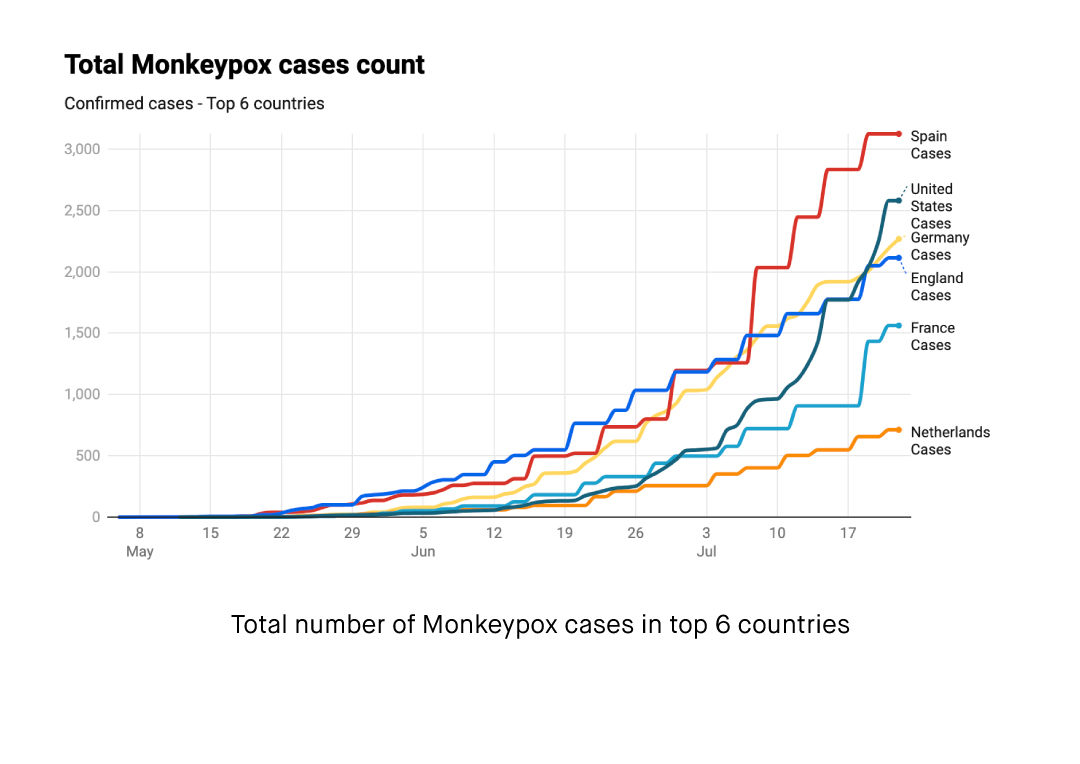
BA.5 Covid Is Incredibly Virulent and MonkeyPox Is in Exponential Growth

Yeah…

https://twitter.com/mattcornell/status/1552082146143207424

Remember that even a mild case of Covid can cause organ damage without you knowing, or can give you Long Covid with symptoms, sometimes extremely severe symptoms and that damage can accumulate each time you get Covid.

Meanwhile, two days ago, from WHO:


Don’t assume that because you aren’t gay or don’t have a lot of partners you won’t get monkeypox; plenty of people who aren’t having anal sex are getting it. Most of the guidance I’ve read says “direct contact,” but…

While experts believe monkeypox spreads primarily in close contact through skin lesions, evidence suggests the virus can also be airborne, at least over short distances. For example, during Nigeria’s monkeypox outbreak in 2017, scientists recorded cases of airborne transmission within a prison and in health care workers who did not have direct contact with patients. However, it is not clear how much airborne transmission contributes to the overall spread of the virus.

What I suspect is that monkeypox can spread through droplets, which is not the same as Covid, which is fully airborne. Droplets is how most scientists originally thought Covid spread, which is why “social distancing” was emphasized so much at the start of the pandemic.

Generally vaccines are not available unless you’re queer and have multiple partners, but check locally. I suspect the directions at the start of Covid should be relatively effective vs. monkeypox: distance, use 70 percent ethanol or dettold, and wear a mask. (Soap alone will not do it – correction.)

This stuff is nasty, takes a month to clear, and can leave permanent disfiguring scars. So keep an eye on it and take it seriously if it’s spreading where you are.

DONATE OR SUBSCRIBE

China Jumps Two Chip Generations Ahead: Why Chip Sanctions Backfired

Faster than most expected:

Semiconductor Manufacturing International Corp (SMIC, 中芯) has likely advanced its production technology by two generations, defying US sanctions intended to halt the rise of China’s largest chipmaker.

The Shanghai-based manufacturer is shipping bitcoin-mining semiconductors built using 7 nanometer technology, industry watcher TechInsights wrote in a blog post on Tuesday.

That would be well ahead of SMIC’s established 14 nanometer technology, a measure of fabrication complexity in which narrower transistor widths help produce faster and more efficient chips.

Since late 2020, the US has barred the unlicensed sale to the Chinese firm of equipment that can be used to fabricate semiconductors of 10 nanometers and beyond, infuriating Beijing.

Now, there’s a question if they can scale, but this is still a huge step. This means that they are ahead of Europe and the US, and behind only Taiwan and Korea. This is also sooner than almost all experts predicted: China did what Western technologists thought could not be done so quickly.

This speed, as I have noted in previous articles, is not that surprising; the technological lead always moves to the country which holds the world’s manufacturing floor. When Britain fell behind the US, it took about 30 years for them to lose their tech lead, but lose it they did. The same will happen with the US and Britain, but likely faster for obvious reasons like jets, the internet, and so on.

To put it simply, when you are right there with the factory floor, your innovation cycles are far faster, or in modern-speak, you iterate more quickly. You also have more practical experience with what actually works.

The “ban semi-equipment and semi-sales” to China card was a card, like the freezing of Russian foreign reserves, that you only get to play once at a great power. China is more than happy to subsidize chip manufacturers to learn how to make this tech domestically, and they are also crashing other key techs they’re behind in (like aviation), because it’s clear if the West would put a ban on semis, they’ll do it to anything or everything else.

China’s Job , and Xi has stated this publicly, is to make it so that they can’t be choked out by the US (the “West” is mealy-mouthed; the US makes the decisions, and the EU, Japan, and so on just do what they’re told, with occasional exceptions). Making Russia a locked-in junior ally with the sanctions regime made it so that China couldn’t be choked out on natural resources, and making it clear that crippling sanctions are on the board caused China to scramble to close the deficiency.

Unlike with choking out Japan over oil before WWII (which is why the Japanese felt they had to attack the US), however, the partial sanctions on China were not crippling, because unlike pre-WWII, the US is not the world’s primary industrial power, and it has its own dependencies on Chinese trade.

In realpolitik terms, because this is the case, sanctions should have been all at once, followed by war (I’m not for this, I’m massively against it, not least because of the issue of nukes). Half-assing it just gave China time to decouple its key dependencies and, as noted above, the anti-Russia sanctions were a gift from heaven to China.

The game continues, and if it were not for climate change, all the smart money would be on China as the pre-eminent world power within 20 years, probably sooner. As it is, a lot will depend on variables that humans have chosen not to control and soon will lack the ability to significantly control.

DONATE OR SUBSCRIBE

Politics Series: Government

(Previous: Power)

(Introduction and Table of Contents)

Government is the people who make choices about law and policy, plus those who implement the policies and enforce the laws.

The strength of a government can be measured by how easily they are able to implement those policies and enforce those laws, and by how many non-approved actors are running shadow governments. It is normal for apparently non-governmental organizations to implement the will of government.

In our society, large firms actually enforce or fail to enforce most tax law, private companies build most buildings and weapons using government funds, and so on. These organizations are effectively arms of government.

Organizations like gangs, mafias, or corporations which are able to ignore the government and do what they will against both law and policy are indications of government weakness. Depending on the government’s strength, this can include warlords, churches which cannot be taxed, self-defense militias, and feudal lords who no longer follow the King’s laws.

Government which uses proxies to enforce its will, as opposed to its own internal resources is generally weaker than governments that have their own capacity. This can, most recently, be seen in China’s response to Covid, which, when necessary, has included door-to-door food delivery, testing of the entire populations of millions of people, and so on. This is capacity that does not exist in most other countries, and which existed in China prior to Covid, and thus could be used to help China implement its zero-Covid strategy.

Strong government has both this internal capacity along with the ability to convince external actors to do what it wants.

Power and legitimacy of government are similar, but not identical. A government’s legitimacy can be measured by how much force they must use to ensure compliance. A government with low legitimacy, but a lot of power, can still be effective, but voluntary cooperation is superior to coercion — those who are compelled may work hard, but they are rarely creative or helpful.

One may think of the amount of force required as equivalent to the physical concept of friction; legitimacy reduces friction and multiplies power.

We tend to talk of “government” as if it is singular, but outside of isolated human bands in the distant past, it never is. There are always multiple governments. Ideally the ostensible “top” government is the most powerful, but that isn’t always the case. Voltaire quipped that “The Holy Roman Empire was neither Holy nor Roman, nor an Empire,” and for large chunks of its history, the Emperor was the supposed head, but lower-level governments were more powerful.

In our own world, for much of the past 40, years the Somali government was substantially weaker than various warlords, and many have suggested that various Western governments are controlled not by themselves, but by corporations or outside forces. This “capture of government by other forces” is important, and we’ll discuss it later.

Most of the organizations which actually govern many Westerners’ lives are not officially governmental; if we work for them or go to them, corporations and schools decide the activities of our day-to-day lives, and they decide much of what will be produced, how and who will get it, what prices and wages will be, and so on. To be sure, they do so in the context of policies and laws set down by government, but corporations have proven to be more than willing to break laws if the price of doing so is less than the benefit to them.

In many countries, corporations are law in large areas. Mining firm mercenaries and security forces regularly inflict violence on those who oppose them, often even killing them, for example.

In the past, feudal lords were the primary law enforcement in regions that dwarfed the areas where the law (writ) of the king or emperor held sway, and even today, a ship’s captain in international waters is a law unto himself. For much of European history, free cities made almost all their own laws, and under the Tokugawa Shogunate, the haughty Samurai found commercial law distasteful and let merchants form and enforce their own laws for regulation of contracts and finance.

Government is what government does. If the rules and policies are formed by an organization we don’t call a government, it is still acting as a government.

Governments usually act to maintain and increase their legitimacy, based on their current ideology. As we discussed in the chapter on groups and coalitions, however, this doesn’t mean they’re concerned about their legitimacy with everyone. If a group isn’t part of the ruling coalition, and especially if it is not powerful, government may take actions that group considers illegitimate. This increases friction, but has all the advantages we previously discussed.

Neoliberal governments, for example, are not particularly concerned with popular opinion. As the Princeton oligarchy study showed, such opinions are essentially irrelevant, all that matters is what those with some degree of wealth and power think. New Deal and post-war liberal governments, on the other hand, did care about popular opinion and often acted in reaction to it, having a broader base of support and weaker financial elites.

In the Dark Ages and much of the Middle Ages, legitimacy with the peasantry wasn’t very important, but keeping the feudal nobles happy was necessary, as Kings relied on vassals for much of their military might and income, and those vassals in return had vassals beneath them. The King, in such situations was the first among equals, acting to keep the nobility in power, and himself at the top of the heap. Indeed, in such governments, even merchants were often treated with little respect, and kings and nobles regularly defaulted on debt with little to no consequence. Killing those whom they owed money to, as with the French King’s famous destruction of the Templar Knights, was common.

In our own developed societies, school and universities are the primary ideological education hubs. In some countries, like the US, churches are very important, and their importance in the US has been the prerequisite for the rise of the modern right-wing, which vaulted Trump to power and which recently overthrew the federal US right to an abortion.

As we’ve discussed elsewhere, ideologies change, legitimacy changes, and societies, including their governments, change with them.

In the modern context, it’s good to remember FDR’s quote: “That, in its essence, is fascism — ownership of government by an individual, by a group, or by any other controlling private power.

It’s not a very good definition of fascism, as this would include monarchies, for example. But it’s an excellent definition of when a state is no longer democratic, whether or not there is voting. By this definition, the US is not a democracy, nor is the UK and nor are a number of other nations who identify as democracies.

But this is why there is fight over ideology and legitimacy. If you redefine what is “the right thing,” then you can change how a society operates — who controls it, and who gets the spoils. If democracy only means, “You get to vote” and doesn’t mean, “the mass of people control what the government does,” then you can try and keep the legitimacy of the word “democracy,” while also keeping the loot and power.

Many, if not most, American universities mandate that arts and social science majors take an introductory economics course in order to graduate. In that course, people are taught (not learn, but are taught), that everyone looks out after their own self-interest, that there are no objective standards for what is good (has utility), and that people acting selfishly (in their own self-interest) leads to the most good.

The great economist Keynes famously quipped that “Capitalism is the astounding belief that the most wickedest of men will do the most wickedest of things for the greatest good of everyone.”

Stated this way, it’s obviously nonsense, but Economics 101 states its axioms (unprovable assertions) as laws, as if they were the equivalent of E=MC Squared.

This is ideological education. Indoctrination. Every society has it. No society I am aware of has existed without it, and I doubt that one ever has or can. Modern capitalism, whose priests are economists, asserts that if you make more money, you get it because you are providing, or did provide, services or goods people want, that what people want always has utility, and that rich people therefore deserve their money and implicitly, deserve even more money than they already have, so that they can produce more utility, which is identified as “good.”

The Divine Right of Kings was fundamentally no different. The Roman cult of the Emperors was similar, and, in the Roman Republic, the gods supported the State as well. All nobles and aristocrats (two different things) have asserted that they are the best people.

So what government is, and who controls it, is always justified by ideology. Ideology isn’t necessarily a dirty word, it’s like sex; it can be lovemaking, it can be just for fun, or it can be rape. It depends on the context.

Change the ideology and the legitimacy and you change what governments can and cannot do. Under feudalism, traditional rights were very important: If your great-great-great grandfather had a right to use the common fields or to 20 percent of the yields of the peasants on the land, so do you. To change those rights is illegitimate.

When absolutist monarchies began to take over Europe, at about the same time capitalism was becoming the dominant economic ideology, is also when we start seeing the enclosure of the commons — lands that peasants had the right to use as a group. It’s when nobles start not being allowed, in many areas, to not have their own troops, or to only have a few. It is when, slowly, nobles start losing the right to be judge, jury, and in some places executioner. The King, through his officials, began taking over those powers.

This change in ideology was driven by changes in technology (firearms and cannons) and by changes in economics. However, these changes were also driven by ideology and legitimacy in ways that are not clear to most people and which are also beyond the scope of this booklet.

It is legitimacy, and ideology, filtered through groups and coalitions, which determine what government can and will do. When governments start doing things that are against the dominant ideology, or physical conditions no longer allow them to keep their ideology, they weaken both themselves and the ideology, and in time, they lose power.

This is what happened in the 1970s, with the oil shocks and stagflation (high inflation and high unemployment at the same time). The promise of the New Deal and post-war liberal orders was increased general prosperity, that all boats would rise together, as John F Kennedy once said. When this was no longer true, and when the government, whether through lack of belief, incompetence, circumstance, or some combination of all three, was unable to meet its ideological promises, it lost legitimacy. The result was the end of the post-war order, symbolized by the election of Ronald Reagan in the US and Margaret Thatcher in the UK.

A government exists, then, to keep the promises of its ideological foundation. Lose the “mandate of heaven” by failing to keep those promises, and you lose power. A government may continue, but that government is based on a different ideology with different requirements for legitimacy.

This isn’t just about individual societies, however, it is about systems of governance which are regional and since the 19th century, global. Government is often imposed from outside a country or society, and it is thus that we will move to foreign affairs in the next chapter.

Next: Foreign Affairs

DONATE OR SUBSCRIBE

Open Thread

Use the comments to discuss topics unrelated to recent posts.

The European Position at the End of the Unipolar World

It’s hard to remember now, but in the early 2000s, the EU appeared to be the onrushing power. It was gaining new members, who clamored to join, both its economy and the Euro were strong, and it had avoided entanglement in Iraq. Its prestige was high (having nations begging you to let them in their club tends to do that).

What I suggested the Europeans do, at the time, was try and make the Euro into an alternate reserve currency. They also should have increased their military, making them non-reliant on the US in the guise of NATO. Within the EU, steps needed to be taken to stop the abuse of the Euro by Germany as a subsidy for its manufacturing (because the Euro was lower than a pure-German currency would have been) and to allow genuine subsidies in other countries to make up for the disadvantages they would incur as a result of using a Euro — which was priced too high. Aggressive moves towards energy independence would also be necessary, as Europe was –and is — obviously resource deficient.

None of this was done. It appears that EU leaders were comfortable being US subjects, or at least, they didn’t want to challenge it. Germany’s policy towards Russia was trade, sold on the assumption that trade alone would make them good little Europeans, without offering them a path into either NATO or the EU, and with the added insult of allowing and participating in the looting of Russia during the 90s.

As for economic policies like subsidies and some counterweight to German exports, well, that would contravene the neoliberal, technocratic ideology that very much rules Eurocrat elites: the rules are the rules and if your economy gets trashed by them, as Finland and Italy, among others, found out.

In 2008, the Europeans followed the Fed (and, admittedly, everyone else) into a gigantic bank bailout, then spent most of their time since printing money for rich people (a reasonable description of central bank special operations during that era).

Meanwhile, anti-Russia sanctions proliferated, Russia-EU/US relations deteriorated (especially due to to the fight for influence over Ukraine — but that was definitely not the reason), and it all flared into crisis when Russia invaded Ukraine after years of Ukrainian military operations in the Donetsk and Luhansk Republics.

That led to sanctions, which have so far hurt Europe worse than Russia, as the European (and especially German) power grid needs Russia natural gas and coal which they can’t easily obtain elsewhere. Damage to industry has also occurred, and some observers expect it to cost entire German industries and millions of jobs; nor is the rest of Europe unaffected.

The problem now is that a fast move away from natural gas, oil, and coal isn’t possible. Heat exchangers work, but there aren’t enough available. Renewables are great, but transitioning takes time and anti-Xinjiang sanctions mean that 50 percent of the world’s silica supply, along with much of its solar panels, are no longer available.

Meanwhile there’s a heat wave, Europeans don’t have air-conditioning, and live in buildings largely designed for cold weather (with some southern exceptions), and, as everyone loves to say, “Winter is coming.”

Transition is not impossible, but it will take time. It is going to require restarting any nuclear plants which can still work (the numbers do not work without it) and probably building some new nuclear reactors, along with a buildout of various forms of renewable energy. Even moving to imported, and more expensive, US natural gas is not as easy as it seems: it requires infrastructure which does not exist.

Russia, meanwhile, as we’ve discussed before, is restricting natural gas supplies and threatening cutoffs. They can’t buy European goods, and they need the money less than Europe needs gas, coal, and minerals. They are diversifying to the East and South as fast as they can. Add to that to their position as one of the world’s largest grain producers is serendipitous at a time grain production comes under pressure from climate change, and consider that they are capturing a fair bit of Ukraine’s farmland, some of the most productive in the world.

Then there is China. Europe does a lot of business with China and there are massive trade ties. But Europe continues its anti-China rhetoric and keeps putting on additional sanctions against China. China wants the European market, and there are still some advanced items they need to buy from Europe, but political considerations, especially with regards to Taiwan and Xinjiang, may trump such considerations. In particular, it is not in China’s interest for Russia to be defeated or broken up as so many in Europe want, as Russia is a key supplier without which China cannot resist a US naval blockade.

Europe finds itself in a position where it’s scared of Russia and outraged. Eastern Europeans in particular want a complete hardline because they genuinely fear conquest or Finlandization. Without reliable access to Russian resource, Europe is forced to rely on the US and various unpleasant Middle Eastern states and to pay higher prices.

And meanwhile, the simple fact is that transitioning to energy and resources without Russia is hard and will take years. I’d think a full transition, even if done competently, will take a decade or so. Combined with the need for the US in order to stand up to Russia (EU militaries are a joke, Ukraine actually had the largest one), and the Europeans find themselves completely back in US satrapy mode. The US is sending more troops and building bases and that’s how it has to be, if hostility to Russia remains.

Which means that the EU has another task: it has to build its own military, capable of standing up to Russia. This is by no means impossible: Europe is technologically advanced and still has the necessary industry, including world leading aviation, but right now all that is happening is buying more US made weapons and hosting more US troops.

If Europe wants to be anything but a satrapy, it has to fix it energy and resource issues; it has to build a military and it needs to do something even harder—it needs to rethink its ideology, and allow proper industrial policy internally. This is hard to do when it’s dependent on outside resources from a hegemonic power, but if it refuses to do so, it will remain an American satrapy.

How much of this will be done is unclear. Exchanging reliance on Russia for the US may seem like an improvement, but it is still dependence and if Chinese relations sour, the Europeans become “locked in”, with few options.

It’s hard to imagine the current generation of European leadership managing this well, but perhaps they will surprise or, more hopefully, perhaps they will be replaced by more competent politicians.

But overall, it looks like Europe is slowly marching towards its historical norm, less and less important and powerful on the global stage.

A lot, of course, will depend on climate change and who gets hit the worst and handle it the best, but right now Europe looks to be in decline, with an opportunity, if they take it, to use this crisis to come out stronger and less dependent on outsiders.

I hope they take the opportunity.

DONATE OR SUBSCRIBE

Russia Turns Up the Pressure (and Turns Off the Gas) on Germany and the EU

Well, well…

Russia’s Gazprom has told customers in Europe it cannot guarantee gas supplies because of “extraordinary” circumstances, according to a letter seen by Reuters, upping the ante in an economic tit-for-tat with the west over Moscow’s invasion of Ukraine.

Dated 14 July, the letter from the Russian state gas monopoly said it was declaring force majeure on supplies, starting from 14 June.

Known as an “act of God” clause, a force majeure clause is standard in business contracts and spells out extreme circumstances that excuse a party from their legal obligations.

So, Europe and Germany get gas in exchange for rubles. But Russia can’t spend those rubles for most of what it needs from the West.

The question is, does Europe, especially Germany, need gas more than Russia needs rubles and an increased exchange rate (not always a good thing)?

Everyone has been concentrating on the winter and assuming Germany didn’t need much gas until then, but a great deal of Germany’s electrical grid is supplied by natural gas plants, and as you may have heard, there’s a heat wave in Europe and most of the rest of the world.

So much for air-conditioning. And if much of Germany’s industry will have to shut down as well.

Germany can lose a huge chunk of its industrial base if this continues. The whole “keep buying gas from Russia until we can transition off of it” idea was always dubious, because other gas is much more expensive, but it also rested on the idea that Russia was desperate to keep selling; that there was a symmetry of needs.

But Russia will suffer a lot less without sales than Europe will without gas, and in any case, a shutoff will likely increase the price of gas they are selling elsewhere, making up some of the losses.

The fact is that Germany, an industrial state without a lot of resources, and Russia, a resource state, are natural economic allies, but Germany needs Russia more than Russia needs Germany.

The companies who have been given notice that of force majeure are saying they don’t accept it, but what are they going to do?

The grace period for payments on two of Gazprom’s international bonds expires on 19 July, and if foreign creditors are not paid by then the company will technically be in default.

This is a non-threat threat, because Russia has already defaulted on loans, as it is largely shut out from the Western banking system and thus can’t even transfer the money. (As happened to Argentina.) More defaults theoretically mean that Russia will be unable to access Western loans and so on, but they already can’t, and they have access to the Chinese banking system, which is larger than any Western country’s and perfectly capable of keeping Russia and Russian companies afloat.

Understand clearly that most Germans and Europeans support the anti-Russia sanctions. This is a popularly backed policy: Europeans are paralyzed by fear of Russia and were long before Ukraine. I had a friend in Austria tell me how he scared he was of Putin back in 2016.

We will, however, see what the result of this is. I would guess that in the short-term, it will stiffen opposition to Russia, but I’m less sure about the medium- and long-term. German elites, especially, will feel a need to end the Ukraine war and get back to a steady Russian supply.

No matter what, however, it highlights the price Europe is paying for its anti-Russia stance.

DONATE OR SUBSCRIBE

As the Sun Sets on the United Kingdom

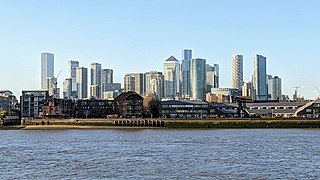
In Peter Hall’s Cities in Civilization, there’s a long chapter on the destruction of the Port of London. Hall doesn’t call it that; he is more impressed by the change from a decaying port which was close to a slum, which was losing importance to a new neighbourhood, headlined by the huge Canary Wharf complex, which is 97 acres with 16 million square feet of indoor space.

The port of London had been the greatest port in the world in the 19th century, but had slipped into decline in the 20th century, especially after WWI and II. The problems seemed intractable and the fact was that London was no longer the center of the world by 1980; it was New York. The Empire was gone, and when Britain joined the EU it abandoned its emphasis on economic and trade ties with the Commonwealth, made up of former members of the Empire like India, Australia, South Africa, Canada, and many more.

I remember the Commonwealth world, if barely, and my parents lived the prime of their lives in it. There was a lot of trade and travel and an entire class of people who moved easily between Commonwealth nations. But Britain, post-WWII had been de-industrializing, and Thatcher’s policies, economically, amounted to a “Fuck it, we’re giving up industry and pivoting entirely to finance.”

I recently saw someone mention the debate in England right now between the policies of Thatcher and Reagan (there wasn’t that much difference) but this is insane.

Thatcherism, Reganism, and indeed, neoliberalism, relied on built-up fat of the land. Thatcher’s big bribe to voters was letting them buy their council housing for below what it was worth. Over the neoliberal period, virtually everything owned by the state was sold off to the private sector: water, power, railroads, and as much administrative outsourcing as possible. Regulations were cut as much as possible, held back by the EU, which while neoliberal, prefers to keep some standards.

Industry was sold off to whoever wanted to buy it, often at fire-sale prices, and most of the purchases were moved overseas to places with cheaper labor.

A huge housing bubble, largely in greater London, was created. Housing bubbles always seem like free money at first, but they don’t create productive assets; what they do is make some people rich, let those who own at the beginning or get in early enough gain unearned wealth, and drive up the costs of living, and thus labor costs. This means that housing bubbles actually make a country less productive.

They’re attractive as hell, at first, and the play has been done often. Turkey under Erdogan ran one, and for about 15 years it looked great and a lot of people were made better off. But Turkey had a lot less fat to burn on the fires of housing speculation than the US, Britain, or Canada and when it ran out Turkey went into an economic tailspin. (There’s more to it than that, of course, but you can’t have housing as your engine of growth forever.)

Now, clearly, Britain was not going to regain its position as the greatest industrial nation, but by financializing and running a long housing bubble, and deliberately selling off all the areas of the state which need to be performed with competence, uniformly and at a low, fixed cost, Britain destroyed most of what it had left.

The port of London is symbolic of this. While London didn’t need it, and certainly wasn’t going to need the kind of mega-port it had been earlier, just giving it up meant the wholesale destruction of a myriad of small shipping, logistics, insurance, chandlery, repair, and shipbuilding companies.

It’s easy to destroy a network like that, but it’s hard to rebuild it. The smart play would have been to plan for a smaller port, but do what they could to keep as much of the network as possible. Mercantile policies similar to what Germany followed (or Northern Italy, until the Euro smashed them) were what was required for Britain to have a prosperous future.

What they did, instead, was throw everything productive on a huge fire, and live off what Brits had created for centuries. It worked for about 30 years, for at least a plurality of Brits, and it made a lot of people rich, but it also impoverished the industrial north and created massive distrust for the establishment, which was later parlayed to sell Brexit, as British decline was correlated so strongly with the period of its membership in the EU. (The EU was not responsible, and its policies made doing the right thing possible — if anyone had wanted to. No one did, but even so, EU laws actually slowed down the burn.)

Britain came out of WWII with a very bad hand. The US wanted to replace them, and they put the boots to Britain, doing what they could to ensure the UK would experience no industrial recovery, and that Britain would remain an American satrapy.

But as bad as that hand was, Thatcherism was a self-inflicted wound. There were alternative policies which wouldn’t have sold the patrimony to have a 30-year party.

Britain is in a position now where there is almost nothing left to throw on the fire. The NHS is next, but that’s about all there is.

Corbyn was the last chance to make a turn, but the British elite united against him, smearing him with lies and Labour party operatives actively worked against his election — to the extent of lying to him about what ads were running and making sure his phone would see ads ordinary people didn’t.

So now, the Brits have a situation where “Great Britain” will likely come to an end: Remember that the United Kingdom is Scotland + England + Northern Ireland, and that Scotland is soon likely to go. I expect Northern Ireland as well, and even Wales is possible in a couple decades.

Those who rule England will still be rich, but they will rule over an impoverished nation. They’ll be able to afford servants and estates again, though, and I suspect they want a return to that “kind of life” more than anything else.

If the British, or the English (or the Scottish, etc.), want a future, they need to do something they’ve so far been unwilling to do: Replace their leadership class wholesale, getting rid of their class of public school-educated politicians and businessmen. Without this, it is not possible for the right things to be done — and even if they got rid of those people, they’ll have to rebuild from very close to nothing.

It seems likely that the sun will set on Britain, as it has on every other great empire.

Hail Britannia, and goodbye.

DONATE OR SUBSCRIBE

Page 117 of 437

Powered by WordPress & Theme by Anders Norén