Use to discuss topics unrelated to recent posts.
Author: Ian Welsh Page 118 of 437
Let’s put an end to this nonsense:
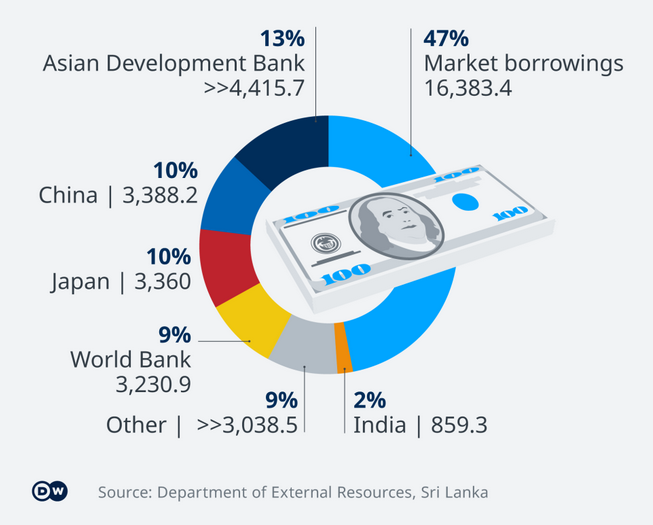
The Asian Development Banks is essentially a US proxy and the World Bank is mostly controlled by the US. Market borrowings are almost entirely from Western sources.
The article goes into more detail:
Sri Lankan President Gotabaya Rajapaksa, who spent a significant part of his life working in the United States, entered office in 2019 and immediately imposed a series of neoliberal economic policies, which included cutting taxes on corporations.
These neoliberal policies decreased government revenue. And the precarious economic situation was only exacerbated by the impact of the Covid-19 pandemic.
Facing an out-of-control 39.1% inflation rate in May, the Sri Lankan government did a 180 and suddenly raised taxes again, further contributing to popular discontent, which broke out in a social explosion in July.
Seems that cutting revenues makes you more likely to default on your debts and does not magically improve the economy. And when you do it just before a pandemic, well maybe it doesn’t work out well.
From Reuters, about that tax increase too late.
An increase in Value Added Tax (VAT) to 12% from 8% with immediate effect is among the key tax increases announced on Tuesday, which is expected to boost government revenues by 65 billion Sri Lankan rupees ($180.56 million).
Other measures, including increasing corporate income tax to 30% from 24% from October, will earn an additional 52 billion rupees for the exchequer.
Withholding tax on employment income has been made mandatory and exemptions for individual taxpayers have been reduced, the statement said.
So, the biggest chunk of it was a regressive VAT tax increase.
I’m not an expert on Sri Lanka, but the third world debt trap, which started primarily in the 1970s was based on the idea that you could borrow money and use that money to buy development. The play was to spend the money to turn to exports the West wanted (cash crops, minerals, etc…), which you had a “comparative advantage” in. Problem is that everyone was getting the same advice, so the supply of cash crops and minerals increased in multiple countries and the price crashed. Worse, to grow cash crops you had to get your subsistence farmers off the land. They went into slums, and you now had to feed them, which meant you had to import food.
In Sri Lanka’s case tea, spices and coconuts are key exports. You can only eat one of those three. When Covid happened the market collapsed, incomes were already down, debt load was high and … BOOM. According to the figures Sri Lanka is a net “agri” exporter, but it exports mostly non food agri items and can’t feed its own population.
(Rule #1: if your country can’t feed its own population, you are always vulnerable to outside forces.)
So, anyway, Sri Lanka spent generations servicing debt by selling the developed world luxury agri-goods, but the prices of those weren’t that high, and they didn’t get a developed economy out of their loans, but still had to pay the loans while unable to feed their own population. Pretty normal story, sadly. (Egypt is the saddest, from the cornucopia of the world to a food importer. The Aswan dam should never have been built, losing the Nile’s annual flood was too high a price to pay for its electricity.)
Now, the media is constantly full of stories about the Chinese Debt Trap. They’re bullshit.
African countries owe three times more debt to Western banks, asset managers and oil traders than to China, and are charged double the interest, according to a study released on Monday by British campaign charity Debt Justice.
This is entirely consistent with what I have discovered every time I’ve looked into the issue. It is not that there have never been corrupt high interest Chinese loans, but generally speaking, Chinese terms are far better than Western ones.
The reasons are twofold:
- China wants resources. In exchange they are willing to build infrastructure for cheap in countries who will sell them those resources. If you want hospitals and schools or even an entire city as well, they’re happy to build that for you too. This seem similar to Western policies from the 70s but is different in important respects: the West wanted the resources and they wanted to make lots of money off the loans and they wanted to gain control of economic policy in developing countries so they could institute neoliberal policies like getting rid of food subsidies.
- China has just spent decades developing its own country. While the job isn’t done, it has slowed down and China found itself with a lot of extra development ability: companies and workers specialized in building infrastructure: from ports and airports and railways, to everything a city needs, including sewage and power. They want to keep that industry running, and not have to get rid of millions of employees and have firms downsize and go bankrupt. So those firms, and often workers now develop countries all around the world. As long as they make some profit, that’s good enough for China. It doesn’t have to be high, especially, again, as they’re getting resources in exchange.
The “developing” world is a mess because of the West, not China. It is our policies which made it nearly impossible for most nations to develop. Those policies were designed to make our coporations and banks rich and to weaken the ability of poorer countries to resist us. They were exactly the opposite of what is required to develop a country, which is almost always done behind trade barriers and by moving UP the value added chain, not by selling raw materials and crops. This is how the US did it, Britain did it and almost every country in Europe did it. It is how Japan and Taiwan and Korea did it.
We sold countries like Sri Lanka advice that was bad for them and good for us, and which put them into a debt trap we refused to let them get out of by pretending that debt default was unthinkable and debts sacrosanct and by hurting any country which tried to default brutally.
This isn’t the historical norm. Previously third world countries defaulted all the time, and they soon floated new debt and yes, investors loaned to them anyway.
People who loan money should not be protected that much from default. Some protection is reasonable, but when a person or country is bankrupt, they should be able to default. Doing so keeps lenders honest: they either don’t lend, or they accept the risks, and they have incentives to keep debt reasonable, since if they don’t, they will be hurt.
When we made it so that default was virtually unthinkable, we changed the incentives (so beloved by economism believer) in ways that made it make sense for investors to lend money which was to be used in ways which crippled entire countries, indeed continents and made it impossible for countries to change course and pursue strategies which would actually allow them to develop.
That’s the story of most of the developing world.
And if you need to borrow money as a third world nation? Borrow it from China, not the West, if they’ll lend to you. As for the IMF, their job is to keep the payments going and keep countries in the debt trap so they can never develop and never have policies independent of the US and the West.
I recently had a long conversation with a fellow Canadian about current events, especially Covid and the economy. He read a lot of newspapers: he’s well informed by normal standards.
But over the course of the conversation I realized he was terribly informed.
For Covid, he was convinced both that China had only controlled Covid thru very long lockdowns and that they were lying about results. In particular, he remembered Shanghai well, but didn’t realize Shanghai was an exception. Most Chinese cities have locked down much less over the course of Covid than we have.
When I mentioned that other countries had much lower rates than us, he dismissed that as well. He thought travel bans and quarantines were completely pointless, when they have worked very well for those countries which implemented them. Western Australia’s travel ban kept Covid low there for ages, and New Zealand had a wave almost immediately after as they released restrictions.
He believed that not doing zero-Covid style policies was better for the economy and that China’s economy was in free fall. It has issues, to be sure, but it also has a 2% inflation rate, among other advantages.
He was convinced governments could not just find money to support people in lockdowns, believing money comes from taxes (it doesn’t, most money is created of thin air, this is something the MMT people are right about.)
He believed that vaccines are the most effective anti-Covid measure. They aren’t: China has worse vaccines than us and much better performance, and Covid variants have optimized for vaccine and natural immunity evasion. BA.5 in particular laughs at immunity, whether natural or vaccine.
In general he felt that the economy must be prioritized, and that is done best by keeping it open at all times. There was no acknowledgment of long Covid as a factor, or of the fact that each infection increases the odds of long term health damage to victims.
There was a sense of hopelessness about Covid being international, and that it would just keep going forever as a result, without knowledge of us restricting vaccines for much of the world, not doing travel bans or quarantine properly and not supporting other countries to do the right things (not that we are ourselves.)
He wouldn’t acknowledge that if shutdowns are to be done, they should be done at the point where numbers start going into exponential growth, even though there aren’t a lot of cases then, instead of waiting for hospital ICUs to be overwhelmed, and that by doing so we’d actually have shorter lockdowns and a lot less deaths and disabled and sick people.
This isn’t a badly read guy; he knew about the things the media has covered at length.
And this is the problem with propaganda; it creates a world view among its victims that is simply incorrect, and if you don’t actually know what’s going on you can’t make good decisions or support good decision at the political level.
What I see is that the West, in most cases, is creating circumstances where 15-20%, or more, of our population will wind up disabled in some way. Repeated Covid infections are going to gut us: our society cannot run with that many people with long term health damage.
But the media’s coverage has been of the “what we’re doing is the best way and everyone else is doing it badly.” It’s not that there aren’t exceptions, but that’s the general tone and message, along with a huge push for vaccines at the cost of other measures like masking, quarantines, travel bans, and proper indoor ventilation which actually, in some combination, work better.
One could call this “learned helplessness.” My conversation partner was convinced that everything reasonable had been tried, that zero-Covid policies hadn’t worked where tried and that doing them was tyrannical, bad for the economy and worse than what we had done.
Nothing could be done, so Covid would remain chronic, with wave after wave.
In a sense he’s right, except that so far we have refused to do what works, so Covid will keep going.
One of the most useful things you were probably made to do in school is argue for points of view you disagree with. Make the choice case if you are pro-life, make the pro-life case if you’re anti-abortion.
Write the Palestinian case or the Israeli case, whichever you oppose.
Make the best case you can that Russia was right to invade, or the best case you can that Russia was wrong. Make the case that NATO was responsible, then make the case it had nothing to do with it. Make the case Ukraine is Nazi-infested, make the case it isn’t.
Honestly making the best argument you can for the other side is a very useful exercise. I rarely write such articles any more, but I still do it informally quite often and I couldn’t write what I do if I hadn’t been trained this way.
To really make this work, though, you have to be able to empathize: to feel what people feel. David Ben-Gurion once said that if were Palestinian he would be in the violent resistance. That was a man who wasn’t so caught up in his own world that it blinded him.
And don’t rush to disagree with the case you’re making. Make it first. FEEL the case. Get self-righteous.
It’s not hard to feel self-righteous about being pro-life for example, to feel you’re a paladin for justice and anyone opposing you is evil.
But it’s also easy, as a Russian, to see the Russian invasion of Ukraine as justified and feel righteous about it. If you can’t do it, you don’t really get the argument.
The same can be done for the Ukrainian side (somewhat easier, if you’re a westerner.)
Because some arguments are illogical, you always have to be able to feel. There is no question Israelis took Palestinian land and are still taking it, so you have to feel what makes them think that’s good.
Same with understanding our genocide of natives in N. America.
Or, for that matter, truly understanding the emotions behind the Holocaust (which, remember was not just Jews.)
If you’re authoritarian (most Americans are, most Westerners even) you need to learn how to feel in egalitarian modes.
If you’re egalitarian, you need to learn to think in authoritarian mode (Authority is GOOD, it makes you feel safe and loved and taken care of.)
One problem with all this is that doing this engages the disgust emotion, or even contempt (contempt is the most dangerous emotion to other people, it gives license for violence.) I can’t count the number of times I’ve explained a position I don’t agree with and people have hated me.
This is especially so when you start dealing with questions of “evil”. Why are people cruel? Well, a lot of it is that pushing people around and hurting them engages the feeling of having power, and feeling powerful is enjoyable. To understand this you have to feel it.
But you’ve now felt the emotional drive-train of a certain type of evil, and others will hate or despise you for it (especially if they get a flicker), then deny it.
If you truly want to understand the world and other people, you have to be willing to engage your emotions.
It actually takes bravery, because you will feel things you really don’t want to.
So, I’m not sure if it’s all ATMs, but I know Interac (our debit) is down. This is also apparently affecting 911 (emergency) calls.
Canada has three providers of phone and internet, everyone else is either niche (satellite) or actually uses their networks. They are Bell, Telus and Rogers.
Rogers is down, with no ETA to being back up. I found out when I tried to call Canada’s tax people (the Canada Revenue Agency) and got “no network”.
The short term point here is to always keep some cash. I’ve got $25 in my pocket, which is less than it should be but at least I can buy some food and so on.
Cashless societies are bad. Not just because it’s easy for the infrastructure to go down for technical reasons or due to some disaster or war or terrorism, but because they are inherently totalitarian. The government or corporations can freeze people out of the economy any time they want. PayPal, Visa and Mastercard have done this repeatedly (many years ago it was Wikileaks, since it’s been people with the wrong political views.)
I didn’t much like the Trucker protests in Ottawa, Canada, but they should have been dealt with by the police, not by freezing people’s bank accounts. That’s tyranny. It was done, I’m fairly sure, because the Ottawa police were sympathetic to the truckers and politicians didn’t think they’d obey orders.
Likewise, many folks who use things like bitcoin don’t understand blockchain technology: it’s inherently totalitarian and its traceable. It’s a LOT harder to trace cash. If you want anonymity, cash is still king. Any society which removes cash is doing so for two reasons:
- So they can track much more, micromanage what people spend and shut people and organizations they don’t approve out of the economy easily; and,
- So that middlemen (corps, governments if they want to) can take a cut off everything.
I believe we should pay our taxes, but it’s not an absolute value. Black and especially gray markets exist for a reason, and it’s not always a bad thing. In particular, in many countries, including the US and Canada, you can’t always get a bank account. The cash economy allows those who can’t to survive; it allows those shut out to survive, and gray and black markets put a check on government power to say “absolutely not” to people things really want or need.
That’s a good thing, not a bad thing.
The more we love to e-cash only, the more our societies, intrinsically, are vulnerable to shocks, to authoritarianism and to rentierism.
Cash is worth keeping and I would go so far as to make it illegal for most businesses to not accept cash. Cash is, in a certain sense, freedom. In another deeper sense money based societies are anti-freedom, but that’s another argument and for another time. If we use money, we need cash that can’t go down and which isn’t inherently authoritarian.
One does have to wonder who anti-Russian sanctions are actually designed to hurt.
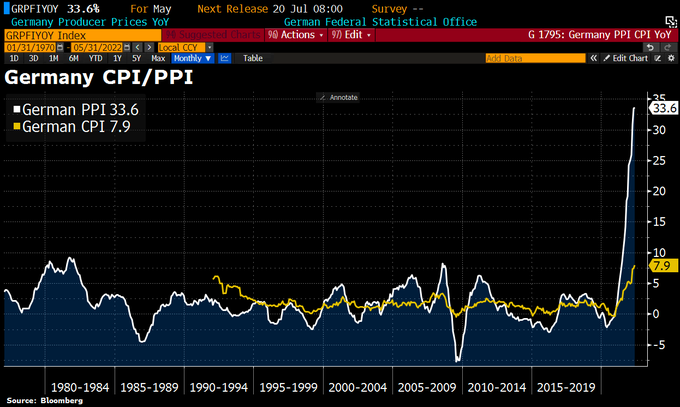
German producer price inflation in May.
German trade balance:
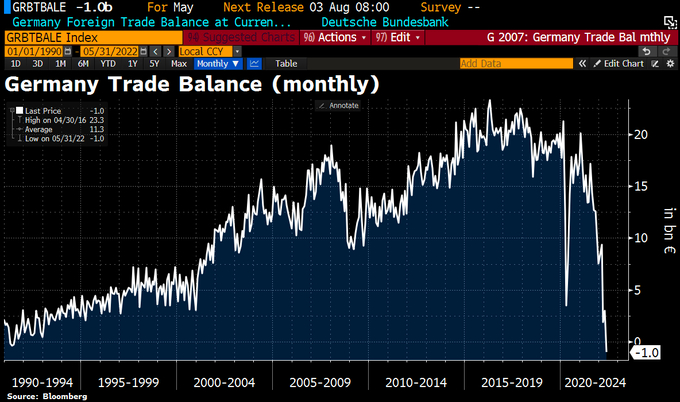
Hey, the first negative trade balance in 30 years. Of course, it’s not very negative yet, but wow, that’s a decline.
Top German industries could face collapse because of cuts in the supplies of Russian natural gas, the country’s top union official warned before crisis talks with Chancellor Olaf Scholz starting Monday.
“Because of the gas bottlenecks, entire industries are in danger of permanently collapsing: aluminum, glass, the chemical industry,” said Yasmin Fahimi, the head of the German Federation of Trade Unions (DGB), in an interview with the newspaper Bild am Sonntag. “Such a collapse would have massive consequences for the entire economy and jobs in Germany.”
The German economy is essentially mercantalist. The Euro, because it includes countries which are net importers, has been undervalued. The Germans bought cheap materials, made them into high value goods and got pretty rich.
Now the Euro collapsing (it’s almost down to even with the dollar), but it’s not collapsing enough and in any case there’s a problem, one which has been forgotten in the global order.
Physical objects, like natural gas and aluminum and oil and so on are dug up in certain places, refined in other places and shipped thru specific pipelines or on specific trucks over specific roads, or specific trains over specific railroads. They cannot be magically replaced if you cut off a large supplier, and even when they can be replaced they may cost a lot more money and the replacement isn’t instant, as with buying US natural gas.
The PPI increase is “if you can even get it.”
Germany is a manufacturing state which does not have a lot of natural resources in its own borders. It must be a trading state, and Russia was the cheapest place to get a lot of what it needed, plus there isn’t enough excess on the global market to make every good and even when there is it requires logistical solutions (ports, ships, rail lines, refineries, etc…) which are not in place.
Meanwhile the EU has sanctioned goods coming from the Chinese province of Xinjiang. It turns out that Xinjiang produces about half of the world’s supply of polysilicon, which is the primary ingredient in solar panels.
It is to laugh.
Germany is committing economic suicide over Ukraine, and Germany is the industrial heartland of the EU.
Some bottlenecks just aren’t going to be broken without some sort of deal or cut-out, the supply isn’t there.
Others can be dealt with by paying more, some will require money and time measured in years. Europe is going to wind up going nuclear, there’s no other way to make the numbers work. (So will Japan and many other nations.)
But overall the people saying that the EU was hurt more by Russian sanctions are correct.
Now don’t think this is anti-democratic: polls show that most Europeans want to cut off trade ties with Russia.
But we’ll see how they feel as they take the hits required to do so.
I spent a fair bit of time staring at this graph yesterday, and I want to return to it, because it says some very important things about what’s coming up over the next decades.
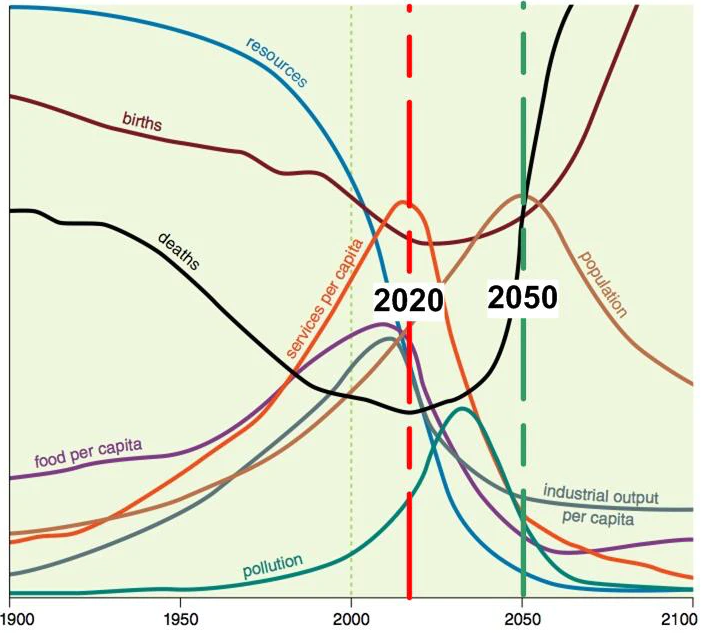
The first thing to understand is that the future is, as William Gibson has noted, unevenly distributed. Sri Lanka is currently all-out collapse, for example.
The chart above is GLOBAL. Regional charts will be similar, but not identical and the time axis will differ. Some regions will collapse slower, peak later and so on.
The first thing I want you do is find the population line. Notice that it peaks in 2050.
Now, find the services per capita line. Peaks about 2020.
Now, the industrial output per capita. Also peaks about 2020.
And now look at the food per capita line, same thing.
But it’s not the peak that matters, go back and look at what happens after the peak.
Now, go back to those three lines and see what they do after 2020.
Not quite vertical declines, but very very steep.
Look at the food per capita line now. Go to the very right of the chart, then to the very left.
Somewhat under half the food per capita in 1900 will be produced in 2100. Move back a little and you’ll see it actually bottoms around 2060, then slowly recovers.
All three of the production lines have precipitous declines. The industrial production line manages best, winding up around a 1950 number, but remember that most of the world was not industrialized back then, just Europe, Japan, and North America. This is a world number. Next, consider the primary industrial nation today is China: don’t assume that it’s Europe and North America who will necessarily be the one with the big chunk of the remains: it isn’t going to be just a reversion to 1950 (especially considering the food collapse.)
Services come off the worst: services are, in most cases, luxuries. If we want to keep the important services like health care and education we’re going to have to prioritize them and be ruthless about cutting service crap we don’t actually need.
As for the good stuff, pollution peaks around 2035 in this model. Sounds promising and it is, but the problem is that we will be past self-reinforcing cycles at that point: methane release from permafrost for example, so climate change will continue. And as people become desperate for food, and they will, every wild animal, including the fish, and anything else edible will be plundered, so ecological collapse will continue and even accelerate.
Population doesn’t peak till 2050 in this model. Look down to the food line and you’ll see that food per capita recovers when population declines. In part this indicates a semi-permanent change in the Earth’s carrying capacity: some will recover, over time, but for a long time it just won’t be able to produce as much food for us.
Now, flip over to the death line. It goes vertical in the 2040s. Of course, the Club of Rome couldn’t model Covid, so I suspect we may get there earlier and the plague may help a number of these lines be somewhat better, ironically.
But do notice that when the death line goes vertical, it’s damn near at 90 degrees. A LOT of people are going die.
The population, death and birth lines indicate that deaths are driving the population decrease. I’m hoping that the births line is wrong, it goes vertical not long after the deaths line and that’s why the food per capita numbers remain abysmal. If we want to have even semi-decent conditions for most people we’re going to need decreasing population for quite some time. I’ve seen estimates that the world carrying capacity may crash as much as 80%. Hopefully it won’t be that bad, but if most of the tropics are uninhabitable we’re in a world of hurt and every estimate I’ve seen is that climate change takes away far more agricultural land than it creates farther north.
All of that before we get to the permanent damage done to our supplies of fresh water, which is a definite limiting factor. Even if we make desalinization work, well, there’s a lot of land that’s nowhere near the sea.
This is a chart you should spend time with, till it soaks into your emotional bones. Look at the shape of those curves.
This is civilization collapse. It is going to be very bad, much worse than most people expect.
The collapse has begun, worldwide. It’s not evenly distributed, but it’s here.
We are post peak. Plan accordingly.