The horizon is not so far as we can see, but as far as we can imagine

Author: Ian Welsh Page 116 of 437

The Basic Pattern to Most Meditation

There are hundreds of types of meditation — maybe thousands. But most of them have a simple pattern.

1) Do something.

2) When you notice you aren’t doing that thing, go back to doing it.

Breath meditation:

  1. Follow the sensations of your breath.
  2. When you notice you aren’t paying attention to your breath, go back to paying attention to your breath.

All types of concentration meditation are similar. Here’s mantra meditation:

  1. Say a mantra (a series of words) over and over again, either out loud or mentally.
  2. When you notice you aren’t saying the mantra, or aren’t paying attention to it, go back to the mantra.

Discursive meditation (beloved by Western ritual mages, but not exclusively):

  1. Pick something to think about.
  2. When you notice you aren’t thinking about it, go back to the last thought you had that was on topic and continue.

Vipassana:

  1. Sense a feeling in the body. Mentally say what it is: “itch, pressure, warmth, happy, love, fear, hatred.” Go on to the next sensation you notice.
  2. Notice you are no longer doing the above, go back to it.

Loving-Kindness:

  1. Find or generate a loving feeling.
  2. Concentrate on that loving feeling.
  3. If you notice you aren’t concentrating on it go back to it. If you notice it’s gone away, generate it again.

Do-nothing meditation (just sitting, Mahamudra, etc…):

  • Don’t try to control your attention.
  • Notice when you are are controlling or intend to control attention. Don’t.

Of course there are details, and techniques and subtleties, but if you just remember “do something, notice I’m not doing it, go back to it” and stick to it you can make a lot of progress. This also means that you shouldn’t switch meditation types mid-season — that would break the “go back to it” part.

Notice here that the important part is “notice when I’m not doing it.” This develops “meta-attention” which is the ability to know what you’re doing. It may seem like you know what you’re doing all the time, but a few minutes of attempting to concentrate on your breath or an object should convince you otherwise.

This also develops your ability follow your intention; it trains your mind to do what you want it to do. All we really have is our intentions, but, as we know from when we decide to do something and fail, it isn’t actually easy.

Now, of course, what you intend to do and do matters. Different types of meditation have different effects. But most types of meditation have a loop which is, at its heart, really this simple even if you intend to do multiple things, like sit in a specific way, or have the tip of your tongue touching the roof of your mouth and have your hands resting on your knees with forefinger and thumb touching while doing nothing else, or concentrating on your breath or whatever.

The basics really are this simple, though the permutations are vast.

DONATE OR SUBSCRIBE

The Law of Equal Treatment

Last Friday, I wrote an article on the idea that if a society has a rule or duty, it must apply that to everyone in the applicable situation, no matter who they are, even if it’s someone you love. It was interesting to me that most of the commenters disagreed. Perhaps this is my fault, as I chose to use the famous example of a German general executing his own son for abandoning his sentry duty to fight and win a small skirmish, though I think this speaks partially to people not understanding how important sentry duty is — a group of soldiers ambushed in an encampment because sentries fail tends to get wiped out.

But whether the rule was reasonable or fair was NOT THE POINT. The point was that, if you have a rule, it must be enforced for everyone in the same situation. This can be a punishment, as in the example, or it could be a reward.

And that everyone isn’t just about people you love, it’s about you.

Ask yourself this: For what crimes, if you committed them, would you turn yourself over to the police? Those are the laws you actually support. You don’t support any other criminal laws, no matter what you say. This exercise may be a little hard, because most people support laws because they lack the imagination to conceive they would break them or be caught if they did, but give it a shot.

The law that everyone in the same situation should be treated the same is almost the most foundational law of a good society. Finland often ranked as having the world’s best education system. A researcher asked someone involved in designing and setting it up about how they did it, and they replied that hadn’t been the intention; they were trying to make sure that everyone was treated equally.

Again, though they didn’t say it, “in the same situation,” that clause is very important. If your kid is disabled in way X, they get treated the same as a rich or powerful person’s kid who is disabled in the same way. You can use power or money or connections to get better treatment, and not having money, power or connections doesn’t mean you will be treated badly.

There is a famous quote from Anatole France:

The law, in its majestic equality, forbids the rich as well as the poor to sleep under bridges, to beg in the streets, and to steal bread.

These are bad laws, because they don’t acknowledge context. A better law about sleeping outside on another’s property might be that only those who have nowhere else to sleep can do this — with exceptions for camping and whatnot. Or, perhaps we would assume that if someone is sleeping outside they have a good reason, and when we see someone doing so in an odd place (a.k.a. not camping) we ask what the reason is, then get them some decent shelter if it’s because they have nowhere else. (As opposed to sending them to a homeless shelter, where theft and assault are common.)

If someone steals basic food, well, again, probably they need help because they’re hungry, and sending them to prison probably isn’t the best answer to the issue. In this case, the law might be that those who steal food and are found to not have the ability to otherwise feed themselves are sent to a social worker, not prison, and the state reimburses the business. Or perhaps a decent system of social support makes this sort of thing virtually not a problem. People who are old enough will remember that food banks were almost unheard of before the 80s recession because most countries had decent welfare system, and the chronic street people (of whom there were far fewer) were helped by soup kitchens run by a few large private organizations.

All of this is important. This is so basic that if it isn’t grasped, having a decent society is essentially impossible. Everyone must be treated the same in the same circumstances. Everyone. The poor and unconnected must be treated well when the rules say so, and the rich and powerful and connected must be treated badly when the rules say so. (Doing so is the best way to fix evil rules, by the way. Enforce them against the powerful.)

There’s a step beyond this, a prescriptive step. We’ll touch on that in a later article.

DONATE OR SUBSCRIBE

How to Deal with Anxiety and Trauma Using Meditation

One of the common pitfalls of “mindfulness” meditation is that practitioners become very good at noticing sense objects in their body. (More simply: feelings.) Now, if those feelings are negative, that can lead to more anxiety and fear, and if you contact the emotions around a traumatic experience, you can be re-traumatized; the trauma can become worse.

Understand how the mind works. When something bad happens, the mind brings it up again and again as a warning; “This was bad, you should watch out for it.” The mind is trying to be helpful (our minds/brains are not that smart, but they are trying to help).

If, when a negative feeling comes up, you don’t react to it, or you react with warmth/love/security, it weakens. If, on the other hand, you are upset, and you add an additional negative load to it, your mind thinks, “Oh my, this is still a danger, I should bring it up more often and stronger.”

So the key to using meditation to help with trauma and anxiety is to not react, or to react with warmth, love, or indifference.

This means that mindfulness and Vipassana meditation styles should not be used alone. A concentrated mind (from shamatha: concentration on an object like the breath or meditation, or a loving mind, from Metta or something like puppy meditation will react more calmly or even with warmth.

When that happens, the underlying anxiety or trauma weakens. Repeated applications will reduce it a great deal.

This means that you should always do more concentration and loving kindness meditation than Vipassana or mindfulness — at least a 2/1 ratio, and do shamatha and loving-kindness before you do vipassana. I suggest concentration first (breath or mantra are easiest for most people), then do mindfulness or vipassana.

If you contact an emotion you can’t deal with, immediately switch over to concentration, then after a few minutes, go to loving-kindness.

DONATE OR SUBSCRIBE

Open Thread

Use to discuss topics unrelated to recent posts.

What Is Right for Those You Love Is Right for All


Trial of Titus Manlius’s Son

The Roman Consul Titus Manlius Imperiosus Torquatus was at war with the Latins. He instructed that anyone who disobeyed orders would be executed. His own son, and some companions left their sentry posts to skirmish with some enemies, defeated them, and returned to his father with the spoils. Seeing that his son had left his post (leaving a sentry post is particularly bad), he had him executed for disobeying orders.

Now, if you think Manlius did the wrong thing, we disagree.

“If you would do it to your son, daughter, spouse, or parent, you should do it to anyone.”

This is a fundamental rule. If someone random does something, and you would punish or reward them, then if you don’t act the same to those you care about, you are unsuited to have any authority, private or public.

Everyone has a father and mother. If you’d kill someone else’s child, or imprison them, or otherwise hurt them, then you must do the same to your child in identical circumstances. The same is true of reward: If you’d reward your child, and someone else is under your authority, they must be rewarded the same.

This is true beyond immediate authority, though: If you believe that people should be killed if they murder, you must support that for those you care about. If three crimes, no matter how petty, means 20 years in prison, then if someone you care about commits three crimes, they, too, must serve those 20 years.

Anything you would not do to someone you love in terms of punishment or reward, you cannot do or support doing to anyone else. If Manlius would have executed anyone else for disobeying orders, he had to execute his son.

The application of this to larger issues, like those who vote for war not sending their children, and those who will never be affected by a law voting for it are left, for the moment, to readers to work through.

DONATE OR SUBSCRIBE

When the Profit Motive Is Unnecessary or Harmful

Markets are good for some activities, but for others they are actively harmful. There are a lot of jobs that people want to do, and all you have to do is give them a decent salary and whatever tools are necessary, and they’ll work hard. A good example is curing cancer, or, indeed, most medical research. People love the idea of helping people and saving lives. As long as they know that, if they do cure whatever it is, they can move on to curing something else (i.e., their economic welfare is not dependent on not solving the problem), they’ll bust their asses.

On the other hand, if the profit motive is involved, some problems don’t get solved. If you’re a pharmaceutical company, you don’t want to cure diseases: You want to sell a pill, shot, or treatment that people have to take over and over again. You want to develop palliatives, not cures. Using for-profit companies to try and cure something, including Covid, is deranged. It would cost them hundreds of billions of future profits if they actually cured the plague or cancer, or anything else.

This is also why, when they do come up with actual cures, they price them massively high. After all, you only get to sell a cure once to each patient.

People like doing useful work. What you have to pay people for is to do bullshit work, and the more bullshit it is, or the more harm it does, the more you have to pay them. Meanwhile, work that is good and useful is underpaid, or not paid for at all, because our economy tries to free ride on the fact that people will do that work for less or nothing.

Doesn’t quite work — because no matter how idealistic you are, you need to eat, pay rent, and sock away some savings, and so work that is genuinely important goes undone, and Wall Street pays multi-billion dollar bonuses.

Capitalism thus often optimizes for activities that are actively harmful, or unnecessary, and actively makes it hard to work on what is important and good.

DONATE OR SUBSCRIBE


Are Our Elites Starting to Get It?

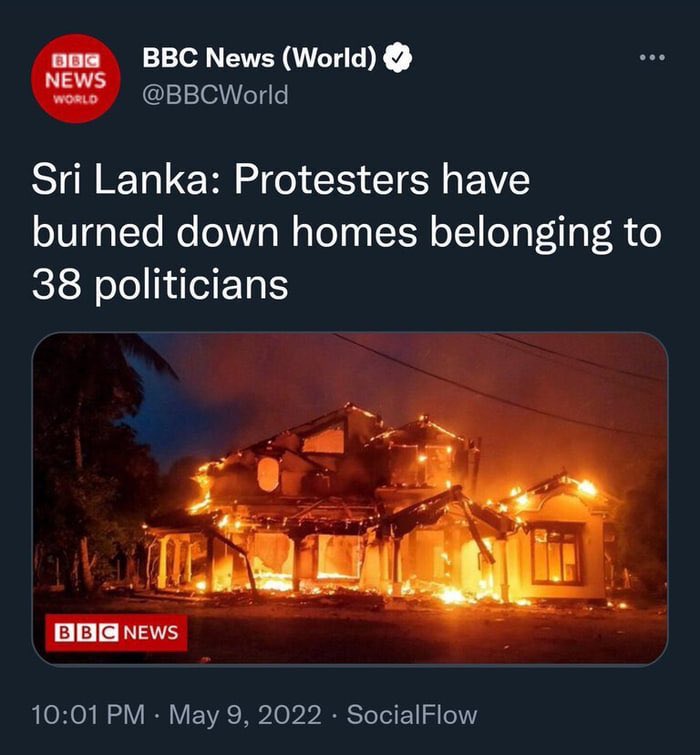
Back in May, in Sri Lanka:

Recently, they also burned down the President’s home.

Meanwhile, the Canadian government:

The tax will apply to new cars and aircraft with a retail sales price over $100,000 and to vessels over $250,000. It will be calculated at the lesser of 20 percent of the value above a set threshold ($100,000 for cars and personal aircraft, and $250,000 for vessels) and ten percent of the full value of the item subjected to tax.

And the US Senate’s Climate bill, which Manchin approved:

The bill includes $60 billion to boost domestic clean energy manufacturing, including $30 billion in production tax credits for solar panels, wind turbines, batteries and critical mineral processing. It also offers lower- and middle-income motorists a $7,500 tax credit for clean vehicles, while states and electric utilities would see $30 billion in grants and loans to expand clean energy. The bill also includes $60 billion for environmental justice communities and a fee on methane emissions that will rise to $1,500 a ton by 2026.

All of these are what I would class as “good news,” though insufficient. Adam Smith once quipped that “there is a lot of ruin in a nation,” but a country like Sri Lanka has less ruin than many others. England’s decline could be considered to have begun in 1914, and it’s only this decade that they’re likely to lose Scotland — and it’ll be a while yet before Brits start burning down toff mansions wholesale.

The problem with Sri Lanka is that almost all of the debt which is crippling it is to Western institutions, not to China (which is at about ten percent), but China is the country which will wind up bailing it out after the initial IMF stopgap, because China needs a stable country to have a naval base in. If India was smart, they’d step in instead, to deny the Chinese the base. As for the West, they don’t care and just want their money. China is likely delaying in part because they’d rather not send a ton of money to the West by paying for Sri Lanka’s debt.

Elites finally seem to be starting to understanding that climate change is serious, and that the rich are out of control. I think that the rich will come to regret the Russian oligarch sanctions hunt, because it taught everyone how easy it actually is to take everything from rich people, a lesson of the post-war era which has been forgotten because most who remember it are old or dead.

This is all very slim “good news.” With respect to climate change, I am of the opinion that we will not hold it at two degrees C, though some climate scientists disagree. I have found that the more “pessimistic” forecasts have consistently been more reliable, and I believe that self-reinforcing cycles, such as methane release from permafrost and swamps, and the destruction of most of the world’s remaining great forests, have been triggered. We can and should mitigate climate change by reducing emissions, but we have left it too late to contain catastrophic climate change. (I also expect a couple of marine inundations this century (colloquially, great floods) — and earlier than most people think likely.)

As for the rich, they’re still in control, but that control is unlikely to remain as firm as they expect. They were warned of this many times; that they couldn’t allow rampant inequality, poverty, catastrophe, and gouge on necessities like water, food, fuel, and life-saving medicines and expect to escape unscathed.

They key variable to watch is food, or rather, hunger. When people can’t eat (or drink), social controls break down. The Chinese understand that; every dynasty has known that if they didn’t feed the people, they were in great danger, and the Communist dynasty (that’s what it is, and it’s still essentially “rule by bureaucrats”) understands it as well. The Indian government, on the other hand, obsessed with fucking over non-Hindus and cleansing the country, seems to have forgotten.

The West, as a whole, has a great deal of agricultural surplus, and it will take some time for hunger to really hit, unless neoliberal ideology blinds politicians to the danger of continuing to allow rampant food inflation. If people can’t afford to eat, it’s the same as there not being enough food for them, and hunger leads to people with little to lose.

Interesting times, etc. Might as well enjoy the show as best we can, because we’re going to suffer through it as well.

DONATE OR SUBSCRIBE


Open Thread

Use to discuss topics unrelated to recent posts.

Page 116 of 437

Powered by WordPress & Theme by Anders Norén