The horizon is not so far as we can see, but as far as we can imagine

Author: Ian Welsh Page 115 of 437

Weberian Meaningful Action & Why It Matters

Weber was concerned with ideal types. An ideal type is an extreme: a person who is entirely rational, a society that is entirely traditional. Ideal types don’t exist in the world, but they are useful for analysis. A society may be primarily traditional, and one can look at where it is traditional and where it isn’t. (For example, a lot of Dark Ages society was traditional, but there was also a lot of value rational action.

The four types are goal rational, value rational, affection/emotional, and traditional.

Goal rational is “I want to accomplish X, so I do Y. You want to lose weight, so you diet. But this is a good example of how goal rational can be mixed up: how you achieve the goal is dieting, but whey you want to be thin could be because you think fat people are bad, or you want to look better, or because people in your organization are usually thin (ascetics, for example.)

Value rational is similar to virtue ethics. You tell the truth, even if it’s bad for your other goals, perhaps. You give money, because charity is a value you follow. You stand and fight because you believe in bravery or discipline, even though the fight is helpless. Classical Greek ethics is heavily value rational, and so was a lot of Victorian ethics and society. When someone says we should give everyone health care or no one should be in poverty, because everyone human deserves dignity, that’s value rationality. When you say that everyone deserves health care because it costs society less and because it makes the spread of plagues and disease less likely, that’s goal rational.

Affective/emotional is when you act based on your emotions. You’re sad and you cry, you’re angry and you hit someone or scream at them. You might hit someone even though you believe in non-violence, and you might cry even though you believe “real men don’t cry.” You might hit someone even though that will get you in prison, and that would interfere with your various goals in life. Your emotions are in charge.

Traditional is when you do it that way because that’s how your group or society does it. Dark Ages and Medieval society was very traditional: your forbears had certain rights, it’s traditional, and thus you get them too. Correct action is the action which has always been taken. Religions are often torn between value rationality and traditions, but so are nations. Whenever someone says, “this is how we’ve always done it” you’re dealing with traditional action. Traditional action has a bad reputation post-enlightenment, but it’s not all bad: unwritten constitutions are traditional constitutions, “we do it this way because we’ve always done it this way.”

Traditional isn’t necessarily irrational: if something has been done for a long time, it may be because it has worked, and making changes could have unforseen effects. If you keep doing what you’ve always done, things will keep going as they have. Of course, it doesn’t always work: burning fossil fuels because we’ve been doing so for 250 years is a good way to create radical change: not what someone who genuinely values tradition usually wants.

All types of action have value. Goal oriented is often the best way to actuate the other three, but it’s amoral. The Nazi bureaucrats making the trains and furnaces run on time mostly did so not out of any real belief in the holocaust, but because their primary value was to do what they were told to do in the most efficient and effective way. Confucius emphasized that if you do a traditional ritual without feeling the appropriate emotion (sorrow at the death of your parents, for example) you have failed the ritual, since the purpose of rituals is to create emotions in specific circumstances: and those circumstances and emotions are based on values, such as reverence for your parents.

So when you try to analyze actions using Weber’s classifications, what you’re looking for is how the types of action fit together. If traditional actions aren’t maintaining the society or group, traditional action is undercutting itself, for example. Is a goal based action leading to a goal supported by one of the other three types of action? Are your value based actions undercutting the larger goals, and if they are do the values or the goals need to change?

But also, if you know why someone is doing something, you can talk to them effectively. Saying the only way to save our society is to burn less fossil fuels works with a traditional actor. Saying that burning fossil fuels hurts more people than it helps may work with someone value oriented who thinks compassion, kindness and charity are important. And to activate people who are primarily emotional, pictures and stories of animals and humans being hurt might work best.

Without an understanding of the type of action, the type of rationality, you can’t understand others’ actions or influence them effectively, especially if they are acting from a type of rationality you don’t respect and you can’t predict their actions.

People are different; societies and groups are different, and understanding the the ways in which they are different opens up the world for you.
DONATE OR SUBSCRIBE

Open Thread

Use to discuss topics unrelated to recent posts.

The Trifecta+ Which Will Make The Next 100 Years Hell

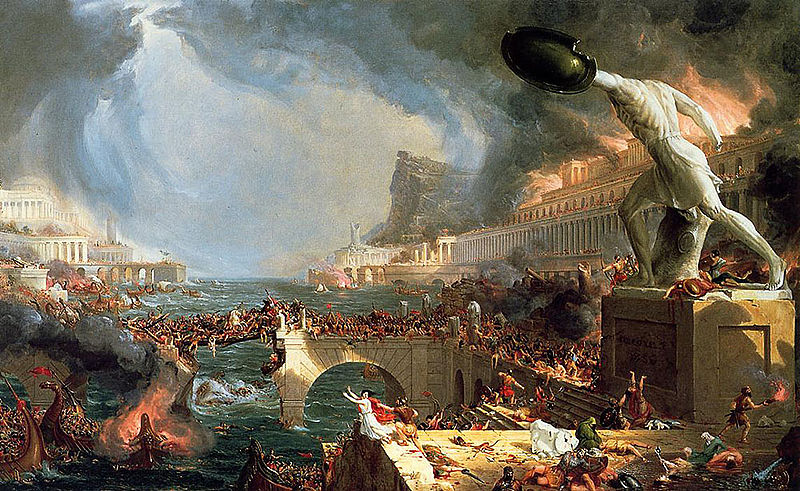
The Course of Empire by Thomas Cole

The Course of Empire by Thomas Cole

We have three major challenges all coming to peak close to each other.

Or possibly four, depending on how you define your terms.

First: the end of a sub-ideological era. Neoliberalism is on its last legs, just as New Deal liberalism was in the 70s. Ends of sub-ideologies tend to be tumultuous and it’s worse when it’s the end of a fundamentally extractive sub-ideology like neoliberalism, than it is with the end of a “building” ideology like the New Deal which worked to strengthen people, regulate companies and build vast human and inanimate infrastructure.

Neoliberalism was, fundamentally, the realization that all that build-up led to a huge looting opportunity. Get rid of the regulations, stop enforcing anti-oligopoly laws, force massive asset bubbles and those on the inside could get stinking rich.

The New Deal was a reaction to the problems created by a certain type of exploitative capitalism: a “we can’t allow this sort of abuse”, where neoliberalism was “man, abusing people, and destroying/privatizing institutions makes a lot of money.”

So, the 70s sucked, but they were nothing near as bad as the great depression and WWII.

But that’s also because the transition to neoliberalsim did not coincide with—

Second: the end of a hegemonic era. 1914 to 1945 is the end of not just British but European world hegemony. At the end WWII the USSR and US divide Europe in half, with the US controlling the Western half and the USSR the eastern. That the America glove was often velvet, did not change the fact that there was a steel gauntlet underneath (look up Gladio, as an example.)

The death tolls of WWI (21m), II(50m) and the Great Depression (uncounted), plus the anti-colonial wars, famines and the Japanese conquests(14m) and colonial wars is in excess of a 100 million. At the end of WWII, the world population was about 1.33 billion people. That’s a lot dead people and we aren’t counting all the people who were maimed, impoverished, made into refugees, raped or tortured. Nor are we counting the USSR pogroms (we probably should) or the colonial famines (we probably should.)

Hegemonic powers do not go easy into the sunset, and the more powerful they were, the harder they die.

But although there were some serious environmental problems in this era (the dust bowl, for example), the simultaneous end of the hegemonic and sub-ideological cycles which occurred in the early 20th century (which includes communism), didn’t have what we have coming—

Third: a worldwide environmental crisis which will reduce the Earth’s carrying capacity semi-permanently. At best reversal will take hundreds of years and be partial, because we aren’t going to be able to un-extinct all the species we’re killing and the depth and vibrancy of the ecological web is a huge part of Earth’s biological carrying capacity.

So, we can reasonably expect that a significantly greater proportion of the Earth’s human population will die during the upcoming period and more people will be impoverished, tortured, raped, turned into refugees and so on. It is not impossible to imagine a scenario where that didn’t happen, but it requires human social groups to act with decisiveness, wisdom, compassion and forethought which have no precedent in human history I am aware of.

These is what I’ve partially labelled in my categories as “The Age of War and Revolution” and “The Twilight of Neoliberalism”, but they are much larger than that.

Now there is also a larger cycle coming. You’ll note that I kept calling New Deal Capitalism and Neoliberalism sub-ideologies. They’re both capitalist ideologies, and the capitalist world-system has been around since the late 15th century, blossoming with the industrial revolution into a global world-system. Previous to this, contradicting the name, most world-systems didn’t cover the entire globe, but capitalism did. Even communism was part of the system (that’s an entire other article, but the USSR was not in autarchy and was forced to play the game by capitalist world rules.)

Capitalism is ending. There are a bunch of reasons (follow the prior link), but one big part of it is simply that it’s going to have been seen to have failed and be blamed by everyone for the environmental crisis (it’s not just a climate crisis, ecological collapse is at least as important). Democracy stands a chance of getting it in the neck too.

We aren’t just going to be changing sub-ideologies and swapping hegemonic powers and dealing with an enviro-collapse; we are going to be changing how we fundamentally run our societies, because it is almost certain that you can’t be capitalist and fix the environment, and in any case, again, capitalism will totally be discredited by all the deaths and catastrophes during this era.

Likewise, we are going to have to transition from the hydrocarbon era which has run since near the start of the industrial revolution because we cannot fix our environmental issues and have hydrocarbons be our primary energy source.

So, depending on whether you count the transition from capitalism to whatever, we’ve got the end of 5 eras or so. (WWI to II also saw a sub-transition in energy, from coal and steam engines to oil and internal combustion.)

This is compounded by the fact that end of sub-ideological and ideological eras always occurs with fanatically incompetent elites in charge. The classic western example is the fall of Rome, but look at the Weimar Republic, at Hoover, at Nixon/Ford/Carter and so on. The generations who created the previous system are dead or out of power and their heirs are boobs who don’t know how to repair their system. When the Lost generation, the last generation to remember the 20s, not just the great depression) died, a subset of the GI and Silent generations then destroyed the New Deal, both negatively (unable to deal with the oil shocks) and positively (Reagan/Thatcher/Friedman, etc..)

The people in charge now are radically incompetent at everything except internal power games. They are good at accumulating money and staying in charge and bad at everything else. They cannot fix any problems, at best they mitigate, and their mitigations (such as central banks printing money in response to the 2008 financial crisis) make underlying problems worse. On top of simple mechanical incompetence, they are also unimaginative: they cannot conceive of different ways of running society. Even when there are partial exceptions (Chinese leadership handling Covid semi-competently is an example) the elites can’t see their way to ending the ideology (capitalism, and yes, China is a capitalist mixed society) which is destroying the conditions for its own existence.

So this is where we are: the end of an ideological era; the end of a hegemonic era and a huge environmental crisis, all of which can’t be handled without fundamental ideological and leadership changes and which an reasonably be expected to kill billions of people while we “figure” or “fumble” it out.

Welcome to the fin de siecle. More than one. Enjoy the fruits of decadence while they still last.

DONATE OR SUBSCRIBE

You Don’t Have To Be Upset

Terrible things are happening all time. Right now, as you read it, people are suffering in monstrous, awful ways. Many, many people.

That’s how it is. That’s how it has always been, and as long as there is life of the type there is on Earth, that’s the way it will be. Human and many animal bodies are built for pain and suffering, and not only are we often astoundingly cruel to each other, but accident, disease and the infirmities of old age will scourge us till we, perhaps, become homo-deus.

One of the wisest things I ever read was a 90+ year old who met their spouse to be at the gym, when they were both in their 90s, who said, “neither my (spouse) nor I spend one second worrying about anything we can’t control.”

And, if you can control something, there’s no reason to worry about that.

Bad things are happening all the time. But if you get upset about them, you aren’t helping: your being upset doesn’t make the situation better.

What it does do is make you suffer. All you’re doing is making the world worse, for yourself.

This is one of the most important things I’ve ever written, so re-read the above two paragraphs and think about them.

Much of our sympathetic suffering is because we think that we should be upset, or angry, or worried. Having the emotion either feels like something a good person would do (and we want to be good people) or it feels like, in itself, it is taking action.

Or both. Read that last paragraph again.

There are absolutely situations where feeling bad is wise: they are almost all where you are with someone else who is feeling bad, and your sympathetic misery lets them know you care.

But even in such situations, staying miserable is rarely helpful to the other person. Getting in sync with them, then helping lift them out sometimes works and sometimes what they need is just your misery with them.

But when you leave their presence, being miserable doesn’t help them, and it hurts you.

You also don’t need to feel bad to take action. You can do something to help people who are suffering without having to suffer yourself.

The best states to help from are usually compassion or love. Those states are good for you and good for the people  you’re helping.

But first don’t make the world worse by suffering when your suffering doesn’t help.

This is a real disease in our society and it is made worse by 24/7 global coverage of bad shit. There’s always something terrible happening and you can always find something to feel terrible about. Our sympathetic mirroring of others emotions arose when we lived in small bands, it is not adapted to an internet world where we identify with people we’ve never met and never will.

But to break this habit, to stop hurting yourself, you have to internalize the logic that not feeling bad when bad things happen, especially bad things when you’re not there, does not mean you’re a bad person and you need to split the idea of “feeling” from taking action to help. (And, after all, most of the time you aren’t going to do anything, and often you effectively can’t do anything: there’s just too much evil.)

To do this, to break these connection is the ethical and moral action, because hurting yourself is not required in most cases to help others, so all you’re doing is increasing the world’s suffering. As the Buddha supposedly said, “your compassion is not complete if it does not include yourself.”

Please stop hurting yourself needlessly.

DONATE OR SUBSCRIBE

Collapse Of Water Supply For Countries Around Tibet

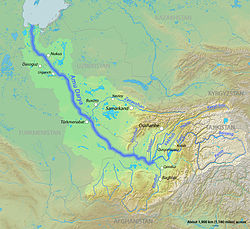
Amu-Darya Watershed

Tibet is a water tower; its glaciers, snow packs and lakes are the source of many of the greatest rivers in the countries around it. Two of those are the Indus river in India and Pakisatan, and the Amu-Darya which flows along the border of Afghanistan.

A recent study predicts:

large declines under a mid-range carbon emissions scenario by the mid-twenty-first century. Excess water-loss projections for the Amu Darya and Indus basins present a critical water resource threat, indicating declines of 119% and 79% in water-supply capacity, respectively.

Wait? Over 100%?

Anyway, this sort of thing is why I’m so negative on prospects for India and the areas which rely on the Tibetan glaciers and snow pack for water, which includes much of China, Thailand and Vietnam (the Mekong) as well. Note that this same process is occurring elsewhere: in the European alps, in the Rockies in North America, and in the rivers fed by the great northern glaciers of Canada.

What happens here will lead to denialist stupidity: the increased heat will, in some areas, lead to some years where there are is MORE water, and floods and so on, until the glaciers, in particular, collapse. So we are likely to alternate drought with floods, until the rivers just dry up, and many of the lakes with them.

When the Tibetan water tower collapses, the countries around it will be devastated. The West of North America will suffer a similar fate, though those on the coast may be able to replace much of the water with desalinization (it’s expensive, but the numbers I’ve seen indicate it’s doable, especially if you decide to stop growing almonds and other water expensive crops), but those on the wrong side of the Rockies, or high up, are pretty much out of luck. The East is in somewhat better shape, but the Great Lakes, which are close to stasis anyway, will be put under great pressure and if we try to use very much water from them we will easily drain them.

On the other side of the equation, rain patterns will shift. Hotter air means more rain, generally speaking, but where it goes is likely to change. It’s reasonable to suppose that the Sahara might get monsoons again, for example, but we just don’t know the full effects. If the monsoon fails in any region, that region will be devastated.

Add to this the massive drainage and poisoning of aquifers, including in North America, India and China and we have a situation where it is entirely reasonable to expect an absolute collapse of food production. I suspect, as I’ve discussed in other articles, that as per the “Limits to Growth” modeling, we’re about at the per capita food production peak, though not yet the absolute peak.

This stuff appears to be me to be baked in. It would require much more radical restriction of CO2 and other climate change gasses than we are doing or likely to do to stop it, and there’s some reason to believe we may be at the point where processes are now self-reinforcing, as with methane release from permafrost and swamps and the Amazon becoming a net emitter of carbon rather than a sink. As these new sources emit, they cause climate change no longer directly driven by our current actions and in doing so cause more emissions and that loop will come to drive more and more change.

That’s the situation. If we keep deaths to a billion people, that would be an extraordinarily good result, because these processes will also drive political change, including vast amounts of violence and waves of refugees which make the puny European refugee crisis look like a pygmy.

Welcome to the future. It’s here, and it’s going to get much, much worse.

DONATE OR SUBSCRIBE

The Espionage Act Is Bad Law Even When It Is Used Against People I Despise Like Trump

Back in June 2019, the New Yorker wrote an article lambasting the Espionage Act.

The George W. Bush Administration pursued several government insiders for leaking classified information, but it was the Obama Administration that normalized the use of the Espionage Act against journalists’ sources. Among its targets were Jeffrey Sterling, a former C.I.A. officer, who was sentenced to three and a half years for supplying the Times with classified information about U.S. efforts to disrupt Iran’s nuclear program; Donald Sachtleben, a former F.B.I. agent who was sentenced to three and a half years for providing the Associated Press with information about a foiled terrorist plot in Yemen; and Chelsea Manning, a former military-intelligence analyst who was sentenced to thirty-five years for providing Assange’s WikiLeaks with hundreds of thousands of pages of classified government documents…

…(about the Trump admin) Later that year, Sessions told Congress that the Justice Department was engaged in twenty-seven investigations into classified leaks — a dramatic escalation over previous years. In the two and a half years since Trump complained to Comey, the Justice Department has indicted three people under the Espionage Act for providing information of public concern to the press.

Now, the New Yorker is concentrating on people who were prosecuted for supplying information to the press, or in the case of Assange, for publishing information (acting as the press himself.) And one can easily say “This isn’t the same thing — Trump isn’t a whistleblower.”

And I agree. If Trump has taken information and given it to a foreign power, then it’s one of the few semi-legitimate uses of the Espionage Act to go after him.

But if it’s just sat in some boxes, well, the truth is that for senior people, like Clinton (yes, a junior person would have had their career destroyed and likely gone to prison for using their own private server the way she did) and General Petraeus (who avoided indictment under the act), the law is usually an empty letter.

One might then say, well, but these are nuclear secrets and much more serious.

But all of this caviling and caveats brings out the essential point: The Espionage Act is so widely written that it’s a prosecutor’s cudgel, and the choice of whether to use it or not is a political decision, not a matter of whether someone violated the letter of the law. For most of the 20th century, after the original proscriptions (used against communists and people who opposed the draft), it was rarely used, and the choice to use it was clearly a political choice.

It’s a bad law. It shouldn’t be on the books. If it is on the books, it should be applied evenly, and in all cases, for the simple reason that using it against people with power is how it would be repealed and replaced with something much less prone to abuse. If it had actually been used against Clinton, there would have been massive pressure to repeal it.

And that’s the good thing, here. If it’s used against Trump, well, perhaps the Republicans, next time they’re in a position to do so (which could be as early as 2024), will repeal it.

Or, instead, maybe they’ll go tit-for-tat and continue with its weaponization, going after Democrats and left-wingers.

That would be bad, but it would also have the potential for good. You get rules of war and politics when both or all sides have been monsters, and they finally realize that mutual monstrosity is bad.

As for Trump, I have little sympathy. He used the law badly, and for him to be hoist on it amuses. It’s a pity that Obama, who really weaponized it, is smart enough to have not laid himself open. But if I were Clinton, I’d be concerned after 2025.

DONATE OR SUBSCRIBE

Open Thread

Use the comments to discuss topics unrelated to recent posts.

So Much Plastic Chemical Contamination in Rainwater It’s Unsafe to Drink

Sigh.

Remember when you were a kid, and it was fun to tip your head back during a rainstorm and open your mouth to drink the drops? You shouldn’t do that anymore. That’s because you’ll be ingesting too many particles of Perfluoroalkyl and Polyfluoroalkyl Substances (PFAS), the hazardous chemicals that leach from the ultra-durable plastics we’ve created for about the past 120 years.

Earth is officially past its safe zone for plastic contamination. The PFAS “boundary has been exceeded,” according to a study published August 2 in the journal Environmental Science and Technology. PFAS are known to be hazardous to both the environment and human health. At this point, these “forever chemicals” are all over the globe and have seeded the atmosphere. Most importantly, they don’t break down in the environment.

This stuff can be removed from drinking water in various ways, but that doesn’t remove it from the environment. This also implies that drinking water from most, perhaps all, freshwater sources, is no longer safe. As a child in British Columbia and the Yukon in Canada, I often drank water from snow- and glacier-driven streams and rivers, but no longer.

Health Effects:

The health effects of PFAS vary, but include reproductive, developmental, and immunological problems. Since PFAS don’t easily break down and can accumulate in the human body overtime, the more exposure a person has, the greater the chance of negative health effects. The EPA has cited evidence linking PFAS exposure to the following:

    • increased cholesterol levels
    • suppressed immune system
    • thyroid hormone disruption
    • liver and kidney damage
    • low infant birth weight
    • cancer

… PFAS can be removed from water through reverse osmosis, activated carbon filtration, and ion exchange.

Ah, joy.

This is separate from the issue of microplastics, which are now commonly found in blood and organs of humans and animals, and which some bacteria do feed on, though not enough to have a significant effect yet. (We can hope that evolution, natural or human-induced, will create more bacteria which eats plastic.)

Based on these type of studies, researchers have hypothesized that human exposure to microplastics could lead to oxidative stress, DNA damage, and inflammationamong other health problems. Particularly, when inflammation becomes chronic, this can pave the way to very serious health problems. However, it’s not only the plastic particles themselves that are potentially harmful: The microplastic surfaces in the environment are colonised by micro-organisms, some of which have been identified as human pathogens.

Human pathogens have a particularly strong bind to plastic waste, more so than to natural surfaces. Research published in 2016 identified the human pathogen Vibrio cholera, which causes cholera in humans, attached to microplastics sampled from the North and Baltic Seas.

Wonderful. I can’t find the original source, but I remember someone quipping:

“Born too late to explore the world, and too soon to roam the stars, but just in time to have microplastics in our blood.

Of course in many areas, rainwater is still too acidic to drink, so there’s that — though at least the horrible acid rain of my youth no longer plagues most of North America. We exported the industry which produces it to south-east China and various other manufacturing domiciles.

The fact of the matter is that human society is simply incapable of handling the power we’ve gained since the industrial revolution. Even when we know we’re doing massive harm, we don’t stop, or clean up, and we lie about it. In my youth, we moved from glass bottles for almost everything (including pop, as they were massively heavy) to plastic, and said “plastic can be recycled.” But most plastic isn’t recycled; only about eight percent ever has been and it’s not easy to recycle plastic because it has to be separated into different types first, since each type requires a different heat to be melted and reformed.

What’s happening, with climate, pathogens, plastic, and far more is classic “sorcerer’s apprentice” stuff: We have power we can’t control, and when we use it, we do harm.

This is why even if all the “best time ever to be alive” books and articles were right (a questionable assertion, but it is true for many people), they’re wrong in a larger sense — it’s like saying, “Man, I’m staying warm!” as you burn down your house. Once you’re finished burning your house, you’re screwed. Except what we’re burning down is the environment which keeps us healthy, fed, watered, and protected from temperatures too cold or hot to survive, as with the infamous point where it’s so hot the human body can’t cool itself.

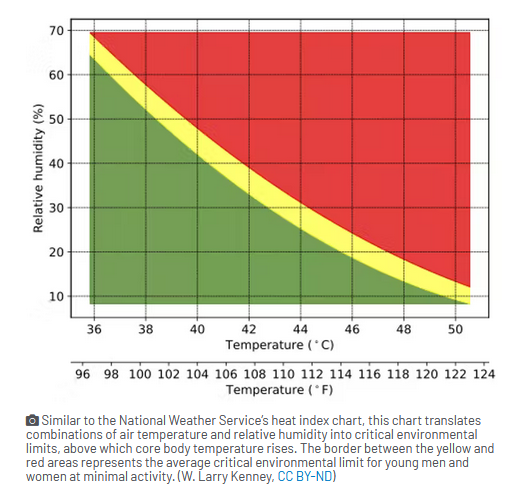
People often point to a study published in 2010 that estimated that a wet-bulb temperature of 35 C – equal to 95 F at 100 percent humidity, or 115 F at 50 percent humidity – would be the upper limit of safety, beyond which the human body can no longer cool itself by evaporating sweat from the surface of the body to maintain a stable body core temperature…

…Our studies on young, healthy men and women show that this upper environmental limit is even lower than the theorized 35 C. It’s more like a wet-bulb temperature of 31 C (88 F). That would equal 31 C at 100 percent humidity, or 38 C (100 F) at 60 percent humidity.

This temperature has been hit over the last couple years in India.

It’s a brave new world, and our descendants, and, indeed, many people alive today are or will be cursing us — and with good reason.

DONATE OR SUBSCRIBE

Page 115 of 437

Powered by WordPress & Theme by Anders Norén