
Ian Welsh

The horizon is not so far as we can see, but as far as we can imagine

UK’S Reform Party Is Poised To Destroy the Consersvatives, and Deserves To

The latest polls show Reform, led by Nigel Farage neck and neck, or slightly ahead of the Tories.

I took some time to read their manifesto and it’s pretty bloody awful.

BUT, and it’s a big but, there’s some stuff Reform is promising that no one else is offering. For example:

  • lower rents through reduced migration
  • free tuition for STEM degrees
  • lifting income tax allowance to £20,000

Farage talks about the housing crisis all the time, and these specific policies are laser-targeted at younger people.

Farage wants to stop all non-essential immigration. Britain is like Canada, there’s vastly more immigration than there is housing being created and rents and house prices have sky-rocketed. (A detailed post on that soon.) Tuition averages about $6,000 pounds a year and young adults tend to be poor and have little income.

He also wants to reduce estate taxes, go all-in on anti-trans policies, get rid of clean energy and so on. He’s still a conservative loon.

But he’s offering what neither Labour nor the Conservatives are, or can.

He has the best chance of breaking the Labour/Conservative duopoly that Britain has seen in generations for the same reason LaPen is surging, Brexit happened & Trump is viable: the status quo sucks for most people and they want radical change. Since radical change to the left was stopped with Corbyn’s defeat and the Starmer’s purge of the left from Labout, it’s now the right’s turn.

Like an animal in a leg-trap who chews its own leg off to escape, people in pain who see their lives getting worse and no hope of improvement will take a chance on something radical. Sometimes, as with Javier in Argentina, that something radical is extremely stupid, but at a certain point people will try anything.

For a lot of people in Britain, as in France and Argentina and America, the risk is worth it.

As with Corbyn, the press is now turning hard against Reform. Any change from the neoliberal status quo will be opposed with their full weight. It worked against Corbyn, but at some point it will stop working.

Reform won’t win the election, but they don’t need to. They need to replace the Tories as the second party, either in this election or the next. Once they are part of the duopoly, power is only a matter of time.

Let us hope the left learns from this and raises its own challenge to Labour, replacing it, because Reform’s policies, overall, are horrid.

Neoliberalism is dying in country after country, who and what replaces it matters.

Donors and subscribers make it possible for me to write, so if you value my writing, please DONATE or SUBSCRIBE
Week-end Wrap – Political Economy – June 23 2024

by Tony Wikrent


Strategic Political Economy

Is the 4th Amendment Dead in Cyberspace?

Tracy Mitrano [Inside Higher Ed, via Thomas Neuburger, God’s Spies, June 21, 2024]

Over a year ago former director of both the NSA and CIA, Michael Hayden, flat out admitted, “we kill people based on metadata.” He quickly distinguished between the metadata about which the debate was focused, telephone records, and other forms of surveillance metadata upon which covert actions are taken. Not surprised about the actions, I confess I was taken aback when I considered the implications that this disclosure has on Fourth Amendment jurisprudence in cyberspace.

Ever since the USA-Patriot Act in 2001, I have been harping on complications of the Fourth Amendment between content and metadata in data networking. For as many years I have hoped for a revision of the Electronic Communications Privacy Act (ECPA) to correct the discordance. In all that time, I have assumed that a restructuring of Fourth Amendment jurisprudence around these distinctions might be possible.

I no longer believe that is a reasonable fix. The advanced algorithms applied to metadata in government surveillance make metadata the equivalent of content. That is what struck me about Hayden’s remarks. Not just occasional leaks of subject lines or an Internet Protocol address that resolves to a web page found in routing records, but the sorting, combining and redefining of that data into identifiable predictive behaviors that function as the basis of military or law enforcement actions. It is in this sense that I declare the Fourth Amendment dead in cyberspace. The only way to resurrect the Fourth Amendment could be to place all data, both content and metadata, under Fourth Amendment rubric.

[Neuburger: “The Fourth Amendment is gone. It was lost in 1928. So, to the question above, will we see it enforced again — in today’s security-fed state, the answer is no.” ]


Why Won’t the US Help Negotiate a Peaceful End to the War in Ukraine?

Jeffrey D. Sachs, June 19, 2024 [Common Dreams]

For the fifth time since 2008, Russia has proposed to negotiate with the U.S. over security arrangements, this time in proposals made by President Vladimir Putin on June 14, 2024. Four previous times, the U.S. rejected the offer of negotiations in favor of a neocon strategy to weaken or dismember Russia through war and covert operations. The U.S. neocon tactics have failed disastrously, devastating Ukraine in the process, and endangering the whole world. After all the warmongering, it’s time for Biden to open negotiations for peace with Russia.

Since the end of the Cold War, the U.S. grand strategy has been to weaken Russia. As early as 1992, then Defense Secretary Richard Cheney opined that following the 1991 demise of the Soviet Union, Russia too should be dismembered. Zbigniew Brzezinski opined in 1997 that Russia should be divided into three loosely confederated entities in Russian Europe, Siberia, and the far east. In 1999, the U.S.-led NATO alliance bombed Russia’s ally, Serbia, for 78 days in order to break Serbia apart and install a massive NATO military base in breakaway Kosovo. Leaders of the U.S. military-industrial complex vociferously supported the Chechen war against Russia in the early 2000s.

To secure these U.S. advances against Russia, Washington aggressively pushed NATO enlargement, despite promises to Mikhail Gorbachev and Boris Yeltsin that NATO would not move one inch eastward from Germany. Most tendentiously, the U.S. pushed NATO enlargement to Ukraine and Georgia, with the idea of surrounding Russia’s naval fleet in Sevastopol, Crimea with NATO states….

Brzezinski spelled out a chronology of NATO enlargement in 1997, including NATO membership of Ukraine during 2005-2010….

…In my view, [the February 2014 Maidan revolution in Ukraine] was a standard CIA-led covert regime change operation, of which there have been several dozen around the world, including sixty-four episodes between 1947 and 1989 meticulously documented by Professor Lindsey O’Rourke. Covert regime-change operations are of course not really hidden from view, but the U.S. government vociferously denies its role, keeps all documents highly confidential, and systematically gaslights the world….


Global power shift

US reputation on the line at Second Thomas Shoal 

[Asia Times, via Naked Capitalism 06-22-2024]

June 17 saw the most recent and most violent effort yet by the China Coast Guard to prevent the Philippines from resupplying the BNP Sierra Madre, an old navy ship deliberately grounded on Second Thomas Shoal and manned by a detachment of sailors and marines to assert Philippine control of the sea feature.

Open Thread

Use to discuss topics unrelated to recent posts. No vax/anti-vax.

US Likely To Sanction World’s Largest Drone Manufacturer

And, it’s Chinese, of course.

The United States House of Representatives passed a ban on the future sale of DJI drones in the U.S. on Friday, making the DJI ban more likely than not. The “Countering CCP Drones Act” is part of the United States’ 2025 National Defense Authorization Act (FY25 NDAA), a major piece of yearly legislation allotting defense spending for the coming year.

Drone maker DJI is based in China and controls over 70% of the world’s drone market share, a combination that threatens U.S. lawmakers

But…

DJI has 90% market share of the U.S. hobby market, 70% market share of the industrial market and over 80% market share of the first responder market. And their main competitor is Autel Robotics which… is also a Chinese company

(my emphasis)

As I noted years ago, what’s going to happen, er, is happening, is the world splitting into two trade blocs. Problem is the Western bloc is smaller, economically and in terms of land mass, than the one led by China and Russia, which includes a big chunk of Africa and South America, in addition, and which is growing.

Now bans and tariffs aren’t automatically bad. They can give space to domestic industry to compete. China’s “overcapacity” is the result of a lower cost structure and, in many areas, fierce competition. There are twenty-two significant drone manufacturers on this list, for example, and there are hundreds more.

To compete, the US needs to create a competitive market again, and it needs to reduce its cost structure. The simplest ways to do that would be to reduce housing and medical costs; to enforce anti-trust laws vigorously and to reduce barriers to entry for new businesses.

But part of the problem is simple: the US market is no longer as big as the one China has access to. For a long time, access to the American market was what mattered, but that’s no longer the case. The US, and the West in general, has to catch up, and they have to do so in an environment where they are the underdogs. This reality doesn’t seem to have penetrated thru to policy makers—if it had, they wouldn’t still think that sanction after sanction does significant damage to China or Russia, or almost anyone else.

But, with an oligarchy and a commitment to neoliberal “crush wages and workers and embrace austerity” ideology, the West is damaging its internal demand and markets at the same time as it needs those markets to catch up.

The USSR lost to the West for fairly simple reasons, and the main was that the West had more industrial base and more population. Now the shoe is on the other foot. It’s not likely to work out better for us than it did for the Soviets.

Why Do I Talk About Real Food Shortages In The Future?

Well, this is one reason:

Martin Frick told the BBC that some of the most deprived areas had now reached a tipping point of having “zero” harvests left, as extreme weather was pushing already degraded land beyond use.

He said that as a result, parts of Africa, the Middle East and Latin America were now dependent on humanitarian aid.

Mr Frick warned that without efforts to reverse land degradation globally, richer countries would also begin to suffer crop failures.

The Global Environment Facility estimates that 95% of the world’s land could become degraded by 2050. The UN says that 40% is already degraded.

This seems… bad. Of course, we could do something about it. In theory:

But he argued such an eventuality could be avoided by moving toward localised farming that seeks to reinvigorate the land.

The food agency chief said there was currently an “unhealthy dependence” on crops such as wheat, maize and rice, and the few nations that are large-scale exporters of them – creating food shortages that particularly affect the developing world when those nations’ harvests are interrupted.

He noted how the Russian invasion of Ukraine had caused grain shortages in places such as East Africa.

Mr Frick said that to tackle hunger and land degradation at the same time, the world’s poorest should be incentivised to rejuvenate degraded land through regenerative practices –

Not till catastrophe, at least in most places.

This is on top of loss of nutrients from soil, more extreme weather events which effect crops, water shortages, groundwater being poisoned, and some of the richest agricultural areas having their climates change so they are no longer as productive.

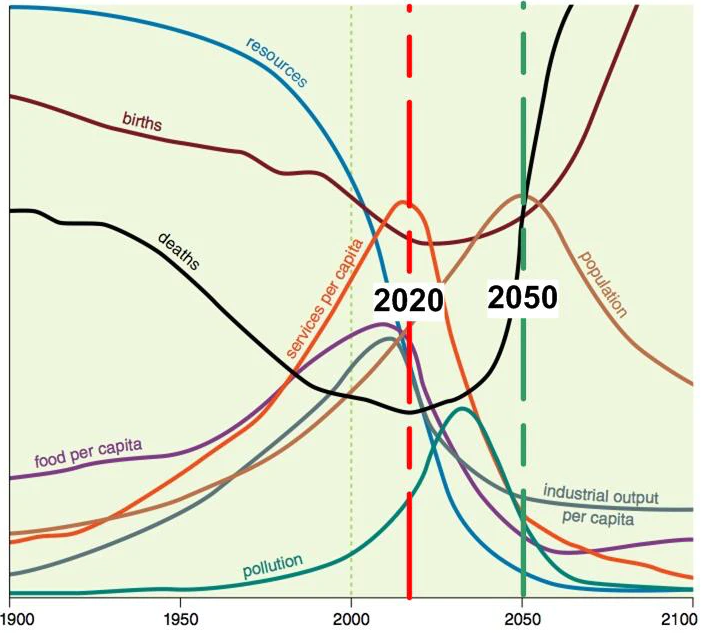
This sort of thing is why the food per capita line on the chart below (from Limits to Growth) is so… dismal.

Notice how fast that food per capita line drops, and notice also that it drops below the food per capita in 1900, not a year where people were known for over-eating.

I want to emphasize, again, that just getting a garden isn’t sufficient for personal food security. Weather and climate variability are going to make growing outside unreliable, and when you need the food most is when it fails widely.

China’s Rise Is Normal

China used trade protection and cheap wages & grabbed industry from the leading industrial power exactly the same as the US did with Britain.


The tech/science lead follows the manufacturing floor, with some delay, this was, again, the same with Britain & the USA.

The dynamics of industrialization are well understood at this point. The first books to read are “Bad Samaritans” and “Wealth and Democracy”.

Unlike Japan or South Korea, China has a larger population than America (same as America vs. Britain) and is has a large land mass and plenty of resources. In fact, it has slightly more land area than America.

Initial industrialization in England is an interesting story and still hotly debated. Later industrialization waves are mostly all the same. (The USSR is an exception, as are city states.)

Big leaps, as opposed to adaptations of existing models almost always come from states in hot competition, and among them the peripheral states usually win (Britain, for example, is peripheral to Europe.) The biggest tech surges in Chinese history came during warring states periods.

I’m very impressed by China’s rise and the West’s sheer incompetence in enabling it, but it’s not a huge leap the way the industrial revolution was. It’s just an extension of a previously existing model.

Japan’s rise was more impressive than China’s, as the first non-European nation to pull it off. But as an island nation with limited population, they were sharply limited. They made 2 runs at the US, one a war, one industrial, and neither let them become the foremost power.

The West was very good at keeping everyone but client states from industrializing. Even Japan needed British aid (the first time), then America’s (the second time.) But the West got stupid under neoliberal “end of history” ideology & let China run the playbook, thinking it wouldn’t challenge the West. Oops.

Americans probably should have learned from the Western experience with Japan. The British enabled Japan’s rise only to have Japan attack British possessions. Without American aid, that loss would have been permanent. But China is a continental power w/a massive population. The stupid was epic.

A radical change in economic model hasn’t happened yet, and seems unlikely to before ecological and economic collapse puts an end to the viability of the current model. Looking at Chinese cities with the 7 lane highways is instructive. It’s just a better version of the same old

A complete change of the permission system will be necessary for radical economic change. No one in power, whether in the West or China, wants that or can even imagine it.

Who knows, radical economic change might happen in China when collapse really starts biting. After all, they have the manufacturing base. But usually it happens at a periphery or in a tight area with multiple competing states.

This stuff is fairly well understood. However it’s not economists who put the pieces together, it’s sociologist and historians and even some anthropologists. Economists have done more damage to the West than astrologers did to Chinese dynasties. MBA factories get an honorary mention. (They mostly weaponized economic theories, as when they noticed economic theory saying that high profits come from not competing.)

One of the most instructive trends right now is watching so many people screaming about population collapse, when what the world actually needs is a lower population. (We could have avoided that necessity, but the window is closed. Sometimes you have to act at the right time.)

All people who yell about lower birth rates can imagine is economic growth through population expansion. Anyone who thinks that way can’t create a new economic model, they’re stuck in the old one. (Elon Musk is a good example.)

People who can’t even understand population overshoot are incapable of the thinking required to deal with the world’s actual problems.

We’ll talk about permission systems at a later date. As noted, they’re key.

Week-end Wrap – Political Economy – June 16 2024

by Tony Wikrent


Strategic Political Economy

‘The whole supply chain is subsidised’: inside the EU’s blockbuster Chinese EV probe 

[South China Morning Post, via Naked Capitalism 06-13-2024]

…the tariff percentages the EU would slap on electric vehicle imports from China landed with a bang.

In the Belgian capital, officials set about briefing reporters on what had been uncovered in an investigation that saw dozens of case handlers spend 250 mission days on the ground in China, conducting 100-plus company visits, piecing together thousands of pages of evidence, which cumulatively tore a new rift in an already fraught relationship.

“The whole supply chain is subsidised,” said a senior official, who read through the charge sheet on a case that many predict could launch a trade war.
“This means that the Chinese government provides subsidies to all operators,” he continued. “Starting from the refining of lithium used in the batteries, to production of cells and batteries, to the production of BEVs [battery electric vehicles], and even transport of BEVs to EU markets.”….
Between January 2020 and September 2023, Chinese companies increased their EU market share from 4 per cent to 25 per cent, while local rivals’ share dropped from 69 per cent to almost 60 per cent, officials said.
[TW: If you really want to transition off of fossil fuels, it is basic common sense you should support in any way possible the design, manufacture, and sale of electric vehicles. This is a monstrous example of how the leadership of the West has been lobotomized by neoliberal “free market” ideology.” ]

Global power shift

MAJOR: Russia Officially Becomes World’s 4th Largest Economy, Passing Japan 

[Simplicius the Thinker, via Naked Capitalism 06-10-2024]


China has become a scientific superpower 

[The Economist, via Naked Capitalism 06-15-2024]

[X-Twitter, via Naked Capitalism 06-14-2024]


Gaza / Palestine / Israel

How ‘Israel’ Has Lost The North 

[indi.ca, via Naked Capitalism 06-14-2024]

‘Israel’ has completely lost the north of occupied Palestine. It’s under fire and on fire every day now. Hezbollah has methodically eye-poked ‘Israel’s’ intelligence outposts and is literally blasting them in the nuts every day, on camera. The map above shows the new line of control for occupied Palestine, as reported by the thinking man’s Der StürmerHaaretz. ‘Israel’ has lost it.

It’s fascinatingly boring how Hezbollah did this. For months their videos have been methodically mundane, blowing up this communication tower, that building, that listening station. It seemed like a bunch of nothing, but it adds up. Hezbollah had a list of ‘Israel’s’ eyes and ears in the north and has spent months methodically eye poking them, like Odysseus and the Cyclops. Now—however big the IOF might be—they’re effectively blinded.

As Hezbollah opens bigger and bigger gaps in ‘Israel’s’ air defenses, they can send bigger and more missiles in, with better and better penetration. For ‘Israel’, this attrition is a compounding problem. Their air defenses are a connected system and the network is increasingly returning 404. Take for example, the destruction of the $230 million dollar SKYDEW blimp/spy balloon….

Each time a hole in ‘Israeli’ air defenses opens, the hole only gets bigger, because of Hezbollah is damaging complex, interconnected systems.

Now the Meron base can barely defend itself, let alone the region. ‘Israel’ has responded by assassinating Hezbollah (and Iranian) leaders, but the Resistance just names missiles after the martyrs and send more. This is a battle of attrition and Hezbollah is paying attention while ‘Israel’ is mindlessly lashing out. ‘Israel’ is completely distracted by a genocide in the south, and has lost the battle for the north….


Suppressing Palestinian Drone Forces: U.S. Uses Aid Pier to Deploy Anti-Drone Combat Vehicles to Gaza 

[Military Watch Magazine, via Naked Capitalism 06-09-2024]

Open Thread

Use to discuss topics unrelated to recent posts.

Page 97 of 517

Powered by WordPress & Theme by Anders Norén