Ian Welsh

The horizon is not so far as we can see, but as far as we can imagine

Consequences of the British Election

Labor won with a massive majority. In seats:
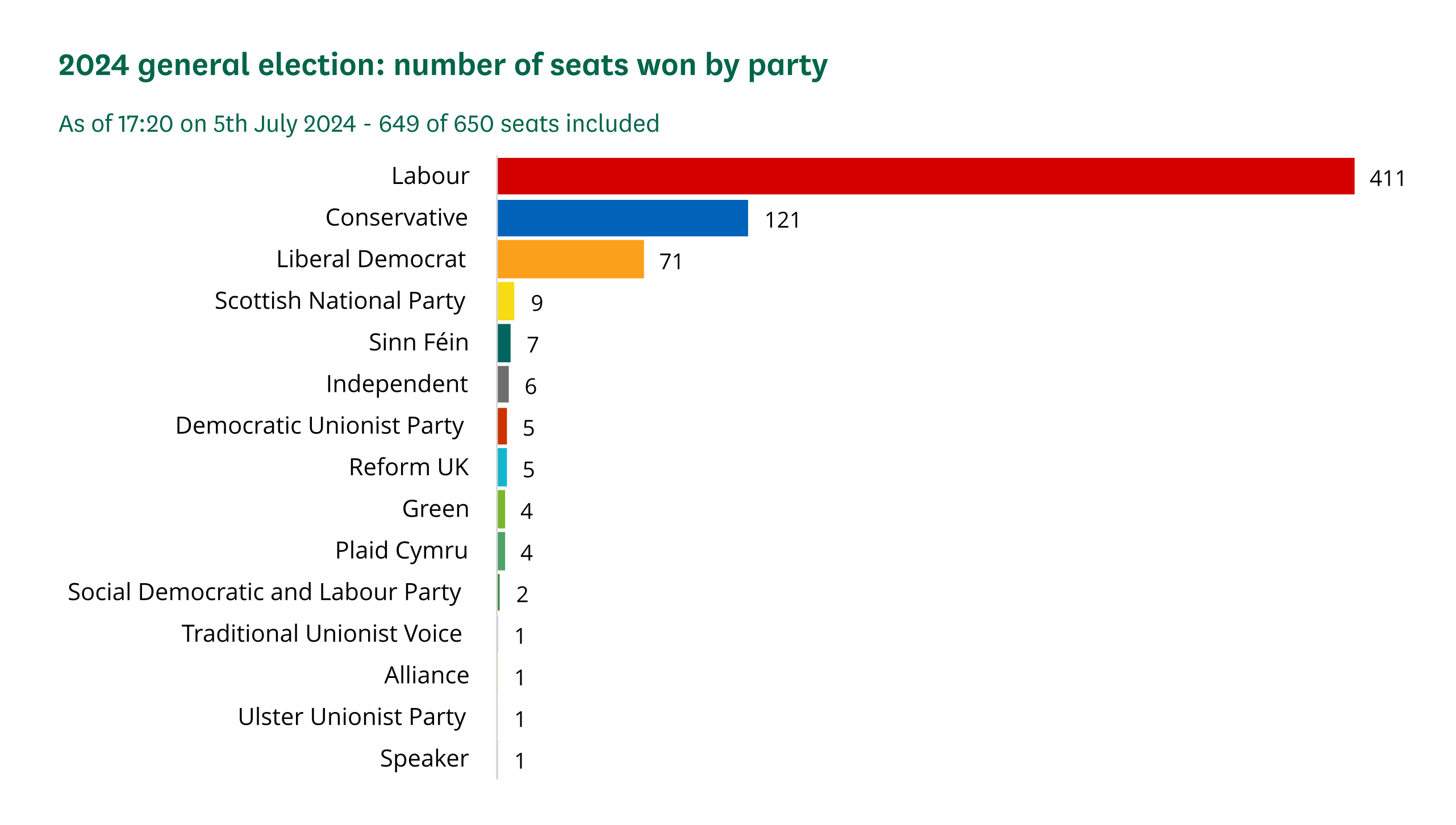
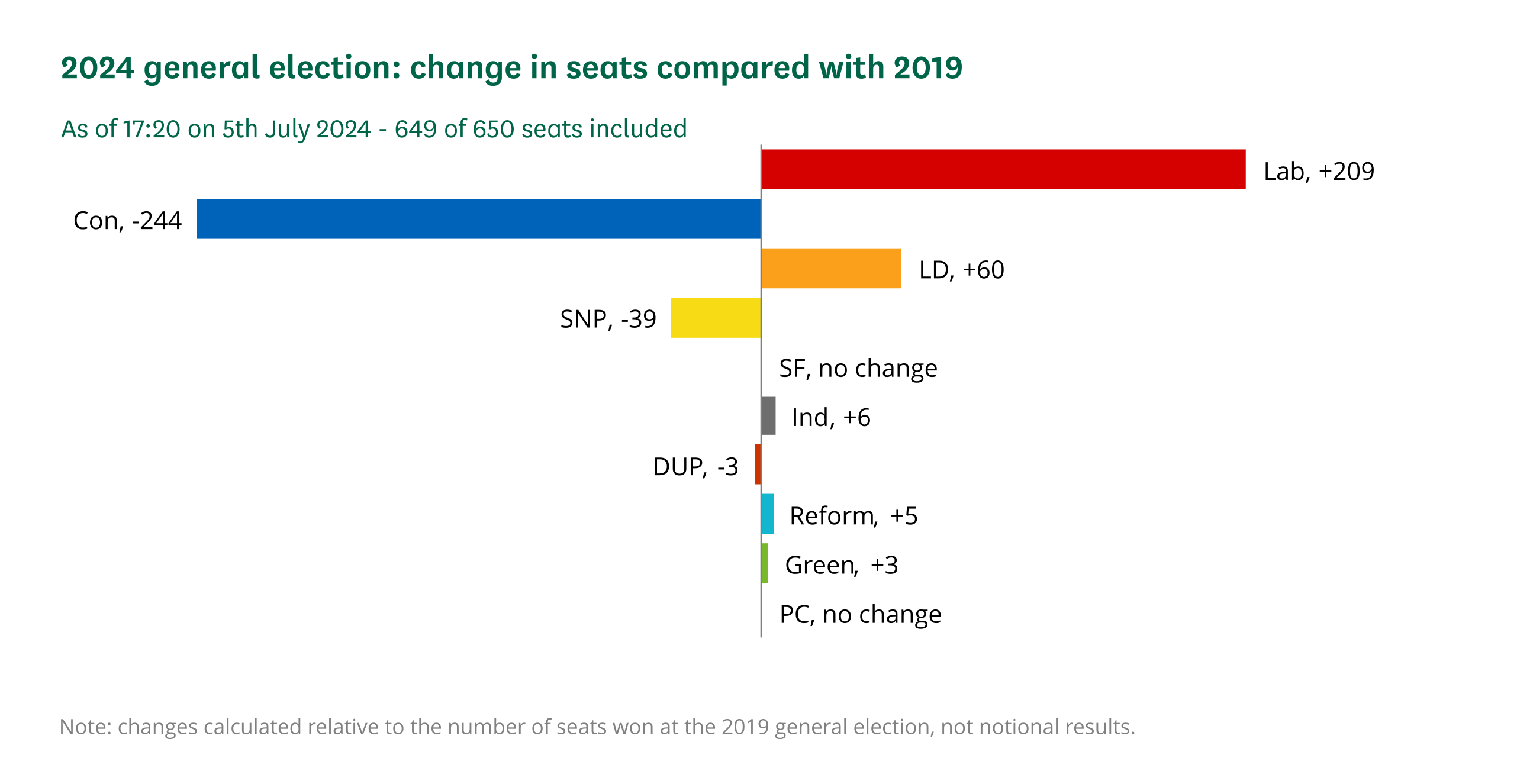
 

Of course Britain has a first past the post system, so these aren’t nearly the same as the percentage results.

  • Labour Party: 35 percent vote share, 412 seats
  • Conservative Party: 24 percent vote share, 121 seats
  • Liberal Democrats: 12 percent vote share, 71 seats
  • Reform UK: 14 percent vote share, 4 seats
  • Green Party: 7 percent vote share, 4 seats
  • Scottish National Party (SNP): 2 percent vote share, 9 seats
  • Sinn Fein: 0.7 percent vote share, 7 seats
  • Plaid Cymru: 0.7 percent vote share, 4 seats

Labour has a huge MP majority, but received less of the vote than they did in 2017 under Corbyn.

The Reform surge, which at one point looked like it might overtake and pass the conservatives died out, alas. But note that Reform received more votes than the Liberal Democrats but received four seats to their seventy-one and Sinn Fein received 7 seats for .7% of the vote. In first past the post, you want your votes clumped, not spread out. In vote total terms, Reform is now the third party.

It’s also worth noting that almost no one is voting Labour because they like Labour or Keir Starmer:
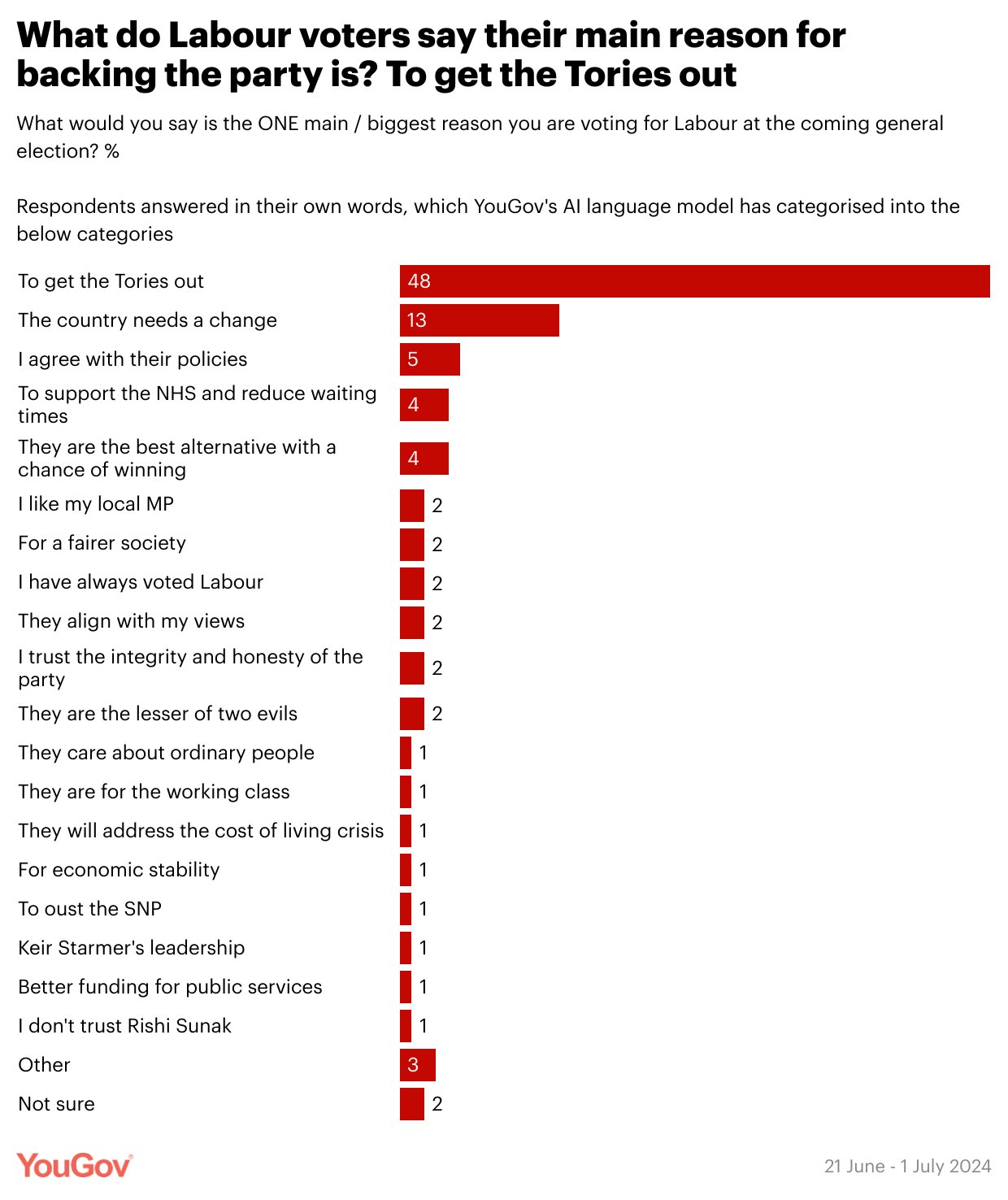
As with LaPen’s National Rally, Reform may well improve with each election and Labour is vulnerable to a real challenge from the left.

But let’s move to more immediate consequences.

The Conservative austerity policies severely gutted Britain:

  • The grant to local governments dropped 60% from 2010 to 2020. They’re the ones who run most of the government: libraries, fire departments, council housing, roads, public transit and so on.
  • 20% of libraries closed
  • Spending on old people down 35% with one estimate saying this killed 45K people.
  • Inflation adjusted wages are lower than in 2007, and the inflation numbers are certainly lower than reality.
  • Rent and housing costs are way up.
  • Twenty percent less people get cancer treatment on time.
  • The UK now has the highest homelessness rates in the Western world.
  • Gutted universities, one of the few world class industries left in Britain (and one which brings in a lot of foreign currency.)

And so on. Tory rule has been a catastrophe.

But there’s little reason to expect Labour rule to be much better. They voted for many of the bills that caused this catastrophe, and didn’t oppose most of the rest. They still believe in austerity and neoliberalism. It’s likely they’ll increase some taxes, but they’re not likely to use the money to spend much more and fix problems: Britain is serious fiscal condition, and the level of tax raises necessary to deal with that and to allow spending is off the table, especially as to really get money they’d have to tax the city and massively raise taxes on the rich.

They will continue to clamp down on public dissent, and likely use the banking system against protestors, along with locking them up. I’m unsure how they’ll handle strikes, but odds are that Starmer will be unsympathetic to mass strikes and use legislation and the police against them (which is why the big unions should leave Labour and support a new left party.)

In other words, Britain’s decline is not going to halt under Labour and neither is the decline in standards of living for most Britons.

This means that there will be room for Reform and a new left party to surge. While I’m not a fan of right wing social policies, Brits tend to be more left wing economically than Labour but socially conservative, which means Galloway’s “Worker’s Party” is positioned to take advantage, being economically left and socially right on some key issues, such as trans rights.

However Galloway’s party’s social conservatism is a barrier to some left wingers, like Corbyn (who won his seat as an independent) joining.

Whatever the specifics, there is a constituency for an economically left wing party, and Labour’s likely terrible economic performance now that it’s in power leaves an opening.

Generally speaking, as neoliberalism dies, there will be changeovers in dominant parties: either the parties themselves will change, or they will be replaced: this is true in almost every country. If we want a good world, and government which genuinely tries to help ordinary people, we have to work for and hope for the real left to take power.

One good piece of news in this regards is the continued weakening of the Zionist movement, since accusations of anti-semitism have been one of the main weapons used against the left, as they were against Corbyn and as they have been used against the left in France. Making charges of anti-semitism for supporting Palestine identically to excusing genocide (which they are) is necessary, and underway, especially among younger voters.

To summarize, however: nothing much will change immediately or in the next four years because Labour won. They’re still austerity loving neoliberal scum who can’t imagine, let alone institute any of the policies required to turn around Britain’s decline. The medium term trends, however, and the consequences of their failure to govern effectively offer some promise for the future, though by the time someone with sense gets in power it’s going to be nearly impossible to turn Britain around, assuming it’s even the United Kingdom any more. (Scotland should leave, and so should Northern Ireland, and both stand a good chance of doing so.)

Plus ca change, etc…

Your support makes it possible for me to write, if you like my writing and want more, please SUBSCRIBE OR DONATE

Happy Food Coma Day

If you have the day off and celebrate, I hope you enjoy! Doesn’t seem like much point in a regular post when the majority of readers will probably be otherwise occupied.

Let’s Talk About Joe Biden

The debate made it clear that Biden is in serious decline. Remember that it’s not just about now, it’s about four years from now. The media has turned on him hard, and so have many in the Democratic party.
My first takeaway from the debate was that Biden if Democrats were honest and honorable, they would have already forced him to step down, using the 25th amendment. Being President is a hard job, and he’s not up to it. The Vice-President exists for a reason.

My second is that a constitutional amendment is needed to prevent anyone over, say, sixty-nine, from running for President.

The third is to ask, who’s been running America? I had thought it was no longer Biden, but what we’re hearing is that it is Biden, and that he’s erratic and angry and doesn’t understand much of what he’s doing. Biden has done some good things as President, mostly thru some good appointments, but when age related decline starts, it often moves fast.

As for what’s going to happen—I have no idea. I don’t much like Harris, among other things when she was a DA she deliberately put people she knew were innocent in prison. But she’s not senile, and Democrats are panicking. If Biden won’t go peacefully, they should twenty-five him, get Kamala a good running mate & pray a lot.

The other option being floated is a “speed primary”, get it done in four to five weeks, but that seems problematic.

Either way, getting rid of GenocideJoe and having a candidate who can distance themselves would be the smart political move. I imagine Trump will still win, but it might not be a complete disaster.

America’s in serious decline and this clusterfuck is just a symptom of the elite’s inability to govern effectively. This problem should have been dealt with before it blew up, but everyone was pretending there was no problem, despite dozens of clips of Biden’s decline making the rounds. The strategy was denial, denial, denial. “The Emperor’s clothes are the most beautiful in the world!”

But Biden himself played the part of the kid “The Emperor has no clothes” and the feeding frenzy has begun. There will be more leaks and bad press, the knives are out for him, because other Democrats think he’s going to take them with him. Just as bad for Biden, Obama, who made Joe President last time by arranging for him to win the primary, seems to have abandoned him. Not sure if the Clinton machine is still onside: Hilary is stupid and might be, if Bill’s making the decisions, they will jump ship

If nothing else, it will be quite the show.

Edit: Harris’s numbers are now trending better than Biden’s.

Addendum 2: One thing about Harris is that she’s less pro-Israeli. To win, Democrats need Muslims. Trump is hardcore pro-Israel. If Kamala became president and pushed back against Netanyahu in some way that matters, she’d get a lot on the left and among Muslims. Heck, if she’s good enough, I’d endorse her (not that my endorsement matters). Always go with the person who isn’t pro-genocide. (I recognize she’ll probably bow to the pro-Israeli lobby.)

Your support makes it possible for me to write, if you like my writing and want more, please SUBSCRIBE OR DONATE

The UK’s Housing And Immigration Crisis In Charts

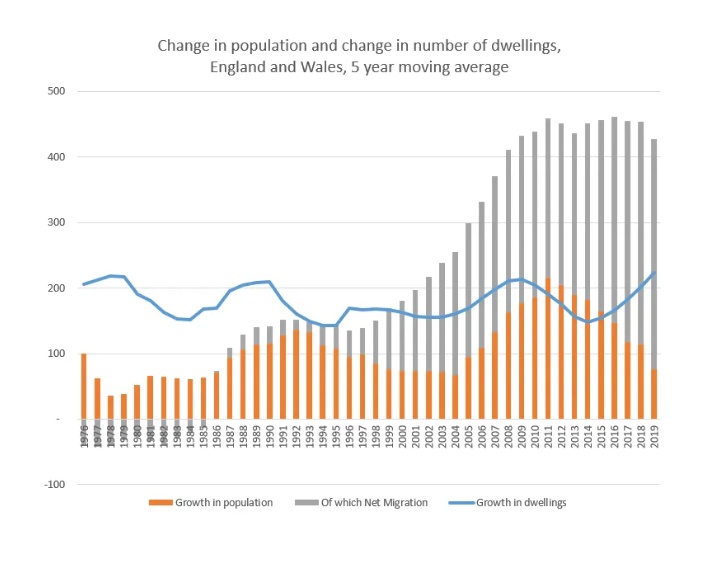
Here’s the TLDR: the UK has a housing crisis because it is bringing in way more immigrants than usual and not building way more housing.

(Most of the charts from Simulcrax.)

For a long time Britain was building more housing than it had population increase. This was good, because as anyone who visited England in the 50s or 60s will tell you, it didn’t start with an excess.But starting around 2000AD it increased immigration and didn’t increase how much housing it was building, and after a while that caught up.

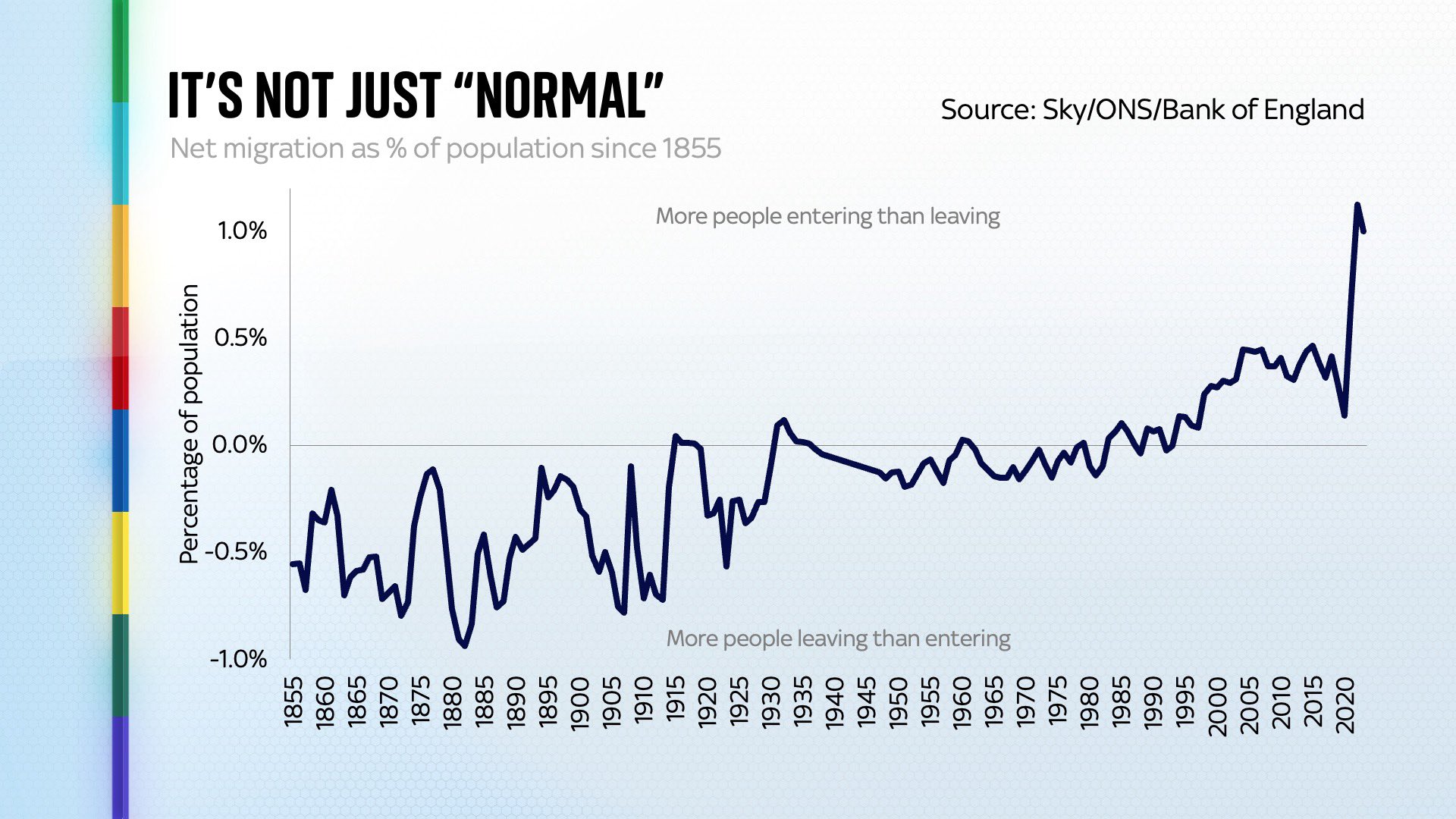
The chart only goes till 2019, though. Let’s see what happened afterwards.


Wow. That’s pretty ugly, and hey, it happened under the anti-immigrant Conservative party, and after Brexit, which was supposed to reduce immigration. Anyone wonder why Reform is challenging the Conservatives for second party status?

Now let’s be clear: immigration can be good, bad or mixed. If your economy is doing really well, you have low inequality and high wages and not enough workers and an economy which makes most of what you need domestically, then immigration is going to be good: the immigrants will get good jobs, increase demand and the economy will expand. But if you’ve gotten rid of your industry, have high inequality and an economy which is sucking wind then immigration is going to take jobs from natives and keep wages lower. And if you aren’t building enough housing and don’t do something about that, it’s going to raise housing prices, especially at the bottom and middle, which is going to hurt people.

The people it will hurt most, of course, are:

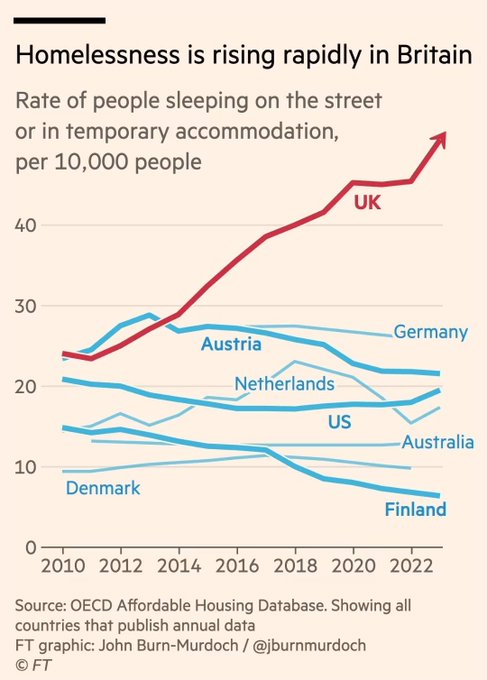
The chart pretty much speaks for itself. Let’s look at one more chart:
Ouch. I mean, it’s not like the situation is good in the US, is it?
Let’s be clear about what’s happening: it’s not that the UK can’t reduce immigration, it can, especially post-Brexit. Like Canada, however, it wants to increase GDP and keep wages low, so it’s bringing in as many people as it can, as deliberate government policy and doing so, without a booming economy, is hurting people who already live in Britain.

You don’t have to be racist or xenophobic to believe, accurately, that too much immigration is bad if there isn’t enough housing and jobs to absorb the immigrants. Problem is, given how people are, they will blame the immigrants and become racist and xenophobic, when the correct response is to hate the government and ruling class.

Britain, having deliberately de-industrialized, especially since Thatcher, can’t absorb this many people without causing extreme harm to people already living in Britain, especially if the government doesn’t move, massively, to social housing. People who want less immigration are correct, the only way to absorb this sort of influx without harm would be an entirely different set of government policies, even then, the immigration surge wouldn’t make sense until the policies take effect.

Unfortunately the only chance of pursuing anything like those policies was to elect Corbyn, and that chance has passed.

The sun always sets, and now it sets on Britain.

Addendum: Stumbled on this after writing the article.

He continues: “According to the Government’s own methodology, we needed to expand the housing stock by around 3.4 million homes over the last decade: 2.2 million to meet existing housing pressures, and 1.2 million to cope with net migration. We increased the number of homes by only 2.1 million.”

So, without immigration, they’d only be down 100,000 over the last twent years, rather than 1.3 million.

Your support makes it possible for me to write, by helping pay my rent and buy my food, if you like my writing and want more, please SUBSCRIBE OR DONATE

Week-end Wrap – Political Economy – June 30 2024

by Tony Wikrent


The (anti)Federalist Society assault on the Constitution

[TW: There were a number of articles and videos in which people complained that “this Supreme Court is out of control.” I do not think such framing is useful. The conservative majority on the Supreme Court is very much in control of itself, and is carefully and deliberately implementing the hostile philosophy of government propounded by conservative, anti-republican theorists ever since Thomas Paine clashed with Edmund Burke, after Paine met Burke, and realized Burke may have been sympathetic to the American revolt against corrupt King, Parliament, and ministries, but was actually implacably hostile to the philosophy of self government of civic republicanism.

[Almost all of USA political history includes the background of this clash between the republicanism of Paine and the conservativism of Burke. Conservatism is simply philosophically hostile to the American experiment in republican self government. It is why conservatives argue that the Preamble of the Constitution is a meaningless flourish; that the General Welfare mandate and clause are dangerous mistakes that enable an overpowering “administrative state” and that the powers bestowed by the Constitution on the government are “strictly enumerated” and limited, not broad grants of legitimate power to solve problems not foreseen by the “founding fathers.” The Heritage collaboration with the Center for Renewing America and over 80 other right-wing groups to dismantle the “administrative state” by sharply curtailing government capacity while at the same time misusing executive power to punish political enemies — the infamous Project 2025 plan — is merely the latest development in this centuries-old struggle between conservativism and republicanism.

[There are no Democratic Party leaders I know of — with the notable exception of Representative Raskin (see below) — who discuss these issues of a philosophy for governing. In that sense, all the screaming, hollering, and agonizing over Biden’s awful debate performance is largely meaningless: there is no one in the leadership of the Democratic Party who is even attuned to the conservative / (anti)Republican assault on our government.  ]

‘Gift to Corporate Greed’: Dire Warnings as Supreme Court Scraps Chevron Doctrine

Jake Johnson, June 28, 2024 [CommonDreams]

The high court’s 6-3 ruling along ideological lines in Loper Bright Enterprises v. Raimondo and Relentless, Inc. v. Department of Commerce significantly constrains the regulatory authority of federal agencies tasked with crafting rules on a range of critical matters, from worker protection to the climate to drug safety.

The majority’s decision was written by Chief Justice John Roberts.

“The weight of human suffering likely to arise from this decision should keep the justices up at night,” said Emily Peterson-Cassin of Demand Progress, a watchdog group that called the decision “a gift to corporate greed.”

“The Supreme Court is threatening safeguards that protect hundreds of millions of people from unsafe products, bad medicines, dangerous chemicals, illegal scams, and more,” Peterson-Cassin added. “By handing policy decisions usually deliberated over by experts to lower level judges, the Supreme Court has set off a seismic political shift that primarily serves only the most powerful corporate interests.”


The Supreme Court Upends the Separation of Powers

Open Thread

Use to discuss topics unrelated to recent posts. No vax/anti-vax.

Why Am I Writing About China So Much?

Regular readers will have noted that for the past few years I’ve been writing far more about China than I used to.

Why?

The primary purpose of this blog is to explain the world: how it works, how it has worked, and how it will work.

China is probably the most important nation in the world right now: it has the most manufacturing, is about tied for population, is the largest trade partner of the greatest number of nations and leads in most scientific and technological fields.

If you don’t understand China, you don’t understand the world. In the same way that I spent so much time learning about and understanding America, I (and you) need to understand China. I’m so serious about this I’m probably going to learn Manadarin, and if you’re under fifty, I suggest that you should do the same. In ten to fifteen years not speaking Manadarin will be as crippling as not speaking English currently is.

As we move into a multipolar or cold-war period, nations are rising in importance: China, Russia, Iran, Vietnam, and so on. If we don’t understand the internal and external dynamics of those countries, we are ignorant of how the world works in the worst sense of that word.

As this happens, nations are losing importance: all of Europe, America and the Anglosphere, in particular. I live in Canada, I’m a member of the West and the Anglosphere, and of European descent, so I’m concerned with those countries. But maintaining too much of a focus on them would be foolish.

It is also important to understand what other countries are doing and have done right. If China is now the world’s most important nation, why? What is it doing? How are its policies likely to turn out? The same is true of Russia, whose economy is doing better than, say, Europe’s.

Of course, understanding what the West is doing wrong (and the rare things it’s doing right) matters too, but I’ve spent twenty years writing those articles.

The world is changing. To understand it and to operate skillfully within it, we must change with it.

You get what you support. If you like my writing, please SUBSCRIBE OR DONATE

What Xi Jingping Has Done Right to Preserve CCP Power and Effectiveness

I was a doubter about Xi. His early anti-corruption drive seemed most likely to be a way to purge the Party of his enemies, and I assumed he was driven primarily by ambition for personal power.

I was wrong.

If you want to join the CCP, you have to be accepted. It isn’t automatic. Once accepted you undergo training and if you want real power you have to rise: you have to be in charge and deliver.

In this the CCP is similar to the old Roman Republic: high political rank required you to rise up thru the cursus honorum. Doing so required you to gain experience with government: roads, sewage, trade, law and so on. In practice, few people were elected to the highest offices without military experience, and the result was that high elected officials had some actual experience with how both military and civic affairs ran.

The CCP has much the same virtues, minus the de-facto military experience. You can’t get to the top without having risen from the bottom.

There were serious threats to this in the early years of the second decade of the twenty-first century. The first was corruption: the job of officials shouldn’t be to make themselves and their families rich. People shouldn’t rise to the top because they’ve spread wealth to their supporters.

So an actual crackdown on corruption was required to retain the CCP’s policy effectiveness.

The second threat was the “princelings”. Children or grandchildren of high Communist officials, often companions of Mao. They expected office and power without having truly earned it. Xi has sidelined the majority of them. Very few have any real power in the CCP.

The third was the oligarchs. By one calculation the wealth of billionaires declined by 47% between 2021 and 2024. During the same period in America it increased over 70%. More than that, the CCP has prosecuted and imprisoned multiple billionaires, something the West never does.

Wealth=power. Huge concentrations of power outside the CCP were a huge threat to it, especially in combination with internal corruption, since corrupt and rich party members were cooperating with the oligarchs.

This has allowed China to do things like move massively to social housing and crash the housing market, something oligarchs would never allow the government to deliberately do in America. Young people being unable to afford housing was (and still is) a huge threat to the CCP’s legitimacy, but it’s being dealt with.

Weakening oligarchs hasn’t come at the expense of industry and commerce, either: the Chinese economy continues to grow, science and engineering progress is rapid, and they have recently taken control of the majority of the global EV market.

Internal corruption, cliques and external power centers controlling government are the biggest threats to any government and especially to any one party state. Xi has dealt with these problems effectively and relatively quickly and is moving on other policy concerns.

This doesn’t mean the CCP is perfect or doesn’t make mistakes. Zero Covid was done very badly (avoiding Covid was the right policy, but they screwed it up.) It does mean that they retain the ability to implement policy, often effectively.

And that’s a big win for China and the CCP.

Donors and subscribers make it possible for me to write, so if you value my writing, please DONATE or SUBSCRIBE

Page 96 of 517

Powered by WordPress & Theme by Anders Norén