
Ian Welsh

The horizon is not so far as we can see, but as far as we can imagine

If You Believe Either Biden Or Trump Will Halt Decline You’re A Fool

There are those, even some smart people whom I otherwise respect, who think that Trump is a way to halt and reverse American decline.
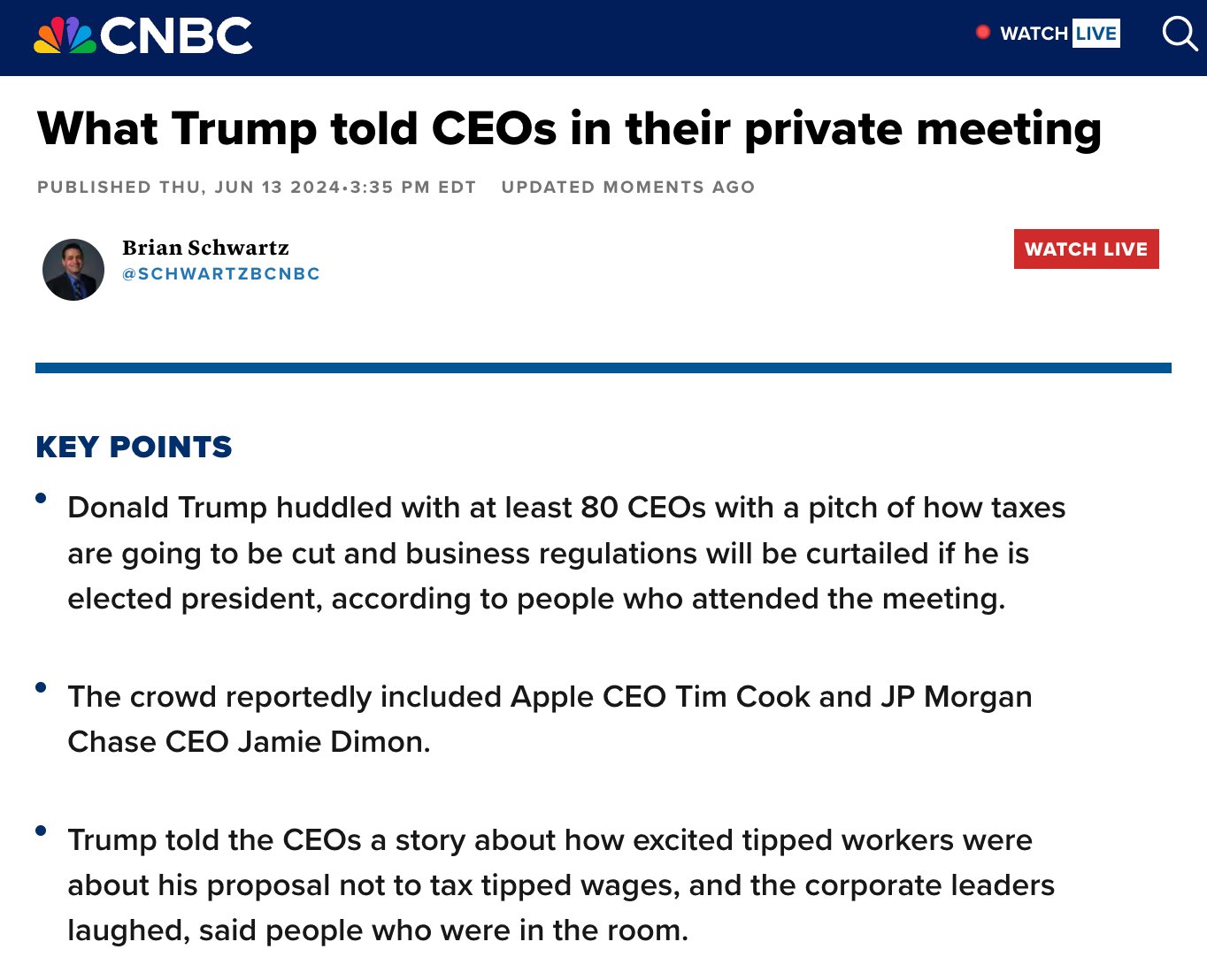
This is delusional.


As for Biden, his claims to success are based on statistics that only a toddler or an economist would believe reflect reality, leaving aside the fact that he’s overseeing the loss of the US dollar as the primary trade currency, which will hurt the US worse than an Israeli shoving a red hot metal rod up a Palestinian civilian’s ass.

I’m on team tariff. I think they’re often a good thing. But tariffs alone cannot fix the US economy. America has too many economic pathologies. Without crushing the rich, dropping housing prices, making Private Equity illegal, forbidding share buybacks, ending stock options for executives, massive anti-trust enforcement and huge number of other policies, the US cannot take advantage of being hidden behind tariffs, especially when China is now producing more scientific and engineering advances than America.

People want hope. They need it. And they will find it, or what passes for it. We saw that with Obama, the ultimate neoliberal wannabe, who immunized bankers from their crimes and helped them steal millions of houses with fraudulent documents, then expanded fracking and bragged about, not just giving up the last chance to slow or stop climate change, but actually lighting gas on fire to speed it up.

Then Obama bragged about how much he had increased oil and gas production. Bragged.

No one is coming to save you if you are American, or, indeed Western. LePen will me a garbage fire. Starmer is one of the most mendacious neoliberal politicians of the past 50 years, an impressive feat.

If you want to do politics, you have to stop pretending that you can fix the major parties, and go third party. Yes, it’s a long shot, but it’s your only shot.

More realistically, national politics isn’t going to save your ass. You’re going to have to do it yourself, ideally with the help of other citizens. Perhaps thru a church, perhaps through a neighbourhood association, perhaps through a maker group: whatever, find a way to get like minded non-idiots together and support each other and start making the necessary changes so that you, your family and your friends have a better chance of getting thru the bad times.

It’s up to you. Climate change will not be stopped. My bet is that it is now into self-reinforcing growth. If it isn’t yet, it will be. The West’s hegemony is collapsing. As I have written repeatedly, Europe is going back to what it was for most of its history: a peripheral shithole on the edge of the Asian continent. The US is losing its empire and when it no longer had dollar privilege or a military that other countries are in terror of, Americans will find out the cost of sending their industrial base to China because if you can’t make it, other countries are going to demand a pound of flesh to send it to you.

Hell is coming and both Biden and Trump lead there, just by slightly different routes.

You get what you support. If you like my writing, please SUBSCRIBE OR DONATE
Remembering the Good Job Market Of the 70s

If you’re under 68 or so, and weren’t involved in regional boom or something like the internet bubble, you probably have never experienced a good job market. At age 56, I remember the 70s, and I even remember the job market after a sense: I was an only child and around my parents adult friends a lot. I had no uncles or Aunts by blood where I lived, but half a dozen Uncles and Aunts by friendship. And I do remember that just getting a job wasn’t a problem, at least not till the late 70s and the early 80s recession.

But better the words be from someone who was actually there. I think this is important, so I’ve elevated a comment from Marku52:

My wife points this out to me often “Back then (mid 70’s) I had tons of jobs. I’d lose one one day and have another one in a couple of days. It wasn’t a problem. And what a breadth of experience. She was a waitress (terrible at it, got fired), a photographers assistant, a computer data input person for an auto parts chain that was digitizing (She told the other workers “you know, they are only doing this so they can get rid of you”), and finally a paginator at a news paper using a brand new digital pagination system. All kinds of opportunities out there.

And for me, I got hired at a cabinet shop with nothing but some very basic woodworking skills, eventually became shop foreman, left to do electronic tech work at a sound company, boss even paid for another tech to come in once a week and train me. I went back to school and got my EE degree. (for $85 per quarter!)

Sure was a different time, and a way way better one.

This is what was lost because of neoliberalism and the decision to handle the oil shocks by crushing employment to crush wages. It’s a world hardly anyone even remembers any more.

But it did happen, and a world like it, but good for the environment and fair to women and minorities, is possible.


If Bosses Want At-Will Firing This Is What Is Required (The Good Society)

One of the great complaints of bosses and corporations is that they can’t fire people whenever they want to. Employee protections were one of the great victories of the 20th century and the union movement, though far more in Europe than in America, except in the Federal civil services.

But bosses do have a point: being able to get rid of employees without fuss isn’t unreasonable: they’re hired to do a job, and if you don’t like how they’re doing it, firing them makes sense.

At first glance the problem is that often such power is abused, in too many ways to recount.

But the real problem is that without a job, people suffer: they have less, they may wind up homeless, in the US they’re essentially cut off from medical care and so on.

In a society where you would have a decent life whether employed or not, it wouldn’t matter if at employment was “at-will.”

We still live in a surplus society. If we were to get rid of planned obsolesence, massively reduce pollution, and work hard at public services like frequent and reliable public transit, free post-secondary education and plenty of third place gathering spots, we could have even more of a surplus: or rather, use much less and stop destroying the environment, so that we would stay a surplus society. Making people work when what they do isn’t actually necessary, is a “bullshit job” or actually does great harm, like almost all of the financial industry, is stupid, and doesn’t increase human welfare.

So the compromise is guaranteeing everyone in society a good life: housing, transit, health care and recreation. Again, we can do this, we have the surplus, and if we got rid of 40% of work, well, we’d have a society which would actually produce more welfare, because that work is useless of harmful.

And in a guaranteed good life society, very few people are going to want to spend their lives figuring out how to serve ads better, or other nonsense. They will want meaningful work: work which is enjoyable or which makes the world a better place. They will tend to self-select for jobs which really do benefit others, especially if, at the same time, we cap wealth at something like 10x median, and income at 3x what’s guaranteed. (Which also means those who want wealth will have to improve the baseline guaranteed wealth.)

At that point, if bosses want to fire people at will, who cares? It doesn’t matter. In fact, it’s more likely that bosses who offer work that isn’t meaningful or enjoyable, or both, won’t be able to get workers.

And that, my friends, is what a good surplus society looks like.

You get what you support. If you like my writing, please SUBSCRIBE OR DONATE
A Few Words On Prediction

Prediction usually boils down to figuring out essentials.

I’m committed to finding out the 20% which explains 80%. Despite what one might think, that involves quite a lot of work, I’ve read thousands of books over the years, and don’t just get my info on twitter and from news media but I often cover current events and that requires current info, not carefully thought out books. (As an example, I’ve read books on Hezbollah.)

I find a few determined priorities/ideology/power + resource constraints tend to create most apparent complexity (most, not all.) Complexity is mostly in execution, not in ideation or decision.

Much of Fed rate policy from 79 to the 00s, for example, can be explained by a simple commitment to crush wage based inflation. Add in a commitment to increase asset prices and you have two theses which worked very very well predictively at the time and which still have a great deal of utility.

A reading of Bernanke’s academic work showed that much of it boiled down to “how do we avoid an FDR after a major financial crisis?” When the financial crisis hit, he put his beliefs to work.

That the innovation base moves to the place with the manufacturing base is another important dynamic, and that comes from books. (In particular, “Wealth and Democracy” by Kevin Phillips.)

Find the key drivers/commitments. Understand the world view and ideology. Understand historical and group dynamics. Those are my commitments and that’s how I approach understanding the world, groups, nations, and making predictions.

I’ve been working at this since about 1990. I’m not a great writer, I’m someone who’s interested in how societies work.

You get what you support. If you like my writing, please SUBSCRIBE OR DONATE

Le Pen Is Delusional But Macron Deserves To Lose

So, Macron has dissolved his government and a French legislative election is on. The Harris Interactive June 9/10 poll shows La Pen with the highest support at 34%, with the left wing Nantes coalition at 22% and Macron’s ENS coalition at 19%. Macron is not on the ballot, but if his party loses power, the Prime Minister of whatever group has the majority will be in control of French domestic policy, leaving Macron to foreign affairs.

Macron has been a terrible President. He got in only because of strategic voting. In the second round, people were too scared to give Le Pen a chance, so they went for him. During his tenure France has been rocked by repeated and massive protests. Economic performance has been bad and his signature move was to increase the age at which people can retire.

This is the Brexit/Trump/Javier problem. To whit, when things are bad for a long time and nothing seems to help, people reach for something extreme. They know the status quo isn’t working and that things keep getting worse no matter who they vote for among the mainstream, so they look for someone or something completely different. Trump is a billionaire, but he doesn’t parse the same as normal politicians. The EU was adopted around about the time Britain went into a severe multi-generational slump manufactured to hurt the working class. The EU wasn’t mostly responsible for it, but the status quo was “things are going to get worse, but if you stay in the EU more slowly than if you leave” and people were willing to throw the dice.

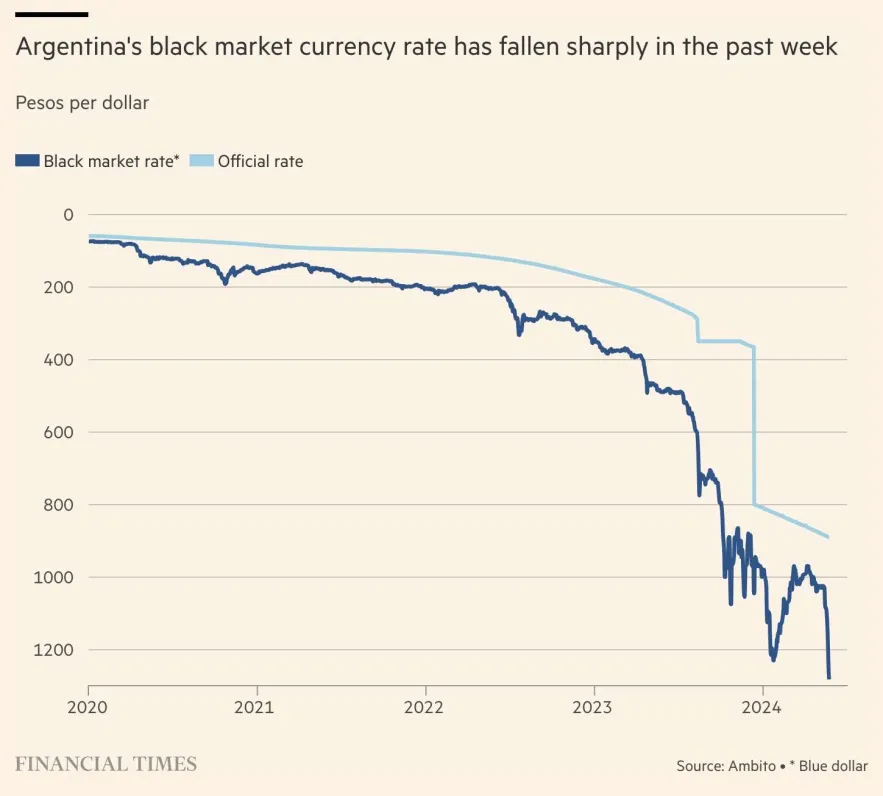
Javier is a libertarian loon who looks and talks nothing like a normal politician, so Argentinians gave him a shot: neither ordinary right nor ordinary left had been able to fix Argentina.

Of course, Javier is a loon, so:

La Pen is delusional, and not a solution. As an illustration:

Le Pen – who calls wind turbines “horrors that cost us a fortune” – would end all subsidies to the solar and wind energy sector, apply a moratorium on both and dismantle already existing turbines.

Solar is substantially cheaper than fossil fuels. Wind varies, in France it seems to be slightly more expensive than fossil fuels, but prices continue to drop, and thanks to Europe’s geopolitical stance the price of fossil fuels is higher than it once was. Even if you don’t want to build more turbines, dismantling already existing turbines is expensive stupidity.

Ending subsidies is questionable, in the sense that if you want to end subsidies and allow “true” competition, you’d also have to end fossil fuel and nuclear subsidies.

But a moratorium is beyond stupid. If solar is cheaper, why not build it?

There’s a lot of this sort of nonsense on the right, “liberals and left wingers like renewable energy and acknowledge climate change, therefor we must oppose renewable energy and deny climate change.”

It’s driven by tribal nonsense, science denialism and desire to keep things the same.

But sticking your head in the sand doesn’t change the fact that climate change is real and happening, or that solar is now cheaper than fossil fuels in most cases.

We can’t fix our problems is we deny reality. It’s that simple. It afflicts the center as well, with their “we’ll win in Ukraine” nonsense and their complete unwillingness to recognize the consequences of austerity and neoliberal politics. They want lots of rich people, so anything that would mean less rich rich people is anathema.

But the right, like Le Pen, are equally delusional. She may do some good things. Perhaps she’ll undo the increase in pension ages, for example. I hope so.

But the right isn’t the answer to real problems. Everything but climate change and ecological collapse, in 20 years, will seem like a sideline, completely meaningless. Any politician who isn’t taking it seriously and preparing for it shouldn’t be in office. Macron was not doing enough, not even close. Le Pen wants to make it worse.

France’s only real chance is to go left: fix the social and economic problems at the same time as dealing realistically with environmental problems.

Perhaps that will happen. If it doesn’t, as with Britain rejecting Corbyn, they will pay a frightful price. The European era is over, but how well France adjusts to its new place in the world will matter a great deal to those who live there, and, indeed, to all of Europe.

Right now the French seem determined to accelerate their decline rather than adapt to new circumstance in a way which is beneficial to them.

You get what you support. If you like my writing, please SUBSCRIBE OR DONATE

Week-end Wrap – Political Economy – June 09 2024

by Tony Wikrent


Strategic Political Economy

骑 虎 难 下

Average Old Democrat, June 02, 2024 [DailyKos]

…What happens to the Republican Party?  Where do they go and who will lead them?

The Chinese have an adage —     – “When you ride the tiger, it is impossible to dismount.”

For the past several decades, the GOP has mounted up on a lot of tigers, none of which will be happy when, post-Trump, the Republican Party tries to dismount and return to being the Republicans I grew up with – responsible, reasonable, fiscally cautious, internationalist, willing to compromise . .

… with Reagan’s August 1980 speech in Philadelphia, Mississippi, and the GOP mounted the Southern white supremacist tiger.

Then there’s the NRA tiger, which the GOP is only to happy to ride.

The list of tigers they must get down from is long — the anti-abortion tiger that now is the anti-contraception tiger; the “great replacement theory” tiger; the reduce and kill Social Security and Medicare tiger; the “teachers are grooming your children” tiger; elections are rigged tiger . . . I could go on and on but you get the picture.

How 1978 Shifted Power In America And Laid The Groundwork For Our Current Political Moment

Joshua Green, January 12, 2024 [Talking Points Memo]

…There is a backstory that illuminates the Democratic Party’s embrace of finance in the years leading up to the [2008] crash — a story that begins in 1978. At the time, Democrats were still reliable partisans of the New Deal, but the steady economic progress of the American middle class was coming to a turbulent end. Jimmy Carter was president. He was struggling, without much success, to manage an economy buffeted by inflation, oil shocks and recessions — problems for which his party had no answers. A conservative countermovement of business groups and Republican politicians was beginning to gather force. One of history’s critical inflection points arrived that fall, when Wall Street made its first deep incursion into the Democratic Party in a way that would have lasting significance, although it passed mostly unnoticed at the time.

The great irony of this early conquest is that it began with Carter’s ambitious attempt to change the tax code to favor workers at the direct expense of Wall Street investors. Instead, Carter and his fellow reformers suffered a defeat so thorough that the financial lobby not only got to preserve its favorable tax treatment, but was able, with Democratic help, to rewrite the rules of the economy in a way that gave Wall Street an enduring structural advantage at the expense of the middle class — the opposite of what Carter had set out to do….

Soon after Carter launched his presidential bid, [Charls] Walker took over a sleepy financial industry trade group called the American Council on Capital Gains and Estate Taxation and rebranded it as the more exalted-sounding “American Council on Capital Formation,” a euphemism for the aggressive accumulation of wealth. Walker began pushing the idea that the economy’s productivity crisis could be solved if the government changed the way it induced business investment. Since the New Deal, the preferred method had been the investment tax credit, which rewarded companies for building factories. This generally satisfied labor interests, since factories produce jobs. The major business lobbies like the Chamber of Commerce and the National Association of Manufacturers liked the investment tax credit because many of their members were large industrial corporations. Carter’s plan to eliminate the capital gains preference didn’t threaten them.

But it terrified Wall Street. Walker’s project was to pull off a feat of legislative legerdemain by persuading lawmakers that the solution to U.S. economic malaise lay in shifting the government’s focus to encouraging capital formation — a move that would, its backers insisted, revitalize the supply side of the economy by spurring investment, unleashing entrepreneurial energies and turbocharging productivity. In practical terms, this meant preserving the biggest giveaway to investors in the tax code: the capital gains preference….

What Is Israel’s Goal In the Gaza War?

I think it’s worth emphasizing that based on actions—priority targeting of hospitals, health workers, journalists and civilians;  and cutting off food and water while not accepting ceasefires agreements which would have returned the hostages, that the Israel’s goal is genocide.

There are no significant signs that they are defeating Hamas, and their actions, as opposed to their words, don’t indicate that was ever the intention. Certainly rescuing the hostages isn’t an important goal.

I think Israel would accept ethnic cleansing if they could find someone to take the Palestinians, but since they can’t, mass murder is the goal.

This is consistent with Israel’s history: it’s a colonial settler project where the goals has always been to remove Palestinians and occupy their land and, if not ruined, even their homes.

The WHO estimated that up to a million Gazans were at risk of death due to famine by next month. The longer the war and the blockade goes on, the more will die.

Back in 2006 I wrote that Israel only had two options for its future:

  1. Accept Palestinians as citizens and create a single, secular, state; or,
  2. Genocide or ethnic cleanse the Palestinians.

And so it has come to be.

You get what you support. If you like my writing, please SUBSCRIBE OR DONATE

The Real Test Of The Gaza War Will Be The Israeli Invasion Of Southern Lebanon

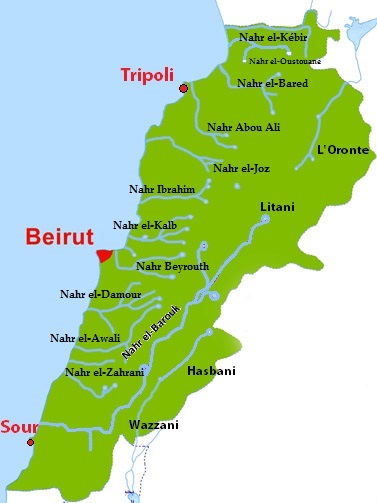
Israel’s been talking smack about invading Lebanon to occupy southern Lebanon up to the Litani River for some time. (The southern-most river on the map.)

Lebanon has been wrecking havoc in Northern Israel with missiles and drones and Israel has been able to do very little to stop them. Although Hezbollah usually hits military targets recently an attack caused a wildfire and the attacks, even before the wildfire, had caused most of the settlers in the northern region to flee, for example:

Settlers residing in Kiryat Shmona are now at 3k, down from 24k before Hezbollah started operations WSJ cites the settlement’s mayor: 40% don’t intend to return & they are among the settlement’s richest.

(Ian – AKA: those with other options aren’t returning.)

General consensus seems to be the attack is most likely in August or September.

Israel has completely lost deterrence against Hezbollah. Their air strikes don’t make Hezbollah stop and if they go to full air war, Hezbollah will go to full missile war. The only way to reduce the strikes is to control enough of Lebanon so that the shorter range weapons can’t reach Israel.

It’s unclear if Israel will actually invade, but there’s a strong argument they have no choice.

According to an analyst who’s been fairly good thru the war, it seems likely the total number combat soldiers will be about eighteen thousand, twice as much as the 2006 invasion.

About half of them will be reserve soldiers.

In 2006, the last time Israel invaded Lebanon, Hezbollah won. If I were a betting man I’d give 3:1 that Hezbollah wins. The Israeli army has not covered itself in glory in Gaza and Hezbollah’s troops are battle-hardened veterans of the long Syrian civil war, plus are heavily dug in with tunnel networks and bunkers.

No doubt America will provide some assistance, but unlike a Hezbollah ground invasion scenario, it’s unlikely the US will commit troops on the ground or serious air-power to an Israeli invasion. On top of that it’s clear that Biden’s beginning to realize that the Israeli war is costing him electorally, and he’s unlikely to want to get drawn in further.

If Israel actually invades it is a truth moment: until they do, they can bluster and act tough, but if they invade and lose everyone will know how weak they’ve become. At that point truly all they will have left is their nuclear deterrent: the Israeli military, once considered the finest in the world, will be derided as a joke. If Israel doesn’t invade, this will be why: they’re avoiding losing what’s left of the reputation of their military.

You get what you support. If you like my writing, please SUBSCRIBE OR DONATE

Page 98 of 517

Powered by WordPress & Theme by Anders Norén