The horizon is not so far as we can see, but as far as we can imagine

Category: health care Page 23 of 35

The Economics of a Flu Pandemic (Virus)

winged_caduceusReposted from 2009 – obviously, we do now have a pandemic.

While I don’t think the current swine flu outbreak is all that likely to turn into a pandemic, I’ve had some requests to re-post my article on flu pandemic economics.

Overview

When I was approached to write about the economics of a flu pandemic, my first reaction was “What’s there to write about?” Because, in the normal terms that people consider personal economics (such as how to diversify your portfolio, and so on), there isn’t a lot to talk about. Most of the obvious losers (medical insurance companies, hospitals, airlines, freight companies) and so on will either be bailed out by the government afterwards or aren’t quite the obvious losers that they seem. There is, perhaps, an argument for investing in drug companies and medical supply companies, on the assumption of an increase in demand, not so much during the pandemic, but after it. However even that sort of play is dubious, because the reaction to how the system performs in any pandemic situation may not rebound to the benefit of private companies.

But economics isn’t really about the stock market, it’s about how rare assets are allocated. And as such, there’s a fair bit we can talk about when it comes to a pandemic.

First, let’s lay out the basic scenario. I am assuming a serious pandemic, with all non-essential travel shut down for the duration (kiss your vacation goodbye), with both infected individuals and any individuals who have come into contact with them instructed to quarantine themselves, or being forcibly quarantined.

I am also assuming a pandemic large enough to overwhelm the health systems in most countries which get hit. There are not enough beds, not enough ventilators, and most likely not enough anti-virals to go around in most countries. There certainly won’t be enough trained medical personnel.

The situation will be much like that in wartime. Government will concentrate on keeping key infrastructure operating. Power, sewage, water, emergency services, and food distribution. Distribution of most goods through the system will be discontinued, since people can be asymptomatic and still carriers, it will be decided to keep any cross-country travel to a minimum. Most retail outlets will close, either voluntarily or by government fiat. Food will be trucked either into distribution centers or into supermarkets which agree to stay open and will be rationed out exactly as in wartime. As such, a black market will certainly appear.

Preparations

If you think that such a pandemic is likely to occur, then the steps you should take are much the same you would take for any natural disaster. Because the banking system will likely shut down during the crisis (and bank machines will likely not be restocked even if they do not go down due to loss of system personnel) you should have a stock of money at home to allow you to buy whatever you need which is available. If you can arrange to have independent power generation, you should do so. You should have a good supply of canned food and water. Make your estimate of how much you need and double or triple it. Others will not have planned, and you do not want to find yourself not being able to help friends, family, and neighbors. In addition, you will want to have tradeables available for the black market. Money will be a poor second to having goods people want. In this regard, stocking up on some medical items such as surgical masks and OTC medicines will be especially wise. I’m not encouraging profiteering, but you will need something you can trade which people want. Badly.

In terms of personal finances, other than investing your money in survival goods like food, water, candles, kerosene lamps, and stoves and so on (in case of a power out), and taking some money out for use in buying what goods are available, there’s little to do. Make sure you have an up-to-date, written statement of your assets every month, so that if records are lost you can successfully argue with your bank/broker about what situation you were in.

Most stock markets will shut down for the duration of the crisis, either voluntarily or by government fiat. However, some may stay open. The action on those exchanges will be wild, and probably very depressing. Ignore it for the duration. Don’t sell, don’t buy unless you are a trader who knows exactly what you’re doing. Many companies will get bailed out after the pandemic is over, and what the stock price will be a year from the pandemic is impossible to tell.

The most important thing you can do before the actual pandemic starts is make sure your personal relationships with whomever you live with are in good shape, that you have a circle of friends and family you can trust and that you have a relationship with your neighbors and any important people in your neighborhood. Leaving aside personal health factors, one of the most import predictors for survival will be the strength of your social ties to others. You may need help. Almost certainly someone in your family or social circle will need help. Make sure it’s there, by making sure ahead of time that people like you and want to help you and can’t bear the idea of you suffering or dying alone.

During…

The primary economic effect of a pandemic will be the slowing of almost all non-related economic activity to a crawl or even a halt. The primary tool of public health in any pandemic situation will be quarantine and the primary goal will be slowing or halting the spread of the disease, not just within a given community, but from community to community. As such, both international and domestic trade, including trucking, train, and air freight, will take a phenomenal dive. Nothing that is not a necessity will travel. For all intents and purposes the official economy will be driven down to little more than essential services and the shipping of essential goods like food, medicine, and goods necessary to maintain essential services.

Don’t expect to be getting a paycheck during this period unless you work in an essential service. Most companies will either shut down voluntarily, be shut down by government fiat, or will operate with a skeleton staff. And don’t expect to be able to cash your check or get money out of the bank – odds are they’ll shut down and even if the ATMs stay up, they likely won’t be restocked with money.

What there will be is a black market. In situations like this there is always a black market. There’ll be people selling food, water, and medicines (a lot of the medicine will be fake) and medical supplies like masks. If you want or need any of these things, you’ll either pay though the nose or have to have something to barter. In general, I discourage people from getting involved in black markets. But you may not have a choice and if you don’t, then make sure you have something to barter with.

Because public transit will likely be either shut down or operating on a much-reduced schedule, consider how you’re going to travel if you need to. For urban types, a bicycle is good. For suburban types, make sure you have gas, because there will be, almost guaranteed, gas rationing and long lines for gasoline. Rural types are advised to store gasoline or diesel fuel.

After

The long term effects of a pandemic are hard to judge. It really depends on a few things: how many people die; what the demographic profile of those who die is, and; how the public reacts to the disaster.

In a situation with relatively light casualties, say one percent of the population, the world will go on. Everyone will know someone who lost someone, or will have lost someone themselves. But the bottom line, sad as it is, is that it won’t make a huge difference. Demand will drop and thus it won’t have a huge effect on employment one way or the other; it’ll reduce GDP noticeably, but not disastrously, and otherwise, it’ll be business as usual with sadness.

However, if we have heavy casualties, with the worst casualties inflicted on healthy people between the ages of 20 to 40 the effect will be quite noticeable. It will put a lot of pressure on increasing retirement ages, decreasing retirement benefits (as programs like SS are paid for by current workers) and will mean that countries will have to consider encouraging more immigration. There will be a significant demand shock and GDP will take a big enough hit to be noticeable. Because some things can’t be downsized proportional to the loss of population, the employment situation will probably be better than before (assuming it doesn’t throw us into a depression, which it might).

In either the low- or high-end casualty estimates, the government will either bail out or take over a lot of companies, including health insurers, airlines, and freight companies. The worse things are, the less likely it that companies will be bailed out. Government revenue will take a significant hit in these scenarios, but especially in the heavy casualty scenario, and they will not be able to bail out everyone.

But the real question regarding the long-term effect is how the public reacts. If the public and private health systems crack under the strain, and many people die who could have been saved, then the outcry is likely to be something fierce. Everything will be up for grabs – and it’s hard to say if it’ll lead to more public health care, the scalping of politicians, or the weakening of drug patent laws. It could lead to an end of health insurance companies and drug companies as we know them today – or, they could turn the tables and claim it was the public system that failed.

But it’s safe to say that there’ll be less travel, less trade, and more care taken to ensure diseases don’t spread in the future. Get used to being checked every time you cross a border, and don’t be surprised if you see a lot less foreign goods on store shelves.

The real economic fallout will be determined by politics, not economics, per se. The political decisions made will determine the fate of entire industries, and trade and travel for some time to come.

Politics almost always trumps economics.


The results of the work I do, like this article, are free, but food isn’t, so if you value my work, please DONATE or SUBSCRIBE.

Coronavirus Bungling Is What We Voted For

Okay, let’s lay it on the line.

Donald Trump is a blithering idiot, and he’s incompetent at the actual mechanics of running a government. This isn’t to deny his other competencies in bullying and running a campaign, but he’s obviously mentally deficient.

He is bungling the Coronavirus response. That’s going to lead to a lot of dead people, including a lot of old people who, forgive me, voted for him.

Meanwhile, there is a Democratic primary going on in which the candidate who is obviously suffering from dementia and doesn’t want universal health care is winning.

So apparently, Democrats also want to be governed by an incompetent, they just weren’t offered one before.

If you elect incompetents, they will do incompetent things–like bungle epidemic responses.

Then we have Britain, where Prime Minister Boris Johnson is bungling the response, including, hilariously, not shutting down Parliament. Apparently, British elites are now so inbred and incompetent that they can no longer even manage the basics, like, “killing the commoners while staying alive ourselves.”

Britain has possibly the lowest number of beds per capita in Europe. When it gets hit hard, people are going to die in droves. Likely millions.

Brits had two chances to vote for Corbyn. If they’d elected him in 2017, he’d have re-staffed the NHS and opened many more beds. Nor is it possible to imagine that he would have bungled the response to the epidemic in this manner.

The British media, according to an academic study, lied about Corbyn over 75 percent of the time. They suggested Labour was anti-semitic, when the evidence showed to be trivial amounts, no greater than under Blair. They actively campaigned against him.

Every “journalist” and producer who did so has blood on their hands, and it’s going to be a lot of blood.

But voters have responsibilities, too. I have sympathy for those who are going to suffer and die, and I’m in the moderate risk group (over 50, bad lungs). But we have been voting for incompetents who have gutted any collective action ability for decades.

I live in Ontario, ruled by Doug Ford. Dougie is arguably more incompetent and slightly more evil than Trump. He is bungling the response. Trudeau, our Prime Minister, who is very pretty and has nice abs, is bungling the response. There were competent alternatives to these people, but those competent alternatives were left-wing (NDP) and wanted to help the poors, and the electorate didn’t want that. (“Oh no! A poor might be helped!”)

Well, now the poors weren’t helped and the old people who voted to not help the poors (because, yes, that’s how these elections all went) are going to die.

I do have sympathy, because I don’t like people suffering, but when people deliberately take action to ensure other people don’t get help, when they deliberately elect incompetents (even ones who are obviously suffering from mental problems like Trump, Bush, and Biden), and then find out that they too will suffer? Well, one’s sympathy has to be somewhat leavened.

Oh, and it’s still a, umm, thing of terrible beauty to see that Britain’s leadership class has so degraded that they are keeping Parliament open so that they can die along with their subjects. Not because they’re noble, but because they are stupid.

You couldn’t make this stuff up. No one would believe this in fiction; that people could be so stupid, short-sighted, mean, and venal–especially against their own self interests.

But here we are.

Meanwhile, I like my readers, so kindly take care of yourself. If you’re in a place early on the curve, and especially if old, take the precautions. Remember, systems will be overwhelmed in many places, and there will not be enough beds or ventilators. This is not a drill. Do what you can to save your life.

Edit: And…the panic buying has hit Toronto, where I live. Went to the local supermarket, and locusts had descended.


The results of the work I do, like this article, are free, but food isn’t, so if you value my work, please DONATE or SUBSCRIBE.

Taking the Coronvirus Seriously

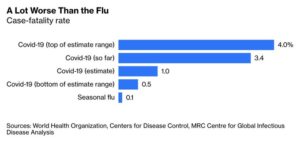
Covid Fatality from Bloomberg

Three weeks ago, Italy had almost no cases of Coronavirus. Today the country is on lockdown. There are so many cases that doctors cannot put ventilators in everyone who needs them, and are having to choose who gets them, leaving many to die who might otherwise live.

Covid-19 has an exponential spread if it is not handled correctly. Donald Trump and the US have chosen to not manage it properly. In fact, in most cases the US has chosen to not even test. We do not know how widespread the Coronavirus is.

Trump is acting like the average American CEO, he is managing the numbers, not the underlying reality.

That may get you killed. Maybe you’re young and healthy, then it may kill your parents, grandparents, or other older people you care about.

You should assume, at this point, that there will be an epidemic in the United States and you should prepare for one. Buy the necessary supplies for staying in place for at least two weeks if you have not already. Include any medications if you can. Get some non-prescription anti-virals if you can (raw garlic and bee propolis are decent), because while conventional medicine is superior, you must assume that there will not be enough ventilators, for example, to go around. Heck, there may not even be even be enough beds.

British readers should take note as well.

A lot of organizations are cancelling meetings, there are planes flying entirely empty, school is being cancelled, and so on. All of these things are good.

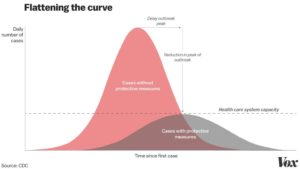
Note that the fatality rate soars if the spread of the disease is not slowed, because if there are too many cases all at once, and hospitals are overwhelmed. The chart going around to illustrate this follows.
 

The US isn’t going to have a better curve. So assume that you aren’t going to get good hospital care, and that you might not get hospital care at all.

All of this is, of course, a bad case scenario. But that scenario is happening, right now, in Italy. If you make preparations and you don’t need them, that’s not a problem. If you do need them, you’ll be glad you did.

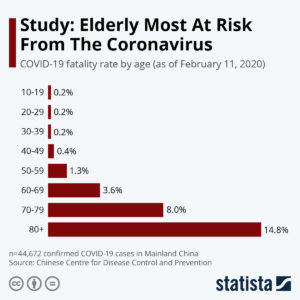
This virus specializes in older, unhealthy people. But young people are carriers, even if they don’t die. So if you don’t have to, you should probably be avoiding older people for the duration.
Social distancing is not a bad idea. If you can work for home, you probably should. Employers which can have their workers work from home should do that now. Schools should be sending students home, conventions should be cancelled, etc.

In Italy, the government has cancelled mortgage payments. I would suggest that other governments consider the same and do something similar for renters, while also cancelling utility payments, with the government directly compensating utilities. Other similar measures can be imagined.

The American government’s inclination will be to give money to rich people through the Federal Reserve, but it is poor people who need to be convinced they can afford to stay home, and not go to work and keep spreading the disease.

Remember that the virus has a five day average incubation period. You could have it now and feel fine. Further you can have the virus and never get symptoms, but spread it. This is especially likely if you are young and healthy.

So, take this all seriously. It might save your life, or it might save the life of someone you care about.

As for the politics, it all depends. If it’s not too bad, Trump can keep the lid on it. People will die, the media doesn’t really report it, he survives. If it truly breaks out, and people are sharing videos of their grandmothers dying without health care because hospitals are overwhelemed, he’s going to get the blame–quite deservedly so. Of course, most politicians, including Trump, Biden, and Sanders, are old, and are at high risk to get the disease and die. Trump, in particular, is obviously not healthy.

The Coronavirus is not a hoax, it is deadlier than the flu, and the response has been bungled.

Edit: One of the symptoms is coughing blood. An herbalist I respect has suggested Dragon’s Blood (Sangre De Grado) might help with that. I pass this on very tentatively, I’m not a doctor and don’t play one, but I have ordered some for myself. It’s not expensive. None of this is a substitute for hospital care, of course, but hospitals may be overwhelmed.


The results of the work I do, like this article, are free, but food isn’t, so if you value my work, please DONATE or SUBSCRIBE.

Preparing for the Coronavirus

I haven’t written about this because others have been dealing with it well and pandemics aren’t something I know a great deal about.

It does look, now, like the Coronavirus stands a good chance of turning into a pandemic, and I think we should discuss preparation a bit.

Our world produces most goods in a highly fragile, just-in-time production chain. There may be multiple inputs to a finished good, but the parts are made in a very few places. Most countries do not produce everything they need, there are not many sources of key goods and warehouses do not keep large inventories; production tends to run just ahead of need. This is efficient, but it also means that any serious disruption to production can produce shortages almost immediately.

China is a lynchpin producer of a great number of goods, including medicines. Korea, which is starting to get hit, produces many goods as well. It’s hard to say who exactly produces what unless you’re an expert, for example, after Puerto Rico got hit by a hurricane the US experienced shortages of IV bags. Who knew that the primary IV bag supplier for the US was in Puerto Rico?

So in most cases I don’t think it’s worth spending a lot of time tracking specific dependencies, especially if you’re dealing with a complex chain with many inputs–hit it in one place and you can take out the entire production.

Because fighting a pandemic is mostly about isolating people, production hits are inevitable: You can’t let people go to work.

So, if there are things you need, stock up now so you can shelter in place for a couple months if you have to.

In particular, I want to emphasize looking at your health needs. Many, many drugs are made in China. If you are on something you need to stay alive, or you are on something with ugly withdrawal symptoms, like most SSRIs, drugs which affect GABA, etc, etc., go see your doctor and convince him to give you an extra prescription or two (2) months’ supply – then go fill it.

Yeah, I know this is hard, because doctors can be stubborn and stupid, and I know it may be hard for financial reasons, but if you can, do it.

I can’t guarantee you’ll need it, of course. I can guarantee that if you need it and you don’t have it, you’ll regret it.

Remember that the United States, among developed nations, is going to be uniquely shitty at public health because a lot of people won’t go to hospitals and so on because of money issues.

As for the rest: Wash your hands, don’t touch your face, etc. Remember that this is a particularly difficult bug: It’s too small for masks to work well, it doesn’t show symptoms for 5-24 days (reports differ), it lives on surfaces for days, etc. It is a fast mutating bug, and the theory is that that’s good, because it is more likely to mutate to be LESS dangerous over time–but that also means you may catch it more than once.

This bug is likely to highlight both the stupidity of and the weaknesses in how we’ve ordered production through the world. Anything that is important, any reasonably large nation should produce for itself–if can manage it at all. “Efficiency” gains or profit gains are not worth catastrophic failure vulnerability, or the political choice weakness which comes from dependence (not to mention how globalization has been deliberately used to crush labor).

Anyway, check your meds and make sure you’re not going to be undergoing involuntary withdrawal from something you need, or something with horrific withdrawal symptoms.


The results of the work I do, like this article, are free, but food isn’t, so if you value my work, please DONATE or SUBSCRIBE.

The Problem with Pharma Research

Capitalism is based on the premise that profits reflect work that people want done, which is also worth more than the costs of its inputs.

The problem with this theory is that it often just isn’t so; the work being done involves a misallocation of resources.

Take pharma, for example. It is more profitable to sell someone a pill a day than to cure them.

This is simply inescapably true in most cases.

A man who needs erection pills, a person who needs insulin, are much better customers than someone who needs a single round of the latest antibiotic.

If you do have an actual cure, since you can’t keep charging forever, you want to charge as much as possible for it. So you raise the price for a Hep C cure (the majority of the research actually having been done with public money) to six figures, when it costs about a $100 to produce.

And a lot of people die or suffer who don’t have to.

The profit motive is a very blunt instrument, and it’s unnecessary for a lot of work. To be sure, no one wants to pick up garbage, but plenty of people want to be medical researchers, because it’s interesting work which does good for humanity, and a lot of people want to do good. Give them a salary sufficient to support their family and a lab, and most of them will be fine with that.

The actual manufacturing is not so fun, but that could easily be done by a range of contracting companies or even by the government.

And in such a situation, suddenly the emphasis is on cures.

If you must have big payouts, make them bounties: “Cure X, and we give you a billion dollars.”

Pharma does do a lot of research, but it wants a pill a day, it wants extensions of already profitable drugs, or it wants hugely pricey cures. It wants to create new forms of addictive drugs, like opiates, rather than just using, oh, morphine and various other forms of painkiller which work perfectly well and already exist and which can’t be patented.

None of this is hard to figure out. There’s a place for private pharma, to be sure, mostly to act as a cost check on public pharma, but as it exists now, what it’s doing is massively misallocating resources.


The results of the work I do, like this article, are free, but food isn’t, so if you value my work, please DONATE or SUBSCRIBE.


Pharma Execs Should Go to Jail and Pharma Should Be Publicly Run

*One vial of insulin cost $21 in 1996, compared to $320 in 2018. The cost of Big Pharma’s outrageous greed is American lives. If they will not end their greed, then we will end it for them.* —Bernie Sanders

Corporations are bundles of rights. The most important right is a shield from liability. Corporation rights used to be contentious–in particular, a lot of capitalists thought that it was wrong for corporate officers and owners to not be liable for wrongdoing and debts.

Corporations are given their special rights because it is assumed to be in the best interest of the public. Corporations exist, thus, to make the public better off. When they do not do so, they should be put down. (I would argue corporations have too many rights. Certainly they should not have personhood.)


(I am fundraising to determine how much I’ll write this year. If you value my writing and want more of it, please consider donating.)


So, they’re murderers. Mass murderers. They take actions they will know will kill many people.

The sane response, beyond the simple, “Get them out of the business and have government take over drug research and manufacture,” which would lead to better, cheaper drugs relatively quickly, is to throw them in jail. They kill people in large numbers, and they know they are doing so.

And, in death-penalty states, well, hang them high.

That said, again, it is stupid to run drug research and manufacturing privately. The promotion budgets are larger than the research budgets, and the incentives are all wrong, leading to palliatives rather than cures and insufficient research in important drug classes like antibiotics.

There are things markets do well, but drug research isn’t one of them. (And, in fact, a vast amount of the money still comes from government and flows through universities, but the profits are privatized.)

Lock up the murderous executives, break up their companies, and move the research to public bodies.

DONATE OR SUBSCRIBE


The Golden Rule for Judging HealthCare Reform

So, I see today that Democrat Tammy Baldwin has endorsed doing a Medicare buy-in starting at age 50.

Which means that access to good health care will remain age- and money-gated. If you’re too young and too poor, you don’t get health care, or you get worse health care.

Here’s the simple rule for a good healthcare system: The health care someone gets is based only on what they need and not on ANY other consideration.

This means everyone is treated the same. If society decides that some treatments are too expensive, then the criteria used for whether you get them is never “Can you pay?” it is criteria like “Who will this help most, medically?”

Of course, it is impossible to deal with America’s healthcare mess without also dealing with oligopoly device and medicine providers.

That means you must either regulate them (“You will make a 5 percent profit, no more and no less”) or you must break them up, or you must nationalize them.

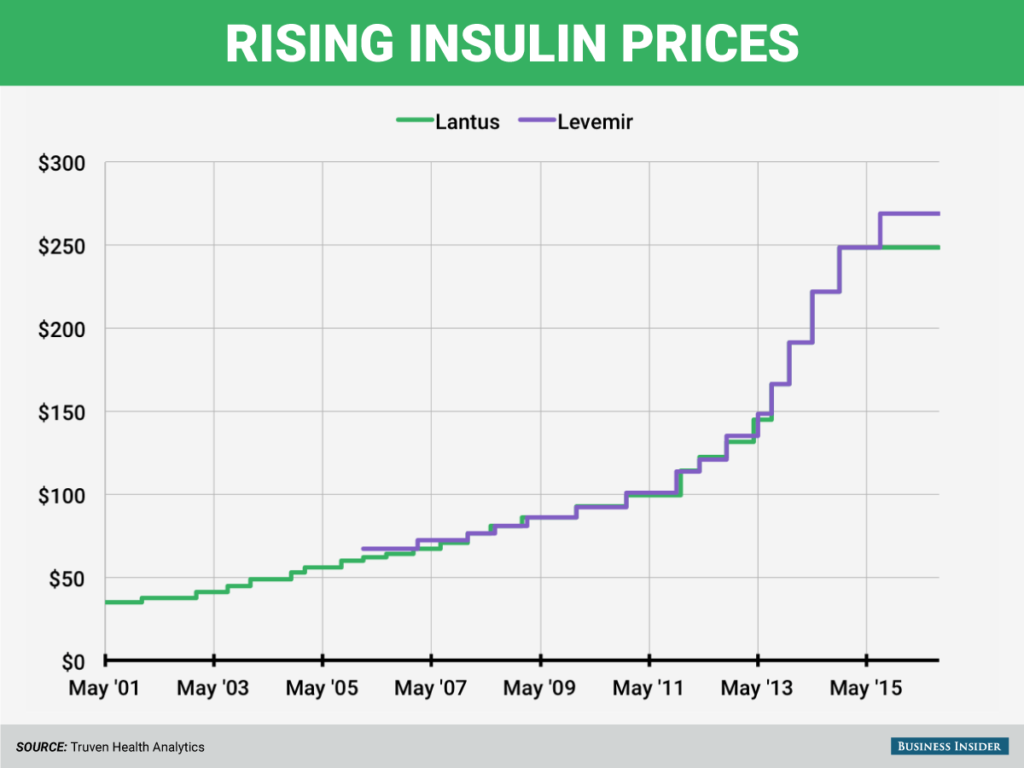
When the price of insulin has risen like this…

… you know that the market has failed. And this is for a drug that is not patented.

A few people are getting very rich, by killing people. Those people should have their companies expropriated for nothing, and then, if any charge can be found, criminal proceedings should ensue. At the least, they should be made pariahs, and anyone who deals with them in any way should be ostracized.

But, moving back to policy, if you just give everyone health care, stop rationing based on money and age, and break the oligopolies (while fixing various other perverse incentives like doctors owning testing companies), not only will the cost of healthcare plummet (Canada’s per capita costs dropped by a third in ten years just by changing to universal care), its quality will increase.

But I still want to see most pharmacare executives in prison.


The results of the work I do, like this article, are free, but food isn’t, so if you value my work, please DONATE or SUBSCRIBE.

Tales of Canadian Healthcare and Potential Russia/US War in Syria

So, posting has been, errr, non-existent for a bit as I’ve been dealing with some (probably minor) healthcare issues.

Earlier this week, I had exploratory surgery and, later, an MRI. The total time for the exploratory surgery (entering the hospital to leaving) was about five hours. The total time for the MRI was two hours, of which I spent 45 minutes semi-dozing inside the machine.

Total price? $20 for some pain killers to take home with me after the day-surgery. Oxycodone (the generic form of Oxycontin), which is the first time I’ve had it (I’ve had plenty of morphine and codeine at various points), and, ummm, I can see why a lot of people get addicted.

Generally speaking the nurses, doctors, techs, and orderlies were all polite and efficient. The nurses and doctors at the day surgery stood out as particularly solicitous, which I appreciated. I haven’t always had the best experience with surgery (understatement alert), so getting the feeling that they cared and were competent was nice.

Contrary to the propaganda, all of this was relatively expeditious. I don’t have an urgent problem, so the process hasn’t been super fast, but it hasn’t been slow, either.

And this is Canadian healthcare.

Regular posting should resume soon.

Idlib province in Syria is a potential flashpoint between the US and Syria/Russia. The Syrians want to clear up the Al-Qaeda subsidiary there, and the Americans want to pretend they aren’t Al-Qaeda, and have been saber rattling and stating that Assad is going to attack chemically, and the US will retaliate.

Lots of stupid here, and a small–but real–chance of starting something nasty between the US and Russia, which the US might well lose, actually, since the US has fallen behind both on missiles and missile defense technology.

Let’s hope not. Not getting into a war in Syria with Russia was Trump’s main selling point, but he seems to have since become deranged about Syria’s Iran ties, because the US’s foreign policy, apparently, is about doing what Saudi Arabia and Israel want, not what is good for the US.

Sigh.


The results of the work I do, like this article, are free, but food isn’t, so if you value my work, please DONATE or SUBSCRIBE.

Page 23 of 35

Powered by WordPress & Theme by Anders Norén