The horizon is not so far as we can see, but as far as we can imagine

Category: Electoral Politics Page 26 of 30

Progressive Blog #Fail: Moral Failure or Demographic Doom?

(This post is written by Pachacutec, not by me. Pachacutec was a long time blogger at FireDogLake, and deeply involved in Netroots Strategy through 2009. – Ian)

By Pachacutec:

I read with interest my old friend Ian’s take on the failure of the progressive blogosphere, or “netroots,” from its beginnings in the early 2000’s until now. Ian and I had a little exchange about it on twitter, and he invited me to blog my take. Bottom line: I think Ian gets it partly right, but oversimplifies what happened.

Ian thinks the problem was essentially a moral failure:

So progressives have no power, because they have no principles: they cannot be expected to actually vote for the most progressive candidate, to successfully primary candidates, to care about policy first and identity second, to not take scraps from the table and sell out other progressive’s interests.

He also thinks progressives are more tribal than Tea Party conservatives are:

Unlike the Tea Party, most left wingers don’t really believe their own ideology.  They put partisanship first, or they put the color of a candidate’s skin or the shape of their genitals over the candidate’s policy.  Identity is more important to them than how many brown children that politician is killing.

[SNIP]

The Tea Party, say what you will about them, gets a great deal of obeisance from Republicans for one simple reason: they will primary you if they don’t like how you’ve been voting, and they’ll probably win that primary.  They are feared.

I don’t want to get distracted by this last point, but let me just state my opinion that Tea Party, liberals, and anyone else you can name are all tribal as hell, and just as tribal as each other. What made the Tea Party different in electoral effectiveness was Koch brothers’ money. There were moral failures in the netroots, most spectacularly in the ways that various people responded to scarcity, the dearth of any money to be made and food to be bought out of full time activist liberal blogging. But that’s not the big reason for progressive bloggers inability to translate online passion into raw political power.

My role in the netroots was part activist blogger and partly as a guy trying to find a way to get sustainable funds into progressive blogs. That meant I purchased and paid close attention to metrics of progressive blog audience demographics. One reason we didn’t become a destabilizing political force, able to shape policy and elect politicians, was because we just lacked the demographic reach to do it. We thought (hoped) we could be a populist wave for change. Turns out we were just a current.

Progressive blog audiences mostly reached more educated white boomers, and, with some exceptions, more men than women. Progressive blog audiences geographically reached all over the US, but their very dispersion made it difficult to get anything going on the ground where people of like mind could coordinate together. That limited audience reach and growth that could translate into coalition building and political power.

It’s true, as Ian hints, that our white boomer audiences were still mostly people who believed in institutions. They grew up that way. They were collectively shocked at the direction of the country and the corruption of media and government in the Bush years, but they were not radicals. They still believed in these institutions. Most wanted reform, not fundamental systemic change. They still listened to a lot of NPR.

This is what Ian is getting at in his argument, though I don’t see this so much as a moral failure as it is a lack of educated boomer tribal experience, a function of cohort. These boomers believed in the American Dream, but the next generation coming up is having a very different experience in its formative years. I see this as more of a systems phenomenon, related to how generations learn and form their assumptions, than as a collective moral failing.

Some bloggers tried to get around their weakness in organizing people on the ground by allying with unions, whose whole infrastructure of politics was about people taking collective action locally. But it was an uneasy alliance for tribal reasons: blog audiences were not working class and were far less diverse than the membership of service employee unions.

Without funds to amplify or rapidly escalate their local reach, the way the Tea Party has had, the netroots got bypassed by the fundraising and organizing machine of Obama campaign, which tapped the rising demographic wave ready to be plucked on the center-left: young people, women and people of color.

The 2008 primary wars were the worst time for progressive blogging, because the ugliest sides of latent liberal tribalism between the Clinton camp and the Obama camp were in full bloom. Obama held the netroots in contempt and allied with establishment forces and hedge fund money to suck all the organizing life out of the netroots. That’s what constitutes the “failure” Ian describes, but with hindsight, I don’t think there was any way we could have overcome all of these systemic obstacles. We lacked money, we were too narrow in our reach, too unorganized, and as a result, we could not overcome establishment efforts to beat us back.

We did have a partial victory with Lamont over Lieberman, where we succeeded in creating a local presence. However, as Ian points out, Lieberman won as an Independent. We have, in part, both the Clintons and Obama to thank for this. As validators, they helped Lieberman. Obama travelled right through Connecticut during the campaign and avoided an appearance with the Democratic nominee, Ned Lamont, reneging on a non-public promise. Lieberman had been his mentor in the Senate. None of this was an accident. Bill Clinton talked up Lieberman, in spite of the fact that Holy Joe made much of his name pontificating about Bill’s penis.

Still, the Lamont campaign showed the establishment that the netroots really had to be dealt with. Obama performed the hit, in what we have come to know as his signature Quiet American style. There were no drones involved, unless you want to use the word to describe paid and unpaid tribal attack hacks, rather than flying death machines. Either way, Obama never likes to leave fingerprints or get his hands visibly dirty.

What remains of the netroots is not a movement in itself but a continuing current. Some people came through this very clarifying period for one’s character scarred but with their integrity intact. Duncan (Atrios) and Digby still document the atrocities. Howie Klein fights the good fight for grass roots candidates and against the DCCC. Joe Sudbay works persistently and effectively for gay equality and disenfranchised immigrants. Marcy’s persistent OCD and ability to connect the dots influences the influencers and the debate on the NSA. Ian shakes his fist at us, challenges us and reminds us of things we try not to think about because we just want to get through our day. Even Tom Matzzie, who has left politics, pops up from his embedded perch to fuck with Michael Hayden. There are others as well, I’m just citing examples to make my point.

Collectively, we failed at our most lofty ambitions, though we didn’t fail at everything. But with climate change and the time it will take for a possibly more radicalized youth cohort to effect more radical economic and social change, it may all be too late. Then again, it took decades between God and Man at Yale and Ted Cruz. There is something to be said for just finding a way to hang around and keep the narrative alive. It’s about all we can still do, and below the level of institutions, there are signs the culture may be catching up.
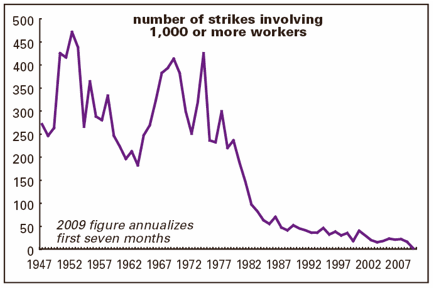
Jerome Armstrong on the Failure of the Netroots

(This a comment elevated from my post on the failure of the progressive blog movement.  It is written by Jerome Armstrong, not by me. Jerome was the founder of MyDD (Kos’s Blogfather) and co-author of Crashing the Gates, among other things- Ian)

by Jerome Armstrong

I didn’t see Lieberman’s 2006 win in quite as pinnacle a light at the time, and it certainly wouldn’t have been, had we followed it up more often, and won.

Yet I certainly peg the crux of lost movement with the rise of Obama’s campaign. It was an awful place to be in with Clinton vs. Obama, in the 2008 primary. My basic impulse (after Edwards –who had the populist message– imploded) was, like many bloggers (not the masses), to go with Clinton because she at least showed signs of being accountable to the netroots movement, unlike Obama. He didn’t need the netroots for his message and candidate-movement, he had places like Politico to push out of, and was basically an identity-politics cult for many new to politics that flooded the blogs.

But, I view the clincher happening a bit later, with Bill Halter’s loss in the 2010 Democratic primary in Arkansas. That is when it really ended. The whole Labor-Netroots coalition, Accountability Now, the blogs went all-in big (still barely united) with MoveOn and PCCC. Over $10 million to defeat a BlueDog that gave us this crappy corporate ACA debacle. But Obama did all he could behind to the scenes to defeat Halter. Obama dissed Lt. Gov Halter by embracing Lincoln (Michelle Obama once came to Fayetteville and recognized all of the politicians on the stage — Lincoln, and even Republicans — while ignoring Democratic Lt Gov Bill Halter standing behind her). Obama mailers pushed the LR area African-American vote into Lincoln’s camp in the run-off. Lincoln was a rural democrat– a base of voters that Halter took away from her. Obama being just neutral would have meant a Halter victory. But it wasn’t just the Lincoln victory, it was the way that national Democrats reacted to Halter’s message that convinced me the movement was finished. It took the attack site that we put up, BailoutBlanche.com, for me to see clearly what had happened.

This rising against the Democrats that aligned with the banks was the defining issue if this was to be a populist progressive movement within the party in 2010. We rolled it out with Bill’s campaign, and it struck her hard. Halter’s numbers soared among  rural Democrats, taking on the banks was the top polling issue. Halter was gaining on the issue, overtook Lincoln, and the Democratic Party backlash against him was immense (it’s when Obama got involved heavily too). Halter buckled, and made us take down the website. A symbolic cave. Lincoln won the run-off by 4 percent.

Another flawed candidate progressives sided with? Sure, but it really didn’t matter in the big scheme of things. When Democrats sided with the banks in 2008, and the progressive movement balked at primary challenges against those bankster-sponsored incumbents in 2010, it was all over.

The night of Halter’s loss, I sunk into a couch at the Excelsior in Little Rock across from PCCC’s Adam Green and Stephanie Taylor. We all just slumped over speechless. So yea, contrast that with the highpoint party we had when Lamont defeated Lieberman in the ‘06 primary in Connecticut– when MoveOn’s Tom Mattzie was busting open the biggest champagne bottle I’d ever seen. This is where we arrived 4 years later. When, after having $10M to spend in a primary against a incumbent that sided with the banks and defeated the public option in the Senate, all it proved was that the sitting Democratic President was against us.

I would agree with your general basis of criticism, that of our movement being non-ideological to a fault, but I am not convinced that is a defining feature of the reason for the failure. First, we just have to recognize that Obama (and Clinton, for that matter) are hugely compromised politicians. Flawed liars, and the most responsible for the failure of enacting a “progressive” agenda. And second, that the Democratic Party as an establishment voice can be summed up pretty much the same way. Wellstone and Feingold are gone, and no one else has stood up.

You know, when Markos and I wrote Crashing The Gates, just when we finished the draft, I had an OMG moment, saying to him–”you know, we haven’t said at all what we meant by ‘progressive’ throughout the book.” I threw in a link in the footnotes to something about it moving things forward, but really, it made me pause to wonder at my faith that they meant what we meant. So, I’ve had to accept the failure to grasp that insight. We thought it was just about using tough tactics and the rest would follow. Because we knew it was the moment for the Democrats to have a massive majority. Fuck, weren’t we naive?

I left the Democratic party after 2010– threw away the whole Gravy Train Democratic consulting gig. Sure, I didn’t like the way that my entire world got dropped. I too put some years into it. As a sort of cleansing, last cycle I went to work helping to primary some incumbents in both parties for a rich Texan PAC, and managing libertarian Gary Johnson’s internet campaign. I felt a lot clearer and cleaner having done the partisan purge. It made me realize that libertarians and progressives have a lot more in common than do either libertarians with the Republican party or progressives with the Democratic party. I’ve also come to believe that this alliance is where the next movement is.  It scares the shit out of the major parties, and the Government as a whole.

Yesterday, I was out on the DC Mall with this alliance. Against the surveillance state. Syria was another moment. SOPA also, and Audit the Fed. It’s a paradigm shifter, and it’s going to happen more and more. It could turn into something even bigger.

The alliance of progressives and libertarians (lets call it that for lack of a particular name for now) isn’t, for the most part, going to attract the purity-partisan types, the Democratic socialites like Tom Watson of Joan Walsh, or Daily Kos (though maybe Markos will get around to writing his “Libertarian Democrat” book and make a sea change there), but it’s going to happen regardless.

The oomph of the Democratic party in the blogosphere today can be summed up with a cursory glance at posts and comments on Balloon Juice, Little Green Footballs and Booman Tribune. They bend over backwards to justify the party bailing out banks, the nation going deeper into debt with global military expansion, and spying on citizens, yet they’ll nitpick that a libertarian is willing to allow abortion to be a state issue. They are more concerned with attacking truth-tellers like Julian Assange, Glenn Greenwald, and Edward Snowden than they are keeping anyone accountable or demanding transparency. That’s what they are really good at– justifying why the powerful should stay so and attacking the ones who challenge power. And, if needed, providing a handy social lifestyle issue to keep the division. There’s no energy left. Nothing that inspires people that are pissed off and want change. Just finger-pointing at the other team. It’s become pointless and principle-less tribalism.

We saw a big step with the netroots organizing last decade. It was the most exciting thing to happen within the Democratic Party in decades, but I now view it in a wider scope, without the partisan obstacle.I don’t think it’s over. It is dark. The internet is still hopeful for organizing a revolution. What I saw happen with the movement against Obama invading Syria tugged at my attention. Maybe we still could have some real transformational shifts happen, in the US and globally. I hope so. I’m counting on it to keep my sanity from making the traditional American blitz. When things get too tight, picking it all up and moving further west… to some remote pacific island. No wifi, just yoga :)

A brief note on why the progressive blog movement failed

In the early 2000s progressive blogging seemed like a big deal.  At the first Yearly Kos, as it was called then, big name politicians came and kissed our ass.  We were covered by major newspaper and TV outlets.  Etc…

Today, we are nothing.

The reason is simple: we could not elect enough of our people. We could not instill sufficient fear.  We could not defeat incumbents.  We did not produce juice.  Clark and Dean didn’t win the 2004 Presidential nomination. Dean was taken out in a particularly nasty fashion (via the manufactured Dean Scream.)

The turning point was when Joe Lieberman, though defeated in a primary, managed to be elected anyway.  After the 2006 House capture by Democrats, Pelosi’s democrats betrayed the fundamental principles that the prog blogosphere stood for: they did nothing to stop the war, for example.  The Prog blogosphere took it, and worse, most of the blogs that did come out against House Democratic Vichy behaviour, lost audience.  (Yes, they did. I tracked this stuff carefully at the time.)

The nail in the coffin was the 2008 primaries.  To put it simply, Obama bypassed the blogging gatekeepers. Commenters, whether free or bought (and yes, I believe many were on the payroll) capsized DKos and other major blogs.  Obama did not need the gatekeepers, he simply bought out the movement.  The bloggers were irrelevant.  At least one major blogger acted as a conduit for Obama hits: was fed oppo, and put that oppo out there.

After 2008 everyone knew that they didn’t need prog-bloggers and that they didn’t really need to fear bloggers. (They may be annoyed by “Firebaggers”, they do not fear them.)

Unlike the Tea Party, most left wingers don’t really believe their own ideology.  They put partisanship first, or they put the color of a candidate’s skin or the shape of their genitals over the candidate’s policy.  Identity is more important to them than how many brown children that politician is killing.

So progressives have no power, because they have no principles: they cannot be expected to actually vote for the most progressive candidate, to successfully primary candidates, to care about policy first and identity second, to not take scraps from the table and sell out other progressive’s interests.

The Tea Party, say what you will about them, gets a great deal of obeisance from Republicans for one simple reason: they will primary you if they don’t like how you’ve been voting, and they’ll probably win that primary.  They are feared.  Progressives are not feared, because they do not believe enough in their ostensible principles to act on them in an effective fashion.

That is why the progressive revolution of the early 2000s failed.  If you want the next left wing push to succeed, whatever it is called, learn the lessons of the last failure.

(Note: I poured years of my life into the movement. Its failure is my failure, and I take no pleasure in it at all.)

The Left Wing Case Against Obama and Obama’s Next Term

Matt Stoller’s made the left wing case against Obama, and then responded to his critics, who, he’s right, don’t address his points.  The two articles are excellent, and you should read them.

I haven’t really bothered writing that much about the election because it simply isn’t very important, despite the hysteria.  Romney would probably be worse on the margins, but the difference is at the margins, except, possibly, for the Supreme Court.  The most intellectually honest argument for Obama can be summarized as “he’s an evil man who has gutted the constitution and done everything possible to enshrine oligarchy, but he’ll probably appoint a Justice who will keep Roe. v. Wade and a few shattered spars of the Bill of Rights around.”

The key thing to realize is that Obama is the President who normalized Bush’s Republic.  He normalized routine civil liberties violations, normalized anti-immigrant raids, normalized the eternal war on terror, pushed executive power even further than Bush with a unilateral war against the wishes of Congress in Libya and by arrogating for himself the right to kill any American.  He made sure the rich not only stayed rich, in the face of a financial collapse which he could have used to break their power, but has increased inequality significantly.  The wealth and wages of ordinary Americans have dropped, the portion of the country’s income going to the wealthy has increased, and the US is well on its way to becoming a corrupt petro-state.  Nothing is more hilarious than Mayor Bloomberg endorsing Obama because of climate change, when Obama has quite deliberately overseen a huge increase in hydrocarbon production and openly embraces so-called “clean” coal.   Obama may agree that Global Warming exists, and Romney may pretend that it doesn’t, but the policies of the two are functionally identical and the money Obama spent on renewables was so horribly misspent as to do nothing but discredit the industry.

The argument for “who cares” is simple enough.  Yes, Romney will be worse than Obama in certain respects, but if Obama is not in charge, then the Democrats are far more likely to oppose both civil liberties absuses and efforts to cut Social Security and Medicare.

Let me tell you how Obama’s second term will play out.

1) He will appoint a milquetoast “liberal” to the Supremes.  You’ll keep the remains of Roe vs. Wade, but he’ll keep doing things like overruling Plan B as an over the counter medication, because he doesn’t really believe that girls impregnated by their fathers have a right not to have the child.  And every case that enshrines oligarchy, like Citizens United or HCR, will go for oligarchy (you aren’t stupid enough to think that Roberts switched his vote for any reasons other than to give insurance companies their bailout and gut Medicaid, I hope.)

2) The economy will struggle along till he gets his grand bargain, then it will absolutely crater.  You’ve got a couple years of lousy but not awful economy at most, use it, because years 3 and 4 are going to be awful.

3) He will make a Grand Bargain.  Winning by only a small margin of the popular vote will help with this.  The rich will pay slightly more, but most of the money will come from cutting Social Security, Medicare and other such programs.  The Republicans will give him just enough votes to pass it, so that it will be the Democrats who have gutted SS and Medicare.

4) The Republicans will nominate a right wing crazy in 2016.  He will stand a good chance of winning, because the Democrats, having cut SS and Medicare will now stand for nothing other than “fear the Supreme Court!”  In fact, the Republicans will run as the defenders of SS and Medicare.

Because the Republican Congress is now extremely far right wing, in fact reactionary, when they get their President, they will be able to do almost anything they want.  And all they will need is the House and 51 votes in the Senate, because they will not play stupid games about the filibuster, they’ll pass under reconciliation or just do it with 51 votes and tell everyone to go fuck themselves.  There will be no nonsense about super-majorities.  HCR will, at that point, be removed or gutted.  The court decision making Medicaid optional, however, will remain the law of the land.

Reelecting Obama does mean a better economy for the next couple years.  It does mean that people who can afford health care with mandated issue, and who must have it to make the bridge to Medicare, will get that.  It means nothing else.  It will gut the Democratic coalition, it will make a reactionary right wing president far more likely, it will kick the restructuring of the economy which is needed down the road further, making it more difficult when, or rather if, it ever occurs.  It will make the Grand Compromise, meaning SS and Medicare cuts, far more possible than if Romney were in power and Democrats were opposing the bill.  And yes, poor women will still be able, at least theoretically, to get abortions (upper middle class women are always able to get them, since they can travel.)

Is it worth it?  I don’t, personally, think so.  As with Matt Stoller and many others, if I could vote, I wouldn’t vote Obama.  To be clear, I wouldn’t vote for Romney either.  I’d probably vote for Jill Stein, making a third party viable starts with, oh, voting for it

On edit: one more thing, there is no excuse to vote for Obama if you are not in a swing state.  NONE.  Vote third party.

Observations on Canadian NDP leader Mulcair and the politics of class

Last weekend, the federal New Democratic Party (NDP) elected a new leader: Thomas Mulcair, an MP from Quebec, who was a minister in the provincial Liberal government there, before he resigned rather than open a park for development.

Mulcair was the front runner, and his victory was hardly a surprise.  Many NDPers thought that he would move to the center and would abandon left-wing principles in pursuit of power, and a number of key members of the prior leader’s team have left.

I had my doubts, but Mulcair has gone a long way to assuage them in just a week.  First, this, in his first day in Parliament:

Speaking to reporters afterward, he laid out his concerns for the state of the Canadian economy and accused the federal government of neglecting workers as it promotes the extraction of natural resources, mainly in Western Canada.

“That’s driven up the value of the Canadian dollar, made it more difficult to export our own goods. We’re killing our manufacturing sector,” he said. “The way the Conservatives are acting has had a devastating impact on good jobs with pensions.”

There was a lot of whining from Alberta about this statement, but it’s just a fact.  The classic Canadian economy was a mixed one, which combined resource extraction and manufacturing.  When manufacturing does well, resources generally don’t.  When resources do, manufacturing doesn’t.  In the old model this was considered a strength, since it meant that part of the economy was doing well, no matter what resource prices were.  And when one sector was up, it was meant to subsidize the other sector.

Resource booms always end.  Every single one.  The oil boom will end, the question is when.  If Canada doesn’t have a manufacturing sector left when the boom ends, we will become a basket case South American country.  And Alberta will become the new Maritimes (remember, the Maritimes was originally a resource boom area.)

Politically speaking, this is also smart, because the NDP just isn’t going to get a lot of MPS out of Alberta in specific or the Prairies in general.  If attacking the tar sands, and calling for Canada to add value to resources before shipping them out of the country costs votes there, so be it.  The battleground is not Alberta.  Alberta went all in with the Conservatives, and they have to live with that.  There’s no point in pandering to Albertans, it would take a huge shift in voting to gain many more seats.

The places in play are the Maritimes and Ontario, and it is there that the election will be won or lost.  It is Ontario which has been losing its manufacturing due to the high dollar, and the Maritimes has been treated shoddily by the Conservatives as well.  So on both politics and economics Mulcair’s stance is a good one, which appeals to the regions where the NDP can make gains and pisses of people who would never vote NDP anyway.

Then there was this, yesterday, when the Tory austerity budget was unveiled:

“The Conservatives have caused the problem by gutting the fiscal capacity of the government,” Thomas Mulcair, the newly crowned NDP leader, said Wednesday.

“Now they’re saying, oh, gee whiz, no more fiscal capacity in the government, we know what we’ll do, we’ll start cutting the services of the government.”

Oh my, pointing out the obvious.  Conservative tax cuts and reckless spending caused the defict.  But tax cuts for rich people are sacrosanct, so old folks will have to wait till 67 to retire.

And this:

“Everything indicates the Conservative budget will be synonymous with cutbacks and job losses. A few months ago, the Prime Minister promised textually, in this House, that he would not touch pensions, would not cut health transfers to the provinces, would not touch services to the population?” Mr. Mulcair said. “Will the Prime Minister live up to his word, or will he break his promise?”

And then, Harper cut pensions and cut health transfer to the provinces.

Ouch.  That had to smart.

Yeah, I’m liking Mulcair.

One of the things which has distressed me most about the West is that no one on the left has really been willing to hammer the politics of class.  Mulcair, who has also hit inequality, shows some signs of doing so.  It is conventional wisdom that tax increases won’t fly, but the polling data doesn’t support that, at least not if you want to tax the rich and make that clear.  Heck, if even Globe and Mail readers (the primary business newspaper in Canada) want tax increases and more spending, I think we can conclude that it’ll fly (yes, I’m aware of the limitations of that particular poll).  But even the upper middle and lower upper class think that the true rich should pay their share.  Coming out of Quebec, which is somewhat insulated from the political culture of the rest of North America, Mulcair seems willing to play class politics, and seems to know how to do so.

So far, so good.  And as for the budget, Prime Minister Harper isn’t going to get the cuts he wants from the public service without causing great pain.  Nor is cutting other forms of spending going to help the economy.  Harper better get down on his knees and pray to God that there isn’t a major downturn in China, because he’s betting everything on resource prices.  If they crumble, the Canadian economy will go with them.  And so will Harper’s job.

This is opposition politics 101: whatever the government does, you oppose. If Harper’s bet on the resource economy works, then the Conservatives will get another term.  If it doesn’t, the NDP needs to be seen as the party which opposed his policies.  Mulcair is positioning them for that, and doing so in a way which allow him, if he gets in power, to put in place policies which will reward the constituencies he needs to win—everyone not attached to the oil teat.

The NDP Leadership Debate in Toronto

I came. I saw. I listened. And what I listened to was a lot of what MP Nathan Cullen characterized as “violent agreement”.

The packed crowd (people had to be turned away) listened to candidates who agree, violently, on what government should do. Grow the economy sustainably, help the downtrodden, ensure equality, and so on.

The disagreements, with one exception, were subtle. They were either about political strategy, or about implementation. Everyone may agree on what to do, everyone does not agree on how to do it. But with only a minute or 30 seconds to answer each question you had to listen sharply to hear the differences.

With that one exception. Cullen proposed open primaries for all non Conservative parties with only the winning candidate running, so that there would be one candidate in each riding to oppose the Conservatives.

The hissing was immediate. A heartbeat later, the clapping began. Because the NDP wants to be government, wants it bad. They’ve been in the wilderness for too long, and they sure don’t trust the Liberals to do the right things. But NDP supporters also understand that Harper is a transformational Prime Minister–in the worst way possible. He is making a Canada which is less equal, less prosperous and far, far meaner. He is undermining medicare, undermining small farms and plans to center Canada’s economy around resource extraction of the kind which leaves behind only a legacy of ruin. (Every resource boom ends. Every single one.) So defeating Harper is important.

That aside, there was so much agreement that I began doing what I prefer not to do in American politics: I started considering electability.

There were only three candidates on that stage, in my opinion, who had the raw charisma and polished speaking skills necessary to lead the NDP to victory. Thomas Mulcair, Nathan Cullen and Peggy Nash. The NDP cannot afford a leader who is not charismatic, and the others simply don’t have the ability to hold attention. Nash and Mulcair are bilingual, Cullen’s french is weaker, but getting better.

Below I’m going to go through my observations on all eight, starting with the three I feel have the charisma for the job.

Thomas Mulcair

Mulcair has a reputation as a firebrand, but the man I saw on the stage was calm and in command of the facts. Able to switch easily between rabble rousing and policy, he also showed a clear command of the actual policy levers, as when he commented that the CMHC (the Canadian Mortgage and Housing Corporation) was the key to affordable housing, or when noted areas of provincial jurisdiction. He was also the strongest opposing voice to Cullen’s suggestion of open nominations, making a passionate case that the NDP can win as the NDP. I didn’t go in with a very favorable impression of Mulcair, but I came out with one. He would be vulnerable to attacks on his strong support for Quebec provincial jurisdiction, and I’d like to hear his current views on the role of the federal government in areas on Provincial jurisdiction, but his charisma and command of the issues made a strong impression in the debate. His point about youth engagement being key to victory was also well taken, and I’d like to hear more about how he plans to increase the youth vote.

Peggy Nash

Nash was the most relentlessly rah-rah of all the candidates. Her answers were much more often pep talks and rally the troop moments than any other candidate. She reliably commanded the crowd. Her rhetoric on issues of social equality was very skillful, making the point that if some people are better off (union workers who have pensions, for example) the solution isn’t to take those pensions away, the solution is to make sure everyone has good pensions. Of the three candidates with charisma Nash left me coldest, but I was in the minority in the crowd. She didn’t demonstrate the same ready command of the nuts and bolts of issues as Mulcair, Cullen and Romeo Saganash but given the format of the debate and her background, I would assume she is just as knowledgeable and she certainly has enough policy proposals out. I like to hear her plans for winning the next election, and holding on the the gains in Quebec.

Nathan Cullen

I should confess first off that Cullen said many of the things I like to think I’d have said were I up on the stage, and said them the way I’d say them. He was the most combative of the candidates, and he was the one to call for specifics, and to call BS. The open primary suggestion was the main point of conflict in the debate, but he also made the point that when it comes to professional associations recognizing immigrant’s qualifications, “dialogue” isn’t going to cut it. He showed a ready understanding of the actual dynamics of power and how parliament works. And he was a smooth and clean speaker with charisma. As with Nash or Muclair, he commands attention. I don’t know his ideas on how the NDP should win, if the Liberals reject his open primary idea (which I’m pretty sure they would), but I’d like to hear them. As with all candidates not from Quebec, I’d like to hear how he plans to maintain the NDP’s success in that province, as well as grow outside it.

Niki Ashton

Ashton has a tendency towards mushy talk. The solution to too many things is apparently dialogue. We need to “talk” about everything. Certainly right on the issues (but so is everyone) but I didn’t get the impression she was ready for the leadership spot yet. She didn’t demonstrate the ability to make the case in a short, pithy, commanding way, and in our media environment, that’s disqualifying.

Paul Dewar

Comes across as likeable. The bloke you’d want to have a beer with, which so many political reporters seem to think is important. Good on the issues, like everyone.. Kind of forgettable otherwise. Nothing stands out from him in my mind other than “such a swell guy”. Of course that can go a long way in politics, and if Dewar were fluently bilingual his likeability could pass as charisma. As it is I think he’s a good candidate for the leadership in the next race, if he fixes his french.

Romeo Saganash

Romeo isn’t a good public speaker. I winced when he made his introductory speech. But he grew on me through the debate. He had an excellent grasp not just of the details of how government works but of what is most important. He made the single most important policy point in the entire debate – that the government has almost 200 billion dollars worth of tax loopholes, subsidies and so on. (He gave the exact number, but I didn’t note it down at the time.) The 5 billion in tax cuts for the rich which could be rescinded is just the top of the iceberg. That money means that if the NDP is serious, it can remake Canada. And his record in Quebec, bringing Quebec Hydro to heel and making it work for everyone in Quebec, is impressive. In any NDP government I’d want to see Saganash in a senior ministerial role. He impressed me as a man who could turn good intentions into policy which worked. He wouldn’t make a good leader, because he’s not a man for the soundbite era, or a great giver of speeches. But for the actual work of government, he’d seemed perfect.

Martin Singh

I think Singh knows he isn’t going to win. But he kept making the same point and it’s well taken: Canadians trust the NDP on social values, medicare and so on. They know the NDP will do the right thing. The sale which needs to be made is that the NDP can handle and grow the economy. I think that his point, and Nash’s combined, are the argument the NDP should go with: that Canadians don’t have to be mean to each other to grow the economy, but that we can all be prosperous together. Make that case, and the NDP wins. Fail to make the case, and the NDP can only back into power if Canadians hate Harper and see the NDP as the alternative. The other candidates, and the eventual leader, should listen to Singh on this.

Brian Topp

Another likeable man, though he doesn’t come across quite as personable as the immensely likeable Dewar. I get his mail, and he or whoever writes his pieces is a great writer, who hits all the right emotive spots. His policy papers are smart. But he came across flat and wasn’t a significant presence in the debate.

Closing Remarks

It’s important for the NDP to elect a leader who can win, and who if he or she becomes Prime Minister will do the right things, and do them effectively. Eight years of a Harper majority will change the country dramatically, and when adding in his years as minority leader, will make him one of the longest serving PMs in our history. Incredible damage will be done to the country as Harper’s policies strip mine resources and largely ignore the rest of the economy, leaving Canada in great danger when the resource boom ends, as they always do.

I don’t know enough about the candidates to make an endorsement, I will simply say that electability and ability to govern are the two things which I believe matter most. The candidates who struck me as having the necessary charisma, administrative chops and sheer bloodymindedness required were (in alphabetical order), Cullen, Mulcair and Nash.

There’s more I’d like to hear, including some big ideas. Instead of “increased sustainable housing” something like “in 10 years, every building in Canada will be energy neutral”. Or “we will roll make university tuition $2k a year, and student aid will be 80% grants.” (Oh, and bankruptcy from student loans will be allowed again). “We will overturn everything Harper has done.” Big things. The vision thing. Not “tax rebate for X”. Ten point plans are all very nice, but they won’t win the election, a clearly different vision for Canada will.

In the era we’re going into Canada has a lot going for it, not the least of which is that we have oil and other resources in a period when resources are scarce and prices will stay high for a while. Offhand I can’t think of a country better positioned to prosper over the next generation. But resources can destroy us, annihilating the other sectors of our economy, including manufacturing, so that we become nothing but hewers of wood and drawers of oil. When the eventual resource crash happens, we can become Argentina north. The grab the money and run strategy of the conservatives is incredibly shortsighted.

So the Conservatives must lose. The NDP must win. And having won, it must govern effectively. For the sake of Canada, may the NDP choose the right man or woman for the job.

(View the Toronto NDP Leadership Debate yourself.)

NB: corrections made. I used the word Sovereigntist sloppily with regards to Mulcair.  He has never been for Quebec independence, he does have strong views on the role of the Federal government in Quebec which could be charitably characterized as asymmetrical federalism.  Nathan Cullen is not fluently bilingual, but does speak French.

Ron Paul Hysteria

So, I’m noticing a ton of attacks on Ron Paul from progressives.  The reason is simple enough, Ron Paul is great on some key things the left cares about, and horrible on others.  His last ad in Iowa says he’d ban abortion, for example.  On the other hand, he wants to withdraw all troops from foreign wars and bring back the troops from America’s far flung military bases.  And he’s the only candidate to unequivocally state that he would never order the assassination of Americans.

Paul’s economic policies are straight up insane, and would throw the world into a full catastrophic Great Depression, even worse than the one we’re in now and worse than the one in the 30s.

But the problem is that current policies by more “mainstream” candidates just get to the same place more slowly.  And maybe not even that much more slowly.  Numerian thinks this could be the year of the big crash, for example, one where even the first world has food shortages and so on.

We’re going to get there.  There is a consensus for austerity amongst the transnational developed world elites which is breathtaking in its unanimity, imperviousness to argument and lack of regard for democratic niceties.  There is no consensus on how to deal with the oil bottleneck, no plan for actually dealing with the leveraged debt overhang, no understanding of how to create real growth, as opposed to bubbles.  If they do manage to hang on, what will happen is a huge non-conventional oil boom (read Fracking) and that will devastate ground water and turn large areas into wastelands.  Nor will it last all that long or feel all that good (it’ll be better than now, but probably not even as good as the best Bush years.)

After that I see no scenario in which things don’t crack up, completely.

So Ron Paul will cause a crack up, possibly a little bit ahead of schedule.  That sucks for old people who might have died before the world went to hell, but for young people, you might as well get it done.

But Ron Paul also might do some real damage to the military industrial complex.  There is no route forward for the US which does not require taking that misallocated effort, and using it for other things.  So this is necessary.

Also the movement of manufacturing and other expertise overseas means that the US labor force is a wasting asset.  The longer the decline goes on the fewer people there will be with the skills to bootstrap back up, the less of an industrial base other than defense there will be, and so on.  Infrastructure will be more degraded, not less, and so on.  So from that point of view, cracking up sooner, rather than later, is preferable because it leaves a clearer path to the future.

But let’s move back to the title.  The reason Ron Paul causes hysterics is he pits interest group against interest group, morality vs. morality. He’s a different kind of lesser evil.  If Afghans got to vote in the US election, who would they vote for?  How important is Habeas Corpus to you really?  What about pot legalization?  Etc…  Ron Paul is awful on some issues, and very good on others.  Are abortion rights more important than dead Afghans and Pakistanis at weddings?  (I don’t claim they are, or aren’t, I simply note Paul forces you to make that choice.)  And Paul would end all bank bailouts.  Hate the banksters?  Think they’re the key problem?  Paul’s your man.

Obama is objectively awful.  Paul is objectively awful.  But unlike Romney, Paul is objectively awful in different ways than Obama.  Romney would just be Obama, but slightly worse.  If you’re going to choose a lesser evil, you might as well choose Obama.  But when it comes to Paul vs. Obama the equation changes.

And that’s why many progressives are attacking any other progressive who says anything good about Paul, because Paul threatens to split the left, and because Paul makes progressives decide what they value most.

Ontario Liberals Win

They are fundamentally a right wing party, and their leader is a serial liar about important policy issues.  But, at the end of the day, the NDP did not want to win.  If they had wanted to win they would have promised a referendum on repealing the HST.  They refused to do so, they chose to run as liberal light “no new income taxes” and so they lost.  If Ontarians want to be lied to about taxes, they can vote Liberal.

As for Horwath, she needs to go.  Does not have what it takes.

Page 26 of 30

Powered by WordPress & Theme by Anders Norén