The horizon is not so far as we can see, but as far as we can imagine

Author: Sean Paul Kelley Page 3 of 13

'89-'93 BA History, Houston
'95-'07 Morgan Stanley, Associate Vice President
'99-'02 MS International Relations and Economic Development, Saint Mary's University
'07-'13 International Software Sales Manager, Singapore
'13-'16 MA, History, Thesis on Ancient Silk Road City of Merv, UTSA
Kelley lives in San Antonio, Texas.

America’s Economic Future: Imminent Pain and Dislocation Not Seen Since the ’30s

~by Sean Paul Kelley

The end of this credit cycle is going to include the following macro events: a credit crisis, a housing crisis, an energy shock, with the potential for massive failed deliveries necessary to third world nations creating famine on a biblical scale, at least one Too Big To Fail failing, as Lehman Bros and AIG did in 2008, and the AI bubble bust. All of these will happen. Locked in. Fixed. No way out.

In a previous post I outlined the order in which the financial catastrophe barreling down on us like oncoming freight will occur. I’ve simply included one new variable: the energy shock.

Here’s how it’ll go down.

First, there is an expansion. Stocks rise. At some point the rise becomes divorced from realistic earnings expectations. This is when intense speculation drives equities into bubble territory. After all, Nvidia’s market cap is just shy of ($4.2trillion) the annual GDP of India ($4.4trillion) as of Monday March 23, 2026. Simultaneously, US Treasury buyers, ‘prudent’ investors, qualified investors (people with more than $5 million in net worth), pension funds, insurance and re-insurance companies and good old orphans and widows, as they always do, got a bit jealous and so reached for yield. They wanted safety with high returns. But in this world you can have safe or you can have high returns. You’re a fool to think you can get both at the same time; alas we have a superabundance of fools these days.

So just like in 2007-08, the shadow banking system, ie. the issuers of supposedly safe and high yielding assets, called subprime loans, experienced serious losses, that lead to the unwinding phase of the financial crisis. The 2008 fin crisis started on a lovely summer day in NYC, June 22 2007—I think the Yankees won that day—when two Bear Stearns subprime hedge funs went belly up. This was 2008’s canary in the coal mine.

This time around it isn’t subprime that has precipitated the unwind but the dominance of private equity/private credit shadow banks, such as Blue Owl, Blackstone, Blackrock, and others.

As previously noted, the current crisis’ canary in the coal mine was Blue Owl. Their very rude wake up call arrived in the form of $1.4 bn in redemption demands, which forced Blue Owl to sell assets to meet redemption needs. It was a catastrophe for Blue Owl, in every way a fire sale in which every Wall Street trader exacted his pound of flesh. It also led to a very ugly unravelling of contracts with Oracle. Oracle’ stock plummeted.

Many others have followed in the weeks since Blue Owl burped up a massive fur ball. The specifics can be found in this post and are beyond the scope of this discussion. They are pertinent, but listing them would make this a Tolstoyian endeavor. The upshot is this: normally, an enormous amount of credit destruction (read, debt) has to happen until we get to phase three of the credit cycle. One counterintuitive effect: a stronger dollar. We’re already seeing this versus the other major fiat currencies.

Moving on to one of the other developments I outlined in the first paragraph: a housing crisis. Home building has long been the foundation of the American economy. It’s in serious stress right now. As I mentioned before, last month saw a full -17.6% collapse in the purchase of new homes. In the Northeast it was an epic cow patty catastrophe: -44%. In my hometown, sellers outstrip buyers buy a full 114%. This in the heart of the ‘Texas miracle.’ I honestly don’t know how a collapse in homebuilding will effect this economy coupled with the headwinds it’s facing. I know it won’t be salutary and will exacerbate already dangerous liquidity and solvency issues caused by the private credit/private debt unwind. What else? “Cannot say. Saying, I would know. Do not know, so cannot say.” Five bucks to whoever gets that reference.

Will the Fed be able to contain both? FuckifIknow?

Adding to fierce headwinds, Trump’s war against Iran has had a similar effect on the global economy as Odysseus ill-timed opening of Aeolus’s wind bag: it’s blown us on a completely fucktarded vector, beyond any rational goal, that will take five years-at a minimum-to recover from if we stop now. Plenty of us predicted this but we’re just dipshits sitting in the basement wearing our jammies. If the Israeli’s continue their wanton destruction of everything, there is no telling how Iran will respond. And I’m not even pondering nukes here.

The effects the closure of the Straits of Hormuz are and will continue to have on the global economy, rather the effects faced by the Rules Based Order the West imposed on much of the globe will be make the European energy crisis look like a night out with Sidney Sweeney.

One effect: potential famine in those third world countries-on a biblical scale-unable to import desperately needed fertilizer from the Persian Gulf at reasonable prices.

Second, no helium. Helium is a gas essential to modern industrial life, everywhere.

Third, my best friend in Denmark joked, “hell, we might soon be back on bikes eating only porridge for dinner.” He also rued the demise of Nordstream and said, unequivocally that Danish renewables won’t be enough. This from the one European nation with the largest sector of renewables. Imagine the second order effects cascading out across the globe?

And what about the cost of transport? Not just everywhere, but especially here in the US? Anyone given any thought to just how super human stupid just in time delivery looks now? I’ve always warned about this. You know: chickens, roosting; shit like that.

Fuck it. I’ve got more than ten years of Wall Street experience so what the hell do I know?

Well, I know this as I know the sun rises in the East and sets in the West: the exogenous shock waves rippling towards the US economy are bad. Vewwy, vewwy bad. And there is no double-slilt experiement available to cancel out the oncoming waves.

What next?

Oh yeah: Too Big To Fail. Nope. Stress test? Are you Dave Chapelle?

Just ask Lehman Bros or AIG. This time around one of the Too Big To Fail institutions will fail. Maybe more than one. If I had my choice it would be Goldman, but if I am being realistic I’d put odds on Wells Fargo and/or Citigroup. Why? Well, Wells Fargo has a history of laundering tons of cartel cash, so no real culture of compliance/risk management. Citigroup has brazenly challenged the SEC to regulate them on multiple occasions. Those would be my two choices.

Finally, I’ll recap phase three of the credit cycle: the Ponzi unwind. As I wrote here,

“Crypto will be the first big Ponzi unwind. And it will take a lot of suckers with it. Plus, a damn lot of fools who worked for investment, commercial banks and private credit/equity shops. Crypto is bullshit, wrapped in dead fish skin that’s been perfumed by Chanel. No matter how good it smells, it’s rotten to the core. Crypto is to this financial crisis as CDOs and synthetic CDOs were to 2008.”

Moroever,

“The AI-hyperscalers will suffer as well, during the Ponzi unwind. Why? They are in essence engaging in a similar sort of vendor financing like CISCO and Juniper Networks did in the dot-com bubble. Nvidia is giving chips to AI-hyperscalers as collateral for loans. Never mind the chips will depreciate long before the earnings are solid enough for the AI-hyperscalers to payback the “loans.”

It’s accounting legerdemain in extremis.

So, to be clear: multiple endogenous-domestic-headwinds coupled with very ugly exogenous-international-shocks, real and potential, increase the odds, hourly, that we’re nearing financial armageddon.

To recount what to expect: a housing crisis, a credit crisis, an energy-shock, fertilizer shortages leading to potential famine, one or two Too Big To Fail, failing and the AI bubble bursting. All at the same time. Same time. Boom. Boom. Boom.

This ain’t gonna resemble your daddy’s financial crisis. In the words of Grunge’s greatest lyricist, Chris Cornell, “I’m feeling California, but looking Minnesota.”

Israel, Nukes and Armageddon For Real

~by Sean Paul Kelley

I planned on writing a post about how the Russians were the ultimate winners of the Iran War, what with all that petroleum and natural gas they have. Truly, the Russian’s have got God by the balls (Как бога за яйца поймал).Windfall after windfall is accreting in an economy that is supposed to be in the doldrums. The reverse is true: Trump’s witless pursuit of war against Iran is effecting the collapse of the entire global economic order, except those nations trading with, well, you guessed it: Russia. I can’t fathom right now. How does one convey the stupendous amount of boomerangishness happening? It’s like karma grew a pair of balls and teabagged the entire Western order.

That said, I failed to write the post. Instead I got profoundly distracted by Col. Larry Wilkerson’s disturbing prediction that Israel will more than likely use up to 15 nukes on Iran to settle the conflict. Watch the video yourself. It’s a mercifully brief 7:03 minutes of terror. It’s the stuff of nightmares. I ain’t kidding. I’m dumbfounded. Dismayed because he makes a plausible case for Israel’s use of nukes.

If Israel opts for nukes the entire calculus of war changes. Nukes virtually guarantee the inclusion of other great powers in the war. I’ve taken to joking lately that we’re watching Armageddon. I didn’t mean literally, but now? I’m really at a lack for words.

We’re all going to die.

Afterthought : Before we all perish in flames, some more shitty news: sales of newly built houses fell a full 17.6% nationwide. In the Northeast it was a rout: down 44%. Adding insult to injury, McDonald’s, Pepsi and Dollar Tree are all racing to the bottom by reducing prices. Not goody, vewwy baddy.

Afterthought : The spread between home-sellers and home-buyers in San Antonio, my town, has widened to an astonishing 114%. That’s absolute brutality to home-builders. So, the end of this credit cycle is going to include the following macro events: housing crash, credit crisis, energy shock and at least one Too Big To Fail will fail, just as Lehman Bros and AIG did in 2008. Oh, and the AI bubble will unravel. Wow, that’s almost a perfect storm.

The Credit Cycle: Phase Two Accelerating

~by Sean Paul Kelley

Here are today’s Phase Two developments. Many are ominous. Things not looky so goody.

The smartest guys in the room, i.e., Goldman Sachs had this to say about AI: “Massive investment in AI contributed basically zero to US economic growth last year.” What will they predict next? An oil price spike if we go to war with Iran? Oh wait. 

Dario notes that the liquidity crisis is going global: “Middle East liquidity crisis in the financial system is surfacing.”

He cites Rashid ben Saeed who elaborates: “Citi and Standard Chartered literally evacuated their offices this week. Told staff go home, work remote. HSBC closed their Qatar branches. Hedge funds are in “contingency mode.” That’s a polite way of saying they’re bricking it. Analysts are saying customers could pull out $307 BILLION if this goes on another month.” 

First Squawk writes that both JP Morgan and Goldman are offering Hedge Funds ways to short private credit. That’s just weird.

Ripplebrain conveys just how devastating the attack on QatarEnergy’s LNG production is:17% of QatarEnergy’s production is 3.4% of the world’s LNG production.” Ending ominously saying, that it’s “gone in the blink of an eye, perhaps for years.”

The irrepressible Matt Stoller highlights a video that highlights “straightforward market manipulation.He also points our attention to the #2 story at the Wall Street Journal:U.S. Regulators Propose More Lenient Capital Rules for Big Banks.” This kind of proposal is in direct contravention to the ‘stress test’ rules put in place after the 2008 Financial Crisis. It also clearly foreshadows liquidity and/or solvency issues that the commericial banks will soon face. 

In another clear phase two clusterfuck is this story from the WSJ, cited by Unicus Research. The upshot: “Stone Ridge’s LENDX fund just told investors it would honor only 11% of redemption requests.” The post on X also includes what kind of garbage is in the fund. Go take a look. It’ll engender a ton of schadenfruede. Enjoy! 

As pending crises morph into full blown disasters investment banks often prepare by enacting the following policies. First, they raise production quotas for their employees while simultaneously cutting their commission payouts. It’s a cut-throat business. Payout cuts are painful. I’ve lived it. And they always cut payouts right before or during bear markets. I endured this twice at Morgan Stanley. Guess what: Goldman has begun that process, as First Squawk reports: “Goldman plans performance-based job cuts in late April.” This we can infer two important factoids from this: Goldman is worried about cash-flow. You don’t plan to run employees off if you’re flush with cash. Two: timing, Goldman clearly sees this credit cycle accelerating rapidly with an April inflection point.

Shashank Joshi catches an excellent highlight from the Economist:Average prices of petrol and diesel have reached $3.88 and $5.09 a gallon, compared with $3.11 and $3.72 at Mr Trump’s inauguration. Republican support for the war is strong, but softening.”

More Perfect Union informs us “the cost of vegetables jumped 49% last month as inflation hit hard and companies raised prices.” Its source is BLS data. Now I know, some will dispute how the CPI is computed. I thinks it full of balderdash and male bovine excrement. So does Ian. So I post and you decide. 

Sohrab Ahmari notes, unconfirmed but entirely plausible, that “force majeur [has been declared] on Qatari LNG contracts for up to five years.” Five years? That’s going to pile Pelion atop the already messa Ossa of the energy markets globaly. 

CORRECTION: according to EarlyGray the video below does not say anything about Japan buying Russian oil. Mea culpa. I regret the error. SPK

Richard posts a video and apparently translates it. If true, it’s a bombshell: “Japan is now openly buying Russian oil with the yuan.” Why not with JPY? I would imagine that China has already set up a Yuan based transaction system for buying and selling oil to steadily chip, chip, chip away at dollar hegemony. Yeah, Japan has said it publically and officialy. That’s pretty much like pissing on the petrodollar. Our closest North East Asian Ally. That’s fuckery on an hitherto unseen level. 

Meanwhile, to Japan’s northwest, South Korea is considering resuming imports of Russian oil.

And I make the observation, in utterly obscene Russian fashion that “with these high oil prices the Russian Treasury has certainly Как бога за яйца поймал.” Translated idiomatically: Russia is in the catbird seat. Translated directly:they got God by the balls.

Rory Johnston notes just how high Dubai crude prices have risen: “Cash Dubai crude (balance of the month) just broke above $170 per barrel.”

Here’s what I’ve previously written on this credit cycle. I stand by it all. The only comment I’ll add at present is this: if the exogenous shocks to the US economy continue and the energy shock intensifies, all bets are off on the proximate cause of the end of dollar hegemony.


Donald Trump and the Apotheosis of Chimpanzee Politics

The most salient observation in Lawrence Freedman’s book Strategy: A History, comes early, paraphrasing Frans De Waal’s seminal study Chimpanzee Politics, Freedman writes, “De Waal concluded that rather than changing the social relationships, the fights [to become or overthrow and alpha or to wage war] tended to reflect the changes that had already taken place.”

This “Chimpanzee Framework” is a useful way of understanding the catastrophe unfolding in the Persian Gulf today and the accelerating collapse of American power globally. The “Chimpanzee framework” clarifies just how and why American foreign and economic policy actions resemble a honey drenched giant fighting off an hungry sleuth of bears more than a smart, historically informed nation. American policy and its actions are uncoordinated, moored in shared delusion and filled with several metric shit-tons of hopium. (See, more proof ‘Muricans can do Metric!)

Why would American actions be otherwise? America inhabits a fundamentally different world than it did a decade ago. The unipolar moment is gone; multipolarity is fact, not wishful thinking. BRICS grow faster every day, searching for the perfect red-pill of knocking the dollar off its hegemony throne. Meanwhile, the United States cannot affect international policy change to its liking regardless where it acts. Not in the Ukraine. Not in Iran. Worse, the inevitable defeat in Iran will cascade into Venezuelan and Cuban failure as the small shrug off the rotten shackles of a wounded giant.

America’s inept inefficacy is not limited to international policy: economic policy vis-a-vis tariffs is an abject failure as it was under Biden. The United States will find re-industrializing an impossible adjustment when the reality of a nationwide collapse of its standard of living happens. Reindustrializing starts with a vigorous textile industry, not more computer and AI chip plants.

So, just how many Americans are willing to work for peanuts in sweat-shops? How many machinists can we realistically turn out in five, ten, even fifteen years? Do Americans even know what machinists do? How many high school graduates can use a lathe, much less know what one is? Our domestic reality is as equally grim as our international one, except our international collapse will compound already enormous burdens pervading an economy of misaligned priorities and a poorly performing one at that.

In Strategy, Freedman also discusses the utility and efficacy of coalition building among chimpanzees, their alphas and those tribes they war against. In his most striking note, he describes the political complexities, violence and the necessity of building stronger, effective coalitions, be they to wage war for a nearby fig tree or to install a new alpha. His conclusion is counterintuitive and profound: chimpanzee violence doesn’t represent an overthrow or revolution. It confirms a preexisting reality.

Henry Kissinger made the same argument in his doctoral dissertation, later published as A World Restored, not regarding chimpanzees, but in the context of Metternich’s formation of the Sixth Coalition against Bonaparte. The Befreiungskriege, as it was called in Metternich’s native German, confirmed the reality on the ground that Bonaparte’s 1812 invasion of Russia was a mortal own goal for the French; the War of the Sixth Coalition merely confirmed it; and the subsequent peace codified it for almost a hundred years.

The same argument can be made regarding the United States and its quickly deteriorating Western coalition of the unwilling. Not to mention its Far East allies who are quickly tiring of American shenanigans, outright betrayal and economic, tariff-related fuckery. That this coalition, a coalition that dominated the post-Cold War world, cannot now manufacture more artillery shells than a single nation, the Russian Federation, is proof positive of a deeply misunderstood alignment of power and an pre-existing altered reality is met with blank stares and outright denial.

That this coalition is blindly following a great power lead by the nose by a tiny, recalcitrant and criminal regime running Israel has historical precedent. Think Serbia and Russia in the days before August 1914. The Serbs were deeply complicit in the assassination of the Austrian Archduke (read Sleepwalkers by Christopher Clark for proof). And Russian mobilization in support of their little Slav Brothers (or if you really need me to spell it out in today’s terms, those who we share Judeo-Christian values with) guaranteed German entry into the war.

Freedman’s “Chimpanzee framework” goes far in explaining the escalating devastation of petroleum related infrastructure and targeting of natural gas fields in the Persian Gulf. The world desperately needs to move away from fossil fuels. And many nations have made great efforts to do so. Thus, the destruction in the Persian Gulf of petroleum assets, refineries, gas wells, LNG and oil terminals, represents a symptom of a larger global reality: the world has turned an epoch making corner on fossil fuels. The day of fossil fuels is far from over, but this is the beginning of the end. There will be winners and losers, cliché I know, and yet countries that have made strong investments in renewable energy will make the inevitable and painful adjustments successfully. The losers like the USA, are those who will maintain their reliance on petroleum, come hell or high-water.

Most Americans dispute the idea that we higher primates and chimpanzees have a common ancestor or share any commonalities for that matter. They are in need of a rethink. Our politics are too similar, our warmaking just as brutal and our collective decision-making is too catastrophe prone to deny.

So, anyone got a fig? Or know where a fig tree is?

In Memoriam: John Timothy Ater April 10, 1953-January 20, 2026

Outside my Mother and Father, few people had a more profound, wide-reaching and persistent impact on my life than John Ater.

I met John when I was 16. I was a deeply troubled youth. Still wickedly angry at my parents, their divorce and how they used me (and my little sister) as a weapon to hurt each other. I was on probation–convicted of juvenile delinquency–and still engaging in bouts of mayhem. Add to that far too much experience hoping chemistry might improve life, plus a penchant for late night theft and I was a handful. I’m not ashamed to tell y’all John was my therapist. I hated him the first time I met him. I hated him a good long while. He had one rule for me. He said, “I will treat you like an adult so long as you act like one. If you don’t I’ll treat you like a child.” For some reason, something unrecognizable compelled me to return week after week. I wasn’t aware of it yet, but I wanted change. I yearned for it from a place I didn’t recognize. But that soon changed.

His undivided attention to me while in therapy was profound. Without doubt, I was never an afterthought by my parents, but John’s ability to listen to me and cut right to the matter at hand was attention from an adult on a whole new level for me. For the first time in my life I was seen by an adult willing to see me as I was, not as a parent would have me. While I wasn’t mature enough to recongize this as liberating, I felt heard and I felt a growing sense of nurture. (Although I only saw this in the clairvoyance of hindsight.)

My dislike of him soon grew into genuine fondness. So, I stuck with him for eight years, from 16 to 24, years old I saw him weekly until I graduated university. By then I had grown to love him. After that we were friends. He was my confidant, a sounding board and a shoulder to cry on. He never asked for anything in return. He gave of himself, that he might receive from others.

He was fond of telling me, “Sean Paul, I am here to comfort the disturbed and disturb the comforted.” And that is what he did.

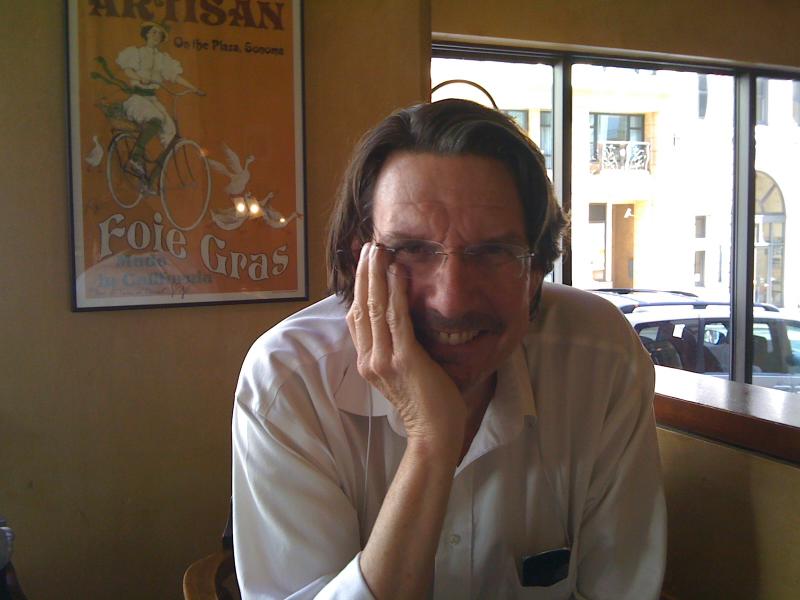
San Francisco, May 2010

When I was up and full of myself–which happened a lot in my late 20s and early 30s, he called me on my bullshit. When I was down he lifted me up. I would not have survived two major depressive episodes in my life were it not for his patience and love.

He was also fond of saying, “when you point the finger at someone, do realize you’re pointing three back at yourself.”

My personal favorite was, “evolution gave you two ears and one mouth, use them in their proper proportion.”

They say a mother teaches her son what is expected of a man. And a father teaches his son how to live up to his expectations.

But John taught me something entirely different. He taught me how to be an adult. He taught me how to be kind. How not to hold grudges. How not to second guess myself. He taught me that it was much more difficult to admit when I was wrong or had made a mistake than to deny or ignore it, but that I had a moral obligation to do so, regardless of how I felt. He taught me the difference between morals and ethics. He taught me how to walk into a room and read it, painful introvert that I was. “The people in the room want your attention just as much as you want theirs. Go, ask questions of them, open-ended questions and you’ll make more friends than you know what to do with.” He was right.

John drilled into me that color, creed and sexual orientation–he was openly gay–meant not absolute zippo in the grand scheme of things, that we were all divine children of the Cosmos. And he taught me how to stand firm when my principles or integrity were questioned. To never start a fight, but be damn sure to finish it. Another crucial lesson John imparted upon me was the necessity of asking for help when in over my head, or even when I just didn’t know something. And he always added, “just because someone said no, does not let you off the hook. You can’t stop asking for help.”

He was also fond of saying, “the universe answers prayers in three ways only, ‘yes, no and not yet.’

More than anything John ever taught me, it was the immense amounts of time he sat listening to me at coffee shops and then on the phone when he moved to San Francisco. He never asked for anything in return. All he said was, “be as good as you can to others, at all times.”

I spoke to John a few weeks before he died. He said it would be the last time we spoke. I told him how much I loved him and how responsible he was for me becoming the human being that I am.”Imperfect,” he said, “but fundamentally decent.” These were his penultimate words to me.

John died on January 25, 2026. It was not unexpected, but it hurts like hell. He was 73.

The Cosmos broke the mold when John was created. And I am diminshed by his loss.

John is survived by two sons.

His last Facebook post epitomizes John:

Every Credit Cycle Is Different, Just Like This One

~by Sean Paul Kelley

Every credit cycle is different: they don’t repeat, but they do rhyme at the end.

Phase One: the Expansion

The credit cycle begins when intense speculation drives asset prices into bubble territory. This time around AI is the prime mover.  AI stocks have clearly inflated, irrationally, and dangerously market averages. Nvidia’s market cap ($4.9 trillion) is larger than India’s annual GDP ($4.5 trillion).

As Barton Biggs, a mentor-of-sorts when I was at Morgan Stanley, said about the dot-com bubble, “things that cannot go on forever, don’t.”

That rule applies to the 10 Horsemen of the AI-pocalypse.

The bubble will deflate, jus not the way you think.

It won’t go “boom” and pop all of a sudden. As Kathleen Tyson, a commenter as qualified as any to opine on this market, notes, “credit bubbles collapse from the periphery toward the centre [just as empires do]. Always. Overextension creates a vulnerable, unstable margin at the extremes.”

The bubble is here and it’s collapsing from the outside, just like a balloon does. Wrap your hands around an imaginary balloon and feel it lose gas. You can see it now, yeah?

So what does this mean? Well, it means we’ve reached the end of the beginning of the first part of this credit cycle. Part two is up next and it’ll be a like a rodeo-clown getting gored by a ten-tonne bull.

Phase Two: The Big Unwind

Phase two of the credit cycle is the credit unwind, read credit destruction, linked to insolvency concerns, similar to what FSK KKR is undergoing:

“FSK’s portfolio was hit by large markdowns in the fourth quarter on debt extended to software companies. The fund’s holdings in debt tied to janitorial services groups, and so-called roll-ups of dental clinics, veterinarians groups and defence contractors also saw markdowns.” 

Other private credit shops that have taken some heavy markdowns and/or halted redemptions, as I disucss below. But seriously, if you know the private-equity model, you should be appalled their taking over janitorial serivices, dental clinics and veterinarians. Mom and pop shops par excellence. And they are now having the profitable assets stripped and the rest is larder with tons of debt and left out in the world to go bankrupt. I have a cousin in private equity and I’ve lost all respect for him. It’s probably mutual. I’m no role model.

But I digress . . .

The real kicker is our Bearn Stearns moment: an analog to the precise moment the 2008 Financial Crisis became inevitable. Recall summer 2007 when two Bear Stearns hedge funds met the guillotine. Blue Owl and it’s recent woes are this crisis’ first canary in the coal mine. Blue Owl, essentially an SPE/SPV for AI-hyperscalers to offload debt from their balance sheet, is ground zero for Oracle’s recent woes. SPE/SPVs, for those of you who don’t remember, are what killed Enron and destroyed AIG. Blue Owl vis-a-vis Oracle signals the end of the inflating bubble and beginning of the credit unwind.

“So who’s unwinding and why, you ask?”

The first-comer was Blue Owl. They got a rude wake up call when investors demanded $1.4 bn in redemptions, which forced Blue Owl to sell assets to meet redemption needs, in essence a fire sale. Every trader on the street worth his salt knew who was selling and what. It was brutal, as I’ve heard it told from some old Wall Street pals of mine.

Then Blackstone gets hammered with $1.7bln in redemptions and halts all redemptions. Blue Owl is a shadow lending facility for corporations, not individuals. But the next examples affect the money of individuals, billionaires that is.

So here comes Blackrock, sideswiped by $1.2bn in redemption requests, of which they honored only half of them. Resulting in a bunch of high net worth investors got sucker punched.

This ongoing and accelerating unwind in private credit is canary number two of our next credit crunch/crisis all the while the Fed is, unsuccessfully trying to backstop the slippery-slide of private credit into insolvent credit: on February 17th they injected $17.8bn into the debt markets via overnight repos.

So a lot of credit destruction has to happen—and will—before we get to the third and final phase.

We are a closing in, accelerating for sure. In fact, the appraoching crisis, because the mass fuckery of private credit does not have to legally disclose holdings, will make 2008 look like a Roman Holiday. No candles included.

Added at 9:30 AM Central Time: Teachers’ Pension Reportedly Loses $7 Billion in Private Equity Bets in 2025

“Ontario Teachers’ Posts First Private Equity Loss Since 2009”

If you run a pension fund and you invest the funds money with private equity you are shit. You are giving money to the very people that are strip mining this country’s middle class businesses. Regardless, the contagion is on. This thing is getting perilously close to becoming uncontainable. Remember that catchphrase form 2007-08? “It’s contained!”

Phase Three: the grand finalé.

Where credit cycles rhyme, as I said above, are how they end: on the last two syllables. Can you say it with me: Ponzi? In the end the ponzi finance bubble always collapses.

I suspect Crypto will be the first big Ponzi unwind. And it will take a lot of suckers with it. Plus, a damn lot of fools who worked for investment, commercial banks and private credit/equity shops. Crypto is bullshit, wrapped in dead fish skin that’s been perfumed by Chanel. No matter how good it smells, it’s rotten to the core. Crypto is to this financial crisis as CDOs and synthetic CDOs were to 2008.

The AI-hyperscalers will suffer as well, during the Ponzi unwind.

Why?

They are in essence engaging in a similar sort of vendor financing like CISCO and Juniper Networks did in the dot-com bubble. Nvidia is giving chips to AI-hyperscalers as collateral for loans. Never mind the chips will depreciate long before the earnings are solid enough for the AI-hyperscalers to payback the “loans.”

Once the AI driving stock bubble bursts, all hell breaks loose. One or two investment banks will go bust this time around. Maybe Morgan Stanley? Maybe Goldman? (I doubt Goldman goes bust, they’re too politically well connected.)

Note, as I and Ian have both said, this will be the final financial crisis the Fed is willing to backstop. Broad political support for a bailout hasn’t eroded completely.

But the next one? It’ll be unstoppable. Not only will the political will have evaporated, but so will have the resources to do so.

As we say down here in Texas, cowboy up, ride’s about to get real.

Nota bene: Phase Two of this credit cycle is accelerating: JPMorgan Restricts Private Credit Lending After Loan Markdowns. (Hey, Dimon can be a putz, but he’s a careful, shrewd banker.)

Key takeaway from my post at X: “JPMorgan Chase & Co. is restricting some lending to private credit funds after marking down the value of certain loans in their portfolios, according to a person familiar with the matter, in the latest sign of stress in the $1.8 trillion industry.” Morgan took a $22 billion haircut. 

And this: “L&G’s solvency ratio — a measure of its ability to meet long-term financial obligations — declined to 203 per cent for 2025, down from 232 per cent in the previous year and below a Visible Alpha consensus of 217 per cent.” h/t for both stories go to Ventzu.

That’s some special fuckery there, folks.

Nota bene, bene: Good Morning from Germany, where today’s 10y govt bond auction technically failed.

Nota benissima: Well fuck, Cliffwater is the next domino to fall. First, huge redemption demands-to the tune of $33bn–at Cliffwater, LLC, force the private equity shop into a firesale a lá Blue Owl. So Cliffwater, LLC is a twofer!

And JPMorgan is dealing with some collateral stress issues. Whatever the fuck that means. When banksters make up words, be careful, you’re about to get screwed.

Even PIMCO piles on saying that they see “a crisis in bad underwriting in private credit.” Christian Stracke, president of PIMCO reiterated the headline news, “[this news] is the result of years of sloppy underwriting standards in lending.” Basically calling out the private credit/shadow credit industry for engaging in the 2007 equivalent NINJA–No income, no job–loans to any company that want cash. He also added, “there is a reckoning going on right now. . . . It’s not just a crisis of confidence, it’s a crisis of really bad underwriting.” Makes one wonder just how many cockroaches are going to come out of the dark, dank Wall Street kitchen this time around once the lights come on?

Phase Two of the credit crisis has arrived, and it came heavy.

Saturday Morning Grab Bag Of Baddies and Goodies

~by Sean Paul Kelley

I’ll begin, as usual, with the economy. JP Morgan lays odds for a global recession at 60% now. Causes? According to JPMorgan it’s threefold: the conflict in Iran, the tariffs and AI. But JP Morgan is forgetting another huge variable, the private credit/shadow credit unwind happening in real time. Blackrock halted redemptions from its flagship debt fund to the tune of $1.2bn. Blackrock to investors: fuck off. Blackrock’s fuckery marks the third private credit shop in the last three months to shut investor redemptions down: first Blue Owl, then Blackstone and now Blackrock. 

As Dario intones ruefully, “Mark my words, the damage to the financial system the private credit space will cause will be greater by many orders of magnitude than the one subprime caused in 2008.” I’m pretty well convinced he’s right. That said, the political will to backstop another financial crisis has not eroded totally, so the emerging credit crunch will be the last one backstopped by the Fed and/or Congress. 

Another variable JP Morgan doesn’t address is the most recent (un)employment numbers. If the first reported, non-revised numbers of a -92,000 jobs is any indication, once the numbers are revised, February’s numbers are likely to resemble a catastrophe. 

On the ugly, catastrophe side of things, Dubai has only ten days of fresh food remaining if the Straits remain closed. I suppose they can eat dates, no? 

Also of note, The Reptile, aka Peter Thiel (yes, it’s a real anagram, google it if you donnae believe me!), dumped 2 million shares of Palantir. It’s a bright flashing red light, a semaphore both unmistakable and of serious consequence, when top execs dump shares of the corps they run. They are cashing out, leaving the equity collapse in the hands of suckers, ermm, retail investors, widows and orphans-like. 

If you want a fuller understanding of the logic logic behind Iran’s attacks on the region’s infrastructure, read here. Speaking of oil, one can’t fix stupid. Shorting oil in this kind of risk environment is nucking futs.

Maintaining our focus on petroleum for a bit longer, I have to note, if oil breaks bad to the north, past say $120, the resulting global recession will have deleterious effects on commodities, especially gold and silver. But more gold than silver, as the silver supply-demand equation has been so structurally out of whack for so long, the recession would have to be almost depression-like to impose enough demand destruction for the price to sink below the mid $70s.

Sticking with petrol it appears the Euros might come a begging to Czar Pootie-poot for gas and oil the longer the Straits remain inaccesible. Apparently Czar Vladimir has already hinted the Euros can, in Russian, “пошел нахуй.” I’m sure you can suss the meaning out of that one. If true, this volte face by the Euros is staggering in its hyprocrisy and implications. But it is far from surprising. Anyone with a halfway decent brain on their head could have seen this ugly denouement coming a mile away. Wait, a kilometer and some change. Yeah, ‘Muricans can do metric!

In genuinely good news, Indonesia has enacted a total and complete ban on the riding of elephants. When I traveled in South East Asia I refused to ride any elephants, they are too sensitive emotionally and very much deserving of my respect. As I note on X: 

This is supremely welcome humane news. The limbic system in elephants is so extensive and well developed it creates “profound emotional intelligence, long-term memory, and social bonds [in elephants.] [Their] brain structure allows for intense empathy, mourning, [and] social cohesion,” making them closer to humans in social development than any other class of animals than primates and ceteceans.

Check out the photo of an elephant getting frisky with me. Suprised me to no end, you can see it in my face. This news makes me smile and happy. Somewhere somebody is doing something right. Faith in humanity remains unrestored, but a credit has been added to the depleted account of faith, nonetheless. One of my finest memories is seeing a herd of wild elephants emerging out of the bush about sixty miles south of Mysore, India in 2009. Wild effing elephants. How cool is that? Portions of my life have been truly charmed and I’m grateful.

Speaking of memories, I was only five years old when Nadia Comaneci stuck 7 perfecf tens at the 1976 Summer Olympics in Montreal, but even then I knew I was witnessing something very special. My view hasn’t changed in 50 years. And her performance is as elegant and perfect as it was then.

How about some music on this fine March Saturday morning? I’ll note in brief the quiet but powerful resurgence of political and human vitality to American music. As I post regarding Tyler Childers:

Tyler Childers’ song, “White House Road”, written in 2017, paints a generalized portrait of American misfortune and hardship, but uses the patois of the Appalachian South in particular to stoke the emotions of the listener. And it’s why Childer’s imagery works no matter where you live in the US-hell, it’s almost Dickensian and could be anywhere. The tune’s poignance is just that brutally authentic and powerfully magnetic.

Don’t, for a second, confuse this with C&W. It ain’t that. This is threadbare roots Americana. If this doesn’t stir your heart, you don’t have one. 

The raw explosive emotion of Childer’s lyricism propels a simple 3-chord song (E-D-A) across the ragged, tragic and increasingly impoverished tableau of a decomposing America. Childers tells an old rural story, but ‘makes it new’ as Ezra Pound frequently exhorted young writers and poets. Indeed, there is a touch of Chris Whitley’s muse to this song.
 
Childers voice is a beacon of distress, masquerading as joy, “a damn good feeling to run these roads.” He sings.”Get me drinkin’ that moonshine/Get me higher than the grocery bill/Take my troubles to the highwall/Throw’em in the river and get your fill.”

His distress is amplified by his vocal register; and his range acts like the kinetic tension in an unsprung faucet, Schrodinger-like: at once blowing in a soft mountain drawl, only to tornado-up into a raspy hard emotional sucker punch landing on your solar-plexus and leaving you breathless. 
 
Tyler is proof that there are only two types of music: good music and bad music.
 
I dare you to listen and not stomp your feet.

More to the point, Jack White has single-handedly reinvented and fused Delta blues, Chicago blues and rock music right back into political and cultural relevance. One example is the global adoption of his anthemic Seven Nation Army.

His appearance on SNL in 2020 is another solid proof of concept.

Honorable mention goes to the Stone Foxes and their fantastic and criminally underrated retelling of the death of Delta Blues legend Robert Johnson, “I killed Robert Johnson.” The song is 15 years old. So what, it’s aged well.

While you’re at it, this lovely morning, check out this music here and rock out to this and this. The last two are representitive of a new breed of American rock bands. You won’t hear ’em on the radio, but rock is alive. And that’s a good thing, like this cover of Dancing in the Street, by the Struts.

Who ever talks about modern dance, or takes an interest in it ought give this video a solid once over: the choreogrpahy on display is a stuning blend of traditonal renaissance era galliard or volta, early Appalachian line dancing and urban American break dance, yeah, break dancing, for a tune straight out of my Scotch-Irish heritage

While you’re at it, check out this Ryan Adams cover of the Iron Maiden classic, Wasted Years.

Last one, I promise, this Band of Heathens song, “Hanging Tree,” eeriely echoes old-timey Protestant hymns sung by a choir, except it’s about infideltiy and damn near a murder ballad. It’s about 15 years old, as well, but it has aged like a fine Irish whiskey. Lastly, I have rarely in life coveted anything. And I use the word ‘covet’ purposefully. But that Dobro he’s playing in the video: me want one something fierce. But I’m left handed and those cost upwards of $1500. Ouch!

More if it happens. Maybe.

Nota bene: Apparently Kuwait Oil has declared force majeure on oil sales. That’s not confirmed, but plausible and bad news if true. As one commenter in the X thread linked wryly noted, “You know shit has hit the fan when you have to start using French terms.”

LMFAO.

There Is Stupid and Then There Is Superhuman Stupid

~by Sean Paul Kelley

How about we review Cipollla’s Five Rules of Human Stupidity? 

One: Everyone always and inevitably underestimates the number of stupid people in circulation.

Two: The probability that a person is stupid is independent of any other characteristic of that person.

Three: A stupid person is a person who causes losses to another person or group of people when he or she does not benefit and may even suffer losses.

Four: Non-stupid people always underestimate the destructive power of stupid individuals.

Five: A stupid person is the most dangerous type of person.

Rumors persist on Wall Street for a second day, natch, for a day and a bit cause it’s early yet. But the rumors are several institutional investors, read hedge funds or investment banks like Morgan or Goldman, are desperate to unload large naked shorts on oil futures.

WTI has risen from $58 to $77 in less than 30 days. Brent has spiked in a similar fashion. Urals Crude is trading between $57-$65, higher than just a few weeks ago when it traded between $45-$50.

Today is the day I cease underestimating just how stupid, stupid can get. It’s like “killing the chicken to scare the monkeys” levels of stupid have taken over. 


Page 3 of 13

Powered by WordPress & Theme by Anders Norén