Use to discuss topics unrelated to recent posts.
Author: Ian Welsh Page 86 of 436
I remember the first time I heard of Francis Fukuyama’s “The End of History”, and I remember thinking “no one can be stupid enough to believe that.”
But I knew I was wrong, because it kept popping up. The article became a book, even, and fools further down the intellectual stupidity chain made careers out of sub-theses, like Thomas Friedman’s “the world is flat”.
The thesis of the “End of History” was that the ideological wars were over: democratic market capitalism had won, everyone knew it, and history was in effect over because the great ideological war of the 20th century between capitalism/democracy, communism and fascism/democracy had ended. Everyone admitted that democratic capitalism had won and was the best system and now inevitably it would sweep the world and usher in an era of prosperity and relatively good government.
This is what elites wanted to hear after the fall of the USSR and Francis was the one to tell them. He was considered a great intellectual, made lots of money and elites proceeded to act as if he were right.
There were a lot of knock on consequences but there two were most important. The first was that without a competing model, western elites felt free to really rev up the immiseration train started by Reagan and Thacher. Post-war elites had been genuinely scared of Communism, in the “we could wind up dead” way and that had driven a lot of their acquiescence to cutting ordinary people a good deal. (A lot, not all. Much of it was just that the Great Depression cut their legs out from under them, and FDR then broke their kneecaps.)
The shipping of industry to allies and to the third world did not start at the end of the Cold War, but it did go into overdrive. The old police was to make sure that the countries it was sent to were not a real threat: either small to medium developing, or American allies. Now, however, the offshoring and outsourcing train traveled to China. Deng had opened up markets and privatized a large chunk of the economy, and Fukuyama had said that capitalism lead to democracy, so by shipping all that industry to China, well, the West would make them into a democracy.
The Chinese Communist party, in this storyline, were a bunch of suckers, who were inviting in the very forces which would overthrow them.
The line in poker is that if you don’t know who the sucker at the table is, it’s you, but the real danger is when you think someone else is the sucker, and they aren’t.
The CCP had understood Americans and the West very well. Ironically they were aided in this by Marxism and their belief that capitalists were blinded by greed. They offered Western elites cheap labor and high profits and dangled the dream of access to a market of a billion people.
There was a time when it was understood that what made countries mighty was industry, and that you kept the industry at home. In the post-war era that was relaxed: by you still didn’t send your industry to anyone who might well become an enemy.
But history was over and there were no enemies and the West, with its transnational elite largely shorn of patriotism figured they’d co-opt Chinese elites and make them no longer nationalist.
They didn’t understand that the CCP didn’t feel that way: they were proud of being Chinese and they also believed that if they lost power a lot of them would wind up dead. They obsessively studied the fall of the USSR (and its communist party) and were determined that wouldn’t happen to them. And they deeply resented the west, including America, for the “century of humiliation.”
Sure, they were willing to go to a mixed economy with a lot of capitalism, but they were determined to stay in charge and never become democratic capitalists, and they wanted to return China to its natural place as the richest and most important country in the world, a position it had occupied for most of the last 2,000 years (before that it was India, and before that it was Mesopotamia with Egyptian interregnums.)
So you had two bets. The West, led by America, bet that if they shipped industry to China, China would become just another country like them, happy to be part of an international community running on laws that had been created when China was at its weakest.
The Chinese Communist Party bet that they could let some capitalism in and catch up in technology, and even exceed the West in terms of industrial base.
We now know who was right, and it wasn’t the West. Our tech boycotts are a sign of weakness, not strength. We know we can’t stay ahead of them without restricting their access, but it’s very much a case of slamming the barn door after the horses have left. The tech lead moves to where the manufacturing floor is. Britain stayed in the lead technologically for about 20 years after the US became the #1 manufacturing power, for example, but it was a lagging indicator, and ironically Britain had done the same thing America has done with China: it invested big time, built the factories and transferred a ton of tech.
Fukuyama was full of it. He sold a fairy tale to an elite desperate to believe they had won forever and he in selling it and they in believing it took the exact steps required to ensure it wasn’t true, by empowering the only nation in the world strong enough to challenge America. (India was never in the running due to severe corruption and governance issues.)
But the people who engaged in this foolishness (from the POV of the Americ and its allies) reaped their mortal reward: the elites became stinking rich, and Fukuyama become wealthy and was regarded as a genius for telling the story his audience wanted to hear, even if it was obviously wrong.
History never ends. There is no end-state ideology or system and when someone tells you the world is exactly as wonderful as you want it to be, run.
Folks, it’s your donations and subscriptions which make it possible for me to keep writing (since I need to eat and pay rent and the cost of both have skyrocketed) so please (if you aren’t struggling) DONATE or SUBSCRIBE.
Capitalism has a lot of problems, a lot of ways it can go wrong. But power accumulation is baked in. Capitalism is the centralization of capital in a few private hands. This is justified in the ideological literature (mostly economics), because it allows for scale, and thus economies of scale, and allows for development. If capital doesn’t accumulate in a few hands it is hard to build factories, huge mines, and so on. (This is the theory, there are obviously other ways to do large scale tasks.)
Now, power accumulation is a problem in all systems. You need some to get things done, but doing too much always leads to dysfunction.
In capitalism, money controls capital (labor, land, resources, etc.). That’s what makes it different from communism, feudalism, despotism, or centralized monarchy. This is so true that the pre-conditions for capitalism include being able to buy labor and land and resources with money. This is because in, say, feudalism, you can’t — in feudalism, people mostly aren’t for hire, land is controlled by nobility and clergy, and free farmers who don’t (and in many cases can’t) sell much.
Money, in a capitalist system, is power. Power is the ability to decide what other people do. At the lowest level, this is known as demand. If you buy a chicken, it sends a signal to someone to keep producing chickens. If more chickens are bought, it says “breed more chickens.” If you’re an ordinary individual, you have this power only in aggregate.
The more money you have, the more demand you control, but you also gain the ability to not just signal; you can rent people to work for you, and they’ll do what you say.
At a certain point, you gain political power because you can hire people to influence politicians, or give them things they want, or help them get elected, and pretty soon they tend to do what you want.
The problem is that capitalism is a money accumulation system. Unless the tendency is carefully checked, money flows to the top, and so does power. Whatever secondary system is in control, be it representational democracy or the CCP, they stop making decisions based on democratic or party principles and start making them based on money.
But capitalism, to the extent it works, works because of good price signaling and semi-competitive markets. For markets to deliver, no one must have market power except a government which is acting out of motives other than profit motives.
Competitive markets are dynamic: it’s hard to keep your money over the long term, let alone for you children and grandchildren, who did nothing to deserve it, to keep it.
So capitalists on winning want to change the rules so that markets aren’t competitive.
They also want to expand capitalism into areas it should not control: roughly anything that is a natural monopoly (all of which should be run by government) or a fundamental welfare service (health, education, etc…) or which runs better when vastly dispersed.
So capitalism becomes a cancer: not only does it grow further than it should, it destroys the proper functioning of markets and of anything else it takes over which should never be part of capitalism.
The further effect is a fairly simple mechanical one: the more money is concentrated, the weaker is demand for non-luxury, non-investment goods. Back in the 2010s people were crowing about how low inflation was, but it wasn’t: the price of arts, collectibles, yachts, real-estate and so on soared: all the things rich people want. This causes general demand collapses which lead to recessions and eventually depressions.
They also distort price signals so that what the majority of the population wants and needs is under-produced and what the elites want are over-produced.
So the general rule for capitalism is that the rich have to be kept poor, which is a specific instance of the general rule across all society types that the powerful must be kept weak if the people are to prosper.
JFK was the first post-war break: he dropped high marginal tax rates significantly. Estate, income and capital gains taxes all need to be quite high on those with the most.
As for oganizations, the corporate socialists are more or less correct. We organized control in the wrong ways: large businesses must be controlled either by their employees or by their customers, or perhaps both, with the community also having some control and a veto over destructive actions. Small business are fine in the control of a single person, large ones are not. We’ve proved that over and over again.
Every good thing about capitalism is based on keeping markets relatively competitive and keeping capitalism out of the parts of the economy it shouldn’t control (about 60% of it.) And doing that means keeping the rich poor and weak.
Folks, it’s your donations and subscriptions which make it possible for me to keep writing (since I need to eat and pay rent and the cost of both have skyrocketed) so please (if you aren’t struggling) DONATE or SUBSCRIBE.
Is knowing who to trust.
The people were right to trust FDR and probably right to trust Eisenhower, for example. (Truman was a much worse president than his reputation.)
Clinton and Obama could not be trusted, both made things considerably worse for their rank and file followers and did so deliberately.
We’re about a third of the way there: a lot of ordinary people have realized they can’t trust ordinary elites. They’re increasingly open to people who don’t feel like the normal politician.
This is behind Brexit, Trump, the rise of LaPen in France. It was behind Corbyn’s rise and how well Sanders did.
But there are large gaps. Distrusting the neoliberal technocrats who joined the EU and slowly immiserated almost all of Britain outside of parts of London made sense, but turning to Boris Johnson indicated monumental bad judgment. I think Brexit could have been a boon, but not run by Boris and the Conservatives, because what they objected to in the EU was the good stuff, not the evil.
In America, people turned to Trump, who presented himself as a right winger FDR: the class traitor who knows how the system works but is out for ordinary people. (Although religious fundamentalists who voted for him were right to trust him. He’s not Christian in any meaningful way, but he delivered for them.)
Corbyn was a good sign: but ordinary people proved susceptible to a propaganda campaign. They trusted the media, which lied about 80% of the time with respect to Corbyn, and then they trusted Starmer, who could not have been elected Labour leader if he had not embraced most of Corbyn’s policies: which he has since walked back and which a pre-schooler should have known he never believed in, nor intended to honor.
In a democracy you can’t be well led if you won’t support people who have your best interests at heart. It’s just that simple.
Now it’s true that elites have spent a lot of time and money building a media, intellectual and educational apparatus designed to make sure that people don’t learn good judgement in their childhood and if they stumble across a good judgement in their adulthood don’t stick with it. This isn’t precisely ordinary people’s “fault” but they, we, have to fix it, because sure as hell our elites won’t.
Every society has leaders. Even relatively egalitarian societies. It’s up to us to learn how to pick and support good ones.
Folks, it’s your donations and subscriptions which make it possible for me to keep writing (since I need to eat and pay rent and the cost of both have skyrocketed) so please (if you aren’t struggling) DONATE or SUBSCRIBE.
The BRICS group of nations has decided to invite six countries – Argentina, Egypt, Iran, Ethiopia, Saudi Arabia and the United Arab Emirates
BRICS already included Brazil, Russia, India, China and South Africa.
The era isn’t over yet, but when you consider that US/European sanctions against Russia failed to gain much support from India, China, and almost all of Africa and South America, it’s clear that US/West is down to its core again: the EU, Canada, Australia, New Zealand, Japan, Taiwan and South Korea. These are all either core West states or their key “uplifts” — the nations they let into the club and industrialized.
This leads to the new cold war, which everyone has noticed now, and has the world’s greatest industrial power, China, on the other side. Ironically the most important nations on the West’s side, other than the US, are South Korea and Japan, which remain technological powerhouses, while Europe is coasting on legacy technology and failing to advance compared to China, the US, Japan and South Korea (more or less in that order.)
The majority of trade, about 90%, still uses the dollar, but dollar reserves are at their lowest since the fall of the USSR, and will continue to fall, as the freezing of Russia’s dollar reserves (which will probably be seized in the end) and the massive sanctions have made it clear that dollars are only useful if you don’t cross America, and many nations, including China, know that’s only a matter of time.
Bilateral trade using local currencies will continue to increase, as will trade using the Yuan.
All Empires end, as do all eras. Neoliberalism is dying, the US world order is dying and the unipolar era is dead. A new multipolar era is upon us.
These are all good things, more than bad, for most of the world’s population as the post-Soviet order was used to crush countries the US disapproved of under horrid neoliberal austerity policies. That doesn’t mean the new era will feel good, or even be good: that’s not possible with our environmental problems, and the onrushing civilization collapse, but at least countries will increasingly be able to do what they feel is good for them and their citizens without the IMF and US/EU sanctions crushing them.
Folks, it’s your donations and subscriptions which make it possible for me to keep writing (since I need to eat and pay rent and the cost of both have skyrocketed) so please (if you aren’t struggling) DONATE or SUBSCRIBE.
His private jet “crashed.” I must say it’s a nice change from falling out of a window, though still a standard (those who have reason to believe powerful people want them dead should not fly in private planes.)
There were other people in the plane and they may not have “had it coming” (I don’t know) but Prigozhin was a piece of human garbage whose prison sentence was, for among things, choking awoman so he could rob her.
I won a bet with a friend on this, who thought that Prigozhin couldn’t be taken out without causing a clash with his troops.
This is classic: what Putin did was separate Prigozhin from his loyal troops so he wouldn’t have to fight them all, then take him out. The delay was to let those Wagner members who were still loyal to Prigozhin realize the loss. (The remains of Wagner will now mostly be integrated into the military.)
Prigozhin had to killed or put in prison. Putin could not allow him to be seen to prosper after he launched a coup attempt, however abortive that attempt was. Others might get the idea they could take a run at the king and if they failed, no big deal.
Remember that Prigozhin received no support from the Russian establishment: not one governor or senior official; no military support (hardly surprising after he alienated them by attacking a senior officer and constantly denigrating them.)
Prigozhin was a fool, he thought he was bigger and more popular than he was, and he paid the price.
Putin’s “weakness”, such as it is, comes from the simple fact that he is old and everyone knows nature will force him to leave at some point. He doesn’t have another twenty years at the top, and he has no obvious designated successor, so people are starting to jockey to replace him and for those who aren’t in the running, to pick sides, as you often can’t remain neutral. That said, his polling remains good, the military is loyal enough, and while there are some economic issues, they aren’t (yet, or perhaps ever) such as to cause him concern.
Remember the rebellion trifecta: an elite faction, the enforcer class unwilling to intervene, and a popular faction. Prigozhin tried to neutralize the enforcers by attacking while most of the pointy part of the military was at war, but he didn’t get any of it.
A palace coup remains possible, but at least for now, anything else is very unlikely.
“You come for the king, you best not miss.”
Folks, it’s your donations and subscriptions which make it possible for me to keep writing (since I need to eat and pay rent and the cost of both have skyrocketed) so please (if you aren’t struggling) DONATE or SUBSCRIBE.
Alright, let’s cover this again, with a bit more explication, since the idiots are really doubling down on “oh no, decreasing population.”
Population collapse is the biggest threat to civilization.
• Japan had it's largest total drop in population since 1968.
• U.S. population flatlining as birth rate stagnates.
• China's fertility rate hits record low.
• Singapore's birth rate falls to record low.
• UK… pic.twitter.com/OwloSfysBi
— DogeDesigner (@cb_doge) August 21, 2023
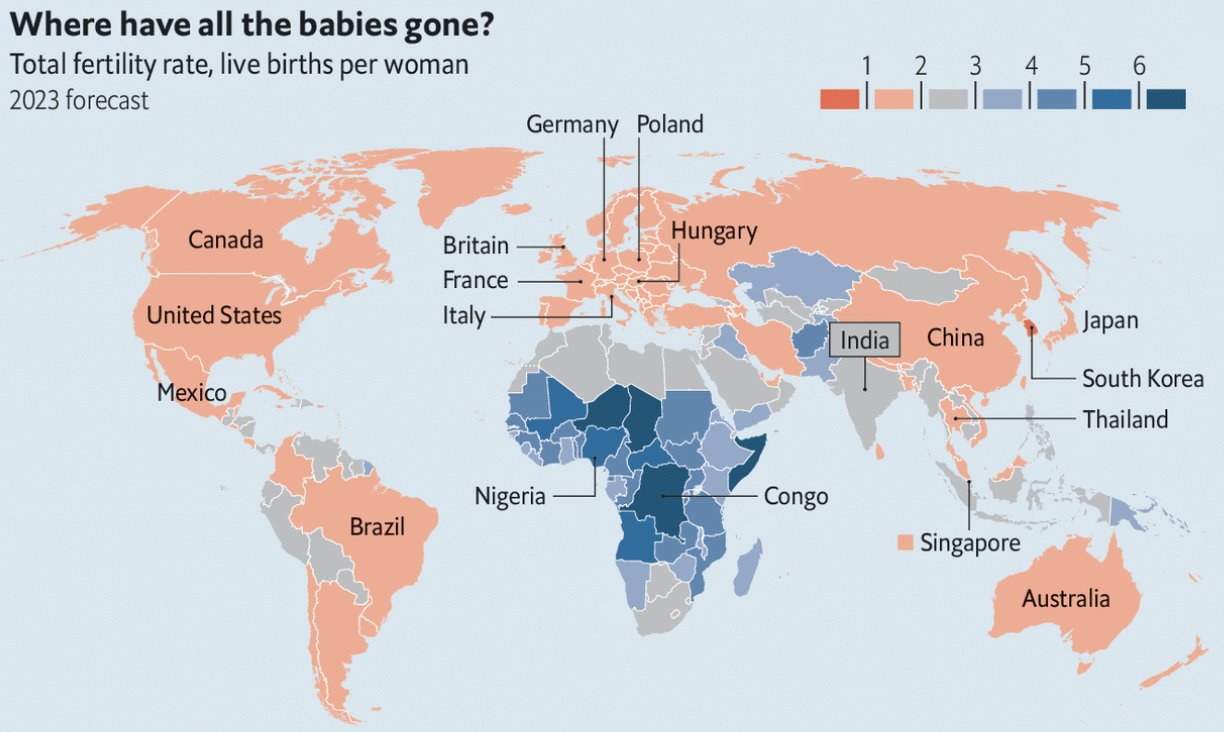
If you want to see it on a map, here goes:
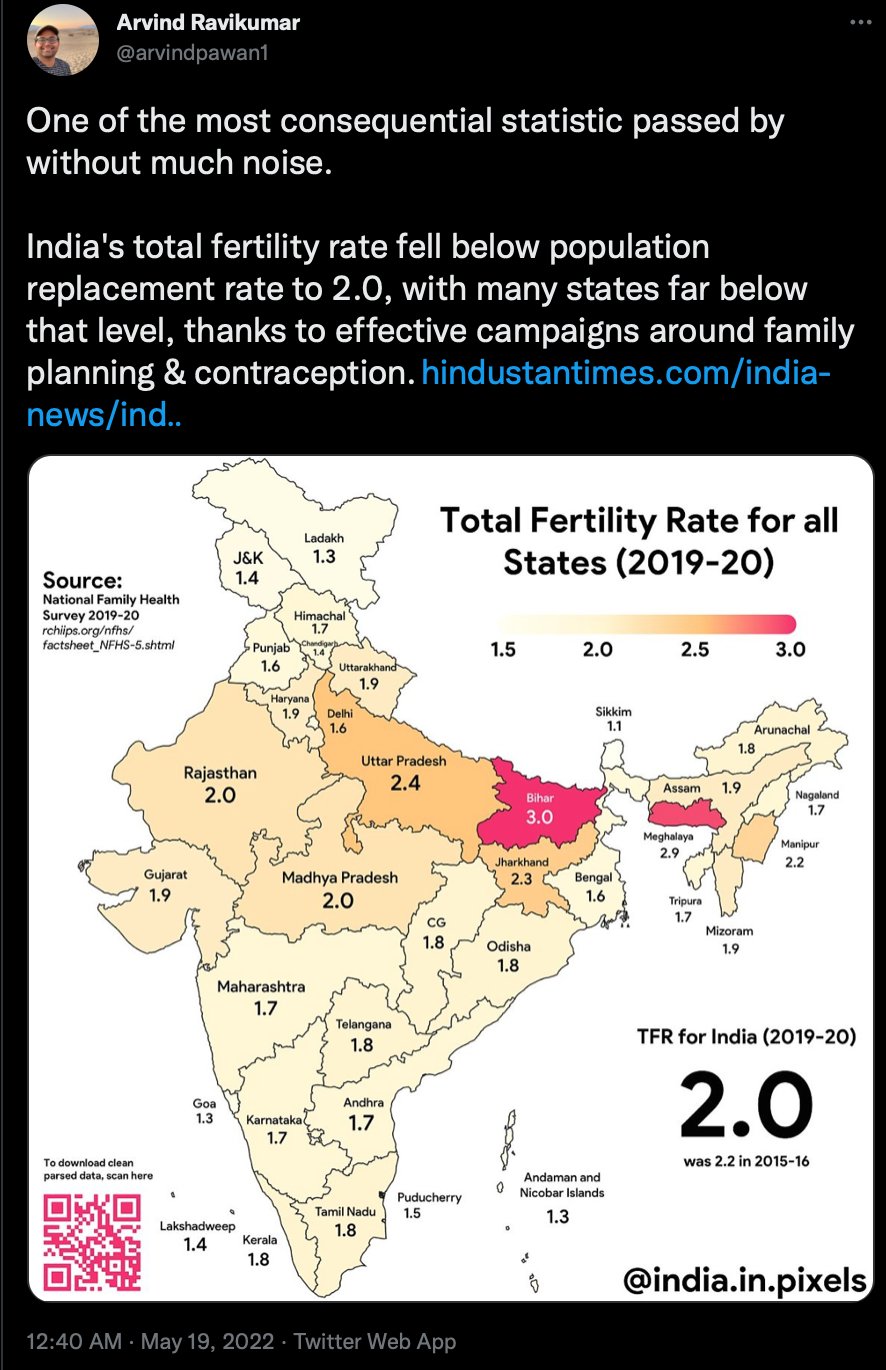
Even India has dropped to about replacement rate.
Now, let’s deal with this.
First, to the extent the plummet in birth rates is because of decreased biological fertility, like reduced sperm counts, it’s bad.
Second, despite this, we are well over the world’s carrying capacity and you are seeing it in the collapse of other life forms (ecological collapse) and climate change.
Third: the world’s carrying capacity is variable in a sense: what matters is number of people times the average per capita carrying cost of each person.
Fourth: the more population we want to have, the lower our per capita carrying costs have to be.
Fifth: a lot of people whine about this and to a certain extent rightly so. It is associated with austerity.
Sixth: imagine a world in which you bought a phone and used it for 20 years with modular upgrades; a car and used it for 50 (with modular upgrades); a washer and dryer and used it for 75 years, and where all of those things, when they finally ended their lives, were carefully recycled as much as possible.
Imagine a world in which almost nothing was made out of plastic. (In the 70s almost all bottles were glass and we used paper bags and grocery items were not individually wrapped in plastic and fuck “germs!” Covid has proven we don’t really care about that.)
Imagine a world in which we work half as much, create stuff that lasts for decades or even half a century or more.
Seventh: “but how can we afford this?” We can afford anything we can actually physically do. Each individual item would be more expensive, but last far longer and be cheaper overall. Yes, we would have to change how we distribute permission to have things, but we need to do that already.
Eighth: even in capitalist terms the “oh, without population gain how can we have economic growth” stuff is incoherent. Capitalism is supposed to increase productivity massively, so you should still be able to have growth, certainly per-capita growth. If you can’t, you’re a bad capitalist.
Ninth: that particular issue is related to oligarchs wanting to funnel all the money upwards and instead of relying on customers, rely on government, including central bank, subsidies. (Neither Tesla nor SpaceX would have made it without massive government subsidies.) In actual capitalism capitalists want high wages, because “everyone else’s employees are my customers.” The cost of high wages is more than made up for by people being able to afford their goods. This is why the economy of the post-war era was so good: high wages and lots of consumptiong.
Tenth: of course this sort of capitalism has to go away, we can’t afford a planned obsolesence economy in a world over carrying capacity and with limited stocks of key resources (the way we’re burning thru lithium should be literally criminal). But even in capitalist terms “oh no, population decrease” is an admission of failure.
Eleven: the dependency ratio is how many working people are supporting non-working (old, young, disabled and not allowed to work) people. Yes, a lower ratio makes things harder, but again, productivity is what matters and capitalism keeps claiming it’s good at raising productivity. Plus the actual percentage of people working for wages in high prosperity periods has often actually been lower than in high prosperity periods.
Twelve: oh, and worker compensation is likely to go up as population decreases and as the carry ratio decreases (or at least, be higher than it would have been otherwise, civilization collapse is also in the mix.) After the black death, welfare increased massively. We’re already seeing some of this effect due to the pandemic (one of the only good things to come out of it.)
***
We need less population. The world’s population has over doubled just in my lifetime (I’m 55). That’s ridiculous. And minus the internet and a few good medical improvements, I’ll tell you that life wasn’t worse then. (Even Africa had higher growth rates in the 50s and 60s and the dire poverty numbers are bullshit, because subsistence farming was far more common, but that’s another article.)
We have no problems we can’t adapt to, minus a few scenarios like the Venus runaway, a full ecological collapse which eliminates the apex species (that’s us) or polluting the world so much we can’t survive (which includes nuclear war.) We can, in theory and even in practice, if our politics wasn’t so screwed up, even make most people better off at the same time. But it will take time, and the most important problems are made simpler by population reductions.
What is going to make everything harder, actually, is our refusal to deal with Covid and our “New Emperor’s Clothes” insistence on pretending it’s over, while it continues as a mass disabling event. Yeah, we can handle a lower dependency ratio, but crippling hundreds of millions of people and making hundreds of millions more sicker is an unnecessary self-inflicted wound.
As before, as so far always in this crisis, the most important thing we have to do is replace our leadership class: political and private, en-masse, so that the correct decisions can be made. And yes, capitalism as we understand it is going to have to go away.
But this weird idea that population reduction right now is bad is breathtakingly stupid, and people who believe it have been fooled, or are fools
Folks, it’s your donations and subscriptions which make it possible for me to keep writing (since I need to eat and pay rent and the cost of both have skyrocked) so please (if you aren’t struggling) DONATE or SUBSCRIBE.