
Use to discuss topics unrelated to recent posts.
Author: Ian Welsh Page 85 of 436
One of the most irritating things about writing this blog is making statements that are obviously correct which people, especially those with power and large platforms dispute, then later being proven correct.
Covid has been a masterclass:
First, Covid is not over. It will not be over till we either get very lucky and it mutates massively to be less dangerous, or we do what is necessary to end it. Remember that Covid is a pandemic. It moves in waves.
Second, Covid damages immunity.
Third, Covid damages a wide variety of organs, including the heart, lungs, circulatory system and your brain. This damage can be non-symptomatic, or it can be bad enough to be Long Covid.
Fourth, every time you get Covid, it has a chance of doing more damage.
Fifth, therefore getting Covid multiple times builds up damage to your body, including your immune symptom. This is why we are seeing significant increases in the number of people getting heart attacks and cancer, for example. (It’s also probably behind the significant increase in auto accidents.)
Sixth, other than masks the best way to protect against Covid is to constantly purify the air.
Seventh, Covid infections are and were driven by children at school. Not only do they give it each other, they take it back to their families.
Eight: Long Covid is more important than deaths, as it hits working age people.
Nine: Long Covid and, to a lesser extent deaths are are a huge contributor to the labor force tightness, and as such are helping with efforts to increase wages.
Tenth: that notwithstanding, so far Covid has mostly been used as a profit opportunity and excuse to raise prices, and as such has seen a massive increase in prices. Those workers who have the ability to raise their wages can keep up or maybe even get ahead, those who don’t are screwed.
Bonus: as I said a couple years ago, when children aren’t in school there are less suicides, because school (especially high school) is ass. Certainly there are children who need school to escape from abusive parents (I was one of them), but while large in number, they are a minority.
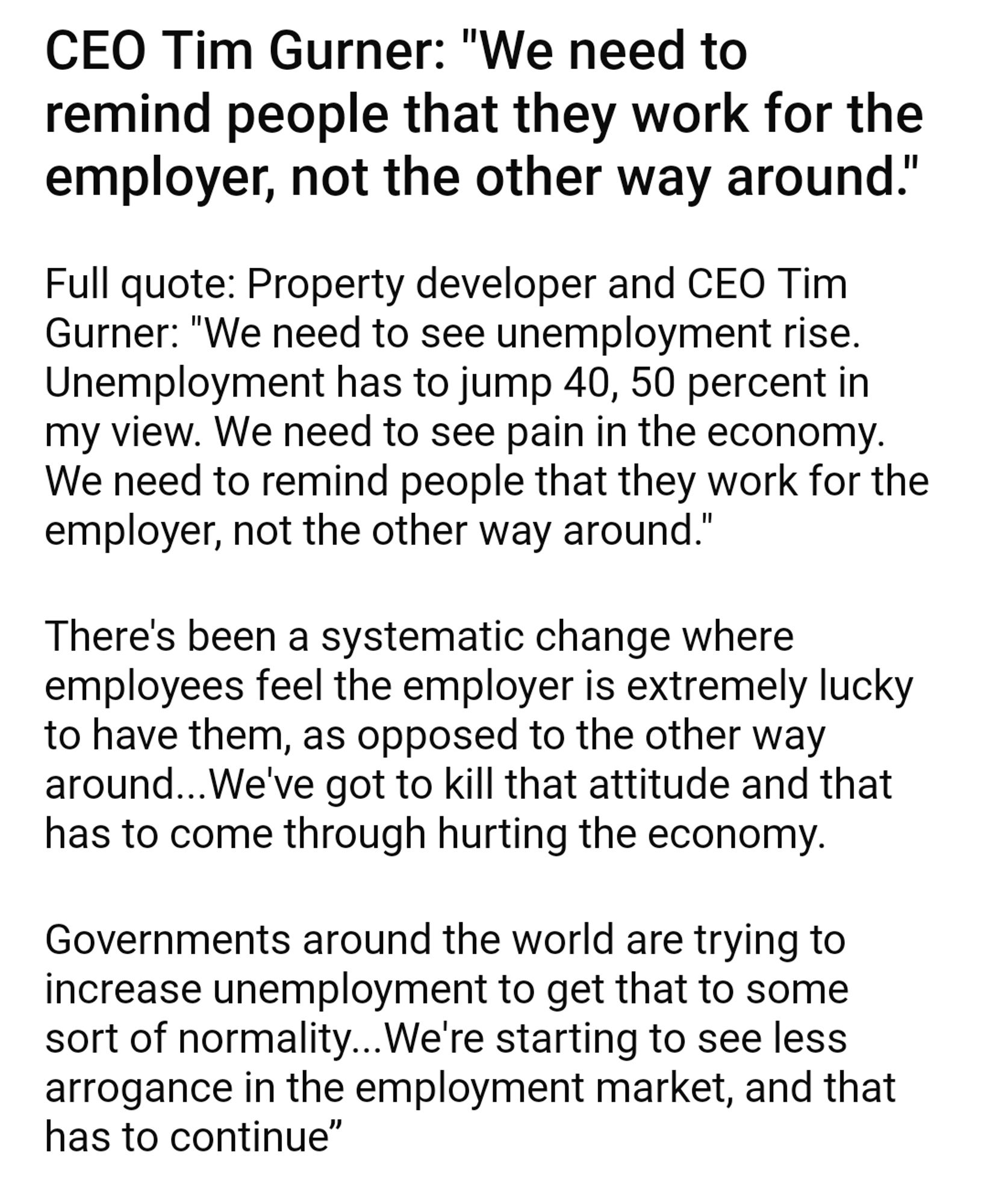
I really appreciate CEO developer Tim Gurney’s honesty here:
A lot of people are focusing on the idea that Gurney is a terrible person.
Which he is.
But there are two important facts he makes very clear here. The first is that most bosses like being able to push people around. Money is good, yes, but the real motivation is power and power over other people is what a lot of bosses get off on. Unless you inherited, you rarely get to the top without enjoying making other people do what you want: that’s most of the job of “leaders” and “managers” after all.
The good ones focus on motivating teams in positive ways, but the bad ones, well, they use fear and greed.
The second bit is the honesty about governments trying to increase unemployment. This is something a lot ofpeople won’t believe when a leftist or a Marxist tells them it, but perhaps when a CEO does, they will.
It should be emphasized that this isn’t an “always” situation: for most of the period from 1933-79 US government policy was intended to decrease unemployment. That sub-era of capitalism wanted high wages, in part because everyone’s workers are someone else’s customers. China’s big goal right now is to figure out how to increase wages across the economy, and thus escape the middle income trap. (They’re doing it wrong, because their economy came of age during a global neoliberal age, but they know it’s what they should do.)
But since 79 deliberate policy in most developed countries has been to keep unemployment high to crush wages. That’s how the current capitalism.
This is also a pure example of “job creator” ideology. “We the big bosses create the jobs. All the good things come from us. Without us people wouldn’t have jobs. They should be grateful and obedient and subservient because they are worth something only when being used by us.”
This is specific example of what’s common in almost all eras: the people who have the most power believe that means they are also the best people. “The GodKing makes the rains the flow and the sun rise. All bow to the GodKing.”
From the capitalists come all that is good, therefore government and ordinary people should revere and obey them and do what they say.
So I really do appreciate Tim Gurney’s honesty here: he’s saying the quiet part out loud. He’s not being a hypocrite, like most of his peers. This is who he is and they are. Good for him for being authentic and telling the truth.
This is a donor supported site, so if you value the writing, please DONATE or SUBSCRIBE.
Let’s get the obvious out of the way: Osama Bin Laden was not a good man.
Great is not a synonym for good. Genghis Khan was a great man. Hitler was a great man. FDR was a great man. Ivan the Terrible was a great man. Queen Elizabeth the first was a great woman. Of the five, only FDR was a good person.
Bin Laden didn’t quite win (though the jury is out), but he did accomplish much of what he wanted. His theory was simple: the US, the far enemy, was why when pious Muslims tried to reform their societies, they lost. The US supported the local governments or conservative/sell out forces, and with that support, the governments won.
This theory is a good one: it’s mostly true.
Bin Laden fought as one of the Mujahadeen against the USSR. He lead troops from the front. (He was a brave man, something most Americans refuse to admit.) He believed that the USSR broke up, in large part, because of their loss in Afghanistan. Pouring so many men and resources into the Afghan war put enough additional strain on the USSR to be decisive.
This theory is a good one: it has a lot of truth to it (though it’s only partially true.)
Osama also believed that the US military was fundamentally weak: they were good at battles and awful at prolonged combat. They were not tough: they could not win large-scale guerilla wars. Against tough warriors who wouldn’t give up, like the Vietnamese, they would eventually lose. This would destroy the myth of American military superiority.
So Osama’s plan was to suck the US into a war it couldn’t win, in Afghanistan. 9/11 was the method and it worked.
The US, under George W. Bush then also invaded Iraq, a self-inflicted wound.
And Osama was right, though more in Iraq than Afghanistan (which was fought more on the cheap.) The US won the initial battles, was bogged down and eventually forced out.
The cost was astronomical, and it did damage America, distracting America from its bleeding economic and social ulcers, and its real danger: China and the US. The money and men spent in Afghanistan and Iraq and in the endless “war on terror”; the attention paid to it, changed America in ways which made it weaker.
It didn’t, directly, cause the US collapse. America was stronger than the USSR had been in the 80s.
But Osama got much of what he wanted and planned: his wars; America defeated militarily, and America weakened. He found America’s trigger button and pushed it, and America acted as he wanted.
That he later died means nothing. His greatness was in making the greatest power of his time dance to his tune, and in so doing weaken itself.
The War on Terror was a great, essentially self-inflicted wound. Osama could never have damaged the US so much if America had not cooperated, but it did, because Bin Laden understood America enough to make it do what he wanted.
Bin Laden isn’t in the first tier of great men and women, but he qualifies for great: he made the world dance to his tune.
It’s important to recognize this. We can say of someone that they were evil and great. We can admit someone’s virtues if they are our enemies. If we can’t, we will underestimate them, and underestimating an enemy is sheerest stupidity, and a constant American vice.
You grant your enemies their greatness, or you are a fool.
This is a donor supported site, so if you value the writing, please DONATE or SUBSCRIBE.
RICO is a shit law, which criminalizes association and free speech. When it was passed, to take down the mob, far-sighted commenters noted it would be abused. Now it is being used to take down “Stop Cop City”.
It doesn’t seem a coincidence that this sprawling indictment is appearing when the Stop Cop City movement has reached its zenith of public support. Activists campaigning to put Cop City on the ballot have gathered over 100,000 signatures, well north of the number of votes Andre Dickens secured in his race for the Atlanta mayorship. Mainstream civil and human rights organizations, including the King Center, have come out in favor of the ballot initiative. Stop Cop City solidarity groups have popped up in at least twenty-one states, and progressive groups nationwide have leaned into support. The Stop Cop City movement stands a fighting chance, and so the state has exacted retribution.
***
As part of the negotiation of normalization of relations between Israel and Saudi Arabia, a formal alliance is being suggested. This seems misjudged: the Saudi regime isn’t just a terrible one, it’s a bad ally to the US; almost certainly part of the 9/11 attacks. Moreover, as Foreign Policy notes, normalizing with Israel may cost the Sauds their peace with Iran, and that could lead to war with Iran.
***
Thomas Neuberger, summarizing Hansen, notes that sea level rises are likely to happen much faster than standard models, and that means disaster for Asia (but not just Asia.) All of these won’t happen this century, I suspect, but plenty will.
This map (from NASA) is must viewing:

As is this one, where the dark green is low lying areas that will be flooded early.
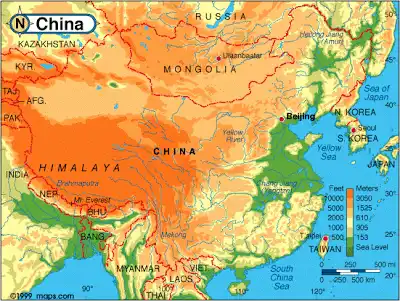
Neuberger notes that:
Beijing is now a coastal city. Notice also that the North China Plain, the Chinese “breadbasket” and engine of Chinese growth, is now under water. In the image below, the green area south of Beijing is the North China Plain. Green shows how close it is to sea level today. It will flood early in the process. (my emphasis)
You’ll also notice that Bangladesh is on the “floods early” slate. Imagine how that will effect India, and notice that there’s plenty of early Indian flooding too.
***
So, New York has a partial AirBnB ban which has finally gone into effect.
New Yorkers are forbidden from renting out their residence. If they wish to rent, they must be present in the home, as a host. And they must prove that they’re not effectively running an illegal hotel by turning over all kinds of information to the city, which will then list them in a registry
What seems to have happened is a lot of short term rentals being moved to long term, with some drop outs.
The drop, recorded between August 4 and September 5, the day New York City began enforcing the new law, represents the disappearance of some 15,000 short-term listings from Airbnb. The figures are based on data provided by Inside Airbnb, a housing advocacy group that tracks listings on the platform.
In August, there were some 22,000 short-term listings on Airbnb in New York City. As of September 5, there were 6,841. But it seems some short-term listings have been switched to long-term listings, which can only be booked for 30 days or more. The number of long-term rentals jumped by about 11,000 to a total of 32,612 from August 4 to September 5. These listings do not need to be registered under the new law.
Additionally, Inside Airbnb estimates that around 4,000 rentals in total have disappeared from Airbnb since the law took effect.
So, all of a 4K difference. I suspect this law is not going to be enough, but if the long term rentals drop in price so that they are viable for true renting; if they can become homes, then fine, AirBnB has just become a central site for long term rentals.
We’ll see.
A lot will also depend on enforcement. Many, perhaps most of the remaining short term AirBnB rentals are likely illegal, and if New York doesn’t go after then and punish both the landlords and AirBnB itself, the law will not matter. An unenforced book is only a political stick to be used against citizens who cross the wrong person.
I also agree with NYDaily News that allowing people to rent their own homes, without being there, for say a month a year, would be ideal. If someone is on vacation and wants to rent their house for the duration of their vacation, that’s reasonable and not a threat to the housing market.
Chalk this one down as “good potential first step, but we’ll see.”
x
x
Huawei Technologies and China’s top chipmaker SMIC have built an advanced 7-nanometer processor to power its latest smartphone, according to a teardown report by analysis firm TechInsights.
Huawei’s Mate 60 Pro is powered by a new Kirin 9000s chip that was made in China by Semiconductor Manufacturing International Corp (SMIC)…
…The processor is the first to utilize SMIC’s most advanced 7nm technology and suggests the Chinese government is making some headway in attempts to build a domestic chip ecosystem, the research firm said…
…Buyers of the phone in China have been posting tear-down videos and sharing speed tests on social media that suggest the Mate 60 Pro is capable of download speeds exceeding those of top line 5G phones.
(Oh, and while it performs better in some ways than the best iPhone or Samsung, it costs about half of what they do.)
When I talked to an expert a couple years ago, he told me it would take many years to really deal with the sanctions because of the difficulty in creating the “tech that creates the tech.”
But that appears to not be true. The West didn’t ban lithography machines until nowish (the Dutch will export them till the end of the year), but…
Shanghai Micro Electronics Equipment (SMEE) is expected to deliver by year-end its proprietary SSA/800-10W, a 28-nm lithography machine, according to a report last week by Chinese newspaper Securities Daily.
This is less advanced than what you can get from the West, and there’s a scaling issue, but the idea that the Chinese won’t catch up is absurd and always has been, and no country can scale faster than the Chinese.
The end result of the chip bans will be that China winds up with the largest chip industry in the world, and I’d bet that in ten to fifteen years (and perhaps sooner, as they keep coming in before forecast) they will be slightly in advance of the West.
Scale matters. The West sent the world’s manufacturing floor to China, and just as when it moved to the US the Americans took the overall tech lead (with Germany the only real competitor at the time), China will take the tech lead.
These sanctions should have been used only a couple years prior to a war. (A war with China would be horrific, and the West is not ready for one, especially right now with the massive equipment and munitions draw down for Ukraine.)
Chinese aren’t stupid, the West is no longer special, having sold its patrimony and the idea that the Chinese were somehow incapable of catching up in tech if sanctioned was always ludicrous.
Folks, it’s your donations and subscriptions which make it possible for me to keep writing (since I need to eat and pay rent and the cost of both have skyrocketed) so please (if you aren’t struggling) DONATE or SUBSCRIBE.
On this Labor day it seems like a good time to discuss what labor in general and unions in specific have to look forward to.
There’s been some very good labor news recently, for example, the UPS strike:
UPS Teamsters have won their biggest wage boost in decades: at least $7.50 an hour over five years for every current UPSer, and more for the lowest-paid. Even the 1997 strike only boosted part-time wages 50 cents (equivalent to 95 cents today) over five years.
The agreement would also end the forced sixth workday for drivers, create seventy-five hundred new full-time inside jobs, and eliminate the second tier of drivers — reversing the infamous concession in the 2018 contract.
There is also a desperation effect: there has been a lot of inflation, often higher than reported (I’d judge food inflation at the check-out where I live to have been about 66% over the last 3 years and rent inflation c.40% or so.)
A lot of unions have been having successful strikes and many non-union businesses have had to raise wages to attract workers. Anti-worker forces are fighting back, with variable success. In Britain striking is likely to be near-illegal soon, and this is something Labor agrees with the Conservatives on. Laws in some US states allowing younger teenagers to work in food processing plants and so on are also an attempt to break the power of workers.
This power is based on Covid. Covid killed a lot of “essential” workers (with restaurant workers in particular taking it on the chin) and Long Covid has moved a pile more workers off the table and will move more workers over time.
This leaves those who remain in a stronger position: in a market economy without strong pro-worker laws wages are almost entirely based on the supply of workers versus demand. This can be specific, where particular types of skilled workers are short, but for non-skilled workers its mostly aggregate.
From about 1979 Federal Reserve and ECB policy has been to raise interest rates to crush the economy any time workers began to make wage gains, but this time it isn’t working: both because the shortage is real and because the West is, though marginally, trying to decouple from China, meaning China’s mitigating effect on goods inflation is decreased. There aren’t a lot of truly cheap places left where you can easily move production because most remaining cheap places aren’t politically stable and pro-US.
In Europe the news is more mixed because Europe is shedding industry due to anti-Russia sanctions. England, having de-industrialized is now losing its developed nation status.
The pressure on the workforce will continue: Covid is still around, Long Covid and sub-perceptual organ damage will continue to increase and will continue to have an effect on the labour force, not just reducing it from what it would have been, but making a lot of people, while not disabled, less able and worse at their jobs.
There are, of course, things the ruling class can do about this. In Canada we’re bringing in about a half-million new immigrants a year (which has caused a housing crisis), in a nation of 40 million. There’s the child labor law changes and the anti-union laws.
The right is going to make some hay on this, because immigration does increase the work force and thus put downward pressure on wages. If the right were simply to stop being anti-union and anti-worker in other ways, they’d clean up. Up here in Canada, I despise the conservatives, but I have friends who are now homeless because of the housing crisis caused by the Liberals immigration policies.
In the further future, immigration will continue to be the big issue. Climate change refugees will be massive in number and hard to stop (I full expect so many machine-gunning refugees stories by 2035 that it’s “dog bites man.) Elites will want to let enough in to crush local efforts to raise wages.
So we have a window to do the best we can to improve wages. After that, things will become more difficult. Inflation will continue to be an issue (there’s a small chance of deflationary depression) because climate change will lead to real shortages of raw materials, especially food and water.
Of course, if climate change were treated as the emergency it is, there would be a ton of work available, a WWII style mobilization. And that’s the best possible future at this point: a mobilization to deal with climate change properly.
We’ll see if we do, and do it while we still can, before too much civilization collapse.
Folks, it’s your donations and subscriptions which make it possible for me to keep writing (since I need to eat and pay rent and the cost of both have skyrocketed) so please (if you aren’t struggling) DONATE or SUBSCRIBE.