
Use to discuss topics unrelated to recent posts.
Author: Ian Welsh Page 84 of 436
The army, or a part of it at the war college, has perked up and noticed some of the lessons of the Ukraine war, and that it’s a war that the US military could not fight. They’ve missed a lot of things, or felt they couldn’t/shouldn’t write about them, but they’ve figured some stuff out and written about them in a new report, “A Call to Action: Lessons from Ukraine for the Future Force” by Lieutenant Colonel Katie Crombe, and Professor John A. Nagle.
The entire thing is worth reading, but I’m going to pull out three of the main points. The first is that a volunteer US military can’t fight a real war.
The Russia-Ukraine War is exposing significant vulnerabilities in the Army’s strategic personnel depth and ability to withstand and replace casualties.11 Army theater medical planners may anticipate a sustained rate of roughly 3,600 casualties per day, ranging from those killed in action to those wounded in action or suffering disease or other non-battle injuries. With a 25 percent predicted replacement rate, the personnel system will require 800 new personnel each day. For context, the United States sustained about 50,000 casualties in two decades of fighting in Iraq and Afghanistan. In large-scale combat operations, the United States could experience that same number of casualties in two weeks. (emphasis mine)
Huh. Yeah, that seems bad. And it comes just as the US military is having trouble with volunteer recruitment, though even if wasn’t volunteer recruitment couldn’t keep up with the meat grinder of a real war.
The US Army is facing a dire combination of a recruiting shortfall and a shrinking Individual Ready Reserve. This recruiting shortfall, nearly 50 percent in the combat arms career management fields, is a longitudinal problem. Every infantry and armor soldier we do not recruit today is a strategic mobilization asset we will not have in 2031. The Individual Ready Reserve, which stood at 700,000 in 1973 and 450,000 in 1994, now stands at 76,000. These numbers cannot fill the existing gaps in the active force, let alone any casualty replacement or expansion during a large-scale combat operation. The implication is that the 1970s concept of an all-volunteer force has outlived its shelf life and does not align with the current operating environment. The technological revolution described below suggests this force has reached obsolescence. Large-scale combat operations troop requirements may well require a reconceptualization of the 1970s and 1980s volunteer force and a move toward partial conscription. (emphasis mine).
If the US expects to fight Russia, China, or even Iran, they’re going to face a real war.
The US has spent 20 years fighting with air, artillery and surveillance supremacy, with clear communications. American veterans who went to Ukraine were unprepared for a war where the other side has, if not supremacy, air and artillery superiority, and the Ukraine war has been a meatgrinder. Plus, the current command methods the army use don’t work in an environment like the Ukraine:
Twenty years of counterinsurgency and counterterrorism operationsin the Middle East, largely enabled by air, signals, and electromagnetic dominance, generated chains of command reliant on perfect, uncontested communication lines and an extraordinary and accurate common operating picture of the battlefield broadcast in real time to co-located staff in large Joint Operations Centers. The Russia-Ukraine War makes it clear that the electromagnetic signature emitted from the command posts of the past 20 years cannot survive against the pace and precision of an adversary who possesses sensor-based technologies, electronic warfare, and unmanned aerial systems or has access to satellite imagery; this includes nearly every state or nonstate actor the United States might find itself fighting in the near future
Back in 2012 I wrote an article titled “Drones are not weapons of the powerful.” I posited that they’re cheap, easy to make and everyone would eventually get them. We’re pretty much there, in terms of large group actors (the step after that is individuals, leading to an era where even a single person or small group can launch significant attacks.).
The authors of the article agree:
These systems, coupled with emerging artificial intelligence platforms, dramatically accelerate the pace of modern war. Tools and tactics that were viewed as niche capabilities in previous conflicts are becoming primary weapons systems that require education and training to understand, exploit, and counter. Nonstate actors and less capable nation-states can now acquire and capitalize on technologies that bring David’s powers closer to Goliath’s.
There are issues the authors don’t deal with, the main one is “designed in California, built in China.” The US’s weapon building capacity is massively degraded. As one example, the Chinese can build 3 ships per one the US builds, and the ships are probably better.
Since WWII, in every war the US has fought, they’ve had air superiority or supremacy and more advanced weapons than the enemy. They’ve also had more “stuff”. But the WWII “arsenal of democracy” is dead, it doesn’t exist any more.
Another issue is that the US military has outsourced too much of its capabilities. The corporate mantra of “outsource everything except your core competency” doesn’t work in a real war. All support functions should be run by the military and soldiers. (I may write an article on that in the future.) Contractors are too expensive and unwilling to really risk their necks, and outsourcing maintainance to non-army technicians is a disaster.
The US retains one huge advantage, however, its continental position makes it hard to attack the mainland. But this is also a disadvantage if the US loses air and naval supremacy. America’s enemies can only be reached by air and sea, after all.
Anyway, one takeaway is that conscription is likely to come back. I assume they’ll first make a huge push to recruit immigrants, undocumented or not, but that isn’t going to be enough. Get ready and remember, Empires rarely fade, they go down in huge conflagarations. The British Empire’s end involved two world wars.
Donors and subscribers make it possible for me to write, so if you value my writing, please DONATE or SUBSCRIBE
Trump was found guilty in a very interesting suit.
Judge Arthur Engoron, ruling in a civil lawsuit brought by New York Attorney General Letitia James, found that Trump and his company deceived banks, insurers and others by massively overvaluing his assets and exaggerating his net worth on paperwork used in making deals and securing loans.
Engoron ordered that some of Trump’s business licenses be rescinded as punishment, making it difficult or impossible for them to do business in New York, and said he would continue to have an independent monitor oversee Trump Organization operations.
There are a few interesting things about this case.
- It’s was brought by the New York Attorney General, not any of the people Trump defrauded.
- It was a civil and not criminal case. The Attorney General first considered criminal charges, but then decided on a civil case. Guilt is found in civil cases on the “preponderance of evidence”, where criminal cases are decides on “reasonable doubt.” Guilt is a lot easier to find in civil cases.
- Everyone has known, for decades, that Trump was a fraudster and pulling various shenanigans. He wasn’t charged. Why? Because the sort of fraud he committed is endemic in the real estate industry: it is normal. So while it’s against the law, it isn’t usually enforced.
- This means Trump is being charged for something most real-estate developers are being allowed to slide on.
- The end effect here is to remove Trump’s control of a big chunk of his own empire, thus reducing his power and ability to fund his own campaign. (That isn’t likely to matter, he will be able to fund it with donations, unlike the first time.)
Obviously what has changed is that Democrats, and the cases are being brought by Democrats, don’t want him to be president again. This isn’t necessarily unreasonable: he did try and launch a coup, after all.
But as I’ve written before, it’s a change in elite consensus. This sort of thing used to be done rarely, and not at the Presidential level. It’s going to lead to a situation where both parties go after the other party’s leaders in jurisdictions they control.
In a sense, this is bipartisan. Republicans are using this mostly to challenge laws they hate, like those allowing abortion or trans-therapy. They do it in a jurisdiction they control, then count on the Supreme Court (under Republican control) backing them up in the end. Most, but not all of the time, the Supreme Court does.
Which leads to the question, what happens when all of these cases against Trump make it to the Supremes? All the Republicans aren’t Trumpists, some aren’t fans.
But a judicial hit policy is dangerous when you don’t control the supreme court.
Something to think about.
And, overall, this indicates a new era in American politics: the gloves are coming off, even more, on both sides and previous elite norms are changing.
This makes some sense when you consider that the US, in certain terms, is in decline. In the old days, there was plenty for everyone. But with the US is relative decline (and arguably absolute decline), and with elites having taken so much from the poor and middle class that there’s little more to loot, any further gains must come from each other.
Welcome to decline.
Folks, it’s your donations and subscriptions which make it possible for me to keep writing (since I need to eat and pay rent and the cost of both have skyrocketed) so please (if you aren’t struggling) DONATE or SUBSCRIBE.
Multiple industries. Germany, much like the US, but even more so, let China pick up, among other things, much of the tool making industry, especially those related to auto manufacture.
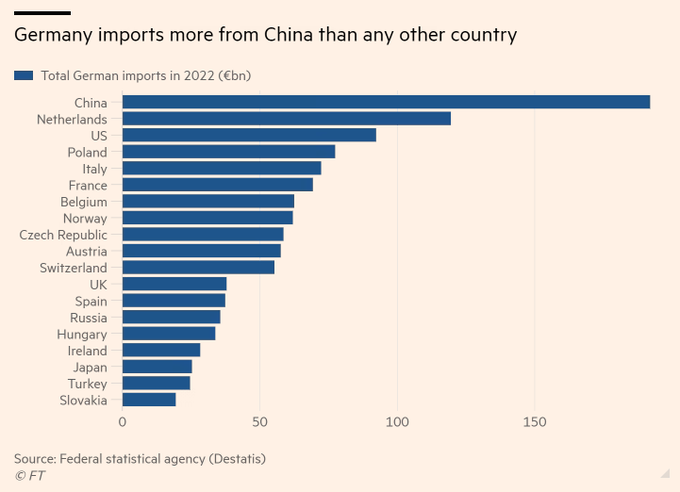
Ouch.
When you consider this is an absolute terms and not relative, it’s even worse.
This comes on top of anti-Russia sanctions and the sabotage of the Nord Stream pipelines cutting off Germany’s access to cheap energy.
Germany is a relatively small country without a lot of natural resources. To be wealthy it needs to produce high value goods, and to do that it needs inexpensive inputs for its industries, or it needs to have much higher industrial productivity than everyone else.
Outsourcing so much of the supply chain for its manufacturers was an understandable mistake: it made those inputs cheaper.
But if you’re a small country without a lot of resources, you have to keep your supply chains and trading relationships stable. German leaders at the start of the Ukraine war expressed the most doubts about massive sanctions and they were right.
Germany is, as predicted at the time, in real trouble. Their model had flaws, and was a mean one, impoverishing and de-industrializing other EU nations, so there’s a certain irony to EU consensus Russia policy now screwing them over, but at this point if Germany goes down it’ll take the entire EU’s economy with it.
Germany cannot afford to follow the US into a cold trade war with China.
Moreover, this is a demonstration of something simple: what is good for Western EU countries and what most Eastern EU countries want (anti-Russia policies and NATO expansion) are two different things. Germany needs good relations with cheap resource suppliers and the only practical one was Russia.
It’s all very well to say, as many have, that this is the price of standing up for “freedom”, but if Germany goes down, so does the EU.
Likewise, what is “good” for the US, is not good for most European countries, and especially not good for Germany. (Ironically, Macron is the only major EU leader to be honest about this.)
The EU, if it continues on this course, will be reduced to an even weaker American satrapy than it was is the cold war period, and one with a lot worse living conditions.
China’s moving up the value chain. Sanctions against China, rather than slowing this down are speeding it up. Correct industrial policy would have been to negotiate with China about what industries or segments of industry each country is going to specialize in.
Incorrect policy is to have a cold war against both your cheapest energy supplier and the country that is now the world’s manufacturing floor.
Damn near suicidal policy, in fact.
Europeans need to get thru their heads that the European/American near monopoly on tech and high productivity is broken and that Europe, in particular, is coasting on legacy industry, without a great number of natural advantages. It was a backwater for most of history, and is reverting. The job of European leaders is to keep that reversion from happening for as long as possible and to slow down whatever reversion occurs.
Now, it could be that full commitment to a “US and Europe+Anglo countries” trade block, with full re-shoring would be a viable policy, if aggressively pursued, but that’s not what’s happening, the US is, instead, taking advantage of EU and German weakness to grab up high energy cost industries.
As for Europe’s elites, they should remember that owning overseas resources is dangerous. Britain’s “hidden empire” — its overseas investments, was a huge part of its strength, and essentially liquidated in WWI. Germany’s chemical patents and electrical patents were broken by the Allies in WWI and they didn’t reinstate them after the war was over.
Anything you own in another country doesn’t really belong to you unless you have the troops and willingness to occupy that country and the ability to then administer the country.
Germany in specific, and Europe in general, if they don’t change their policies and their commitment to being American satrapies, are on the path to ruin.
(Oh, and as I said at the time, most of the Eastern European countries should never have been let into either NATO or the EU. They offer little but vulnerability; are economic soaks, and have interests contrary to those of Western European countries. The only way they could have been absorbed effectively was if the EU decided to become a real federal nation with former countries reduced to provinces at most, and in most cases divided into multiple provinces.)
Folks, it’s your donations and subscriptions which make it possible for me to keep writing (since I need to eat and pay rent and the cost of both have skyrocketed) so please (if you aren’t struggling) DONATE or SUBSCRIBE.
A Sikh activist was killed in Canada. The Canadian government claims he was killed by India. Canada’s Prime Minister, Justin Trudeau has made this accusation himself, and the dispute saw an exchange of diplomatic expulsions.
This is the sort of thing that governments tend to wink on, unless they don’t like the other side, so why is Canada making such a big fuss?
Simple enough, Canada has a huge number of Sikh immigrants. They started coming in the 70s, and they’re politically powerful. They’ve done well in Canada (and are well thought of, over all.)
Canada has no significant trade ties to India. Imports and exports as of 2020, were about 20 billion Canadian. That’s peanuts.
So we have no interests that matter with India, and we have a large minority which feels oppressed in India (because they are, especially under Modi.) Sikhs have a long-simmering desire for their own state, as well, and a tradition of violence, so it’s not surprising the Indian government worries about them. Back in 1985 an Air India jet was blown up in the air by Sikh terrorists.
So, fundamentally, what Canada thinks of India doesn’t matter much to India and what India thinks of Canada doesn’t matter much to Canada, but both nations have powerful domestic political reasons to be willing to row.
One man’s terrorist is another man’s freedom-fighter.
This is the same reason that Canada has been so pro-Ukraine. Canada has a huge Ukrainian community, and Russia competes with us: we sell the same things, and we have competing claims in the Arctic.
Again, it’s a domestic issue and what Russia thinks of Canada really doesn’t matter much, nor vice-versa.
(Our dispute with China is far more stupid.)
The Americans are very keen to use India as a counter-weight against China, as is the West in general, which is why Canada hasn’t received much support, but that doesn’t really matter: India isn’t going to make its decision on cooperation with the US based on how much it likes Canada and unlike Turkey pressuring Sweden and Finland on Turkish “terrorists” or they won’t let them into NATO, there’s nothing Canada really needs from India.
All of which is to say, for both India’s Modi and Canada’s Trudeau a fight over Sikhs is a winner domestically, with no serious international consequences, so why not?
Edit: India has stopped visas for Canadians. Canada has two million citizens of Indian descent and sends over 750K tourists to India a year. This is an attempt to put domestic pressure on the Canadian government.
It’s also worth noting that India has a record of killing overseas Sikh activists, though usually in south-east Asian countries. So the allegation isn’t that far fetched.
Folks, it’s your donations and subscriptions which make it possible for me to keep writing (since I need to eat and pay rent and the cost of both have skyrocketed) so please (if you aren’t struggling) DONATE or SUBSCRIBE.
Money is something you can (sometimes) exchange for wealth, but it’s not wealth itself.
When I say sometimes I mean that there are things you can’t buy: what those things are change from place to place and time to time. The classic formulation of the preconditions for capitalism includes the ability to buy land, labor and capital. In most places and times you couldn’t actually hire most people to work–they were bound to the land, their clans, or whatever or they could support themselves and sure didn’t want to work for someone else.
Likewise most land was inherited or in the commons and definitely not for sale. You couldn’t buy it.
Wealth is what you control (not own, control) that can be used to make something, grow something or support violent people.
Violent people are what enable you to retain control, and this is as true now as it was in feudal times or ancient Sumeria. Property law and contracts and taxation and so on are all ultimately backed by the fact that if you don’t obey, unpleasant men with guns will show up and do horrible things to you.
In the dark and middle ages, those with a lot of money had sharp limits on how much power they had. The King of France famously destroyed the Knights Templar to get out of his debts to them and to steal their wealth. Henry the Eighth of England dissolved the monasteries and stole all their lands and wealth. Rich merchants regularly had their noble or royal patrons default on their debts and often wound up dead as a result.
Nor could they buy much in the way of land, or hire too many people. Right up to the middle of the 19th century, the standard pattern for a rich merchant was to either marry their heirs into the nobility or buy a patent of nobility, then get some land, and become a noble and give up most of their mercantile enterprises. These were sharp customers, they did this because they felt it was the only way to be secure and truly take care of their descendants.
In the modern world, when new money is created without an increase in actual productive ability (goods, resources, improvements in land, improved real productivity) wealth hasn’t been created. Wealth is only created by increases in money if there is unused productive capacity and that capacity is being held back by lack of money (i.e. it’s available, but not being used by the people who would use it productively) and that money gets to the people who would use it productively AND those people then get control of those resources and use them productively. (That’s a lot of “ands”.
We’ve been pumping a ton of money into the economy ever since 2008. It mostly, in the West, has not been used to increase production, it has been used either in attempts to gain control of already existing productive resources or to loot said productive resources, burning them to the ground, as with much of private equity. A good example is Toys’R’Us, which was entirely profitable till it was bought and larded up with debt by the buyers.
Money isn’t wealth. Sometimes, in some times and societies, it seems like it, but at best it is a proxy for wealth.
Folks, it’s your donations and subscriptions which make it possible for me to keep writing (since I need to eat and pay rent and the cost of both have skyrocketed) so please (if you aren’t struggling) DONATE or SUBSCRIBE.
As regular readers know, I live in Ontario and because I have cancer (no worries, my odds of dying are about 2%) I’ve been in and out of the hospital system a lot from about 2018 to now.
That means I’ve gotten to see what happened to hospital care, albeit mostly in two hospitals; but two important, well funded research and teaching hospitals.
And it has been bad. Getting imaging tests which I would have had within a month to two before Covid took almost a year. A surgeon I know told me how he was fighting to get people urgent care. I’m lucky, I have a slow growing type of cancer, if I’d had something fast, odds are I’d be dead.
Diagnosing early is important for all sorts of diseases, not just cancer, and so is getting people quick care.
The union responsible for health care workers in Ontario (CUPE) put out a report on Ontario’s hospital care situation. I read it. It’s based entirely only publicly available numbers from various agencies like Statistics Canada, so even though CUPE has an obvious axe to grind I find the report accurate . And those numbers confirm what was obvious anecdotally.
(As an aside, the federal government gave Ontario billions of dollars to help with Covid which it did not spend on Covid.)
It starts with a section showing that Ontario has less health care workers (except research types) than other provinces. It’s not that they’re doing great, it’s that Ontario is worse and was even before Covid. It then shows how many vacancies there are:
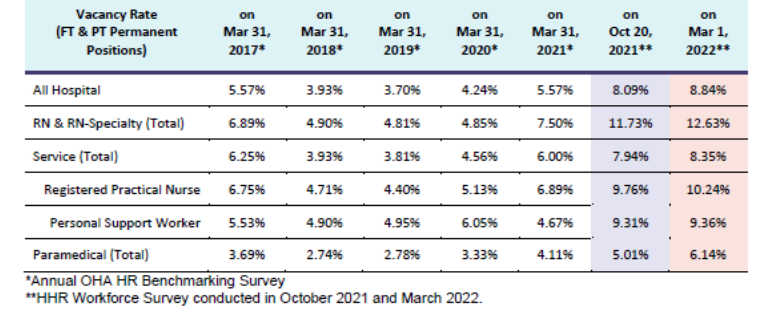
The effect of Covid is pretty clear.
We then move to the reduction in number of surgeries (but, alas, no report on imaging wait times.)
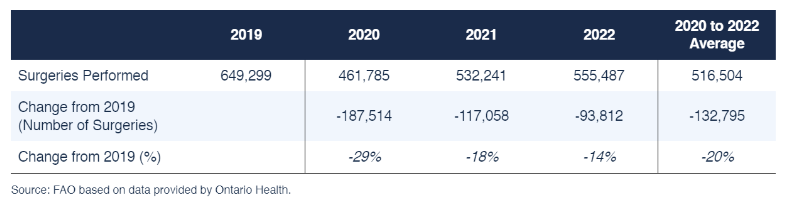
Given the population is increasing (massive immigration) and getting older this is pretty significant, and…
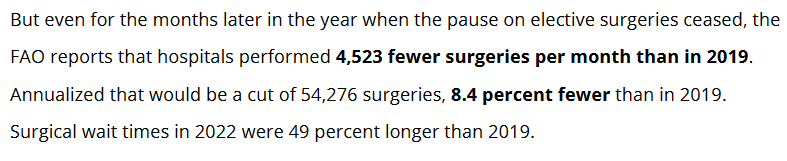
So, yeah, less surgeries, increased wait times and not just for elective surgeries. In visual format:

And….
So, what’s the government doing about this? I’ll just quote straight from the report (excuse the images, the report is a pdf and it’s easier to just show a picture.)
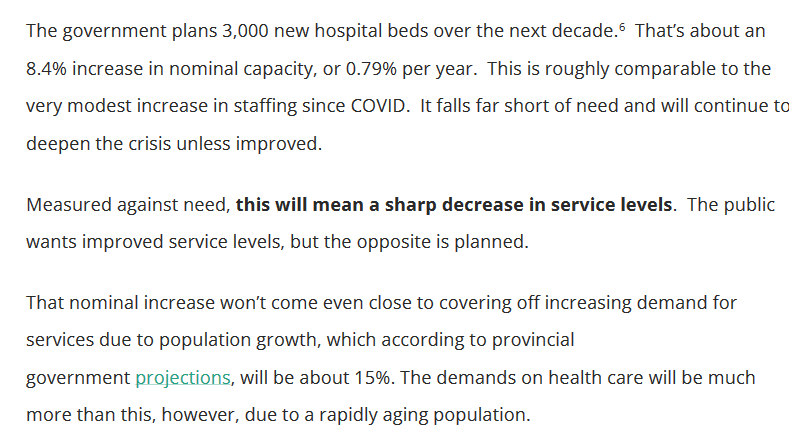
In other words, the government plan will make things worse. To keep service levels where they are (not to get back to pre-Covid levels) would require a little over 3,000 beds.
To go back to pre-Covid levels of care would require 8,170 beds over 4 years. The beds have to be staffed:
A 5.18% annual increase in staff means 13,986 extra staff added in the first year. (Assuming we start with 270,000 hospital staff). This would mean 60,000 extra hospital staff over 4 years (a 22.39% increase). This is not the number of staff that needed to be recruited, this is the number of extra staff needed to be added to the existing complement.
So, health care in Ontario hospitals, unless government changes course (they aren’t going to, at least not under this government) will keep getting worse, and it’s already bad in many ways (the actual care in the hospitals I go to is good, once you get past the wait times, though I haven’t been an in-patient since Covid started.)
CUPE has a bunch of other suggestions about how to fix this, you can read them all if you want, but I’ll highlight a couple:
Ban the use of nursing agency staff. These agencies charge 2x and 3x what hospitalspay their own staff, and they bleed away resources from round the clock and weekend staffing, worsening morale and weakening the continuity of care.
Real wages must increase. In any other labour market with skill shortages, wages would increase to retain and recruit. But real wages are being cut for Ontario’s health care workers and this policy is leading to an exodus of staff and to demoralization
There are about 15,000 licensed nurses who don’t practice in Ontario and thousands of frontline support staff have quit and to lure them back you’ll need to pay.
Anyway, what’s Ontario doing, in addition to not increasing beds enough? (If you guessed their non-solution starts with P, go to the front of the class.)

Now CUPE charming notes that the percentage increase is of such a small amount that it can’t fix the problem, but we all know that the real plan is simple: keep making public care shitty and eventually increase the private share massively, splitting the system into a shitty one that poor and middle class people have to use and a good system that the upper class and rich (and politicians who somehow get discounts) use.
The Ontario privatization plan is in its infancy, but the bones of it are clear. Get the people with power and influence to stop supporting public health care by letting them avoid its problems and get good care, make the care in the public system bad to make the mass population support privatization thinking they’ll get to use it when they really need it (as in the US, if you’re really sick and middle class or even lower upper class, you won’t be able to afford private health care), and eventually make politically connected friends very rich while destroying effective public health care.
You may be thinking “who cares what’s happening in a single Canadian province? I’m not Canadian, and don’t live in Ontario.”
But this is a general pattern. It’s happening in multiple countries including the UK (where it’s much further along), Canada, Australia and others. I highlight this one because of just how clear the report is, both on the effects of Covid and the longer term issues and because my personal experience supports it.
If you want good health care you have to pay for it. Public health care is cheaper than private (this isn’t even remotely in question, but beyond the scope of today’s post) and the only way to get good health care is if people are treated equally. If people with power or wealth can skip the queues and get better, faster care, then they don’t care what’s happening in the system you use and that system will get shit fast.
The first stage of privatization was creating a very tiny alternate system where the richest could get everything from private hospital care to bespoke MD care. I spent a tiny bit of time in that system around 2013/2014 and I can tell you, the care is better, by far. (Among other things, the doctor isn’t trying to rush you out of the office in fifteen minutes max and hoping for five minutes. I spent an hour and a half with a doctor during my first intake and often 30 minutes on other occasions. In the US they are offering two day complete check-ups seeing multiple specialists at a major hospital. Don’t worry, not 1-in-100 of my readers can afford that.)
Everyone gets treated the same for the same problem, or care will suck for everyone who isn’t powerful and rich.
As for Covid, we all knew it had a massive effect on the hospital system, and I guarantee that is true almost everywhere, not just in Ontario.
If you want good healthcare, the care the upper classes get can be no better than yours.
And Covid isn’t over and even if you never get it, it can still kill you, your kids, or someone you care about because they don’t get the care they need, when they need it.
(Read the full Ontariot Hospital Care report.)
Folks, it’s your donations and subscriptions which make it possible for me to keep writing (since I need to eat and pay rent and the cost of both have skyrocketed) so please (if you aren’t struggling) DONATE or SUBSCRIBE.