
Use to discuss topics unrelated to recent posts.
Author: Ian Welsh Page 59 of 448
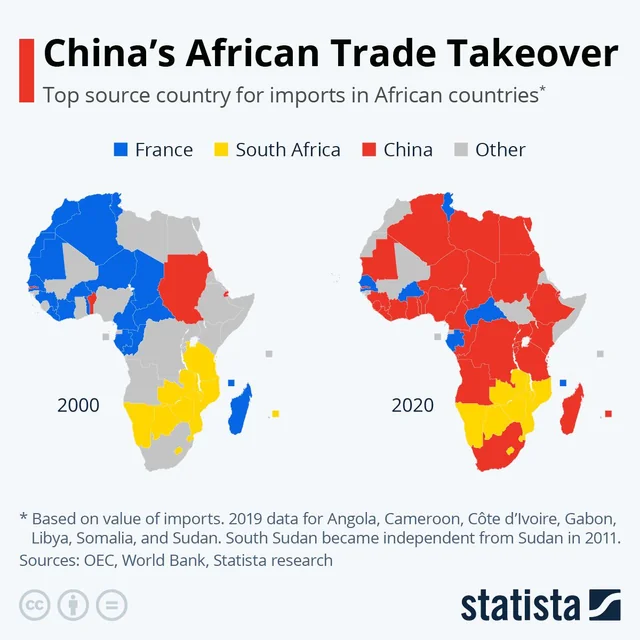
Recently French troops have had to leave Mali, Niger and Burkina Faso. Now it’s Chad booting them.
Update: Senegal has now announced it intends to seek the withdrawal of French troops.
The first three countries have Russian troops in them now. Wonder how long it’ll be before Chad joins the crowd?
France has been the most important country in a lot of its ex-colonies in Africa, but it’s losing its place, not just militarily but economically. Countries are turning to China for imported goods and development at the same time as they turn to Russia for security. Chinese goods, development and loans are cheaper, and neither Russia nor China interfere nearly as much in domestic politics.
It’s just a better deal. For a long time you HAD to go to the West, but now Russia and China can supply pretty much everything you need.
As regular readers know I’ve been following Europe’s collapse for a few years now. It’s practically a freefall. In Germany Volkswagon, for example, is planning on closing factories for the first time.
Europe’s well on its way to being what it was for most of history: a backwards and irrelevant peninsula, with the main action and most important civilizations elsewhere in Asia.
People meditate because they want something from it. Most serious meditators I know, the people who made real progress, were miserable. The two main benefits from meditation might be classified as “capacity” or “exercise” and “insight.”
When I was younger, I could run 10 miles in 50 minutes and not be exhausted afterwards. I can’t do that now because I don’t run regularly.
Some benefits from meditation are like this. Concentration meditation, where you hold your attention on something like your breath or a mantra, or the spot between your brows or a candle is “mind exercise.” The more you do it, with proper technique, the better you get. If you stop doing it you lose the benefits: being more relaxed, more able to focus on anything and more able to ignore stuff like pain and anxiety.
The other main set of benefits are like learning to ride a bicycle. At first it’s impossible, then you get the knack for it, and from then on you have the benefit. Most of these are insight benefits: if you truly realize that you aren’t the body, say, then you let go of it and suffering is permanently reduced. If you see thru conditioning and realize you don’t have to obey it, you become free of it (often this goes in steps, by types of conditioning.)
Some other similar benefits are skill based. If you practice bringing up emotions on demand after a while they become “on tap” and you can just experience them at will.
Now meditation methods tend to work in concert. The reason Shamatha (concentration/mental exercise) is often done alongside Vipassana (insight) is that if you want to see the mechanics of how sense objects like emotions and thoughts work, being able to concentrate: having a focused mind make it a lot easier.
Of course there’s some overlap: I know how to run properly. I know how to get in shape. If I were to take up running again, those would make it easier for me and even when I’m in bad shape I run better than people who have never learned proper running technique (plus I’m used to the suffering of pushing myself.) Same is true of concentration: I’m out of practice, but I know how it’s done and I’m better than someone who’s never done a lot of concentration meditation. But I’m nowhere as good as someone who’s kept up a practice of an hour or two a day. (Two hours is about the minimum to be able to get reliably into certain states.)
Whatever it is you want from meditation, and there are lots of different possible achievements, you need to know what you need to do to get them, and how to keep them. But no matter what you want, meditation is either like exercise (for capacity) or like learning a skill.
Know what you want and find out how to get it.
So, terror bombing appears to have won the Gaza war. Israel’s ground invasion was pathetic, Hezbollah’s troops proved their reputation is deserved, but Hezbollah has agreed to a ceasefire.
That’s what Israel needed: that’s a strategic victory. Without Hezbollah missiles and drones hitting Israel, a ton of the pressure is off, especially economic pressure. Now Israel can concentrate on Gaza and Hamas. Without Hezbollah, they’re doomed and the genocide and ethnic cleansing of, at least, Northern Gaza will be successful.
This is why I always felt that Hezbollah, Iran and the Iraq militias needed to put much more pressure on, especially back when the Israeli army was concentrating on Gaza and Hamas still had most of its troops.
There’s a good chance this ceasefire won’t hold, of course, but if it does it’s an Israeli victory. Anyone spinning it any other way is full of shit.
If there’s going to be another round, then Iran needs to get serious anti-air to Hezbollah, because with terror bombing having worked, the Israelis will do it again.
 Times are hard for a hell of a lot of people and I’m very grateful to everyone who’s given this year.
We have raised approximately $9,350 out of a goal of $13,000.
Along the way we’ve unlocked six book reviews.
- “India Is Broken”
- “The Invention of Capitalism”
- “One Disease, One Cure” by Whip Randolph
- “The Sociology of Philisophies”
- “MITI and the Japanese Mircale”
- “Wealth and Democracy” by Kevin Phillips.
At $10,000 I’ll write an article on one of the fundamental processes which keeps societies together and breaks them up.
I’m going to add another book review at $11,000 and $12,000. If we reach $11,000 I’ll review “A Paradise Built In Hell”, which is about how during and after catastrophes people pull together, help each other and made the community wonderful.
If we reach $12,000 I’ll review “Why Read Marx Today?” by Wolff.
At $13,000 (should we make it) I’ll write an article on the weaknesses of North American style police, and how a determined and ruthless opponent could take advantage of those weaknesses to rip them a new one.
If anyone still intends to make to a large donation, please consider doing it as a matching donation: those do usually work.
Again, I appreciate everyone who’s given, and all my readers. These years of writing for you have been very worthwhile.
The functional chassis of all real spirituality are metaphysical statements, often called views. Each view is a way of understanding reality. Every view in real spirituality is connected with a “way”. The way is the path to being that view.
The “I am awareness” view is that of chunks of Hinduism, especially Vedanta and its various offshoots. The best book written from this perspective is “I Am That”, which I recommend highly. A good one, especially the first forty percent or so is “The Essence of Enlightenment” by James Swartz.
The “I am awareness” argument is that the only thing which always exists is awareness, and therefor that is what we are. We are not our bodies, or even our consciousness: both can be absent and awareness still exists.
Everything I am aware of is an object in consciousness. This is obvious. All of these objects change over time, often appearing and disappearing. Whether they exist or not, I always exist: they are dependent on me, I am not dependent on them.
One may suggest this isn’t true by two methods. The first is “I’m not aware when I’m in deep sleep.” With enough meditation of the right type you can prove that wrong: you can be aware that you are deep asleep and if someone yells near you while you’re in deep sleep you wake up, so awareness appears to still exist.
The second is that awareness didn’t exist before birth, and won’t exist after death. This is a more serious objection, but it’s not proven, and certain experiences on the spiritual path where you appear to exist without the body suggest it may be wrong. Instead you simply don’t remember before your birth.
To many this will seem like utter nonsense, but most people haven’t done the necessary work to have an opinion worth caring about.
There are a few ways or paths towards this view. The main one is simply examination. Is it true that objects come and go and I remain? Watch sense objects and see what happens. This is meditation. It’s part of what Buddhist Vipassana does, actually, though only part.
A second is to simply concentrate on the sense of “I am” and don’t pay much attention to anything else.
A third is the Vedantic super-imposition method: you learn the view and apply it. Whenever you think “I am the body”, you simply correct the thought to “I am awareness.” (There’s more to it than that, I’m simplifying vastly.)
Our normal view is something like “I am the mind, which is produced by the body, and I live in a world that is not me.”
Most spiritual paths say that the body exists in the mind (it does, though that doesn’t have to mean that it isn’t produced by the brain).
So what’s the benefit of having this view, of grounding it in?
First, you let go of sense objects. You don’t push bad sense objects away (pain, fear, etc…), and you don’t try and grasp good sense objects (love, happiness, etc…)
If you leave sense objects alone, what happens it that the bad ones bother you less and the good ones last longer.
Second, when you don’t regard the body and mind as “you” suffering drops massively. It’s not happening to you, you don’t have to care. Suffering is basically pain times attachment.
Third, your conditioning weakens. Every time a conditioned sense object comes up, if you react to it with anything but detachment or detached love, it is renewed and usually grows stronger. Say you were once burned and are now scared of fire. Every time you see or hear fire you are scared. You try and push the fear away. The fear is renewed, and may even grow stronger. If you don’t care, if you don’t react or you counter-act the fear with love or another positive emotion, the conditioning weakens.
Fourth, your general level of fear grows lower. Over time your ambient anxiety drops. Almost everyone has some anxiety, even if it’s below the threshold of consciousness. As fear goes away it is replaced by a directionless detached love. You feel love all the time. When this starts, it’s intermittent. You feel happiness or love for no reason you can determine. Over time it becomes more and more steady. (I’ve spent fairly substantial time in this state. It’s not theoretical.) As best I can tell, human nature when truly not scared IS love.
The more solid your identification with awareness is, and the less you identify with consciousness, sense objects and the body, the better your experience is. This seems to be what the Hindu types are talking about when they say that the nature of the self is bliss. You no longer rely on getting things, having things or circumstances in order to feel good. You just… feel good.
There’s more to all this, of course, rather vast volumes have been written about it, often in allegorical language which is hard to understand if you weren’t trained it. But this is the essence: you are awareness, and fully knowing that frees you of the need for objects at any psychological level. Of course, if you want the body to stick around you’ve still got to take care of it, but you are no longer subject to the tyranny of running from desire to desire and away from fear after fear.
***
Close to the end of the annual fundraiser, which has been weaker than normal despite increased traffic. Given how much I write about the economy, I understand, but if you can afford it and value my writing, I’d appreciate it if you subscribe or donate.
Nothing saves money on people who are old, disabled and unable to work like just killing them.
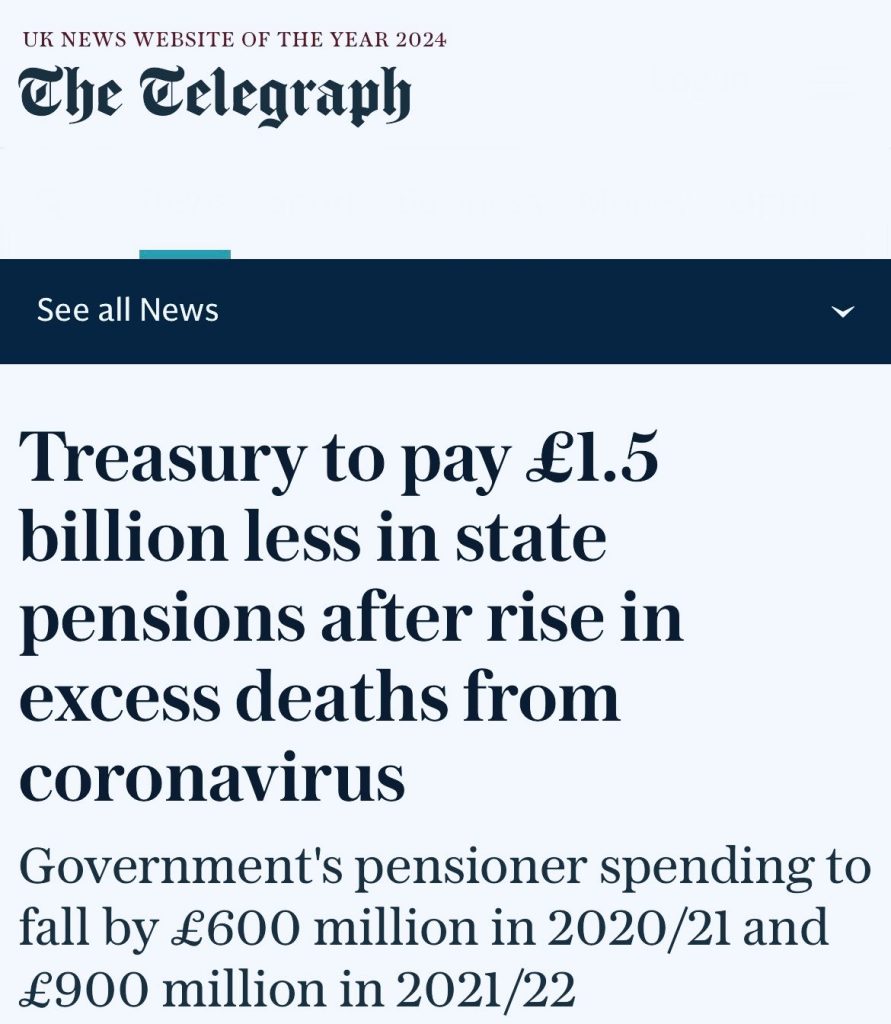
Covid killed mostly old people. That saved the government money in the long run, although in the short run it was expensive, except for Sweden where they just euthanized their old people with Covid instead of treating them. (Gave them opiods even when they had enough oxygen and drugs.)
Since Covid, however, there’s been an unfortunate increase in people who can’t work because they’re chronically ill.
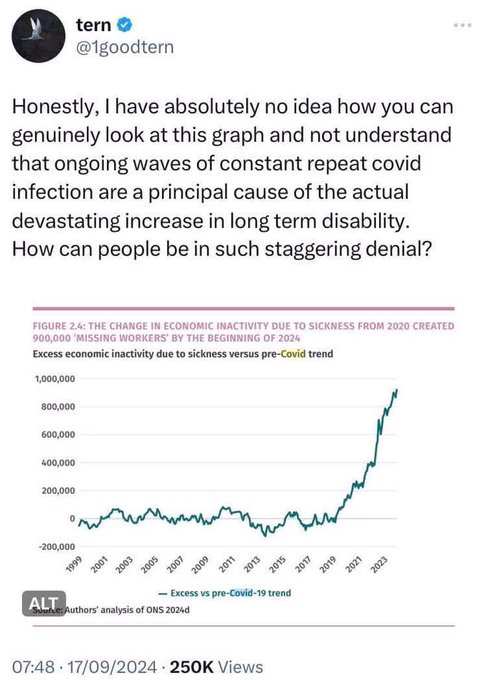
This isn’t hard to understand. Britain is massively importing young people who can work, or older people who have lots of money, but at the same time the number of people who are liabilities, financially speaking, is exploding. If you have a liability the easiest way to get rid of it is to… get rid of it.
Canada’s in the same boat, and these bills will spread.
Assisted suicide isn’t automatically a bad thing, mind you. If people were properly supported and cared for I’d support it. People who are in a ton of pain and won’t get better ought to have the option.
But when the government is whining about benefits and cutting them, as in Britain, one doesn’t expect this is being done from a humanitarian impulse. And the medical and social workers, in hospitals and palliative care centers that are overstretched and don’t have enough nurses or doctors or beds, well, convincing someone who’s taking up time or a bed to just die already will have to be pretty tempting, sometimes even with somewhat good motives: to free up resources for people who can be cared for.
But, of course, what will often happen is that chronically ill people or homeless types who could live for quite a long time and with proper care could be fairly happy will wind up dead because in Britain and Canada we don’t help them enough: to get enough housing, food, help and pain meds (given the way we’re so scared of opiates.)
Wikipedia lists some known cases of abuse of the law:
- In 2017, a mother of a young woman with cerebral palsy was told by a doctor that not applying for MAID was “selfish”. Her daughter was in the room when the conversation took place and described the experience as traumatic.[71]
- In 2018, Roger Foley was being treated for cerebellar ataxia at an Ontario hospital. Foley alleged that his only options were to be forcibly discharged from the hospital and then treated by an organization that had previously failed to provide him adequate care or apply for MAID. Foley hired a lawyer for a charter challenge.[72]
- In 2019, Alan Nichols successfully applied for MAID while being hospitalized for suicide ideation. The reason given on his application was hearing loss.[1]
- In September 2021, Rosina Kamis, a 41-year-old Malaysian woman, applied for MAID citing fibromyalgia as the reason. However, in conversations and recordings shared with friends, she mentioned financial hardship and social isolation as additional factors influencing her decision.[73]
- In February 2022, an anonymous Torontonian suffering from extreme chemical sensitivity syndrome with the pseudonym Sophia had a medically assisted death after failing to find affordable housing that was free from tobacco smoke and other chemicals.[74] This case was addressed by her health care provider in testimony provided to the Special Joint Committee on MAID, and was referenced in their final report.[75]
One can safely assume there are many, many more. The fact is that even doctors and social workers think some lives are worth more than others. No one who’s spent time in the medical system believes otherwise.
The West is in decline. Our elites are wedded to austerity as a “solution”. They often, probably usually, feel that people who are non-productive are useless eaters and a burden on the state.
That combination is going to lead to a truly vast expansion of measures intended to get people off benefit rolls.
In a way assisted suicide, or euthanasia, is the most honest of those policies and maybe even the most merciful. There’s nothing honest about deliberate policies which make people homeless, leading to most of their deaths, after all. Politicians know that winding up on the street long term is essentially a death sentence, they know that policies like mass immigration without increasing the housing supply to match will cause homelessness, so they know their policies cause homelessness and death but they can pretend it’s an unintended side effect.
Just killing people is at least not hypocritical.
***
Close to the end of the annual fundraiser, which has been weaker than normal despite increased traffic. Given how much I write about the economy, I understand, but if you can afford it and value my writing, I’d appreciate it if you subscribe or donate.