Use to discuss topics unrelated to recent posts. (No Covid, no “truckers”.)
Author: Ian Welsh Page 130 of 437
There are broadly three groups of enforcers: police, secret police (spies), and the military. All three have a tendency to attract people who are reactionary, and who enjoy having authority and causing fear. The great attraction of being an enforcer, for many people, is that you get to make other people do things, and hurt them, and they can’t fight back.
Police, in particular, are always making choices as to what laws they enforce and how, and how strictly they enforce them. There’s a lot of discretion in the job. It’s long been noted that some people are treated far more harshly, for the same infraction, than others. Indeed, what can get you beaten up and arrested by cops if you’re part of a group they don’t like, or you irritate a particular cop, can also be ignored if they like you, or you’re part of a group they like.
This was a common complaint during the BLM protests, where right-wing protesters would be protected by cops and not arrested for actions for which they would have come down hard on the BLM protesters. In Canada, during the “trucker” protests, it’s been noted over and over again that indigenous and left-wing protesters would never have been treated so leniently by the police for so long — and indeed, it was only when protesters blocked trade between the US and Canada that any serious action was taken.
The most critical part of that action was financial. Chrystia Freeland announced that accounts would be frozen and that truckers’ insurance (without which you cannot operate a rig in Canada) would be terminated. That’s interesting, because these are administrative actions that don’t require the cops to actually do much, beyond report who’s there. There’s no going in with the horses and riot gear and tear gas and beating people up like they do to the indigenous and G7 protesters.
At least when dealing with local cops, and especially in Ottawa and Windsor, it seems like the police basically refused to do their jobs or even, in Ottawa, follow direct orders from the police chief (who has since resigned and who also seemed, initially, very friendly to the protesters).
As I’ve noted before, there are normally three requirements for revolution: an elite faction in support of the revolution, a popular faction in support (at a higher percent than the “truckers” have, about 25 percent to 30 percent), and the refusal of enforcers to protect the current regime.
So, enforcer willingness to act against any threat is important.
But it’s also worth noting that enforcers aren’t a monolith. Police aren’t secret police, who aren’t cops, and even within, say, police, there can be splits. In the US during school integration, local cops usually wouldn’t protect school integration, so the federal police (FBI) were sent in and they did. The FBI traditionally had bad relations with local cops and were happy to stick their thumb in.
This leads to one of the main rules of running enforcers. You want them to hate each other. You want the feds to hate the state/provincial local police. You want the military to despise the spies and look down on the police, state and local. You want the local police to hate the state/feds for horning in on them, and loathe the secret police for keeping track of them and you want them to think the military are out of touch.
You also don’t want them cross-training. They do different things, and what is appropriate for police is not appropriate for secret police or military, and vice versa. As a rule, you should not allow someone who has worked in one branch to apply to have jobs in the others — no vets into the police or secret police and vice versa. You don’t want them thinking of themselves as one group — and in any case, militarized police are always a mistake and militaries that do police and occupation work always become incompetent, weak, and fight worse. This is what turned the Israeli army from one of the best in the world into crackers who get their asses handed to them by Hezbollah and are scared of even fighting it.
This is also why, in the military, there shouldn’t be one “military,” but multiple services. Anything you gain from combining them into one service is more than counterbalanced by the danger. (And, it’s clear, in many ways, they perform better when they feel competitive, in any case.)
The next problem is one of the oldest in history: Demobilizing armed men. This is one of the hardest things to do. Because it’s clear that the Ottawa police, for example, are no longer under civilian control, the majority of them need to be let go and replaced with people who will obey orders.
Doing this is hard. They would probably strike and become even more unwilling enforce laws, and it’s quite likely they would threaten elected officials. Once you’ve given a group a semi-monopoly on force, breaking that monopoly is difficult. This is why you need a divided enforcer class. While you’re disarming and firing, say, the spies, you need to be able to use the federal or provincial police, or in a worst case scenario, the military (who should only be used for policing in emergencies — they’re bad at it, and it’s bad for them, as previously discussed).
Finally, while you will always need some police, we need a lot less. Various cities have experimented with unarmed crisis response teams: If someone’s having a mental breakdown, sending non-police almost always leads to better outcomes, and if force does turn out to be required, someone trained in the sort of violence in which orderlies sometimes need to engage (restrainment) is far better than a police.
Take away all the miscellaneous activities from armed police, and you’ll have a lot less trouble. Make the traffic enforcers a completely different organization, the mental health guys different, expand the paramedics, etc. The less men with guns and a propensity for violence, the better.
Also, while you may never hear me say this in the case of anything else, I don’t think armed men should also have unions. Police unions always seem to be the worst of the worst. There’s a reason the military doesn’t allow unions and it applies to police, too.
There is also a selection issue, and we need to find a way to not select for reactionaries and bullies in the enforcer class. In the military, this was traditionally done by a draft (which I hate but tentatively endorse). In the police and the secret police, we have to find out a way to do it as well.
In Canada and the US both, the police are out of control. They are gangs, the most dangerous gang wherever they operate, and they despise and look down on civilians, including the politicians who are their nominal superiors. They need to be replaced en-masse, and the new police forces need to be much smaller. Police militarization needs to end, and rivalry between different police forces, the military, and the secret police (spies) needs to be encouraged, while the actual number of police needs to be cut at least in half to a third by giving many of their roles to other groups who are unarmed — or at the very least, don’t have guns, tazers, and so on.
This would be true no matter what type of government you ran. The enforcers are always dangerous, and they always have to be kept divided, and they are always ripe for abusing their power due to impartiality.
No big post today, though I’ve got some things to say about inflation and policing soonish.
Just noting that the people who don’t want zero-Covid are, objectively, pro-death and pro-disabling. They’re the pro-death lobby and the pro-death protesters. This includes most Western politicians, who, if it were up to me, would be removed from power, tried for crimes against humanity — and in countries with a death penalty, hung from the neck until dead. Zero-Covid works when done properly, anyone in power who doesn’t do it is a mass murderer, and people who protest for the right to not even wear masks are either idiots, fools, or scum. (As with people who insist climate change is a hoax, or who know it is real and oppose doing anything.)
Your leaders, and people like the “truckers,” want you, your children, and your parents to die for their convenience and profit. They are pro-death.
One of the reasons I didn’t condemn the strategy used by the truckers is simple: For a couple decades now, I’ve been saying that this general sort of thing is what the left should do. Change happens only when you inflict real pain. In fact, the trucker protests aren’t that new, this sort of thing happens in France all the time. Truckers have big vehicles they can use to block roads in a way that’s harder to stop than a bunch of people just lining up or even chaining themselves up.
Commenter someofparts, riffing off Lambert said it well:
So then, the question Strether raised that I keep thinking about is – why isn’t it the left wing doing this? Since a caravan that disrupts the supply chain is a brilliant way to pressure our leaders, why isn’t it being done by the big unions instead of the shopkeepers?
Obviously the real question I am chewing on is to wonder what needs to change so that it IS the unions doing this instead of the bourgeoisie? I don’t have any ready answers to that question, but I figure that having a clear idea of where we need to go is the first step. The prospect of supply chain disruption sponsored by the teamsters on behalf of the real working class is a good place to start.
Unions are scared.
They have central headquarters and bank accounts. It is trivial and easy for them to be broken by seizing their assets. They feel they must keep within the letter of what the law allows, because they know what happens if they don’t.
For whatever reason, the truckers here are not scared of asset seizure, which is interesting, because the government easily could take their licenses and their trucks and probably hit them with damages.
As part of my politics book series, I talked about legitimacy. In the neoliberal world order, the right is legitimate, and so are neoliberals (our “center”) but the left and unions aren’t. It is okay to mess other people up in the name of right-wing values, but not in the name of the left-wing (economic, not social) values. There’s some tolerance for cultural left-wingism, since neoliberal elites are more than good with it, but not for economic left-wing populism.
Back during “Occupy Wall Street,” I saw a march in Toronto. It was surrounded on three sides by police (the fourth being pressed up against one side of the road. They had paddy wagons and horse-cops right there, right next to the protesters. I also saw the G-7 protests in Toronto, with the kettling of protestors and mass (unconstitutional, but not illegal) arrests.
Protesting the fundamental economic relationships that control our society is not allowed. Effective unions lead to wages rising faster than inflation and it is FUNDAMENTAL to our order that wages for most people must not rise faster than inflation. (Yes, that’s not what the figures say, but the inflation statistics are systematically manipulated.)
The left cannot do what the truckers do because if they did, they would be shut down with extreme violence — if they were even allowed to get going. Remember, the Ottawa police chief let the truckers set up, knowing in advance what they were going to do.
Note also, that the right uses decentralized action a lot. Their shooters are created by their ideology, but act individually. The truckers may have organization, but they are individuals. Each truck has to be seized individually. There is some central organization, and when its visible it’s taken out (the shut down of the GoFundMe) but mostly it’s buried in the financial and third-party weeds. Ezra Levant of Rebel news, for example, hired a lawyer to fight parking tickets for the truckers. He’s not directly involved so far as we know yet, but he is indirectly involved.
Then there’s Ontario’s Prime Minister, Doug Ford. Doug could have this stuff broken up easily, and if it truly does need the military, he’s the person with the authority to call them in (the Feds arguably can’t without passing a new law). Doug’s daughter is with the protesters.
FDR alleged (but only allegedly) once said, “You’ve convinced me. I agree with what you’ve said. Now go out and make me do it.” Doug almost certainly agrees with the truckers, but he knows that polling is against him.
“Make me do it.”
Killing people for the market is economic orthodoxy. Impoverishing people so the rich can get richer is economic orthodoxy. Taking care of people, in the US, Canada, and Britain is against the ruling ideology — it is actually not legitimate. (It is in China and Japan, as people there are viewed as productive assets, not as assets to be mined.)
For unions to do what the truckers do they would have to start by decentralizing. No significant headquarters, few assets to be seized, and leadership that doesn’t matter because anyone can lead. If the “president” is locked up, it doesn’t matter because someone else steps up, and regular members know what to do anyway.
Plus, there needs to an implicit threat. “If you take us out by force, we will keep showing up, and you can’t lock us all up.” The “truckers” (most truckers disagree with them, including the Teamsters) belong to a movement that shows up at school board meetings, that pickets hospitals & legislatures and threatens nurses, and that is generally perceived as dangerous. Politicians don’t feel entirely safe using force and law against them, though this is (or was) far more true in the US than in Canada. The left has spent generations telling themselves that violence is always bad and that even the threat of it should never ever even be considered because Gandhi, Gandhi, Gandhi.
All people are equal, but some people are more equal than others. All protests are equal, but some protests are more equal. Some ideologies are far more equal than others.
In the thirties, it was not unknown for unions to fight the police, straight up. The Feds would often stay out of it, and usually there was no attempt to destroy the union as a whole. Unions were legitimate, especially since FDR generally supported them and wouldn’t let the Feds intervene.
Today, unions are illegitimate according to the dominant ideologies. Practically the first thing Reagan did was break a major union (the Air Traffic Controllers). Thatcher showed she was in charge and that things had changed by defeating the Miners in Britain. Punching left is good, punching right is verboten.
The “truckers” can do what they’re doing because they’re doing it in service of right-wing values, not left-wing ones, and they are supported by powerful elite factions, including most of Canada’s Conservative party.
They may well be stopped, and even have the law used against them, mainly because they’ve stopped trade between the US and Canada, but they would never have been allowed to run this far if they were left-wing. They’re legitimate, they have elite backing and the cops are sympathetic.
These are also, by the way, the pre-conditions for revolution: An elite faction in support, enforcer class unwilling to step up, and a popular faction in support (although they are decided minority, which is the only reason they aren’t already in charge).
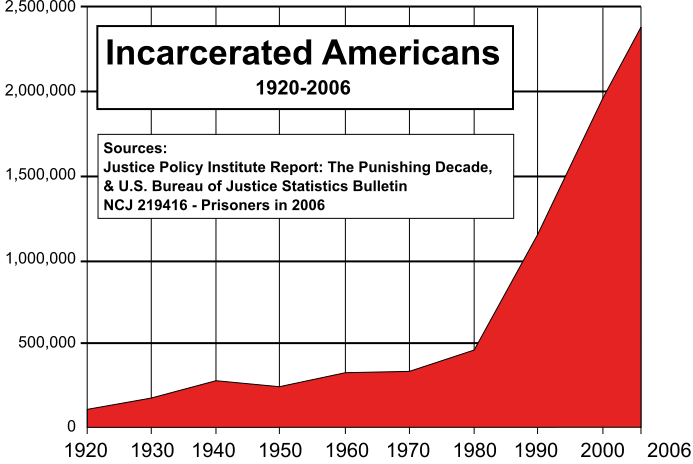
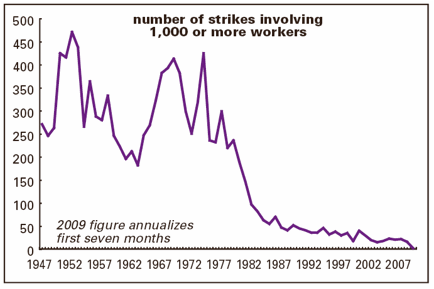 In the Anglo-US world, post-war liberalism has been on the defensive since the 1970s. This is normally shown through various wage or wealth graphs, but I’m going to show two graphs of a different nature. The first, to the right, is the number of strikes involving more than 1K workers. Fascinating, eh?
The second, below and to your left, is the incarceration rate. It isn’t adjusted for population increases, but even if it was, the picture wouldn’t change significantly.
This is the change caused by the Reagan revolution in the US, which, as is the case with most revolutions, started before its flagship personality.
(Article re-published as it’s important and a lot of current readers won’t have seen it.)
From Wikipedia
I was born in 1968. I remember the 70s, albeit from a child’s perspective. They were very different from today. My overwhelming impression is that people were more relaxed and having a lot more fun. They were also far more open. The omnipresent security personnel, the constant ID checks, and so forth, did not exist. Those came in to force, in Canada, in the early 1990s. As a bike courier in Ottawa, I would regularly walk around government offices to deliver packages. A few, like the Department of National Defense and Foreign Affairs, would make us call up or make us deliver to the mail room, but in most cases I’d just go up to the recipient’s office. Virtually all corporate offices were open, gated only by a receptionist. Even the higher security places were freer. I used to walk through Defense headquarters virtually every day, as they connected two bridges with a heated pedestrian walkway. That walkway closed in the Gulf War and has never, so far as I know, re-opened.
I also walked freely through Parliament Hill, un-escorted, with no ID check to get in.
This may seem like a sideline, but it isn’t. The post-war liberal state was fundamentally different from the one we have today. It was open. The bureaucrats and the politicians and even the important private citizens were not nearly as cut off from ordinary people as they are today. As a bike courier, I interrupted senior meetings of Assistant Deputy Ministers with deliveries. I walked right in. (They were very gracious — in every case.)
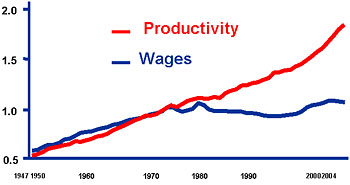
The post-war liberal state involved multiple sectors, in conflict, but in agreement about that conflict. Strikes were allowed, they were expected, and unions were considered to have their part to play. It was understood that workers had a right to fight for their part of the pie. Capitalism, liberal capitalism, meant collective action because only groups of ordinary workers can win their share of productivity increases.
productivity and wages
Which leads us to our second chart. The moment you lock up everyone who causes trouble (usually for non-violent, non-compliance with drug laws), the moment you crack down on strikes, ordinary people don’t get their share of productivity increases. It’s really just that simple.
This is all of a piece. The closing off of politicians and bureaucrats from public contact, the soaring CEO and executive salaries which allow them to live without seeing anyone who isn’t part of their class or a servitor, the locking up of people who don’t obey laws that make no sense (and drug laws are almost always stupid laws), the crushing of unions, which are a way to give unfettered feedback to politicians and our corporate masters, are all about allowing them to take the lion’s share of the meat of economic gains and leave the scraps for everyone else.
But why did the liberal state fail? Why did this come about? Let’s highlight three reasons: (1) the rise of the disconnected technocrat; (2) the failure to handle the oil crisis, and; (3) the aging of the liberal generations.
The rise of the disconnected technocrat has been discussed often, generally with respect to the Vietnam war. The “best and the brightest” had all the numbers, managed the war, and lost it. They did so because they mistook the numbers for reality and lost control. The numbers they had were managed up, by the people on the ground. They were fake. The kill counts coming out of Vietnam, for example, were completely fake and inflated. Having never worked on the ground, having not “worked their way up from the mail room,” having not served in the military themselves, disconnected technocrats didn’t realize how badly they were being played. They could not call bullshit. This is a version of the same problem which saw the Soviet Politburo lose control over production in the USSR.
The second, specific failure was the inability to manage the oil shocks and the rise of OPEC. As a child in the 1970s, I saw the price of chocolate bars go from 25c to a dollar in a few years. The same thing happened to comic books. The same thing happened to everything. The post-war liberal state was built on cheap oil and the loss of it cascaded through the economy. This is related to the Vietnam war. As with the Iraq war in the 2000s, there was an opportunity cost to war. Attention was on an essentially meaningless war in SE Asia while the important events were occurring in the Middle East. The cost, the financial cost of the war, should have been spent instead on transitioning the economy to a more efficient one — to a “super-analog” world. All the techs were not in place, but enough were there, so that, with temporizing and research starting in the late 1960s, the transition could have been made.
Instead, the attempt was left too late, at which point the liberal state had lost most of its legitimacy. Carter tried, but was a bad politician and not trusted sufficiently. Nor did he truly believe in, or understand, liberalism, which is why Kennedy ran against him in 1980.
But Kennedy didn’t win and neither did Carter. Reagan did. And what Reagan bet was that new oil resources would come online soon enough to bail him out. He was right. They did and the moment faded. Paul Volcker, as Fed Chairman, appointed by Carter, crushed inflation by crushing wages, but once inflation was crushed and he wanted to give workers their share of the new economy, he was purged and “the Maestro,” Alan Greenspan, was put in charge. Under Greenspan, the Fed treated so-called wage push inflation as the most important form of inflation.
Greenspan’s tenure as Fed chairman can be summed up as follows: Crush wage gains that are faster than inflation and make sure the stock market keeps rising no matter what (the Greenspan Put). Any time the market would falter, Greenspan would be there with cheap money. Any time workers looked like they might get their share of productivity gains, Greenspan would crush the economy. This wasn’t just so the rich could get richer, it was to keep commodity inflation under control, as workers would then spend their wages on activities and items which increased oil consumption.
The third reason for the failure of liberalism was the aging of the liberal generation. Last year, I read Chief Justice Robert Jackson’s brief biography of FDR (which you should read). At the end of the book are brief biographies of main New Deal figures other than Roosevelt. Reading them, I was struck by how many were dying in the 1970s. The great lions who created modern liberalism, who created the New Deal, who understood the moving parts were dead or old. They had not created successors who understood their system, who understood how the economy and the politics of the economy worked, or even who understood how to do rationing properly during a changeover to the new economy.
The hard-core of the liberal coalition, the people who were adults in the Great Depression, who felt in their bones that you had to be fair to the poor, because without the grace of God there go you, were old and dying. The suburban part of the GI generation was willing to betray liberalism to keep suburbia; it was their version of the good life, for which everything else must be sacrificed. And sacrificed it was, and has been, because suburbia, as it is currently constituted, cannot survive high oil prices without draining the rest of society dry.
Reagan offered a way out, a way that didn’t involve obvious sacrifice. He attacked a liberal establishment which had not handled high oil prices, which had lost the Vietnam war, and which had alienated its core southern supporters by giving Blacks rights.
And he delivered, after a fashion. The economy did improve, many people did well, and inflation was brought under control (granted, it would have been if Carter had his second term, but people don’t think like that). The people who already had good jobs were generally okay, especially if they were older. If you were in your 40s or 50s when Reagan took charge in 1980, it was a good bet that you’d be dead before the bill really came due. You would win the death bet.
Liberalism failed because it couldn’t handle the war and crisis of the late 60s and 70s. The people who could have helped were dead or too old. They had not properly trained successors; those successors were paying attention to the wrong problem and had become disconnected from the reality on the ground. And the New Deal coalition was fracturing, more interested in hating blacks or keeping the “good” suburban lifestyle than in making sure that a rising tide lifted all boats (a prescriptive, not descriptive, statement).
There are those who say liberalism is dying now. That’s true, sort of, in Europe, ex-Britain. The social-democratic European state is being dismantled. The EU is turning, frankly, tyrannical, and the Euro is being used as a tool to extract value from peripheral nations by the core nations. But in the Anglo-American world, liberalism was already dead, with the few great spars like Glass-Steagall, defined benefit pensions, SS, Medicare, welfare, and so on, under constant assault.
Europe was cushioned from what happened to the US by high density and a different political culture. The oil shocks hit them hard, but as they were without significant suburbia, without sprawl, it hit them tolerably. They were able to maintain the social-democratic state. They are now losing it, not because they must, but because their elites want it. Every part of the social-democratic state is something which could be privatized to make money for your lords and masters, or it can be gotten rid of if no money can be made from it and the money once spent on it can be redirected towards elite priorities.
Liberalism died and is dying because liberals aren’t really liberal, and when they are, they can’t do anything about it.
None of this means that modern conservatism (which is far different from the conservatism of my childhood) is a success if one cares about mass well-being. It isn’t. But it is a success in the sense that it has done what its lords and masters wanted —- it has transferred wealth, income, and power to them. It is self-sustaining, in the sense that it transfers power to those who want it to continue. It builds and strengthens its own coalition.
Any political coalition, any ideology behind a political coalition, must do this: It must build and strengthen support. It must have people who know that, if it continues, they will do well, and that if it doesn’t, they won’t. Liberalism failed to make that case to Southerners, who doubled down on cheap factory jobs and racism, as well as to suburbanite GI Generation types, who wanted to keep the value of their homes and knew they couldn’t if oil prices and inflation weren’t controlled. Their perceived interests no longer aligned with liberalism and so they left the coalition.
We can have a new form of liberalism (or whatever we wish to call it) when we understand why the old form failed and can articulate the conditions for our new form’s success. Maybe more on that another time.
Published April 11, 2015, published back in the ’00s too, but I don’t remember when. Republishing doesn’t send out to lists, so I’m doing it as new piece. The original and comments can also be viewed.
If you enjoyed this article, and want me to write more, please DONATE or SUBSCRIBE.
The history of capitalism and democracy shows that we need to choose one or the other. The problem is that capitalism concentrates power in the hands of a few people who aren’t chosen through democratic means. Capitalism requires those people to pursue unlimited profit, because those who don’t lose their power to those who do.
When they have that power, they then buy government, because government is both the main threat to them, and the force which by which, through use of law and means like central banks bailing them out, they can keep themselves obscenely rich — even when markets would otherwise cause them to lose their money and thus their power.
The history from the Great Depression onwards is instructive. Capitalism caused a huge, nearly worldwide, depression. Government did not bail them out, and so they lost their power. FDR came to power, and more or less following Keynes’s prescriptions, he bailed them out. He and the people working with him put in place multiple protections to make sure that capitalism couldn’t cause such a crisis again.
Capitalists hated him for it. He had rescued them, but with the cost of 90 percent top marginal tax rates, huge estate taxes, regulation and aggressive anti-trust laws. Upon his death (little could be done while he was alive, as he was so popular), they immediately started attacking all the protections he had put in place. It took them decades, but they stuck to it, and after all, even in their reduced state, they were still powerful and could afford to pay people to spend their lives working against the New Deal.
The foremost intellectual servant of these men was Milton Friedman, but many, many labored in this cause. They built a political, economic, and intellectual infrastructure and waited for their opportunity. With the oil crises, inflation, and unemployment of the 70s, they had their chance. They made sure that an egalitarian model for dealing with the crisis wouldn’t work, and they got Thatcher and Reagan elected. Then, they dismantled the New Deal and all the protections against another economic catastrophe like the Great Depression.
This allowed them to vastly consolidate wealth, pushing power into the hands of fewer and fewer people. Antitrust law was gutted, unions cut to ribbons, and regulations which protected against them were destroyed, while new ones were put in place to ensure the concentration of wealth and power.
A small example of this was given to me by an accountant, who in the 70s used to do the taxes for Indian bands. When Reagan took over, the regulations were changed so that only large companies were allowed in the business and he was frozen out. This sort of thing happened everywhere, and, indeed, continues to this day.
But, alas, the capitalists weren’t stupid, and they knew that market concentration and removal of protections against bubbles meant that one day there might be another great crisis.
So they bought up economics lock, stock and barrel and paid economists like Bernanke to figure out how to make sure they’d never lose their wealth (and thus power) in a great market collapse again. Bernanke’s academic ouvre was described to me by Stirling Newberry, back around 2005, as “how to make sure another 1929 doesn’t lead to another FDR.”
They got him into the Federal Reserve, and people like him into other central banks, and when the Financial crisis of 2007/8 happened, the Fed bailed out the rich. Without the Federal Reserve, most of them would have lost everything, but the Fed alone effectively printed and gave them 20 trillion dollars, accepted their worthless securities at near face value for loans, and so on.
Meanwhile, largely under Obama, the crimes they had committed (and there was fraud all the way down, I doubt a single senior executive on Wall Street hadn’t engaged in red-letter fraud), were forgiven in exchange for fines that were less than the amount of money they had individual earned.
Power and money consolidated even further, and the “another-FDR moment” was avoided.
Since then, they have seized further and further control and increased their wealth and power even more. Citizen’s United, which allowed unlimited money into elections was probably the red line moment, but really, once the full-faith and money-printing ability of government was behind the rich, ensuring they could never lose power as a class, it was over.
The important thing to understand is that this structural. If capitalism is hegemonic (that is, dictates how most economic decisions are made and how power is parceled out), then this pattern repeats. FDR made the best effort in the history of capitalism to stop it form happening again, and he failed, buying only a few decades of relative egalitarianism and control of democratically-elected government over business rather than business over government.
There can be no peace between democracy and capitalism. They are in direct opposition to each other. Democracy requires egalitarianism to work, and capitalism requires money and power to be concentrated in a few hands.
We can have democracy, or we can have capitalism and we need to stop pretending that democracy can control capitalism sufficiently to stop it from doing vast damage. Indeed, the terrible timing of having capitalists take over democracy in the core industrial nations just as action on climate change and ecological collapse became necessary will cause billions of lives, and wipe out about half of all known species on Earth.
Because democracy also failed, democracy is now on the firing line. As things get worse (and they will get MUCH worse), every political arrangement and ideology which failed to deal with climate and ecology will be discredited.
Either democracy blames capitalism and kills capitalism, finding a new way to organize the economy, or democracy is likely to die with capitalism. And it will deserve to do so.
I’m not 100 percent against occupations. They are often effective ways of protesting. In particular when truckers, miners, and other blue collar workers, who have access to big machinery and who are used to hard work get involved, they tend to be very effective protesters. You see this most often in France, where truckers routinely shut down roads.
Protests are about causing inconvenience to someone, about getting in their face. A protest which doesn’t do so, isn’t effective. There was a time when they were, but that time is now generations ago, because our modern elites don’t care about protests that don’t scare or hurt them.
The truckers have a right to protest, but it’s not a protest I am in political sympathy with, as I don’t have a problem with vaccine mandates. It should also be noted that the majority of Canadians support vaccine mandates. Of course, just because a majority agree with you doesn’t mean you’re right. A majority of Americans opposed Martin Luther King, after all.
What is interesting about the trucker occupation is how cooperative the police have been, especially in Ottawa, where the Chief let them into the core, let them set up supply camps and logistics. The truckers deliberately disabled some vehicles to make it harder to re-open the streets and remove them. In Toronto, the police did keep the truckers away from a few key areas: some hospitals (one of which, actually, I’ll spend time at on Monday), and the capital, but they did let them occupy a fair chunk of important downtown real-estate.
Vancouver’s is the most interesting case, because while the police didn’t do much, by the time the convoy rolled into Vancouver civilians had seen what was up, and counter protesters blocked the convoys over and over again as best they could.
The convoys then, are non-city people coming to the city to protest, and they aren’t generally welcomed by those who live in these urban cores, most of whom don’t agree with the truckers and are the ones inconvenienced.
As noted, the police really haven’t done much, though that’s beginning to change in Ottawa. Few arrests, no impounding vehicles, etc…, outside of Quebec, where the province has simply sent in the vehicle inspectors (truckers hate vehicle inspectors) and made a point of photographing all the plates. I’m familiar with how left-wing protests are treated in Canada, and I am confident in saying that if this was some First Nations or anti-poverty protesters, they’d have been broken up already with however much violence the cops felt like using (probably a lot) and thrown in prison, with their vehicles already impounded.
Certainly, Canadian police have done so for protests that caused a lot less inconvenience than occupying the capital city and the largest city in Canada’s core.
So, fairly obviously, the police are in a fair bit of sympathy with the truckers, and that includes the leadership. The Chief of Ottawa police has been, in fact, co-operative.
The final thing to note here is that the money from this appears to have largely come from the United States, not from Canada, and so does the ideology. Canadian traditions are a lot less about, “can’t tell me to not make my fellow citizens sick,” than the USA. Canada is the “Peace, Order, and Good Government” country. In general, the right-wing in Canada has been very badly affected by US-based ideology, going from being Red Tories to folks who think Trump was pretty good, actually.
Americans still have an idealized idea of what Canada is like. The truth is that we have a much smaller population than the US, and a much smaller economy, and all our trends are moving in the same direction as the US: more and more neoliberalism, more and more right-wing “populism.”
Inequality has grown worse for generations, and this has left us vulnerable to right-wing agitation in ways we really weren’t in the past — because the social contract has been broken in the same general ways as in the US and most of the West. The difference is solely that we started from a better place, but in the province of Alberta, for example, the government is doing their best to move towards privatized medicine and gutting Medicare, in very much the same way as Britain has.
With the center solidly neoliberal, even as they pretend to be liberals, and with the left primarily concerned with identity politics, the hard-core of the left’s old power used to be people like truckers and miners and farmers, and they have slipped over to the right, even though their material interests largely aren’t served there. But the right panders to them culturally, while the center thinks they’re uneducated louts and the left despises them as socially backwards.
And so we have the trucker protests. Truckers have power because they have heavy machinery, and they’re using it. Many of them are sincere and think they are doing the right thing, for the right reasons. Most Canadians don’t agree, but the police are sympathetic, the Premier of Ontario’s daughter is with the protesters in Ottawa (because he’s a right-winger rather similar to Trump), and, after all, neoliberal politicians like Trudeau really want to reopen and aren’t entirely opposed to the truckers’ demands, though they are wedded to vaccines.
Societies are subject to revolution when an elite faction wants it, the enforcer class is unwilling to defend the status quo, and there is a significant popular faction who want change. All three are generally necessary.
If I were among Canada’s current rulers, I’d be worried, not by the left, but by the right. The left doesn’t have an elite faction supporting it or the complicity of at least some police. The right, even if most Canadians don’t agree, does.
Update: The Ottawa police have begun to choke off supplies. Hearing right-wingers squeal about how police seizing gasoline and food is illegal and wrong is very precious, since I don’t remember any of them complaining about it when police seized the property of homeless people who were causing a lot less trouble.