Use to discuss topics unrelated to recent posts.
Author: Ian Welsh Page 131 of 437
So, Biden has warned that other countries should not help Russia evade Ukraine-based sanctions.
Meanwhile, China’s Xi has backed Russia on its “no NATO expansion” demand and received support in return:
In the joint statement released by the Kremlin, Putin and Xi called on NATO to rule out expansion in eastern Europe, denounced the formation of security blocs in the Asia-Pacific region, and criticised the Aukus trilateral security pact between the United States, United Kingdom, and Australia.
I don’t expect Russia to invade, but what it can and will probably do is recognize the breakaway regions in the Ukraine, Donbass and Luhansk, and help them enforce their borders.
This will trigger sanctions, including personal sanctions against Putin. China will, indeed, help Russia “evade” the sanctions, and China, Russia, and other states will move forward with their own payments area.
Trade will become more difficult, so will travel, and another huge step towards the on-rushing Cold War will occur.
This isn’t rocket surgery, the US is moving hard towards “containment” of Russia & China, and those countries recognize that they have interests in common. Because neither of them can make a separate peace — the US won’t allow that. The US effectively won’t negotiate with Russia at all (saying no to everything the Russians have asked for isn’t negotiation), so they may as well continue preparing for what they know is coming.
This is certainly the stupidest world. American elites, backed by European subject states (they all are), don’t seem to get that it isn’t 1947 or 1991. They no longer control the world’s most important economies, and their states are dysfunctional, incapable of even handling a pandemic, let alone rallying the necessary social support to win a two-generation economic war while in the midst of ecological collapse, climate change, and with a huge proportion of their populations suffering from health problems due to Long Covid, as well as a pandemic that goes on and on.
China and Russia combined are stronger than the USSR was, and the US and Europe are weaker than they were during the Cold War.
This won’t end well.
All right, after this I’m going to write about Covid less, because “all Covid, all the time” makes Ian bored and Ian’s blog boring. But once more for the road:
Staggering failure. https://t.co/hvVohumIMF
— Nikhil Pal Singh (@nikhil_palsingh) February 2, 2022
If your country didn’t control Omicron (or any other variant), it is because your country’s leaders chose not to control Omicron. It is entirely do-able, and any competent leadership class that isn’t in a failed state can do it.
I hear the comments about the US as a failed state already, but… are all of these countries failed states by any useful definition of failed state?
In a sense, they are. They are states which can no longer govern: They are ruled by oligarchies on looting expeditions, and they have almost all completely gutted actual government capacity.
China isn’t on that chart, but I’ve followed its pandemic response more closely than Japan’s, and it is enabled by the fact that China has a lot of local government capacity. When they do lockdowns, for example, they can go door to door to every door with food and water. They can track and trace. They can put up a new field hospital in days. They haven’t outsourced their entire government to expensive and incompetent private enterprise.
Another country which has done atrociously (far worse than the official stats) is Russia.
Russia’s population declined by more than one million people in 2021, the statistics agency Rosstat reported Friday, a historic drop not seen since the collapse of the Soviet Union.
Ongoing demographic woes have been exacerbated by the pandemic, with Rosstat figures showing that more than 660,000 had died with coronavirus since health officials recorded the first case in the country.
The new figures continue a downward trend from the previous year when Russia’s population fell by more than half a million.
The Covid-related fatalities figures published monthly by Rosstat are far higher than death figures released by a separate government web site, which is dedicated to tracking the pandemic in the country.
Those government web site figures only take into account fatalities where the virus was established as the primary cause of death after an autopsy and shows just 329,443 total fatalities.
[Ian – I’m sure India has even worse numbers per capita, though we may never know.]
This is complete government failure and puts the lie to the idea that Putin is fundamentally able to run domestic politics well. Russia NEEDS citizens. The government has been screaming at its population to breed for decades. It is not in Russia’s interest, nor its rulers interests, to lose citizens like this, and — more importantly — it isn’t in the ruling class’s perceived interests to have this many people die. (Then there are the affects of Long Covid, which Russia also cannot afford.)
Even if one says “herd culling,” and assumes a psychopathic government which wants people with co-morbidities dead, because of Long Covid, the long-term cost will be higher than the long-term benefits, as Covid produces health problems faster than it kills people with them.
At the end of the day, Russia lacks government capacity and will. It has never recovered from the collapse of the USSR, and it is still corrupt in the bad way. Good corruption gets things done, bad corruption makes it hard to do things. Russia has the second kind and China has the first, as did the US in the late 1900s. (The US now has bad corruption, not good, but it often isn’t recognized since it’s almost all legal and isn’t about petty bribes by citizens to low-level bureaucrats.)
Bottom line is that Covid has been a test of leaders, governments, and populations. It has revealed which countries or regions are still capable of operating. Some do so because of social consensus, some because leaders recognize that allowing Covid to run free is against their interests (Western Australia) and some because they somehow have leaders who aren ‘t psychopaths (New Zealand).
Covid can be controlled, even Omicron can be controlled. We know this because some countries have controlled it, and by controlled we don’t mean “half the US deaths per capita” we mean “actually had almost no deaths and not very many cases.”
We also could have, at least theoretically, done this worldwide, if the leadership of the major countries wanted it controlled and gave it the necessary aid.
So the pandemic is a choice, and about 99 percent of the deaths and suffering are the results of choices.
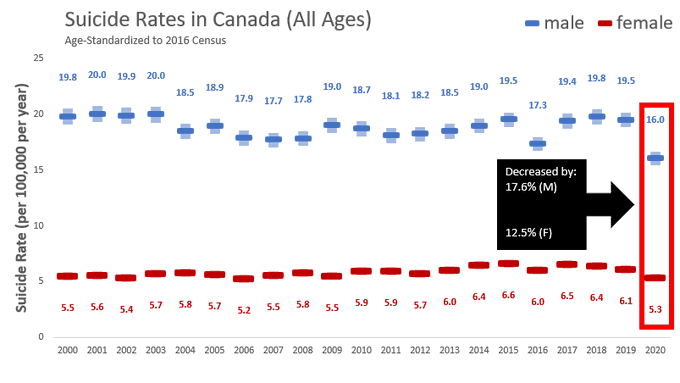
During the first year of the pandemic, there was a great deal of squealing about suicide. Turns out the squealers, as usual, were exactly wrong.
I have a friendly acquaintance who quit his job to teach the Alexander Technique online. He had a good paying consultant gig. First, for a month, he basically collapsed. Nine months later, he looks like a different person.
I just came across an older video of mine while I was still at work: I look tired and stressed, my face is showing some kind of burden
contrast this to the podcast I did with @tasshinfogleman yesterday…
this is absolutely wild to be able to see looking back
cc @visakanv pic.twitter.com/NMjTdlPet1
— Michael Ashcroft (@m_ashcroft) October 20, 2021
Daily life in our societies is essentially slavery. We spend most of the day doing what we are told, when we are told — things we would never do if we didn’t need the money, because without it we would wind up on the street.
For children, it is little different: School is training for work. Sit down, speak only when given permission, do what your’re told, the way you’re told to do it. Don’t even use the bathroom without permission.
Once the school or work day is over, we have a few hours, mostly, to do things like eat, wash, commute, and take care of family members — with perhaps a few hours of entertainment, usually something passive.
If we’re lucky, we get two days off a week, one of which most people spend on chores.
Our entire lives are oriented around doing what our masters tell us, when they tell us, in the way they want, and, if we refuse (unless we were born rich or are very lucky), we suffer.
So it’s no surprise that when we got a good period off from work or school, suicide rates dropped EVEN during a pandemic.
There was a plague, but people were still less likely to kill themselves than during ordinary work periods.
Wage slavery and school are just a description of everyday life for most people and almost any break from it, even due to a plague, is a relief.
I particularly find ridiculous all the adults who seem to have forgotten how happy most children were when school ended and summer break happened. School was and is, for most people, a lot less pleasant than “no school.” Not because of the subject matter learning (what little there is), but because the real teaching at school isn’t centered on subject matter, it’s centered on “how to be a good little slave so you’ll slave well for the bosses in the future.”
Omicron BA.1 was the most infectious disease in known history.
Omicron BA.2?
Reopening is a mistake and it WILL cause another wave in most cases, is my guess.https://t.co/4VJH5WF0Fe
— Ian Welsh (@iwelsh) January 29, 2022
Yeehah!
Add to this the fact that Covid in general, and Omicron in particular, is a disease which creates very little immunity from getting it, and what immunity you have fades fast.
It is not possible for us to just declare victory on Covid, and go back to work and school, because Covid keeps mutating. If we don’t get lucky, and a dominant version doesn’t evolve that is all of much less virulent and doesn’t cause Long Covid, we’re just setting ourselves up for wave after wave, and vast numbers of people getting long-term damage or being crippled by this thing.
Nor, clearly, can vaccines alone work, especially because we refuse to vaccinate everyone in the world. Basic pandemic control measures (known colloquially as “Zero Covid”) are necessary.
The most infectious disease in history, if it can reinfect over and over again, and cause permanent damage to many people who get it, doesn’t have to be “Black Plague” level deadly to wreck our societies. If this goes on for a few more years, which it might, it could cause collapse — because, children, there is a real economy, and just raising and lowering interest rates and giving free money to the rich, which is the only type of “economic” policy most of the West seems to know how to do any more, won’t fix the holes that wave after wave, and mass disablities, will blow in the real world economy of growing, making, and distributing things.
We may get lucky, yes, but we are now betting on luck.
People who bet what they can’t afford to lose, in my experience, tend to lose more often than the odds suggest.
I read two fairly good articles this week. One, in Foreign Affairs, makes out the maximalist Russian case:
Putin also believes that Russia has an absolute right to a sphere of privileged interests in the post-Soviet space. This means its former Soviet neighbors should not join any alliances that are deemed hostile to Moscow, particularly NATO or the European Union. Putin has made this demand clear in the two treaties proposed by the Kremlin on December 17, which require that Ukraine and other post-Soviet countries — as well as Sweden and Finland — commit to permanent neutrality and eschew seeking NATO membership. NATO would also have to retreat to its 1997 military posture, before its first enlargement, by removing all troops and equipment in central and eastern Europe. (This would reduce NATO’s military presence to what it was when the Soviet Union disintegrated.) Russia would also have veto power over the foreign policy choices of its non-NATO neighbors. This would ensure that pro-Russian governments are in power in countries bordering Russia — including, foremost, Ukraine.
This is, of course, the maximalist Russian position, but it is very tiresome to have it presented as “take it or leave it.” What it is, is a negotiating position. In negotiations, one traditionally asks for more than one expects to get. But Washington has responded to this negotiating position by refusing everything. Every single thing.
There are three possible elements to a compromise with Russia, two of which the West has in effect already conceded. The first is either a treaty of neutrality or a moratorium of ten or 20 years on Ukrainian membership of NATO. The West loses nothing by this, as it is clear that Ukraine cannot, in fact, join NATO with its conflicts with Russia unresolved. In any case, the U.S. and NATO have made it absolutely clear that they cannot and will not defend Ukraine by force.
The second element is a return to the (Adapted) Conventional Forces in Europe Agreement limiting NATO forces in eastern Europe and Russian forces in contiguous territories. And the third is internationally-guaranteed autonomy for a demilitarized Donbas within Ukraine, according to the Minsk II agreement of 2015 brokered by Germany and France but since, in effect, rejected by Ukraine.
Failing at least initial moves towards such a compromise, it does indeed look likely that there will be some form of new Russian attack on Ukraine, though by no means necessarily a large-scale invasion.
Putin isn’t insane, and he doesn’t expect to get everything he wants. But he is old, like me, and the three of us –me, Putin, and the Time writer — remember that George Bush Sr. promised NATO wouldn’t expand past a reunited Germany.
So much for Negotiation 101. Let’s move on to the world model. I think this is somewhat accurate (from the Foreign Affairs article).
The modern Kremlin’s interpretation of sovereignty has notable parallels to that of the Soviet Union’s. It holds, to paraphrase George Orwell, that some states are more sovereign than others. Putin has said that only a few great powers — Russia, China, India, and the United States — enjoy absolute sovereignty, free to choose which alliances they join or reject. Smaller countries, such as Ukraine or Georgia, are not fully sovereign and must respect Russia’s strictures, just as Central America and South America, according to Putin, must heed their large, northern neighbor
Now, here’s the thing: I’m Canadian.
So I KNOW that Canada is not a fully sovereign nation. When the US really gets serious about cracking the whip, we buckle, because we have a population one-tenth of that of the US, and a much smaller military and economy, and Americans are savage warmongers who have invaded or hurt the nations around them (and nowhere near them) hundreds of times in the past couple hundred years.
No South American or Central American nation is under any illusion they have full sovereignty. They don’t. The US is clear about it, too, from its actions and words. Hell, the US is currently holding on to 90 billion dollars it stole from Afghanistan as Afghans starve, nowhere near the US. The US is holding Venezuelan assets, and seizes other countries merchant ships on the high seas, then sells the contents if it feels like.
The US is a fully sovereign nation. No nation in Central or South America is. I would say that no one in Europe is, either, given that Europe is still an American protectorate (if barely). The EU could be a fully sovereign nation if it ever chooses to grow up and accept responsibility, but it isn’t now, though it’s more sovereign than anyone other than the US, China, and maybe Russia. (India might be fully sovereign, I suppose, but I don’t consider them a true Great Power yet.)
Is this “how it should be?” I’d say no. I’d prefer a world full of fully-sovereign nations. I don’t like being under the American boot, personally, and I’m not interested in trading that for some other taste of boot leather.
But this is the way the world is, and US foreign policy “professionals” refuse to admit it, while Putin is clear.
All that is being argued about here is whether almost everyone will be under the US boot, or whether or not there will be three boots: China, Russia, and the US — with perhaps the EU putting on some nice German black leather boots itself, if it ever decides to take responsibility for itself again, and the rest of the EU decides that they’re okay with even more German rule, eased a bit by the French.
The Foreign Affairs author understands this:
Weakening the transatlantic alliance could pave the way for Putin to realize his ultimate aim: Jettisoning the post–Cold War, liberal, rules-based international order promoted by Europe, Japan, and the United States in favor of one more amenable to Russia. For Moscow, this new system might resemble the nineteenth-century concert of powers. It could also turn into a new incarnation of the Yalta system, where Russia, the United States, and now China divide the world into tripolar spheres of influence. Moscow’s growing rapprochement with Beijing has, indeed, reinforced Russia’s call for a post-West order. Both Russia and China demand a new system in which they exercise more influence in a multipolar world.
The nineteenth- and twentieth-century systems both recognized certain rules of the game. After all, during the Cold War, the United States and the Soviet Union mostly respected each other’s spheres of influence. The two most dangerous crises of that era — Soviet Premier Nikita Khrushchev’s 1958 Berlin ultimatum and the 1962 Cuban missile crisis — were defused before military conflict broke out. But if the present is any indication, it looks as if Putin’s post-West “order” would be a disordered Hobbesian world with few rules of the game.
But every time I see “rules-based international order,” I reach for my gun, because I know what that means is the US seizing ships and invading countries and slamming everyone in sight with financial sanctions while fomenting fake revolutions and engaging in coups. Oh, other countries have been bad actors too, but really the “rules-based international order” means “there’s only one superpower.”
So yes, Putin, and for that matter Xi, want a multipolar great-power world. So does Iran, Venezuela, Iraq, Libya, and most African countries. (Though I suppose Putin might acknowledge the US right to crush Venezuela given his own rights are respected.)
BUT, this is the maximal position. The US “rules-based international order” is doomed. That’s simply a fact; the US is no longer powerful enough to support it. You can’t have that after you’ve given up your position as the primary manufacturing state to another country. It’s impossible. Britain didn’t keep it, and neither will the US — the only question is how many hundreds of millions of people will die creating the international order.
If the US wanted a fair world order, truly, then it would have to actually acknowledge and genuinely respect the autonomy of other states. But Libya, Iraq, Afghanistan, Venezeula, Iran, and, yes, Russia, among many others indicate it doesn’t. If it did, the US would have vast numbers of allies.
But that order wouldn’t be the “rules-based international order” of today. You wouldn’t be able to unilaterally cut nations out of the payment systems and invade other countries with the acquiescence of only a few core European allies.
So what’s being argued over isn’t about a choice between a “good system” versus a “bad system,” despite the author’s mutterings about Hobbesianism, but a choice between two bad systems.
And in that case, it’s just a question of the power of those who want to keep the status quo and those who want the new state. And in that case, it’s not clear that the US can keep its precious privilege to hurt everyone else because it’s the only real great power. If you want to the only hegemonic state, you have to have the power and enough lackeys who are willing to fight with you.
If the US does, and is willing to fight, then maybe it can keep its order.
But I doubt it, again for the simple reason that US primacy was based on economic primacy, and the US doesn’t have that any more. (Their military primacy, since the Industrial Revolution, has been based on industrial primacy.)
Given that US elites decided to give China their industrial core in exchange for a few pieces of silver (so they could kick the shit out of the poor and the middle class internally), they’ve already made their choice. They got their money and their internal supremacy. The price is going to be their international primacy.
That was always the price. US international primacy was based on power and benefit-sharing at home. When US elites decided that they’d rather be oligarchs, they decided they’d also rather not rule the world.
Putin and Xi are just pointing out the consequences of decisions already made.
 I’ve been a big reader since I was perhaps seven years old. In grade one, I actually had remedial English: I’d been taught both whole word and phonics and it had screwed me up. Once I learned to actually read, I fell in love with it; trudging to the library, taking out the maximum, and luxuriating in other worlds and other lives.
I always find the strivers, attempting to read a book a week or a month funny. No real reader considers those numbers anything but pathetic, but it’s not a matter of willpower, or discipline, or any of that nonsense. A real reader reads because they want to, because they love it, and one always finds time for what one truly loves because it isn’t a chore.
As a kid and teenager, I read mostly fiction. It’s a bit hard to say how much, but I remember a period where I went to the public library once a week, took out the max (12), also was reading books from the school library and would read some of my father’s thrillers. Twenty, at least, I’d guess.
Computers were bad for my reading, and the internet worse. Though I never did stop reading, I just slowed down. About five years ago, I got back into it fairly seriously, though I probably average seven to eight books a week now. In some periods, I read mostly non-fiction, but lately I’ve been on a fiction binge.
As any dedicated reader will know, one of the best feelings is when you find a new author or series, or hopefully both, which you love. As you grow older, this becomes a rarer and rarer event, since when young, you have all the fiction of history to draw from.
Most recently, a couple weeks ago I stumbled across Rex Stout’s Nero Wolfe books. I’d seen the TV show in the 80s, but never read the books, and the show struck my young self as stuffy and boring.
But the books: Ah, they’re not stuffy at all, or they’re stuffy in just the right way and proportion.
As most readers probably know, Wolfe is the fat genius who never wants to leave his house and who wraps up the cases by getting everyone together and revealing the murderer, while Archie Goodwin is his legman.
Archie’s the viewpoint character. First person. He’s a perfect 30s gumshoe. Brave, funny, charming, and scrappy. He’s smart, but not a genius, as he often points out to Wolfe, but he’s the sort of viewpoint character I love spending time as, and given how popular the Wolfe books were, I know I’m not alone.
The mysteries themselves are good enough, but they aren’t the sharpest around. The draw of the books isn’t so much “Whodonit?” but spending time with Archie, Wolfe, and other characters like the always irascible Inspector Cramer (who I always suspect of deliberately pulling Wolfe’s chain to manipulate him), Saul Panzer, the second best detective in New York, Fritz, the live-in chef, and so on.
The books, in their own weird way, are suffused with love. For all they constantly rag on each other, Archie and Nero are dedicated to each other, and Wolfe will do things for Archie he’d do for almost no one else, though both pretend otherwise. And the spread of affection is far wider — to the other residents of the house and the wider “family” of returning characters, and even many of the clients.
The Wolfe novels are cozies, then: Some bad things happen, even very bad things, but they’re a visit to a very comfortable world where the emotional relationships between the core characters are certain, and one knows that Wolfe and Archie will act according to their own code and honor.
I’m down to five books out of fourty-six in the series I’m reading (Stout wrote 33 novels and 41 shorter works) and feeling a bit sad; it’s rare to find a good long series. I’ll never really say goodbye to Archie and Wolfe, though, because the strength of the books is the place, characters, and writing. The feeling. Whodunit isn’t really the point, visiting old friends is, so I’m sure for as long as I live they’ll join the rotation of books who are old friends, read every few years for the pleasure of return.
Are there any series of books you love, that you return to time and again?