The horizon is not so far as we can see, but as far as we can imagine

Author: Ian Welsh Page 109 of 437

None of This Had to Be: The Two Paths

There are broadly two views of the situation we humans are in.

The first is that what is happening is just a result of human nature. It is who we are. We are stupid, short-sighted, and profoundly cruel to each other and to other living beings. Our history is one of war, rape, and torture. In Tudor times, we would cut open a person’s belly and burn their intestines while they were still alive. Crowds would gather, and turn the occasion into a celebration.

Environmental destruction is old, too. Mesopotamia was not a desert once, but we made it into one.

There are those who look to the time before agriculture made possible the rise of kings and nobles and see it as better (and there is some truth to that), but there was violence then, too. The kings domesticated us, turned us into sheep, and except when they turn us on each other, there is less violence now. But, then a shepherd doesn’t want his animals to fight each other; they exist to be shorn, and die to feed the shepherd.

Humans are, in this view, too stupid, mean, and short-sighted to be considered more than animals. No smarter than bacteria in a petri dish, who expand until we choke to death on our own waste.

It may be that this view is correct.

There is a second view, however, which says that humans might be able to learn wisdom, foresight, and kindness — that we might be able to make that scale in both space and time. That we might be able to avoid the generational cycles of rise and fall; that we might learn to shape ourselves into a race which isn’t stunningly cruel, stupid, and foolish.

This isn’t a utopian view. It doesn’t pretend that the demons of human nature don’t exist. It says that we may be able to control them; that we may learn not to let predators and parasites run our societies, and that we might understand that what happens to the least of us, and to the least of the animals and plants, matters most, because whatever we do those without power is what we will do, in the end, to ourselves.

In prisons, rapists get raped, and those who do so become rapists. Those who laugh and consider it part of the punishment are rapists by proxy; their approval makes them monsters. When we say “this person deserves it,” we indict ourselves.

The penalty for abuse of power, in this view, is only to be permitted no power. To abuse the abusers is to become abusers, and those who are abused, themselves abuse later.

We live in cycles of abuse and powerlessness, and have given away our responsibilities to the worst among us. No serial killer is as evil as a President, or the CEO of a major bank or oil company. They have not killed nearly as many people, after all, nor hurt as many. But a serial killer’s killing, their cruelty, is that of a sheep against other sheep, and the sheep cry out that only the shepherd is allowed to kill and indulge in cruelty.

We are faced, today, with our the power we have created through technology, science, and our own domestication. We have become instruments of a few people — the cruelest and worst of us. But they rule because we have been made tame, and we have learned to see the world they way they do: that their power is legitimate and that we must acquiesce. They could enforce none of it if we did not acquiesce, and if they did not have their sheepdogs.

In this second view, we took the wrong path a long time ago, and followed it to self-destruction, misery, and powerlessness. We let the first kings and the first warrior castes rise, and we let the scribes become their servants, who turned into our modern scientists and engineers, forever crying out that what is done with their creations is not their fault.

When we take the wrong path, we must first recognize that we have done so, and that where we are is not where we want to be. We must understand how we came to walk that path, why it seemed reasonable.

Then we must change and find new ways of navigating.

In human society, this means a new culture. A new way of interacting with each other and with the animals and plants with whom we share the world.

Because we have gone so far down the path of (forgive the word) “evil,” almost everything will have to change.

Is that possible?

The second view claims that it is — that human nature possesses a range of possibilities, and that range emphasizes choice, and as we have choices, we can choose.

Is the second view true? Is the first? Are we evil because of an invariant human nature we will never be able to shape into something wiser, kinder, and longer-sighted?

The answer is, for now, unknown.

I choose to work for the second view, that what we have now is not the only possible expression of human nature at a global level, and that we can change, that we can be better.

It’s not the easy path because if it’s true, we’re going to have to have to give up almost everything we believe and are; everything we have shaped ourselves into over the millennia. Simply shrugging, living one’s life, and dying is easier.

And, perhaps, it is better. False hope is a sickness, not a blessing.

So I’ll not condemn those who shrug and say, “This is just who we are. Cruel, stupid, and short-sighted. The masses are nothing but sheep, the sheepdogs are the masters’ self-congratulatory tools who make serial killers look like children.”

We’re here now, just past the peak of our civilization (a cursed word, for almost all have been worse than the savages they scorn). This is the time we, you, must decide which of the two views you hold, and if you will work for the second path.

Is there a way to the good, or are we doomed to evil, for evil it is?
DONATE OR SUBSCRIBE

The Rules Based International Order is the Minority

I’ve said this for a while, but now we have empirical proof that most of the world likes Russia and China more than the US (h/t Johnstone):

“Among the 1.2bn people who inhabit the world’s liberal democracies, three-quarters (75%) now hold a negative view of China, and 87% a negative view of Russia,” the report reads. “However, for the 6.3bn people who live in the rest of the world, the picture is reversed. In these societies, 70% feel positively towards China, and 66% positively towards Russia.”

However, across a vast span of countries stretching from continental Eurasia to the north and west of Africa, we find the opposite – societies that have moved closer to China and Russia over the course of the last decade. As a result, China and Russia are now narrowly ahead of the United States in their popularity among developing countries.

While the war in Ukraine has accentuated this divide, it has been a decade in the making. As a result, the world is torn between two opposing clusters: a maritime alliance of democracies, led by the United States; and a Eurasian bloc of illiberal or autocratic states, centred upon Russia and China.

Now, what they’re saying without quite saying it is that the Ukraine war correlated with even better public opinion towards Russia and China.

I find the next chunk predictable:

However, what matters may not be so much the presence of democratic institutions, but
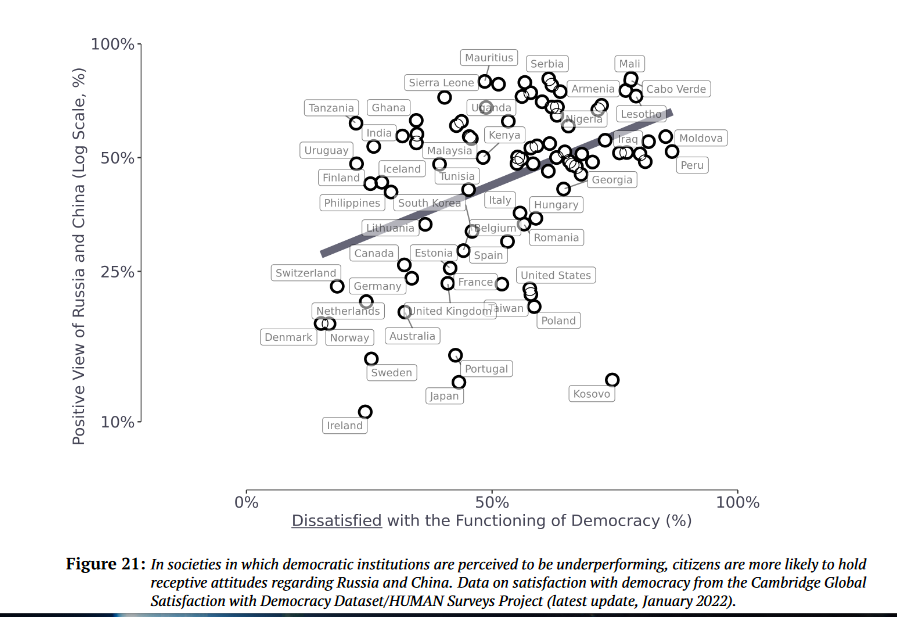
rather, whether they are valued and appreciated by citizens. If so, attitudes towardscountries such as Russia or the United States might take into account their potential to assist – or damage – the health of their democracy. For a closer look at Figure 20 reveals anumber of electoral democracies, such as Indonesia, India or Nigeria, in which the public remains sympathetic to Russian or Chinese influence, in spite of a difference in political regime. Thus it is not simply whether democratic institutions exist that countsbut rather, the degree to which they are seen as functional and legitimate.

This seems reasonable, at first glance. Here’s the chart:

Eyeball those nations above and below the 50% mark.

What does the grouping below 50% all have in common? What does the grouping above 50% have in common?

Whether or not they could be considered part of the Westerns sphere. Those above the line are generally not those who have done well under US hegemony and who are not Western allies.

So, yeah, this looks to me to be a case of “correlation is not causation”. I would gently suggest that what creates the legitimacy of “democratic institutions” is whether they have delivered for people and that those countries under 50% tend to be those who have been inside the Western (US/EU/close allies bubble.)

So, yes, it is actually about the new cold war.

Now remember, China now does most of the world’s development. It isn’t even close. They build the new ports, airports, hospitals, roads, bridges and even cities. Further, they do it cheaper than the West does it.

So, if you’re a developing nation who isn’t inside the “blessed bubble”, even as bad as that bubble has become under neoliberalism, China looks good and America looks… well, not so good, especially since the US has been the primary driver of trade and finance rules which have been very bad for the third world.

This has been going on for a long time, but since the collapse the USSR there hasn’t been another option. China offers one, and Russia is thumbing its nose at a global order that has gone out of its way to screw over the countries which are above that 50% line.

So, I wouldn’t say it’s exactly about “democratic legitimacy” — that legitimacy is a dependent variable and it is associated with America, NATO and to a lesser extent the EU. When a global regime doesn’t deliver it is discredited, and in fact even in countries under the 50% mark, most have been losing trust in “democratic legitimacy” as well. Americans and British will know well of what I speak.

The end result is that most of the world now slightly favors China and Russia and the important part is that trend is likely to continue. There will be a cold war, and most of the world wants to remain neutral or slightly favors China/Russia. On election Lula in Brazil said they would keep trading with both sides and not be drawn into the cold war, but Brazil is one of the founding members of the BRICS (Brazil, Russia, India, China, South Africa) the most important economic bloc that doesn’t include the US. Brazil will remain “neutral” but 31% of Brazil’s exports now go to China and 11% to the US. If the US is stupid enough to push, and military might isn’t determinative, Brazil would be foolish not to go with China.

Power follows industrial capacity and popularity follows treatment. With a few notable exceptions, if you’re a third world country, China treats you better than the US has in ages. As for Russia, well, they may screw with nearby countries, but otherwise they don’t get involved much (remember Syria invited them in, and is a long time ally.) Indians, in particular, remember that Russia was a friend for generations when the US and Europe were not. As for Africa, China has been developing good relations thru trade and development for decades now.

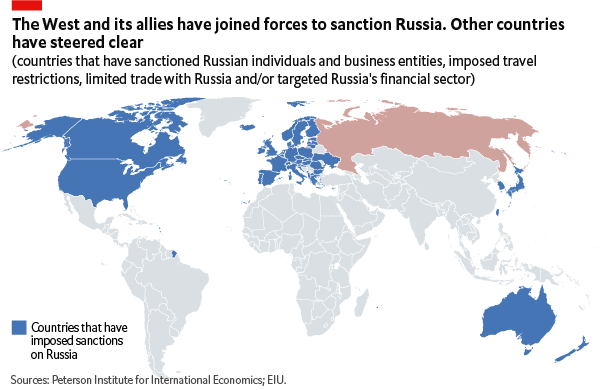
In this cold war, the West is going to be the one isolated, as the above (older) map from the Economist suggests. Yes, they are “neutral” for now, but if forced to choose, don’t assume they’ll choose the current order.

The “rules based international order” is rather small and how it has been run has damaged democratic legitimacy far more than “China” or “Russia”.

DONATE OR SUBSCRIBE

Open Thread

Use to discuss topics unrelated to recent posts.

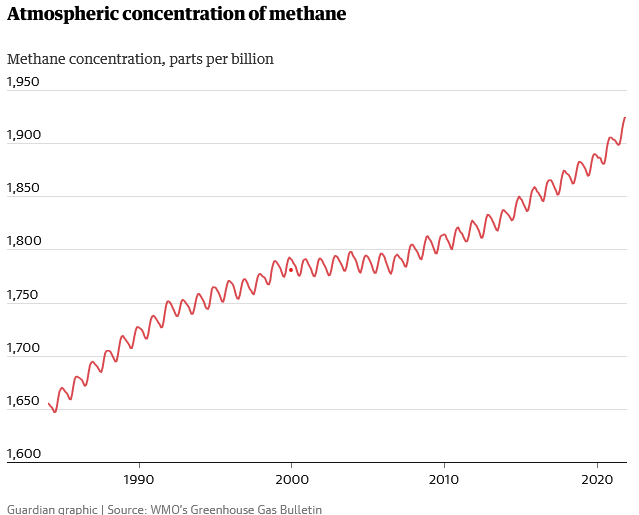
Climate change is getting worse, faster. It’s accelerating. What is required to change that?

Who would have expected? All three are accelerating, with Methane the worst.

Now my first reaction was that this was a reaction to Covid restrictions ending, but if you look at the chart it’s clear that isn’t the case, as the amount of increase is more than Pre-Covid.

Related:

This is why I laughed when people heralded Kyoto or Paris or any other climate agreements. The treaties have no teeth and are generally dead on arrival. And it’s small countries that tend to do the most, which isn’t what is needed.

To put it simply, there is no way we’re going to stop at a 2 degrees change, and those who say otherwise are guilty, at best, of wishful thinking. Yes, it’s “theoretically” possible, but there is a real world and in the real world it will not happen absent revolution, peaceful or otherwise, because it requires actions our rulers will not take. (Look at Germany, in energy crisis, still refusing to turn nuclear reactors back on.)

Nor will anything other than radical change work. In the beginning of the pandemic, when most of the major industrial countries were in lockdown, concentrations kept going up. The very structure of our society requires these emissions and thus we will have to change the structure, simply doing “less” the same way won’t do the job, though it may happen, albeit not voluntarily.

We must move to a full electrical economy. We are going to have to design and build better, safer nuclear reactors and we are going to have become the sort of societies which can run nuclear safely. To fix the ecosystem collapse (related but not identical) we’re going to have to change how we do agriculture almost entirely, remove almost all toxins from our products and go to a combination of very high density cities (no more sprawl) and people who live outside of those high density areas will have to be ecological stewards: their existence must make ecodiversity increase, not decrease or they simply can’t be allowed.

We will also have to outlaw planned obsolesence and make it a criminal offense for anyone, including officers of corporations and perhaps even shareholders to create a product which does not have the smallest possible footprint or which is not designed to be easily repaired and upgraded. No more non-biodegradable products which are not designed for long lives. As much as possible will have to be made bio-degradable and again, not doing so will be a crime, with criminal sentences in prison.

None of this is impossible, and oddly, it will create a world which is in certain ways, much more pleasant to live in and which gives people much more agency.

But it won’t happen under the current system or with the current elites. Capitalism as we know it has to go, and every ruling elite in every major country must be replaced.

DONATE OR SUBSCRIBE


The Inflationary Consequences of Friendzoning and Decoupling

During the rise of China and the “One World/Free Trade” period, one good thing which can be said for offshoring is that it helped reduce inflation.

It, indeed, drove much of the inflation reduction, with most of the rest of the inflation reduction being concerted efforts to keep wages low, with a strong assist from the Bureau of Labor Statistics to use methods like hedonics to pretend that inflation was lower than it actually was.

The new mantra is “friendzoning” — not so much bringing industry back to the US but moving it to friendly countries. Vietnam and Bangladesh are mentioned often, and Mexico will benefit as well. But friendzoning has limits, these countries don’t have the capacity to quickly take on all the production done for the US and Europe, nor do they really have the technological ability in the medium run.

This means that the determination to have a new cold war, and possibly a hot war with China will drive inflation higher for years to come.

The solution would be to, more than friendzone, re-shore: bring production back to core nations. But that would require reducing the cost structure: and I don’t mean wages so much as I do predatory finance and driving rent and housing prices down massively — about two-thirds at a minimum, along with no longer health-care predation. Do those things and wages don’t have to rise nearly as much, and the US (and Europe to a lesser extent) become much more competitive.

But to re-shore, you have to, in effect, give ordinary people a decent deal and not treat them as assets to shorn, but rather as productive assets to be cared for. (Note you don’t have to do this out of the goodness of your heart, our elites don’t have any of that.)

For the time being, this seems unlikely, so don’t expect inflation to go away. All the Federal Reserve can really do to stop it is push the economy into the dirt, but that’s not going to be a long term solution unless it stabilizes at “you’re a third world nation”, which, actually, probably won’t solve it either.

DONATE OR SUBSCRIBE

Open Thread

Use to discuss topics unrelated to recent posts.

The Adderall Shortage Is Just the First Major Shortage

People who have read me for a while know that for years I’ve been warning of prescription drug shortages or even stoppages. Well, now we have one that’s large enough to have made headlines:

A national shortage of Adderall has left patients who rely on the pills for attention-deficit/hyperactivity disorder scrambling to find alternative treatments and uncertain whether they will be able to refill their medication.

The Food and Drug Administration announced the shortage last week, saying that one of the largest producers is experiencing “intermittent manufacturing delays” and that other makers cannot keep up with demand.

Some patients say the announcement was a belated acknowledgment of a reality they have faced for months — pharmacies unable to fill their orders and anxiety about whether they will run out of a medication needed to manage their daily lives.

Experts say it is often difficult for patients to access Adderall, a stimulant that is tightly regulated as a controlled substance because of high potential for abuse. Medication management generally requires monthly doctor visits. There have been other shortages in recent years.

“This one is more sustained,” said Timothy Wilens,

Now, it may be possible to move to generics, and a lot of the reason for this is how regulated amphetamines are as part of the war on some drugs. Back in the 60s it was possible to buy pure amphetamines over the counter just as at one time one could buy cocaine, morphine and codeine OTC.

That said, supply lines are under pressure and those pressures, though they will fluctuate, are going to get worse over the next years and decades.

Going off Adderall can be nasty, but there are other drugs where it’s downright hell, including SSRIs and Benzos. I know one guy whose careful titration of Xanax took a year, and when another friend’s was without for two days because of a prescription problem his body started just moving and speaking on its own. (GABA is what allows you to not do things, and benzos crush your bodies natural production.)

Then, of course, there are drugs people need because without them they will die or become seriously ill.

As we go forward, all of these things will be subject to the possibility of supply shocks and shortages. I would say, indeed, that more drug and medicine shortages and supply shocks are inevitable.

It’s hard to say what to do about this, because you can’t build up a supply of your own: doctors can’t let you have a 6 months buffer, say, of benzos (which if you take them every day, is about what I’d guess you’d need to have enough to safely take yourself off them with small reductions over time.)

But be aware of this issue and see if you can figure out a way to protect yourself. And remember, even without shortages, there will be future “insulin situations” — where those who have a drug people must have jack the price up so high many people can’t afford it.

Plan ahead if you can, and be well.

Update: Someone who wants to remain anonymous offers the following suggestions:

Avoiding Added Emotional Suffering (Buddha’s Second Arrow)

When I say in this post to imagine something stop and imagine it, or you won’t get the necessary effect.

First, imagine falling. You catch yourself on your hands, you’re not seriously injured, but your hands are abraded and you’ve wrenched a muscle in you back.

Next. Imagine that you fell unavoidably: there was a small bit of ice, but you were walking carefully and there’s nothing you could have done.

Third: imagine that you were careless. There was an obvious piece of ice, you weren’t paying attention, and you knew there could be ice. Feel this.

Fourth: imagine that you feel on a walkway that someone should have cleared (it’s usually the law in places with a lot of snow and ice.) You were careful, but still fell. Feel this.

Fifth: imagine you feel because someone deliberately tripped you. Feel this.

If you’re a normal person and you took the time to actually feel, these felt different. Either number three (carelessness) or number five (someone tripping you), feels worst: you’re angry at yourself or someone else.

But even with the first one: it just happened and no one is responsible, you may be upset: it’s not just the pain you’re feeling, but your upset.

This anger, upset, hatred, sadness, etc… is what Buddha called the second arrow.

There is pain and nauseau and itching and so on. They feel bad. But unless you’ve got drugs or advanced meditative skills, they just happen, and there’s not much you can do about them.

Everything else is added by your emotional reaction. That’s the low-hanging fruit. That’s the stuff that’s (relatively) easier to control or choose.

Different people have different ways of doing this, but the first concept is simple enough “adding a negative emotion doesn’t help the situation, and it makes me feel worse.”

As someone who spent a lot of time beating themselves up for mistakes or not living up to my ideal self, I eventually realized that not only did it make me feel bad, it didn’t drive long term changes in behaviour. It had no benefit.

As for getting angry at other people, my experience, as someone who spent years and years not just angry, but enraged (long term readers will know I speak the truth), is that it didn’t help the situation, and it made me miserable (and eventually had negative health effects.)

As Mark Twain said, “Anger is an acid that can do more harm to the vessel in which it is stored than to anything on which it is poured.”

This doesn’t mean you have to forgive them, though sometimes that brings relief. It doesn’t mean you can’t take the person who didn’t clear the sidewalk to task, even to the police or court. You don’t need to be angry or to hate to act.

Which leads to a point I’ve made before: a lot of our emotions happen because we believe we ought to feel them. We ought to be sad, or angry or hate or love or be sympathetic. (Forcing yourself to feel positive emotions rarely works well, though learning to bring love or happiness or relaxation up is useful.)

If you think you should have an emotion, you probably will and if you don’t, you’ll feel bad because you aren’t being the person you think you should be. So kill the idea that you must feel certain emotions in certain circumstances.

You do this, in my experience, by carefully examining the question “does this emotion help and is it worth it?” Examine it now, and examine it next time you get upset.

If the answer to either question is “no”, stop believing you should have the emotion.

This is as true for simple things like dropping a plate on the floor. It’s done, and being upset makes the situation worse. Sometimes a display of remorse is necessary socially, but in my experience a rueful laugh and apology works fine with anyone who isn’t an asshole.

The second arrow is the low lying fruit. And remember, people who deliberately fuck with you usually want an emotional reaction from  you. They like it when you get angry or upset.

So don’t. If you need to hit them or otherwise retaliate to make a point, do. But don’t bother with the anger or upset: you’re just giving them what they want. They love your anger, especially if you don’t do anything: your powerless rage makes them feel strong and in control.

Give your enemies nothing but hell. Never let them see you sweat. And as for the internal censor who think you should be upset and miserable, dump that guy.

And when you forget or fail, that’s when you forgive–yourself. Just try and remember next time.

DONATE OR SUBSCRIBE

Page 109 of 437

Powered by WordPress & Theme by Anders Norén