The horizon is not so far as we can see, but as far as we can imagine

Author: Ian Welsh Page 108 of 437

How We Created A Population Incapable Of Radical Change

One of the defining characteristics of our era is that we believe we are free thinkers, and that we are good at making choices, but we’re wrong.

Our education system, as anyone who had gone through it knows, is about sitting down, not talking unless given permission, and giving the teacher the answer they want, the way they want it. Our adult lives are about giving the boss what they want, the way they want it. This is how we spend most of our time from about age five.

In our lives outside of work, we make choices from menus. We create almost nothing ourselves; the possibilities are predetermined. Even if we help create something that is on one of the menus, we usually work on a small part of it, at best. Our society creates, but as individuals, almost none of us create anything, and almost never anything important.

In our political lives, we again choose from a menu. “This politician or that politician.” Even if we are primary voters, few of us choose the politicians available among the primary possibilities, and if we somehow elect a maverick, they are soon defanged. (See “The Squad” for a good example.)

Our actual lives are about doing what we are told, and choosing from a list of choices created by other people.

We’re followers. Unimaginative followers. It’s not our fault, they got us when we were children and spent the rest of our lives conditioning us. Heck, they condition us, then get us to condition others. Those who are conditioned best become the next group in authority, and condition the next generation (though this is more true for bosses and politicians than teachers, still, teachers are given almost no freedom about what or how they teach).

This isn’t as “ancient as the seas” or anything; our particular pattern is about 150 years old, which is when wage slavery and mass schooling started. Oh, previous eras had other methods, but they had at least partially broken down by the 19th century, which is one reason why new methods were required. The other reason is that the old methods weren’t good at creating wage laborers. Say what you will about peasants and free farmers, they weren’t under close supervision, and they made a lot of their own goods and services.

The problem with all this should be obvious: When change is required, people who have been conditioned to choose from a menu created other people who spend their entire lives doing what they’re told in the way they’re told to please boss/teacher (or else live a miserable life, as boss and teacher control access to the good life) are not suited to create new choices, or even to choose something radical, something that isn’t on the usual menus they’ve been seeing all their lives.

The consequence is that for people to take action, en masse, we have to reach the point where it’s obvious, to paraphrase Lenin, that none of the choices on offer are safe and that doing something radical is necessary.

But since we’ve been trained solely for choosing from menus, we often choose stupidly. We Brexit under a Conservative like Boris Johnson. We elect a Trump. We keep selecting from whatever’s on the menu, and our only criterion is “this feels like radical change.” Often it isn’t, and if it is, it’s worse than the usual menu.

We recognize radical change is necessary, but lack the judgment to choose or create the right kind, because we’ve never had to make radical choices or to create anything large during our lives. Having never done either, we’re bad at both.

Creating unimaginative followers may please our elites, but it leads to hell when real change is necessary.

DONATE OR SUBSCRIBE

Every Covid Infection Does More Damage & Makes You Less Healthy and More Likely to Die

Okay. From very early on in the plague, I’ve been saying getting infected multiple times was a terrible idea, and a worse plan.

The key to being right in advance is being willing to run before things are completely proven, but when they are obvious. It was obvious that reinfections were terrible for people. Now the firm data is coming in. (Read the entire thing here.

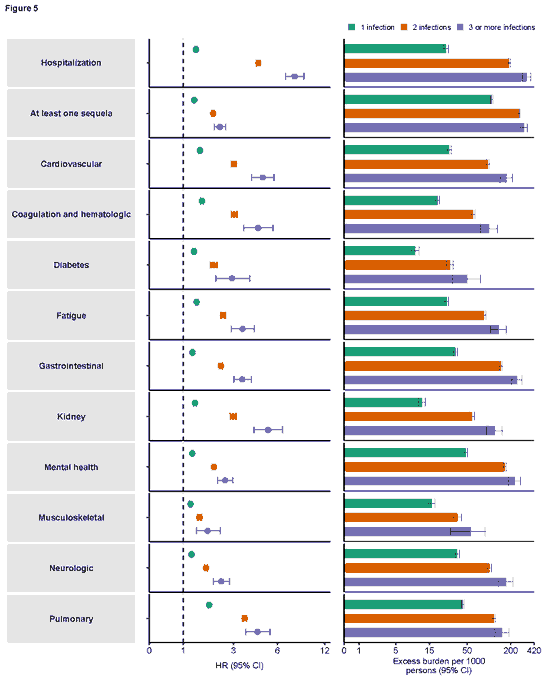
“Compared to those with no reinfection, those who had reinfection exhibited an increased risk of all-cause mortality” of over 2x those with no reinfection. Three times for hospitalization, heart problems, and blood clotting. There was also increased incidence of diabetes, fatigue, kidney problems, mental health disorders, musculoskeletal problems, neurologic disorders, and lung problems.

I mean, one might be tempted to just say, “Reinfection makes you more likely to have all health problems,” and not be too far wrong. It may be that things get better, but this study found increased risks right out to six months, which is as far as it studied.

Bonus! As I’ve said almost right from the start, each reinfection makes things worse.

Every time you get infected by Covid, it has a chance to do even more damage, and if that damage heals after the acute phase, it’s damn slow — if.

Now, let’s talk about “immunity debt.” The way the immune system works isn’t like going to the gym, and slowly getting stronger by lifting heavier weights. Instead, it’s like cops or customs agents with mug shots. “If you see this guy, shoot him.” One thing Covid does to evade immunity is mess up the mug shots so that they aren’t recognized. This means that you get other diseases after Covid, to which you were previously immune — because it’s messed up the recognition system. This is probably a big part of why there are so many auto-immune disorders popping up in Covid survivors; mess up the mug shots enough, and the immune system will start going after innocent civilians, i.e., parts of your own body. (Having had  ulcerative colitis when I was young, I can tell you this can be more not-fun than most of you can imagine.)

Getting Covid is very likely to make your immune system worse, not better, and the above is only one mechanism by which this is true.

Too much of the Covid debate has centered on vaccines, which were not, and are not, a silver-bullet. The best results have been in countries that took public health measure approaches, of which vaccines are only a small part.

But for you individually, the “takeaway” is simple: don’t get multiple infections. Don’t let your kids get multiple infections. No matter how strong the social pressure, short of “lose your job” (and maybe not even then, if you can easily get another), do not stop protecting yourself, whatever level you consider appropriate. (I don’t wear masks outside unless it’s a crowded locale, for example, and I keep my tiny apartment ventilated all times. Most people should have a HEPA air purifier running all the time where they live, and your employer should be doing something similar if you work inside.)

Covid is already causing a permanent reduction in lifespans and an increase in illness. It’s not just Covid infections clogging up hospitals, it’s people with other illnesses getting them at increased rates. Keep protecting yourself.

And remember, with proper public health measures, we probably could have ended this plague in the first four months or so. Our lords and masters chose not to. Stupid? Evil? Why not both? I have suspicions (Covid made them a lot richer), but at the end of the day, they were okay with you and the people you care about dying or having serious health problems, likely for the rest of your lives.

Remember how much they were and are willing to hurt and kill you. Remember, also, this goes for all parties in power or near power in most countries. This certainly isn’t significantly different between Democrats and Republicans in the US.

DONATE OR SUBSCRIBE

Open Thread

Use to discuss topics unrelated to recent posts.

Losing the Power of the Printing Press

If you look up whether governments can “just print more money,” what you’ll find at most sites is the answer, “No, because it only increases the amount of money, not the amount of economic activity.”

This is not true, and it’s not true in a number of ways.

If there is under-utilization of capacity, you can print. Here’s US capacity:
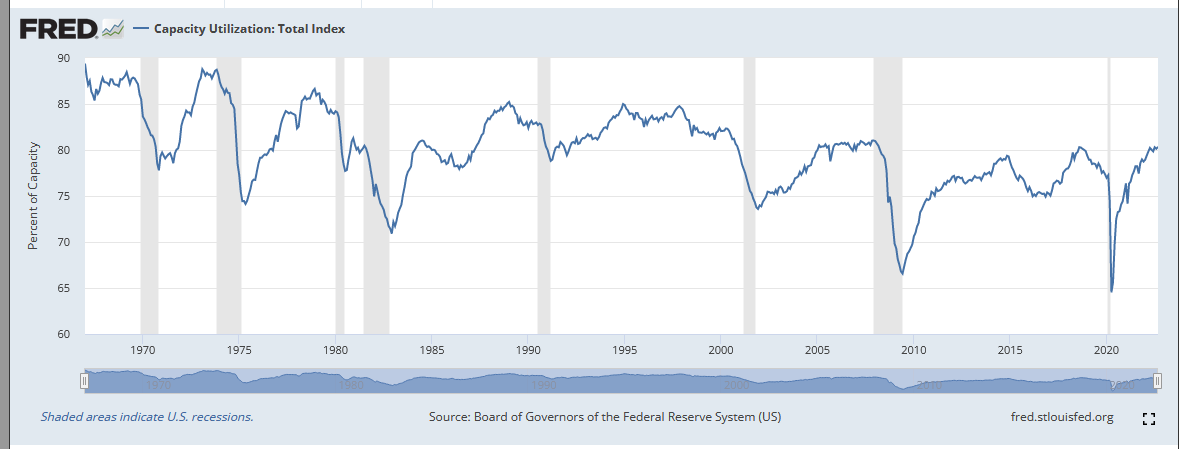
The US has been running substantially under capacity for a long time.

But, you say, there was a lot of money printing (private and public, most money is created by banks, brokerages, and so on), and capacity utilization didn’t go up. In fact, it went down.

Well, yes, because the money went to other countries like China, where it increased capacity vastly, or it went into assets (the housing bubble, stock bubbles, and so on), or it bought private jets and yachts and so on.

Which is to say, it’s not just about money creation; it’s about who gets the money. Since virtually all the money creation of the past 40+ years has gone to rich people, capacity has been created for what they want. And because it was cheaper and more profitable to build capacity overseas, that’s where the money created went.

In addition, there’s the fact that the US dollar is used to buy oil and is the general medium of exchange in most foreign trade. It’s also the “gold” currency, in that during crises it tends to go up, so people want to hold a store of it against bad times.

All of these factors are contingent. If oil was not sold primarily in dollars, or trade settled in dollars, for example, there’d be a lot less demand for dollars. If the trade regime didn’t allow for vast imports and exports, but the world was more autarchic, then building new industry overseas wouldn’t make any sense, and so on.

This is to say, nothing is eternal. The dollar’s position is a historical artifact, based on specific circumstances which did not, and will not, always exist.

Remember, there was a time when the center of the world economy was Britain (chart from Mike Todd).
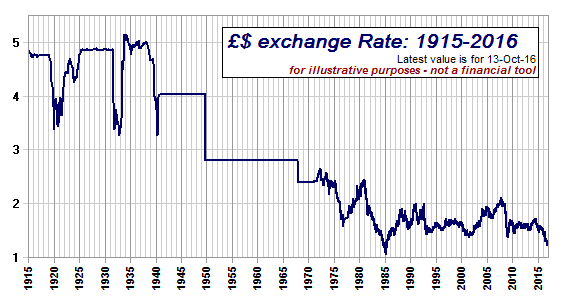
What you see in that chart (and it’s going to keep getting worse) is the switch from London to New York; from the pound to the dollar, because the pound wasn’t the primary international currency any more AND (and this is important) the UK kept de-industrializing so there was less and less relative demand for its products, though the City of London retained an important financial role, which kept the pound higher than the economic situation of Britain would otherwise have allowed.

Developing countries, as a rule, cannot run the printing the press because people only want enough of their currency to buy whatever goods and services they produce. In addition, because most Third World countries have vast import requirements (more so as time has gone on), and their agricultural bases have been destroyed, printing money causes inflation very fast. It’s not just an internal matter, more money chasing goods, it’s that people try and use the new money to buy goods produced externally, and their exchange rate collapses.

When the US prints money, a lot of it goes into other countries reserves and the reserves of people and companies. It pools, as it were, uselessly, and to the extent that it is “more money chasing the same goods,” its effect is spread over most of the world and not just internally.

Once this was true of the British pound.

The original conception of comparative advantage was based on the assumption (true at the time) that money mostly pooled inside countries and could not be used to create production in other countries. If Britain produced less widgets because French widgets were cheaper, the money freed up in Britain would go to produce something in which they had a comparative advantage, say woolens, instead of fleeing overseas. (See Ricardo’s Caveat for the long form of why comparative advantage doesn’t work with free capital flows.)

Now, you can also print money if you give it to the useless classes, i.e., the rich. In that case, it drives bubbles (see the SPX chart above or art prices) or creates niche markets, like yachts and private jets. It doesn’t drive general inflation, it only drives inflation for what useless people want.

Unfortunately, that inflation does eventually cause various crises, but for a time, it seems “free” — you make the rich much richer without causing widespread inflation.

What matters, then, is who you give the money to, and what they spend it on. Volcker crushed wages because, in addition to wanting to make useless people richer, he didn’t want ordinary people to have more money because they would spend it on things which lead to buying more oil, and given oil prices at the time, that would lead to more inflation. He needed to smash oil prices, and he did so by smashing wages to smash oil demand.

If you print money and give it to ordinary people, and it just leads to them buying more stuff from overseas, it won’t move that capacity utilization number you see in the chart at the top very much.

But this isn’t to say that printing money doesn’t “work.” It does work. It always does something. Someone benefits. If you print a bunch of money, and make sure it goes to ordinary people in your country, and that your country increases utilization and/or increases how much it produces, then it can produce a general wave of prosperity. After all, when wages rise higher than the cost of goods and services, that’s prosperity, but companies don’t like that unless they’re still making more money because they’re selling more overall.

(That last sentence, by the way, is the secret of the post-war good era. Meditate upon it.)

You lose the power of the printing press when no one wants your currency because you can’t produce enough, or increase production, AND it isn’t necessary for other things (like international trade).

This goes in stages. Britain, outside of the EU and with less and less industry, and with less reason to send money to the City of London, is in danger of losing the power of the printing press in the way Third World countries do. “There’s no reason to buy any more of this than however much you need to buy their goods.”

At that point, you need to figure out how to re-industrialize and under a free trade order like the neoliberal one, that’s hard. Every time you try, money floods out of your country instead of increasing activity inside of it.

As for the US, it’s in an extraordinarily privileged position, but as China and the BRICS move to conduct more and more trade without dollars, and as trust in the US to run the international monetary system drops and drops due to repeated sanctions and thefts of reserves, that privilege will decline, and the US will find more and more that if it wants goods from another country, it will need to provide not dollars (though they may still be exchanged), but actual goods and services itself.
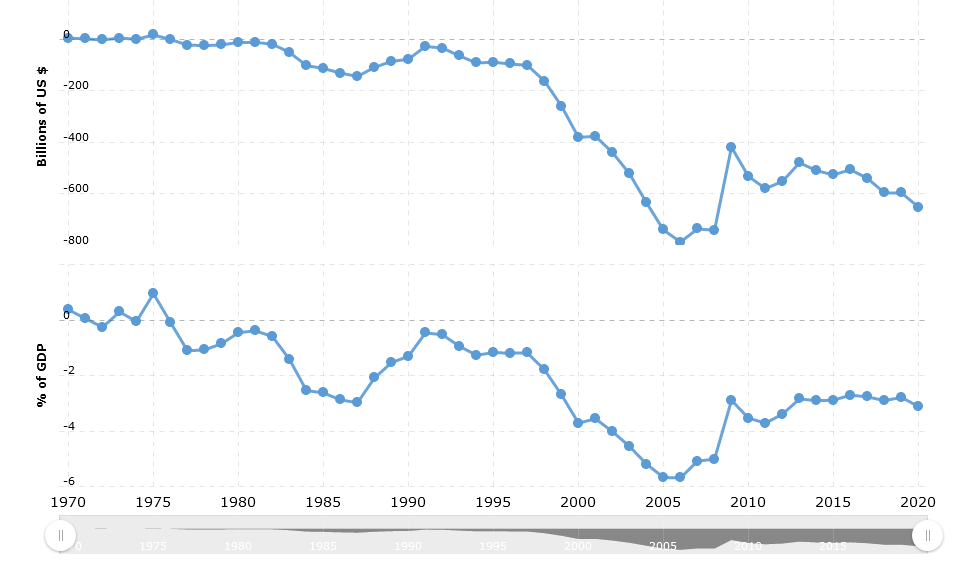
If you can’t pay with goods and services, you pay by selling your patrimony — companies, land, resources, etc.

The power of the printing press is great, but it can be used for ill and good. It can create real economic growth and widespread prosperity under the right conditions, conditions which are partially under a country’s control. But if you become too weak or poor, you can lose even the theoretical ability to create those conditions. There is essentially nothing most African countries can do to restore enough sovereignty to allow them to use the printing press for good, and if you’re a relatively rich country which does still have the freedom of the printing press, there is always the temptation to use it foolishly or venally, as the US mostly has in recent generations.

Money is a social creation. So is how we run the economy. It can be made to work for everyone, for a few people, or as a machine of impoverishment. The choice, on aggregate, is ours.

DONATE OR SUBSCRIBE

The Great Favor the West Is Doing China by Banning Equipment Needed to Make Chips

We really are run by fools.

“If you shut out [China] with export control, [they’ll] strive toward tech sovereignty… [Then] they’ll be able to do it all by themselves and the market [for European suppliers] will be gone.”

The great problem in the neoliberal era is that the usual road for tech and industrial catch-up, protectionist tariffs is mostly closed. (This is how Britain, the US, and almost everyone created their industrial base and caught up in tech.)

Despite what a lot of people seem to think, China isn’t a command economy. It’s a capitalist one, albeit with a large state company sector. Letting markets in is explicitly how Deng created the Chinese economic miracle.

So China buys a lot from other countries. It is a trading state, and that makes it more difficult to catch up in some techs.

Now, if this was done to, say, Bangladesh, or probably even India, those countries would be screwed — they don’t have the industrial and knowledge base. But China has these things; sure, it wasn’t cost-effective to do all the research necessary to learn how to make this equipment when they could just buy it, and after all, they need to buy some things from their customers.

But if they can’t buy it, they can learn how to make it themselves. Sure, it’ll cost them two or three years. It’ll hurt. But they’ll get over it, and then they can make it for themselves.

The knock-on effect is fun, though: Once China can make this equipment, they can sell it to other countries, which means those countries (Brazil, Iran, India, etc.) don’t need to get it from the West, and sanctions become much less effective because there’s another option on the table.

So by sanctioning China, the West will soon lose its ability to sanction not just China but pretty much the rest of the world.

Fun!

This is also true of the sanctions on aircraft equipment, by the way. China, which has a rather advanced space industry, will learn how to make its own civilian aircraft, and then, instead of everyone having to get aircraft from Europe (Airbus) or the US (Boeing, though Boeing is losing the ability make aircraft), they’ll be able to get it from China (and possibly Russia as well).

Now sanctions like these have their place: You do them just before you’re about to declare war. But if we aren’t going to do that (and there are certainly factions in Washington who do want a war with China soon), then it’s just foolishness.

Let’s hope it’s just foolishness.

DONATE OR SUBSCRIBE

Election Discussion Open Thread

I don’t cover US elections real time any more, but for those who want to talk about it, this is the place.

Open Thread

Use to discuss topics unrelated to recent posts.

Growth Through Real Estate Bubbles v.s. Sustainable High Income Growth (China)

All right. Let’s talk some basic development stuff, primarily in the neoliberal era.

Because industrial policy was disallowed with a few marginal exceptions due to the “rule based order” enforced by a variety of trade agreements and organizations, the traditional route of protecting domestic industries and growing behind tariffs became very difficult to do.

Various countries used different dodges. Russia, to get out of the Yeltsin era collapse, went whole hog into resources: advanced nations had to have oil and natural gas and minerals, and bribed key financial regions like London’s city with huge influxes of resource-money.

China did something different. They opened up partially and let foreign companies in, but they used bureaucracy to keep them under control (as had Japan, in part) and offered foreign elites huge labor arbitrage profits. They bribed the West’s elites with personal wealth, in effect. In exchange they insisted on, generally very strictly, in real technology transfer. Meanwhile, they created a protectionist bubble thru monetary policy, keeping the exchange rate in their favor.

But the other thing they did is what Turkey tried. They created a self-reinforcing property bubble. Municipalities and states built tons of new homes, people flooded in from the countryside to get the new factory jobs and the service and government and construction jobs which supported industry. Prices went up, municipal and state budgets went way up and a virtuous cycle was created, for a time.

Turkey did the same thing, but the problem is Turkey didn’t have an expanding industrial base, and that’s why Turkey imploded sooner.

All bubbles, including property bubbles are time limited. The more of a real economy you have, the longer they can run, but eventually inflation in property becomes too high, and most citizens can’t afford the housing. Meanwhile, inflationary increases in living costs make workers too pricey, and the industrial base begins to suffer.

You can start from three positions.

  1. Like the US or UK or much of the EU you can start with an industrial base and cannibalize it, or..
  2. Like Turkey you can start with a poor but big country and cannibalize an increasing part of your population, plus what little industry and agriculture you have (India is similar, but much larger and managed to get some industrialization out of this strategy), or..
  3. Like China you can build your industrial base at the same time.

Whatever you do, this strategy eventually runs into the roadblock of a cost structure which becomes too high to allow actual productive industries.

At that point, you have to tame the housing market and other out of control costs (medical, food, whatever). If  you don’t, you’re pushed back from 3 to 1, or if you did 2, the artificial prosperity begins to collapse. (India’s calories per capita have spent decades decreasing and someone who spent time there in the 80s, I can tell you Indians weren’t overfed to start with.)

So China’s now in a position where rather than bubbles, especially the housing bubble, being synergistic with industry and improvements in technology, they’re starting to strangle growth.

The route out (minus mercantalist imperialism, which is long run a loser too) requires you to stop relying on property bubbles, and start strangling your cost structure. The “free” money from asset bubbles has to go away, and you have to create a consumer society: not one like we have now, but one like we had in the post-war liberal era. Housing costs have to be kept at a level where people can buy or rent homes fairly easily: 30% of wages for rent or so, and at most about 5 years wages to buy a small home or condo.

Since the free profits of bubbles and speculation have to go away, companies have to make real money by providing real services and not just count on “real estate always goes up” or (America) “people have to have health care, so we’ll increase prices thru the roof.”

This is the task that China now has. It’s a hard task, akin to getting of hard drugs like heroin or SSRIs or Xanax. It hurts, because the financial pipes are reliant on what amounts to free or easy money.

During this transition, headline GDP and so on will suffer, there is no way around it minus looting expeditions, especially since simply running the printing press (something we’ll talk about in another article) defeats the point, which is making companies earn their money by providing goods and services for small markups at scale. (The post war liberal era worked on 3-4% markups for most mass goods.)

This is where China is. Where America and most of the West is similar: except it’s after destroying much of the industrial base and real consumer economy that doesn’t rely on massive price gouging on items people must have. There is no way to bring the good jobs back for most of the population in the US or UK or Canada or Australia without crushing the cost structure, strangling property speculation and prices and in the US tackling the medical and drug cartels.

China’s making the attempt. A lot of what they’re doing is clumsy and crude (but then, so was the one child law, but it worked even if it caused future problems.) So far the UK and Canada and the US and most of the West are not even trying, which is why you hear more about friend-shoring (aka to cheap places that are Western allies) rather than re-shoring, which can only be done for the goods that are either very high margin or which elites have realized are too militarily strategic to do in other countries.

This is why, as far as I’m concerned, the smart money is still on China, and if it wasn’t for climate change and ecological collapse, I’d consider it a done deal even if it took a couple more decades and a lot of screaming and shooting.

As it is, we’ll see. But China’s at least trying to do the right thing.

DONATE OR SUBSCRIBE

Page 108 of 437

Powered by WordPress & Theme by Anders Norén