The horizon is not so far as we can see, but as far as we can imagine

Tag: Saudi Arabia Page 1 of 2

Defending Most Infrastructure Is Now Impossible But No One’s Getting It

After Ansar Allah grabbed a huge chunk of territory, including coast and islands which let it control the Red Sea, and after blowing up a pumping station and pipeline which will require weeks to repair, the Sauds are doubling down with airstrikes and missile attacks.

And I’m wondering what’s going thru their heads.

Because we’re in a period where, with a few exceptions, anything can be destroyed by missiles and drones if you’re within range. That especially mean port infrastructure, airports, refineries (which have also been hit) and, yes, pipelines.

Whatever one thinks of Ansar Allah, they have shown an ability to absorb massive amounts of damage, and frankly, they have almost nothing. If it comes to a tit-for-tat exchange, they can take the punishment, while Saudi Arabia has all sorts of vulnerable infrastructure.

It’ll take, supposedly, six weeks to repair the pipeline.

Then it can just be hit again, because there is no way to protect it.

This is the new calculus of missile power. It’s hard to defend against, and in the context of western interceptor stockpiles being almost depleted, it’s effectively impossible.

In Ukraine/Russia this favors Russia, because they can hit more. In Yemen/Saudi Arabia it favors Yemen because what they can hit matters much more.

As with the Iran war, the correct play here is peace. Yemen wants an end to the blockade. Give it to them.

Saudi Arabia’s army is an infamous joke. They’re flirting with the end of the House of Saud here, because if the money stops, then their population will become a serious threat. The military is weak to avoid a possible coup, but that means it can’t stop a major uprising or invasion. The secret police are scary, but they only work at stomping out small fires, they can’t stop anything major.

Everyone hates the Saudi Royals. I’ve never met anyone who dealt with them who didn’t despise them, even if they were being paid well by the Sauds, they hated them.

This is a new world. Saudi Arabia bet on America to protect them, and that worked for generations. But America can’t any more. The royal family needs to find a new way, and so far the Pakistan/Turkey alliance is a dud.

It’s not looking good for them, but the first thing they need to do if they want to survive is get real about their situation, and about how warfare has changed.

I rather hope they don’t.

What I write here is for the benefit of everyone, but alas, I live in capitalism and I, and the site, take money to keep running. If you value the writing here and can, please subscribe or donate.

Ansar-Allah’s Blitz Likely To Reduce Saudi Oil Exports To Near Zero

The picture above is from an Ansar-Allah (Houthi) strike on Saudi Arabia’s East-West pipeline. That and the Red Sea are how they were getting around the Iranian blockade.

About the Red Sea:

Yemen appears to have captured four islands plus the West coast of Yemen, most of which they didn’t previously control. This is… remarkable… because they have no navy, no airforce and one of the islands had an air base.

Meanwhile, they completely routed Saudi mercenary forces, capturing vast amounts of land in thirty six hours:

Saudi (and a few UAE proxies) were routed. They basically fled on contact. This is what happens when merecenaries go up against real troops, and the US isn’t there to help. Saudi Arabia has a huge air force, but it appears to have done basically nothing. (It’s an open secret that the Saudi military is a complete joke.)

MBS begged Trump for help and got none:

Saudi Crown Prince MBS called US President Trump twice on thursday, urging the US to carry out strikes but Trump reportedly declined as there are currently no plans for direct intervention. (Axios)

The US is over-stretched, and not just low on interceptors on missiles, glide bombs and so on.

The war in Yemen was a big project for Obama, and it included a hell of a lot of US support. Even with all that support they were only able to contain Ansar-Allah, not defeat it. (It’s worth knowing that while most of Yemen is not under Ansar-Allah control even now, the areas they control have 80% of the population.)

This is what it looks like when an Empire is in fatal decline.

I consider this good news, overall, but it’s going to absolutely suck for almost everyone. I have warned before, I’m warning again: stock up on staple foods, fuels and so on. Ansar-Allah now has complete control of the Strait, plus that pipeline is down for a while, and they can take it out again, or hit more refineries. Combined with the Iranian blockade, hardly any Saudi oil will be getting out, nor will the precursors for fertilizers.

Much of what was holding the oil market down (other than massive manipulation and releases from the reserves) was China reducing its purchases for months, but they’ve started up again, so demand is actually increasing.

We’ll see if Saudi Arabia has more sense than America: the correct action is to make whatever concessions are necessary. The Sauds cannot protect their infrastructure, their army is garbage, their mercenaries won’t fight and Ansar Allah has them by the throat. If they insist on fighting on they risk losing everything, because without oil revenue, Saudi Arabia is not viable, right down to not having enough food.

Much like the Iranians, Yemen has escalation dominance and is more willing and able to take pain (they lost millions to the last war) than the corrupt and effete Saudis. The Sauds have LOST and if they refuse to admit that, the House of Saud itself may fall. (No one will miss it, except people like Kushner, whom it has bribed.)

I consider yesterday one of the best days, geopolitically, of my life. The American Raj is taking body blow after body blow and is fatally overstretched. But it is going to SUCK for most of us, as prices rise and there are shortages, unless Trump has surgery to correct his chronic case of head in ass and agrees to Iran’s terms, while the Sauds do the same with Yemen.

It’s hard to predict Trump, but my guess is his Israeli masters won’t let him make peace, so get ready: the next year is going to be awful in much of the world.


What I write here is for the benefit of everyone, but alas, I live in capitalism and I, and the site, take money to keep running. If you value the writing here and can, please subscribe or donate.

Iran Has Broken The US Middle East Raj

It turns out that Trump’s plan to help ships go thru the Strait was ended when both Saudi Arabia and Kuwait refused to let the US use their airspace or US bases in their countries to launch attacks.

The reason is obvious—Iran has repeatedly said that if the war restarts they will hit the Gulf States much harder than before, going after oil infrastructure in particular.

America has proved it can’t protect its Gulf allies. It’s low on interceptors, and what they have goes to Israel. Even with interceptors attacks get thru.

Bases have gone from defending countries to being liabilities. Being American allies drew the Gulf states into a war that devastated them. The Sauds and Kuwaitis have nothing to gain from letting the US launch attacks from their territory. The lesson was painful, but it has been learned.

This also puts an end to the idea that countries can’t deny the US. They just did, as did Spain.

The US Empire is dead. Officially dead. It does not come back from this because the new way of war centered on drones and missiles means that it is impossible for the US to protect its allies.

Likewise the US can no longer guarantee free navigation. This has been obvious for a couple years: if they couldn’t even defeat the Yemenis, they weren’t going to stand a chance against any real nation.

It’s over.

Again this doesn’t mean the US isn’t still a Great power, especially regionally. It can still shove around weak countries which aren’t willing to bear the heavy cost of standing up to it, like Venezuela.

But as time goes by the missiles and drones will spread from China, Russia and Iran to everyone else. Aircraft carriers will be forced way back, reducing sortie tempos, and blockades using ships will become harder and harder. Probably the best way to do a blockade against a far away country will be drone carriers, but even they will be vulnerable to counter-strikes.

This is also going to be a huge problem for the American military industrial complex: their weapons suck. No one is going to want to buy them. The key weapons needed are missiles, drones and air defense and all of those are cheaper and in many cases better from other suppliers.

At this point without data centers the US wouldn’t have essentially zero GDP growth. The stock market is being held up by a few major internet firms who are engaged in a massive circle jerk of financing their customers purchases. Chinese AI is behind American, but 95% cheaper, open source and will converge on the same general abilities, but better for real world tasks involving robots, autonomous vehicles and so on.

If you need to buy something you don’t want to get it from the US. Odds are China has it for less and at least as good, possibly better.

The world doesn’t need American goods. Everyone’s going to move off oil as fast as possible and it’s China that sells that stack. American weapons are crap. American alliances do nothing but give you a nuclear umbrella you can’t trust the US to deploy.  Trade is increasingly moving off the dollar and on to the Yuan, so sanctions will work less and less well and in less than five years will be basically useless except against vassals.

All that will be left is a wasting ability to use a legacy 90s tech military against the weak, and that’s going away too.

The US Empire is cooked. America’s elites were handed one of the strongest hands in history and pissed it all away in three generations. Truly late Roman Empire levels of incompetence.

Everyone reads these article for free, but the site and Ian take money to run. If you value the writing here and can, please subscribe or donate.
The Dollar Is Impregnable & The West Will Always Control International Banking (Honest)

What is geopolitical risk, you ask, and the Saudis answer:

Saudi Arabia warned it could sell off some European debt holdings in retaliation to a move by the G-7 to seize almost $300bn in frozen Russian assets, according to a report by Bloomberg.

The veiled threat was passed along from Saudi Arabia’s finance ministry earlier this year to some G-7 counterparts, as the group weighed seizing Russian assets designed to support Ukraine.

Saudi Arabia specifically signalled out the euro debt issued by France, according to Bloomberg.

Riyadh has been concerned about western efforts to seize the Kremlin’s assets for months. In April, Politico reported that Saudi Arabia, along with China and Indonesia, was privately lobbying the EU against confiscation.

Notice that Indonesia is also involved. China is less surprising, they know that freezing and even confiscation is in the cards for them when things heat up between the West and china.

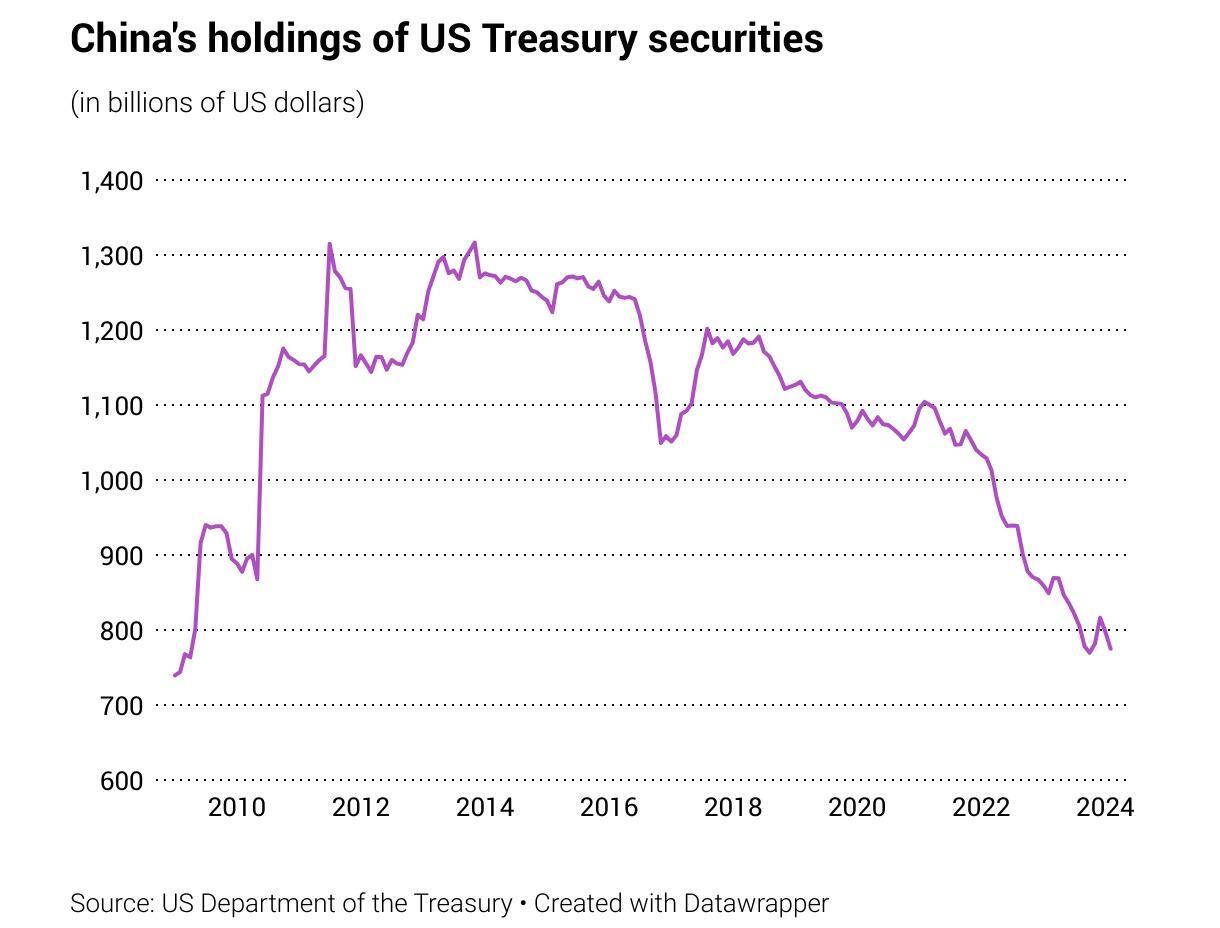
China has been reducing its risk:

Edit: (Or perhaps they aren’t?)

No one wants to do business with nations that will simply take away their money. Freezing was bad, but normal. Seizure is not. Since no one seized or freezed America’s overseas assets when it invaded, say, Iraq, and no one ever seizes or freezes West European assets, it might be thought that this isn’t about “law” but about “power.” For that matter, why haven’t Israel’s overseas assets been seized?

The level of geopolitical risk from doing business in the dollar or using the Western banking system is just too high. Freezing, seizure and sanctions, plus the US applying its law extra-territorially simply because a transfer happened to go thru an American bank even though the sender and end party were both outside of America.

This abuse is long-standing, you can read accounts from the fifties, but it really picked up in the 90s. Indeed there’s an entire book, Treasury’s War, about the phenomenon.

And this is what all the economists and similar pundits who go on about how the dollar can’t be replaced don’t understand: that they are right that the costs of replacing the dollar are significant; that it’s hard, and that it’s not really worth it.

Except it is worth it, because if the cost of trade and money transfers goes up slightly under a non-dollar regime, and even a slight increase is massive when multiplied by the number and amount of transactions, it’s still worth it because of the massive reduction in geopolitical risk. And nattering on about how the Yuan can’t be used because the Chinese can’t accept the costs of using the Yuan is stupid: that’s not what the BRICS are trying to do: the idea is to create a central, multinational currency, and to simply use local currencies whenever possible, while avoiding the Western banking system entirely.

Everyone knows that the dollar and the Western banking system are guns, and that everyone who uses the dollar and the Western banking system are under those guns and can be hit at any moment if D.C. or Brussels desires it.

When this was hardly ever done, it was a risk worth taking. When China was the main industrial power who you could buy almost everything you wanted from, and the West was the only option for most technological goods, well, you had no choice.

But now nations see a way out from under the guns, and they’re going to take it, even if it costs them, because the potential cost of not doing so is catastrophic.


IanWelsh.net is supported by readers. Please subscribe or donate, and please share articles. The more you help, the more I can write.

China Leads A Successful Middle East Summit

Something which has slipped past most people’s radar is that China recently acted as the intermediary for peace talks between Iran and Saudi Arabia. The two countries have been at each other’s throats for decades, funding and running operations and proxies against each other. Elijah Manjier has a decent summary (part is behind a subscriber wall) from a pro-Iranian point of view.

It’s also interesting that in this conference no English was used!

Now it’s obvious why the US couldn’t be involved: it hates Iran and doesn’t intend to change that any time soon. But that China was reached out to indicates that it has good relationships with Iran and Saudi Arabia and that it’s considered powerful and prestigious enough to be involved a region far from its core.

On the Saudi side this shows the continued movement away from being a US ally. It suggests continued movement towards China, and that the petro-dollar really is under significant threat.

For Iran, it suggests that the days of the US being able to coordinate sanctions over it are likely numbered. If the Sauds break out of the US bloc, one can expect the Gulf States to follow if Iran is also in the Chinese bloc: these are the regional and cultural great powers. As Chinese/Russian payments expand and with petrochemicals priced in Yuan or Rubles, and with the most important Middle Eastern powers friendly to China, the US is reduced to its core allies. These are important countries, no doubt—Europe, Japan, South Korean, Taiwan and so on, but it is a minority of the world and is filled with countries terrified of US sanctions, looking for a way out under the potential hammerlock.

I don’t want to over-state how important this mediation by China was, but it was important and it’s one of those milestone moments. It wasn’t the US or Europe who the Sauds and Iranians went to, and just as importantly, they didn’t feel they needed US approval. Saudi Arabia using China, whom the US has declared an enemy, to move towards peace with a country the US has been hostile to for about 45 years is an earthquake.

Whether the peace will really happen is more dubious, but if movement, even hesitant 2 steps forward, one step backwards movement continues, it will be worthwhile. I am most interested to see if this will mean some sort of peace can be worked out in Yemen, or if it means the Iranians will abandon the Houthis, which would be sad.


The results of the work I do, like this article, are free, but food isn’t, so if you value my work, please DONATE or SUBSCRIBE.

Russian Debt Default + Consequences, Simply Explained

I don’t want to spend a lot of time on this, but the fundamentals are worth a quick review.
Russia had hundreds of billions of dollars on reserve at central banks. We have frozen them so they can’t spend them, and we’ve also forbidden banks, in general, to do almost any business with them in dollars.

So they have the money to avoid default, but are not allowed to use it to pay their debts.

This is like if you personally had an account at the bank for $10 million and they said, “We’ve frozen it so you can’t spend it, and we won’t accept money from anywhere else, but we still expect you to pay your mortgage.”

It’s obviously unfair, and everyone outside of the West knows it, as many countries have invaded other countries and none of them were hit this way. This punishment is so harsh because Russia is outside the club and didn’t have the nod or a similar punishment would have been doled out over Iraq, Libya, and Yemen, among many others.

It has made other countries scared for their money. Even countries that have license, like Saudi Arabia — who is currently bombing the hell out of Yemen with a sanction in sight.

Saudi Arabia is considering accepting the Yuan for oil payments.

Of course, the US is pushing back hard — that oil is priced in dollars, and it’s one of the main reasons the dollar is the global reserve currency.

But while the Sauds are in good for now, who is to say they always will be? What if one day the US decides to sanction them? Perhaps they see it as in their interest to diversify their reserves. Perhaps they also see Beijing as FAR less likely to sanction them? If they do, I agree. Just don’t piss China off about Taiwan, and the odds of China ever freezing your Yuan reserves or sanctioning you is essentially zero, not least because in order to grab reserve status from the US, they need to be more trustworthy.

I don’t know if the Sauds will do this yet; the pressure the US must be bringing is immense. But I do believe that when we look back on these massive sanctions, we will see that forcing Russia into default was the end of the dollar’s hegemony. This weapon has been used before, but only on marginal states. To do it to a Great Power is quite different.

The US can’t be trusted with your money. Before, people was perceived the US was the safest place.

For most countries, the dollar hegemony has been terrible; they sold American stuff and got numbers on a computer in return. (China on the other hand, played the game smart. They got the US industrial base in return and, even if the US freezes every dollar they have, they’ll still be ahead.)

Most countries will be better off in a de-dollarized world. But the US won’t, and if Europe stays a US satrapy (which most indications suggest it will) then it will be bad for them. Ironically, back in the early- to mid-2000s, the Europeans had the opportunity to make the Euro an independent reserve currency, but, as usual for Europe in the age of American dominance, they lacked the guts.

None of this will happen immediately. But I believe we’re either at, or within, a year of when we will be able to look back and see this as the tipping point.

DONATE OR SUBSCRIBE

How Important Is the Drone Attack on the Saudi Oil Field?

As you’d expect from the title, both more and less than it seems.
The impact on oil prices is not that big a deal, despite the screaming. If they were to, say, wind up at $75/barrel for a few months, well the last time we had prices that high was…less than a year ago. It’s possible this will push us into a long-delayed recession, but if it does, that recession was going to happen anyway.

If Trump acts like an idiot and attacks Iran, of course, this will turn out to be a big deal. Otherwise, it isn’t a big deal, in and of itself.

Nor should anyone be crying for the Saudis. Assume it is true the attack was launched by Yemeni Houthis with some Iranian support. Remember that Saudi Arabia has been bombing and deliberately starving Yemen for years. They’re at war, and if the Houthis have a bit of support from Iran, what of it? Saudi Arabia itself has supported many organizations which have attacked other nations, possibly including Al-Qaeda and 9/11.

If you bomb the shit out of a country, and they manage to get in one hit against you? Boo-hoo.

Nor should the US care, as Saudi Arabia is a terrible ally who has done more harm to American interests than any other “ally” in the world, with the only possible exception of Israel.

This isn’t a US problem–and it shouldn’t be their war, and they should stop helping Saudi Arabia hit Yemen. But I guess the Sauds have always been good to the House of Trump, so perhaps there will be a war, on behalf of Trump hotels.

That aside, as I have written a number of times, drones are, and were always going to be, a weapon of the weak, and it is becoming harder and harder to defend against them. The US military was incredibly stupid to develop them, because ultimately they remove part of the monopoly of force from powerful countries. A world in which air strikes require jets that only a few countries can build, and which are expensive, large, and easy-to-find is a world which is much more favorable to great powers.

Instead, we have the cost of a somewhat-effective air force and assassination force dropping through the floor. Soon, these things will be routinely used by very small governments and non-state actors to kill their enemies; specific, named enemies, just as the US has been doing for a couple decades now.

This is going to get ugly.

It’s not all bad, taken from a longer point of view. Ages where elites can easily be killed tend to concentrate elite minds. In some places, that will lead to even worse police states, but the other way to solve the issue is to make people’s lives pretty good. People with pretty good lives tend to have better things to do than engage in political violence.


The results of the work I do, like this article, are free, but food isn’t, so if you value my work, please DONATE or SUBSCRIBE.


Saudi Arabia’s Laughably Stupid Plan for the End of Oil

Image by Yuan2003

I’ve been predicting Saudi Arabia’s crackup for some time. Their society is completely dependent on oil revenues, and their rulers have no idea how to diversify off in time.

Couldn’t happen to a bigger bunch of jerks, though as usual, many innocents and powerless people will get dead, raped, and tortured as Saudi Arabia falls.

This piece by Jeff Spross, hasn’t changed my mind. It’s about how the Sauds are selling assets to get US dollars so they can pay for the changeover.

The expert Spross talks to has ideas on what the Sauds could use that money on:

Kaboub proposes the country use advanced aquaponics to build up its self-sufficiency in food — aquaponics can be done indoors for ten percent of the water used by traditional agriculture — and switch over to renewable energy. “It’s a prime location for wind and solar and geothermal,” he noted. Kaboub’s also a fan of a universal job guarantee, which he thinks can serve as a staging policy to lower unemployment and build up other domestic industries.

What does the royal family, lead by the Crown Prince bin Salman (of the Yemeni war and the chopping a journalist to pieces in the Istanbul embassy) think is a good plan?

For the moment, though, the Saudi government has a different vision. Their plan focuses somewhat on renewables and diversifying manufacturing, but the big initiative is on moving the economy more into high-end luxury tourism.

I am entirely sincere when I say that I never imagined they would be this stupid.

The Saud family’s days ruling Saudi Arabia are numbered. Praise God, because only he could have made them quite this imbecilic.

Lifted from the comments, by StewartM

Tourism?

As someone who knows someone who worked a stint in Saudi Arabia, this is gobsmacking. Let’s just name a few:

1) Want to go on a desert excursion? Oops, be careful, you may meet some religiously conservative armed Bedouins.

2) Hey, how about scuba diving along the coast? Well, don’t have an accident or the bends, because hospital services are limited to deal with it.

3) Public displays of affection are a no-no (we’re talking heterosexual husband and wife; don’t even thing same-gender). Mixing of the genders if they’re unrelated is a no-no too. The moral code is enforced by “volunteer” police zealots who have the power to detain you if they think you are breaking Islamic law.

Homosexuality and other violations of the Saudi Islamic moral code apply even in compounds exclusively for foreigners and are enforced in surprise raids.

4) Alcohol and pornography are banned. Mind you, the Saudis may deem your favorite character on the video game on your phone or laptop “pornographic” and seize your device, so their definition of “pornography” probably doesn’t match yours.

5) See something interesting? Want to take a photo? Don’t. You could be arrested for it, as a spy.

6) Don’t talk about politics, especially if it casts even the slightest detraction against the Saudi government or royal family.

7) Don’t wear any non-Islam religious emblems. Public observances of any other religious in a crime.

8) And let’s not talk about the difficulty in obtaining both an entry visa, and an exit visa, to boot. (I’d presume they’d fix that).

In short, Saudi Arabia would be a land where rich tourists would check into their $5,000-a-night hotel in a gated Western compound, and just stay there, not daring to go out. Oh, even then there might be a raid if immoral conduct is suspected.

Unless Crown Prince bin Salman’s plan involves remaking Saudi Arabia into a secular state, from stem to stern, Saudi Arabia will be a country where almost nobody wants to go visit. This is by design:

“My Kingdom will survive only insofar as it remains a country difficult to access, where the foreigner will have no other aim, with his task fulfilled, but to get out.” — King Abdul Aziz bin Saud, c. 1930


The results of the work I do, like this article, are free, but food isn’t, so if you value my work, please DONATE or SUBSCRIBE.

Page 1 of 2

Powered by WordPress & Theme by Anders Norén