I’m back again to bury the Biden legacy.
Once again, I have to remind readers why I’m bothering with this when the Corrupt Dotard Donald Trump is in full-on florid psychosis and threatening to annihilate Iran while breaking all records for Presidential corruption.
Since Trump sucks so bad (and yes, I’d say he’s even worse than Biden, and there IS a difference between the kinds of administrations we get with the different parties), why bother with ol’ Plagiarism Joe?
The reason is simple.
Until Americans, particularly Democrats, reckon with just how disastrous the last three Democratic presidential administrations have been (yes, America’s neocon foreign policy starts with Bill Clinton blowing up Yugoslavia and turning NATO into an offensive alliance and has continued to warmonger ever since, regardless of which party was in power), we’ll keep getting stuck with more of the same “not quite as bad as the Republicans” bullshit; we will only continue hurtling toward the undeniable end of the American Republic.
There is currently a well-funded counter-revolution occurring in the Democratic Party in which centrist Dems and the MSM are aligning to destroy anti-genocide, anti-war candidates like Graham Platner in Maine (got him) and replacing them with consultant-pliable candidates who are willing to disappear their progressive bona fides, take pro-genocide money, stop talking like a local, and do embarrassing crap on social media.
If Dem voters don’t belatedly realize that their party establishment leadership is as corrupt as the GOP and actively push to purge them, we will not be able to vote our way out.
Never forget the Iron Law of Oligarchy.
So let’s get back to the Delaware groper’s (and credibly accused rapist) abysmal record as US President.
In part 1 of this mini-series within a series (the prequel covered COVID, we’ll wrap with Gaza), I covered the post-Cold War years when Joe Biden ran point in the US Senate under the Clinton and Bush 2 administrations.
In part 2, I covered Joe’s misleadership role as Vice President up to the success of the Maidan Coup in 2014.
Part 3 finished out Biden’s term as VP, during which his portfolio included a nearly free hand in Ukraine because Obama was busy hanging out with Jay Z or some shit.
This is the penultimate post in the series and will cover Biden’s relentless efforts to provoke Putin’s “unprovoked” invasion of Ukraine throughout 2021.
I’ll come back to Trump’s term because the Donald laid the groundwork for Biden to entrap Putin into a costly and very bloody war in Ukraine, but I’m going to go ahead and rant about what Biden did in 2020 and 2021 that has cost so many Ukrainian and Russian lives.
Tough Talking Senior Citizen Made No Secret of His Plans
I’d written off Biden’s chances of winning the presidency throughout the early 2020 campaign season right up until Barack Obama and the utterly compromised and corrupt South Carolina Congressman Jim Clyburn conspired to rig the primaries (with the help of all the “moderate” candidates who dropped out en masse to help and Elizabeth Warren who stayed in despite having no chance of winning to hurt Bernie Sanders), only to be enraged and horrified by the 2020 campaign and the dreadful choice between more Trump and obviously senile and incredibly bellicose Joe Biden.
Biden made talking mad shit about Russia a centerpiece of his 2020 Presidential campaign (such as it was) from his January 2020 Foreign Affairs piece:
We must impose real costs on Russia for its violations of international norms…To counter Russian aggression, we must keep the alliance’s military capabilities sharp.
To his Sept 2020 Town Hall in Scranton, Pennsylvania:
I believe Russia is an opponent. I really do. But I assure you, they will pay a price.
To his Oct 2020 60 Minutes interview:
…the biggest threat to America right now in terms of breaking up our– our security and our alliances is Russia.
President Joe Was All Brinksmanship All the Time
Joe Biden entered office dead set on fanning the flames of war in Ukraine. Like all neo-cons, Biden’s contempt for Russia knows no bounds, and there’s no evidence he’s ever lost sleep at the thought of the devastation his actions have wrought on Ukraine.
President Joe wasted no time in turning up the heat on Putin, from his February 4 speech to Victoria Nuland’s State Department:
…the days of the United States rolling over in the face of Russia’s aggressive actions… are over. We will not hesitate to raise the cost on Russia.
To his March 2021 interview with ABC’s George Stephanopoulos:
You think he’s a killer? Uh-huh. I do. He will pay a price.
Putin’s reply was typically savage, for a playground:
…whatever you call me is what you are called yourself. I wish him good health.
Biden happily reiterated his support for George W. Bush’s aggressive policy of expanding NATO to include Ukraine at the June, 2021 NATO Brussels Summit.
And in July 2021, Biden revealed he completely underestimated Russia and had no concept of what an industrial autarky can do in wartime, saying, “(Putin’s) sitting on top of an economy that has nuclear weapons and oil wells and nothing else.”
Don’t forget this policy was considered so aggressive at the time that it caused Bush’s Ambassador to Russia (and Biden’s CIA chief) Bill Burns to fire off the infamous Nyet Means Nyet Memo, and inspired Angela Merkel to write in her 2024 memoir that it was a “battle cry” aimed at Putin.
But that meant nothing to our big talking Joe, who told the DC press corps on December 3, 2021 that “I won’t accept anybody’s red line.”
I spent the whole year of 2021 freaking out about the potential of war in Europe even though no one I knew in real life or online seemed to care.
Gaslit to the Point of Panic
I’d been terrified about NATO expansion since I realized we’d admitted Albania and the Baltic States into the alliance at some point late in the Bush administration.
I was alarmed but not surprised when war immediately broke out between Russia and Georgia, but I was relieved when the American electorate reacted with utter bafflement to John McCain’s claim that “Today, we’re all Georgians” and threatened war with Russia on the campaign trail.
Little did I know that the insane warmonger John “Bomb Bomb Bomb, Bomb Bomb Iran” McCain would become a lodestone and role model to mainstream Democrats by the end of the 2010s.
It was reassuring when Obama laughed off Mitt Romney’s claim that Russia was “without question our #1 geopolitical foe” in 2012 by saying “the 80’s called and they want their foreign policy back.”
But after the Clinton campaign blamed Russia for losing the 2016 election to Trump and the liberal corporate media went into a frenzy over RussiaGate, there were no more reassuring laughs to be had.
Friends, family, work colleagues all turned into blood-thirsty warmongers who saw Putin as the villain of villains, solely responsible for the Trump presidency, and were not shy in calling me a “Trump enabler” and worse for being profoundly opposed to any kind of military conflict with nuclear-armed Russia and the deadly serious and quite competent Vladimir Putin.
Only the excellent Congressional Dish podcast by the brilliant and incredibly thorough Jennifer Briney provided some well-sourced reinforcement of my sanity with its December 2021 episode “Keeping Ukraine.”
So I spent all of 2021 in isolated terror at what I saw as Biden’s relentless efforts to provoke Putin and Russia, using Ukraine as his bludgeon.
As worried as I was, I could never have imagined the full-bore information war that would overwhelm the West in 2022.
We’ll get to that next time, but before I wrap, I need to go back to Trump, for completeness’ sake.
Trump Arms Ukraine
Despite Obama giving Biden, McCain, Nuland, and company a free hand to stir shit in Ukraine in his term, he refused to provide aid to the Ukrainian military, recognizing that Russia would always have “escalatory dominance” in the region.
Trump, perhaps stung by the Clinton campaign’s trumped-up (no pun intended, I lie) RussiaGate bullshit, handed his Ukraine policy over to neo-cons Mike Pompeo and John Bolton and had a much more aggressive policy posture than Obama had allowed.
Trump Arms Ukraine
- 2017: CIA program expands, backed by Pompeo and Bolton
- Dec 2017: First lethal aid: Javelins approved
- 2017–2020: CIA paramilitary training “expanded under Trump”
- 21 Apr 2019: BBC: Comedian Zelensky wins presidency by landslide
- Jul–Sep 2019: Trump holds $214m in Pentagon aid, then releases it
Trump Gets Himself Impeached
The Democratic Congressional Majority had a principled opposition to charging Trump with violating the Emoluments Clause, despite the many open bribes he’d taken from foreign countries, but his clumsy 2019 efforts to get Zelensky to incriminate the crooked Biden family with naughty doings in time to impact the 2020 election brought the hammer down.
Follow and support my work at NatWilsonTurner.com
Events in Ukraine 2014-2021
I need to give some basic historical summaries because “History? What’s that?” and the massive amounts of propaganda and lies told in the MSM about Ukraine to this day.
2014
- 22 Feb: Yanukovych flees; the Rada votes him out. Maidan commander Parasyuk to Ukrainska Pravda, 24 Feb: his men held deputies in the building. Yanukovych in Rostov: “nobody has ousted me” (RFE/RL).
- 23 Feb: The Rada votes to repeal the 2012 language law that let Russian be an official regional language. The 2012 law allowed a regional language where at least 10% spoke it. Acting President Oleksandr Turchynov refused to sign the repeal, so the 2012 law stayed in force until the Constitutional Court struck it down on 28 Feb 2018 (Ukrinform).
- 27 Feb: The Crimean parliament votes for a referendum
- 16–18 Mar: Crimea referendum, then annexation. Putin’s Crimea address.
- 14 Apr: Fighting in Donbas begins. OHCHR counts the war from this date. The 2001 Ukrainian census showed that the breakaway regions of Donetsk (74%) and Luhansk (68%) were majority Russian-speaking, as was Crimea (with 77%).
- 2 May: Odesa, House of Trade Unions: 48 dead, 42 of them in the fire. OHCHR.
- 17 Jul: MH17 shot down over Donbas: 298 killed. OHCHR counts them in the 2014 civilian toll.
- 5 Sep: Minsk I: the 12-point protocol. Trilateral Contact Group (Ukraine, Russia, OSCE) plus the separatist leaders. Ceasefire, OSCE monitoring, decentralisation, amnesty, prisoner exchange. The ceasefire failed.
- 2014 total: 2,084 civilians killed, the deadliest year. Includes MH17.
2015–2018
- 12 Feb 2015: Minsk II: the “Package of Measures”. German Chancellor Angela Merkel and French President François Hollande as mediators (UN Peacemaker PDF). Ceasefire from 15 Feb and heavy-weapons withdrawal; local elections in the separatist areas under Ukrainian law, and amnesty; constitutional reform by end-2015 giving “certain areas” of Donetsk and Luhansk special status; Ukraine regains the border only after the elections and the reform. See below for Merkel and Hollande’s comments on the true purpose of the agreement.
- 2015–2018: The political clauses were never carried out. Civilian deaths fell from 955 in 2015 to 58 in 2018.
- Dec 2017: Trump approves Javelins, the first US lethal aid. CNBC/AP.
- Nov 2018: Kerch Strait: Russia seizes three Ukrainian navy ships. State Dept.
2019–2021
- 21 Apr 2019: Zelensky wins with 73% on a peace platform. BBC. Note that he changes his position dramatically after taking office.
- 25 Apr 2019: The Rada passes the state-language law: Ukrainian “the only official state language”. 278 votes; Poroshenko signed it on 15 May, days before leaving office (UNIAN). In force 16 Jul 2019. Language quotas for state and private TV; at least half of printed media text in Ukrainian; “public humiliation” of Ukrainian made an offence (RFE/RL). Private communication and religious ceremonies are exempt (UNIAN).
- 20 May 2019: Inaugural: “Our primary task is ceasefire in Donbas”
- 25 Jul 2019: The Trump call (memo PDF)
- 1 Oct 2019: Zelensky signs the Steinmeier Formula. Ties Minsk to elections in Donbas. “No to Capitulation” protests follow and he backs off. Foreign Policy.
How the EU and Ukrainian Leadership Saw the Minsk Accords
- 7 Dec 2022: Former German Chancellor Angela Merkel to Die Zeit. The 2014 Minsk agreement was an attempt to give Ukraine time, which it used to get stronger.
- 28 Dec 2022: Former French President François Hollande to the Kyiv Independent
- 15 Jun 2022: Poroshenko: Minsk bought “eight years” to build the armed forces. Espreso / Radio Svoboda (Portnikov).
- 2017: CIA program expands, backed by Pompeo and Bolton
- Dec 2017: First lethal aid: Javelins approved
- 2017–2020: CIA paramilitary training “expanded under Trump”
- 2 Feb 2019: US announces intent to withdraw from the INF (Intermediate-Range Nuclear Forces) Treaty, withdrawal is completed in August.
- 21 Apr 2019: BBC: Comedian Zelensky wins presidency by landslide
- Jul–Sep 2019: Trump holds $214m in Pentagon aid, then releases it
| 14 Apr 2014 – 31 Dec 2021 | Killed | Injured |
|---|---|---|
| Civilians | at least 3,404 | 7,000–9,000 |
| Ukrainian forces | ~4,400 | 13,800–14,200 |
| Armed groups (DPR/LPR) | ~6,500 | 15,800–16,200 |
| Total | 14,200–14,400 | 37,000–39,000 |
Source: UN OHCHR, 27 Jan 2022. Combatant figures are OHCHR estimates and include non-combat deaths in the conflict zone (accidents, disease, suicide); OHCHR gives no per-year split for them. The 2014 civilian figure includes the 298 killed on MH17. OHCHR’s count stops at 31 Dec 2021; 1 Jan–23 Feb 2022 is not in it.
Under Trump, US military aid (and CIA activity) to Ukraine compared pretty favorably to the kind of money poured into the black hole before Russia invaded in February 2022.
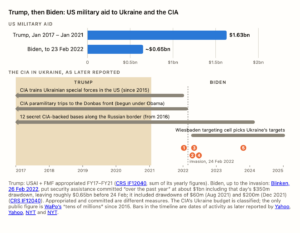
Trump: USAI + FMF appropriated FY17–FY21 (CRS IF12040, sum of its yearly figures). Biden, up to the invasion: Blinken, 26 Feb 2022, put security assistance committed “over the past year” at about $1bn including that day’s $350m drawdown, leaving roughly $0.65bn before 24 Feb; it included drawdowns of $60m (Aug 2021) and $200m (Dec 2021) (CRS IF12040). Appropriated and committed are different measures. The CIA’s Ukraine budget is classified; the only public figure is WaPo’s “tens of millions” since 2015. Bars in the timeline are dates of activity as later reported by Yahoo, Yahoo, NYT and NYT.
Feral Finster
1. Of course the United States and its catamites did everything in their power to provoke Russia, when when Russia didn’t respond, provoke more. When Russia did respond, they screamed bloody murder.
It worked. Russia’s response, when it finally came, has been limp. This has won them only contempt. Dumbfucks want so bad to be part of the club, to be allowed to sit at the high table.
2. Speaking of Team D and the neocons, they have the money and power. Any dissenting candidates that get through will be co-opted or sidelined.
https://www.donotpanic.news/p/the-mamdani-con-is-complete
Normies always lose to sociopaths because normies are constrained by morality, which sociopaths use as a weapon.
Greg
“we will only continue hurtling toward the undeniable end of the American Republic”
And that’s bad?
No, really, I’m asking.
Mark Level
Very thorough as usual, thanks Nat. I’ll mostly agree with Finster, Russia could’ve come in much stronger initially, but wants to be (evidently the Leadership does) in the Kewl Kids’ Globalist Club. Not too strong on slapping around the Genocidal State, even when Zelensky blustered (high on Coke) that Ukraine would be “Big Israel” in the Ukraine and slaughter all the Slavic Untermenschen.
I note that even now China won’t let the Iranians crash the Global Economy further, seeks “restraint,” etc. But I guess even if the Mills of Justice in Eurasia grind slowly against the Banderist/ Waffen SS wannabe state, their days are limited. And the fantasy that Europe and the Baltic Slugs can fund a war contra Russia in 2029 or ’30 seems coke-fiend delusional as well.
Some ugly dreams never die. “The South Will Rise Again”, the 5th Reich (USA clearly the fourth)? Methinks not. And Like and Subscribe, Tallifer, Beau of the 5th Column et al fed the Ukrainians into the Wood Chipper. Great job!! Then just slunk away . . .
Nat Wilson Turner
@Greg I do believe it’s bad. The disruptions suffered by the Romans as their Republic collapsed were brutal for patricians and plebes alike. I think our republic really died after WW2 but the mask of democratic governance is coming off and once we have no pretense to protect us, I expect the brutality will be immense and awful.
Greg
Thank you for the response – For the record I see it the same way, but given the multiple crises globally I doubt there’s any way to avoid it.
But yes, brutal, agreed.
I mean sure, people could band together, cooperate, and work on solving these issues, but my reading of history says that is unlikely.
Best of luck,
Feral Finster
@Greg:
The American Republic is surely ended, but what is coming is The American Empire, ruled by naked force and not even bothering to pretend otherwise.
@Mark Level:
Yes, Russia desperately wants to be allowed to join the Cool Kids Table. China simply wants to be allowed to sell things and make money.
The West, of course, will burn everything down, if that is what they must to not to lose their perch.
That is why they always win. The most aggressive and ruthless always do.
Greg
“@Greg:
The American Republic is surely ended, but what is coming is The American Empire, ruled by naked force and not even bothering to pretend otherwise. ”
You surely don’t mean the American Empire that just lost a war to — check notes — Iran?
Look, I get that the “American Empire” would love to be the brutalist regime that rules the world, and it already did, from as — check notes — our friend Nat notes, from WWII to the present.
But as others in this forum have pointed out, America ain’t shit anymore. It’s ruled by the stupid, for the stupid and of the stupid.
I’m more worried about general civilizational collapse and descent into warlordism, or as better referred to, multinational corporatism.
I’m sure the murders, mayhem and collapse of global civilization will continue until attitudes improve.
Best wishes,
spud
from ford to bush I, i started to see the long downhill slide. capitalism can only work with a robust socialist state.
but to understand today, it was 1993-2001 that set the world on fire.
https://en.wikipedia.org/wiki/Iraq_Liberation_Act
“Iraq Liberation Act of 1998
Great Seal of the United States
Long title An Act to establish a program to support a transition to democracy in Iraq.
Acronyms (colloquial) ILA
Nicknames Iraq Liberation Act of 1998
Enacted by the 105th United States Congress
Effective October 31, 1998
Citations
Public law 105-338
Statutes at Large 112 Stat. 3178
Codification
Titles amended 22 U.S.C.: Foreign Relations and Intercourse
U.S.C. sections amended 22 U.S.C. ch. 32, subch. I § 2151
Legislative history
Introduced in the House as H.R. 4655 by Benjamin Gilman (R–NY) on September 29, 1998
Committee consideration by House International Relations
Passed the House on October 5, 1998 (360–38 Roll call vote 482, via Clerk.House.gov)
Passed the Senate on October 7, 1998 (Passed unanimous consent)
Signed into law by President Bill Clinton on October 31, 1998
Wikisource logo
English Wikisource has original text related to this article:
Iraq Liberation Act
The Iraq Liberation Act of 1998 is a United States Congressional statement of policy stating that “It should be the policy of the United States to support efforts to remove the regime headed by Saddam Hussein from power in Iraq.”[1][2] It was signed into law by President Bill Clinton, and states that it is the policy of the United States to support democratic movements within Iraq. The Act was cited in October 2002 to argue for the authorization of military force against Iraq.”
———
Bill Clinton’s administration pursued NATO expansion into Eastern Europe, which included countries near Russia’s borders, despite significant opposition from Russian President Boris Yeltsin. This expansion was seen by Yeltsin as a “humiliation” for Russia and a potential threat to its security.
George Washington University Peoples World
NATO Expansion Under Bill Clinton
Bill Clinton’s administration actively pursued NATO expansion into Eastern Europe during the 1990s. This strategy aimed to include countries that were formerly part of the Soviet sphere of influence, bringing NATO closer to Russia’s borders.
Key Aspects of NATO Expansion
Motivation: The expansion was driven by a desire to strengthen European security and support democratic governance in post-Soviet states.
Opposition from Russia: Russian President Boris Yeltsin viewed NATO’s eastward expansion as a “humiliation” for Russia. He expressed concerns that it posed a threat to Russian security and sovereignty.
Diplomatic Tensions: The relationship between Clinton and Yeltsin was complicated. While Clinton sought to engage Russia, he also pushed for NATO enlargement, leading to significant diplomatic friction.
Timeline of Events
Date Event Description
January 1994 Clinton announces the Partnership for Peace initiative.
December 1994 Yeltsin publicly criticizes NATO expansion at a summit.
1997 NATO-Russia Founding Act signed, but Yeltsin remains opposed to NATO’s eastward movement.
Clinton’s NATO expansion policy was a pivotal moment in post-Cold War geopolitics, significantly impacting U.S.-Russia relations and contributing to ongoing tensions in the region.
George Washington University Council on Foreign Relations
Boris Yeltsin strongly opposed NATO’s expansion towards Russia’s borders, viewing it as a “betrayal” of the Russian people and a source of humiliation for Russia. He expressed his concerns repeatedly to U.S. President Bill Clinton, emphasizing that such moves would threaten Russia’s security and status as a great power.
George Washington University Peoples World
What were the long-term implications of NATO expansion for U.S.-Russia relations?
NATO expansion has significantly strained U.S.-Russia relations, contributing to perceptions of security threats in Russia and fostering a sense of national humiliation. This has led to increased tensions, military conflicts, and a deterioration of diplomatic ties between the two nations over the decades.
russiamatters.org retroreport.org
https://responsiblestatecraft.org/2022/02/13/the-clinton-era-blunder-that-set-the-stage-for-todays-ukrainian-crisis/
“Understandably enough, commentaries on the crisis between Russia and the West tend to dwell on Ukraine. After all, more than 100,000 Russian soldiers and a fearsome array of weaponry have now been emplaced around the Ukrainian border. Still, such a narrow perspective deflects attention from an American strategic blunder that dates to the 1990s and is still reverberating.
During that decade, Russia was on its knees. Its economy had shrunk by nearly 40%, while unemployment was surging and inflation skyrocketing. (It reached a monumental 86% in 1999.) The Russian military was a mess. Instead of seizing the opportunity to create a new European order that included Russia, President Bill Clinton and his foreign-policy team squandered it by deciding to expand NATO threateningly toward that country’s borders. Such a misbegotten policy guaranteed that Europe would once again be divided, even as Washington created a new order that excluded and progressively alienated post-Soviet Russia.
The Russians were perplexed — as well they should have been.”
———–
Bill Clinton’s administration oversaw NATO’s expansion, which included the Baltic states, effectively surrounding Kaliningrad, Russia’s westernmost exclave. This strategic move brought NATO forces right up to Russia’s borders, raising tensions in the region.
ineteconomics.org engelsbergideas.com
NATO Expansion Under Bill Clinton
During Bill Clinton’s presidency, NATO underwent significant expansion, which included the admission of the Baltic states. This strategic decision effectively brought NATO forces to the borders of Russia, particularly surrounding Kaliningrad, Russia’s westernmost exclave.
NATO’s New Members: The Baltic states (Estonia, Latvia, and Lithuania) joined NATO, which was a pivotal moment in the alliance’s history.
Kaliningrad’s Strategic Position: Kaliningrad became encircled by NATO member states, raising security concerns for Russia. This territory is now bordered by Poland and Lithuania, both NATO members.
Impact on U.S.-Russia Relations: The expansion was seen as a provocative move by Russia, contributing to heightened tensions between the U.S. and Russia during and after Clinton’s administration.
Implications of the Expansion
Aspect Details
Geopolitical Tension NATO’s proximity to Kaliningrad increased fears of military confrontation.
Russian Response Russia viewed the expansion as a threat, leading to a more aggressive military posture.
Long-term Consequences The encirclement of Kaliningrad has continued to influence NATO-Russia relations.
The expansion of NATO under Clinton not only reshaped the security landscape in Europe but also set the stage for ongoing geopolitical challenges in the region.
russiamatters.org Columbia University
————-
Bill Clinton’s intervention in the Yugoslav Wars, particularly in Kosovo, marked a significant shift in international law by establishing the precedent for NATO to conduct military operations without UN approval, focusing on humanitarian intervention. This approach influenced future international relations and military engagements.
Wikipedia Miller Center
Bill Clinton’s Impact on International Law
Humanitarian Intervention and NATO’s Role
Bill Clinton’s administration significantly altered the landscape of international law through its military intervention in the Yugoslav Wars, particularly in Kosovo. This intervention established a new precedent for NATO, allowing military operations to be conducted without explicit approval from the United Nations. The focus was primarily on humanitarian intervention, which aimed to protect civilians from atrocities.
Key Aspects of the Intervention
Aspect Details
Context The intervention was a response to ethnic cleansing and humanitarian crises in Kosovo.
NATO’s Action NATO launched a bombing campaign against Yugoslavia in March 1999, marking a historic first.
Legal Precedent The operation was conducted without UN Security Council approval, challenging traditional norms.
Outcome The intervention led to the withdrawal of Serbian forces from Kosovo and the establishment of a peace plan.
Clinton’s approach to the Yugoslav conflict influenced future military engagements and international relations. It set a precedent for the justification of military action based on humanitarian grounds, impacting how nations respond to crises globally. This shift has been both praised for its moral implications and criticized for bypassing established international legal frameworks.
Wikipedia Miller Center
NATO’s 1999 Kosovo intervention raised legal questions under the UN Charter and NATO’s own treaty, with critics arguing it violated sovereignty and bypassed UN Security Council authorization while supporters cited humanitarian motives and NATO’s New Strategic Concept. The U.S. Court of Appeals later dismissed a challenge to President Clinton’s action under the War Powers Resolution, effectively weakening that law as a constraint on presidential war-making.
Wikipedia papers.ssrn.com
NATO’s Kosovo intervention without UN approval drew criticism for violating international law and undermining the UN Charter’s prohibition on the use of force, as it bypassed the Security Council where Russia and China would have vetoed authorization. Critics also argue the operation set a precedent that could enable future unauthorized interventions and led to unintended consequences like Kosovo’s eventual independence and prolonged NATO peacekeeping presence.
EveryCRSReport digitalcommons.wcl.american.edu
———
really russia, china, and i still think Iran really do not understand what they are up against. but north korea does!
bruce wilder
I don’t understand what references to the “Kewl Kids’ Globalist Club” or “Cool Kids Table” are meant to express.
From a Russian point of view, they don’t have a lot of great options. The 2022 invasion was a desperation move, after earlier attempts to negotiate a settlement or have their interests respected failed repeatedly. They had planned for what they got in 2022 only preliminarily and imperfectly. They are in a better position militarily now, but without great options to take advantage. The Russians have underestimated just how determined to be irrational the Europeans are. Irrational in the sense of being willing to inflict considerable costs on themselves and risk destructive conflict breaking out. The EU and NATO have taken some extreme steps in support of their determination, including some extreme relative to previous commitments to liberal principles. They have brought back piracy in the Dover Straits, threatened the integrity of critical financial custody arrangements, have persecuted Jacques Baud among others for the sin of having views favorable to Russia, and seemingly tolerated the destruction of Nordstream.
My point is that, from a Russian POV, it is hard to configure an offer of carrots to a counterparty so eager to apply sticks to itself and to its previous ideological commitments.
If Russia doesn’t rush to the brink of WW3, aside from its own natural reluctance to bear the cost and destruction that might follow, but also because it isn’t sure Europe could understand the threat and respond within a framework of rational assessment of what futures are desirable.
Feral Finster
Russia simply wants to be accepted. They want to be liked. They refuse to admit that need to be feared. Of course Russia’s interests are not respected – Russia does not make anyone respect them.
Yes, the invasion of 2022 was poorly planned, it was something that the Russian government clearly did not want and since that time it has seized on any possibility of negotiations like a drowning man grasping anything that might float. Of course, Russia only had eight years to get ready, when it should have been obvious from the outset that Minsk-2, like Minsk before it, was nothing but a sham intended to buy time for Ukraine.
Russia was foolish not not have finished Ukraine off in 2014. Russia has been nothing but foolish since then, which it why they keep getting abused. See: Istanbul, the Azov Prisoner Sham, The Odessa Grain Sham, Anchorage, and the recent Kushner-Witkoff shuttle diplomacy.
Russian dithering, incompetence and indecision have spurred on european aggression. One sees similar behavior in jackals and hyenas.
“The EU and NATO have taken some extreme steps in support of their determination, including some extreme relative to previous commitments to liberal principles. They have brought back piracy in the Dover Straits, threatened the integrity of critical financial custody arrangements, have persecuted Jacques Baud among others for the sin of having views favorable to Russia, and seemingly tolerated the destruction of Nordstream.”
All true. So, what does Russia propose to do about it? NATO methods are hypocritical and cynical. So what? They work.
Feral Finster
@Greg:
“The American Republic is surely ended, but what is coming is The American Empire, ruled by naked force and not even bothering to pretend otherwise. ”
You surely don’t mean the American Empire that just lost a war to — check notes — Iran?”
We’ve seen how many premature declarations of victory already? They haven’t lost anything yet.
I suspec that they’ll go nuclear, after the midterms.
No, Russia and China will not do jack.
mago
One sees similar behavior in jackals and hyenas.
Perfect.
And perfect coming from the Feral one who’s hung out in the Ruskie Ukie orbit as I recall.
bruce wilder’s comments are well reasoned as well. I’m inclined towards a combo of the two for whatever my nickle’s worth. Less than the dime it came in on I’m sure.
bruce wilder
Russia is feared but not respected — an unfortunate combination.
The extremities of fear and loathing felt by ethnic /linguistic factions against all things Russian are difficult to overestimate. As in Ukraine, the actual numbers of Russophobes can be relatively small, but fierceness makes up for numbers and often drives national policy to be hostile to Russia.
The collapse of the Soviet Union left behind Russian minorities across Eastern Europe, with their political status and rights an open question and nationalist parties suspecting the Russian-speaking of being fifth columnists. The Communist economy imposed by the Soviets was blamed on the Russians, who were suspected of draining resources and prosperity away toward Moscow; that this was generally not true — Russia, if anything, commonly subsidized its dependents in the Soviet constellation in the hope of pacifying them. The problem was that the Soviet system impoverished everyone and the resentment of privileges accorded even minor Russian “experts” and party officials ran high.
I emphasize again that these resentments and grievances against Russians as neighbors and local “squatters” are emotional and fundamentally irrational — irrational in that substantial costs are willing to be borne to punish and expel ethnic Russians. There can be an attitude of righteousness, of “what’s mine is mine, what’s Russia’s is negotiable” alongside an amazing absence of self-awareness. The equivalent of Bandera worship is hardly unique to Ukraine.
The Finns were allies of the Nazi’s in enforcing the siege of Leningrad but no one on the Finnish side seems to aware of Putin’s probable personal sensitivities (his parents barely lived thru it, his oldest siblings did not). Various Finnish military units had to remove swastikas from traditional unit insignia when Finland petitioned to join NATO.
Finland, after WWII, steered a course of accommodation under Urho Kekkonen that was very successful materially and in international relations status terms. The fundamental compromises that comprised that cautious accommodation seem to have been resented and are now rejected.
The details of how Russia — which is, after all a pale shadow of the Soviet Empire in terms of population and raw material resources — has lost its fearsomeness for but not the hostility of later generations among its neighbors is documented. Russia today has a population of ~140 million compared to ~170 million on the eve of World War II (total Soviet Union: 195 million; US population in 1940, 132 million. The U.S. today is 330 million.
The Soviet Union was deliberately not “Russian” per se but Russians were used in places as counterweights to local ethnic majorities. Today’s Russia is more linguistically and ethnically cohesive. Only in the Caucasus are there constituencies with Russian minorities, but there are no local ethnic or linguistic majorities either. One thinly populated Siberian province has a non-Russian ethnic majority, if I recall correctly.
The relict Russian minorities outside Russia are problems to be solved by nationalists, which creates mutual hostilities with a Russia which wants to protect its diaspora as well as lodge some hope that ethnic Russians might form the kernel of friendly relations to offset the hostility of the resentful. Imperial Russia sponsored the independence of various Slavic and adjacent populations to counter both the Ottoman Turks and the Hapsburgs, whose power was more threatened by the rise of nationalities to claim territorial states. Serbia, Bulgaria, Romania, Greece, Georgia, and Armenia have their Russophiles as a result. The contest with NATO/EU has simply been intensified in these cases, so not necessarily modern bright spots in Russian foreign policy.
From the POV of the U.S. or the Western European Powers (UK, Germany, France, Italy), it would be logical in the interest of peace and mutually beneficial economic cooperation and integration to dampen the hostilities and related centrifugal forces related to Russophobia in Eastern Europe and the Caucasus. Of course, that is not the policy pursued.
The question of Russia’s policy response options are. If Russia remains rationally calculating, it is hard to see a superior play to the displays of closely calculated, self-restrained force employed for limited aims. This is, indeed, a display of “come negotiate”. The collective West is responding with temptation to “FAFO”.
spud
the russian leadership today still desperately clings to the towering intellectual mental midget Gorbechev’s, that his vision was right. i have seen in all my life, of those that attain power, and never really had a original thought of their own.
they become disasters!
you gotta wonder how long will it be till the current russian leadership, capitulates on Kaliningrad, in a desperate hope of appeasement?