The horizon is not so far as we can see, but as far as we can imagine

Tag: lost generation

Are The Boomers To Blame For America’s Decline?

It’s common to slap all the blame on Boomers, but it’s not really fair, though they certainly did plenty of harm. (Yes, some Boomers, elites are more to blame, yadda, yadda.)

But it wasn’t just the boomers. The so-called Reagan Republicans included a ton of GI Generation and Silents. The issue is that the people who created the FDR system weren’t GI Gen, they were Lost and Missionary generation. GI Gen and later lived in the economy created by those generations, but they didn’t really understand how and why it worked because they weren’t adults during the 1920s, so they didn’t get what it was reacting against or what it was trying to fix and avoid a recurrence of.

GI Gen and Silent leaders looked at all the rules FDR and co had put in place and they didn’t really understand why they existed: the rules looked stupid, there seemed to be tons of them,  and they figured “we’re smarter than they were, we won’t do stupid things and life will be a lot easier with less regulation.”

Well that was the rationalization: the other issue was simple enough. Getting rid of the rules let a lot of people become rich and even the middle class thought they’d benefit (and many did, with rising housing and stock prices and lower taxes.) The rules had, quite explicitly, been intended to make sure there couldn’t be another Gilded Age nor another roaring twenties — no stock bubbles, no super rich.

But, of course, a lot of people, especially with power, wanted to become super-rich, or at least richer and getting rid of the rules that were meant to stop that was a no-brainer. Enough middle class people were convinced to go along, and enough racists also joined in (Reagan and Nixon ran heavily on racism.) So a coalition was created which destroyed what had come before.

This started before Reagan, as someone will chime in to tell us, but Reagan was the formalization, the big break.

It happened because people wanted unearned wealth, and because the old system had broken (oil spikes, end of Bretton Woods, end of gold money, staglfation, and no one knew how to fix it (or no one anyone was willing to listen to) because the architects were all old or dead.)

So when offered “you can get rich or at least affluent without work and stick it to the niggers too” a lot of people took that deal. It wasn’t just the Boomers—Silents and GI were key to it, more key than the Boomers in the early years. It’s just that they’re all dead now so we blame the Boomers. Gen-X was complicit, but were still children when the key changes were made.

Boomers get all the blame, but they didn’t start the fire that burned down the old order, they simply threw fuel on it (Clinton, especially) when they could.

This site is only viable due to reader donations. If you value it and can, please subscribe or donate.
Verdun Then and Now

Thirty-one years ago on my first trip overseas I visited Verdun in France. Specifically to see the battlefield of Verdun, where von Falkenhayn sought to bleed the French white. From 21 February 1916 to 18 December 1916, 9 months, 3 weeks and 6 days the Boche–the term the French used for the Germans–did exactly that. I’d written my senior’s honor thesis in history on Verdun and felt it was right to visit.

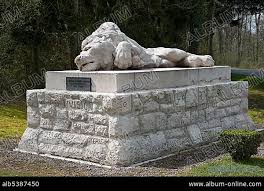
Fallen Lion of France at the Verdun Battlefield

I’m not going to go into too much detail. You can read about it in its fullness here. I only want to add a few things. First, this was the first time any general attempted a strategy of attrition. Some of what Grant did during the Wilderness and the siege of Fredricksburg is semi-attritional, but it wasn’t Grant’s spoken intent as it was the explicit aim of the Cheif of the German General Staff Erich von Falkenhayn’s. He knew he could not break through the ring of forts surrounding the Meuse Heights and the medieval city of Verdun. His aim was to take the heights and dig in and then take the strategic defensive, forcing France to regain her honor at any cost. 50 German divisions squared off against 75 French. von Falkenhayn succeeded in forcing France’s hand, certainly. In the end his strategy was a failure and he was dismissed by the Kaiser and replaced by Ludendorff and Hindenburg, who quickly established a military dictatorship over the Second Reich for the remainder of the war. Needless to say that over a million men–French and German–died fighting in the trenches along and up the heights and into the forts Douamont and Vaux trading them back several times.

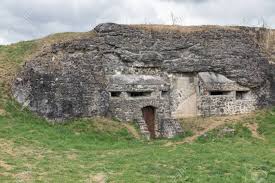
Fort Douamont on the Meuse Heights

If the Miracle on the Marne was the most important battle of the 20th century–and it was we ought paraphrase Churchill and call it France’s finest hour. That being so makes the Battle of Verdun one the finest last stands in the annals of human endeavor. To a man the good, stolid French poilus stood and died in the mud, the filth, the lice, the decaying bodies and the artillery shells shattering overhead all day long, every day for almost a year.

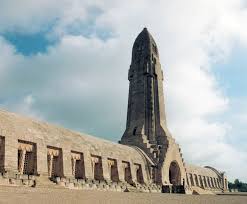
When I visited in 1994 I walked from the city of Verdun all the way up the heights along the single supply route the French called the “voie sacrée” – the sacred way. It was ten miles there and ten miles back. A long day. I walked through trenches, both forts Douamont and Vaux and at the end of the day I walked, rather solemnly through the hallowed arches of the Ossuary, which holds the bones of over 130,000 unidentified French and German soldiers. There was no entrance fee for anything and I was free to roam just about anywhere I wished, except when I saw signs that declared, “Non! Munitions non explosées!” Unexploded ordnance, still active almost a hundred years after being fired.

Ossuary of Verdun

So this morning I watched a video made by a young French woman of the battlefield and its environs. A lot has changed. There is a new, modern museum, and to walk the grounds and see the museum cost about $20. The young woman does an admirable job of guiding the viewer through the most important parts of what I now guess is a monument park of sorts called Mémorial de Verdun Champ de bataille. She’s tactful, sincere, respectful and cognizant of the sacrifice the men made for her. She honors them in her own way. I was pleased to see their sacrifice is still remembered and revered. (As some of you may recall, I had the good fortune to befriend an American WWI veteran in the 1990s before he passed away. So, WWI is important to me, I carry the memory of one of the last American soldiers to fight in the war and I cherish that memory.) She also pays her respects to the Germans who fell during the battle (part of the site was re-dedicated in the 50’s after the Franco-German rapproachment after WWII). She even visited the graves of our doughboys who fought in the area in 1918.

In all honesty, I can’t say I would have enjoyed walking through the museum. Of course seeing the uniforms and the kit of the poilus was fascinating, but there was a rich, chilling awe of gravitas to my imagination that day as I walked through the empty echoing halls of forts Douamont and Vaux. There were no wax figures as there are now. Only a haunting silence. If I listened closely enough I could almost hear the distant echoes of incoming artillery. The shots of mausers. The cracks of the countering French Berthiers. And the loud pops and booms of French and German grenades.

Sometimes less is more.

Regardless, it was an unforgetable experience.

Powered by WordPress & Theme by Anders Norén