I’m not a big fan of Canada’s Prime Minister Carney, the guy who blew two housing bubbles: one in Canada then another in the UK. He’s a neoliberal’s neoliberal.
But unlike most he is neither stupid nor a coward.
It was looking like there would be a Canada/US trade deal, and honestly? I was worried what Canada had given away to get it.
But then according to Carney (the US denies, but the when the Trump administration’s lips are moving, they’re lying), they added a bunch of last minute additions.
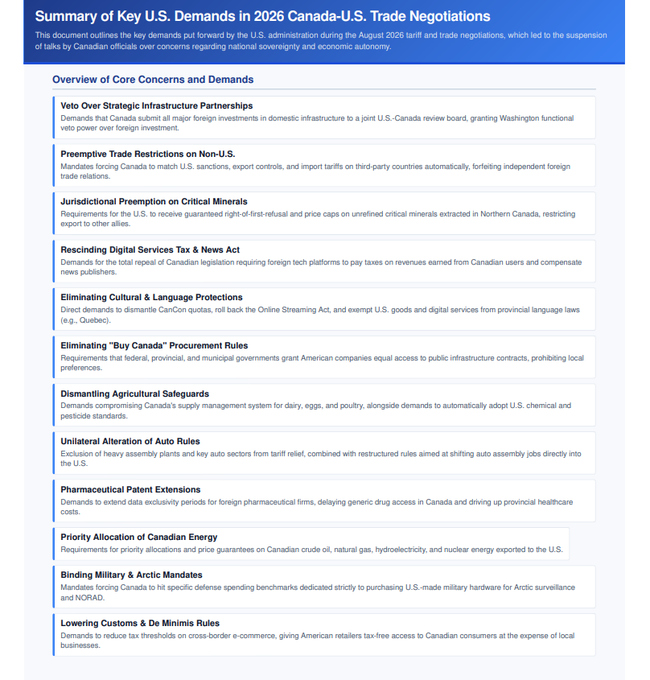
These are pretty close to annexation without the troops: the US would control Canada’s trade and have first call on all its minterals and would have altered our internal laws to suit them. I’m particularly intrigued by America wanting an end to Quebec’s language sign laws: what the hell does that have to do with the US?
It’s always hard to tell what is going on in the Trump administration, but these demands seem calculated to force Carney to refuse. He’d lose the next election if he agreed, the backlash would be immense. Certainly he would have been crushed in Quebec, and without Quebec he has no route to victory.
Moderately sane and informed American officials would know this. So, normally, one would assume they deliberately spiked the talks.
But this is the Trump administation, full of some of the stupidest and most ignorant people on Earth, ruled by a senile old man with the attention span of a grasshopper on cocaine.
So maybe they really figured “Canada has to do what we tell them to!’
Instead, the vast majority of Canadians support Carney, even prairie westerners who usually hate his guts.
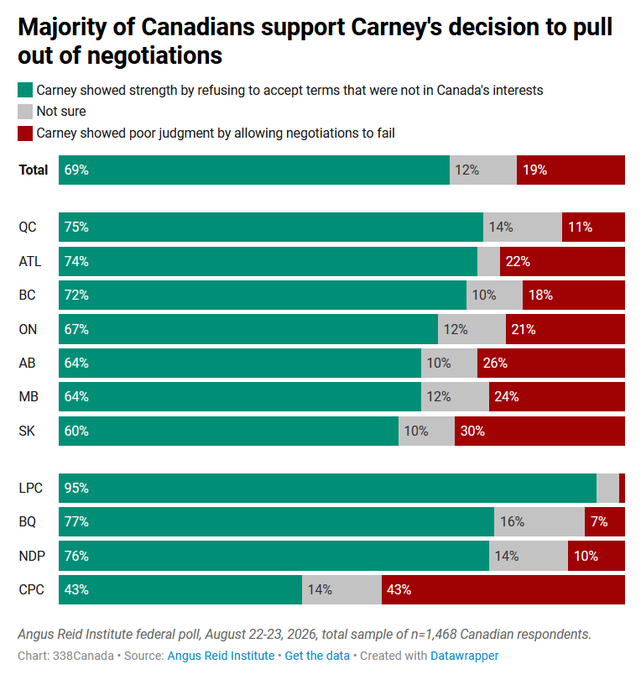
And fortunately it worked out for the best. They pushed a strong hand way too far. The truth is that Canada has a ton of trade with America and is very vulnerable.
But the longer term truth is this: there’s nothing Canada buys from the US it can’t get somewhere else, often for a lot less (hello China) and there’s not much Canada exports that it couldn’t sell to nations other than America. We’re in a bad position because against the opposition of the majority of Canadians a feckless previous Prime Minister signed trade deals with the US which increased integration.
But what was done can be undone, because Canada is not naturally dependent on America.
One argument I keep hearing from Americans is that Canada needs America to defend it. To which the answer is a question: “From whom?”
The truth is that no one but the US is actually an invasion threat to Canada. Second biggest country in the world. Separated by large oceans or thousands of miles of land from every country in the world except America. The only nation America protects us from is America, and that’s what’s known as a protection racket.
Generally I don’t believe in making deals with Trump. No deals at all. He doesn’t keep his deals and if you make any concessions he always assumes that means there’s more to be had and comes back again with more threats.
The task for Canada is, indeed, to diversify away from the US. Trump is doing us a favor. If he’d offered a slightly shitty deal, we’d have accepted it. If he’d asked only for the moon, not the stars, he’d have gotten it. By making demands no Prime Minister could accept without losing the next election, demands which amount to “we control your trade relations with everyone else going foward” Trump made it possible for Carney to tell him no on the entire package.
And while that will suck for Canada; while Canada will be hurt by a trade war: it’s forcing us to do the right thing rather than put it off or do it slowly.
So I’d like to thank Trump.
“Thank you President Trump, for being a complete and utter asshole with the IQ of a squash and no empathy or kindness at all Any President slightly smarter of slightly more able to understand other people could have had Canadian elites giving them cheap everything Canada has an integrating with the US even more. But you keep showing why that’s impossible and stupid.”
Now we just need a strong military deterrent. We have a lot of mountains and Iran has just shown us how to use them.
What I write here is for the benefit of everyone, but alas, I live in capitalism and I, and the site, take money to keep running. If you value the writing here and can, please subscribe or donate.
cc
Agreed, Trump is making the indoctrinated world see the Empire more clearly.
This is the ultimate confirmation for the entire world that the US is simply not-agreement-capable, when not just countries like Russia, China, Iran, but even its closest and most cooperative (euphemism for obedient) ally (euphemism for vassal) gets shafted.
Trump first tore up the decades-old NAFTA agreement and replaced it with his own USMCA/CUSMA, and now – only a few years later – has gone back on the deal that he himself asked for and signed. And this isn’t just just about Trump: In 2008, Barack Obama and Hilary Clinton also threatened to “renegotiate” NAFTA or pull out.
The clear lesson for foolish countries eager to bend over to please the US is that even the country that has bent over the most for the US for years, that has gone out of its way to please the US the most for so many years, will end ultimately up receiving a raw deal from the US.
cc
The US once again trying to control our trade relations with everyone else going forward. As a reminder:
In 2018, Canada (in the first years under Justin Trudeau) had, commendably, actually been trying to diversify our trade away from just the US, primarily through pursuit of a trade deal with China, an important and growing market.
The US, in Trump’s first term, actively foreign-interfered and foreign-meddled in Canada to stop that democratic and sovereign Canadian choice: first going out of their way to overturn the long-established NAFTA agreement and explicitly insert an unprecedented clause into CUSMA/USMCA to discourage trade deals with so-called “non-market countries” – a naked euphemism for China: that clause was widely recognized and reported as the “anti-China clause”, clearly aimed at very strongly discouraging a Canadian trade deal with China.
Just 8 weeks later, to further ensure that our government would not – could not – resume its prior sovereign decision to pursue increased trade with China, the US then got Canada to detain and arrest the Huawei CFO on a stop-over on her way to Mexico. Justin Trudeau, eager to please Trump and the US – especially after Trump called him weak and two-faced after the 2018 G7 in Quebec – foolishly and eagerly fell for the trap, and that arrest and her subsequent multi-year detainment destroyed the previously good relations between Canada and China, ensuring that Canada would not be able to significantly diversify its trade from the US to China.
In the subsequent years, the US only continued its campaign to influence the Canadian politicians, media, and public against China. The Uighur oppression narrative was pushed, much of it hinging on just one or two highly questionable reports, including one from ASPI, the “Australian Strategic Policy Institute”. ASPI has recently been revealed to have been funded by USAID, a US State Department organization used to fund NGOs, think tanks, and opposition groups in other countries to influence and interfere in those countries. As a result of those concocted and planted narratives, Canada’s sheep-like parliament even voted to officially condemn China of “genocide” in 2021, further destroying the relations and the path that Canada had been pursuing as a sovereign nation up until mid-2018. (But of course, Parliament has stayed silent about the horrific genocide in Gaza.)
This was then conveniently followed by accusations of “foreign interference”/”foreign meddling”, largely associated with China, leading to Canada holding a much publicized commission, further destroying those ties and pathways. Were these accusations also fed by foreign actors seeking to influence Canada’s democracy? We have yet to hear which foreign actors these reports came from or what evidence they gave. Did they ultimately originate from the US, perhaps by way of their many deeply-integrated channels of influence into Canada? The likes of CSIS, ex-CSIS figures, the Privy Council, and our establishment news media, have continued to actively push foreign-seeded narratives designed to hinder Canadian economic, and thus political, independence. Are they really defending Canadian sovereignty or are they in fact serving as unwitting vectors and vehicles to help weaken and dismantle Canadian sovereignty?
Again, the lesson for Canada is that we absolutely must diversify our trade to end this unhealthy and dangerous over-dependence on the US.
Feral Finster
No small amount of truth in this.
Not sure how Canada is going to develop this military deterrent, but I get the point.
cc
Speaking of reducing our overdependence on the US, why hasn’t the Carney government stepped in to evaluate and stop the RBC/BMO sale of Moneris to a US corporation?
Allowing that sale to go though would mean that 1 in 3 payment transactions in Canada would go through a foreign, US, entity.
That would be greatly increasing, not decreasing, the ways the US can control and coerce Canada.
The Carney government vaunts a “Protecting Privacy and Consumer Data Act”. How is allowing one-in-three Canadian payment transactions to be handled by a foreign company “protecting” the privacy of Canadians or of our consumer data from the ultimate surveillance state next door?
Carney minister Evan Solomon stated that Canada needs to create a sovereign digital economy that is “free from coercion.” Just how is handing over one in three Canadian payment transactions to a foreign company not making Canada far more vulnerable to coercion from the ultimate coercive state next door?
Dozens of academics and experts even wrote an open letter to Carney urging him to “defend Canada’s digital sovereignty”. So will Carney now defend our digital sovereignty and disallow this sell-out of our data and sovereignty? Or will he just let it be sold off?
“We’re now going to have what has been a Canadian data-processing company that has access to everybody’s purchasing habits … available to other governments. [..] Canadians should be concerned because this is their information.”
– The Privacy and Access Council of Canada
Remember, the US M.O. or strategy is to make other countries dependent on them, and then, once that dependence is established, to exploit and abuse that dependence for profit. Pimps do that, too. The phrase “This is the Way” comes to mind – as in, this is the US way, this is the Epstein way.
The number one provenance of foreign influence and interference – and of extortion/coercion – against Canada is hands-down the US. The overt “51st state” rhetoric campaign is only the small visible tip of the long-time massive iceberg of US foreign influence/interference/meddling/coercion against Canada that many people are taught (conditioned) to not worry about.
The Moneris sale would only increase their overwhelming coercive leverage over us.
Mark Pontin
Ian W: ‘But the longer term truth is this: there’s nothing Canada buys from the US it can’t get somewhere else, often for a lot less (hello China) and there’s not much Canada exports that it couldn’t sell to nations other than America. ‘
True. But more than that, much that the US buys from Canada it can’t get somewhere else. If Carney wants to play hardball, he can hurt the US as much or more than China has with REs.
The U.S. is structurally dependent on Canada for heavy crude oil needed by US refineries (especially Midwest + Gulf Coast), pipeline natural gas for northern US states,
NGLs used in petrochemicals and blending, and cross‑border electricity flows (especially New England and the Great Lakes).
If Canadian supply stopped tomorrow, US refineries would lose two‑thirds of their imported crude and U.S. gas markets would lose essentially all imported pipeline gas. The US would have to scramble for alternative heavy crude (Venezuela, Mexico), which is politically and logistically difficult.
So, as with the REs and much else, the Trump gang has once been guilty of incompetence so monstrous it’s matched only by their arrogance. Morons so moronic that even if anyone wanted to help get them — and everyone’s sick of the US at this point — they’re on a controlled flight into terrain.
Mark Pontin
Feral Finster: ‘Not sure how Canada is going to develop this military deterrent’
Easily. Canada’s CANDU reactors produce plutonium — indeed, are excellent plutonium producers in physics terms. Canada doesn’t separate it and that plutonium remains locked in spent fuel under IAEA safeguards. But that could change.
And plutonium is what you want. Nobody’s built a serious nuclear weapon from enriched uranium since Little Boy was dropped on Hiroshima eighty years ago, and the US only did that to use up what they had at Los Alamos. Plutonium is what Trinity and the Fat Man devices both used, and what modern thermonuclear and boosted fission weapons use. Period.
StewartM
Military deterrent? Canada doesn’t need that much.
The Iran war is showing the cracks in the US military; with a funding system that overpays corporate “people” to a degree (so that the money can be cycled back to support conservative politicians, both in their campaigns and funding their cushy post-career “retirements”) that there’s no money to actually supply the sailors and troops:
https://www.19fortyfive.com/2026/03/11-aircraft-carriers-on-paper-only-3-5-combat-ready-the-iran-war-is-exposing-the-u-s-navys-supercarrier-force-at-the-breaking-point/
https://www.19fortyfive.com/2026/03/2-aircraft-carriers-down-1-breaking-apart-the-u-s-navy-is-running-out-of-supercarriers-during-the-iran-war/
Living conditions on US ships is deteriorating. And there’s not even shipyard capability to keep them up.
This is all the result of our business class “geniuses” (Hi, Elon Musk!) who count success by paper metrics and not on the ability to produce and maintain good-quality stuff.
And honestly, I think that if Trump called for an invasion into Canada there would be mass desertions and surrenders. There’s absolutely no public support for this, save possibly for some capitalist types (recall on the article “Ship of Fools”, written during the Iraq war, some rightwinger bizzarely moving breakfast items around the table telling how he’d take this country’s oil, then that country’s etc.).
Heck, I’m not even sure that the US would defend itself. I commented on this YT:
https://www.youtube.com/watch?v=-A0wc0Zg1is
My comment:
The flaws in your argument?
1) While you admit that the NATO countries may not have a unified command structure, that would be even MORE likely for the various militia units. In fact, in most insurgencies against foreign occupation the insurgents fight each other as much if not more than they fight the invader. At the very least, they would be equally uncoordinated, unless there was some unifying leader (say, someone like Mao, or Tito).
2) Two, related to this, of the leader of the militia was someone who seemed dangerous to ordinary US citizens, these might actively work as informants for the invaders, or even join them. We’re not talking being invaded by a Hitler wanting to murder most of the population, but by democratic countries. At the very least, they might deny the insurgents the things they need to fight. This would drive the insurgents toward brutality against their fellow citizens, which could drive things even more south.
3) Weapons need spare parts and ammo. In the US revolutionary war, these had to come from overseas. The insurgents counting on domestic supply may be tricky.
4) You assume that “gun owners’ mean “fit for military service”, even if they have previous military service, that may not be true. I’ve seen plenty of ads in “patriot” or survivalist publications, and a lot of them tout about how their rations which “are healthy for cholesterol and blood pressure”. Obviously, if that is your worry, you’re not ideal soldier material. So it may be the NATO troops, especially those from Northern Europe and Canada, who bear up under Montana winters better.
In short, pulling off an insurgency is tricky. Many (most?) fail. There’s a lot of variables involved; wars are fought for political reasons, and a lot would depend on what those political reasons are. But even well-supplied insurgencies often don’t do well. I have Earl Ziemke’s book which includes a lot of details about partisan warfare in the USSR during WWII, and although the partisans had military weapons, and a lot were soldiers who had escaped the great encirclements of 1941 (so they had military experience and were young), and they even operated their own airfields and the like, no partisan “center” ever survived a determined attack by German regular army troops.
Feral Finster
@ Mark: besides requiring a political will that Canada doesn’t have, you also need a delivery method and a way to keep your plans secret until your weapons are ready.
tc
Wanna bet Putin is the one coaching him on this? We’re all Ukraine now,eh?
spud
Ian,
“I’m particularly intrigued by America wanting an end to Quebec’s language sign laws: what the hell does that have to do with the US?”
i am not. the american military for the most part, does not speak french. roadsigns are like maps. ask the russians why they made sure, travel by foreigners is not so easy in russia.
think, Quebec, Baffin island, Greenland.
that gives control to the free trade empire, control of the arctic route.
that would only leave the west coast available to canada, stuck between alaska and the lower 48 states, easily blockaded.
you would only have access to the sea through arctic summers via the yukon river, the delta in the northwest territories, and hudson bay. then you would have to try to run the alaskan coast, or the U.S. controlled baffin, greenland straights, your check mated.
what you are watching right now, the Neo-liberals running canada, fell into that free trade trap, with no way out.
just like what’s happening in japan today, it was inevitable. greed ruled for a while, not its fear. the likes of bill clinton, tony blair, Schroeder of germany, roger of new zealand, they offered the dupes greed, now the dupes live in fear.
—————-
Lenin believed that the ruling class, when faced with threats to their power, often turns against their own members to maintain control and suppress dissent. This reflects his view on the nature of class struggle and the lengths to which the elite will go to protect their interests.
history.hanover.edu davidmhart.com
———
get nukes quickly. your gonna need them. victoria island will soon be in the sites of the free traders, so do what north korea did, arm it to the teeth.
Ian Welsh
CC,
apologies, I think I deleted your properly formatted comment along with the others. 🙁
cc
@Ian, no worries, the last line of your post made me think of this:
We have the Rocky Mountains and the Coast Mountains, but the appropriately named “Canadian Shield” – that we all learned about in high school, if not even elementary school – also comes to mind.
https://www.reddit.com/r/geology/comments/ynfcgq/a_map_of_canada_featuring_the_canadian_shield/
https://thecanadianencyclopedia.ca/en/article/shield
Under constant threat from the ever-voracious US predator, for its self-defense and self-preservation, Iran wisely built underground networks under granite mountains, and the Empire’s massive bombings have not been able to get through.
From Indi in Sri Lanka:
“The road less travelled by was missiles. Iran pursued unmanned missiles and drones while everybody else purchased fighter jets like clones. That road led underground, where missiles could easily be stored, while everybody else stored their expensive assets above ground, easily exposed. Now Iran can fire straight into the eye of the cyclops, who searches blindly for people they still consider nobodies. Iran took the road less travelled by, and this has made all the difference.”
https://indi.ca/how-iran-took-the-road-less-travelled-by/
“Besides its natural advantages, Iran has built missile cities under the mountains. Before the Empire even gets to the concrete, they have to get through the mountain. The Great Satan cannot even nuke their way into these missile cities. The best they can do is dust-up the exits, which Iran can sweep clean.
Here are some illustrations of the tunnel cities which are all made up.”
https://indi.ca/irans-greatest-hits/
Carney is announcing major national infrastructure projects – if he’s looking for another project, perhaps Canada could borrow a page in self-defense and sovereignty from Iran. Ditch the boondogle F-35’s (which can’t even be equipped with functioning radar anymore anyway, for lack of access to gallium – so can only be used for prohibitvely expensive flight training, AND have a de facto US kill-switch) and look to smarter, proven ways to defend Canada.
Jan Wiklund
Of course, the EU gave in to an unequal treaty that, for example, let the US sell products in Europe that would be prohibited for EU producers, by EU consumer protection standards.
Nel Bonilla explains this by assuming that the North Atlantic Elite is so chummy with eachother that they don’t bother about the populations they are believed to serve, see https://worldlinesletter.substack.com/p/incompetent-or-imperial-rethinking. They are only interested in building on their “network”.
Strange that Carney had the nerve to back out and fall out with the network.
Carborundum
I am quite certain this purported list of demands is enemy IO. There’s a version floating around with an attribution to a Global news story that never existed. Like all good IO, there’s a fair bit in here that is true – but there’s a bunch that goes well beyond what we would ever have discussed (e.g., a veto over infrastructure partnerships).
This is just a precursor to the IO battles to come. I would bet a significant part of my net worth that there is or soon will be a Presidential finding for a Title 50 covert influence operation to weaken support for the Canadian government and its position. The touch points of the campaign will be Carney as leader and the various regional separatist movements. Non-US IO will be attempting to magnify any differences to make coming to a rational agreement politically impossible for both sides – they will adroitly exploit any effective seams the US manages to surface and amplify beyond anything the US would want (the phrase “catastrophic success” comes again to mind).
The best form of deterrence right now is to not be baited into identity-based partisan politics or anything that seeks to pit one province against another.
KT Chong
The U.S. midterms are in November. Canada should weaponize its counter-tariffs to deliberately drive a massive spike in American consumer prices by October — let Americans feel the full force of the affordability crisis right before they go to the ballot box.
Feral Finster
@tc: stow the wacky conspiracy theories.
If Trump wanted to help Putin, he need only cut of intel sharing, satellite recon and targeting.
All can be done at the stroke of a pen and don’t cost a cent.
Mark Level
I have very little to add to all the spot-on comments above. The Trump Cult are at Jonestown levels of delusion and insanity now, and the Neo-Caligula isn’t naked, he wears a giant diaper, evidently has since at least the time of The Apprentice, has a “very special lady” in her 30s who travels around with him and his diaper bag.
His m.o. is beyond “Heads I win, tails, you lose,” it’s flat “I get everything, you get nothing, and have to be damn grateful for it.” Now there are exceptions within the Neo-Fascist Alliance, Argentina, El Salvador and other right-wing Latin American-run Nations, now including Colombia, who have an old game going with murdering “Leftists” and strongmen. A narrow majority of countries to the South of Mexico are now fascist run and get subsidies from the US, or hold their gulag prisoners, non-criminals sent South for lifelong jailing, US pays a modest fee. Their “crimes”? Not real, things like driving without a license, ‘coz under the Trump Reich they are denied one.
He has allies, though many (Argentina principally) are basket cases, due to Enron Economics. Not too OT, the Ukraine Russia proxy war is about to fail, Iran has won, round 86 of sanctions no more effective against either than the prior 6 efforts.
EUrope slumbers before its total collapse.
The Dimmies ain’t never coming to the rescue, things look ugly. Japan selling US bonds at bargain prices, & Scotty Besant’s plumb bewildered that oil prices are rising!! RoW needs to walk away from stinking Hegemon corpse ASAP. When the gases explode, they spread a real mess.
To whomever beat me on the language thing, thank you, important point. Google maps is pure crap, Starlink little better. I thought it was just a hangover from the Iraq War “Freedumb fries” thing for a bit. cc & spud, detailed granular info shared, always appreciated. Time for Canada to dig in and grow a spine. Ian’s final 2 lines say it all.
The mostly departed KT Chong got it right, noting that Chinese cult that said Trump anointed to END US Empire. Watch the Dimmies try to pick up the scraps?
DMC
It does make the seizure of Venezuelan oil assets make a tiny bit more sense. Heavy crude for Paul Singers newly acquired refineries, especially geared for the Heavy.
different clue
. . . ” I’m particularly intrigued by America wanting an end to Quebec’s language sign laws: what the hell does that have to do with the US? ” . . .
Actually, it isn’t “America” in general which wanted to end Quebec’s language sign laws, it is KlanMAGA Christianazian Republicanfederate America in particular which wanted to end Quebec’s language sign laws. And that was in the spirit of a pure dominance-demand for a pure submission display on Canada’s part. It is an expression of the pure sadism of the KlanMAGA Chrisianazian Republicanfederates.
And that sort of thing will continue unless the “rest of us Americans” are somehow able to reconquer Us’s own country back from Them . . . and effectively and functionally exterminate Them from power and economic and political presence and visibility within Us’s borders.
“Which America” will Canada be dealing with eventually? That question won’t be answered until side is able to march to victory on a road of the other side’s bones. America’s future is utterly zero sum. One side will win by making the other side lose.
And unfortunately the Ethical-Subhuman kumbaya-cuck Democrats are not psychologically or emotionally capable to think in terms of leading Us to total victory against and over Them. Returning the Ethical-Subhuman kumbaya-cuck Democrats to “power” in the House, Senate and even the Presidency will only buy time for those of us who are non-subhuman non-kumbaya non-cucks to create a new force to lead Us to total internal conquest of cultural and political annihilation against Them.
I really don’t care if people choose to not believe me about that now. They will believe events themselves about that in the fullness of time.
Mark Pontin
Feral Finster: ‘…you also need a delivery method’.
Trucks. Planes. SUVs. Boats across the the Great Lakes system (Superior, Huron, Erie, Ontario) and major connecting rivers (St. Lawrence, Niagara, Detroit, St. Clair), plus smaller eastern rivers like the St. Croix.
It’s a 5,525‑mile border between the US and Canada.
Granted, one big technical reason for plutonium’s prominence in nuclear weapons development was that in the 1950s it enabled thermonuclear and boosted fission designs , which in turn enabled warheads miniaturized enough to fit on top of an ICBM by 1958-59. All that demanded the development of enormous expertise.
But basic atomic bombs are relatively simple and no state that seriously set out to develop them ever failed. Even the South Africans built five of those and you can deliver them on a plane or a truck.
Feral Finster: “(and also) requiring a political will that Canada doesn’t have.”
That’s almost certainly the way Trump and his gang would bet. They’ve bet on a lot of things that haven’t worked out like they assumed.
spud
canada should do what the libertarian nutcases keep doing like in argentina, take a chainsaw to socialism, and unleash capitalist raw animal spirits.
the results every single time, a socialist bailout.
——————-
President Trump has provided a $20 billion bailout to Argentina, which includes tariff-free access for Argentine beef to the U.S. market. This move aims to support Argentina’s economy while also raising concerns among American farmers about market stability.
abcnews.com Encyclopedia Britannica
President Trump has initiated a significant financial support package for Argentina, amounting to $20 billion. This bailout is designed to stabilize Argentina’s struggling economy, which has been plagued by high inflation and a depreciating currency.
Key Components of the Bailout
Financial Support
Total Amount: $20 billion
Purpose: To prop up Argentina’s economy and support its currency, the peso.
Trade Agreement
Tariff-Free Access: The bailout includes provisions for tariff-free access for Argentine beef to the U.S. market.
Impact on U.S. Farmers: This move has raised concerns among American farmers, particularly in the beef industry, about potential market disruptions and increased competition.
Implications for U.S. Agriculture
The introduction of tariff-free Argentine beef is expected to affect U.S. ranchers negatively. American farmers have expressed worries that this could lead to instability in the cattle market, especially as they are already facing challenges from drought and high production costs.
Market Volatility: The influx of Argentine beef may destabilize U.S. cattle prices.
Political Reactions: Some U.S. lawmakers have criticized the administration for prioritizing foreign aid over domestic agricultural support.
This bailout reflects a strategic move by the Trump administration to strengthen ties with Argentina while also addressing economic challenges in the region. However, it has sparked significant debate regarding its impact on American farmers and the agricultural market.
Encyclopedia Britannica U.S. House of Representatives
Mark Pontin
Feral Finster: “you also need … a way to keep your plans secret until your weapons are ready.
South Africa built six complete gun‑type nuclear weapons (with a seventh in assembly) entirely secretly and the world was unaware of it till then-President de Klerk revealed it in 1993.
https://isis-online.org/uploads/isis-reports/documents/South_Africa_report_release_29Sept2016_Final.pdf
Purple Library Guy
There is no point in military “deterrence” against Trump and his goons. You can’t deter an overconfident moron, it’s impossible to get them to understand that if they fuck around they’ll find out. So any plans have to be about actually fighting the US military.
So, what would we need? Drones. Lots of drones.
I’m actually less sure than I used to be, that it would even need to be an insurgency; Russia is going to beat Ukraine, but it is a lot harder than they were hoping. The US cannot muster a million man army like Russia, they don’t have the ability to pump out masses of materiel at high speed like Russia, and I think that the US in an unprovoked attack against Canada would have a much lower tolerance for casualties than Russia does in a war that they see as facing the threat of NATO ambition to destroy their country. The Americans would come in a wave of armour, tanks and IFVs and all that stuff, and those are obsolete.
On the other hand, Canada’s own army is tiny compared to the Ukrainian and we have more territory to guard. So yeah, probably, we’d still need to do it insurgency style, but there’s a distinct possibility we could cream so many armoured vehicles early that the Americans would be forced to slow WAY down. So rather than a “US quickly takes over all the population centres and Canadians pick away at the fringes” situation, with drone warfare we could end up with a much more mixed scenario, where the US fails to reach quite a few places and in others is forced to retreat because all their toys got blown away and so did their logistics, leaving them out of supply, and so the Canadian forces retain a significant amount of territory to work from. Canada is, after all, kind of big.
Another thing we should really do is buy air defences from the Chinese, Iranians and/or Russians. It’s not strictly necessary for an insurgency, especially if an invasion happened soon while the US supply of various relevant air stuff is still depleted from fighting Iran and helping Israel and Ukraine. But it would help.
Bill
I think you can be certain that the Americans have and will continue to invest many millions of US$ into disaffected politicians and influencers’ pockets to sway Albertans minds before their referendum.
mago
O Canadá O Canadá
I hear you calling out to me
O Canada what do you want to be?
Make up your fucking mind already.
Serious people want to know . . .
KT Chong
So I enjoy chatting with various AI on various issues: geopolitics, AI, engineering, science, cultures, etc.
Here are some highlights from my chat with Google Gemini on the US-Canada trade war:
– – – – – – – – – –
Q: Realistically, how long will it take Canada to ‘break away’ from US economically so that the US will lose most of its leverages over Canada? For reference: China accomplished it in 4-6 years.
Gemini: Realistically, it will take Canada at least 10 to 15 years to fundamentally break away from U.S. economic dominance and strip Washington of its asymmetric leverage.
The comparison to China highlights a crucial difference in scale, structure, and starting points: China never had to “break away” from a position of total structural integration; it simply built its own massive, independent domestic market from the ground up while controlling all manufacturing. Canada, by contrast, must completely untangle an economy that has been hardwired into the United States for over a century.
[ yada, yada, yada… ]
– – – – – – – – – –
Q: Let say, China is willing to work with Canada to diversify from the US *but* also remains to be wary of Canada due to Canada’s membership in the Five Eyes, will that shorten the timeline?
Gemini: Immediate, transactional economic backing from China would cut Canada’s decoupling timeline in half, reducing a 10-to-15-year process down to just 5 to 10 years.
By acting as a massive, guaranteed buyer of stranded Canadian goods and injecting aggressive capital into alternative infrastructure, Beijing can radically accelerate the transition. However, because China remains wary of Canada’s Five Eyes status, this help will be strictly limited to tangible, transactional infrastructure and commerce, leaving Canada to handle its own high-tech and military independence.
This accelerated timeline breaks down across the core phases of the economic break-away:
🚢 1. Infrastructure Re-Engineering: Cut from 4 Years to 2 Years
The slowest part of diversification is physically building new trade routes. China can accelerate this phase faster than any other nation:
• The Capital Injection: While China may not send workers to Canadian soil due to Five Eyes security friction, Chinese state enterprises can issue massive, long-term prepayment contracts for Canadian oil, liquefied natural gas (LNG), and lithium.
• Rapid Building: This immediate wave of non-U.S. cash allows Ottawa to double construction crews, instantly finishing West Coast pipeline expansions, Pacific deep-water ports, and the C$11 billion Arctic icebreaker fleet in record time. Within 24 months, Canada’s physical dependency on American pipelines and rails is drastically reduced.
⚙️ 2. Supply Chain Decoupling: Cut from 8 Years to 4 Years
Canada’s manufacturing sector is deeply entangled with the U.S. Midwest. China can provide the alternative industrial gravity needed to pull Canada away:
• The Commodity Off-Ramp: Instead of Canadian auto-parts factories slowly retooling over a decade, China can step in as a massive importer of raw Canadian steel, aluminum, and unrefined minerals.
• Mid-Stage Processing: China possesses the world’s largest refining capacity. By absorbing Canada’s raw materials directly, Beijing allows Canadian industries to survive the immediate loss of the American market without having to wait years to build their own domestic high-tech processing plants.
🛑 Where the Timeline Grinds to a Halt: The 10-Year Security Wall
While the economic and physical decoupling drops to a 5-year sprint, the financial and intelligence decoupling will still take the full 10 years due to China’s deep distrust of the Five Eyes:
• The Security Ceiling: Because Canada remains plugged into the NSA and British intelligence networks, China will strictly refuse to deeply integrate its sensitive technology, telecommunications, or central banking systems with Ottawa.
• Strictly “Low-Tech” Trade: Beijing will happily process a trillion dollars in Canadian oil and wheat via the parallel CIPS payment network, but they will not share proprietary AI software, microchip designs, or military-grade tech with a nation that could flip back to the U.S. in the next election cycle.
The 5-to-10-Year Result
By combining its raw resource wealth with China’s insatiable economic appetite, Canada can successfully achieve an initial 50 American / 50 Chinese trade split within 5 to 7 years, completely shattering Washington’s immediate tariff leverage. However, Canada will spend the remaining years of the decade in a geopolitical gray zone — economically fed by Asia and Europe, but defensively locked into the Western alliance, operating as the ultimate high-wire balancing act of the modern world.
– – – – – – – – – –
Q: But, will China even be willing to work with Canada, given their history and mistrust?
Gemini: Yes, China is not only willing to work with Canada, but it is actively doing so right now because the geopolitical benefits to Beijing far outweigh its historic mistrust. (https://www.straitstimes.com/asia/east-asia/china-media-hails-canadas-chinese-style-tariff-retaliation)
In fact, behind the scenes, Prime Minister Mark Carney and Chinese President Xi Jinping have spent most of 2026 executing a dramatic, calculated thaw in relations specifically designed to counter the Trump administration’s trade pressure. To Beijing, helping Canada is the ultimate opportunity to drive a wedge into the Western alliance and prove that Washington’s economic warfare can be defeated. (https://www.nytimes.com/2026/08/24/business/dealbook/canada-carney-tariffs-trump.html)
China’s willingness to step in is driven by a strategy of “Calculated Realism,” balancing economic opportunity with careful security guardrails. (https://www.eurasiareview.com/25082026-china-canada-relations-at-a-strategic-crossroads-xi-jinpings-expected-visit-albertas-referendum-and-implications-for-the-united-states-analysis/)
[ yada, yada, yada… ]
KT Chong
More…
Q: You said “China can step in as a massive importer of raw Canadian steel, aluminum, and unrefined minerals.” Why would China import any raw Canadian steel and aluminum? China already overproduces its owns.
Gemini: You are entirely correct, and that is a sharp catch. China is currently the world’s largest steel and aluminum overproducer. It makes absolutely no sense for Beijing to buy standard, commercial-grade Canadian steel or aluminum to use at home — they are already flooding global markets with their own cheap surplus. (https://clcouncil.org/publications/blog/chinas-excess-steel/)
When analysts discuss China absorbing Canadian metals during this trade war, they are talking about three highly specific, strategic maneuvers that have nothing to do with basic domestic consumption:
1. Transshipment and “Tariff-Laundering” (The Core Strategic Play)
The single biggest reason China would buy Canadian steel and aluminum is to use Canada as a backdoor into the closed American and European markets. (https://pluang.com/en/news-feed/negara-kuat-di-seberang-dunia-pengaruhi-perang-dagang-trump)
• The Loophole: Because the U.S. and EU have placed massive, sweeping anti-dumping tariffs directly on Chinese metals, Chinese state-owned companies are heavily restricted.
• The Mechanism: By purchasing raw or semi-finished Canadian metal, or buying equity directly into Canadian mills, Chinese firms can process these materials slightly inside Canada, slap a “Made in Canada” stamp on them, and export them into the U.S. and EU. This is precisely why the Trump administration collapsed the trade talks on August 21 — the U.S. explicitly demanded a veto over Canada-China trade ties to stop this exact transshipment loophole. (https://www.brookings.edu/articles/is-china-circumventing-us-tariffs-via-mexico-and-canada/)
2. Specialized, High-Grade Advanced Alloys
While China dominates the market for cheap, low-grade construction steel (rebar) and standard aluminum sheets, it suffers a structural deficit in advanced, specialized metallurgy:
• The Canadian Advantage: Canadian facilities (like Rio Tinto’s aluminum smelters in British Columbia and Quebec) produce some of the highest-grade, lowest-carbon “green aluminum” and specialized aerospace/automotive alloys in the world, powered by cheap domestic hydroelectricity. (https://pfcollins.com/new-25-tariff-assessment-on-steel/)
• The Tech Demand: China’s massive manufacturing pivot into high-end electric vehicles (EVs), shipbuilding, robotics, and aerospace requires these precise, ultra-high-purity alloys. China will gladly buy Canada’s elite, specialized metals that its own coal-powered mills cannot efficiently replicate. (https://www.bigmint.co/insights/detail/chinas-steel-demand-shifts-further-towards-manufacturing-in-jan-jul26-as-property-downturn-deepens-781667)
3. Diplomatic Rebalancing and Global Market Control
For Beijing, buying Canadian metal is a political weapon used to control global supply and build diplomatic leverage:
• Weaponized Arbitrage: By stepping in as an emergency buyer of Canada’s stranded metals, China prevents a total bankruptcy of the Canadian resource sector. This gives Canada the financial oxygen to keep defying Washington.
• Global Hoarding: China often acts as a global warehouse, buying up raw materials when a trade war depresses their prices, hoarding them in state reserves, and releasing them later to manipulate global commodity prices to favor Chinese manufacturers. (https://atradius.cn/zh_CN/knowledge-and-research/reports/industry-trends-metals-and-steel-march-2026)
Summary
China wouldn’t buy Canadian metal to build skyscrapers in Shanghai; they would buy it to process and flip it right back into Western markets, secure ultra-high-grade alloys for their EV factories, and keep Canada from surrendering to the Trump administration. (https://www.mltaikins.com/insights/a-new-era-in-canada-china-trade-key-tariff-changes-and-industry-impacts/)
Feral Finster
@Mark Pontin:
This assumes that the Canadian security apparatus is not shot through with American agents, and that the Americans would not bother to look over the borders.
Moreover, South African nuclear weapons were an open secret for years (somewhat like Israeli right now).
Keep up the wishful thinking!
Feral Finster
@PLG: “But insurgents!” is more cope, intended as an excuse for Russian dithering and indecision.
The one thing every successful insurgency has in common is a young population. Even more than conventional warfare, guerilla war is a young man’s game.
The median age in Yemen is something like 19. The median age in Ukraine was over 40, and that from before the war.
Feral Finster
@Mark Pontin:
You’re going to deliver a nuclear weapon on a speed boat. Go on, pull the other one.
cc
@KT Chong, thanks for the fascinating comments. Keep them coming!
Carborundum
The South African devices were HEU fuelled. Most covert attempts at developing a nuclear capability over the past 20 – 30 years have taken the uranium pathway. If you’re going to have an overt program (particularly if one wants a range of yields), Pu makes sense, but as Deir al-Azor teaches, it involves a much more visible signature.
The challenge with nuclear weapons is that we would not be able to keep the program covert. As soon as it went overt, we would switch to a different largely unsupportable category (even among countries that would otherwise be allies) and the program would be up to its ass in 1st Ranger Battalion – on their terms – which would not be fun.
The strategy should be nuclear capability, including the complete fuel cycle, yes. Nuclear weapons program, no. I don’t need special weapons to be an existential threat, just that simple. If you thought Afghans were fun, you’ll love having opponents that pass for native operating at will in the rear area who know how every single speck of significant infrastructure works.
Dan Kelly
In line with some of KT Chong’s analysis is the fact that China is well aware of the deep-seated military-intel alliance that Canada-US-NATO maintain and there is no point in trying to tackle that head-on even if they so desired.
China is uber-pragmatic.
Dan Kelly
Carney suspended trade talks to influence the U.S. midterm elections. Carney takes his marching orders from the DNC. He’s betting the entire farm on the Democrats taking control of Congress. – Julian Assange
https://x.com/ImJulianAssange/status/2091052339251806581
The DNC Have set up the midterm election campaigns headquarters in the Canadian Prime Ministers office.
spud
Feral Finster:
and there are reports that the u.k. gave ukraine storm shadow missiles, surely a act of war.
Purple Library Guy
@Feral Finster I REALLY don’t think you understood what I was saying. So, first of all, nowhere did I say anything about prospects for a Ukrainian insurgency. What I said was that drones had allowed Ukraine to hold defensive lines for a long time against a seriously superior foe. Therefore, drones might allow Canada to do the same, especially since when it comes to ground invasion of a large territory, the US is missing several capabilities that Russia has.
However, the Canadian armed forces are small in number of troops, so even with drones they probably could not hold defensive lines in a big place like Canada. Which brings me to the next thing: That would mean the Canadians would have to fight in insurgency STYLE. That doesn’t mean an actual insurgency, in the sense of self-organized civilians trying to start something. It means the Canadian armed forces not trying to hold defensive lines but instead fighting from hiding so they don’t get killed. A nation’s whole army fighting in guerilla style is not the same as random kids trying to put something together. But with a lot of drones, such a fighting style could end up effectively holding territory just by making it very difficult for the invaders to move around and get supplies. Drones can at this point create kill zones where no vehicle can exist for long. One reason the Russian advance is slow is quite simply that at the front, they have to WALK, and it takes a long time to get anywhere, especially while trying not to be seen. That problem would be worse in Canada; it would become very hard just to GET to the whole place even if nobody was technically standing in the way.
As to whether it’s a young man’s game . . . somewhat, but the current tech really changes that. Again, if we want to fight a US invasion, we need to start now purchasing and manufacturing LOTS of drones. Wrangling drones doesn’t need young men. Going back a half generation of combat style, neither does placing roadside bombs. I’m 60, I could do that stuff.
At any rate, I think it is extremely unlikely that the United States could in the end succeed in occupying Canada. I don’t think they could beat a drone-heavy, insurgency style defence. But also, one big key difference between attacking Canada and their wars against everyone else is, Canada gets to attack back. Canadians could easily infiltrate the US to kill and destroy, the border is many thousands of kilometres long and Canadians look just like Americans. Americans aren’t used to enemies that can hurt them back.
Carborundum
We have actually modelled the defence of Canada against a large-scale US invasion. We get about 72 – 96 hours and we don’t get much out of that expenditure if we try to go force-on-force. It’s a coin-flip whether we’d even be able to get enough of the pols out to even have a government in exile. Pretty much everything depends on the level of strategic warning.
The notion that drones will allow us to create kill zones where vehicles can’t survive is not realistic. Drones are great against slow-moving, largely stable lines, particularly when the opposing force is a bunch of bozos practicing attrition warfare (i.e., Ukraine with predominantly ex-Sov doctrine on both sides). This wouldn’t be like that at all – we’d be facing an extremely competent combined arms force, skilled in maneuver warfare and very capable of actually pulling off coup de main for government decapitation. You can use drones tactically in ambush, but the conditions for the same strategic use seen in Ukraine are not going to exist – we’re just not going to have the base for fires.
I’ve strongly argued that our best strategy would be to conserve forces to try and use them as the nucleus for disbursed resistance. The main point of that effort would be to keep the state politically viable. A non-trivial component of the population is infected with a MAGA-like political virus and will be willing to cash out; look for that to grow to some sort of tipping point if there isn’t a visible, effective, domestic resistance. “This is the land of the tall pine tree. This is Pineland.”
The centre of gravity would actually be an unconventional warfare campaign in the American rear area, aimed at destroying as much critical infrastructure as possible – make life miserable for Joe Public and provoke US authorities into severely curtailing civil liberties as they attempt to defend the 150 years of legacy systems they haven’t been maintaining properly. This is why my advice to the Yanks is to take it seriously, put on their big boy pants, and get to cleaning political house.
Ian Welsh
Major Canadian cities are all close to the border.
The model is Afghanistan, not Ukraine. We’d lose all our cities fast, but God himself made Canada for guerilla warfare and the stuff that makes Canada worth invading is the stuff that is almost impossible to defend from guerilla warfire (isolated mines, well, pipelines, railways, roads and bridges to bring them south.)
Plus, of course, Canadians can easily infiltrate the US and blow stuff up and China and Russia would gleefully supply partisans like the US did in Afghanistan. Bleeding ulcer.
Politically it would also destroy NATO and probably even the EU would turn hostile to America. Canada’s rep may be somewhat undeserved these days, but it still exists, plus if Canada is attacked anyone might be would be the reaction. Absolute end to the US Atlantic alliance system
Carborundum
It depends on what you mean by “lose”. Control of governments and some degree of control of the civil apparatus, I would agree. However, my view would be that we’d almost certainly see the cities be the main loci of conflict – that would be where I would seek to do most of the domestic bleeding.
Fighting in cities sucks and it’s the best common environment I can think of to reduce a modern technology-heavy force’s advantages (particularly if they are casualty averse and unable to deploy heavy ordnance). The only folks I’ve seen able to fight really effectively in that environment is JSOC. More conventional US forces are certainly capable of operating, but I wouldn’t see them as being able to make sufficient headway to change on the ground realities in the absence of a political resolution / scorched earth tactics that I don’t think they’d be able to resort to.
Conversely, fighting out in the sticks plays to US strengths (ISTAR, ability to bring down rapid, effective fires) and doesn’t achieve enough for the investment. If the strategy is increasing US costs, which it would be, above all we’d need to avoid heavily unfavourable exchange ratios. One of the few strategic things I’d do out there would be to take that 3.9 MMbbl/d of heavy, sour crude (about 3 of which is irreplaceable) off line and keep it that way. Pulling somewhere between a fifth and a quarter of total US crude supply (depending on what they could substitute from other sources) would be an effective economic weapon. (I don’t know the equivalent figures for gas off the top of my head, but that would be a lot more substitutable – though it is becoming rapidly more constrained than it historically has been given the rapid increase in use for electricity generation.)
Dan Kelly
Some questions to ask…and some further questions to ask.
1) Canada can cut US electricity easily?
‘Canada can physically cut off or heavily tax its electricity exports to the U.S., but doing so is a drastic measure that carries significant economic risks for both nations.
While individual Canadian provinces like Ontario and New Brunswick have direct control over their cross-border transmission lines, a total cutoff would disrupt regional power grids…’
2) ‘While individual Canadian provinces like Ontario and New Brunswick have direct control over their cross-border transmission lines…’
So they could conceivably do this rather easily?
What would it entail?
What percentage are these two provinces’ electric generation as compared to the entirety of Canadian electric going to the US?
‘Canadian provinces can execute a cutoff relatively easily from a technical standpoint, but the legal and legislative process creates a major bottleneck…
Mechanically, it takes a few keystrokes.
Provincial governments hold ownership or strict oversight of the utilities and the provincial grid regulators—such as Ontario’s Independent Electricity System Operator (IESO). A directive would be issued to these operators to throttle or completely zero out power flow across the 31 high-voltage international transmission lines connecting to the U.S….
The Legislative Snag (The Hard Part):
In Ontario, Premier Doug Ford cannot just shut down the grid by executive decree.
To legally impose a permanent surcharge or a full export ban, the provincial government must pass emergency legislation The Narwhal.
Because THE ONTARIO LEGISLATURE IS ON AN EXTENDED SUMMER BREAK UNTIL OCTOBER 27 (lmao!!!!!!!!!!!), Ford would either have to officially recall politicians early to pass a bill or find an unprecedented legal loophole to expedite it…
Export Share: Ontario & New Brunswick vs. Total Canada Exports
While Ontario dominates headlines because of Premier Ford’s vocal opposition to U.S. tariffs, it and New Brunswick actually make up a minority share of total Canadian power sent to the United States.
The vast majority of Canada’s electricity exports are driven by Quebec, British Columbia, and Manitoba.
While Ontario’s 10-15% slice seems small on a national scale, it is highly targeted. Throttling it specifically hits Michigan and New York.
Meanwhile, New Brunswick’s tiny 2% slice is the only thing keeping the lights on for 58,000 Americans in northern Maine who are entirely isolated from the rest of the domestic U.S. grid.’
3) That is upstate NY, not NYC and the tri-state area which are on the US grid?
Can the US connect these areas to its grid easily?
i mean, capacity may be a problem but assuming it isn’t is the techncial capability even remotely possible?
‘Technically, connecting these isolated pockets to the broader U.S. grid is exceptionally difficult and takes years…
Upstate NY (The Target):
Upstate New York is heavily plugged into Ontario’s grid.
If Ontario Premier Doug Ford cuts power, Upstate manufacturing hubs and cities are the ones that immediately lose juice and face spiking bills.
NYC and the Tri-State Area (The Exception):
New York City and the Tri-State area are mostly powered by local fossil fuel plants, nuclear, and the broader Mid-Atlantic/U.S. grid.
However, NYC is connected to Canada via the newly completed Champlain Hudson Power Express (CHPE). But that line brings power from Quebec (Hydro-Québec), not Ontario.
Can Upstate just buy power from NYC/U.S. instead?
No, because of “Transmission Congestion…
The Northern Maine Nightmare (NMISA)….
Why can’t the U.S. just link Northern Maine to Southern Maine?…
The Verdict:
If New Brunswick actually flipped the switch tomorrow, the U.S. could not “reroute” power to Northern Maine.
The U.S. military or FEMA would literally have to roll in massive industrial diesel generators to keep towns like Presque Isle and Caribou from freezing or losing power.’
4) So southern Maine is actually connected to the US grid?
it’s just northern maine and parts of michigan and the pacific northwest that would be hurt by these Canadian actions were they to happen?
‘Yes, Southern Maine is fully connected to the domestic U.S. grid (specifically the New England network), but your assumption that a cutoff would only hurt isolated pockets like Northern Maine, Michigan, and the Pacific Northwest is not entirely correct.
Even in fully connected regions, a Canadian cutoff would trigger immediate financial pain, and in a worst-case scenario, widespread grid instability.The impact is divided into two distinct types of “hurt”: physical blackouts and economic shockwave.
The Regions Facing Physical Blackouts (The Grid “Islands”)
As noted, these are the areas that are physically stranded from the rest of the U.S. grid infrastructure. If Canada flips the switch, they cannot simply pull power from their American neighbors because the physical wires do not exist.
Northern & Eastern Maine, Parts of the Pacific Northwest, Upper Midwest (Pockets of MN & ND)…
The Regions Facing Economic Shockwaves (The Connected States)
This is where the distinction lies. Southern Maine, New York City, and Michigan are heavily connected to the U.S. grid. If Canada cuts the power, these areas will not go dark, but their residents will see their electricity bills skyrocket.
The “Hidden” Danger: Grid Instability….’
5) is this all one-way? Or does Canada depend on the US grid for some energy?
Are they interliniked in a way?
‘No, it is definitely not a one-way street. Canada and the United States share a deeply interlinked, reciprocal power grid that relies on mutual dependence.
While Canada behaves as a net exporter of electricity, the U.S. frequently loops massive amounts of power back north…
If Canada were to completely sever ties, parts of its own domestic grid would face immediate instability, high costs, and potential blackouts.
Canada sends over its cheap, excess baseload power (mainly hydro) when its reservoirs are full EIA. However, when Canada experiences intense winter cold snaps, localized droughts that drain hydro reservoirs, or routine power plant maintenance, it buys massive amounts of American electricity to keep its own lights on EIA.
Physical Interlocking: “The Loop Flow” Problem…
The Ontario-Michigan Loop…
The Lake Erie Hurdle…
Shared Brains: Joint Reliability Standards
The grid is governed as a single machine by an international regulatory framework WUNC.
The North American Electric Reliability Corporation (NERC) dictates the exact operating protocols for utilities in both nations.
This ensures that operators in New York, New England, Ontario, and Quebec constantly talk to each other to balance grid frequencies EIA.
The two countries are bound by mutual electrical dependence.
While Canada holds the upper hand as the primary seller, its grid is physically woven into the U.S. framework. Any attempt to cleanly “cut” the wire would cause immediate technical and financial backfire inside Canadian borders.’
6) So in the extraordinarily unlikely event that the vacationing Canadian politicos were to come back to ‘work’ and implement these measures, Canada itself would experience massive economic pain as well?
‘Yes, Canada would absolutely feel severe economic and structural pain.
A total electricity cutoff is a classic example of a “mutually assured destruction” economic policy.
If Ontario and New Brunswick lawmakers were to cut off the U.S., the financial and physical blowback on Canada would be swift and intense.
Massive Financial Losses for Canadian Taxpayers
In Canada, major power utilities are Crown Corporations, meaning they are owned by the provincial governments.Who takes the hit:
When Ontario Power Generation or Hydro-Québec loses billions in export revenue, that deficit lands directly on Canadian taxpayers.
Physical Waste: “Spilling” Clean Energy
Unlike gas or coal, you cannot easily “store” large amounts of excess electricity.
The Dilemma: Canada’s power grid is structured around generating massive, continuous baseload power (like nuclear in Ontario and hydro in Quebec).
The Reality: If Canada suddenly stops sending its excess power to Michigan and New York, it has nowhere else to send it. Utilities would be forced to literally waste energy.
For hydro dams, this means “spilling” water over the dams without running it through turbines, generating zero revenue from a valuable natural resource.
For nuclear plants, it means complex and expensive throttling operations.
The Target:
Canada’s economy is profoundly dependent on exporting cars, auto parts, steel, and aluminum to the U.S.
The Pain:
If Ontario cuts off Michigan’s power, the U.S. could easily retaliate by completely shutting down cross-border automotive supply chains.
Because Ontario’s manufacturing sector relies entirely on the smooth, tariff-free flow of goods into the U.S. Midwest, a broader economic freeze would spark widespread factory closures and mass layoffs across Canada.
Conclusion:
Canadian leaders recognize that cutting the power is a high-stakes, desperate gamble.
They would not be doing it because it is “easy” or painless; they would be doing it as a highly damaging act of economic retaliation, fully aware that Canada’s own citizens and budgets would suffer alongside American consumers.’
Some Guy
Yeah, similar to my thoughts, Ian. Reminded me of when Obama wanted to make a deal on social security but the Republicans voted it down. The sooner we started pulling the band-aid off, the better. Sure, the US is next door, and a natural trade partner, but Canada is 2x the size of Australia, so we can manage fine if our US trade shrinks down to Aussie levels. Biggest hit will be the auto industry, but that is going to get crushed by China anyway sooner or later.
different clue
Here is a Kyle Kulinski Secular Talk video about Canadian response to Jabba the Trump’s latest round of anti-Canada tariffs. Kulinski runs clips ( and text) from various Canadian power players indicating that the CanadaGov is acting in a strategically targeted manner. The official Canadian reciprocal tariffs will be designed to selectively target the businesses and economies of the Maganazi Republican Red States which supported Trump and Republicans. I assume that is meant to help the residents of the Maganazi Republican states to re-think their support of the KCR Occupation Regime ( which they consider THEIR regime aGAINST “Occupied Blue America”.
If these targetted reciprocal tariffs can torture enough people of the KCR states into voting Democrat out of fear for their own survival, then that would be a good introductory outcome. Then the Democratic officewinners would have to decide whether they are human enough to destroy America’s internal enemies, or still so subhuman that they still want to “reach across the aisle” to America’s internal enemies.
If that is what the Democrats do with their victory, if they have one, then I hope Canada ( and others) can start tariffing and boycotting the KCR Red States so overwhelmingly and totally that those states are so weakened and destroyed that the Blue States can liberate ourselves from Red State Occupation altogether.
‘YOU’RE DONE’: Canada’s BRUTAL REACTION To Trump Trade War SHOCKS ALL!! | The Kyle Kulinski Show
https://www.youtube.com/watch?v=c78-S2sXi9s
Jessica
“Major Canadian cities are all close to the border.”
Not Edmonton, Not Edmonton
Conor gets to raise the cup
in the capital of Free Canada.
If there is going to be a direct military invasion, it will happen under the current President. Any US president with more sense and more emotional continence would first cripple the economy and use a failed independence referendum as an excuse (it was stolen) for sanctions etc. Military invasion would be a stupid way to go about annexing Canada.
I hope Canada does maintain its independence and regain real sovereignty. It may well be that what will be required is to stand clear as the US falls and not get hit by the debris.
It is ironic that if Trump had just kept his mouth closed (I know. Other than that Mrs. Lincoln how was the play), Canada was on track to elect its own Trump.