
“If Joe Biden had just pronounced five words: ‘Ukraine will not join NATO.’” — Stephen Kinzer, author Boiling Point: How America Brought War to Ukraine.
https://t.co/uZVnnmOQkA
— Nat Wilson Turner (@natwilsonturner) November 17, 2026
With the news that Dutch missiles using NATO targeting took out the Kerch Bridge to Crimea, I decided I’d better get back on the horse and finish this series.
In part 1 of this mini-series within a series (the prequel covered COVID; we’ll wrap with Gaza), I covered the post-Cold War years when Joe Biden ran point in the US Senate under the Clinton and Bush 2 administrations.
In part 2, I covered Joe’s misleadership role as Vice President up to the success of the Maidan Coup in 2014.
In part 3, I finished out Biden’s term as VP, during which his portfolio included a nearly free hand in Ukraine because Obama was busy hanging out with Jay Z or some shit.
In part 4, I covered Biden’s relentless efforts to provoke Putin’s “unprovoked” invasion of Ukraine throughout 2021 (and backfilled what Trump had done to escalate the situation, despite his putative relationship with Putin).
This one will cover the kickoff of the war Biden had been working to provoke since the end of the Cold War and some of its consequences.
Putin Presents His Demands, Biden Ignores Them
In December 2021, Russia published two complete draft treaties — one with the US, one with NATO. Some key demands included:
- Neither side use other states’ territory to prepare an attack on the other
- The US would “undertake to prevent further eastward expansion of the North Atlantic Treaty Organization (NATO) and deny accession to the Alliance to the States of the former Union of Soviet Socialist Republics”
- No nuclear weapons outside national territory; weapons already abroad come home and the infrastructure is eliminated.
The US replied in late January 2022 with a five-page “non-paper” declaring that it “continues to firmly support NATO’s Open Door Policy” and ignoring the issue of nuclear weapons placed in other countries.
Secretary of State Antony Blinken said that “NATO’s door is open, remains open, and that is our commitment.”
The next day, then-Under Secretary of State for Political Affairs Victoria Nuland reiterated Blinken’s statement and then added, “If Russia invades Ukraine, one way or another, Nord Stream 2 will not move forward.”
In February, Biden reiterated Nuland’s threat, saying, “If Germany — if Russia invades — that means tanks or troops crossing the — the border of Ukraine again — then there will be — we — there will be no longer a Nord Stream 2. We will bring an end to it.”
When asked how, he said, “We will — I promise you, we’ll be able to do it.”
On February 12th, Biden and Putin had their last phone call and, per the readout, Biden “was clear with President Putin that while the United States remains prepared to engage in diplomacy, in full coordination with our Allies and partners, we are equally prepared for other scenarios.”
Meanwhile, the US media was creating a fog of agit-prop and manufacturing consent like motherfuckers.
Unprovoked?
As I mentioned last time, the most alarming part of the Ukraine War to me was the immediate lockstep propaganda by the US media.
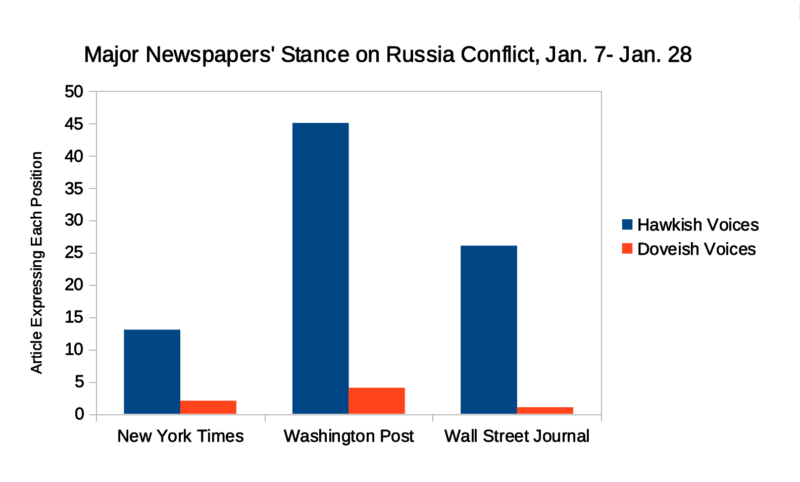
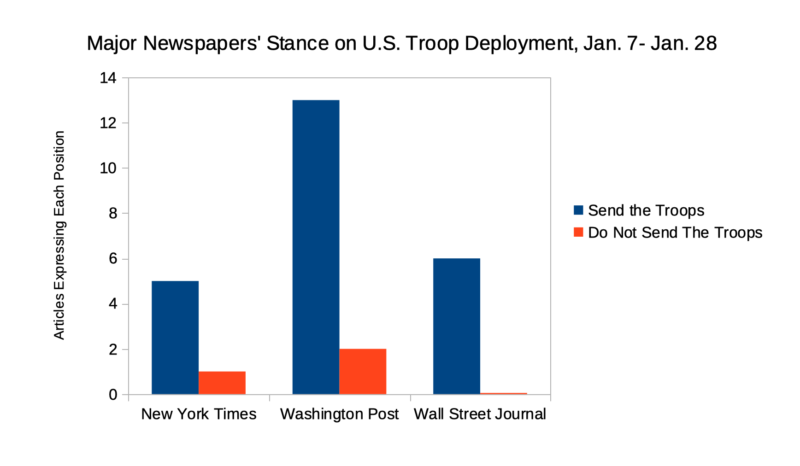
Alan MacLeod of MintPress warned about this in a study of 91 US media opinion pieces from January 2022:
Overall, the tone from the three newspapers studied was exceedingly hawkish, with around 90% of the columns expressing a “get tough” message. There was little to no variation among the outlets in their tone. “[Russian President Vladimir] Putin aims beyond Ukraine. Checking him right now is crucial,” ran the headline of former general Wesley Clark’s Washington Post article. Columnist Max Boot claimed that Putin “definitely wants to resurrect the Soviet empire.” Boot’s colleague at the Post, Henry Olsen, launched a bitter attack on Biden for not being hawkish enough, describing the president as a weakling who is unfit to lead. Meanwhile, The Wall Street Journal took the opportunity to denounce the American left for focusing on non-existent U.S. imperialism when it should be uniting with Washington to combat imperialism in the only places it exists any more: Russia and China. The little pushback to the incessant drum beats for war came from voices such as Peter Beinart in the Times, Katrina vanden Heuvel in the Post, or from more isolationist conservative voices. However, these were few and far between.
There was essentially complete unanimity in presenting Russia (and not NATO) as the aggressor, with 87 of the 91 articles presenting the issue as such (four articles did not identify any entity as the aggressor). There was overwhelming support for sending in both huge quantities of what the Biden administration has termed “lethal aid” (i.e., weapons), and also deploying American troops in the region – a move that would rapidly escalate the threat of terminal nuclear war.
After Putin made the fateful “unprovoked” decision to invade, it got worse.
The New York Times used the term “unprovoked invasion” 327 times in the first two months after the invasion.
According to GDELT (Global Database of Events, Language and Tone), CNN used the term “unprovoked invasion” in 66 airtime clips, “unprovoked war” 125 times, “unprovoked attack” 53 times, and “unprovoked” 418 times in the first two months of the war.
MSNBC racked up comparable numbers: “unprovoked invasion” in 57 clips; “unprovoked war” 76; “unprovoked attack” 35; “unprovoked” (any use) 300.
Fox News: “unprovoked invasion” in 28 clips; “unprovoked war” 25; “unprovoked attack” 26; “unprovoked” (any use) 168.
Caitlin Johnstone wrote on the power of repetition and “the illusory truth effect” (i.e., using the advice, often attributed to Goebbels, to “Repeat a lie often enough and it becomes the truth”) and quoted Noam Chomsky to great effect:
The western media claim to report the facts, but the way they’ve fallen in line behind the “unprovoked” narrative reveals that their actual job is to frame world events in a way that serves the information interests of their government. Which would be bad enough if that narrative was just a biased framing of a contentious issue, and not the bald-faced lie that it actually is.
During an interview last year with the Useful Idiots podcast, Noam Chomsky argued that the reason we keep hearing the western press using the word “unprovoked” in reference to Russia’s invasion of Ukraine is because it absolutely was provoked, and they know it.
“Right now if you’re a respectable writer and you want to write in the main journals, you talk about the Russian invasion of Ukraine, you have to call it ‘the unprovoked Russian invasion of Ukraine,” Chomsky said. “It’s a very interesting phrase; it was never used before. You look back, you look at Iraq, which was totally unprovoked, nobody ever called it ‘the unprovoked invasion of Iraq.’ In fact I don’t know if the term was ever used — if it was it was very marginal. Now you look it up on Google, and hundreds of thousands of hits. Every article that comes out has to talk about the unprovoked invasion of Ukraine.”
“Why? Because they know perfectly well it was provoked,” Chomsky said. “That doesn’t justify it, but it was massively provoked.”
FAIR pushed back, the proverbial voice in the wilderness, with this graphic of NATO expansion from 1949 to 2020:
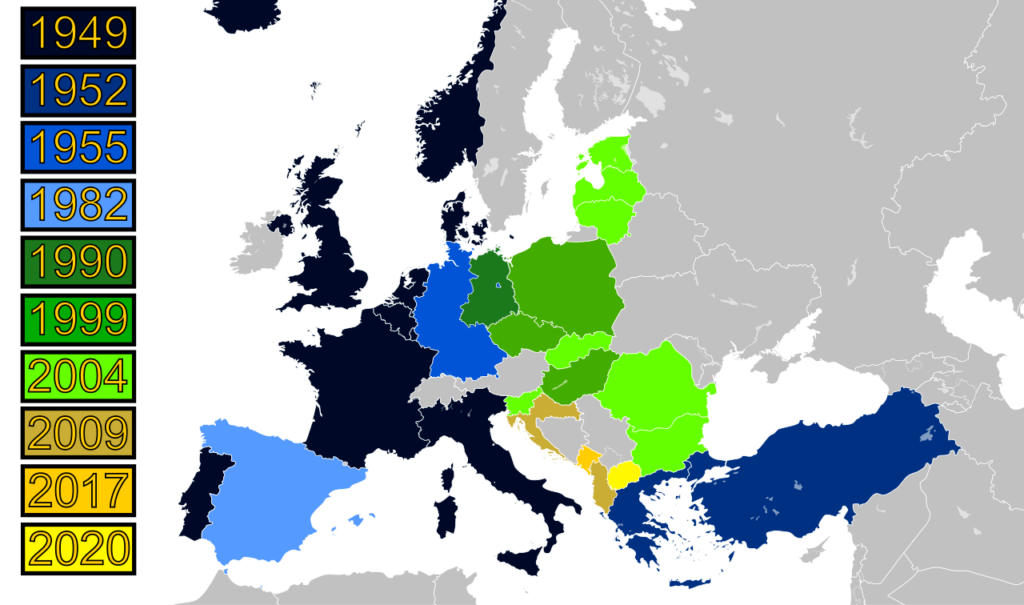
And an excellent article debunking the “unprovoked” propaganda:
On NATO expansion, the State Department continued to insist that they would not compromise NATO’s open door policy—in other words, it asserted the right to expand NATO and to ignore Russia’s red line.
While the US has signaled that it would approve of an informal agreement to keep Ukraine from joining the alliance for a period of time, this clearly was not going to be enough for Russia, which still remembers the last broken agreement.
Instead of addressing Russian concerns about Ukraine’s NATO relationship, the US instead chose to pour hundreds of millions of dollars of weapons into Ukraine, exacerbating Putin’s expressed concerns. Ukrainian President Volodymyr Zelenskyy didn’t help matters by suggesting that Ukraine might begin a nuclear weapons program at the height of the tensions.
After Putin announced his recognition of the breakaway republics, Secretary of State Antony Blinken canceled talks with Putin, and began the process of implementing sanctions on Russia—all before Russian soldiers had set foot into Ukraine.
Had the US been genuinely interested in avoiding war, it would have taken every opportunity to de-escalate the situation. Instead, it did the opposite nearly every step of the way.
In its explainer piece, the Washington Post (2/28/22) downplayed the significance of the US’s rejection of Russia’s core concerns, writing: “Russia has said that it wants guarantees Ukraine will be barred from joining NATO—a non-starter for the Western alliance, which maintains an open-door policy.” NATO’s open door policy is simply accepted as an immutable policy that Putin just needs to deal with. This very assumption, so key to the Ukraine crisis, goes unchallenged in the US media ecosystem.
Ultimately, Biden and company got the war they wanted when Putin launched the “Special Military Operation” in February 2022.
Putin Invades, Biden Acts Thrilled
When Russia invaded Ukraine, Biden seemed thrilled to go before the cameras and puff and bluster threats like “Putin is the aggressor. Putin chose this war. And now he and his country will bear the consequences” and “Putin will be a pariah on the international stage.”
Within a month, he was declaring Putin a “war criminal”, a “butcher”, and said in Warsaw, “For God’s sake, this man cannot remain in power.”
Biden later accused Putin of committing “genocide” — something he never accused his “pal” Benjamin Netanyahu of, even when he actually did it.
In April, he doubled down, “Yes, I called it genocide. It has become clearer and clearer that Putin is just trying to wipe out the idea of even being — being able to be Ukrainian…We’ll let the lawyers decide internationally whether or not it qualifies, but it sure seems that way to me.”
But worse was yet to come.
Peace Almost Broke Out in 2022
In March 2022, negotiations between Russia and Ukraine nearly resulted in a peace deal whose like Ukraine would not see again:
Agreed in principle (Ukraine’s March 29th, 2022 Istanbul proposals, accepted by the Russian delegation as the basis for a treaty)
- Neutrality: Ukraine would be permanently neutral, nonaligned with any blocs and without nuclear weapons, which means no NATO.
- No foreign troops: Ukraine would host no foreign military bases or troop contingents.
- Security guarantees: Russia, Britain, China, the United States, France, Turkey, Germany, Canada, Italy, Poland and Israel would act as guarantors. They would consult within three days of an attack and give aid up to closing Ukraine’s airspace.
- EU membership: the guarantors, Russia included, would promote Ukraine’s membership in the European Union.
- Crimea and Sevastopol: excluded from the guarantees, with 15 years of bilateral talks on their status and a pledge not to settle it by military means.
- Donbas: certain areas excluded from the guarantees, their boundaries left for a meeting between Volodymyr Zelensky and Vladimir Putin, who would sign the treaty.
- Ratification: a nationwide referendum on neutrality, then constitutional amendments and ratification by Ukraine and the guarantors.
- Russian withdrawal: according to former senior US officials quoted by Fiona Hill and Angela Stent, the negotiators “tentatively agreed” that Russia would withdraw to its February 23rd, 2022 positions in exchange for Ukraine giving up NATO membership and receiving guarantees.
Still open in the April 15th, 2022 draft treaty
- Army size: Ukraine proposed a 250,000-strong army, while Russia wanted 85,000; Ukraine proposed 800 tanks, Russia 342; and Ukraine wanted missiles with a 280 km range, Russia 40 km.
- Guarantor veto: Russia wanted all the guarantors, itself included, to agree before any of them came to Ukraine’s defense.
How close it got
- Vladimir Putin, June 17th, 2023: showed African leaders the draft “Treaty on Permanent Neutrality,” saying Kyiv’s lead negotiator had initialled it.
- Davyd Arakhamia, Ukraine’s lead negotiator, Nov. 24th, 2023: Russia was ready to end the war if Ukraine took neutrality and pledged not to join NATO.
Unfortunately for Ukraine, UK Prime Minister Boris Johnson went to Kyiv and brought two simple messages, per Ukrainska Pravda: “The first is that Putin is a war criminal; he should be pressured, not negotiated with. And the second is that even if Ukraine is ready to sign some agreements on guarantees with Putin, they (the collective West) are not.”
Turkish Foreign Minister Mevlüt Çavuşoğlu said at the time, “There are those within the NATO member states that want the war to continue, let the war continue, and Russia gets weaker. They don’t care much about the situation in Ukraine.”
In August 2026, Turkish parliament speaker Numan Kurtulmuş said the Istanbul deal failed because “other countries” did not want it.
Former Israeli Prime Minister Naftali Bennett played a large role in those April 2022 negotiations. In an interview, he also claimed that Russia and Ukraine were willing to make major concessions and end the conflict, until pressure from then UK Prime Minister Boris Johnson convinced Zelensky to back down from such a deal. Davyd Arakhamia, a Ukrainian parliamentary representative at the talks, made a similar claim. “They were hoping almost to the end to put pressure on us to sign such a document and accept neutrality. It was a big deal for them,” he said in November 2023, referring to the Russians. “They were ready to end the war if we, like Finland once did, would accept neutrality and pledge not to join NATO. In fact, that was the main point. All the rest are cosmetic and political ‘additions.’”
The American Conservative has more:
In his new book, The Russo-Ukrainian War: Follies of Empire, Richard Sakwa observes that “seven out of the eight members of the [Ukrainian] delegation confirm that a detailed peace deal had been agreed in Istanbul.” The eighth didn’t because he couldn’t: Denis Kireev was assassinated by Ukrainian intelligence upon returning to Kiev from talks in Belarus.
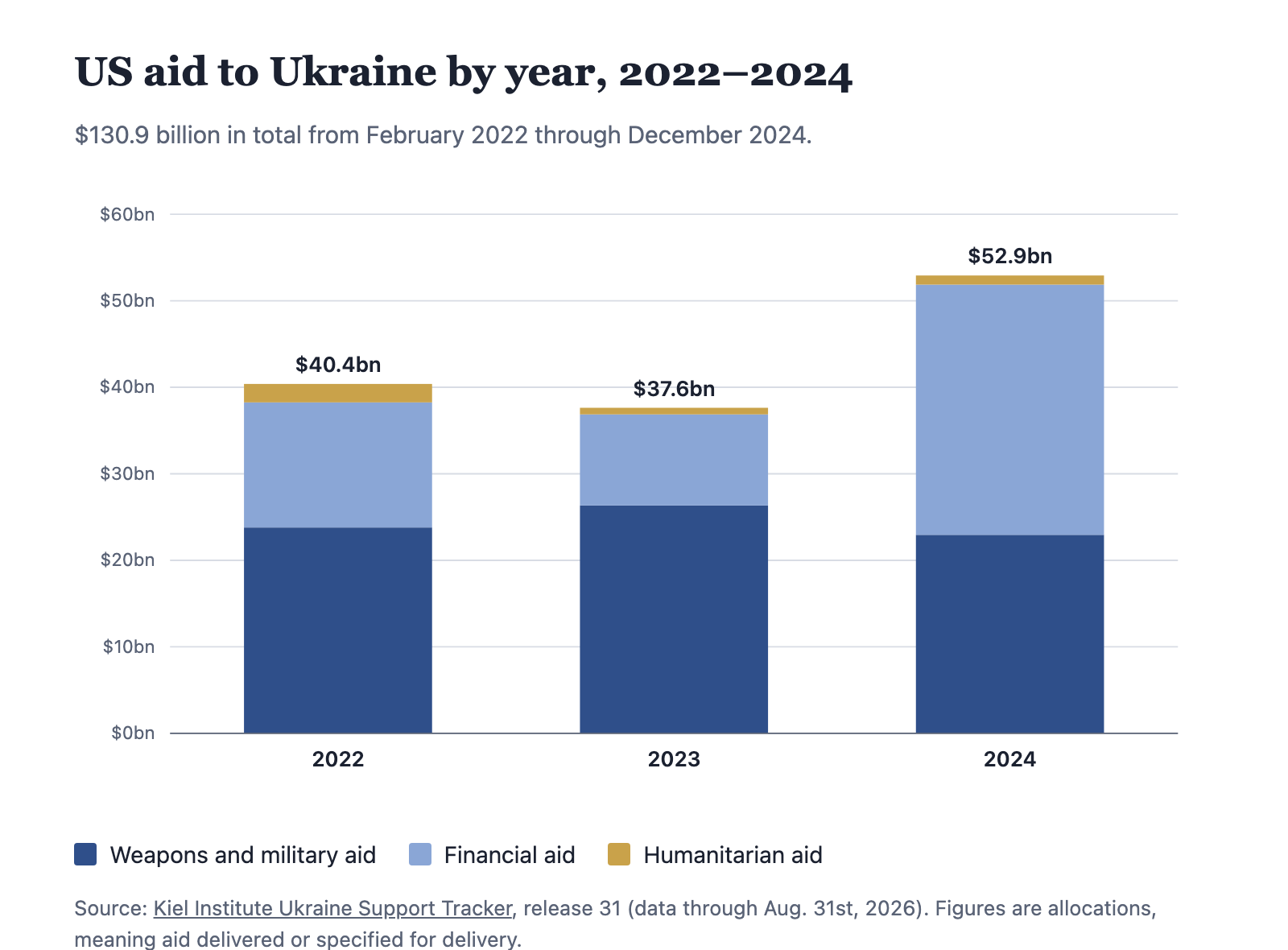
And the cost of not cutting a deal in 2022?
American Taxpayers Have Paid and Paid
Biden elected to pour gasoline on the fire instead:
But the infinitely higher price has been paid in Ukrainian and Russian lives.
Ukrainians and Russians Have Paid With Their Lives
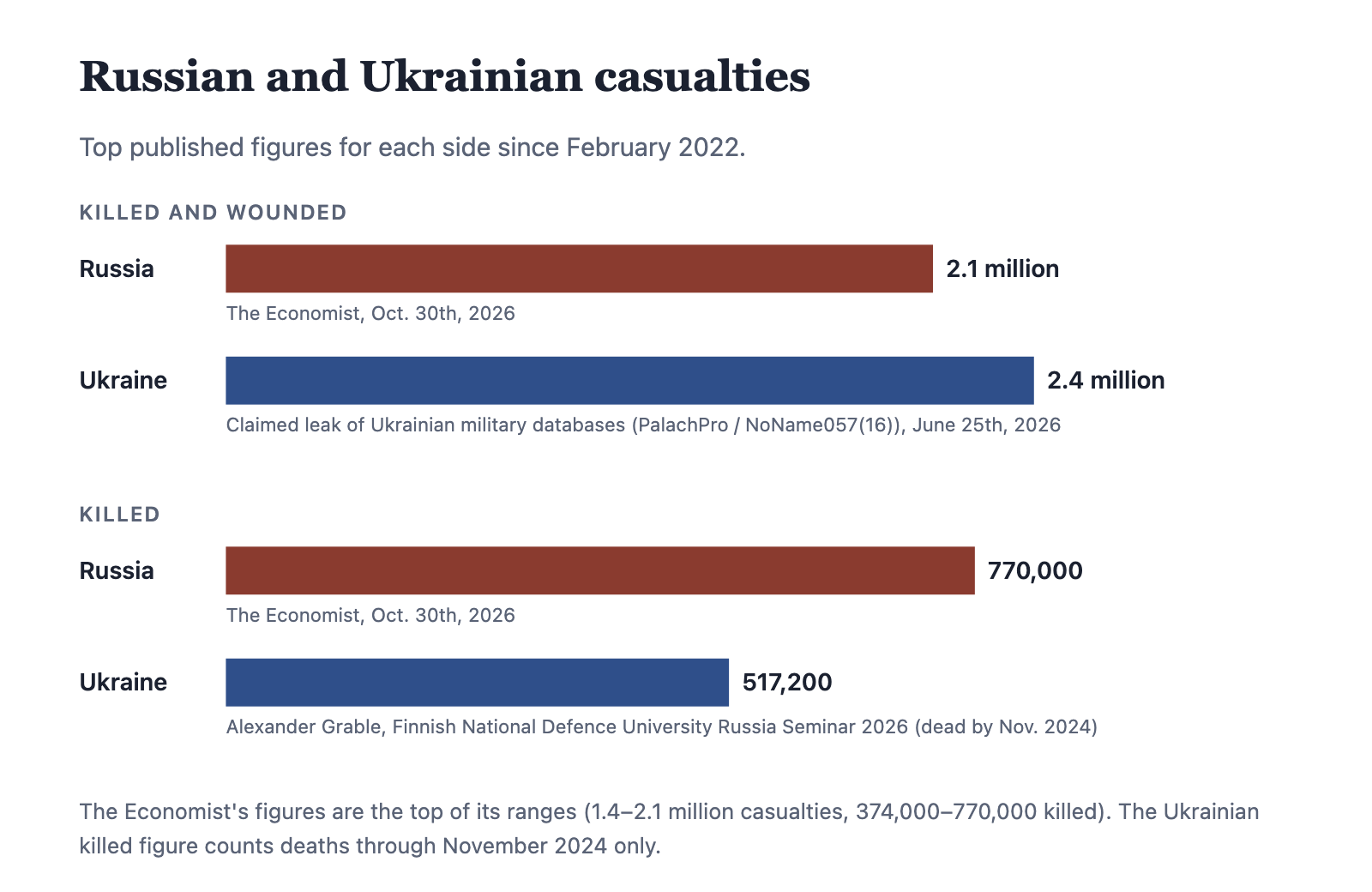
I know that all of the figures above are unreliable. Nothing in this war has been more consistently lied about than the casualty numbers. But there is no doubt that the war has been a colossal human tragedy and much of the blame can be laid at the feet of Joe Biden.
I’ll be back soon with Biden’s final genocide: Gaza.
Leave a Reply