Ian Welsh

The horizon is not so far as we can see, but as far as we can imagine

How Much Does Having More Babies Matter For Domestic Politics?

The right is strongly pro-natal. Some of it is for religious reasons, some of it is because they want to control (no, don’t even, the constant talk of male leadership leaves this unquestionable), but a lot of it is that they figure if they out-breed their opponents they’ll win.

Now if you’re talking ethnicity or “race” this is indisputable. Want more whites, or latinos, or whatever, if you breed less than others, that’s going to tell.

But when you’re talking ideology and culture, it isn’t.

The anti-abortion right thinks that out-breeding will work for them, but out-breeding only works if the kids you’re popping up keep your beliefs.
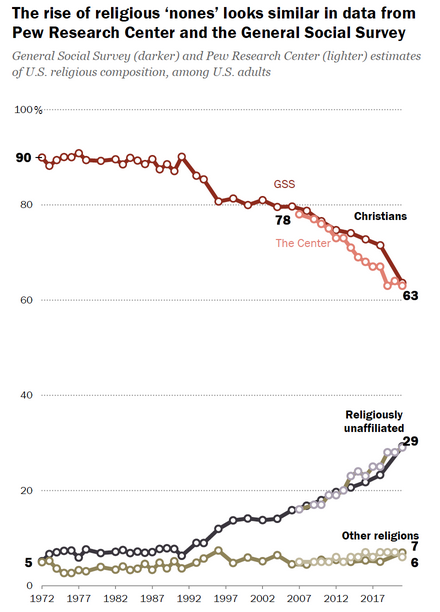
Now this all very nice, and the numbers don’t look too bad, but there’s more to it than nominal membership. If you call yourself Christian but believe in abortion rights and contraception and women’s equality, you aren’t what the Christian “right” is looking for, are you?

So here’s over time:

Basically flat. What about by age?

Huh. Doesn’t look so good, does it? If you raise ’em and they don’t stay with you and you can’t convert non-members very well…

Whatever the deeper causes, religious disaffiliation in the U.S. is being fueled by switching patterns that started “snowballing” from generation to generation in the 1990s. The core population of “nones” has an increasingly “sticky” identity as it rolls forward, and it is gaining a lot more people than it is shedding, in a dynamic that has a kind of demographic momentum.

Christians have experienced the opposite pattern. With each generation, progressively fewer adults retain the Christian identity they were raised with, which in turn means fewer parents are raising their children in Christian households.

Now America’s still a very religious society. Far more so than Europe or most of the rest of the developed world.

***

(If you like the writing here, well, support it if you can. There aren’t a lot of places like this left on the Web. Every year I fundraise to keep it going. Please Subscribe or Donate.)

***

But replacement rates aren’t just about popping up babies and raising them with your beliefs. You have to be able to keep them once they’re adults. And seculars have been very, very good at converstion. Even back when everyone still said they were Christian, notice that abortion became legal, women got legal rights, contraception spread and so on. People said they were Christian, but if the Pope or their pastor said “no condoms, no pill” they ignored them.

Most people enjoy having sex. Most people, at least at some points in their lives, want to have a lot of sex, and want to do it without worrying about suddenly having to raise kids or having to go thru pregnancy.

(I often suspect that the most vehement anti-contraception and anti-abortion activists are people who are closet or in denial gays, or essentially asexual. “Sex is a duty, if we only have to have it to make babies, I won’t have to have it so often.”)

But the larger point here is that replacement rate for anything but biology is determined by ideological reproduction rates. If you can’t keep the people you raise in your ideology, then popping out more kids isn’t the solution.

Early Christians out-produced pagans, but if they hadn’t been able to keep their kids Christian: if pagans had been good at converting them, well, they would never have won.

What Christianity offers, in the US, is the church community. Church groups are one of the few social support groups left. If you need help, the church will often step up. And that makes it odd that the stickiness rate started declining in the 90s, just as government support also started a serious decline and as good jobs became harder and harder to get.

But there are other factors. One is that seculars, starting in the 70s, offered a better deal to women: a lot better deal. You could have your own bank account when married, you had no fault divorce, you could get that abortion and you didn’t have to always do what your husband said, nor did you have to marry just to get support.

Part of the secular offer became a lot better for half the population.

At the same time Christian ideology became less and less appealing. It was around the late 80s and early 90s that the hard-core Christians really began to win internal battles and made being anti-abortion the litmus test, moved towards hardcore natalism and heavy parental authoritarianism with plenty of beating of children. Oh, and when all the “male leadership” stuff cropped up.

This is a better deal for some men (the one’s who like keeping their kids and wife under their thumbs with force) but it isn’t a better deal for a lot of women and kids. And when the kids grow up, well, all that heavy handed authoritarianism, justified by religion doesn’t make them think fondly of religion.

The community support deal within Christianity is a good one, but if the price is domestic violence, corporal punishment, an inferior position for women and less sex, plus more pregnancies whether you want them or not, plus more dangerous pregancies, well maybe the cost of that social support is too high?

Reproduction of groups and ideologies over time isn’t just about who bears more kids, it’s about who keeps them. If “give me the child and I’ll give you the adult works” you’re golden, but if it’s breaking down, well, you may just be producing the next generation of your ideological enemies.

Breeding isn’t enough. The life you offer has to seem better than what your opponents offer.

Churches should be cleaning up. As the last solid community support structure the offer something that almost no one else does. But at the same time as this became true they decided to be anti-sex, pro-hitting children, and for women to be subordinate to men.

Weird that more and more people don’t want that life.
Week-end Wrap – Political Economy – November 17, 2024

by Tony Wikrent


Strategic Political Economy

The Elephant in the Room–No, the Other Elephant 

Charles Hugh Smith [Of Two Minds, via Naked Capitalism 11-15-2024]

…The reason why it’s so easy to ignore extreme wealth inequality (EWI) is that we don’t experience EWI as a thing, we experience a decline in our standard of living as wealth is siphoned up into the top 10%….

The RAND study Trends in Income From 1975 to 2018 concluded that capital skimmed $50 trillion from labor from 1975 to 2018.

Using data from the Federal Reserve’s FRED database (series A4102E1A156NBEA), correspondent Alain M. calculated the actual sum for the period 1970 to 2022 (2022 being the most recent data available) was a staggering $149 trillion: his spreadsheet is available here as a PDF: Employees Share of Gross Domestic Income 1970-2022.

If wage earners’ share of Gross Domestic Income had remained at 51% instead of declining to 43%, wage earners would have received an additional $149 trillion over those 52 years. That’s roughly $3 trillion a year, which works out to an additional $22,000 annually for America’s 134 million full-time workers or an additional $18,000 annually for the nation’s entire work force (full-time, part-time, self-employed, gig workers) of 163 million….

In my view, there should be zero taxes on all earnings up to the median wage of $60,000 annually–no Social Security taxes, nothing–and progressively steeper taxes on all income / capital gains from capital/finance above some modest amount, say half of the median wage ($30,000 annually), along with a transaction tax for every financial trade submitted, whether it executes or not. Shifting the tax burden from labor to capital/finance would at least start the overdue rebalancing….

Crypto industry accounts for half of corporate donations in 2024 election

GRAPH: Top 10 corporate campaign funders in the 2024 US election

[Public Citizen, via The Big Picture 11-17-2024]

  • In 2024, crypto corporations have poured over $119 million directly into influencing federal elections, primarily into a non-partisan super PAC dedicated to electing pro-crypto candidates and defeating crypto skeptics.
  • Crypto corporations are by far the dominant corporate political spenders in 2024 as nearly half (44%) of all corporate money contributed during this year’s elections ($274 million so far) came from crypto backers.
  • Koch Industries is a distant second place in 2024. The privately held conglomerate owned by Charles and, formerly, the late David Koch, contributed $25 million to its Koch-controlled Americans for Prosperity Action and $3.25 million toward electing Republicans to Congress.

[TW: cryptocurrencies were created and promoted by libertarians in line with their dream of total freedom from government regulation and oversight. In the Federalist Number 10, Madison wrote “The regulation of these various and interfering interests forms the principal task of modern legislation.” In the Federalist Number 15, Hamilton poses one simple question to test the worth of any national financial scheme: “Is private credit the friend and patron of industry?” Which has contributed more to the advance of the human condition? Libertarianism, or the civic republicanism embodied by Madison and Hamilton? It is exactly because they are unable or unwilling to contemplate such questions that USA and western elites have so little support among their publics. ]


Welcome To The United States of Crypto (podcast)

Jared Jacang Maher, November 15, 2024 [The Lever]

After spending hundreds of millions to influence politicians in both parties, the industry defeated some of its fiercest critics and scored bipartisan support, particularly from President-elect Donald Trump, despite crypto’s potential risks for consumers and the financial system. Today on Lever Time, Lever reporter Freddy Brewster discusses crypto’s emergence as a political power broker and what industry insiders are hoping for in return for their massive donations….

For a transcript of this episode, click here.

Open Thread

Use to discuss topics unrelated to recent posts.

DOGE Will Wind Up Costing the Government More Money

Elon Musk will be in charge of the effort by Trump to cut government waste.

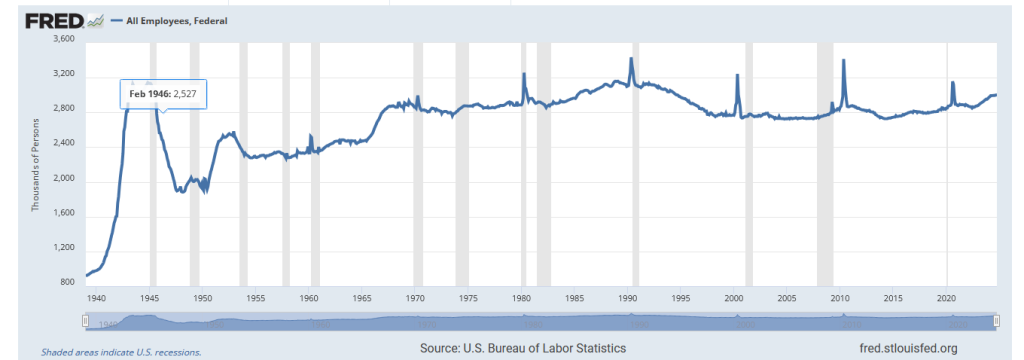
Problem is, most government workers actually do something necessary. The last time a government seriously slashed government workers, under Clinton, all that happened is that contractors were hired to do the work: and contractors cost more. Nor has there been any real increase in federal employees in decades. In fact, as a percentage of the US population, federal government workers are in decline.

Besides, if you’re going to actually go after waste, you need to hit the Department of Defense and allow things like Medicare negotiating drug prices.

Government is a profit center for private business, as Musk, whose businesses (especially SpaceX) run on subsidies and government contracts well knows. Musk’s savings will turn into money for the rich and corporations.

A few genuine “savings” may be made by slashing enforcement of things like environmental laws, but they will be paid for in different ways.

Oddly, the best way to save the government money would probably be to reduce use of contractors and hire more government employees and the best way to improve the top line would be to hire more auditors for the IRS and have them go after the rich.

The real world isn’t the world of outraged right wingers, alas.

What It Means To Be Left Wing

We discussed Communism recently, which is one type of left wing belief.

I would suggest that the left’s core belief is:

Everyone should have a good life and society should work to make that happen.

What different left ideologies are arguing about his the means more than the end. A Communist believes the only way for this to be achieved is for the proletariat to control the means of production. (This makes them effectively the left oppositional image of capitalists.)

I, personally, want everyone to have enough and be happy. I recognize that the second is impossible: but it’s a guiding principle. However, at least since the 20th century it’s been more than possible for everyone to have enough food, water, shelter and medicine. We produce or can produce more than enough of all of them (especially food). We simply choose not to distribute to everyone because our current main economic  ideology says that if you don’t have enough money you don’t deserve anything.

In the modern world there are three main ideological groupings. Broadly the right, the left, and liberals/neoliberals. These don’t appear on a line, they’re a triangle and each has something in common with the others. The left, generally speaking, is anti-war, for example, and so are parts of the right, especially paleocons. Liberals are very identity politics focused and the left has sympathy for that, but isn’t as dedicated to it. The left’s primary focus is on economic issues and relationships and the relationship to IP is more of “of course everyone should be treated equally.”

The left’s argument about IP is that is splits coalitions when taken to extremes like micro-aggression hunting and reeducation for everyone because everyone’s racist and sexist. Liberals IP, on the other hands, is along the lines of “of course women and minorities should be able to become CEOs and President!”

Neoliberals, the dominant sub-ideology of liberalism believe in regulated markets intended to funnel money towards market winners and to keeping the mass of the population from making long term real wage gains. That’s why, over time, they’ve lost the support of the working class. Democrats were left wing under FDR, a coalition of left and liberals (not neoliberals) from 44 to 79, and have been neoliberal controlled ever since.

(If you like the writing here, well, support it if you can. There aren’t a lot of places like this left on the Web. Every year I fundraise to keep it going. Please Subscribe or Donate.)

Neoliberalism is in direct opposition to most strains for left-wing ideology. All may not be as extreme in their distrust of concentrations of wealth and capital as communism, but all believe that you can’t take care of everyone if the rich are too powerful. FDR had 90% top marginal tax rates for a reason and estate taxes under post-war British governments were absolutely punitive, but didn’t break up the great Ducal estates, alas.

We’ll discuss conservatives at a later time, but the general orientation is towards authoritarian identity. The left emphasizes horizontal ties, conservatives emphasize primitive identity (religion and culture) mediated through vertical ties. Ruler, nobles, rich, church. Nation and race and ethnicity. (The exception is theoretically libertarians, but they’re completely marginal.) The NASA mission to the moon was about many people’s contribution. Admirers of SpaceX give all credit to Elon Musk, who’s hasn’t engineered or built anything on his rockets.

Liberals are the great apostles of capitalism, not conservatives, though they like the way capitalism stratifies society. Left wingers are the opposition to capitalism. The most extreme versions want an end to it entirely, the moderate versions want it under firm control, made to contribute to mass prosperity, not turned to produce billionaires.

And, again, this is because what the left wants everyone prosperous, not a highly stratifed society, where a stratified society is a goal both liberals and conservatives share.

What is Woke? Depends on Who You Are Asking

Simple question for you, what is woke?

To liberals woke equates with the advencement of and/or equality of people of color.

To the vast majority of conservatives–but not all–woke is a dogwhistle, hell, it’s probably a straight out whistle about the transgender ‘agenda.’

Although the media will probably never report how much influence all the transgender scaremongering had over the election–I imagine it had a material impact.

The entire transgeder issue is the ultimate in idenity politics failure.

Fundraising Update #2: New Tier Hit, Close To The Next One

This blog has been around since 2009. I had just stepped down as managing editor of FireDogLake (one of the larger progressive blogs of the time) after editorial direction disagreements. Running FDL was a seventy hour a week job for not very much money, you had to really believe in it. I had for most of my run, and under my editorship readership increased about 70%. After the election the site kept most of the readers who had started following it during the 2008 election, but I had lost my belief in the direction the site was to take. (The publisher trumps the managing editor.)

I still wanted to keep my foot in, so I threw this place up and in a fit of non-inspiration figured “fuck it, I’ll just use my name.”

Any blog this longstanding has a mix of good and bad, but there’s a lot I’m proud of. This collection of articles on character and ideology, for example. Over the years there have been troughs and peaks—ideas burst out, then there are periods of contemplation, then they come again.

I’m hoping to keep going, and to see a few more peaks and troughs. We’re up at a little over $8,300. That puts us past the second goal, adding three more books. One of them will be “MITI and the Japanese Miracle.” Industrialization and re-industrialization are among the topics of our age, and Japan pioneered the Asian model which China has since used to take the world by storm. Another will be “The Sociology of Philosophies”, which rambles over thousands of years of European, Chinese and Indian philosophy. With its rules of small numbers, the consolidation of the weak, the splitting of the strong and so on it offers both a look at the internal workings of intellectual communities and the circumstances which allow them to prosper, or which choke them into insipidness.

At $10,000, which is about 1,700 away, I’ll write an article on one of the fundamental processes, perhaps the fundamental process which keeps society together and how it renews or fails.

Thanks to all who have donated and to all my readers. It’s been a lovely and lively journey, hopefully you’ll be here with me for years more travel towards that horizon which is as far as we can imagine.

SUBSCRIBE OR DONATE TO OUR 2024 FUNDRAISER

What Is A Communist?

One annoying tendency in modern political discourse is right wingers and centrists calling people communist.

They don’t know what the word means.

A communist believes that the means of production should be owned and controlled by the proletariat: the workers.

If you don’t believe this, you aren’t a communist. Wanting universal healthcare doesn’t mean you’re a communist unless you think the health workers themselves (or, just perhaps, the party or government) should control the healthcare providers.

Wanting universal healthcare, in the modern context, makes you a socialist.

Now there’s a lot of argument around what it means for the proletariat to control the means of production. If the “Party” controls it, like in the USSR or pre-Deng China, is that communism, or is it just old fashioned government authoritarianism?

Is modern China communist? About half the economy isn’t controlled by the Party, and worker co-ops are minor players. There’s clearly a capitalist class controlling vast amounts of the means of production, though government is very willing to intervene. The Chinese Communist party says this is still communism but that seems like a stretch to me. The same is true in Vietnam: the Communist party is in charge, but the economy isn’t communist.

Note that you could have a market economy which IS communist. If workers co-ops or something similar control most of the organizations, that would be communism, and it’s something that a lot of intellectuals in America and Europe during the 50s pushed for: a sort of “best of both worlds.”

Centralized control economies like the USSR, from this point of view can’t really be communist, because the workers aren’t really controlling capital.

For myself, I’d say moving away from stock companies and towards a mix of worker owned organizations and perhaps mutual companies (or mixed versions) would be the best way to move towards something that might both be communist and workable, allowing the dynamism of the market.

Generally speaking my time in the workforce convinced me that upper management is usually clueless because they don’t do the job and haven’t done it in ages. You have to be on the front lines to have some idea what the issues actually are.

Communism is worker control of capital, and nothing else. We’ve never really tried it.

Page 92 of 529

Powered by WordPress & Theme by Anders Norén