Ian Welsh

The horizon is not so far as we can see, but as far as we can imagine

A Rare Balanced Update On The Russo-Ukrainian War

As one commenter noted, “Never thought I’d live in a world where I would be hyped for the Austrian army dropping a new video.”

You can watch it here, as I do not know how to embed it in Word Press.

By the way, if you want to understand Putin, you read Dostoevsky, Notes from the Underground, not Mein Kampf to suggest otherwise is an abdication of being intelligent.

Nota bene: Crime and Punishment is the best novel ever written. Just saying.

Nota bene duo: the Ukrainian drone attack at 5:05 on the Russian soldiers is terrifying.

Week-end Wrap – Political Economy – October 20 2024

by Tony Wikrent


Strategic Political Economy

MASTER PLAN, Ep 10: The Master Planners’ Heist Of The Century

[The Lever, October 15, 2024]

By 2010, the master planners had firmly gained the upper hand. Their victory in Citizens United allowed corporations to spend unlimited amounts of money to influence elections, giving business interests unprecedented power in politics. But the master planners’ onslaught wasn’t quite over. In this episode, we show how they embarked on a bold heist to crack the vault protecting democracy itself. It’s the heist story of the century, in three acts.

First, the schemers needed to take out the security cameras: The disclosure laws that in some instances still required the names of big-money donors to be reported. In a perverse act of mental gymnastics, petrochemical tycoon Charles Koch’s Americans for Prosperity sought to eliminate these laws by weaponizing a 1950s ruling that had protected civil rights activists in the Jim Crow South.

In the second part of the heist, the schemers went after the last remaining cops on the beat. They manufactured a scandal at the IRS, the country’s last remaining campaign finance regulators, over the targeting of so-called “social welfare” nonprofits — many of which were fronts for dark money groups.

Finally, the master planners needed a getaway plan, a way to prevent prosecutors from coming after them as they made off with the loot. They found their opportunity with the appointments of Neil Gorsuch, Brett Kavanaugh, and Amy Coney Barrett to the Supreme Court.

As high-profile bribery and corruption convictions fell, the message was clear: The system is rigged, and political officials are ready to play for pay.

Key findings referenced in this episode include:

  • See the evidence from the case in which a Virginia jury convicted former Gov. Bob McDonnell and his wife Maureen for accepting $175,000 in gifts and loans from a businessman — including a $10,000 white leather coat, shopping sprees, use of a Ferrari, and a $6,500 Rolex.
  • In the 2016 case McDonnell v. United States, a wave of amicus briefs flooded the Supreme Court attacking the legality of the anti-bribery laws used to convict the former Virginia governor. Chief Justice John Roberts cited these briefs as evidence of “bipartisanship,” but they mostly came from influential figures in the money and politics sphere, including corporate lobbyists and Federalist Society members like John Ashcroft and Ted Olson. Other notable supporters filing briefs included Christian Right attorney Jay Sekulow and Citizens United mastermind James Bopp Jr. Even Justice Lewis F. Powell’s former corporate law firm joined in, representing a coalition of elite business owners.
  • Indicted New York City Mayor Eric Adams’ lawyers recently filed their first motion to dismiss the bribery and fraud charges lodged against him, heavily relying on Supreme Court rulings that have weakened anti-corruption laws. The motion points to overturned convictions in corruption cases discussed in this episode, including those of McDonnell, former Enron CEO Jeffrey Skilling, small-town mayor James Snyder, and New York power broker Sheldon Silver.
  • Read law professor Zephyr Teachout’s article on how both liberal and conservative justices on the Supreme Court have expressed skepticism about anti-corruption law, narrowing the definition of corruption and limiting public power.

Germany Honors Biden For Destroying Nordstream & Their Economy

I cannot believe this is happening:

Germany honored U.S. President Joe Biden for his contribution to trans-Atlantic relations on Friday, ahead of his meetings with European allies on Russia’s war in Ukraine and the conflict in the Middle East.

TIME Magazine: Germany Honors Biden for His Contribution to Trans-Atlantic Ties as the U.S. Election Looms

Germany Honors Biden for His Contribution to Trans-Atlantic Ties as the U.S. Election Looms

The sheer delight the pathetic “Traffic Light” coalition government takes in abasing itself before the US hegemon is pornographic in its shameless indecency. Especially the same week that the Danes reported this:

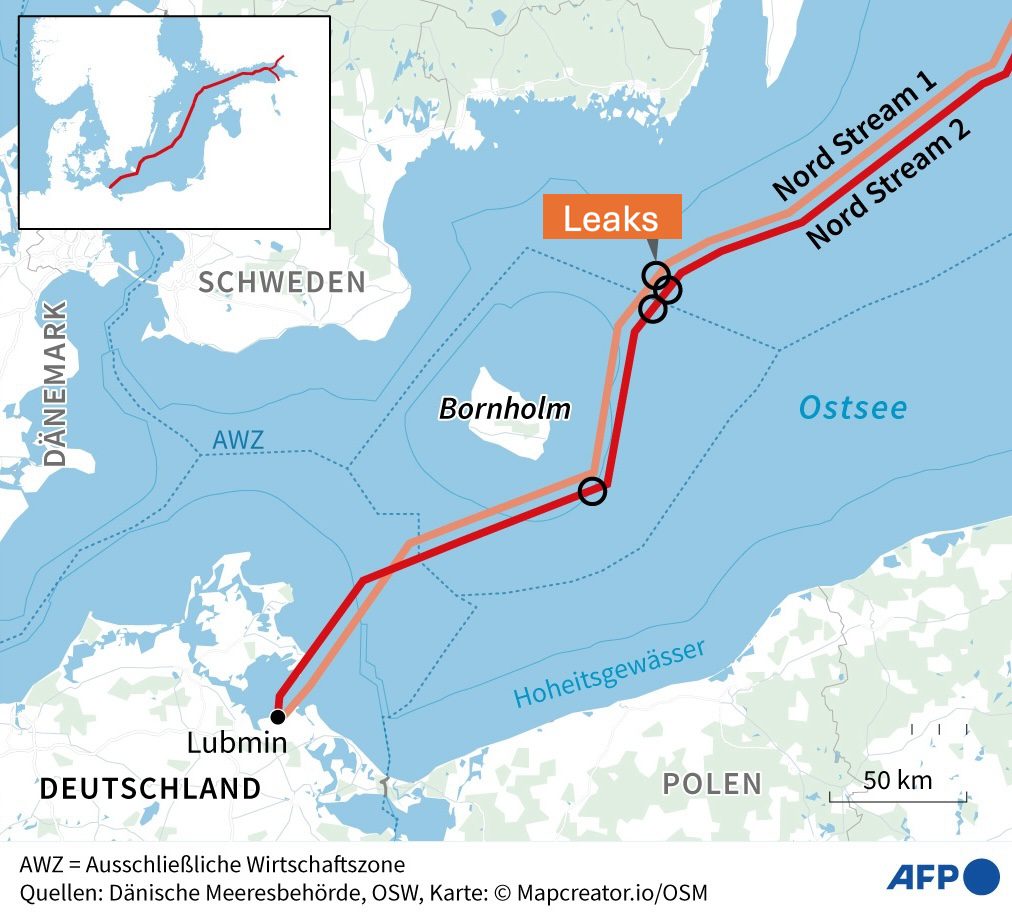
Just days before the Nord Stream gas pipeline attack in September 2022, warships belonging to the U.S. Navy were on the scene and ordered nearby officials to keep away.

That is according to John Anker Nielsen, who is harbour master at Christiansø, the easternmost part of Denmark in the Baltic Sea, northeast of the island of Bornholm and close to the sites of the Nord Stream explosions.

Map showing the route of Nord Stream 1 and 2 in the southern Baltic Sea and location of the leaks. AWZ=Exclusive Economic Zone
Map: AFP / Nadine EHRENBERG, adapted

Nielsen late last month told a reporter at Politiken, a major Danish daily, that he went out with a rescue team four or five days before the blast to check on nearby ships with switched-off radios, suspecting there might have been an accident, only to find U.S. warships, whose staff ordered the team to turn back immediately.

Never forget Biden threatened Nordstream:

Biden: If Russia invades uh that means tanks or troops crossing the uh the border of Ukraine again then uh there will be uh we there will be no longer a Nordstream 2. We will bring an end to it.
Reporter: What? How would you how will you do that exactly since the project and control of the project is within Germany’s control?

Biden: We will. I promise you we’ll be able to do it.

and Nuland did it too. This video is still up on the State Department’s official Facebook page because they’re proud of it:

“If Russia invades Ukraine, one way or another, Nord Stream 2 will not move forward.”

And Never forget what Nuland said at a Senate Foreign Relations Committee hearing on January 26, 2023:

“I am, and I think the administration is, very gratified to know that Nord Stream 2 is now, as you [Ted Cruz] like to say, a hunk of metal at the bottom of the sea.”

Blinken celebrated it as an economic opportunity:

“…ultimately this is also a tremendous opportunity.  It’s a tremendous opportunity to once and for all remove the dependence on Russian energy and thus to take away from Vladimir Putin the weaponization of energy as a means of advancing his imperial designs.  That’s very significant and that offers tremendous strategic opportunity for the years to come…”

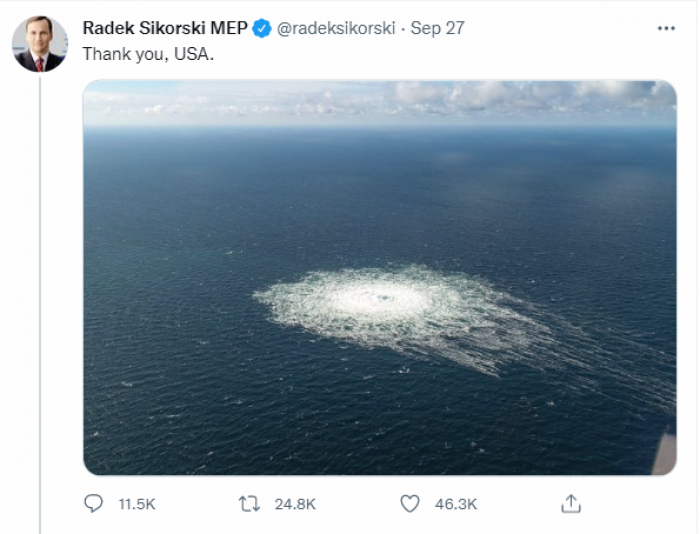
And then there was this from Anne “It’s Time to Prepare for a Ukrainian Victory” Applebaum’s husband who’s a Polish official:

Former Polish FM thanks US for damaging Nord Stream pipeline

The consequences of this have been the deindustrialization of Germany:

German industry increasingly struggles to compete on the world stage. Particularly hard hit are its mighty chemical and heavy industry sectors, which are now in rapid decline. One of the main drivers is policies that have made energy costs skyrocket, and there Germany serves as a canary in the coal mine for other leading industrial nations.

It’s kind of grimly amusing that Forbes’ use of the euphemism “policies that have made energy costs skyrocket” rather than say “self-defeating sanctions on cheap Russian gas combined with the biggest act of industrial sabotage in modern history” and it also doesn’t mention that it’s been America’s policies that have deindustrialized Germany.

It’s also so humiliating as an American that the neo-conservative cabal of psychopathic nitwits has been in sole control of US foreign policy since the Clinton administration and now they have a lock on US corporate media as well.

The above mentioned Anne Applebaum provided the perfect example of their delusion and idiocy with her September, 2022 prediction that Ukrainian victories in Kharkov would bring down Putin.

But that brings me back to Germany’s pathetic ruling coalition. This is how well they’ve done in recent state elections:

In the eastern states of Saxony and Thuringia, the far-right AfD received more than double as many votes as the three parties which make up the federal coalition government — the center-left Social Democrats (SPD), environmentalist Greens and neoliberal Free Democrats (FDP) — combined. These parties’ results are each in the single digits. The Greens in Thuringia and the FDP in both states even failed to meet the 5% threshold to be represented in the state parliaments.

And on the left:

newly established populist party, the Sahra Wagenknecht Alliance (BSW), managed to score votes in the two-digit range in their very first election.

The German people are chomping at the bit to vote out the gang of traitors who have allowed the US to annihilate their economy.

Although in fairness, they also gave the last US President who walloped the Germany economy the same award:

“Biden received the highest class of Germany’s Order of Merit, which was also bestowed on former U.S. President George H.W. Bush for his support of German reunification.”

Kind of fitting that the era of American unipolarity is framed this way. Bush at the beginning. Biden at the end. The Germans footing the bill for American foreign policy.


Open Thread

Use to discuss topics unrelated to recent posts.

Europe Is Turning Anti-Immigrant

Politico has a long article on it, and it’s hilarious. A border wall longer than Trump and Biden’s. “Return centers” in other countries, because they’re too gutless to say deportation, and so on. Complaining about Russia and Belarus’s immigration warfare (letting refugees thru Russia to get to Europe. Including, er, Afghan refugees.)

Let’s cut thru the bullshit.

The EU is in economic decline and can no longer afford refugees they can’t monetize.

Europe is also responsible for much of the refugee crisis, having enabled the destruction of Afghanistan and Iraq (Poland, one biggest criers, was part of the “coalition of the willing.”) Europe, with some honorable exceptions like Ireland and Spain, is behind the Israelis, who are about to institute a flood of Lebanese refugees. Europe, thru the world bank, IMF and various post-colonial policies has worked hard to keep third world nations in poverty, increasing refugee flows.

They have helped destroy or impoverish entire nations, then whine about how migrants come to them begging for safety or a decent life.

In humanitarian terms, and international law terms, what the EU is doing is wrong, but the simple truth is that they can’t afford immigration any more, and that mass immigration has exacerbated the right wing turn. Not that it had to, but if you have large numbers of immigrants into a bad economy, who are competing for jobs and housing and social welfare with the desperate, they will naturally blame the immigrants instead of purging the incompetent and corrupt elites who are managing the economy with eye only to benefit themselves.


(I’m running my annual fundraiser. If you value my writing and want more of it, please consider donating. Your donations really do keep this place running.)


The Ukraine war has made this particularly bad, not just because of all the Ukrainian migrants, but because it has increased the de-industrialization of Europe’s industrial heart, Germany.

This is, again, a self-inflicted wound. If Europe had kept the Minsk accords, or, more long term, treated Russia and its security concerns seriously, there wouldn’t have been a war. If Europe did not insist on being subordinate to America, none of this would have happened.

But Euro elites can’t imagine taking actual responsibility for their own countries and telling the US to bugger off, then following something other than neoliberal politics and economic policies.

Reducing immigration makes some sense, even if it’s inhumane, but it’s very much a “treat the symptoms, not the problems” situation.

Europe’s decline will continue until they decide to take responsibility for themselves and to overthrow an ideology which prioritizes the rich and financial games over the entire population and the real economy.

Immigration is meaningless in comparison.

Harris Is Making The Same Mistake Clinton Did When She Lost To Trump

Harris was asked what she would have done differently from Biden, and she answered:

Nothing comes to mind.

Trump won against Clinton in large part because of the stories they told:

Trump’s was. “I’m going to make America great again.”

Clinton’s was. “America is already great.”

So people who wanted change voted for Trump, if they could stomach him.

It’s that simple.

Economists will go on and on about how great the Biden economy is, but they’re basing that on statistics no one believes, nor that they should believe, like the inflation numbers, which are complete bullshit.

There’s a point at which people will believe their lying eyes, especially when it comes to grocery prices.


(I’m running my annual fundraiser. If you value my writing and want more of it, please consider donating. Your donations really do keep this place running.)


Kamala’s just another mediocre member of the elite. The system worked for her, so she figures it’s basically a good system. She doesn’t have the empathy or intellectual honesty to see that it isn’t good for many, many other people and that she needs some of those people’s support.

This was her election to lose, just as Clinton should have won in 2016. All she had to do was show some genuine concern, some empathy and offer some significant change, even if she was lying.  (This was Obama and Bill Clinton’s strategy, and it worked well. Bill was very empathic as he screwed over the working class and poor.)

She couldn’t even manage that. Polls are now basically dead-even, and battleground states are in the wind. Generally Democrats, because their votes are concentrated in urban and suburban areas need to be a few points ahead.

I won’t predict who’ll win. I don’t know. But I know that Harris is making unforced errors and acting like she doesn’t really want to win.

As for Trump, he’s clearly senile, out to lunch and would make a terrible President, but at least he wants it.

Fundamentals Series: On Problems, Principles & Solutions

When we want to change the world we’re usually reacting to a problem. Even positive visions usually come out of negatives. We want liberty because we have tyranny. We want health because we have sickness. We want prosperity because we have poverty. We want equality because some people have way more than they need and others less than need.

When we solve a problem it’s generally mediated by a principle. Very often the principle is just the problem stated slightly differently.

Problem: Some people have more than they need, others have less than they need.

Principle: Make sure no one has more than they need while anybody has less than they need.

A principle tells you, generally speaking, what you should be doing about a problem. It doesn’t tell you how to do it.

So, for the example above, post-war Welfare states generally came upon the solution:

Solution: Tax the rich heavily and put the poor on Welfare, controlled by social workers and other bureaucrats because poor people can’t be trusted to use money wisely.

If you think poor people aren’t stupid, then you have another solution, basic income + progressive taxation.

Restate the problem slightly by removing having too much as a problem, and the principles and solutions change:

Problem: some people don’t have enough.

Principle: Make it so that everyone has enough, or more than enough.

Solution: Just give everyone who has less than enough money, enough money. (Basic Income.)

Solution: If we make the rich even richer, enough will wind up flowing down to take care of everyone else. (Trickle Down Economics.)

Solution: The rich should give away most of their money over time, on good works or to organizations which do good works. (Charity.)

The difference between welfare and a basic income is instructive: one trusts those without enough money to spend it themselves, the other doesn’t. It’s mediated thru a view of why people are in poverty. Welfarism assumes poor people are somehow defective, basic income assumes they’re fine, they just don’t have enough money.

The first solution assumes having too much is bad, the second solutions all assume that some people having too much isn’t wrong, it’s that others don’t have enough


(I’m running my annual fundraiser. If you value my writing and want more of it, please consider donating. Your donations really do keep this place running.)


Let’s look at another Triune, closely related, which focuses on being rich or powerful as the problem.

Problem: rich and powerful people use their power and wealth to take control of society and direct the benefits to themselves, hurting everyone else.

Principle: Keep the rich poor and the powerful weak.

There are a lot of different solutions to this and solutions are often in used together. Those that work usually only work for a while.

Solution: If they have enough money to influence politics or society, take it from them. (Specific policies like progressive taxation, estate taxes, wealth taxes, and so on.)

Solution: Don’t let the rich spend their money on politics. (Public finance laws, donation limits and so on. Doesn’t work all that well, but does have some effect.)

Solution: Don’t let the rich have private specialists in violence.

Solution: Don’t let rich people happen at all. (Proposals for maximum income and maximum wealth taxes.)

But wealth isn’t the only type of power, so something also needs to be done about people who control rich or powerful organizations. If I only have 3x as much money as median, but control a large bank, that’s all bullshit. I’m rich, I just have some limits on how I can spend that money. And this is where you come up with things like anti-trust law, limits on how large any organization can be, limits on corporate political spending, separation of church and state and so on.

Let’s move to another problem, primarily from the 18th and 19th century.

Problem: industrialization requires large numbers of people willing to work in factories but most people don’t want or need to work in factories because they can support themselves thru agriculture on common lands and factory jobs involve much more work in horrible conditions.

Principle: Large numbers of people must not be able to support themselves without working in factories.

Solution: Take away their commons rights so they must take any other job.

Note that other principles and solutions could have been tried. Perhaps:

Principle: Make factory work more desirable than agricultural commons work.

Solution: concentrate on safety and wages and don’t have 6 1/2 twelve hour shifts a week.

Pay them better and treat them better, in other words. The argument against is that it wouldn’t have been profitable, but profit is a function of political and social choices.

In fact, in post WWII America, that solution was tried, and it worked. China had to deal with this problem, and used both principles and solutions in concert.

Problems suggest principles, and principles suggest solutions, but there relationship isn’t 1:1, it’s mediated thru ideology, which is to say how the decision makers think the world is and should be.

I’m going to write a series of articles on the principles which would create a good society: the Fundamental series.

But it needs to be understood that every principle is based on a perceived problem or vision. Every principle is based on a set of assumptions about the world, an ideology, and that solutions are extensions of principles.

You don’t discard problems unless you don’t think they’re problems.

You don’t discard principles unless you disagree with their underlying ideology.

You blow thru solutions until you find some that work, and work without creating problems you can’t mitigate.

When FDR was in charge he knew what he wanted to do, but if a solution didn’t work, he’d throw it out and try something else. He wasn’t wedded to specific solutions.

There are non-negotiable means, mostly along the lines of “don’t torture or rape”, but mostly the question is “are you actually solving the problem and doing so while respecting the principle?”

This three part design is the first fundamental.

Week-end Wrap – Political Economy – October 13 2024

Week-end Wrap – Political Economy – October 13 2024

by Tony Wikrent

Strategic Political Economy

America Is Lying to Itself About the Cost of Disasters 

Zoë Schlanger, October 5, 2024 [The Atlantic]

…This mismatch, between catastrophes the government has budgeted for and the actual toll of overlapping or supersize disasters, keeps happening—after Hurricane Harvey, Hurricane Maria, Hurricane Florence. Almost every year now, FEMA is hitting the same limits, Carlos Martín, who studies disaster mitigation and recovery for the Brookings Institution, told me. Disaster budgets are calculated to past events, but “that’s just not going to be adequate” as events grow more frequent and intense. Over time, the U.S. has been spending more and more money on disasters in an ad hoc way, outside its main disaster budget, according to Jeffrey Schlegelmilch, the director of the National Center for Disaster Preparedness at Columbia Climate School….

The U.S. is facing a growing number of billion-dollar disasters, fueled both by climate change and by increased development in high-risk places. This one could cost up to $34 billion, Moody’s Analytics estimated. Plus, the country is simply declaring more disasters over time in part because of “shifting political expectations surrounding the federal role in relief and recovery,” according to an analysis by the Brookings Institution….
…A study by the U.S. Chamber of Commerce found that every dollar of disaster preparedness saves communities $13 in damages, cleanup costs, and economic impacts. But since 2018, the government has set aside just 6 percent of the total of its post-disaster grant spending to go toward pre-disaster mitigation….
Meanwhile, costs of these disasters are likely to balloon further because of gaps in insurance. In places such as California, Louisiana, and Florida, insurers are pulling out or raising premiums so high that people can’t afford them, because their business model cannot support the current risks posed by more frequent or intense disasters. So states and the federal government are already taking on greater risks as insurers of last resort. The National Flood Insurance Program, for instance, writes more than 95 percent of the residential flood policies in the United States, according to an estimate from the University of Pennsylvania. But the people who hold those policies are almost all along the coasts, in specially designated flood zones. Inland flooding such as Helene brought doesn’t necessarily conform to those hazard maps; less than 1 percent of the homeowners in Buncombe County, North Carolina, where the city of Asheville was badly hit, had flood insurance….
But some of these measures, such as adopting stronger building codes, tend to be unpopular with the states that hold the authority to change them. “There is a sort of quiet tension between states and the federal government in terms of how to do this,” Schlegelmilch said. The way things work right now, states and local governments would likely end up shouldering more of the cost of preparing for disasters. But they know the federal government will help fund recovery.
Plus, spending money on disaster recovery helps win elected officials votes in the next election. “The amount of funding you bring in has a very strong correlation to votes—how many you get, how many you lose,” Schlegelmilch said. But the same cannot be said for preparedness, which has virtually no correlation with votes.
[TW: “a sort of quiet tension between states and the federal government,” which the rich are exacerbating by their lavish funding of the stridently anti-government conservative and libertarian movements, and, more importantly the corruption of the judiciary so that it provides judicial legitimacy and bite to these anti-government ideas and policies, as in Loper-Bright. As tragic as these disasters are, progressives should be planning beforehand how to use the inevitable public clamor for disaster relief as climate change worsens, and direct that clamor against the anti-government conservative and libertarian movements that are the root cause of unprepardeness. As Stoller writes below: “we are entering a world beset by climate change, which will require a different political order [but] the bulk of our leadership class is still in thrall to a finance-friendly model of industrial fragility.]
Matt Stoller, October 08, 2024 [BIG]
…All of that is a way of saying that hurricanes are really dangerous, and involve massive sums of money and important questions of market power and shortages. And that’s especially true today, with our monopolized and thus fragile supply chains. For instance, when North Carolina got hit with immense rain from Hurricane Helene a few weeks ago, it killed hundreds of people, and also knocked out a mine making 90% of the key pure quartz on which the semiconductor industry depends. To take another example, the American Hospital Association has already asked the President to declare a national emergency due to a shortage of IV fluids as a result of the disaster….
((One factory about 35 miles east of Ashville supplied 60% of the nation’s IV fluids…))

….So what’s the right approach to addressing the resulting crisis?

The response will require more state capacity. Clearly there’s search and rescue and immediate crisis response, which requires a lot more funding for the Federal Emergency Management Agency (FEMA). We’re going to need a permanently larger FEMA, since climate change has dramatically increased the pace of natural disasters. The government should probably just rebuild and then make all cell phone service free in the area for the next two months, and find a way of extending Medicaid to everyone so no one has to deal with billing. Or they could just temporarily nationalize hospitals.

What we can learn from the Covid crisis and the CARES Act is that we should immediately be sending resources to individuals and small businesses in the area. A quick disbursal of cash to everyone in the region, as well as a revival of the Paycheck Protection Program for small business loan/grants, would help people afford basic necessities, and keep businesses alive. Bank regulators should also freeze credit reporting and student debt payments for people in affected counties.

Given the potential crisis of Florida property values and all the financing attached to those, we need to think about bank solvencies. To address the possibility of a financial crisis, Congress should stop working through the Federal Reserve, which is too focused on helping private equity and large banks and far too opaque. Instead, the government should structure a new public bank called the Reconstruction Finance Corporation. It should be run by the FDIC, and be allowed to use the Fed balance sheet for loans, which would all be publicly posted.

We can also learn some lessons from the post-Katrina moment, as well as what happened during Covid, and the CARES Act. What we can learn from Katrina is that it’s important to do as much within the government as possible, instead of through contractors….

… we are entering a world beset by climate change, which will require a different political order. Last July, I wrote a piece on how we are forgetting the lessons from Covid. We are still highly dependent on China, and the fragility of our supply chains hasn’t improved. And that’s because, while there are some good policymakers in positions of authority like Lina Khan and Rohit Chopra, the bulk of our leadership class is still in thrall to a finance-friendly model of industrial fragility. And this dynamic is as much an ideological problem as anything else….

Who Helps and Who Hinders the Climate Conversation

Chapter 3 of A Climate of Corporate Control: How Corporations Have Influenced the US Dialogue on Climate Science and Policy [Union of Concerned Scientists, 2012), pp. 20–30, via JSTOR Daily 10-06-2024]

Page 83 of 517

Powered by WordPress & Theme by Anders Norén