Use to discuss topics unrelated to recent posts.
Regime Change: Inside the Imperial Presidency of Donald Trump
by Maggie Haberman and Jonathan Swan
Simon and Schuster, 464 pp., $34.00

Use to discuss topics unrelated to recent posts.
Financialization and neoliberalism require everything to be looted so the rich can keep getting richer.
The number of people enrolled in Medicaid and Affordable Care Act plans fell by more than 5 million in the last 12 months, according to a new report from the advocacy group Protect Our Care.
The decline stems in part from President Donald Trump’s “big, beautiful” bill — which was signed into law last July — and the expiration of the enhanced ACA subsidies, the group says. The law includes nearly $1 trillion in Medicaid cuts over 10 years; the subsidies expired in December after Republicans declined to extend them, leading to double- to triple-digit premium increases for millions of people.
This general trend is exactly what I predicted during the debate about the ACA: it would initially help, it would become more expensive over time and it would slowly die from a thousand cuts.
Using data from the U.S. Department of Agriculture, CBPP, a left-leaning policy organization, found the number of people on SNAP dropped by 6% — or 2.5 million people — from July, when the bill was signed, to December. In Wisconsin, participation fell by 2.3%, which equates to more than 15,500 people.
The post war consensus was to take care of the poor and people who the economy didn’t work for. Every since the 70s, and especially Clinton (with his welfare “reform”) every part of that architecture has been chiseled away. At one time, by law, all medical institutions were not for profit, including health care. That was repealed in the 70s and the predictable result happened.
Not for profit or mutual insurers are much cheaper. One of the few formal acreditations I have is “Fellow of the Life Management Institute”. Despite the name, it includes a lot about annuities and health insurance, and plenty of cites for studies. (Or did back when I took it.) And the studies are clear: for profit insurance is more expensive. This shouldn’t be a surprise, after all, they want to optimize profits, not care.
Cuts to SNAP have been going on for decades, and except during the pandemic all I remember is cuts and restrictions.
If you’re poor, the government will keep offering less and less help. If you require government assistance to live, or live half decently, you’d better find another way, I’m afraid.
This is also true Medicare and Social Security, which have been nibbled to death by constant under-statement of inflation.
Meanwhile the military budget keeps going up, the Pentagon can’t pass an audit, the US is running out of weapons, Ukraine is out of Patriots and being hammered into the ground, Iran is winning against the US and heck, the US couldn’t even with vs. Yemen’s Ansar-Allah.
If America doesn’t have health care because it has a big military, Americans sure aren’t getting their money’s worth.
But because of the Red Queen’s Race that rich are in, where if they don’t get richer at least as fast as other rich, they get bought out and drop out of the game, nothing is off the table when it comes to cuts. After all, those missiles and weapons have MASSIVE markups and high profit margins. SNAP? Helps some farmers, but otherwise no one’s making money off it, and the margins are low. Medicaid, same idea: low margins.
Surely there are wealthy people, or governments, who can earn the rich higher profits than poor people, so fuck them.
This is the West. This is the legacy of neo-liberalism. All because American whites didn’t want to be forced to live in the same neighbourhoods as blacks, so they voted Reagan. (That was the margin of victory, check into it yourself.)
If you’re in trouble in America, don’t cross the kill line, because once you do, no one’s going to help you enough to matter.
What I write here is for the benefit of everyone, but alas, I live in capitalism and I, and the site, take money to keep running. If you value the writing here and can, please subscribe or donate.
“The banks, as we know, are centres of modern economic life, the principal nerve centres of the whole capitalist economic system.”
–Vladmir Lenin
Deng had four principles for his changes to Chinese Communism:
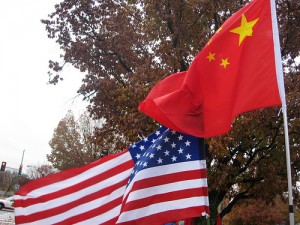
Chinese and American flags flying together
In Marxist thought the capitalist industrial stage is necessary before the final condition of a state completely controlled by the workers, without class.
This is because a significant surplus is required for everyone to have a good life, and it’s capitalist industrialism which creates that.
You can easily create a heavy industrial state in a command economy: both the Soviets and the Chinese under Mao did so. What they could not do was create a state with a lot of consumer goods.
Mao created the pre-conditions: heavy industry, basic infrastructure, and an educated people.
But notice the principles are all “stay socialist and stay in charge.”
The major banks in China are state controlled. The banks that aren’t state controlled are under strong supervision, and in most cases have party members in leadership positions.
Banks (and various shadow banks in the West) are the main way firms get money. If the banks won’t loan, your business won’t happen or won’t survive. If they will loan to you at preferential rates because you are doing what the Party wants, usually based on the five year plan, then you’ll have a good chance of success.
When I wrote my article on principles for running a left wing government I included taking control of the banks and taking control of media as absolute, immediate, necessities.
China has kept control of both.
This issue became especially urgent after the fall of the USSR and the CPC spent a LOT of time studying why the Soviet Union fell.
But despite Deng’s principles what was happening before Xi was the corruption of the CPC and its mingling with the new capitalist rich: after all, if as a party official you helped a firm, they could kick back to you and you’d get rich. Do enough of this and you could become obscenely rich.
This imperiled all four of Deng’s principles, as decision making around loans and regulation was increasingly made not in alignment with the CPC’s goals, but to make people rich. (One example is the massive housing bubble which Xi has since popped.) This is not the issue the Soviets had specifically, but is related: people with power no longer really believed in Communism or put the Party’s power first. (Gorbachev deliberately removed power from the party.)
When Xi took charge his first and most important programs was anti-corruption. At the time I cynically assumed it was a way of taking out his enemies, and that he would tolerate corruption for his faction.
I was, mostly, wrong. Xi’s anti-corruption is real. He’s a sincere Communist who wants to keep the CPC genuinely in charge and not let it be corrupted.
The goal is simple enough: stay in charge, make China vastly prosperous and transition to full socialism. Markets are useful for this, but must be kept under control or they will take control of the party, and capitalists aren’t going to be committed socialists.
Xi, in this light, is just an extension of Deng: actually making Deng work. Deng’s policies caused rapid technological advance and improved light industry massively, but the principles were not actually being enforced.
Xi enforces them. Not just anti-corruption but changes in how the party recruits and trains and promotes, all intended to keep the CPC on the path to socialism.
Will they succeed? Well the transition will come, if it does, with the next leader, most likely. Xi is putting his successor in a good position. AI and robotics are being directed towards physical activities, there are dark factories with no workers, and so on.
Genuine socialism means people shouldn’t have to work a lot if they don’t want to, and should still live a good life. AI and automation, done properly, offers that possibility.
Of course huge problems around distribution and production remain and will have to be figured out. If China stays the course they’re trying to create something which has never existed: something genuinely new. Westerner’s might call it “fully automated luxury communism” though I don’t know if it’ll get that far.
But the ducks are in a row: massive productive capacity, ways to reduce the amount of workers needed, and keeping control of politics and the economy.
This is the plan. No one knows if it will succeed, but it’s not a stupid plan or one that will obviously fail, IF China can deal with resource depletion, ecological collapse and global warming (all of which it is doing more to mitigate than any other country, though it’s far from perfect.)
China is the future. It’s success or failure will determine what political/economic models are considered usable and successful. The age of liberal democracy is near its end.
What I write here is for the benefit of everyone, but alas, I live in capitalism and I, and the site, take money to keep running. If you value the writing here and can, please subscribe or donate.
Why did Trump call off his big attacks? Why did the US stop attacking suddenly?
he U.S. Army has used up much of its stockpile of highly accurate long-range missiles during its five-month war with Iran, according to three people familiar with the data, raising concerns about the military’s readiness for future conflicts.The missiles are principally the Army’s surface-to-surface weapons, known as Army Tactical Missile Systems (ATACMS) and Precision Strike Missiles (PrSM). The U.S. has used “virtually all” of these weapons, according to two of the sources.
There are also claims that the US is running out of long range air to ground munitions as well.
Combined these two things mean that if America wants to keep bombing Iran, they have to actually fly over Iran and put themselves in much more danger from Iranian anti-air, and by all accounts the Iranians still have plenty left.
This problem comes from the same place virtually all US problems come from: rather than optimizing for results (production) everyone optimizes for profits. Selling fewer missiles for much more money is a better business deal, yes?
And that the US cannot significantly increase the production is due to de-industrializing: sending most of America’s key industries to China, because hey, it doesn’t matter where things are made.
China is now the US in WWII. They could, in a war, easily retool to produce literally millions of drones. They can produce a hundred warships per warship the US produces. Etc.
These are systematic issues. De-financialization is politically impossible. Without de-financialization re-industrializing is not possible, as it would require companies to make far lower profits. Chinese companies are MUCH bigger than American ones, and make less profit (not revenue, but profit) and have far lower valuations.
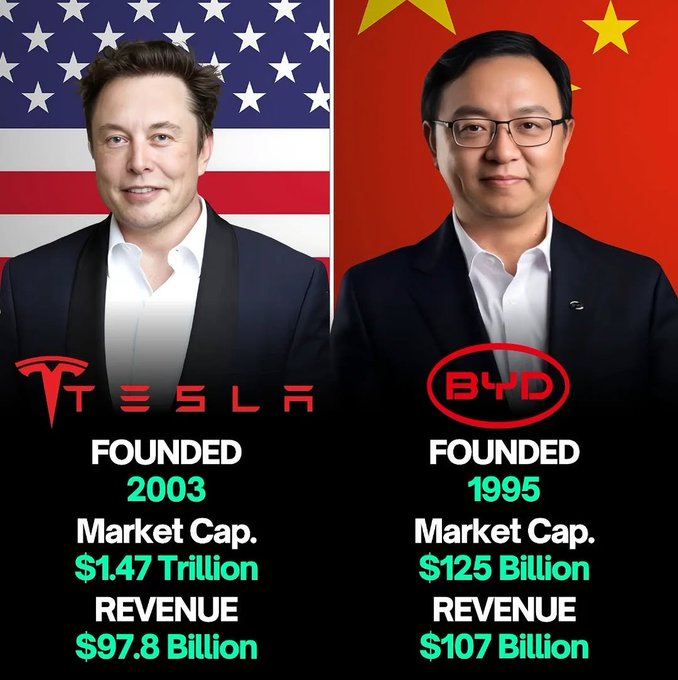
In 2025 BYD sold 2.26 million cars. Tesla sold 1.64 million. And China has many auto companies.
The mindset for scaling and the mindset for profit-maxing are very different. American elites are all looking for moats: they all want to be able to charge more for a product than it is worth because no one is competing with them on price. (This is why Chinese EVs aren’t allowed in America: they compete on price and the American car industry would cease to exist on contact.)
America lost the Iran war over fifty years as it changed from an industrial power to a financial power. Power comes from what a country can actually do. What it can buy from other countries is a minor consideration unless it has the ability to force them to sell, and that ability comes from what the country can do. Against Venezuela and Cuba, the US is still strong enough. Against a middle power which prepared for war and knows how to use geography, not so much.
In general terms, everything that is happening was predicted decades ago by objective people looking at the trends. Power comes from capability, America was systematically getting rid of that capability to optimize for the number of rich people it could generate.
Military decline, industrial decline, technological decline: all of this comes from making profits the end-goal, rather than the mean by which worthwhile goals were achieved.
“We need to make a profit do X” is very different from “we do X to make a profit.”
What I write here is for the benefit of everyone, but alas, I live in capitalism and I, and the site, take money to keep running. If you value the writing here and can, please subscribe or donate.
Escalating against a more powerful foe is usually a bad idea.
Ukrainians are finding this out now. There’s no denying that Ukraine’s strikes on Russia oil infrastructure, especially refineries have been effective, or that its strikes against Russian shipping had an effect but that campaign led to Russia changing its strategy as well.
It has basically turned Ukraine into a landlocked country with massive strikes against Ukrainian ports. This is as the harvest needs to be sold.
A systematic attack on gas and diesel distribution in the country, by taking out gas stations, has made logistics within the country extremely difficult. It’s not just that Ukraine is landlocked, it’s that once you get into the country by land, it’s hard to move at all.
This has always been the problem Ukraine faces: Russia is just more powerful. Putin was very restrained for most of the war, not taking out dual use infrastructure, letting power stay on, etc, etc… This is the sort of stuff that the US usually takes out first, as it did in both Iraq wars. Russia didn’t.
But while Putin has been remarkably humane for a wartime leader, there is an implicit quid-pro-quo here: we leave certain things alone and you return the favor. Ukraine, knowing it was slowly losing by accepting that status quo has broken it multiple times and each time Putin’s release of constraints on the Russian military has meant that Ukraine was hurt worse than Russia.
It’s instructive to notice that in the Iranian war the US has actually been fairly restrained compared to its normal operations, for the simple reason that while Iran can’t hit the US homeland, it can hit US allies infrastructure. So Trump’s latest promise to turn off all the lights in Tehran came to nought, as have the past threats, because Iran can turn off the lights and water in the Middle East, and more importantly, smash oil production and refining in ways that would take a decade to repair, even as US petroleum reserves keep dropping.
John Arnold put together a good timeline:
March 23: Postponed announced attacks on Iran’s power grid, citing “very good and productive” negotiations March 26: Extended deadline by another 10 days; negotiations were “going very well.”
April 7: Two week ceasefire to give time to conclude a proposed 10-point plan April 21: Extended ceasefire indefinitely after mediators requested more time May 18: Held off a major strike because “serious negotiations” were underway
June 11: Canceled strikes hours after threatening to hit Iran “very hard,” claiming a negotiating breakthrough
June 17: Signed an interim ceasefire agreement ending hostilities and beginning a 60-day period to negotiate a final agreement
July 27: Paused bombing campaign to give diplomacy another chance
August 1: Canceled planned attack after claiming that Iran had agreed on parameters of a deal
Iran says there’s not only no deal, but they aren’t even talking.
So deterrence has, to some extent, worked in the Middle East, but it hasn’t worked in Ukraine.
Zelensky is now offering Russia an “air campaign” cease fire: they’ll stop hitting Russia’s oil infrastructure and ports in exchange for the same.
Too late is my guess. “Now that this strategy is hurting us more than you, let’s stop” isn’t likely to be all that convincing to Russia.
Ukrainians are resisting conscription massively, the Russian army’s advance is slow, but it continues to advance, and Ukraine’s almost out of interceptors, since they’re going to the Middle East and Israel. A promise to let Ukraine make its own patriot missiles is unlikely to work: if they build them in Ukraine, they can be hit. This isn’t like drone manufacture, you can’t farm it out to thousands of dispersed households: it’s need a real factory, and the Russians will find that factory and hit it. Oh, and Ukraine’s post-war population is likely to be ten million less than the pre-war population, with women massively outnumbering men.
Ukraine needs a comprehensive peace deal. Much like America in the Middle East, this is a war it cannot win and which hurts it more than it hurts Russia. When you can’t win a war, you make concessions and go to peace. Denial of reality is not a war plan, it’s a way of marching to doom. At some point the Ukrainian army will collapse, and the conditions that Russia imposes in an unconditional surrender scenario are a lot worse than those they’ll get, even now, in a negotiated peace.
The same is true in the Middle East. Yes, Iran can’t conquer America, but what happens when diesel and gasoline and fertilizer and plastic and medicine shortages all hit the US mainland? The deal America gets in that situation is worse than the deal it gets if it makes peace now.
When you’ve lost a war, you’ve lost the war. Making your opponent prove it across the board will never lead to a better outcome.
What I write here is for the benefit of everyone, but alas, I live in capitalism and I, and the site, take money to keep running. If you value the writing here and can, please subscribe or donate.
Week-end Wrap – Political Economy – August 02, 2026
by Tony Wikrent
War
The Math Behind The U.S. Defeat in Iran
Spencer Ackerman, 30 July 2026 [forever-wars.com]
… By spreading out missile and drone attacks across a wide arc of U.S.-used or aligned military bases and civilian infrastructure (energy, data and desalination facilities) spanning from Kuwait to the United Arab Emirates—and now spreading inland—Iran has forced the U.S. into firing off lots of its interceptors. It also successfully attacked on-base radars that the interceptors rely on for accuracy. While story after story reported that Gen. Dan Caine, the chairman of the Joint Chiefs of Staff, warned about the limited supply of interceptors, known as magazine depth, President Trump insisted that the U.S. had sufficient capability to fend off Iranian attacks.
The actual magazine depth of the U.S. military is understandably classified. But yesterday, the Center for Strategic and International Studies (CSIS), a think tank with impeccable establishment credentials—Kissinger was a trustee—published an estimate of the current state of U.S. interceptor stocks. I don’t know what exactly I expected, but the burn rate of the interceptors is so extreme as to make this war look doomed from the outset.
According to CSIS, the U.S. had 2330 Patriot (smaller, short-range) interceptors and 452 THAAD (larger, long-range) interceptors at the start of the war. Five months later, it has between 759 and 827 Patriot interceptors and between 234 and 278 THAADs. Those aren’t figures for the interceptors the U.S. has in the Middle East. They’re the figures for all the interceptors the U.S. has, period.
In other words, the U.S. has so far used up around 66 percent of its Patriot stocks and around 40 percent, conservatively, of its THAADs. It did that in five months across a war it chose. A war that Trump said would be won in four to five weeks.
The rate of expenditure hasn’t been static in those five months. Remember that there was a ceasefire declared on April 8. CSIS’ figures, understandably, show the most intense period of interceptor usage occurring in just the first five weeks of the war. All this helps explain why Trump had to pursue a ceasefire in the first place….
U.S. general warns Pentagon he lacks sufficient forces to protect Israel
The top U.S. general in Europe privately warned the Pentagon this week that he lacks sufficient naval forces to continue protecting Israel from incoming ballistic missiles, officials said, illustrating how the ongoing Iran war has imposed constraints on the military.
Gen. Alexus Grynkewich, the head of U.S. European Command, sent written notification to senior Pentagon officials saying that without another Navy destroyer he will be forced to choose defense of the United States “homeland” over that of Israel, said the officials, who like some others spoke on the condition of anonymity to discuss the correspondence.
Israel and US consider Iran land blockade
Connor Stringer, July 31, 2026 [The Telegraph, via yahoo.com/news]
The United States and Israel are discussing a possible land blockade of Iran, The Telegraph can reveal.
The proposal is one of several options being explored by Donald Trump and Benjamin Netanyahu to ratchet up economic pressure on the regime after months of strikes and a prolonged campaign failed to bring it to heel….
Iran shares borders with Iraq, Turkey, Pakistan, Afghanistan, Turkmenistan, Armenia and Azerbaijan, meaning the leaders would have to persuade these countries, many of which they are not allied with, to co-operate.
Washington may view Pakistan and Iraq, which are not considered its close allies in the region, as weak links.
If any of the seven countries bordering Iran agreed to co-operate, they would face their own economic consequences and the threat of retaliatory strikes by the Islamic Republic….
Trump not violating any law
‘He who saves his Country does not violate any Law’
Joe DePaolo, May 4th, 2025
‘The Boss Wants This Money’: Inside Trump’s Unprecedented Fundraising Operation
Josh Dawsey, Dana Mattioli, Annie Linskey and Emily Glazer, July 30, 2026 [Wall Street Journal, via PoliticsNC]
Almost every night in the White House, President Trump calls his fundraiser, Meredith O’Rourke, for an update.Trump asks O’Rourke which companies and donors have cut checks and which haven’t, and for how much. He often asks her to make much larger financial requests than she was planning—for some donors the ask is $5 million, for others it is $50 million. And the president gives her names to call, often including people who have recently met with him, according to people with knowledge of the calls.“This is very important to the president. He’s asked me to call you and ask you for this donation,” O’Rourke has relayed on phone calls with companies, persistently following up with them. In some calls, she has referred to Trump as the boss, saying “the boss wants this money.” In turn, Trump has called her the “princess of darkness” because she is such a “killer” with donors, according to people who have heard his comments….Trump stands out for taking personal control of the fundraising, and no sitting American president has ever raised these amounts for his pet projects. At the same time, companies have paid new attention to the White House as Trump has gotten involved in regulatory decisions that once were made by independent agencies, dramatically shifting the balance of power across Washington.Trump has been demanding large checks from companies for a range of political and legacy projects—telling executives and lobbyists that their companies should give $25 million or $50 million. He has sometimes offered donors special access….“Trump is shattering all fundraising paradigms in regards to hitting up corporate America for donations. The scope is mind-bogglingly large,” said Douglas Brinkley, a presidential historian at Rice University. “We used to talk about the Lincoln bedroom being for sale, but this is just a wholesale money trough that’s totally different.” Critics alleged in the 1990s that the Clinton administration allowed overnight stays in the White House’s Lincoln bedroom in exchange for campaign contributions….The White House referred requests for comment to Alvarez. She said the president is the “most successful fundraiser in modern political history” and that Trump plans to use the money to “help Republicans win big in the midterms, build an enduring political infrastructure and continue advancing innovative private-sector initiatives.”“One thing has never changed. President Trump can’t be bought,” she said….Several CEOs and board members said they believe there is a link between their contributions and their access to the president. One chairman of a publicly traded company said that if you give the money, you know you are either checked on a list, or crossed off a list if you don’t….Companies have traded notes about what Wall Street analyst Blair Levin calls “The Trump Transaction Tax,” or a payment outside of the cost of normal business. “Another way of saying it,” Levin said, “is simply that we’re replacing the free market with the market for Trump’s affections.” ….
Christopher Armitage, Aug 01, 2026 [The Existentialist Republic]
Trump’s Constitutional Dictatorship
Mark Danner [The New York Review, August 20, 2026 issue]
Reviewed:
Regime Change: Inside the Imperial Presidency of Donald Trump
by Maggie Haberman and Jonathan SwanSimon and Schuster, 464 pp., $34.00… The scene is irresistible: the president of the United States sitting at the Resolute Desk and comparing himself blithely to Mao, Hitler, and Stalin. Still, what does it tell us? That a tireless and amoral will to power is deeply embedded in Donald Trump’s narcissism and vanity is not exactly a revelation: anyone who has watched him perform a ninety-minute stand-up routine before a crowd of supporters—drinking in, with almost erotic delight, the fervent worship of thousands—cannot have failed to notice. And after the undermining of NATO, the destruction of USAID, and the calamity of the Iran war, Trump’s name is more likely to appear on lists of leaders who have diminished their country’s power than lists of those who have increased it. But that he has become one of the most powerful American presidents—that he has since his second inauguration “put on a demonstration of raw executive power the country had not seen since the presidency of FDR”—is well-nigh indisputable. One could go further and say that not only has Trump, like Roosevelt and Lincoln, successfully imposed on the world’s first modern democracy a “constitutional dictatorship,” he is the only president to have done so in the absence of a true emergency.
How did he do it? Aggressively, brutally, relentlessly—weren’t we all watching him? The more specific answer is that he did it by exploiting the chief executive’s myriad emergency powers or, as Haberman and Swan rather politely phrase it, by “redefin[ing] the very concept of an ‘emergency.’” Another way to put it is that Trump did what Trump does as easily as he breathes: he lied. Is the trade deficit, in uninterrupted existence for half a century, an emergency? Can a country leading the world in energy production be said to be undergoing an “energy emergency”? Can we consider that the southern border, where crossings dropped 77 percent after Joe Biden’s executive order limiting entry, remains in the grip of a “border emergency”? The answer is no. But it doesn’t matter. In issuing more than 140 executive orders in his first hundred days in office—Roosevelt issued ninety-nine—Trump declared that the country was beset by no fewer than ten separate emergencies.
And in the face of this supposedly unprecedented onslaught the president must have unprecedented powers to confront them….
Trump’s National Killer Police Force
[The Intercept, July 24, 2026]
Within the span of a week, federal immigration agents shot and killed two people in Maine and Texas, and another was hit by a truck and killed in Florida after trying to avoid ICE agents. A fourth person recently died in ICE custody after reportedly being denied medication.
Their deaths prompted yet another round of questioning as to how federal immigration agents have amassed so much power and so little accountability. This week on The Intercept Briefing, host Akela Lacy speaks with Naureen Shah, of the American Civil Liberties Union, and Nayna Gupta, of the American Immigration Council, on the consequences of allowing the government to build a national policing force that’s bringing Trump’s war on immigrants into communities across the country.
“The $240 billion injection that the Trump administration has given ICE and Border Patrol make these agencies — which already were the largest federal law enforcement agencies — make them far larger than anything that we’ve seen at the federal law enforcement level,” says Shah. “Their budgets are bigger than that of many, actually most militaries around the world.” ….
Use to discuss topics unrelated to recent posts.
 So, SpaceX’s stock is down to $108. It started at $150. It spiked as high as $225. (Hope you didn’t buy it then.)
Ouch.
This was completely predictable, because SpaceX doesn’t have a product worth its MASSIVE valuation. Everything was done to spike SpaceX’s initial offering, including letting it into multiple indices, which means that pension funds and so on were forced, in effect, to buy it.
Meaning your pension fund just took a huge loss.
The key to SpaceX’s valuation, such as it is, is reusable rockets.
The news comes just days after Chinese state-run media showed a Long March 10B rocket booster being caught by an offshore recovery platform, indicating the country was making major strides in catching up with SpaceX’s reusable rocket tech. Over the weekend, an experimental Japanese reusable rocket safely took off and landed, suggesting the nation may be right behind China as well.
Beyond some steepening international space launch competition, experts believe SpaceX’s transformation into an “AI play” may be closely related to its Wall Street woes, as the BBC reports.
“Everyone saw SpaceX as an AI story,” CFRA investment research analyst Keith Snyder told the broadcaster.
“With Elon Musk, any company he touches gets people excited,” he added. “But this was also the first time people felt like they were able to invest in something that was being marketed as an AI play.”
I predicted years ago that Musk didn’t have a moat on reusable rockets. The problem is simple: once the Chinese get a tech, they an always scale much better than competitors, because they have a robust, low priced industrial sector due to actually having competitive markets and useful industrial policy.
As for X being an “AI stock”, well, generally Grok is and has remained by behind most other major AIs in performance benchmarks. There’s no particular reason to believe it’s going to win the AI race, and it’s expensive and closed source, so how it’ll make a profit is unclear to me.
Musk is the world’s greatest conman. Oh, he’s done some important stuff, but it’s been years now since he actually pulled off anything major and real: electrical cars, batteries, reusable rockets are all well in the past. Tesla is only kept alive by the refusal of the US and EU to let much cheaper Chinese EVs into their markets. Spaceship keeps failing. Musk is personally toxic with the sort of people who buy EVs in Europe and the US: liberals and left wingers who believe in climate change.
Anyway, I hope you didn’t buy SpaceX unless you were taking advantage of the rug pull to do a short term trade.
This is just another example of “make the rich, richer” and American delusional belief in their own superiority. Musk is the world’s first trillionaire, but he isn’t going to stay that way.
What I write here is for the benefit of everyone, but alas, I live in capitalism and I, and the site, take money to keep running. If you value the writing here and can, please subscribe or donate.
Powered by WordPress & Theme by Anders Norén