Ian Welsh

The horizon is not so far as we can see, but as far as we can imagine

April 9th US Covid Data

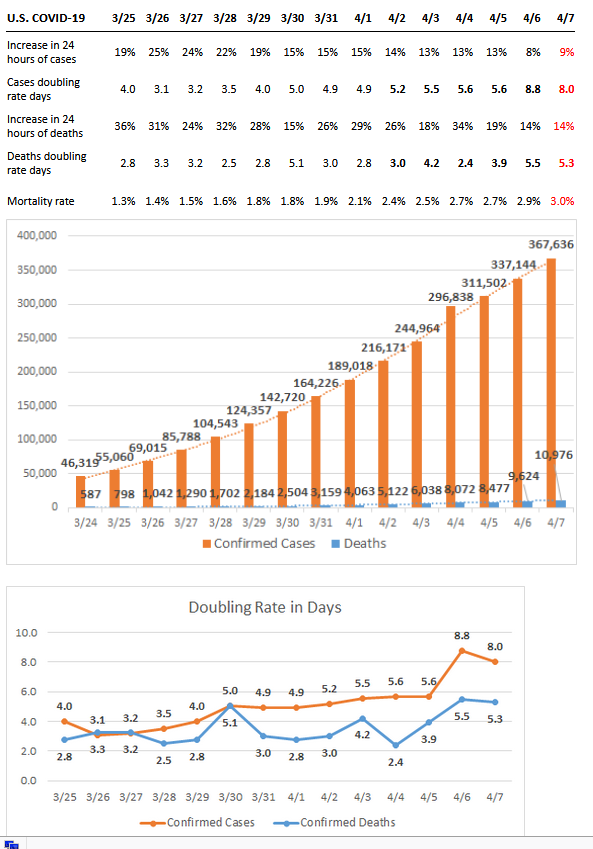
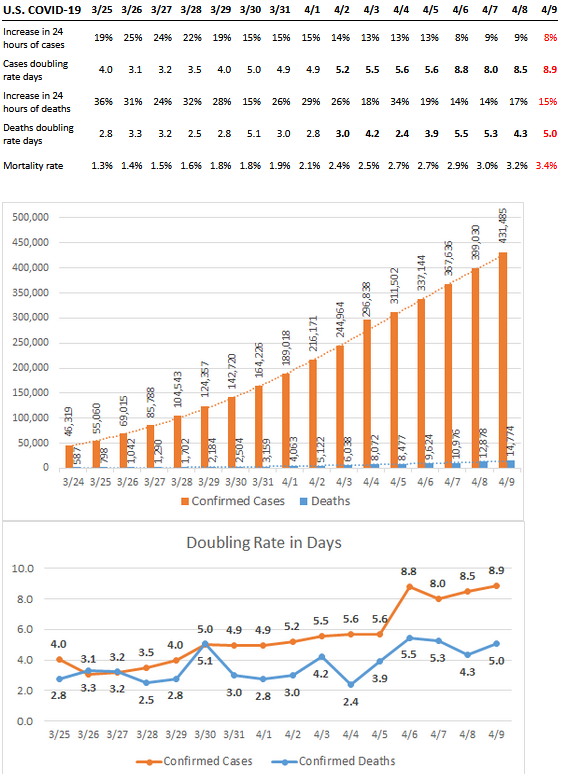
The curve continues to flatten, which is overall good news, though the mortality rate continues its march upwards.

The federal government will stop paying for Covid-19 testing sites on Friday, so data will be even more unreliable after that.

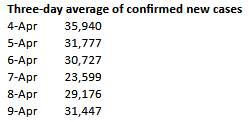
Edit: The three-day moving average chart was wrong for about an hour. It has been corrected. My apologies.


The results of the work I do, like this article, are free, but food isn’t, so if you value my work, please DONATE or SUBSCRIBE.

Sanders Drops Out

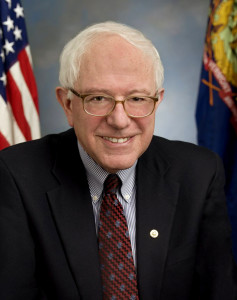
Bernie Sanders

Yeah, not much to say right this moment. I think this is a mistake; there’s a lot of flux right now. This isn’t an ordinary season, and he might have made it in, though, obviously, the odds were against him. I suspect part of Sanders’ reasoning is that, unlike Biden, he wasn’t willing to urge his followers to go vote during a pandemic and many states were making mail-in voting impossible.

Biden was always most likely to win, alas. There are a lot of people who want a return to the old normal, and Biden, for all his flaws, symbolizes that. Plus, for most people, he’s best known threw memes showing him as Obama’s best buddy (thanks, Onion).

Biden won’t be President for long, if he wins. He’s clearly in decline, even if he’s a figurehead, someone else will be running the show. Or they’ll just hand it to the vice president. His vice president pick is incredibly important, since that person may well be who is actually being elected as President.

As for Bernie, this was his last hurrah. Warren is seen as having betrayed the left; she won’t be able to win if she runs again. I would guess AOC is the heir apparent, but we will see.

Bernie lost because Democrats are actually conservatives (Republicans are reactionaries). Independents tend left, but don’t vote as much as registered Democrats. Likewise, the old vote more than the young, and there was heavy-handed engineering to shut down the votes of poorer or younger people. (For example, shutting down polling places in poorer neighbourhoods, leading to massive lineups in the few that remained. Same with campuses.)

Bernie was the only chance of having a good government in charge in the United States for the next four to eight years.

If Trump wins, we have another four years before a chance at someone decent. If Biden wins, it will be eight, as even if Biden’s VP loses in 24, he still takes up the running slot.

Either way, we’re out of time on things like climate change. We were already past the point of no return, we’ve now lost the serious possibility of mitigation.

So be it. Be well, all and take into account that, no matter who wins, the 20s are not going to be a good time unless you’re already quite well-off.


The results of the work I do, like this article, are free, but food isn’t, so if you value my work, please DONATE or SUBSCRIBE.
April 8th US Covid Data

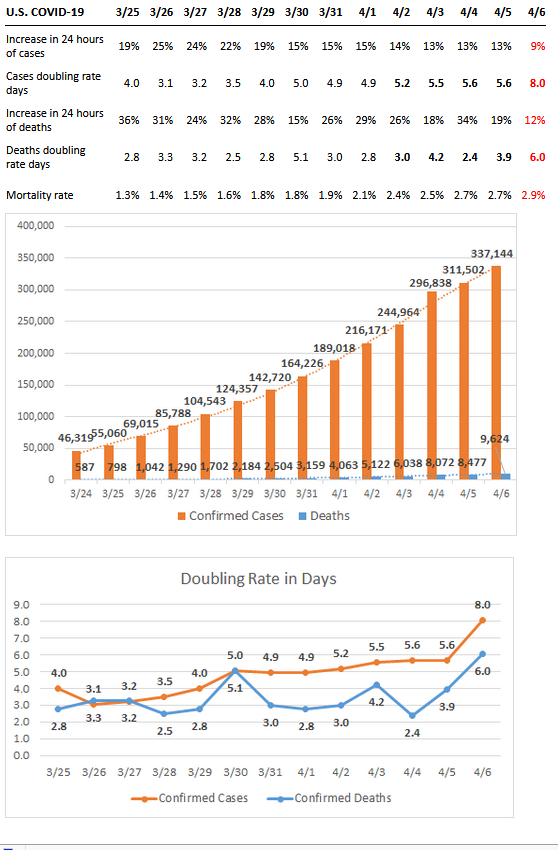
The three-day rate of increase of new cases continues to drop, and the curve continues to bend.

Note that there is good reason to believe that the number of deaths are severely under-counted. For example:

As of Monday afternoon, 2,738 New York City residents have died from ‘confirmed’ cases of COVID-19, according to the city Department of Health. That’s an average of 245 a day since the previous Monday.

But another 200 city residents are now dying at home each day, compared to 20 to 25 such deaths before the pandemic, said Aja Worthy-Davis, a spokeswoman for the medical examiner’s office. And an untold number of them are unconfirmed.

They’ve said they’ll start counting likely Covid cases as Covid, but it seems unlikely they’ll backfit data, and this is only New York.

I’d expect that the death numbers are about double (maybe more) that of the deaths we know about. One of the problems is that when Covid goes from awful to terrible, it can also make it impossible to go for help. So, if you’re on your own or only with other people with cases, don’t leave it too long.

The data from our benefactor:


The results of the work I do, like this article, are free, but food isn’t, so if you value my work, please DONATE or SUBSCRIBE.
Geopolitics and the Economy After Covid-19

Nope, not yet

First the good/bad news. Covid-19 isn’t going to bring down the “system.” It’s not a hard enough shock.

There are things we should learn from it, about what work is actually needed, about the fact that more people will not die because of reduced pollution during isolation periods than from the virus, and so on.

Mostly, we won’t learn those lessons.

One lesson which will be, not exactly learned, but used, is that if you don’t make it in your country, you can’t be sure of having it when it matters. Physical manufacturing matters: It can be designed in the US, but if it’s made in China, well…Trump almost stopped 3m from selling masks to Canada, be sure that the fact that he can has also been noticed.

There were already powerful forces, and not just in the Trump administration, who were unhappy with the current world trade and offshoring system. The more intelligent parts of the American permanent ruling class have noticed that the actual threat to American hegemony is China, and that when China makes things the US needs, China has the US by the balls.

They’ve been wanting to bring as much production back to the US as possible and they’ve been wanting to force the world into two trading blocs. These are the sort people who become livid when a European country chooses Huawei 5G, and start making threats about NATO.

They are, of course, right to be worried. The offshoring of production had catastrophic effects for Britain, when they off-shored to the US in the 19th century. They said the same sort of things Americans say now, “We still design, they just make the stuff.” That didn’t last: Manufacturing produces designers in time, there are things learned best when you’re right next to the plants. It took about three decades, but the design moved to the US, and Britain never recovered, eventually surviving through financialization, a weak shadow of itself, sustained on rents which the rest of the world can easily, one day, decide not to pay.

So Covid-19, which is putting shocks through the trade system anyway, is going to be used to justify bringing production back to various countries, to re-shoring. Trade will go down, not up, the supply chain will be less broken into pieces, and there will be a push towards a new cold war with two trade blocs. There may wind up being three depending on what Europe does, but the plan is to force Europeans into the US bloc.

In general economic terms in the US and UK, what will happen is just what happened after 2008—the big boys will be bailed out, those who have money (or are given trillions by the Fed and Treasury) will then buy up distressed assets. There will be fewer, bigger players again, the general economy will be worse for ordinary people, blah, blah. You know the play.

This won’t lead to revolution or revolutionary change yet, I suspect. I think it’ll take at least one more big shock before people become desperate enough. And, of course, the right play is to pick some part of the poor and have them oppress the other half of the poor in exchange for not-too-shitty a life. Poor white sharecroppers who get to call the equivalent of African Americans “boy.”

That play, given the weakness of the left in America and the UK, may well work. We shall see.

But be sure of this, there will be more shocks. This is a system which has no “give.” It has no surplus capacity to handle shocks, not at the real economy level: All our elites know is politics and printing digital money and giving it to their friends, without insisting on real production. Oh, they’ll try to re-shore production, but they are fundamentally incompetent and will run it badly. Be sure of that.

So this isn’t the big one. But climate change is rumbling, resource shortages are onrushing, and our sclerotic society and incompetent elites will turn what should be shocks that are easily handled into crisis after crisis.

The future is going to be interesting. Be prepared. The old world is dying, the new world has not yet been born, and there will be a great deal of pain and screaming in both the death and birth.


The results of the work I do, like this article, are free, but food isn’t, so if you value my work, please DONATE or SUBSCRIBE.


April 7th US Covid Data: Some Signs of Flattening

Our benefactor wrote:

You can visibly see the trendline in the bar chart starting to curve. (A doctor) and I were discussing what flattening the curve means from a data perspective. Most graphs are log graphs. Ours is a linear one. From his, a doctor’s perspective, flattening would be the number of cases showing up at the hospital every day. In that sense, nationally, we’re right there. It varies from state to state.

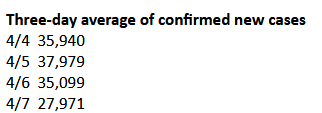
I did a three-day average for new (usually tested) cases, and we’ve peaked over the last two days. Hopefully, that trend continues. It’s hard to tell, because the daily numbers are much more erratic.

Seems like good news. Remember that all of this is on a delay, people walk around without symptoms, then get symptoms, then they get worse and they go to the hospital and usually that’s when they get tested unless they’re important. You can see something similar in the doubling rate for cases vs. deaths: The cases doubling rate peaks eight days before deaths–people get to the hospital, then it takes them some time to die.

If this is the peak, it’s far better than it could have been. Do remember that there’s a long tail even if it is brought down, and even if there’s good testing (like in South Korea). In the US, there may well be multiple peaks.

Still a ways to go.

In other news, UK Prime Minister Boris Johnson is in the hospital and has been intubated. At this point his odds of survival are about 30%, and being on a ventilator sometimes does long term damage, including to brain function.

Boris, of course, deliberately shook hands with infected patients and his original plan for Covid-19 was to not bother with self-isolation. It’s safe to say that his delays will probably be responsible for perhaps a couple thousand avoidable UK deaths.

I dislike anyone suffering, so I hope he’s well-sedated. Ventilators, having had one in briefly in my 20s for surgery and afterwards, feel unbelievably bad. It’s not an exaggeration to say I have lived a life filled with massive pain and suffering, sometimes at levels that pain killers couldn’t deal with, but I think having that ventilator breathe for me may top the list.


The results of the work I do, like this article, are free, but food isn’t, so if you value my work, please DONATE or SUBSCRIBE.

Saving Your Local Economy, 4-6-20

This post is based on some key assumptions:
  • You want to save and preserve small and local businesses in your community or town.
  • You don’t want a local economy that consists almost entirely of chain restaurants and big box stores and a central business district full of empty storefronts.
  • You value the diversity, creativity, idiosyncratic character, and friendliness that thriving small business owners bring to your community or town.


Whenever there are enough links that I think might assist people in organizing responses from their local county and municipal governments, I will post them. It probably will not be every day. 
 

In a phoned-in interview on CNBC, Wilfred Frost urgently reported that Bank of America has received 177,000 applications for some $32.6 billion in emergency liquidity, but so far, only 100 of these loans have been disbursed.
The bank hopes to get most of the stack processed by mid-week, but it’s unclear what they’re basing these hopes on.

Unsanitized: Why Banks Don’t Want to Help Small Businesses [David Dayen,  The Prospect, April 3, 2020]
So why the reticence from the banking sector? I think liability is a red herring; are they really afraid of the heavy regulatory hand of Steve Mnuchin (or any law enforcer involved in the financial crisis)? It looks to me like they don’t want to do the work. Every expectation is for an absolute crush of applications. Thirty million small businesses could be on the line here. The compliance requirements are minimal but banks always whine about the expense of that; that’s why BofA is restricting to already-vetted customers. And the guidelines, which have been “changing by the minute,” could change again. So why bother with the hassle? The money’s good, but it’s marginal, and the big banks think in billions, not millions….
…I’ve talked to dozens of small business owners who are confused by this program, but who are also desperate to participate. There’s not going to be enough money — Congress gave $350 billion — to begin with. If lenders are slow to open the spigot, a lot of these businesses will go down. They don’t have any cash reserves. There’s a lot of concern. Maybe SBA should have found someone more willing to act quickly.

Germany Announces “Limitless” Aid Program for Small Business: SBA Are You Listening? [Zerohedge, 4-6-20]

…Angela Merkel’s government announced a new “limitless” aid program for small- and medium-sized companies (Ed. Note: not a bailout of Germany’s mega corporations) as part of an effort to support Europe’s largest economy in the coronavirus pandemic.
Merkel’s government will provide guarantees of as much as 100 percent, German Finance Minister Olaf Scholz announced at a joint press conference with Economy Minister Peter Altmaier Monday, Bloomberg reports, adding that loans of up to 800,000 euros ($862,000) that will pay out very quickly will be available.

The existing program only provides for an 80 percent to 90 percent loan guarantee and banks have been reluctant to take on new risk as the economy falters. Private lenders have thus pressed the government to expand the existing program by guaranteeing 100 percent of the loans, which it now appears to be doing.

Over the past week, it has come into focus for policymakers just how much strain state and local government budgets are under. They have to make emergency healthcare expenditures among other emergency expenditures, expand unemployment insurance with very low levels of reserves in unemployment insurance funds and do this while tax revenues fall off a cliff since incomes and sales have collapsed. The CARES act provides $340 billion all together with 80 percent or so going to financing  Coronavirus-related expenditures. 150 billion of which is direct aid to state and local governments. Given the scale of the crisis, this is far from adequate….

April 6th US Covid-19 Data

There as been significant improvement in the rate of increase of both deaths and existing cases. Original predictions were a peak at April 9th (at a 0 percent rate); our benefactor notes that seems unlikely, but we’re definitely moving in the right direction.

Note that when cases drop and we are taken off isolation, what will happen is another round of infections, then another round of isolation. Some states are still not isolating and some started only recently, so there’s still road to go, and those non-isolating states constitute pools of infection. I expect a significant spike from Florida, assuming the deaths and cases are counted.

Both death and infection rates remain understated. We will only find out the actual number of deaths when population studies are done afterwards.


The results of the work I do, like this article, are free, but food isn’t, so if you value my work, please DONATE or SUBSCRIBE.

Week-end Wrap – Political Economy – April 5, 2020

by Tony Wikrent
Economics Action Group, North Carolina Democratic Party Progressive Caucus

Economic Armageddon

Coronavirus batters US economy as 6.65 million file for unemployment last week
[The Guardian April 2, 2020]

Some 3.3 million had filed for unemployment the previous week, bringing total claims to 9.95 million for the two weeks.

US Labor Market Update
Len Kiefer April 3-2020
Click through to his animated gif graph, which helps visualize the catastrophic economic convulsion we are in. It takes a few seconds to get to the stunning, shocking end.
http://lenkiefer.com/img/charts_2020_04_03/claimsSA_2020_04_03.gif

Jobs Aren’t Being Destroyed This Fast Elsewhere. Why Is That?

Emmanuel Saez and Gabriel Zucman [NYT, via Naked Capitalism 4-1-20]

This dramatic spike in jobless claims is an American peculiarity. In almost no other country are jobs being destroyed so fast. Why? Because throughout the world, governments are protecting employment. Workers keep their jobs, even in industries that are shut down. The government covers most of their wage through direct payments to employers. Wages are, in effect, socialized for the duration of the crisis.

Instead of safeguarding employment, America is relying on beefed-up unemployment benefits to shield laid-off workers from economic hardship. To give just one example, in both the United States and Britain, the government is asking restaurant workers to stay home. But in Britain, workers are receiving 80 percent of their pay (up to £2,500 a month, or $3,125) and are guaranteed to get their job back once the shutdown is over. In America, the workers are laid off; they must then file for unemployment insurance and wait for the economy to start up again before they can apply for a new job, and if all goes well, sign a new contract and resume working….

This situation for laid-off workers would be bad enough if it were not aggravated by a second American peculiarity. As they are losing their jobs, many workers are also losing their employer-provided health insurance — and now find themselves faced with the Kafkaesque task of obtaining coverage on their own.

One option involves continuing to be covered by one’s former employer, a program known as COBRA. It is prohibitively expensive: Participants have to bear the full cost of insurance, $20,500 per year on average. Another option is to go shopping for a plan on the Affordable Care Act insurance exchange, where one is faced with a bewildering choice between plans like Blue Shield’s Bronze 60 PPO (with a deductible of up to $12,600 per year) and Aetna’s Silver Copay HNOnly (with a $7,000 deductible and up to $14,000 in annual out-of-pocket expenses). The last option is to join the ranks of the uninsured, a catastrophic solution during a pandemic. There are reports that people have already died of Covid-19 because they refused to go to the hospital, worried about bills, or because they were denied treatment for lack of insurance.

Red April: What happens on the first of the month when residents, restaurants, and retail stores don’t pay rent?
Henry Grabar [Slate, March 27, 2020]

Page 273 of 532

Powered by WordPress & Theme by Anders Norén