
Feel free to use the comments to this post to discuss topics unrelated to recent posts.
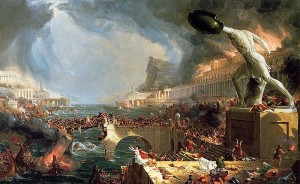
The Course of Empire by Thomas Cole
Covid is one of those disasters which tests whomever it happens to. Countries like Vietnam and Taiwan and even Germany stayed on top of it, or got ahead of it, and are doing fine. Those who mishandled it are taking some hard hits.
This isn’t primarily about deaths, though those are awful, it is about the mishandling of the economy. In Canada, there’s a benefit of $2,000 dollars per month for which most people who lost their jobs qualify. Other countries have done even better: freezing mortgage payments, rent, and so on, and organizing food delivery.
In the US, we have predictions of a 30 percent unemployment rate. I just saw that less than half of Los Angeles county still has a job.
The bailout for regular people is $1,200. In a place like Los Angeles, that won’t even cover most people’s rent.
There’s been a vast bailout, mainly–though not exclusively–through the Fed, for the rich. Basically, as much free money at the trough as they can gorge on.
But small businesses are toast. A third of households, at least, are on the verge of not just homelessness but not being able to eat.
Meanwhile we have a lovely display of typical US business incompetence. The US’s logistics system is a wonder of the world, but it was created in the 80s and 90s by people who are retired or dead now. Meat packing plants are shutting down because of multiple cases, truckers and warehouse workers are getting sick and scared. Farmers complain of problems getting workers. The price of beef for farmers has crashed through the floor, but they can’t get the animals to consumers.
Meanwhile, multiple states have not instituted isolation, and there are “protests,” backed by Republicans, to reopen states that have.
Not isolating nationally means there are pockets of plague which are still expanding exponentially, and which can reinfect the areas which did isolate. Coming out of isolation too soon will mean that cases will explode again a month to a month and a half after self-isolation ends.
The job issues mean trouble. People who can’t afford food become violent. Food riots bring down nations.
Assuming these storms are weathered, or that Americans are so beaten down they won’t riot even when starving, when the economy does re-open, many of the jobs will be gone. People who did not earn during the time down will still have to pay back-rent. At best, their spending is crippled, at worst they get evicted.
Many landlords will lose their property in any case, many small businesses will go bankrupt and never re-appear. The likely scenario, longer term “after” the Coronavirus is another ten-year depression, except this one is likely to be a deflationary depression: No one but the rich has money, and no one is spending.
But imagine the fairly standard scenario of multiple waves of coronavirus with multiple waves of self-isolation. No national policy, so some states stay open as others are closed. People in warehouses keep getting hit, logistics people get hit, migrant workers get hit or can’t even get into the country.
The system, already drawn tight to extract maximum profit and efficiency, starts breaking. Prices surge, there are actual shortages in many places.
This is some months out, I’d guess, although this is the sort of scenario that goes from “eh, it’s OK” to BOOM very, very fast when it does go.
The US is fragile. The choice to not freeze mortgages, rent, interest payments and so on, and to not bail out ordinary people as I instructed is going to explain to the rich that it is everyone else who makes the actual economy run.
There is a real economy, Virginia, and if it freezes up, there will be hell to pay. Logistics workers need PPE and they need them now. Freezes of rent, mortgages, interest payments, and so on, need to be done now. If a complete idiot wasn’t running the country, taking national control of when states close and reopen should happen now. I would suggest that if Americans don’t want their country in a new great depression, that they find a way to depose Trump now, and if Pence won’t be competent, ditch him too.
There is a chance that the US will fumble through, as governors and mayors who aren’t complete incompetents (and the rare, actual competent governor, which doesn’t include New York’s Cuomo), plus the rare competent CEOs, manage to hold thing together–barely.
But right now, this is looking like an epic clusterfuck.
Remember, however, when the riots come, if they do, if you won’t just die quietly for the peace of your masters, to go to where they live, or where the Fed employees live, and riot there. Explain to them about what people do to fat, happy, rich people when they can’t eat.
The results of the work I do, like this article, are free, but food isn’t, so if you value my work, please DONATE or SUBSCRIBE.
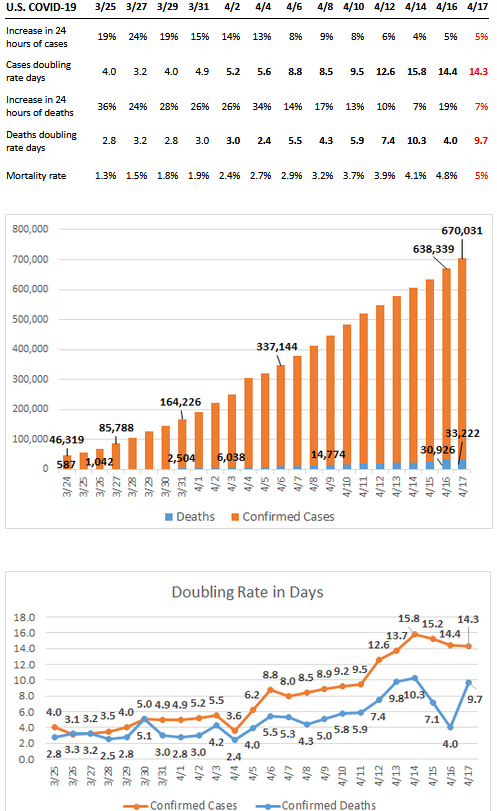
Our benefactor notes that the long tail looks like it will take a long time. (More on that in another post.)
The results of the work I do, like this article, are free, but food isn’t, so if you value my work, please DONATE or SUBSCRIBE.
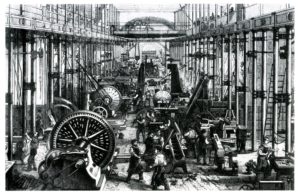 One of the most important things to understand about industrial capitalism is that the lower classes didn’t want it.
Peasants did not leave the land voluntarily. They were forced off, often violently, in a series of enclosures, through which their millennia-old rights to use the land were taken together.
This was a vast, albeit “legal” (because bills were passed that made it legal), seizure of property rights. Property is just rights, and those rights were taken from the peasantry and free farmers and given to the lords.
The justification for this was that “enclosed lands are more productive,” but detailed study has found this was only somewhat true: Commons fields were about 80 percent to 90 percent as productive, and their productivity increased at the same rate as enclosed fields. For some crops, common fields were more productive.
With the the fields enclosed, the peasantry lost control of capital (land is capital). They couldn’t grow their own food, raise sheep for wool, chop down trees for fuel, and so on.
They were thus forced off the land, into the city slums, and had to work for industrialists, six and a half days a week, 12 hours a day on average. They died younger, there was far more disease, they were maimed often, and they lived worse.
They knew this. They resisted. They hated.
Capitalism, among the many things that it is, is the concentration of capital in the hands of a few people. That means access to capital is removed from most people. Most people must now work for someone else. In some times and places that work is nice, at others it is not, but it is a loss of control and choice.
Peasants and free farmers in Britain had far more control over what they did and when than factory workers. In fact, they had more control than most modern American workers do today.
Yes, they had to engage in demeaning status rituals from which we are largely exempt, but they had a type of freedom most wage slaves don’t.
The choice for most people today is to choose their master, not to choose to have no master. The local gentry or nobles did not supervise the peasants most of the time, they let them get on with their work, took their share of the proceeds, and got a certain number of days of work from the peasantry.
But they were not close-supervising them.
Again, we tend to compare today with then, but this is the wrong comparison. The comparison is then (peasant/yeoman) with then (factory worker). The first was so far superior to the second as for there to be no comparison.
Was all of this disempowerment, this removal of capital from everyone but the few, necessary for industrialization and its benefits? Did people have to be forced off the land and into satanic mills, where they worked like dogs and died young?
Or was there a better path, which we did not take?
And what are the results today? The results are, in fact, that fewer and fewer people have control over capital or the means of production, and the rest of us have to do what those people say, not just for a month or two every year and here’s a share, but for five or more days a week, with intrusive monitoring and micro-managing bosses.
They control the capital. We do what they tell us to, negotiating only who wields the whip.
That’s capitalism.
Did it have to be that way?
The results of the work I do, like this article, are free, but food isn’t, so if you value my work, please DONATE or SUBSCRIBE.
Our benefactor writes:
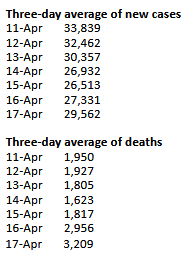
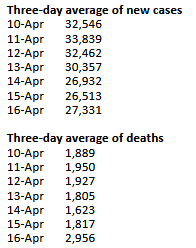
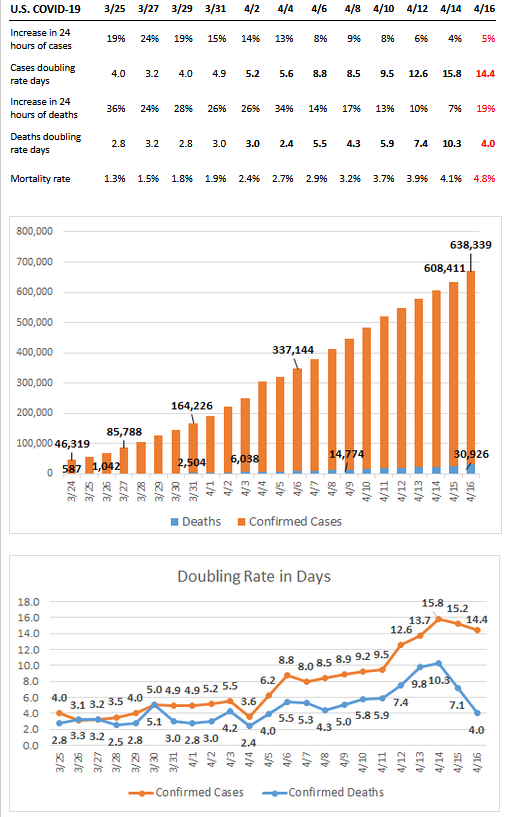
Fixed the three-day averages of deaths, due to the sharp observations of a reader. We might be in for a long tail after the flattening, with the number of deaths significantly higher, an increase of 4,920, of which more than 3,000 came from NY. I double- and triple-checked these numbers. This is not good news. (Ian — New York Added in the deaths from people taken out of their houses, so that jump is due to counting previously uncounted deaths. The huge jump in deaths and three-day averages today is in part an artifact of these deaths being added in one lump, rather than being backfitted.)
The biggest percent increases in cases have come from:
South Dakota (18 percent), Arkansas, Florida, Rhode Island, Mississippi, Alabama, Tennessee, and D.C.The comparisons to the NY Times ultimately revealed that my three-day averages were inaccurate. The NY Times’ daily increases are aligned with Johns Hopkins data.
The results of the work I do, like this article, are free, but food isn’t, so if you value my work, please DONATE or SUBSCRIBE.
Our benefactor writes:
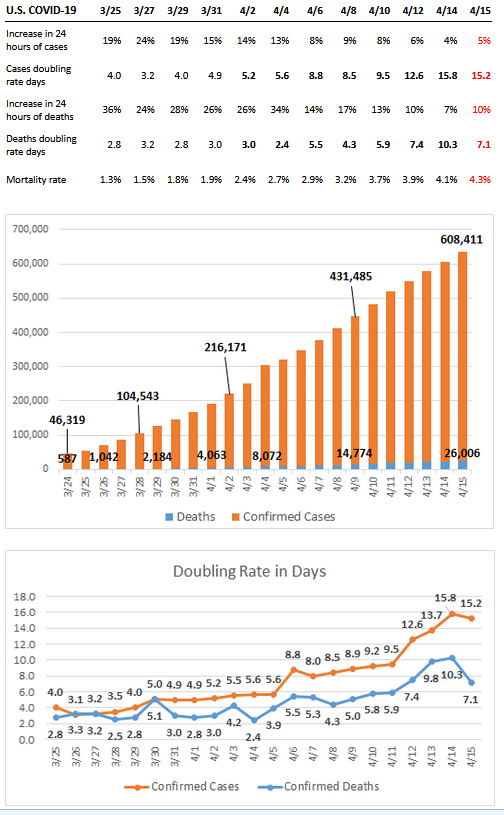
So, a friend of mine forwarded this link to a NY Times reporting tool. If you scroll down, you see the graph below. I was really puzzled by it, because the number of daily deaths is far below what I am getting from Johns Hopkins. The NY Times appears to be collecting their own data in-house and are seriously under-counting. Ironically, at the top of the article they write, “More than 25,000 people with the coronavirus have now died in the United States, according to a New York Times database. Since early April, that death toll has been growing by more than 1,000 each day.” The total count is correct, but the daily rate is totally off. They would never reach that number without a much larger daily rate.
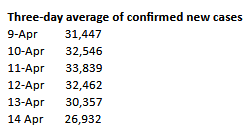
Here is the three-day average from my data, which is taken by state and summed from Johns Hopkins CSSE data. We have not had a single day less than 2,000 cases in the last week. The data are pointing to a worsening of outcomes perhaps due to the increases coming from southern and mid-western states that are not as restrictive about quarantining, combined with expected lags in deaths as compared to new cases.

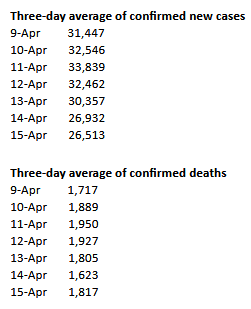
Note: As a commenter pointed out, the three-day averages for deaths were wrong. They’ve been corrected. My apologies. (Ian)
The results of the work I do, like this article, are free, but food isn’t, so if you value my work, please DONATE or SUBSCRIBE.
Let us say that you are leading a movement which, if it wins, will save hundreds of thousands to millions of deaths, and will take millions of out of poverty.
The corollary to this is that if you fail, if you lose, those people will die or be stuck in poverty, and generally that many others will fall into poverty.
Your loss, then, occasions a great deal of suffering.
It is often hard to know what to do to win, and there are red lines. Unless a situation has descended to civil war, or you intend civil war, like America’s founding fathers or slavery abolitionist John Brown, you shouldn’t murder, and obviously rape and torture are off the board no matter what.
But because the stakes are so high, you do have a responsibility to play your hand seriously. It isn’t actually a game.
In modern democracies, the most important thing is to control parties. Margaret Thatcher said that her victory was only complete when Labour accepted her ideology. If they hadn’t, when they got into power, they would have just un-done everything she did. John Major, the Tory PM wasn’t her true successor–Tony Blair was.
When Corbyn won the leadership of the Labour party he took over a neoliberal Blairite party. Most of the MPs had voted for most of the worst Tory policies, or abstained from the key votes. They were complicit in a great deal of the evils of austerity.
They were implacable enemies of Corbyn, as were the party bureaucrats. Indeed, a story came out with emails proving that these bureaucrats worked against Corbyn in the 2017 election. Given just how close that election was, they probably cost Corbyn the victory.
Had Corbyn won, he would have refunded the NHS. If it was a majority victory, he’d still be Prime Minister and he wouldn’t have bungled the Coronavirus response like Johnson, a bungling which appears to have about doubled the death rate next to comparable European countries.
Those bureaucrats, then, are responsible for the deaths caused by Johnson being PM. If you don’t understand this, you need to learn how, because this sort of thing is the key driver of why our societies are so bad: The forseeable consequences of evil actions are treated as if they are incidental. Having incompetent ideologues in charge of government who believe that “society doesn’t exist,” and that government isn’t responsible for people’s welfare has consequences.
Corbyn also failed in another important way: He never kicked out MPs who were traitorously constantly attacking him, nor did he support the mandatory re-selction of MPs, a process by which the Labour membership gets to vote for their nominee.
Doing both of these things would have transformed Labour back into a proper left-wing party, and given Corbyn a much greater chance at victory. Even if he lost both elections, his successor would be left-wing and properly supported by the party, and in first past the post democracy, the second party will eventually wind up in power.
Nothing is more important than ideological control of a party.
Now, the thing here is that neither of these strategies required Corbyn to go against his beliefs: Corbyn always said he believed the party should be run by the membership. Re-selections, indeed re-selection every election, is exactly and completely in accord with that.
Corbyn is a truly good man, but like a lot of people of his generation, he has an addiction to being nice, confusing it with being good.
Being nice to bad actors, to MPs who support cutting the NHS and social welfare and bailing out bankers, isn’t good, it’s evil. They need to be removed from power. This isn’t terrible for them, no centrist MP is likely to wind up on the bread lines if they aren’t an MP (which is part of why they were willing to be evil).
Then we have Sanders. Sanders was never as good a man in political terms as Corbyn, his politics are nowhere near as good. Still, he was a good man in American terms.
Sanders is also addicted to niceness. He refused to attack Biden on Biden’s terrible record, a record which is at odds with everything that Sanders claims to believe in, supposedly because Biden was his good friend.
This is dereliction of duty. If he had done it because he believed it was the best strategy, fine. It might or might not be. But to put his friendship with Biden against the welfare and even the lives of millions of Americans is a sickening betrayal of principle and of his followers.
Power has responsibility. Those who work to save millions of lives and make sure millions more are not in poverty, have a responsibility to their mission, and that responsibility does not allow one to put one’s personal desire to be “nice” ahead of the mission.
Good and nice are not the same thing. Niceness is, well, nice, but people who are willing to impoverish and kill millions are evil people and they need to lose their power. The actions taken to remove their power may not be “nice,” but they are good.
I admire Corbyn more than any other British politician of the past 40 years. But he failed in part because he wasn’t willing to be even moderately ruthless against people who were, well, doing a lot of evil. Traitors, in fact.
As for Sanders, well, it appears the same is true. He asked his followers to fight for someone they didn’t know, but he wasn’t willing to fight someone he did know.
A hypocrite, in effect.
Sanders’ and Corbyn’s times are done. They were the best of the Boomers, the last major politicians who hadn’t sold out or sold their soul. Their failures are not theirs alone. Brits and American Democrats genuinely prefer to let people die and live in poverty than vote for a moderate left-winger. That it is older Brits who voted against Corbyn whom Johnson’s policies are killing is ironic.
New politicians will now rise. Hopefully those on the left are people who understand that if one is the champion of the people, one has responsibilities which go beyond being nice to those doing evil. That, in fact, their responsibility is to remove all power from those who use that power from evil.
Doing so won’t be nice to the people who lose their power. It will be “nice” and good to those who are lifted out of poverty or who don’t die due to evil austerity policies, corruption, and incompetence.
Gotta decide what’s more important. Being nice to bad people, or doing good.
And you have to be willing to actually use power when you have it. The right certainly is. The left needs to be.
The results of the work I do, like this article, are free, but food isn’t, so if you value my work, please DONATE or SUBSCRIBE.
A note from our benefactor:
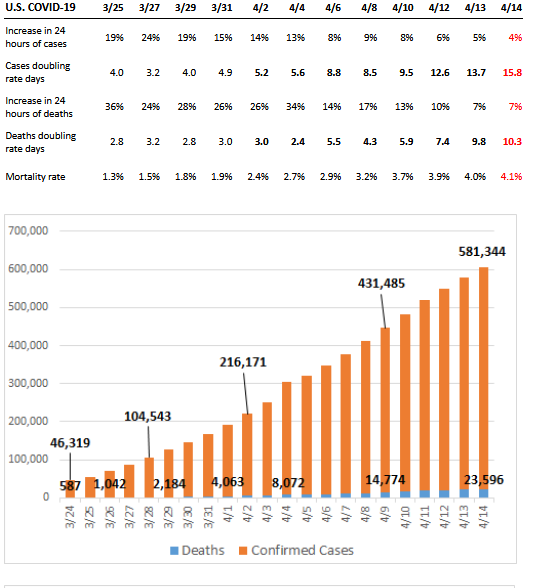
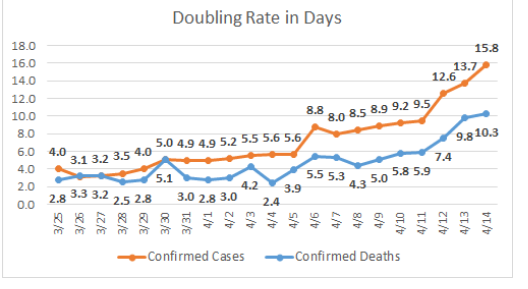
We will probably get to 40,000 deaths by the end of April. We’re still increasing by more than 2,000 deaths per day, and most doctors are seeing a ten to 14 day lag in deaths after new cases. I’ve seen projections of 60,000 deaths by August. If everyone goes back to work in early May, it may be much sooner.
(These are official deaths, of course, the studies done afterwards will show larger numbers.)
The results of the work I do, like this article, are free, but food isn’t, so if you value my work, please DONATE or SUBSCRIBE.