If you’ve been following oil prices since the Iran war started you’ve probably been surprised at how low prices have often been. I certainly was, at first.
The issue is fairly simple: most governments are worried about the price of oil, and not the supply of oil. So they’ve taken various measures to keep prices low. Some of those have been manipulative financial and some of them have been massive releases of oil from reserves.
IEA chief Fatih Birol told Bloomberg that a historic 400-million-barrel emergency release, equal to roughly 2.5 million barrels a day, helped push oil prices down by $20.
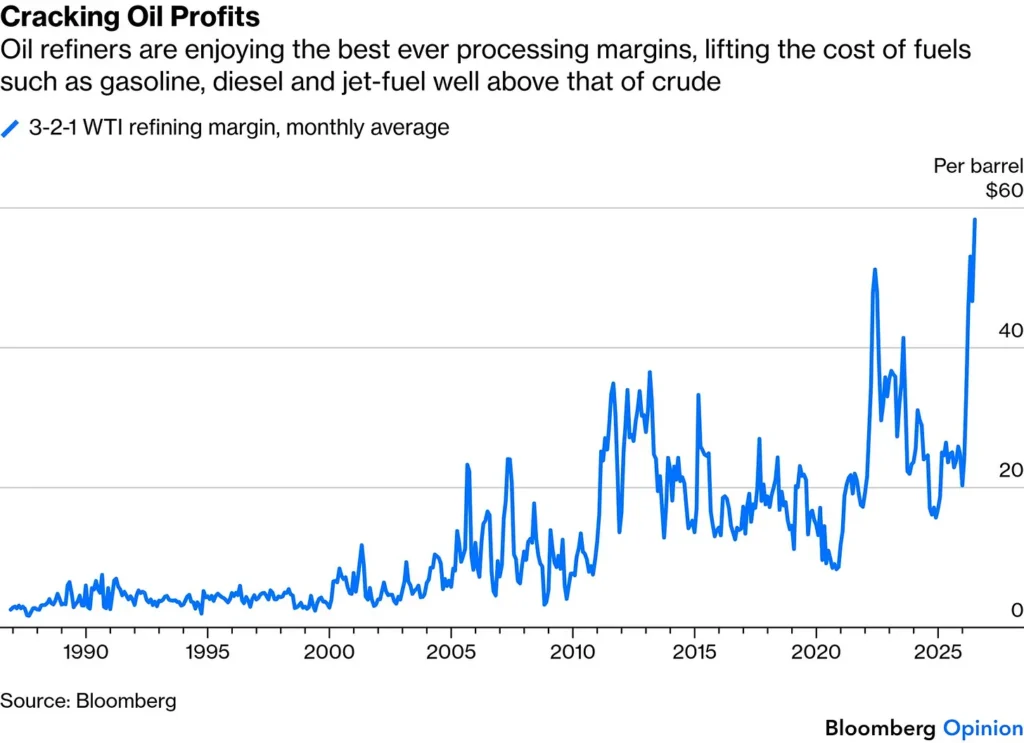
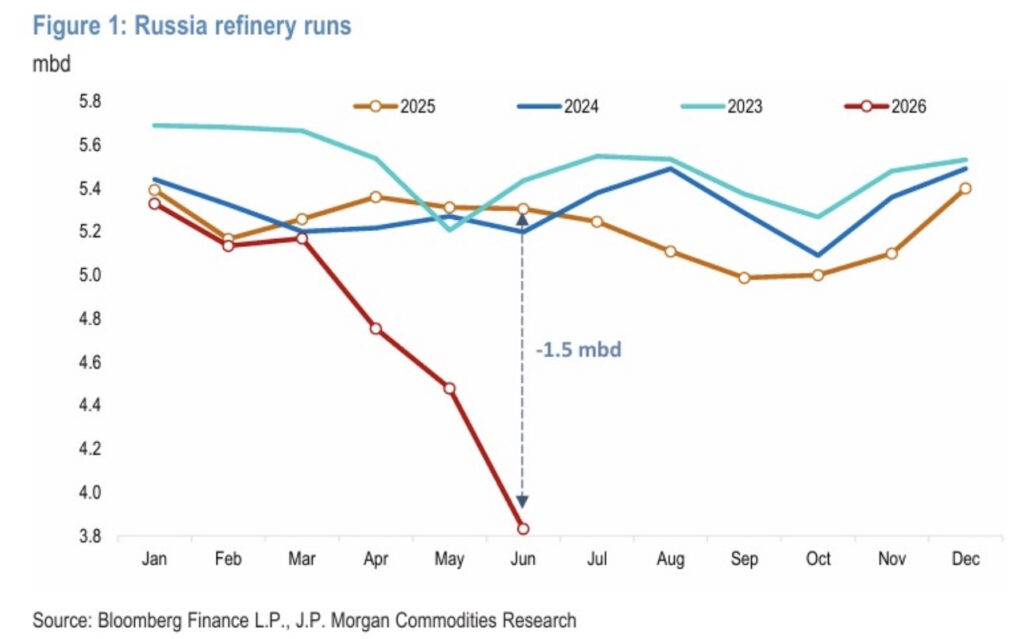
The price of oil, though, isn’t really the issue. One part of it is refinery capacity. A fair bit went off line in the Middle East, but ironically, even more in Russia. Why is Russia systematically destroying ever gas station in Ukraine? It’s retaliation for constant hits on Russian refineries.
Marathon Petroleum’s own management flagged on the Q1 earnings call that roughly 6 million barrels per day of global refining capacity is offline, about 6% of the world total. Ukraine’s drone campaign against Russian refineries is the largest single piece, but Middle Eastern facilities inside the Persian Gulf export corridor, and Chinese refiners voluntarily throttling to preserve inventory, add to the shortfall.
As a result Russia is no longer exporting diesel. And even though oil prices are low, gasoline prices are not as low as one would expect, because short refinery capacity means this:
Amusingly the Europeans and Americans have been encouraging Ukraine to hit refineries.
Now you may think “but America is an excess oil producer.”
Yeah, but it doesn’t matter. What matters is refineries and the type of crude oil involved. We aren’t just talking about gasoline, diesel, jet fuel and bunker fuel (ships), we’re talking about fertilizers, sulfuric acid (used for amazing amounts of processes) and so on. This cascades out into medicine (your aspirin for example), packaging, semiconductor production (hey, even higher prices) and whatnot.
But with rare exceptions (hello, China, again) most governments have not managed the actual supply situation.
In a rational economy prices and supply of crucial goods would be managed. For example farmers would get fertilizer and diesel at subsidized prices. Truckers shipping important goods would get subsidized diesel. Drug manufacturers would get guarnteed supplies (though not subsidized in most cases, they make tons of profits, just force them not raise prices.)
Rational governments would say “OK, what parts of the economy are actualy important (food, medicine, transport)?” and act to protect those parts of the economy, and would ration and subsidize those goods.
Instead our elites manipulate the price numbers and make the actual physical situation worse as they do so, by not allowing high prices to lower use and by not allocating key parts of the economy what they need at reasonable prices. Oh, and by releasing absurd amounts from the reserve to manipulate prices rather than using the reserve for actual necessities. They’re so used to an economy where just manipulating prices seems like all you need to do because there’s a global market with surplus. They don’t know how to handle an economy with actual, genuine shortages.
Anyway, as best I can tell if the Strait stays closed we are now weeks to about two months away from actual physical shortages in the first world. (They’ve already hit in the developing world.)
Then the fall harvest comes in and we get terrible numbers from that, and food prices surge.
This is the stupidest war of my entire lifetime and I’m old enough that this includes Vietnam, which was stupid beyond belief, but not one-tenth as moronic as the Iran war. A war of complete choice which the US has lost, won’t admit it has lost and is in danger of running the world into a decade long depression.
If it stops now or soon, it will suck, but we’ll get thru. But if Trump dismantles Iranian infrastructure like he’s threatened (by no means sure, this is Trump, but also not impossible, this is Trump) the Iranians have said they will respond by dismantling Gulf infrastructure: that means refineries that will take years and years to rebuild. Oil fields. Facilities producing helium. A decade of not enough fertilizer.
There is a real goddamn economy and if this happens, a lot of people will DIE due to famines and fuel shortages. Tens of millions. Maybe much more. You can’t just take 20 to 30% of the world’s supply of key resources offline and think “it’ll all be OK, the market will sort it out.”
I mean, the market will, sort of. But along the way will be a LOT of deaths and suffering
If the US had an even remotely operational governing system Trump would be impeached and removed in record time. He’s a fiasco, and he’s one itchy trigger finger away from being a catastrophe.
What I write here is for the benefit of everyone, but alas, I live in capitalism and I, and the site, take money to keep running. If you value the writing here and can, please subscribe or donate.
Feral Finster
“There is a real goddamn economy and if this happens, a lot of people will DIE due to famines and fuel shortages. Tens of millions. Maybe much more. You can’t just take 20 to 30% of the world’s supply of key resources offline and think “it’ll all be OK, the market will sort it out.”
I mean, the market will, sort of. But along the way will be a LOT of deaths and suffering.”
Why should The Epstein Class care? Sure, live will suck mightily for the peons, but they will have the dosh to buy whatever supplies are available, and that is all that matters to them.
This is why they encourage further strikes on Russian oil refineries. Yes, it will hurt their own economies, but they personally will be fine and face no consequences.
Hell, they’ll go nuclear without a second thought if that is what it takes not to lose their perches.
spud
free market capitalism: “lets pretend its real, then build on it from there.”
like GDP which pretends to count imports, yet just about everything made here, is of foreign made components.
which means its a “lets pretend its real, then build on it from there.”
it matters not who is president. kamala and hillary would be doing the same thing right now.
america was labeled a hyper power in the 1990’s, because war became a tool for free trade.
France referred to America as a hyperpower in 1999, highlighting the unprecedented influence and might of the United States at that time, particularly after the Cold War. This term reflects America’s dominant position in global affairs, especially during Bill Clinton’s presidency, which included military interventions in places like Bosnia and Kosovo.
Wikipedia Council on Foreign Relations
Labeling a nation as a hyperpower implies that it holds unparalleled influence and dominance in multiple domains, such as military, economy, and culture, shaping global politics significantly. This status can lead to a shift in international relations, where the hyperpower’s policies and actions may dictate the behavior of other nations and influence global governance structures.
polsci.institute Yale University
Bill Clinton’s administration used military interventions and foreign policy decisions as tools to promote free trade agreements, such as NAFTA, which aimed to reduce trade barriers between the U.S., Canada, and Mexico. These actions were part of a broader strategy to enhance economic growth and global competitiveness.
Wikipedia UC Santa Barbara
Military Interventions and Free Trade
Overview of Clinton’s Strategy
During Bill Clinton’s presidency, military interventions and foreign policy decisions were strategically employed to promote free trade agreements. This approach was part of a broader effort to enhance economic growth and global competitiveness.
Key Free Trade Agreements
Clinton’s administration focused on several significant trade agreements, notably:
Trade Agreement Countries Involved Purpose
NAFTA U.S., Canada, Mexico Reduce trade barriers and promote economic integration
Other Agreements Various nations Foster global trade relationships and economic cooperation
Clinton’s foreign policy often linked military actions to economic objectives, aiming to create favorable conditions for trade. This included:
Supporting democratic governments that favored free trade.
Using military presence to stabilize regions, making them more attractive for trade partnerships.
Promoting U.S. economic interests abroad through diplomatic and military means.
Clinton’s use of military interventions was not merely for geopolitical reasons but also served as a tool to facilitate and promote free trade, particularly through agreements like NAFTA. This strategy aimed to create a more interconnected global economy, benefiting U.S. economic interests.
Wikipedia UC Santa Barbara
Critics say using military interventions to support “free trade” can create militarism that is beyond democratic oversight, especially under strategies like the George W. Bush “war on terrorism.” They also argue it can serve the interests of elites and major corporations and promote aims such as “regime change” through “preventive” warfare rather than purely advancing trade.
Foreign Policy In Focus Stanford University
——————-
so the wars seem stupid, but that war machine was set in stone in 1993. before that, including vietnam, in a short period of time, americans turned against wars that were viewed as immoral and unethical, and the media reluctantly covered the american public concerns.
that all changed when bill clinton, deregulated the media. the media became, “lets pretend its real, then build on it from there.”
so the legacy media is not going to ask any major relevant questions as to why oil is so cheap, and what are these wars really about.
this system we have today is set in stone, the results of the coming into power, of a Rand/Hayek/Freidman worshiper in 1993, that said the era of big government is over, the rest is history.
its out of the american peoples hands, and also the governments hands.
——-
Free market capitalism can sometimes lead to short-term decision-making, as companies may prioritize immediate profits over long-term investments. This phenomenon, often referred to as “short-termism,” is influenced by investor demands for quick returns, which can negatively impact long-term growth strategies.
Harvard University philanthropyroundtable.org
Understanding Free Market Capitalism and Short-Termism
Free market capitalism is an economic system where prices of goods and services are determined by supply and demand without government intervention. This system encourages competition and innovation, allowing businesses to operate freely.
Short-termism refers to the tendency of companies to prioritize immediate profits over long-term growth. This can lead to several negative consequences:
Reduced Investment in R&D: Companies may cut back on research and development to meet short-term financial goals.
Lower Quality Products: Focusing on quick returns can result in lower quality products as companies may reduce costs.
Stock Buybacks: Firms might engage in stock buybacks to boost share prices temporarily instead of investing in sustainable growth.
Influencing Factors
Several factors contribute to short-termism in free market capitalism:
Investor Pressure: Investors often demand quick returns, pushing companies to focus on short-term results.
Quarterly Reporting: The practice of providing quarterly earnings guidance can lead companies to prioritize short-term performance metrics.
Market Competition: In a competitive market, businesses may feel compelled to deliver immediate results to stay ahead.
While free market capitalism fosters innovation and economic growth, it can also lead to short-term decision-making that undermines long-term success. Balancing immediate profits with sustainable growth strategies is essential for the health of the economy.
Wikipedia Harvard University
Alternatives to free market capitalism that prioritize long-term growth include models such as post-capitalism, socialism, and degrowth, which focus on human and environmental well-being rather than profit maximization. These systems aim to redistribute power and resources to better meet the needs of all people and promote sustainable practices.
greenpeace.org Medium
———
trump and his people are capitalists, just as kamala, obama, biden and of course the clintons are. we are trapped.
different clue
If the war is still going by 2026 elections ( and if the TrumpAdmin and the Republicanfederates are not somehow able to pre-nullify those elections by hook, crook or fraud) then the DemParty candidates can all run on Graceful Surrender with Honor to Iran and give all the votecasters a choice of whether to vote for admitting the war is lost and moving into a slower smaller post-defeat world . . . or sticking with the Republicanfederates in refusing to admit that the Single Greatest Nation in the History of the Universe is defeated or even defeatable.
But that all depends on whether the Dems are honest enough to take the chances on defeat involved in running on Defeat with Honor or not. If they run on the sort of Smarter Victory Ahead through Smarter Officeholders . . . the way that the sort of Liberals written about by Thomas Frank would certainly run on, then we won’t have that choice to make at the electional level.
different clue
Here is a comment I found at today’s Belle of the Ranch comment thread which is in line with my own theory that Trump hates America and wants to destroy it.
” This is exactly what hes wanted to do. Destroy this country as payback for his 2020 loss…. He will just count his money and relocate to Saudi Arabia or Israel aboard his gifted aircraft that we all paid to refurbish and upgrade. He could care less about our country’s future… The world still cannot believe the dumb Americans re elected him. We as citizens will have to deal with his damage caused by ego….. Yeah.. As a veteran I am disgusted with him and his cronies… love the channel… Nice alternative to bought out mainstream media.. ”
The Triple Nazi Coalition are accelerationists and consider Trump to be their choice of propellant and accelerant. Why would they want to stop a process which they hope leads to the sort of pile of wreckage which they can conquer and rearrange to their future plans’s delight?
cc
To go with “This is the stupidest war”, apparently Trump gave the green light for US ally Saudi Arabia to attack Yemen.
https://news.antiwar.com/2026/07/13/report-trump-gave-saudi-crown-prince-greenlight-for-attack-on-yemens-sanaa-airport/
Isn’t that practically begging to get the Bab el-Mandeb Strait of the Red Sea closed too? It’s almost as if the US wants to provoke a bigger crisis.
cc
Additional warnings that the Red Sea chokepoint could be next if the US escalates further:
Iran Tells Houthis To Close Red Sea Energy Chokepoint If Trump Bombs Power Grid
https://www.zerohedge.com/geopolitical/iran-tells-houthis-close-red-sea-energy-chokepoint-if-trump-bombs-power-grid
Re: “the Europeans and Americans have been encouraging Ukraine to hit refineries”
The Tonya Harding way seems to be how the West competes (kneecap anyone that stands in your way.)
Oliver Hua points out that Trump personally calling up his buddy Infantino and getting the rules set aside is part of a larger pattern:
Red Card for the West
The rules of “rules-based order” are discarded the moment they no longer guarantee an advantage for the architects of the system
https://huabinoliver.substack.com/p/red-card-for-the-west
Former CIA director and Secretary of State Pompeo had proudly boasted and glorified, “We lied, we cheated, we stole”.
That’s really just half of it. It’s more: “We lie, we cheat, we steal, we spy, we extort, we blackmail, we sabotage, we terrorize, we assassinate, etc.”.
That seems to be the US way. That seems to be the West’s way (including their vicious pitbull attack dog colony/outpost Israel).
Mark Level
I was wondering when you’d break with a post on this, Ian, as certainly the chickens are coming home to roost even in the US in a month and a half, at most.
Most governments worry about the Price of Oil, the Supply of oil doesn’t matter!! How goddamn En Retard could they be? This relates to Finster’s comment, all of these people are owned, particularly their Minds, colonized by the 0.1%. Rove’s Rule, “We create our own reality” as “we are All-Powerful” prevails. Reminds me when the locals caught a vicious gold-seeking Conquistador in Central America, poured molten gold down his maw, suck on that!! Well, not for long, not a fun way to die.
“Stupidest war of my lifetime”, utterly predictable, each one got stupider. “The Gulf War did not Take Place,” Baudrillard was vindicated. It was forgotten when Poppy Bush ran for election and Slick Willy came in. Finster & spud both nail it, these people are brainwashed, the entire class is brainwashed, not a single one to stop the plunge off the cliff, just get there faster, the explosion will be bigger!! The occasional smart person who walks away, Joe Kent recently, demonized as a “traitor” by the CHUDS for not mutually assuring their destruction.
Diff Clue raises an important point, and I’ll confess to feeling a mixture of fear and giddy weirdness in my gut as I wait for the Orange Emperor’s special “Address” tonite. My best guess is he will announce Federal Control over the impending Elections, as Tony R. likes to run the squib, “He who saves his country . . . ” by cheating, lies, murder, etc. cannot be Wrong. The Donald cannot Risk an election, he knows his popularity is in the toilet, and will be fully flushed if a fair vote occurs. Not that I believe in Electoralism, US was never a Democracy, very briefly a Republic, now it’s just a vomitous Fasist Dystopia, Hunter Thompson and William Burroughs, among others, saw where it was heading. The hope to Vote the Bastard out was always a thin thread to hang above the Abyss with, but I think the R’s won’t allow even the veneer to happen. “Daddy” lost his mind when he lost the 2020 Selection fair and square, he can’t allow the “Radical Democrat Communists” to succeed him with slightly lesser violence and evil. His need to hang onto Power, likely will launch a Family Dynasty, Don Jr. the next President, etc.
Thank you to cc for the share, yes, I heard both Larry Johnson and seperately Pepe Escobar with Nima discussing this moronic move earlier. MBS as Senile and out-of-touch as Trump? Seems so. IF Trump goes full in, Bahrain, UAE, Qatar, parts of Jordan, and the Zionist Entity itself will be a flaming bushel of shit. Saudi land uninhabitable for a couple of decades at least . . .
I’d been wondering whether the Ukrainian Fascist Junta or the GCC Kleptocracies would collapse first, guess if the Trump Junta keeps their eye on the Middle East, that’s first to go.
The good news: They never made the Obama (borrowed from others) “Pivot to Asia,” China the big winner, Russia as well. Heckuva job!!
I vaguely recall that line from the Great Gatsby about how the Clueless Rich can destroy everything in their environs, and walk away having learned nothing. Seems to apply. I always look for a bright side somewhere. Assuming a massive die-off, human labor of survivors will increase in value, some may even retaliate against the Nihilists who ran their societies off a Cliff. Let’s thank Capitalism (a Slaughterhouse the Democrap losers are willing to die on) for finally fully showing its true face.
In closing, the biggest question is, are the people who note that it took 2+ centuries for the Roman Empire to collapse correct in looking at the impending case? Given Climate Change and all the systemic failures, Nuclear Power, Nuke waste, toxic food, a sick, stupid population, Gated communities and Private Policing, the Die-off will be strange and unpredictable. The Plebs won’t be the only victims, early on they may be, later on “No man is an island”, the rain will fall on the Unjust as well.
Mark Level
cc, “thank you for the share”– I often skim past an important detail.
spud
america like any great power, even not so great powers, have always had a war problem. but before 1993, the american public, and the american government had input into stopping, slowing down, or even ending wars.
not today, that all changed in 1993, when wars became official government policy, initiated by those in the shadows, operating for the wealthy, with absolutely no public input, or even government over site. from 1993 on wards, wars are automatically triggered, and can’t be stopped till we are defeated.
—–
Wealthy individuals and companies are profiting from the war in Iran, benefiting from increased defense spending and rising oil prices, while many Americans face higher costs of living due to the conflict. This situation highlights how U.S. foreign policy can serve the interests of the wealthy at the expense of the general public.
the-independent.com Ms. Magazine
Wealthy Beneficiaries of the War in Iran
Profiting from Conflict
The ongoing war in Iran has created significant financial opportunities for wealthy individuals and corporations. Key beneficiaries include:
Defense Contractors: Increased military spending has led to record profits for defense companies.
Oil Companies: Rising oil prices due to the conflict have resulted in substantial earnings for major oil firms.
Impact on U.S. Foreign Policy
The war illustrates how U.S. foreign policy can prioritize the interests of the wealthy over the general public. This has resulted in:
Higher Living Costs: Many Americans are facing increased expenses, particularly in energy and basic necessities, as a direct consequence of the war.
Political Influence: Wealthy individuals and corporations often have significant sway in shaping foreign policy decisions, which can lead to military actions that serve their financial interests.
Summary of Key Points
Category Impact
Defense Spending Record profits for defense contractors
Oil Prices Increased earnings for oil companies
Public Costs Higher living expenses for average Americans
Political Influence Wealthy individuals shape foreign policy
The situation highlights a troubling trend where the financial gains of the wealthy come at the expense of broader societal welfare.
the-independent.com Ms. Magazine
Wealthy individuals are benefiting financially from the war in Iran as over 50% of the profits from recent oil supply shocks have gone to the top 1% of Americans, while the bottom half received just 1%. This trend indicates a significant transfer of wealth to the richest during the conflict.
Jacobin
U.S. foreign policy during the Iran conflict is deeply unpopular among the American public, leading to rising energy prices, inflation, and military costs. This discontent is likely to affect perceptions of the current administration and could influence political dynamics in upcoming elections.
Brookings
Profiting from war in Iran raises significant ethical concerns, particularly regarding corporate complicity in war crimes and the moral responsibility of companies that supply weapons and resources used in conflict. This situation highlights the potential for corporations to be held accountable for contributing to human suffering and violations of international law.
opiniojuris.org
————
what happened from 1993-2001, simply cannot be overstated. its all but impossible to reverse under current governance.
Bob
I agree. It’s very hard not to imagine the US is deliberately trying to make this situation as bad as possible. Is Trump in charge? Naaah, surely not.
Purple Library Guy
And indeed, apparently the Houthis are threatening to do exactly that. If they actually do, that’ll accelerate the timeline to shortages.
Which for Canada, despite our possession of plenty of oil, is still going to hit us because of our vulnerability to world prices and our lack of adequate refining. Kind of makes me wish that back when, someone clever had thought to use Canada’s oil resources to enhance Canadian independence and security, with some kind of national policy about energy . . . they could have called it the National Energy Program . . .
@different clue Come on, they’re politicians. They don’t have to take real positions. This shit’s easy, all they have to say is “Trump’s war was stupid and he’s been running it stupidly and that’s why your gas and everything you buy is more expensive!” It’s even true. Whether, or what, they would do different and whether that would be better–they don’t have to get into that. The point is, it happened on Trump’s watch, and he even did it, so he gets to wear it.
As to whether the Democrats would have started that war–no, they wouldn’t have. Neither would most Republicans, to be honest. It took someone with a major league reality distortion field who ignores not just ordinary experts but military ones to ignore the well known fact that a serious attack on Iran would result in closure of the Strait of Hormuz. Why do you think the Americans never made direct war on Iran from 1979-2025?
different clue
@cc,
” Isn’t that practically begging to get the Bab el-Mandeb Strait of the Red Sea closed too? It’s almost as if the US wants to provoke a bigger crisis. ”
Well, yes. Not the ” US” as such, rather the Triple Nazi Coalition of Accelerationists who are working to consolidate their Occupation Regime. Trump’s personal motivation is based on his hatred for America which drives his desire to destroy America. I personally hope those parts of America which voted for Trump are the parts that get completely destroyed. I personally hope that those parts of America which voted for Harris merely get very badly damaged. As to those who voted Third Party or did not vote . . . . let the Leopards of Darwin decide what to do. That’s the nicest I can be about that.
Now, is the KSA regime dumm enough to take Jabba the Trump’s green light as the permission they want to go right ahead and resume that war? Or is the KSA regime smart enough to decline that kind offer and decide not to resume that war? In which case, is Trump secretly threatening, manipulating and extorting them into resuming that war even if they would rather not?
The theory that Trump hates America would lead one to suspect that the TrumpAdmin is torturing KSA as hard as it can into restarting that war, in order to get Bab al Mandeb firmly closed for the next few-couple years.
Planter of Trees
U.S.A.’s ultimate technique is to turn everyone against the U.S. and then cry ‘self-defense’ as they launch their arsenal. Only half-joking.
different clue
Here, from the UnderreportedNews subreddit is this following videobit of Stephen Miller describing some formal steps and memorandums the TrumpAdmin has issued to advance what I would consider the further consolidation of Nazi Revolutionary Regime power over and within the US.
“Stephen Miller announces the US has taken the action of formally recognizing left wing violence as a form of political terrorism, claiming liberalism “is a direct threat to our national security and the survival of our Republican form of government” ”
https://www.reddit.com/r/UnderReportedNews/comments/1uy42su/stephen_miller_announces_the_us_has_taken_the/
Mark Level
Diff Clue, big thanks for 3 belly-laughs in one Paragraph: “left wing violence as a form of political terrorism . . . ” The man responsible for ICE terrorisms, beatings, public summary executions decries political violence. 2. Equating “left wing violence” (self defense) with Liberalism, endless hippie-punching and fronting for the Fascist Right by boosting dogshit candidates like Hillary, Kamala, et al. Miller should thank the Dimmies for his Terrorist Power Projections. 3. “our Republican form of government,” what a hoot!!
mago
To wage war is human to make peace divine or whatever it was the bard said.
Rude and crude destruction with madness everywhere. I too witnessed the Vietnam war and its atrocities and aftermath that still trickle through the decades.
Don’t need a crystal ball to predict the outcome of current events. Yellow matter custard dripping from a dead dog’s eye. Everybody’s roadkill in the end. Unless maybe you’re the walrus, but even then . . .
Fill your tank with high octane, put the pedal to the metal and roar off the cliff, or play nice and die with a calm mind and clean conscience. I dunno. Guess it’s up to you.
spud
all trump is doing is using the powers that were handed to him on a silver platter by bill clinton,
patriot act started under clinton, doge, clinton started it with his assault on the federal government, the wars, clinton, torture, clinton, medicare advantage, clinton, the attack on immigrants, clinton, and so on.
Donald Trump has significantly utilized the Congressional Review Act, a law established during Bill Clinton’s presidency, to disapprove federal agency rules more than any previous president. This trend reflects a broader Republican strategy to expand congressional power over federal regulations.
eenews.net CNBC
Use of the Congressional Review Act
Donald Trump has effectively leveraged the Congressional Review Act (CRA), a law enacted during Bill Clinton’s presidency, to enhance congressional authority over federal regulations. This act allows Congress to disapprove rules made by federal agencies.
Key Points
Historical Context: The CRA was signed into law by Bill Clinton in 1996 to provide Congress with a mechanism to repeal federal agency rules.
Trump’s Usage: Trump has signed more CRA resolutions of disapproval than any other president, totaling 38 during his time in office. This includes 16 in his first term and 22 in the following year.
Republican Strategy: The Republican Party has increasingly utilized the CRA to challenge and overturn regulations from previous administrations, particularly those of President Biden. This reflects a broader strategy to reshape the federal regulatory landscape.
Impact of Trump’s Actions
Aspect Details
Number of Resolutions Trump signed 38 CRA resolutions, more than any predecessor.
Targeted Regulations Focused on rules related to environmental protections and agency actions.
Political Response Democrats argue that the CRA is being misused to undermine agency functions.
This approach signifies a significant shift in how congressional power is exercised over federal regulations, showcasing the lasting influence of the CRA initiated by Clinton.
eenews.net Cato Institute
The Congressional Review Act (CRA) allows Congress to overturn federal agency regulations, providing a mechanism for legislative oversight of executive actions. It enables Congress to disapprove rules within a 60-day window, preventing agencies from issuing similar rules in the future, thus significantly impacting regulatory processes.
George Washington University pacificlegal.org
Donald Trump has utilized the Congressional Review Act (CRA) more extensively than previous presidents, particularly during his first term, where he invalidated 14 regulations from the Obama administration. This marked a significant increase in the use of the CRA compared to its limited application in earlier years, where it was invoked only once in its first 20 years.
theregreview.org pinpointpolicyinstitute.org
The Congressional Review Act (CRA) was enacted in 1996 as part of the Contract with America Advancement Act, signed by President Bill Clinton. Its purpose is to allow Congress to review and potentially overturn federal agency regulations through a fast-track legislative process, ensuring that agencies operate within the authority granted by Congress.
Wikipedia Harvard University
Donald Trump has utilized executive powers similar to those enacted by Bill Clinton, particularly in areas like immigration and law enforcement. Both presidents have expanded executive authority, reflecting a trend of increasing presidential power over time.
Wikipedia Cato Institute
Executive Powers of Trump and Clinton
Donald Trump has employed executive powers in ways that mirror those of Bill Clinton, particularly in the realms of immigration and law enforcement. This reflects a broader trend of increasing presidential authority over time.
Key Areas of Similarity
Area Bill Clinton’s Approach Donald Trump’s Approach
Immigration Expanded executive authority to manage immigration policies. Issued executive orders to enforce stricter immigration controls.
Law Enforcement Enacted measures to increase police funding and resources. Promoted initiatives to bolster law enforcement and border security.
Trends in Presidential Power
Both presidents have utilized executive orders to implement significant policy changes without needing congressional approval.
This trend indicates a growing reliance on executive action to address pressing issues, reflecting a shift in how presidential power is perceived and exercised.
The use of executive powers by both Trump and Clinton illustrates a pattern where presidents increasingly assert their authority to enact policies, often leading to debates about the limits and implications of such actions.
Wikipedia UC Santa Barbara
Bill Clinton signed an executive order in 1995 to declare an “immigration emergency” addressing rising Haitian arrivals by boat, and in 1998 he issued an executive order barring federal contracts to businesses knowingly hiring unauthorized workers.
UC Santa Barbara americanimmigrationcouncil.org
Executive powers have expanded under Donald Trump, with him issuing more executive orders in his second term than in his first, totaling 221 as of December 2025. In contrast, Bill Clinton issued 364 executive orders throughout his two terms, averaging fewer per year than Trump.
Pew Research Center Cato Institute
Presidential power has expanded significantly from Bill Clinton to Donald Trump, with modern presidents increasingly using executive orders to bypass Congress and implement policies directly. This trend reflects a shift towards a more dominant executive branch, often referred to as “presidential primacy,” where the president’s authority over administrative actions has become more accepted and prevalent.
Harvard Law Review legaltimelines.org
————
actually the war on iran has its roots in bill clintons first term, 1995. when a think tank issued a paper for government, that the caspian sea basin was a must to dominate:
Bill Clinton imposed tough sanctions on Iran starting in 1995 in response to its nuclear program and support for terrorism, which included a comprehensive trade embargo and restrictions on foreign investment in Iran’s oil and gas sector. These sanctions were part of a broader U.S. strategy to pressure Iran into changing its policies.
Columbia University Wikipedia
commons.wikimedia.org
Bob McNeely, The White House[1] / Public domain
Bill Clinton imposed tough sanctions on Iran starting in 1995 in response to its nuclear program and support for terrorism, which included a comprehensive trade embargo and restrictions on foreign investment in Iran’s oil and gas sector. These sanctions were part of a broader U.S. strategy to pressure Iran into changing its policies.
Columbia University Wikipedia
Overview of Sanctions Imposed by Bill Clinton
Bill Clinton initiated a series of stringent sanctions against Iran beginning in 1995. These measures were primarily a response to Iran’s nuclear ambitions and its support for terrorism.
Key Sanctions Implemented
Comprehensive Trade Embargo: This prohibited all trade between the United States and Iran.
Restrictions on Foreign Investment: Sanctions targeted foreign investments in Iran’s oil and gas sector, significantly limiting economic engagement.
Iran and Libya Sanctions Act (ILSA): Signed into law on August 5, 1996, this act imposed penalties on both American and non-American businesses investing over $20 million in Iran’s petroleum resources.
Objectives of the Sanctions
The sanctions aimed to:
Pressure Iran to alter its policies regarding nuclear development and terrorism.
Curb Iran’s influence in the Middle East by limiting its economic resources.
These sanctions were part of a broader U.S. strategy to compel Iran to change its behavior on the international stage.
Wikipedia Columbia University
Clinton-era sanctions expanded in 1995 to include a comprehensive trade embargo and bans on selling aircraft or repair parts to Iranian aviation companies, which constrained Iran’s trade and aviation sectors. As of 2025, these measures remained part of the U.S. sanctions framework against Iran.
Wikipedia Columbia University
Bill Clinton’s sanctions were part of a broader strategy to contain Iran, which strained U.S.-Iran relations significantly. While Clinton aimed to improve dialogue with Iran, the sanctions, rooted in concerns over terrorism and nuclear capabilities, ultimately left relations unchanged and adversarial.
United States Institute of Peace ebsco.com
————
https://www.bakerinstitute.org/sites/default/files/2013-08/import/u-s-policy-towards-the-caspian-region-can-the-wish-list-be-realized.pdf
S E C U R I T Y O F T H E C A S P I A N S E A R E G I O N
Secretary of State to the region.4 There have also been several landmark
addresses by key Clinton Administration officials regarding the ‘importance’ of
Central Asia and the Caucasus to the USA. Perhaps most significant, however,
was the appointment of a ‘special envoy’ to the region.5 This post, by virtue of
its existence, kept Caspian issues on a higher track than might otherwise have
been feasible for a remote region that had no significant trade relationship with
the USA, and posed no significant threat of major war and no significant
immediate threat to regional or international peace and stability.
…
the war on iran, was planned and started by clinton.
Jessica
Commenters here who enjoy sci-fi might enjoy Kim Stanley Robinson’s The Wild Shore. I read it in the 1980s simply as sci-fi, purely fictional, but I think of it often lately. What the rest of the world might do if it finally got sick of US-created mass violence. (By the way, summaries of this book that I have read are inaccurate. In the story, it is unclear exactly who actually did the big deed.)
I think that the Dems or any alternative Republican would have launched the war against Iran. It fits too well with US foreign policy under all recent presidents. It was very much desired by the Israeli government and by their allies in the US. I leave it to other to decide who runs who in the alliance of Israel and US Zionists (including the Christian ones).
Jessica
I am still mystified how the price of oil can be so detached from the statistically probable supply. Surely there is some place where one can, in effect, bet on a massive rise in oil prices. I assume that oil markets are huge, too huge for even the biggest players to manipulate too much for too long, but it is convenient for the US and Israeli and Gulf ally rulers that prices have stayed comparatively low.
different clue
So as read the attack-Yemen article, I see that KSA already bombed Sanaa airport and that KSA itself asked for Trump’s greenlight for it. That seems pretty dumm of KSA.
I wonder what KSA hoped to achieve with that.
different clue
More on that Yemen War resumption thing. Belle of the Ranch has a video called:
Let’s talk about Trump greenlighting another war…
https://www.youtube.com/watch?v=6v8PxTo-560
It is a sensible laying-out of all the further dangers this bombing of Sanaa airport opens up. At the end she gets all wistful and hopiumful when she says that we can’t wait till the midterms for Congress to curtail Trump’s freedom of random action. Her second-to-last sentence is . . . ” Republicans in Congress have to start exercising their authority over U S warmaking.”
” Have to” . . . ? Republicans in Congress don’t “have to” do a god damn thing. And they won’t.
Carborundum
Canada actually doesn’t, in the main, have insufficient refining capacity. We’re a net exporter in every major refined product category except kerosene and petroleum coke. The former is mainly due to our domestic feedstock (producing really light products from it is not an efficient use of resources) and I’m pretty sure that the latter is because we just actually use quite a bit of it.
The challenge with the NEP was that most of the effort was devoted to solving some problems that either weren’t directly related to energy sufficiency or we now really don’t think about at all (i.e., we solved them other ways and/or global events rendered them moot). I’m all for energy self-sufficiency (and a number of the more important things that the policy aimed at there did actually get accomplished – some because of it, some in spite of it), but that was a really badly conceptualized piece of legislation.
Like & Subscribe
This is the stupidest war of my entire lifetime and I’m old enough that this includes Vietnam, which was stupid beyond belief, but not one-tenth as moronic as the Iran war.
I don’t know, I think the Falklands War was as stupid as this war if not more stupid. Argentina was defeated before it even contemplated invading the Falkland Islands. The difference between the two stupid wars is scale but at the heart of both is incompetent hubris.
Like & Subscribe
Jessica, there is a “mystery” manipulator shorting the bejesus out of oil futures. It is what is artificially keeping the price low. No one, except for some insiders I presume, knows who or what this “mystery” manipulator is but the manipulation is prodigiously unprecedented in oil trading.
https://www.youtube.com/watch?v=MWryeJvJMe0
Mark Level
So my minor anxiety over a future Trump Election Steal was overblown. Trump is far En Retard, last week he denounced “The Islamic Republic of Japan” for firing on innocent US Naval ships hundreds of times.
His Conspiracy Quilt of bad actors and insane claims is beyond Rachel Maddow and Adam Shitt’s Russiagate BS, I’m sure Fox News will promote it but only the 30% of the population still pro-Donald will accept it, not that it makes any difference.
Noise about arresting Ossoff and jailing, torturing him likely goes nowhere, Georgia electorate changed on its own. Maduro possibly being tortured to say they worked with Dominion and the Ouija Board-attracted spirit of Chavez to steal 2019 votes. Beyond absurd.
I’ll just quote the smartest comment from somebody going as “TruffautFan” on LG&M, good taste in films, good taste in analysis:
“The Bulwark reports that China is going to be blamed with the aide and assistance of pseudo-journalist John Solomon: https://www.thebulwark.com/p/can-this-pseudo-journalist-destroy-american-democracy-john-solomon-just-the-news-trump
I mean, I guess what new is there to write about now.
Warnock and Ossoff’s 2020 elections are allegedly going to be cast in doubt and their response to this is a combination of mockery and attack but not panicking like chicken little that they will be kicked out of Congress and arrested. NBC, ABC, and CNN refuse to air the speech on their primary networks but ABC and/or NBC will air it on their streaming service at least.
Everyone knows that Trump wants to interfere/cast doubt with the midterms and/or outright cancel them. His efforts so far have fallen flat and there is no evidence to see why this trend won’t continue. However, a good chunk of the opposition that pays attention to politics think this is going to be Trump’s version of Louis-Napoleon’s 1851 coup. Is it possible? I suppose. It just doesn’t seem plausible to me that Trump has people in place to immediately arrest all the opposition and declare military government in the blue states.”
Apart from open, massive Insider Trading, Trump’s got no more Mojo, like with Joe speed of decline is building.
Carborundum
To the contrary, the Falklands campaign was a very close-run thing – that’s a verbatim quote from ADM Woodward.
What the Brits did was incredible, but if they had been even a bit more unlucky, they would been in real trouble. As it was, with the loss of all but one of their Chinooks, success depended on some truly spectacular tabbing, not to mention repeated deliberate assaults on well-fortified lines without numerical advantage (and sometimes significant disadvantage).
Like & Subscribe
Carb, Argentina should have known Reagan would get the UK’s back in their war on the UK in the Falklands. It’s yet another way Trump differs from Reagan. much to the chagrin of Newt Gingrich. That’s the incompetence and hubris. The UK may have been a diminished former empire at that time and still is of course and diminishing further, but even then the UK was out of Argentina’s league.
However, despite that, point taken. How about this for an alternative. Equally silly to America’s and Israel’s war on Iran is Russia’s war on Ukraine. Both Putin and Trump never comprehended they were going to battle with the Black Knight and in that process of battle, they themselves, or their respective countries, in turn are being transformed into the Black Knight.
https://www.youtube.com/watch?v=ZmInkxbvlCs
spud
steve Keen just destroyed bill clintons catastrophic 8 year mismanagement of america that stated markets are efficient.
Keen states the obvious, markets are inefficient. i will add, not self correcting, nor self balancing, nor self policing. markets end up monopolized then collapse.
https://www.youtube.com/watch?v=C44Mrjcv32E
The Finance Model Wall Street Knows Is Broken: Top Economist
Understand the efficient markets hypothesis and why neoclassical economics often fails to explain real-world financial data.
This discussion breaks down the practical limitations of economic models that dominate academic circles. If you have ever questioned why theoretical frameworks like the efficient markets hypothesis do not always align with actual market behavior, this analysis provides the context you need. We examine the disconnect between standard models and the reality of financial decision-making.
We specifically look at a 2004 paper by Fama and French, which famously suggested that the capital asset pricing model should not be utilized for practical applications. By critiquing these pillars of neoclassical economics, we clarify why relying on outdated academic theories can lead to significant errors in investment strategy. This video is for investors and students of finance who want to look past the textbook definitions.
Subscribe for weekly economic theory breakdowns, and let me know in the comments if you think academic models still have a place in modern trading.
The Capital Asset Pricing Model is still taught on the CFA program and used across finance. Steve Keen points out that its own creators, Fama and French, published a paper in 2004 admitting it “should not be used for practical purposes.” He unpacks how the efficient-markets foundation quietly collapsed, and why the establishment keeps teaching a model it knows doesn’t work.
different clue
Tangential to anything but the Falklands War . . . many years ago a friend of mine said he read/heard that one of Britain’s fighting groups ( I don’t know the technical names for various level military formations) was composed of Nepalese Gurkas. And while the Argentinian soldiers on the ground seemed rather quick to surrender to British soldiers of any other type than Gurka, the Gurkas somehow inspired the Argentinian soldiers they faced to peaks of ultimate bravery. When faced with the Gurkas, the Argentinian soldiers decided to be All that They could Be, and fought and died to the last man rather than allow a single one of themselves to be taken prisoner of war.
Mark Level
Argentina has been among the Worst Countries in Latin America for many decades. Back in the 60s-70s it wasn’t as bad as full-out Fascist Hellholes like Paraguay, Uruguay, but it’s worked hard to earn that distinction.
They have a preference for Cacique (“strongman”, the more corrupt the better) rulers, and getting robbed, kicked in the balls and the teeth. It likely dates back before the Perons, Juan just scum, succeeded by his “Don’t cry for me Argentina” Lady MacBeth, Evita.
Around 2001, leadership liquidated the entire economy, a Crash 3x bigger than the Greenspan-Summers Crash in 2008, top admin just stole everything in the banks and market for themselves, stashed it in offshore accounts. The process started in 1998, and of course it “followed a period of market reforms” (sic.) https://en.wikipedia.org/wiki/1998%E2%80%932002_Argentine_great_depression
Businesses liquidated en masse, look at the chart in ’02 when GDP down well below $12,000 annual. A few smart people came together and took over the factories they used to be exploited in, ran them as Syndicalist Cooperatives and thrived for awhile, till the Military were called to shut that down.
Millei openly a traitor and a total Disaster. A supposed “Anarcho-Capitalist”, LoL, that’s like being a Banderist Freedom Fighter, well the latter gravitates to Killing the “Weak”, the former to Looting Everyone. Millei a pretend Christian Anarcho-Cap when he came in, so inspired by the Gaza Genocide that he “converted” to Chabad Judaism!!
He’s selling the country to the highest and lowest bidders, when Israel collapses it, like Cyprus, will be a wholly-owned Zionist subsidiary. Zionists in the wildlands burn everything to the ground, as they assume they will own it in the future, likely with reason. They’re caught, but not jailed, just let go.
Millei a fat lunatic who “performs music” to adoring crowds. He has a cloned dog he believes was his partner/lover in the distant past, in Egypt or some shit. The guy does have a good head of hair though.
FIFA let the Argentine players foul their opponents to win, NO Red or even Yellow Cards for running up behind an opponent & rabbit-punching his head from behind, or trodding on opponent’s foot with your cleats. Infantino’s FIFA a Trump-MAGAt subsidiary, had to throw it for them, everybody knows.
I’ve never been a fan of England, but am impressed at How Far the Mighty Have Fallen, they got screwed along with Egypt, Iran (obviously) and others:
https://sports.yahoo.com/articles/31-dirty-tricks-argentina-unleashed-210549540.html?guccounter=1&guce_referrer=aHR0cHM6Ly93d3cuZ29vZ2xlLmNvbS8&guce_referrer_sig=AQAAAHXMzqO_g1QClVF-UzeQcx5UBHrAco9-zTo6umIaxD6Wdr_1g8vd07aTAWNgihFUym5KvJ01VyYUPi_AahN9Xkqc_pEYQE6leNvu9XWSAJ8fSOD43DUX_pVAiYdIEI5NHQdr7-uq1bGHKgRzWrjxCzME97UtK7RJt3IQqz0xTpQK
https://www.marketscreener.com/news/in-argentina-milei-accelerates-the-great-state-sell-off-ce7f5bddd88ef123
“From a Crisis Economy to an Economy Under Surveillance”– just what the patsies asked for, I guess. Vale!! Manufacturing saw 0.8% growth last year, that’s Trump “reindustrialization” #s, like the single Carrier (A/C) franchise he claimed as a victory in his first term (falsely, it didn’t last out his term.)
The Prior Cacique had wisely kept Argentina’s gold/silver etc. in country, NOT handed it out to the Yanqui Dominator; Millei immediately did the opposite, gave it all to Donald’s coffers, then pegged the currency to the dollar.
They are fucked, perhaps beyond what the US-Occupied Venezuelans are currently suffering. But some suckers ask for it, I guess. North Korea’s far better off than Argentina is now, will be for the forseeable future.
Mark Level
Wasn’t going to respond to the LASTroll, but Baron Serendipity tapped me on the shoulder and told me I need to–
The Duran this morning covering a German Self-Own, “Volkswagen Collapse. 100,000 Jobs Cut”, Major Deindustrialization. They Blame Ghina (of course) but maybe applauding the Biden Crew’s destruction of Nordstream might’ve been unwise?
https://www.youtube.com/watch?v=GeEkzM7qQao
Oh and 3-4 days back, when the Baltic Euro-Slugs were meeting to suck on their Giant Pacifier with the other losers, “Russia is collapsing, it will be defunct in days!” Ursula von der Leyen, possibly Kaja Kallas and others had to run into a Fuhrer Bunker over fears of Russian Drone Swarms. MoA covered this.
Vampire VdL took it with whatever “Stiff Upper Lip” would be in Deutsche, she and her Aristo-Hubby have many grandsires who were high level Nazis, proud of it. If Callous Kallas was there, must’ve been a new and terrifying experience for her.
“So Much Winning,” just like Daddy, eh LAS? More like FAFO.
Ricardo Harvin
@ianwelsh.net Oil companies, however, are worried about the price of oil, and not its supply.
For North American shale oil to be profitable, the price needs to be consistently above $60 per barrel, and for Venezuelan oil to be profitable for U.S. companies, I think the price needs to be even higher, especially with all of the infrastructure work that needs to be done there.
#OperationBrentCrude is for the oligarchs, those who now rule the world above all governments.