
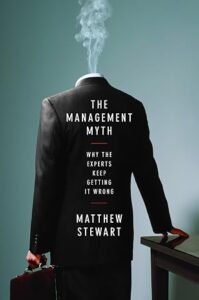
 There’s book from the 2000’s called “The Management Myth” by Stewart on my bookshelf. It didn’t sell all that well, but it’s an important book because it explains what management science is really about.
Stewart was a consultant, he reported from the belly of the beast.
Here’s the short of it: while Economics is crap, it is right about a few things, and one of those is that actual competitive markets have almost no profits.
A competitive market has:
- low barriers to entry
- many buyers and sellers
- no one with pricing power,
- and products are similar, meaning not identical but that competitors can quickly catch up with any advances.
If you’re a businessman, you don’t want to be in a market like this. You won’t make much money. Nor do you want to be in a regulated market where they attempt to make sure that anyone who has pricing power or another “moat” as they like to call it these days doesn’t make huge profits although more than in a competitive market. This is how the West was run between about 1933 to 1979. If your market was competitive, other than baseline rules, you were left alone. If it wasn’t, you were regulated. The most extreme case was usually utilities, which made x% (usually about five percent) profit a year. Not more. Not less.
Anyway, this sucks ass if you want to be as filthy rich as mud wrestlers are dirty.
So what Western businessmen (and a few women, but mostly men) did was take over government and dismantle all the rules and regulations intended to make sure that monopolies and oligopolies and so on didn’t form, and that if they did, they were regulated to protect consumers.
And now companies make MASSIVE profits. It’s sweet.
Except in China, where they mostly don’t. China’s notorious for having a low ROI.
That’s because China runs competitive markets or regulated markets, and very little in between. The CPC is on this like Nancy Pelosi trading inside information. They put CEOs in prison. They execute them. They regulate. You will compete, and if you disobey the law in a way that becomes big enough to notice, they will suggest you come in for a nice little chat.
There’s some talk that China’s low ROI is a “crisis”. And it could maybe bit a little higher. But only a little, to help avoid a deflationary depression trap (see “Great Depression.”)
But if China tackles this by allowing competitive markets to become un-competitive they’ll lose the juggernaut that is crushing industries in the rest of the world. People buy Chinese because it’s cheaper, and sometimes better. Product cycles are blazing fast, everyone’s cutting prices and improving models. This is why China has cars for under $20K—they aren’t able to charge oligopoly pricing. This is also why you can’t buy Chinese cars in America or much of Europe, because Western car makers would wind up like Carthage: burned to the ground, with the earth salted.
To simplify, but not to over-simplify, America and the West lost their lead because their businesses wanted to make lots and lots of money, so they destroyed competitive markets. This is also why you see this happening as the wave of MBAs and quants and other people who know nothing about product but have studies management science take over from the Engineers as CEOs.
Your economy can make lots of profits, or it can be competitive and thus keep prices low for consumers. It cannot do both. Pick one.
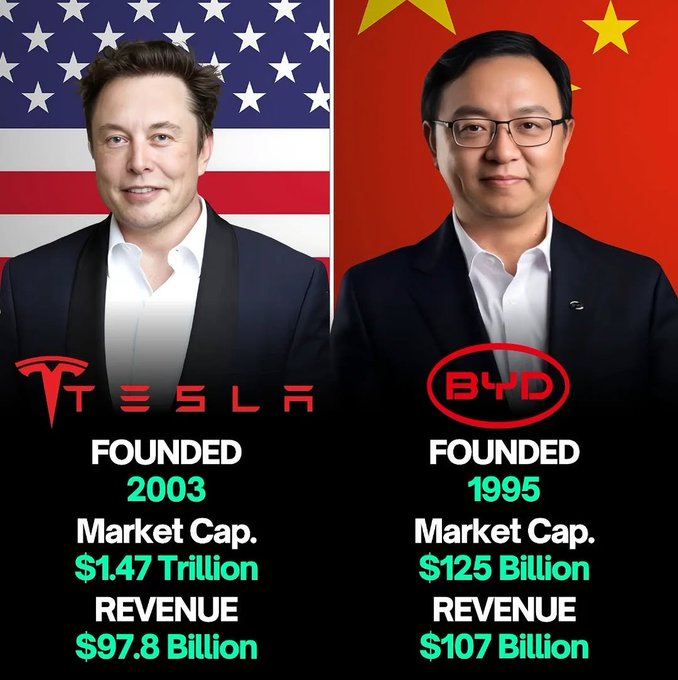
BYD also sells a LOT more cars, their revenue is only comparable with Tesla because Teslas cost MUCH more.
Anyway, if you want the details, read the book, though it’s somewhat out of date now, it gets the basics down better than any other one I’ve read. And since prices keep going up, and since this blog is free to read, perhaps consider subscribing or donating. I promise the money is only, occasionally, wasted on eating something nice and buying books. No I don’t have a book problem. Why are you looking at me like that?
Feral Finster
1. Well of course. Fair competition is for fools. Smart people rig the game in their favor.
2. “A competitive market has:
*low barriers to entry
*many buyers and sellers
*no one with pricing power,
*and products are similar, meaning not identical but that competitors can quickly catch up with any advances.”
This is also why healthcare is not a market good, and why the only problem that “market based healthcare solutions” will actually solve is the problem of “how to transfor more dough into rich people’s pocketses?”.
Soredemos
MBA may be predominantly a bullshit degree (and I’ve seen and heard plenty of people who have one eventually admit it’s kind of a waste, especially when everyone else has one).
But I will say that based on my experiences in the nonprofit sector, which is filled with genuinely enthusiastic amateur clowns, at least an MBA might be *something*. Maybe not a good thing in a lot of ways, but it’s some sort of training for running an enterprise and managing personnel.
Yes, there is absolutely a certain cynical element of a Nonprofit Industrial Conplex, that definitely exists. But far more often it’s people who sincerely believe in some cause but have no idea what they’re doing, which only becomes worse as they, often rapidly, scale up. Now you have people who still don’t know what they’re doing, but who are now in charge of hundreds of thousands, or even millions of dollars, of grants and contracts.
I’ve seen stuff that would never fly even in our loose, corrupt modern market environment because at the end of the day a private business has to turn some sort of real profit. Many nonprofits would quickly go bankrupt if they had that sort of expectation. If you have a skilled grant writer and a charismatic executive director with good networking skills they can keep the gravy train running surprisingly long. The workers are all miserable, unsupported, and burning out, but leadership just calls this ‘expected turnover’ and shrugs and hires new people. There’s no understanding of institutional knowledge or related concepts.
Adam Eran
What you’re describing is Stewart’s observation the reinforce what classical economics called the law of declining profits. Like most 18th and 19th century social science, classical economics is a bit obsolete, but that law remains pretty solid, and firm managers hungry for profit do everything they can to make sure the markets aren’t competitive.
This includes buying competitors, or dumping products at below cost to kill less well capitalized firms. Of course lobbying for regulations that produce barriers to entry and producing unproductive, but profitable things are also in their neoliberal repertoire.
The best example of that last item is US military production. The contracts are often “cost plus”–figuring the cost, and a percentage of that cost as profit. This means the weapons are often very costly, but finicky and less reliable. An AK-47 is far better suited to combat conditions than an M-16. F-35’s can only fly 40% of the time because they’re in for repair so often (never mind the rare earth elements they need), but they are far more expensive than the Chinese fighters that defeated them in the India/Pakistan kerfuffle.
See also Brett Christopher’s “The Price is Wrong: Why Capitalism Won’t Save the Planet” which outlines the reason renewable energy technology still lags behind petroleum as an investment. It’s just not as short-term profitable, and profit guides the West’s investment decisions.
Finally: Stewart was a PhD in philosophy, not an MBA, which might explain why he was able to be so objective about his tenure as a McKinsey consultant. He’s also written about Spinoza (his thesis?) in an interesting way.
bruce wilder
In Econ 101, teachers lay out “perfect competition” and “monopoly” as simple models representing opposite poles of a continuum. “Perfect competition” is formally set out as a case in which firms do NOT act strategically. Sometimes, this is rationalized as firms for some reason(s) not knowing they could (and should in their own self-interest) act strategically. That kind of other-worldly thinking gives rise to a lot of hand-waving leading to your summary of what a “competitive market” is:
Theories exist to train thinking and the theory of “perfect competition” is a ridiculously faulty way to think. These heuristic generalizations that arise from the hand-waving to obscure how faulty the theory is only appear plausible as an opening to useful analysis. Economics has given you no trustworthy theory with which to think about the way the economy works or fails to work well.
People like Steve Keen have played the gadfly critic, trying to provoke academic economists to do better in the textbooks to no avail. The academic literature has produced many fundamental insights but these never seem to feed back reliably to the Econ 101 textbooks or to presuppositions of political journalism and public policy analysis.
What business schools teach students is to think in terms of devising “a business model”.
In business school, it is presumed that all important entrepreneurial and business management decisions entail commitments to sunk-cost investments under uncertainty — they are all risky bets in common parlance. The point of a strategic business model is to identify and implement on the basis of claims of property right and commercial custom, a way to earn and collect an economic rent in return on the sunk-cost investment. This is essentially an exercise of political power to make or manipulate “the rules of the game” to realize what is an economic rent.
The Econ 101 story is effectively an idealized fairy story. You are subtly encouraged to believe in the ability of the neutral and indifferent Market to sort every thing out optimally. Profit will be “maximized” and the better mousetrap will prevail.
The business school, translated into economics terms, is far more problematic. All firms are acting strategically and all firms are rent-seeking. Almost all practical schemes for business investment presume sunk-cost investment in the expectation of increasing returns. In case you don’t know what “increasing returns”, it means scale economies, network economies, bigger is better and so on. In the Econ 101 framework, it means the Market cannot produce an equilibrium price, optimal or otherwise, so “market economy” is a misnomer for most of the economy. “Market power” is demented — there is just Power, the political ability to make or manipulate “the rules of the game.”
“The business model” as taught in elite business schools is just an introduction to the study of Finance, still another subject left outside the scope of Econ 101. In Econ 101, prices are just a given, disembodied from the operations of money finance.
Like & Subscribe
Organizational Behavior is at the heart of it. I got an A but not because I was on board with the indoctrination, rather because I figured out quick the answers to the case studies the prof wanted and the course required. All else emanated from this.
https://www.hbs.edu/faculty/units/ob/Pages/curriculum.aspx
cc
> “So what Western businessmen (and a few women, but mostly men) did was take over government and dismantle all the rules and regulations intended to make sure that monopolies and oligopolies and so on didn’t form”
Case in point: this is epitomized by US billionaire oligarch Peter “Competition is for Losers” Thiel who helped Trump and Vance take office (along with other oligarchs, ex. the rest of the Paypal Mafia, Karp, Ellison, Adelson, etc., and those that backed the other side of the plutocratic Republican/Democrat duopoly coin.)
Unfortunately most of the 99.9% in the West have been indoctrinated into thinking that their countries should be run as businesses, going against their own personal interests as consumers. And so we have our over-inflated costs of living and rentier economy. Pay usury all of your life to the big banks for your student loads, then for your car, then for your rent, then for your mortgage, then for your healthcare, etc.
The West’s oligarchic/plutocratic goal of eliminating competition and securing monopoly for massive profits extends into US/Western foreign policy. Call it the Tonya Harding approach: Instead of trying to compete fairly, kneecap/cripple your competitors, and collect the profits (rape, plunder and loot the rest of the world.)
And so, just in the past six months alone, the US murders over 80 people to kidnap Venezuela’s president and his wife in the middle of the night, besieges Cuba even more to make the people suffer even more, surprise attacks Iran during negotiations along with its vicious pitbull attack dog colony Israel, and gets its European vassals and latest attack dog colony Ukraine to attack Russia, its refineries, and its oil/gas tankers.
As Richard Medhurst points out, it’s an attempt to control/monopolize energy flows.
Richard Medhurst : US Is a Pirate Nation
https://www.youtube.com/watch?v=OK9jqERs3AU
This in order to kneecap China and the rest of the world that try to compete but are constantly Tonya Harding’ed by the “Competition is for Losers” West.
The US wants monopoly to collect profit, and does not want any competition. It prints its Monopoly money at will, runs the bank, and wants to control the energy properties on the Monopoly board. It also wants to establish and monopolize new boxes for AI on the board. If the Monopoly board were updated today, would the Railroads be changed to Oil & Gas and/or chips & AI?
spud
neo-liberal, neo-classical economics is based on “lets pretend its real, then go on from there”!
Jan Wiklund
Competitive markets is the darling of mainstream economics (or neo-classic economics as it used to be called). The problem with it is not only that profits are zero, it is also that nothing will ever be invested in it, because profits are zero. It will languish on, and nothing will happen. And the businesses will be small, with no economies of scale, and the products will be expensive.
The superior model, which mainstream doesn’t like at all, is imperfect competition. Enterprises must succeed fencing in advantages sometimes – but they should never be safe against interlopers. Monopolies have to be crushed from time to time. Otherwise you won’t have any development, either.
bruce wilder
sidenote: India, as far as I know does not have any F-35s. India relies on French Rafales as well as some Russian aircraft
Both sides claimed that they had imposed losses on the other and refuted the claims of the other side.
spud
keens latest,
https://www.youtube.com/watch?v=jAuEgIjGLcQ
The New Fed Chair’s Plan to Cancel $39T Debt Crisis: Top Economist
In 2026, Kevin Warsh steps into the most powerful economic role on earth Federal Reserve Chairman inheriting America’s staggering $39 trillion debt. World-renowned economist Steve Keen, who famously predicted the 2008 global financial crisis, delivers a sobering warning: Warsh is “cut from the same cloth” as every Fed chair before him. Trained in neoclassical economics a discipline Keen argues is built on fantasies that completely ignore money, banks, and private debt Warsh won’t bring the radical change America desperately needs.
Meanwhile, Trump’s military escalation in the Strait of Hormuz has triggered a supply shock that conventional economists are misdiagnosing as demand-driven inflation. By raising interest rates to fight the wrong enemy, the Fed is accelerating bankruptcies, crushing the private sector, and destabilizing the very economy it claims to protect. Keen’s verdict? 2026 is the year of chaos a financial crisis born not of market forces, but of human ignorance.
Why did Trump pick Kevin Warsh as the next Federal Reserve Chairman and what happens when Warsh inevitably disappoints him? How could a Strait of Hormuz blockade disrupt global fertilizer, helium, and sulfuric acid supplies and trigger a worldwide food crisis?
Why does Steve Keen argue that raising interest rates during a supply shock actually causes more bankruptcies, not less inflation? What is neoclassical economics hiding and how do its “fantasy models” that ignore private debt make every financial crisis worse? Will Trump turn on his own hand-picked Fed chair the same way he turned on Jerome Powell? What role will the biggest El Niño in history play in the economic collapse of 2026?
In this in-depth economic analysis, top economist Steve Keen breaks down why the new Federal Reserve Chairman Kevin Warsh cannot solve the United States’ spiraling $39 trillion debt crisis. As the Iran war escalates and the Strait of Hormuz blockade threatens global oil prices and supply chains, conventional economic policy, driven by flawed neoclassical economics, continues raising interest rates despite clear evidence this is a supply shock, not demand-driven inflation.
Keen warns that Trump’s Federal Reserve appointment will fail to prevent the coming global economic crisis, as private debt burdens crush American households and firms. With El Niño’s economic impact compounding the destruction of productive capacity, 2026 is shaping up to be a year of unprecedented financial chaos.
————–
neo-liberal/conservative/libertarian neo-classical economics,
lets pretend its real, then build on from there:)
Purple Library Guy
I, too, don’t have a book problem. It might be argued that I have a bookSHELF problem, in that I need more of them to fit my books on.
@Adam Eran “See also Brett Christopher’s “The Price is Wrong: Why Capitalism Won’t Save the Planet” which outlines the reason renewable energy technology still lags behind petroleum as an investment.”
Mind you, it doesn’t any more. Yes, all else being equal capitalists would rather do fossil fuels because of the windfall profits enabled by the centralized chokepoints and such. But all else isn’t equal. There is also power in the hands of those, including governments, who want cheap electricity. Investment in renewables is surging because that’s what wins the auctions, and has in the last few years actually rather eclipsed new investment in fossil fuel stuff.
Capitalism is certainly not a good system for doing the energy transition. Some kind of socialism would almost certainly be better. But it is nonetheless happening. Mind you, a significant amount of that comes from China’s and Europe’s willingness to use government action to push the shift, so it’s not entirely capitalism doing it . . . but even so, at this point solar + batter is the cheapest power there is, and there is only so much the oil/coal/gas baron subset of capitalists can do to stop all the other capitalists wanting cheaper inputs.
mago
As a humanities draft dodging student in university, I’d watch the button down , brief case clutching business school students exit between class breaks and think wtf are they doing?
Eighteen years old and entrepreneurial I dealt pot and psychedelics to supplement my library work study job and pay the rent and stay alive. Actually, I would drive three hours to SLC and buy a kilo of Mexican pot, break it down into lids and front it to a friend at low percentages, but enough for both to profit while putting the risk on him.
Made the occasional trip to Boulder to score the other stuff, which I also fronted out by the hundred lot. Wasn’t going to sell on the street myself if I could avoid it, although it occurred on occasion.
Underground criminal activity? Yeah, as opposed to above ground legal criminal activity? Kind of callous and mercenary of me, but there was some benefit to self and others, economically and otherwise, although not without negative consequences for all involved.
Not a confessional or autobiography here, so I’ll drop it except to say, the suits and the wannabes are more venal, ruthless and destructive than even the most high powered alternative businessmen I ever knew were—dumber, too.
And just as a side note, without naming commonplace business names, the natural foods industry was kick started with drug money.
And once again, if I possessed any sense I wouldn’t hit submit.
StewartM
Markets are problematic in the best of cases, where there exist a high degree of wealth and income equality. As having money is akin to having “votes” in seeing what is made and not-made, if there is a high degree of income/wealth equality at least the market should respond to the “votes” accordingly and better niche with human needs (though the very poor with no money/income have no votes, and that’s a problem).
But have vast gaps in income/wealth inequality like we do, and the market responds only to the fantasies of the rich. That’s why we’re sinking vast sums of money into AI, and using computing resources and hardware on AI and crypto, while letting say infrastructure decay, let climate change run rampant and see housing and food become unaffordable. The market does this because the very rich who have most of the votes aren’t interested in the latter stuff but salivate over the former. A knock on non-market economies goes “Socialism means no IPhones” which may contain a kernel of truth but that’s because socialism, properly managed, focuses on meeting necessary needs like food, medicine, and shelter for everyone and elevates these over making playthings for the rich like Rolex watches, luxury cars, and fancy phones.
I’m also leery of the Austrian economics contention that there is a “Economic calculation problem” that is only solved by markets because in the real world in real market economies we’re always producing too much of some things and too little of others. Sure, prices MIGHT act as a sign that this is so, but so would a manufacturer checking inventory. And there never is a real ‘balance’, the system is always out-of-whack.
bruce wilder
I think the rhetoric of neoclassical economics, of “the market economy” (which rhetoric is pervasive and part of the indoctrination of most college students) seriously handicaps politics on several levels.
We really are not good at imagining reform, because we do not understand the basics of the institutional architecture of the economy. For the same reason, we are not discerning critics. Our political leaders do not have access to many good sources of specialist knowledge and expertise when it gets to be time for policymaking. The dearth of common knowledge and vocabulary results in even a shortage of evocative slogans.
If we had the political opportunity to restructure the Banking industry or Hollywood, would anyone have a clue what to do? The billionaire class have their desiderata ready to trot out as an agenda for either Party, of course. But, I don’t think much there is much of anything in the way of “socialist” concepts lying around waiting for a crisis. That may prove unfortunate.
It wasn’t always this bad I think. Elite academic economics before 1970 had institutionalists and even a few Marxists. In the 19th century, ideas like Henry George’s single-tax served to rationalize public school and public transportation financing via property taxes. American health care once featured public hospitals and non-profit insurance. The core of what is now the military-industrial complex were once state-run Arsenals, including Springfield which famously pioneered the machining of interchangeable parts, and Naval Shipyards. Populist and progressive movements generated a lot of institution building.
I have been reading a lot recently on the evolution of money and monetary institutions from the gold standard forward. I would not want to oversell the idea of past sophistication of economic ideas or institution-building design. Controversy between the “currency school” and “the banking school” over the “real bills doctrine” was often a mad swirl of half-baked notions that gave rise to institutions that ran by exception to the rules devised as much as by compliance. No one really understood how the Federal Reserve System was to function in many respects. The effectiveness of “open market operations” was discovered by accident and only because WWI borrowing flooded the money markets with Federal securities.
At this moment in U.S. politics, some regulatory agencies first created in the Progressive Era are under assault. There was a case at the Supreme Court triggered by Trump trying to oust Lisa Cook as a Fed governor. I couldn’t tell you what was decided, if anything, but Brad DeLong was upset enough to badly misconstrue the whole history of central banking and to defend Lisa Cook as a paragon of prudent judgment. Meanwhile, as Steve Keen has tried to alert us, growth of private dollar debt is expanding out of control. There really ought to be policy controversy and a contest for control of the institution. The Federal Reserve was designed to be open to populist influence, but most of the Reserve operate hobbyshops for right-wing kook economists and calls them research divisions and no one on the left can be bothered.
Being content to recite the cant of neoclassical economists while cheerleading Monty Python socialism is not likely to lead to institutional reform.
Brian M
Right. This is the basic situation that occurs if the economy controls the state rather than the state controlling the economy. And, by “control”, I don’t mean full, state-owned, command-control. You just have to have a state that decides what is strategically important to the nation, and then insures that those aspects of the economy are a) supported, and b) competitive, in order to ensure that they generate low-cost, high-quality outputs. You also need to ensure that to the degree that companies or individuals are allowed to become wealthy, even extravagantly so, they are not allowed to use that wealth to influence the state.
This is more or less the situation China has created for itself.
The US went the other way. Greed is good. Everything has a price (including government), nothing matters, and anything goes. The government now works in the interest of the masters of capital, rather than ensuring that the opposite is true. Gonna be a shelf life on that.
ProNewerDeal
Let me define a “Toyota-style Productive Capitalist” (PC) as a company that sincerely attempts to consistently over years tries to make a good quality product/service at a fair price, and as a result has satisfied repeat customers, which then are the basis for loyal employees and consistent profits. Toyota has the “kaizen” continual improvement approach and has quality cars that need less maintenance and have a longer 150K+ mile lifespan.
Other PC examples would be China’s BYD, the original electrical engineers Hewlett & Packard who founded HP & the “HP Way”, and InfoTech vendors that help clients implement FOSS software.
Question – what would the “actually useful” business education curriculum be for an entrepreneur or an employee (like a Toyota factory manager/electrical engineer/etc) at a PC company? Perhaps the equivalent of a minor in business would be useful by taking the 101-type courses in Marketing/Finance/etc on openstax or the reading the textbooks in the MIT MBA core curriculum, excluding the specific (strategy & org behavior?) courses this author Matthew Stewart criticizes as junk?
ProNewerDeal
I am reminded of the comment of Ian (a prolific reader/audodidact) noting he knows more about every social studies major then most individuals he met with a BA degree in that field.
It seems to me the subject matter IS relevant as a citizen & worker, but the way at least certain fields (Econ & Political Science) in the US are taught are more like a crazy theology than a scientific/empirical subject.
I suppose studying the 101 on openstax & then read some nonfiction books (for instance Steve Keen & Yves Smith on economics, Thomas Ferguson on political science, etc), would be a good way of being a lifelong educated person – moreso than the vaunted “Liberal Arts education” from a BA in Social Studies/Humanities if they are not exposed to unorthodox works like Keen/Ferguson/etc.
spud
ProNewerDeal:
the japanese ran for years a really really good propaganda campaign about their cars, it reviled what the german reich did in the 1930’s. it was outstanding.
as a ex-mechanic, i saw their stuff, like saran wrap for insulation used in doors, to hold in place balled up newspapers. and yes, the paper was in japanese.
—————-
Ralph Nader has criticized Toyota for its failure to adequately address safety defects and for prioritizing public relations over genuine safety improvements. He has called for more transparency regarding the company’s expenditures on vehicle safety research and development.
nader.org manufacturing.net
Ralph Nader’s Criticism of Toyota
Safety Defects and Public Relations
Ralph Nader has been vocal about Toyota’s handling of safety defects, particularly regarding their failure to adequately address issues related to vehicle safety. He argues that the company has focused more on public relations than on making substantial improvements to safety.
Nader has called for greater transparency from Toyota concerning its spending on vehicle safety research and development. He questions the legitimacy of the $8 billion that Toyota claims to invest in research, suggesting that much of this funding may not directly contribute to safety enhancements.
Inadequate Response: Nader believes Toyota has not sufficiently responded to safety concerns, leading to ongoing issues with vehicle defects.
Lack of Specifics: He has requested detailed breakdowns of how much of the claimed expenditures are actually directed towards safety improvements, rather than general product design or testing.
Continued Safety Issues: Despite significant financial claims, Nader points out that serious safety defects and recalls continue to plague Toyota, indicating a lack of effective action on their part.
Nader’s criticisms highlight the need for automakers like Toyota to prioritize genuine safety measures over public image.
nader.org
Ralph Nader has criticized Toyota for insufficient transparency and action on vehicle safety defects, including a lack of detailed breakdown of its $8 billion-plus annual R&D spending on safety improvements and limited demonstrated safety innovations in its vehicles.
nader.org automotivehalloffame.org
Toyota has acknowledged the importance of automotive safety and has implemented measures to improve vehicle safety in response to criticisms like those from Ralph Nader. The company has established a recall system to address defects and ensure consumer safety, reflecting a broader industry shift towards accountability in vehicle safety.
automotivehalloffame.org toyota-global.com
Toyota’s safety defect issues have significantly damaged consumer trust, as the company’s initial failure to address complaints and the handling of recalls raised serious concerns about corporate transparency and consumer safety. This crisis not only affected Toyota’s reputation but also highlighted the importance of effective communication and responsiveness in maintaining brand trust.
journalism.university file.scirp.org
Mitsubishi Motors admitted to hiding 26 defects in its cars for years, in addition to four previously publicized issues, to avoid issuing recalls. This cover-up has significantly damaged the company’s reputation and consumer trust.
autosafety.org amagicalmess.com
Overview of Deceptive Practices by Japanese Car Makers
Japanese automakers have faced significant scrutiny for misleading practices regarding vehicle defects. This has raised concerns about safety and consumer trust in the industry.
Notable Incidents
Several major Japanese car manufacturers have been implicated in scandals involving the concealment of defects:
Mitsubishi Motors: Admitted to hiding 26 defects in its vehicles over many years to avoid recalls. This cover-up has severely impacted its reputation and consumer confidence.
Toyota: Recently involved in a scandal where it provided incorrect safety data for certification tests. The company has apologized and stated that the findings do not affect the safety of vehicles already on the road.
Honda, Mazda, and Suzuki: These companies have also acknowledged submitting faulty data related to safety tests, indicating a broader issue within the industry.
The consequences of these deceptive practices include:
Loss of Consumer Trust: Repeated scandals have eroded public confidence in the reliability and safety of Japanese vehicles.
Regulatory Scrutiny: Increased inspections and potential penalties from regulatory bodies as a response to these revelations.
Financial Repercussions: Companies may face significant costs related to recalls, legal actions, and damage to their brand image.
The history of deception among Japanese car manufacturers highlights the need for stricter oversight and transparency in the automotive industry to ensure consumer safety and restore trust.
reinsurance.org file.scirp.org
bruce wilder
My reflections on my own intellectual history and experience may be of interest to you, ProNewerDeal. Or, not. But, you made me think back.
My job title as a civil servant out of college was “industry economist” and my initial assignments entailed learning about the auto industry. I was tasked to assess how industry was adapting to government fuel economy and auto safety standards policy and how international competitiveness was changing. I was puzzling out Toyota’s and Honda’s remarkable achievements in the late 1970s.
A young puppy, I had to get out my old textbooks and puzzle out how to apply such doctrines as “comparative advantage” and “production functions”. I had a small headstart in my knowledge of the auto industry in that I grew up in Michigan and I had written my senior thesis on the troubled post-war British Motor Industry.
I am no one’s idea of a genius. I plod my way slowly, and to make much progress, repeatedly thru data and ideas, but I do habitually ask two critical questions repeatedly: “Is this assertion or theory, in some sense, true?” and “In what sense or on the basis of what theory or method?”
I am not a true autodidact — that would require more self-confidence, originality and self-possession than I have ever had. I search for teachers, mostly in books since I don’t do well in person. I look for someone who has confronted the same problem and been acknowledged by peers to have genuine, sophisticated insight. In short, I always want the legitimacy of reconciliation with orthodoxy of a sort.
This peculiar personal psychology has given me a distinctive perspective on the sociology of mainstream economics, which, in my lifetime, has closed up as tight as a medieval monastery under siege. I went to ruling class schools and don’t concede any feeling of social inferiority. I just recognize a group high on their own supply, arrogant and wholly incompetent because they prefer to align in support of a social-political consensus and ideology. It is a strange dance a Krugman or Mankiw or Stiglitz or Solow or Larry Summers or Paul Romer does to maintain membership in the Big Club. They will take performative, epigrammatic swipes at the fundamental flaws in orthodox practice but always return to support the Noble Lies in which academic economics, as a kind of civic religion, indoctrinates the young.
There is a kind of intellectual tension between the flaws of the Econ 101 textbooks and what Big-Time economists know as advanced economics. Krugman, for example, won a faux Nobel for creating mathematical models of increasing returns, an accomplishment which ordinary minds might imagine overturns free-trade dogma and aversion to industrial policy, but not according to Krugman himself or his textbook. (Chinese economists made extensive use of Krugman’s model and insight in devising China’s industrial success.) Bernanke worked out the risk to the banking system of deflation — something that economics as a discipline has resisted acknowledging since before the Great Depression, but his own “discovery” does not make it into his elementary textbook. It just goes on like that: becoming an ironical defense-in-depth to critiques of fundamental flaws: a common response of orthodox economists is “we know all about that (advanced topic or issue); it is in the journals.”
Many of the marginalized dissenters now identify as “heterodox” and argue for “pluralism” as a way of finding academic places for members of their Party. The orthodox in a show of “objective” indifference to ideological preferences put methodology hurdles in place of the aspiring heterodox and this mostly works as an justification for ignoring as well as excluding them. “So-and-so has no model” the secure will say. “Identification fails”.
While the heterodox have a few refuges, the orthodox have the vast expanse of business schools and, since “law and economics” qualified as a niche, some law schools.
Last year, I took Steve Keen’s online course for a while. He’s hooked up with a firm that organizes internet marketing. And, he is in a Hail Mary play to catalyze reform of economics pedagogy and popular policy thinking by making enough money to finance software development of an application that will model money and the macro-economy in a roughly Minsky-consistent way. He and I are almost exactly the same age, so I think I see where the sense of despair at the paucity of one’s life achievements comes from.
Keen is unmistakably manic, and I just assume there are depressive episodes to match. He’s rarely grandiose so the mania is tolerable. In my opinion, he has good judgment: morally grounded and realistic. And, he is not interested in power over people, in dictating what anyone thinks.
It was not my intention to offer a judgment on Keen — I just want to explain what I took away from my participation in that online course about the prospects for a reformed economics and it is pretty pessimistic. My pessimism does not derive from my view of Keen, who I hold in high regard.
The course syllabus implies a lengthy, continuous round of I don’t even remember how many dozens and dozens of lectures were projected, anchored by a relatively concise introductory series of — again I don’t have a precise memory partly because it seemed to change — on the order of 8-12. During my time in the course, he seemed keep starting over both the short sequence and the long.
The content itself tended to be heavy on critique of Econ 101, so organized around the outline of arguments originally given in a intro Econ lecture or textbook correlated with how or why they are wrong. There are obvious hazards in this plan including that you end up teaching economics as a null set: nobody knows nuthin and thinking carefully and systematically yields only skepticism.
Some of the people I regard as the most able critics of conventional economics, like the distinguished Swedish economist, Lars Pålsson Syll, embrace such nihilism rather too readily in my opinion, but that may be partly a matter of taste. Peter Dorman is another critic I find attractive because he is very articulate and he’s written textbooks with big promises to do things differently but with disappointing results. Dorman does not depart from Samuelson’s outline as much as his critiques suggest he might.
I confronted Keen on one particular point — he was asserting that firms can be usefully thought of as practicing mark-up pricing. This can be an excusable simplification when doing some kinds of macro reasoning, but that was not the context where he introduced it as a fact — maybe a stylized fact? I objected and briefly argued the case for the more conventional account, which is that most firms, with common cost structures, are going to opt for more or less elaborate price discrimination. I knew perfectly well that Keen had himself recognized the ubiquity of price discrimination years previously and wouldn’t argue back. I gave him an out. I wasn’t looking to humiliate anyone. I was just frustrated that his version of economics was not making it over a very low threshold of theoretical reason and observation.
I am not the guy to fix any of this. Recently, I have come to a more anthropological understanding of how and why economics is stuck in this particular Staussian “equilibrium”. I am referring to Leo Strauss, of course. Econ 101 is wrong in ways that serve the status quo and powers that be in ways the hoi polloi cannot be admitted to know or be aware of.
In my naïveté, I tend to think academic economists ought to be delighted to embrace some easy “upgrades” to Econ 101 that would correct logical errors and admit factual observation. Like getting new features in a word processor or spreadsheet app. Being able to think about economics ably seems like a public good valuable to the functioning of a democracy. (Of course, the TPTB don’t want a functioning democracy and that explains a lot.)
Anthropology, though, explains a lot about why ordinary people resist replacing fashion and convention and about how “movements” form and adopt dogmas and slogans as shibboleths.
In Keen’s course, I discovered among the students —mostly geriatric like myself — a whole international subculture pursuing crank monetary ideas. (Not Keen’s ideas, which are well within the broad compass of MMT and Post-Keynesianism as well as the Keynesian mainstream and figures like Perry Mehrling.)
Anthropologists would probably say that what “sticks” in people’s minds from a college course in Econ is what people are already prepared to believe and serves the tribe and the culture ceremonially and mythically. Whatever justifies human sacrifice for the cargo cult that is neoliberalism.
I recognized way back in college that most of my fellow students learned a version of the “just world” hypothesis in Econ 101 even though that wasn’t what was explicitly taught. Some probably learned more from Ayn Rand. Milton Friedman did it on PBS! And, as I say, many academics rationalize faulty economic doctrines as Straussian Noble Lies to tame the rabble and prevent the horrors of rent control or protective tariffs or bank regulation.