
Glenn Greenwald has an article in which he goes after AOC and others for the hysteria of the woke era (which is apparently behind us?)
Most of it I agree with, but I’m not entirely down with this:
AOC, on Sunday, went on ABC’s morning news program with Jonathan Karl, where she was asked about some of Hong’s statements, including her call for “abolishing prisons” and “[defunding] the police,” policies and phrases that have proven to be deeply unpopular. AOC, who herself aggressively advocated those policies, sought to laughingly dismiss this all as just some momentary, harmless frenzy of “craziness” that never really meant much and that everyone has all just agreed to move beyond:
I can’t really imagine America operating with no police or prisons.
But if you got rid of three quarters of prisons and released three quarters of prisoners tomorrow I think that’d be a good idea, if done with some care.

These rates are deranged, and “abolish prisons” is exaggeration for effect, but the idea is simple enough: take all that money and spend it on welfare and social services and transfer payments and so on. It’s also worth remembering that the US did not always lock up so many people:
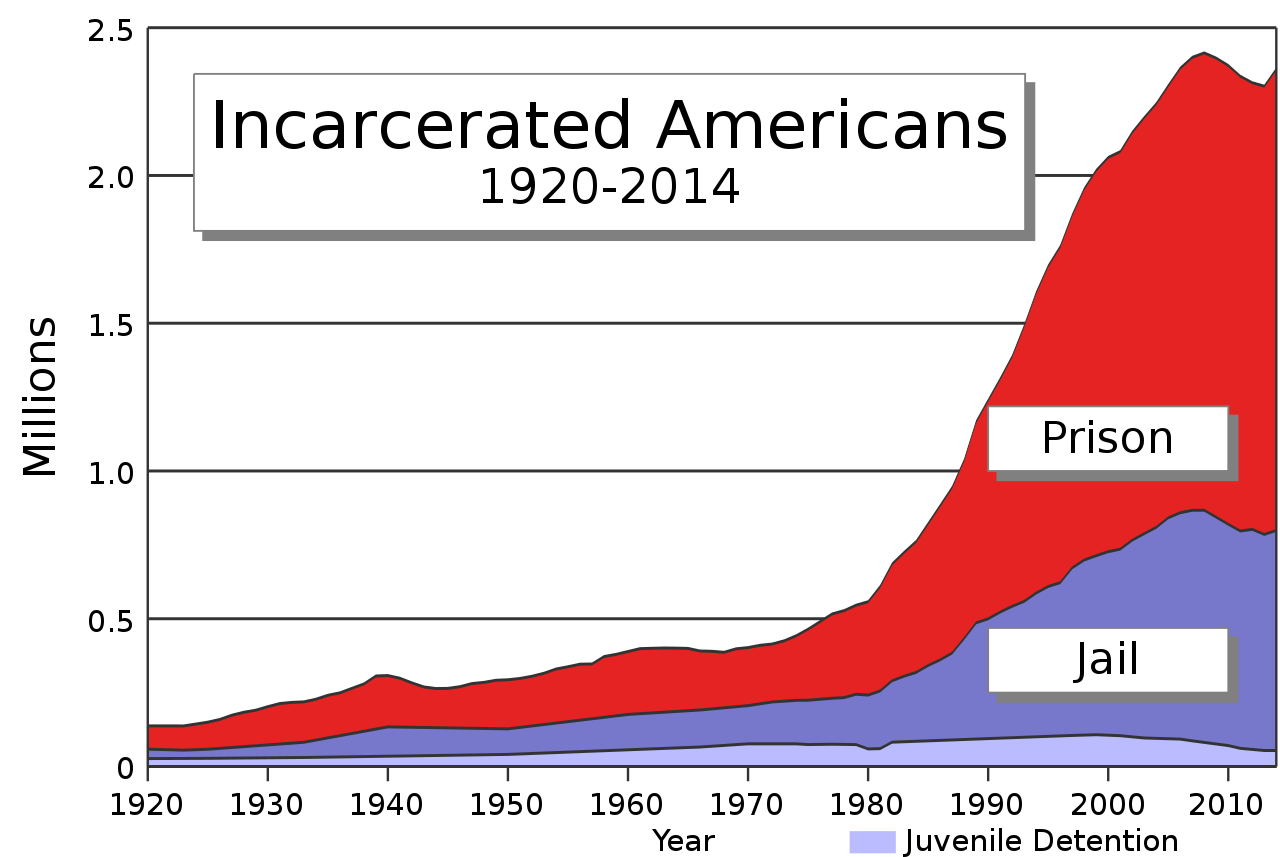
There’s been a slight dip since 2014, but the massive spike in how many people were locked up that started around 1980 has not flattened back to the previous historical norm. American courts are so overwhelmed with cases that most people in prison never had a real trial: they just plead out under threat of massive sentences if they dared fight.
As for police effectiveness, this is a chart of what percentage of homicides they solve.
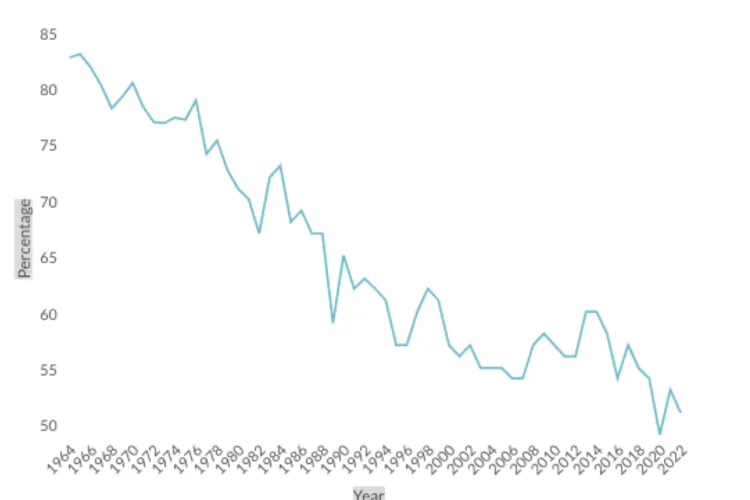
And it’s really worse than the above chart:
That statistic would have stunned detectives in the early 1960s. In 1962 the FBI reported a clearance rate of 93 percent. Today, homicide is the only violent‑crime category that clears even half its reported cases; rape, robbery, and aggravated assault fare far worse. Murders themselves declined by 14.9 percent in 2024, but the clearance rate refused to rebound alongside them.
Why the hell are more and more cops constantly being hired when the more there are the worse they are at catching criminals?
This is like everything in America. No one looks at what actually produces good results. As far as I can tell most of the decline in crime in America isn’t about cops, it’s about getting lead out of gasoline. It certainly isn’t because criminals are scared of being caught.
And this is odd. Really odd. You’d think with all the surveillance devices we now have it’d be easier to solve crimes than in the sixties, not harder, but it turns out that what really matters is whether or not the police are trusted: whether informants will talk to them. And, more and more, they aren’t trusted and most of police work isn’t Sherlock Holmesesque brilliance or cleverly uncovering forensic clues: it’s people being willing to tell the cops what happened.
So when people, especially those in crime ridden areas, start saying things like “abolish prisons and defund the police” this an indication of a problem. And part of the solution probably is to have less cops and less prisons and spend that money on other things. This is especially the case because a lot of what police do could be done in other ways: should police really be doing wellness checks given how often they wind up shooting mentally ill people?
It’d be cheaper to have social workers take over a lot of what cops do, too. Cops are very well paid in America.
I’m no fan of “woke” and I’ve been an opponent of much of identify politics for decades.
But the truth is that America’s incarceration, court and police systems are all world class piles of flaming garbage and everyone involved with them knows it.
The response to police sucking at their jobs and to America locking up more people than anyone else in the world never seems to be a common sense “this isn’t working, we should do something else” it’s always “let’s fund them more, give them more military equipment, get rid of more due process and lock up even more people.”
I’m pretty damn sure that cutting police budgets in a quarter and releasing most non-violent criminals and closing prisons, then directing all that money to social welfare and transfer payments wouldn’t make the US any worse and would probably make it better.
And if that means being “woke”, I’m to that extent woke.
What I write here is for the benefit of everyone, but alas, I live in capitalism and I, and the site, take money to keep running. If you value the writing here and can, please subscribe or donate.
bruce wilder
“abolish prisons” is exaggeration for effect
Yes, but which effect?
Trolling the rubes?
If there are ideas, those ideas are not getting a hearing. This rhetoric does not seem likely to inspire broad trust in policy judgment. “if done with some care”?
Feral Finster
Freddie deBoer has already eviscerated the “abolish the police/prisons” goodthink liberal moral preening.
https://freddiedeboer.substack.com/p/a-conversation-about-crime
That said, goodthink liberals should not be let off the hook, just because they parroted some slogans not so long ago.
Feral Finster
“My politics are therefore really a kind of self-defensive pastiche, an odd Frankensteining of traditional leftist rhetoric and vocabulary from Ivy League humanities departments I don’t understand. I quote Marx, but I got the quote from Tumblr. I cite Gloria Anzaldua, but only because someone on TikTok did it first. I support defunding the police because in 2020, when the social and professional consequences for appearing not to accept social justice norms were enormous, that was the safest place for me to hide.”
Money quote
Feral Finster
1. When goodthink liberals say “Defund The Police!(R)” what they mean is “take money from the underserving (blue-collar cops, mostly less educated and famously unwoke) and give to the deserving (white collar degreed social workers who can be counted on if nothing else to uphold up-to-the-minute standards of Political Correctness.
2. Humans wave away such destructive craziness all the time. “What difference does it make?” even as their actions caused destruction that continues today.
High status humans get away with it. Low status, not so much.
spud
the police and prosecutors are like any other portion of a country that has almost complete immunity and high pay, immunity creates elitism, contempt, laziness and sloppiness.
the police are not employees. but they have a union, that we should unleash rico laws on them, and abolish them.
the founders feared just that, a standing immune army.
otherwise the defund movement will get ever stronger.
—————-
48% of Americans currently express confidence in the police, indicating a decline in trust. This is the first time confidence has dipped below 50% in over 20 years.
counciloncj.org Gallup
Current Trust Levels in the Police
Overall Confidence
48% of Americans currently express confidence in the police. This marks a significant decline, as it is the first time in over 20 years that confidence has dipped below 50%.
Historical Context
Prior to this decline, confidence levels had remained above 50% for two decades. The last recorded high was 57% in 2017.
Demographic Insights
Confidence in the police varies across different demographic groups, with notable differences in perceptions based on race and political affiliation.
Demographic Group Confidence Level
Overall 48%
White Americans 68%
Hispanic Americans 59%
Black Americans 40%
Republicans 81%
Independents 59%
Democrats 59%
This data highlights the ongoing challenges in public trust towards law enforcement, reflecting broader societal issues and differing perspectives among various groups.
counciloncj.org Gallup
Americans’ confidence in the police rose to 51% in 2026, up eight points from 2025, marking the largest year-over-year change among 17 major U.S. institutions measured by Gallup. Confidence had dipped to a record low of 43% in 2025 after falling to 48% in 2020 following the murder of George Floyd.
Gallup
Declining trust in police undermines community safety and makes it harder for law enforcement to effectively perform their duties, as it can lead to reduced cooperation from the public, which is essential for solving crimes. This situation often necessitates reforms in policing policies to rebuild trust and improve community relations.
naacpldf.org FBI
———
examples of what happens when the courts gut the bill of rights, and give elites immunity.
https://www.youtube.com/watch?v=odQm_NebxrQ
Sheriff says cops won’t abuse flock cameras, then cops abuse flock cameras
https://www.youtube.com/watch?v=ClMrMhOfsWs
Long Island Police Departments Are EVIL & Corrupt – Here’s The Proof
https://www.youtube.com/watch?v=PKm6TyNKI3E
Tyrant Cop Caught Faking Evidence to Manhandle a Minor!
https://www.youtube.com/watch?v=ADZUCYXALWM
Cuffed for turn signal that I used
https://www.youtube.com/watch?v=5fpCrtAiSzo
Royse City Officer Pulls Mother by Her Hair—Then Police Drop Every Charge
https://www.youtube.com/watch?v=jZqbpPp0XlY
Police Whistleblower Exposes Racist Coworkers, Gets Hit With Felony Charges
———–
48% is not a good number, and with the current copaganda out there to get their numbers up, they can’t help themselves by sabotaging themselves.
Ian Welsh
The US has too many cops and too many prisons and too many prisoners and too many cop murderers and too much money seized by police from citizens, and no one sane and humane thinks otherwise. I’m pretty sure the black people (of whom there were many) who supported BLM did not operate from “I don’t like blue collar people” as their motivation. Freddie’s fighting his peers and irrelevant here, I’ve supported less cops and less incarceration for decades.
I find people who comment at blogs where they disagree with 90% of the content a bit weird.
Feral Finster
“The US has too many cops and too many prisons and too many prisoners and too many cop murderers and too much money seized by police from citizens, and no one sane and humane thinks otherwise. ”
I don’t think GG, FdB, or I said otherwise.
“I’m pretty sure the black people (of whom there were many) who supported BLM did not operate from “I don’t like blue collar people” as their motivation.”
I said nothing about black people and much about goodthink liberals. Perhaps “the NPR totebag set would have been more apropos.
mago
Once again a rational argument in an irrational world.
I’ve been railing against the US carceral/so called justice system since I was a teenager, and that was a while ago.
Most people behind bars are unlucky mopes caught in the wrong place at the wrong time doing stupid shit, like playing three card monte on the street or dealing a little pot or bailing on child support. Yes, there are rapists, killers and malevolent thugs in jail, and the same among public officials in high places. Depends on your birth station and your skin color in many cases.
As long as there’s money to be made with human immiseration it will continue. Just like wars, it’s the modern capitalist way. Good effing luck in affecting meaningful change. Political action and public protest ain’t gonna work. Wish I had some answers rather than complaints.
StewartM
Most of the commentators are missing the point of why we have this problem. In a nutshell, it’s because the police have become de facto tax collectors for the local/state governments instead of law enforcers. This means:
1) Solving actual crimes, even violent crimes, is a distraction from the real work of raising money (via fines) for the police department and local government(s).
2) Many or most of the people in prisons are there because they can’t afford to pay their fees and fines (either the direct fines, or the probation fees). Most of them are in for minor crimes, or even things like the inability to pay child support.
3) There’s also the incentive of prison labor, in some states. More people in prison = more money for prison labor.
I know people who have been caught “in the system”, and it’s a never-ending struggle to pull themselves out, especially if they ‘re poor. Failing to pay a fee or fine because of poverty means jail time if caught (meaning that they lose whatever job they have) and makes it harder to get a new one, making ever more likely that they’ll end right back in jail again. Repeat and rinse.
Congratulations, in the low-tax Reagan economy, we’re re-introduced debtor’s prison.
In most neighborhoods, calling the police is at best an exercise in futility. Say, you see someone stripping stuff from a vacant house in your neighborhood, and do the “good citizen” thing and call the police. The police will show up, hours later, after everything of value in the house has been stripped. After dutifully making the report, then they might start looking around YOUR place, and see that say a tag on your vehicle is past due. “I’m sorry, Sir, that will be $100 FINE”. It’s why the US is simultaneously both the most over-policed and under-policed country in the world. It’s also why poor neighborhoods stop calling the police.
So–part of the fix is to disallow any fees or fines exacted for crimes to be used by the police department, and indeed the government. Donate it to charity instead. If the public wants to have better policing, let them pay for it entirely by taxes. Ditto with prisons. You’d get more accountability that way, and hopefully this would mean the police are less incentivized to stop people for dinky little crimes to collect fines and more motivated to solve serious crimes.
Egoculexegonos
A quick search says there are around 11.5 million people incarcerated in the world and the prisoner population in the US is estimated to be around 1.8 million people. If these numbers are corright, it means that a bit more than 15% of the prisoners in the world are in US prisons while the USA holds about 4.1% of the world population.
No woKEnder. Prisons are huge businesses in the US. They need increasing raw material inputs to get ever increasing dividends.
Adam Eran
Recommended reading: Alec Karakatsanis’ “Copaganda” and “Usual Cruelty”
Note that the FBI reports “blue-collar” crime (assaults, burglaries, etc.) costs the US economy $12 billion annually. Wage theft costs $50 billion and “white-collar” crime (fraud, subprime loans, derivatives) costs $1 trillion.
If you visit a prison, you will seldom see a wage thief, and even more seldom see a white collar criminal.
spud
StewartM:
much agreement. most traffic tickets should be fix it tickets or warnings, not something that you can be arrested over.
a lot of misdemeanors should be a ticket, or a warning. not something you can be arrested over.
————
Marxists argue that the police exist to uphold capitalist class rule and protect private property, not to serve the working class.
leftcom.org liberationschool.org
Marx’s View on the Police
Role of the Police in Capitalism
Marxists contend that the police are fundamentally aligned with the interests of the capitalist class. They are seen as instruments of state power, designed to maintain the existing social order and protect private property rather than serve the working class. This perspective emphasizes that the police function primarily to uphold capitalist class rule.
Police as Enforcers of Class Oppression
Marx argued that the police are part of the state apparatus, which exists to manage class conflicts. Their role is not to ensure public safety or prevent crime but to suppress dissent and maintain the status quo. This view suggests that the police are not neutral actors but rather enforcers of the ruling class’s interests.
In summary, Marx’s critique of the police highlights their role as protectors of capitalist interests, positioning them as adversaries to the working class rather than allies. This perspective remains influential in contemporary Marxist thought, which advocates for the abolition of policing as part of a broader revolutionary struggle against capitalism.
Wikipedia liberationschool.org
————-
The Founding Fathers were concerned about standing armies, which included fears about the militarization of police forces, as they believed such forces could threaten individual liberties. This apprehension influenced the design of the Constitution to ensure civilian control over military and law enforcement agencies.
The New Republic bostonreview.net
Founders’ Concerns About Police and Militarization
Fear of Standing Armies
The Founding Fathers had significant apprehensions regarding standing armies, which extended to their views on law enforcement. They believed that large armed forces, including police, could pose a threat to individual liberties. This fear was rooted in historical examples where militarized forces suppressed freedoms.
Influence on the Constitution
To address these concerns, the Constitution was designed with mechanisms to ensure civilian control over military and law enforcement agencies. The Founders aimed to prevent any potential tyranny that could arise from a powerful, militarized police force. Key points include:
Civilian Oversight: The Constitution includes provisions that allow Congress and the president to maintain control over military forces.
Historical Context: Many early American communities did not have formal police forces. Instead, they relied on local constables and night watches, which were less militarized.
The militarization of police in contemporary America reflects a departure from the Founders’ vision. The current structure of law enforcement, characterized by heavy-handed tactics and a military-like presence, raises questions about the balance between security and liberty, echoing the Founders’ original fears.
In summary, the Founding Fathers’ concerns about standing armies directly influenced their views on police forces, shaping the constitutional framework to protect individual freedoms from potential abuses of power.
The New Republic bostonreview.net
The Founding Fathers had a unanimous fear of standing armies, which they believed could threaten the rights of free people. They were particularly concerned that militarized law enforcement could lead to tyranny and abuse of power, undermining the liberties they sought to protect.
The New Republic defenseone.com
—————-
https://newrepublic.com/article/157978/police-violence-george-floyd-constitution
Matt Ford/
June 2, 2020
The Police Were a Mistake
Law enforcement agencies have become the standing armies that the Founders feared.
“One issue where the Founders were virtually unanimous, however, was their fear of standing armies. From Julius Caesar’s legions at the Rubicon to Oliver Cromwell’s New Model Army to the forces mustered by European monarchies, large armed forces in peacetime invariably threatened a free people’s rights. Many of the 13 Colonies’ postindependence constitutions included declarations that standing armies “are dangerous to liberty, [and] they ought not to be kept up.” John Adams warned that they should be “watched with a jealous eye,” while Thomas Jefferson referred to them as an “engine of oppression.”…
spud
Alec Karakatsanis, the author of “Copaganda,” continues to work as a civil rights lawyer and founder of the nonprofit Civil Rights Corps, focusing on systemic legal challenges to policing and mass incarceration.
arktimes.com Democracy Now!
Current Status of Alec Karakatsanis
Alec Karakatsanis, the author of “Copaganda,” remains active in his role as a civil rights lawyer and the founder of the nonprofit Civil Rights Corps. His work focuses on addressing systemic issues related to policing and mass incarceration.
Recent Activities
Advocacy: Karakatsanis continues to advocate for civil rights, emphasizing the need for reforms in the criminal justice system.
Public Engagement: He participates in discussions and events to raise awareness about the themes in his book, which critiques how media and law enforcement shape public perceptions of crime and safety.
Impact of “Copaganda”
Public Discourse: The book has contributed to ongoing conversations about police narratives in media and the implications for public safety and justice.
Media Critique: Karakatsanis highlights how media representations can distort public understanding of crime, often leading to increased fear and support for punitive measures.
Karakatsanis’s work remains significant in the context of contemporary discussions about policing, justice reform, and civil rights.
Wikipedia arktimes.com
The main themes in Alec Karakatsanis’s book ‘Copaganda’ include how media narratives shape public perceptions of crime and safety, the manipulation of fear towards marginalized groups, and the critique of the punitive justice system that disproportionately affects the poor. The book also explores the role of media in perpetuating myths that distract from more significant societal issues, such as environmental harm and economic inequality.
University of California nyclu.org
Alec Karakatsanis has significantly influenced civil rights law and policing reform through his work as the founder of Civil Rights Corps, where he has pioneered constitutional civil rights cases that challenge systemic injustices in the U.S. legal system, particularly focusing on wealth-based detention practices and the negative impacts of the punishment bureaucracy. His efforts have led to policy changes that have freed hundreds of thousands of people from jail and returned tens of millions of dollars to indigent families, highlighting the need for reform in the criminal justice system.
civilrightscorps.org John F. Kennedy Presidential Library and Museum
The Civil Rights Corps, under Alec Karakatsanis’s leadership, addresses systemic injustices in the American criminal justice system, particularly focusing on wealth-based detention, for-profit probation systems, and prosecutorial misconduct. Their legal challenges aim to reform practices that disproportionately affect marginalized and impoverished communities.
John F. Kennedy Presidential Library and Museum lawdragon.com
Yes, Alec Karakatsanis has received threats due to his work and advocacy against police practices and the criminal justice system. His activism, particularly surrounding issues of civil rights and police accountability, has made him a target for such threats.
Wikipedia Democracy Now!
Alec Karakatsanis and Threats Received
Background on Alec Karakatsanis
Alec Karakatsanis is a civil rights lawyer and the founder of Civil Rights Corps. He is known for his advocacy against police practices and the criminal justice system, particularly through his book “Copaganda: How Police and the Media Manipulate Our News.”
Threats Received
Nature of Threats: Karakatsanis has received threats due to his work and activism.
Reason for Threats: His focus on civil rights and police accountability has made him a target for those opposed to his views and advocacy.
Karakatsanis’s commitment to challenging systemic issues in law enforcement has led to significant backlash, highlighting the risks faced by activists in this field.
Wikipedia arktimes.com
Alec Karakatsanis has significantly influenced public perception of police accountability through his critiques of “copaganda,” which highlights how police narratives shape media coverage and public understanding of crime, often masking systemic issues and police misconduct. His work challenges the narratives that justify inflated police budgets and calls for greater scrutiny and accountability within law enforcement.
kpfa.org Wikipedia
Threats against civil rights advocates like Alec Karakatsanis can undermine the progress of social justice movements and create a chilling effect on activism, discouraging individuals from speaking out against systemic injustices. Such threats also highlight the ongoing struggle against institutional power and the need for accountability in the face of violence and intimidation.
lawdragon.com whatsjustpresentscriticalconversations.buzzsprout.com
———-
https://equalityalec.substack.com/
Alec’s Copaganda Newsletter
How the police and the media distract us from what matters.
Dan Kelly
I’m sick of wikipedia but I keep using it.
Bear with me on this.
‘The title “The Medium Is the Massage” is a teaser – a way of getting attention.
There’s a wonderful sign hanging in a Toronto junkyard which reads, ‘Help Beautify Junkyards. Throw Something Lovely Away Today.’
This is a very effective way of getting people to notice a lot of things.
And so the title is intended to draw attention to the fact that a medium is not something neutral—it does something to people.
It takes hold of them. It rubs them off, it massages them and bumps them around, chiropractically, as it were, and the general roughing up that any new society gets from a medium, especially a new medium, is what is intended in that title.
Marshall McLuhan argues that a “message” is “the change of scale or pace or pattern” that a new invention or innovation “introduces into human affairs.”
The light bulb is a clear demonstration of the concept of “the medium is the message”
A light bulb does not have content in the way that a newspaper has articles or a television has programs, yet it is a medium that has a social effect.
That is, a light bulb enables people to create spaces during nighttime that would otherwise be enveloped by darkness. He describes the light bulb as a medium without any content.
McLuhan states that:
‘A light bulb creates an environment by its mere presence.’
—
The lightbulb in this case is the pantopicon they are erecting in the cities and suburbs and rural areas and everywhere in varying manifestations.
But, sticking to the policing in urban and urban adjacent regional areas which is where more and more people increasing live…:
The cameras can see everything and they feed directly to urban and regional pollce ‘headquarters’ or whatever.
Look up next time you go shopping and notice all the cameras that are biometic-ing you to death.
I admit it: I recenty smiled to myself when I saw a somewhat grainy picture in an article about a bank heist or something. Just like the old days.
I don’t condone bank heists.
The point is that structurally – deeply structurally – things are very different.
The entire ‘societal edifice’ has changed and as more and more things down to the most mundane have to be accomplished online or worse via ‘smart transponder device’ or in any way digitally…
…and as the required biometric scans increase everywhere and continue to become more and more ingrained into the ‘normalcy’ of each generation…
‘A prison so contructed that the inspector can see each of the prisoners at all times, without being seen’
deeply immersed with
‘a mode of social control in which individuals begin to police themselves due to constant surveillance, thus shaping disciplined, docile and productive bodies.
However, this panoptic gaze does not have to be visible to create disciplinary effects.
In fact the idea that someone could be watching at any time means that the individual, as a precaution, always acts as though they are being watched.’
They have worked on the psyche for decades and I won’t delve into establishment psychology and particularly psychiatry which has become a conduit in the US anyway for the most repulsive drugs – see Oakchair.
And of course these drugs help many to participate in society as presently constructed.
I have very strong suspicons – based on a shitload of experience – that they would not be necessary or would be much much much less so in a different type of society. But that is a book in it itself.
‘Surveillance – the gathering and recording of information – is mobilized to control schools.
Assigned seats, attendance, examinations, and so on.
Workshops, sanitariums, hospitals, and other institutions.
The swarming of disciplinary mechanisms into all aspects of everyday life.
Students aren’t just observed in school, their parents and homelife are under scrutiny as well.
The message of a newscast about a heinous crime may be less about the individual news story itself – the content – and more about the change in public attitude towards crime that the newscast engenders by the fact that such crimes are in effect being brought into the home to watch over dinner.
‘being brought into the home to watch over dinner’
This is constant and instantaneous now due to the ‘smart’ transponder devices.
https://archive.ph/Zesth#selection-1697.0-1697.1
—
The content of any medium is always another medium.
The camera-digital surveillance pantopticon is a ‘medium without any content’ that creates an environment by its mere presence.
—
Cops are often stationed at elementary schools now.
We never had cops anywhere near schools when I was growing up. And there were no cameras and the doors were unlocked.
If we don’t eliminate the all-in-one digital surveillance police pantopticon we will never genuinely be free again.
—
‘The message of a newscast about a heinous crime may be less about the individual news story itself – the content – and more about the change in public attitude towards crime that the newscast engenders by the fact that such crimes are in effect being brought into the home to watch over dinner.’
And as noted this is now persistent and instantaneous.
‘The electric light is pure information. It is a medium without a message’
The digital camera biometric panopticon is pure information.
It is a medium without ‘a message’ rather it has been enveloped into both our inner consciousness and our outside environment and has become – within my lifetime – as normal as the air that we breathe.
And most memory of how things were even twenty years ago and certainly thirty and forty years ago seem quaint and antiquated not to mention – most importantly – dangerous.
And remember the power of fear at all levels as a driver of human conduct.
—
‘People tend to focus on the obvious, which is the content, to provide us valuable information.
But in the process we largely miss the structural changes in our affairs that are introduced subtly – or over long periods of time.
[or both simultaneously]
As society’s values, norms, and ways of doing things change because of the technology, it is then we realize the social implications of the medium.
These range from cultural or religious issues and historical precedents, through interplay with existing conditions, to the secondary or tertiary effects in a cascade of interactions that we are not aware of.’
So we need to reintroduce this awareness. It is imperative to our basic vitality which is the power of enduring life which distinguishes living beings from nonliving entities.
Otherwise all human life will be ‘subconsciously normalized’ to the now almost ‘universally subconsciously normalized’ panopticon.
—
https://www.youtube.com/watch?v=mWp__iBppr8
https://www.youtube.com/watch?v=4GUplz_CKtc
https://www.nytimes.com/2012/12/15/nyregion/shooting-reported-at-connecticut-elementary-school.html
‘Hitchhiking became deeply unpopular by the late 1970s and early 1980s, dropping significantly from its peak popularity during the Great Depression and the 1960s counterculture movement.
“Stranger Danger” and Media Sensationalism
High-profile crimes and the rise of serial killer media coverage in the 1970s fueled massive public paranoia.
Pop culture shifted from portraying hitchhiking as a “meet-cute” or symbol of freedom to a horror trope,’
Soon people may begin hitchhiking again but it will be under the safety of the ubiquitous camera eye.
—
The point of all this wordiness as it relates to Ian’s piece boils down to this:
Any incremental changes in ‘defunding’ the embedded and very fortified and itself increasingly normalized internal local-regional-national police-military-intelligence infrastructure….or even some how gaining community-level ‘policing’ or however we want to term it – these gains will always be offset by the development – often largely secretive at least initially – of better and better surveillance and all its accompanying apparatus.
Ian writes:
”These rates are deranged, and “abolish prisons” is exaggeration for effect, but the idea is simple enough:
Take all that money and spend it on welfare and social services and transfer payments and so on. It’s also worth remembering that the US did not always lock up so many people.’
It is impossible to argue with this.
I would just say that the entire jail-prison complex is an integral component of the entire finance-military-intel-corporate-state panopticonic structure they have assembled.
—
‘Transnational Monopoly capital and its bourgeois supporters used mass-migration to destroy the sad remnants of the welfare state and they are going to use the consequences of that decline to build a massive surveillance state as a reaction to public “insecurity” and in order to crush unrest.’
https://www.nakedcapitalism.com/2026/08/the-ceuta-psyop-shows-the-seams-of-the-european-far-right.html#comment-4453357
‘build a massive surveillance state as a reaction to public “insecurity” and in order to crush unrest’
So, they’ve aleady bullt it.
We’re living in it.
The future is here it’s just not quite yet evenly distributed.
Don’t give up because of this omnipresent surreality.
But do constantly recognize and ‘feel’ the un-camera-ed and un-wholesale-surveilled past.
This vital ‘living memory’ will serve to prevent the all-pervasive digital surveillance camera surreality of the present from destroying what remains of, dare I say…our souls.
Dan Kelly
The U.S. government has put limits on DARPA’s power to experiment with enhancing human capabilities. Ling says colleagues told him of a “directive”: “Congress was very specific,” he said.
“They don’t want us to build a superperson.”
This can’t be the announced goal, Congress seems to be saying, but if we get there by acciden – well, that’s another story.
“If I gave you a third eye, and the eye can see in the ultraviolet, that would be incorporated into everything that you do.
If I gave you a third ear that could hear at a very high frequency, like a bat or like a snake, then you would incorporate all those senses into your experience and you would use that to your advantage.
If you can see at night, you’re better than the person who can’t see at night.”
Enhancing the senses to gain superior advantag – this language suggests weaponry.
Such capacities could certainly have military applications, Ling acknowledged: “You can weaponize anything, right? – before he dismissed the idea and returned to the party line.
“No, actually, this has to do with increasing a human’s capability” in a way that he compared to military training and civilian education, and justified in economic terms.
“Let’s say I gave you a third arm,” and then a fourth arrms – so, two additional hands, he said.
“You would be more capable; you would do more things, right?”
And if you could control four hands as seamlessly as you’re controlling your current two hands, he continued, “you would actually be doing double the amount of work that you would normally do.
It’s as simple as that.
You’re increasing your productivity to do whatever you want to do.”
I started to picture his vision – working with four arms, four hands – and asked, “Where does it end?”
“It won’t ever end.”
https://www.theatlantic.com/magazine/archive/2018/11/the-pentagon-wants-to-weaponize-the-brain-what-could-go-wrong/570841/
—
This is perhaps exteme on the whole but I’m going to pull from it:
Zoltan Istvan Foresees the Ultimate Race War – Legacy Humans Versus the Cyborg Swarm
A great transhumanist war will occur between those who embrace radical technology in their bodies and those who don’t. Many will be affected by this time, and some will call it the end times. Those that side with technology and AI will win.
Most transhumanists would never admit this in public, or even to themselves. They lack the moral courage to do so. The painfully obvious is too much to bear.
Istvan is simply looking at the technological Singularity—that Great Merger of man with machine—and following it to its logical conclusion. In his 2013 novel The Transhumanist Wager, he envisions a fanatic Christian sect attacking transhumanists to stop runaway “progress” in its tracks. In the end, that’s the justification for war.
When you consider the totalizing vision most transhumanists offer:
An inescapable digital grid controlled by AI, with humans jacked into it like flesh-and-blood hardware components, each one lost in his or her own virtual delusion…it’s hard to see how the anti-tech zealots are the bad guys.
I guess it goes to show you, diversity ain’t all it’s cracked up to be.
Remember how hard it was for nakedfaces to live side-by-side with maskholes? Or more recently, for anti-vaxxers to coexist with jab-blasters?
That’s just a foretaste of what’s to come.
If a subset of humans were to actually enhance themselves so radically as to become a new species, and then arm themselves with futuristic weaponry, competition for space and resources could get real nasty, real fast.
In a real sense, the Great Transhumanist Race War is already locked and loaded.
Much of what we consider transhumanist technology – cognitive enhancement, brain implants, bionic limbs, etc – is being funded and developed by the military before making its way to civilian use.
Humanity isn’t just being wired for digital enlightenment. Some are being wired for war.
Any sales pitch is always sugarcoated, though. For the moment, we hear gangly tech freaks talk about their quest to transform the human race in terms of “civil rights” and “morphological freedom.”
Most underdogs toe the line until they get the upper hand.
Should transhumanists gain just a fraction of the techno superpowers they’re striving for, those powers will likely be used to subjugate their primitive kin.
The same thing happened with the spear, the sword, the gun, and the atom bomb. The highest earthly powers have always used every tool at hand to establish and maintain control over lesser powers and the masses more broadly.
The same dynamic holds with the rise of surveillance technology, data extraction, and propaganda devices – all of which are neatly bundled into the smartphone.
In most cases, the direction of control goes from top down.
As we’ve seen in the rise of technocracy in both the West and the East – from Silicon Valley to Singapore – the big fish eat the little ones.
Why would advanced cyborg tech be any different?
https://www.joebot.xyz/p/zoltan-istvan-foresees-the-ultimate
—
Brain-computer interface (BCI) represents an emerging and potentially disruptive area of technology that, to date, has received minimal public discussion in the defense and national security policy communities.
This research considered key areas in which future BCI technologies might be relevant for the warfighters of tomorrow. It sought to explore the operational value of current and future developments regarding man-machine neural communication, the associated vulnerabilities and risks, and the policy levers that should be in place before the technology is deployed.
The project drew from reviews of relevant technical and security literature and discussions with subject-matter experts to develop a July 2018 game convening technical and operational experts.
The game tested the potential utility of functional “BCItoolbox” against two future tactical urban operations vignettes.
Game results indicated that BCI technologies are likely to have practical use on a future battlefield, particularly as the pace and volume of human-machine interaction intensify.
Within the vignettes, participants anticipated that BCI capabilities could enhance the speed of communication, improve common situational awareness, and allow operators to control multiple technological platforms simultaneously.
Participants noted that the pragmatic utility of each BCI capability would depend largely on its fidelity and reliability during combat.
Of the capabilities assessed in the game, direct brain-to-brain communication facilitated by BCI appeared to offer the most transformative applications for operational use but also carried the most significant operational and institutional risks.
Our analysis also explored possible areas of risk associated with the development and application of BCI combat capabilities.
As with many new technological developments, BCI may create new military operational vulnerabilities, new areas of ethical and legal risk, and potentially profound implications for existing military organizational structures.
In particular, the report highlights potential operational vulnerabilities associated with the development and adoption of BCI technologies by the U.S. Department of Defense (DoD), including the potential for new points of failure, adversary access to new information, and new areas of exposure to harm or avenues of influence of service members.
It also underscores institutional vulnerabilities that may arise, including challenges surrounding a deficit of trust in BCI technologies, as well as the potential erosion of unit cohesion, unit leadership, and other critical interpersonal military relationships.
Finally, we consider potential future U.S. government ethical and legal responsibilities to an individual BCI operator, as well as the implications that BCI technologies might have on the ethical and legal responsibilities of that individual.
These considerations should be incorporated into research and development (R&D) efforts early in the process and may warrant dedicated a department wide oversight mechanism as the technologies continue to mature.
Overall, our findings suggest that as the U.S. military increasingly incorporates artificial intelligence (AI) and semiautonomous systems into its operations, BCI could offer an important means to expand and improve human-machine teaming.
However, precautions will need to be taken to mitigate vulnerabilities to DoD operations and institutions and to reduce potential ethical and legal risks associated with DoD’s development and adoption of BCI technologies.
Specifically, we recommend that DoD:
Address the trust deficit.
The game and associated research highlighted the extent to which cultural barriers to BCI, particularly among infantry service members, are likely to be high.
Trust barriers could be mitigated through:
Heavy vetting and testing in noncombat scenarios.
Introduction to service members that already rely on machine technologies.
And an initial focus on noninvasive measures and medical applications.
Collaborate and anticipate:
Our research highlighted examples of where DoD seed funding yielded successful BCI breakthroughs, and examples of emerging private-sector innovation.
Where possible, future collaboration could leverage private-sector advances to the benefit of the U.S. military and, if carefully pursued, could improve trust gaps within the military.
As the commercial market develops BCI technologies, this will help establish its capabilities and shortcomings.
Although BCI applications are currently still in the basic research phase, development of other technologies by the military, including robotics, AI, and big data analysis, will need to consider the eventual availability of BCI.
Plan ahead for institutional implications:
As the U.S. government prepares to incorporate BCI technologies into future military capabilities, it will require institutional innovations to address new ethical and policy issues at each stage of the process, from R&D to operational application to veteran care.
Introduction
The 86 billion neurons of the human brain represent humankind’s primary evolutionary advantage and, perhaps, an area of untapped potential.
Currently, our brains interact with the world through our bodies, sending electrical currents through the nervous system to vocalize with our mouths, to type – or swipe – with our fingers, or to move bipedally through space.
What will happen when human brains are freed of their corporeal confines and can control machines directly?
Neurotechnological advances have already given quadriplegics the ability to perform basic operations in an F-35 simulator with their thoughts and have given scientists the ability to decode speech that subjects are imagining in their minds – albeit imperfectly.
Eventually, our physical bodies might become a constraint that could be circumvented with appropriate neurotechnology.
The technical means for this brain-body bypass are BCIs, defined as methods and systems for providing a direct communication pathway between an enhanced or wired brain and an external device, with bidirectional information flow (between the brain and a device).
Their potential impact is broad and fareaching, and policies on how to develop and manage such technology should be proactive, not reactive.
BCI technology is progressing.
Such progress highlights the need to assess current and potential applications, and to ensure that the technology responds to actual needs in addition to the intentions of developers.
https://www.rand.org/content/dam/rand/pubs/research_reports/RR2900/RR2996/RAND_RR2996.pdf
https://www.wired.com/2015/03/woman-controls-fighter-jet-sim-using-mind/
https://www.darpa.mil/research/programs/next-generation-nonsurgical-neurotechnology
https://assets.publishing.service.gov.uk/government/uploads/system/uploads/attachment_data/file/986301/Human_Augmentation_SIP_access2.pdf
This all primarily conerns human-machine interfacing and humans as machines but remember the pure machine robots will be advancing at the same time.
Jan Wiklund
I think you are damned right about the problem being that Americans don’t trust cops. At least this is what also Randall Collins, author of Violence, Princeton 2009, says: http://sociological-eye.blogspot.com/2020/06/seven-reasons-why-police-are-disliked.html
Many even distrust them so much that they buy firearms to protect themselves with, which makes the problem worse.
bruce wilder
For me, the key insight in the OP is:
Ian takes thoughtless “woke” sloganeering, originally intended as a corrosive to exacerbate social anxiety and conflict, and re-imagines it as a simple, good idea for reforms that, with careful management in implementation, could improve the lives of millions in the society.
I am puzzled, as are some other commenters, about what “it is” that propels American society and political culture along its unchosen path of seemingly mindless, unintended deterioration and frustration. Some candidate answers in the comment thread seem more promising to me than others. Curiosity may be more useful than any individual answer that can fit into a comment.
I think the “woke” phenomenon is an obstacle, not a solution, notwithstanding Ian’s rehabilitation. It is one of many such obstacles to better political “fighting” and that most small-d democratic of rhetorical moves — agreeing to disagree — on the way to trying a compromise reform. Hating and despising the “other” guy for the totality of his thought and being cannot be the dominant priority.
The spectrum of American / “Western” political opinion is fractured and disorganized (measured against historic norms set three or four generations ago), a turning kaleidoscope in the midst of historical realignment. I did not understand the “medium is the message” comment above, but I do understand that development of digital technology is a prime candidate for that “thing” that is driving the whole civilization over a cliff into “enshittification” and “fascism” (aka an authoritarian surveillance polity run by sociopathic Finance bros). Quite a few nominally “conservative” political voices seem to me to notice that, too, while some prominent “progressive” or “moderate centrist” voices appear determined to deny the reality, which makes me suspicious of their aims and motives.
As one example, Walter Kirn, who aligns with right-wing glibertarian Fox News types much of the time, has an insightful critique of Flock camera surveillance, which he’s surfaced recently on X.com. If there’s to be any hope of curtailing the surveillance onslaught, I expect it will require drawing people of conservative prejudices away from their default position of “if you aren’t doing anything wrong, what are you trying to hide?” into a more paranoid imaginary, where they support broad prohibitions. Kirn might be good at that. (It will also require overcoming the ineffectual bureaucratic default mindset of the PMC who “call for transparency” and the like.)
Carborundum
Looking at the DOJ series, which is the source for the prison population element of the graph, it looks to be a reasonably substantial decrease from 2014. The most recent data point available is 2021 and shows a 22.7% decline (from 1.56 million to 1.21 million).
The noteworthy thing about it from a data perspective is that nearly two thirds of this decline occurred during the pandemic years of 2020-2021 (end date for the series). Says to me that the size of the prison population is highly discretionary.
The series for jails shows a similar, though less pronounced, trend dropping about 14.5% to 2021 (from 744,600 to 636,300) and largely staying down until the most recent estimate in 2024 (657,500). Again, indicative of how discretionary the population total is.
None of these declines are back down to 1980s baseline, but I’d bet that if one were to do an age-adjusted comparison accounting for population increase, the current divergence above baseline would be substantially less than the raw top-line totals would indicate.
I don’t read Armitage as a suggesting that the way to remedy declining homicide clearance rates is defunding. Instead, it sounds very much like thumb up bum “management” is rampant and needs to be remedied. (Tangentially, I would be delighted if TPS could get its clearance rate *up* to the current US norm.)
All that said, I do fundamentally agree with the notion of increasing spending to combat demand side factors and expanding focus beyond mitigation. Like with most social issues, if one excludes demand-side initiatives to fight the battle solely in the hallways of huge institutions (hospitals, courts, universities, etc.) one is fighting on deadly ground. The key issue is how much spending one re-profiles and, particularly, how one keeps the privileged on-side. The huge fly in the ointment is that increasing mitigation spending on politically influential neighbourhoods / demographics is inherently *much* more predictable, visible / measurable, and politically rewarding than risky, seemingly inefficient measures to reduce demand-side factors.
different clue
If I could have 8 eyes all over my forehead, then I could be Jumping Spiderman.
https://images.search.yahoo.com/search/images;_ylt=Awriio3AcHtqLAIAXkZXNyoA;_ylu=Y29sbwNiZjEEcG9zAzEEdnRpZAMEc2VjA3Nj?p=jumping+spider+image&fr=sfp&th=355&tw=474&imgurl=https%3A%2F%2Fi.pinimg.com%2Foriginals%2F4a%2F41%2Fba%2F4a41ba8424422ded0a68d3b00cea81a3.jpg&rurl=https%3A%2F%2Fwww.pinterest.com%2Fpin%2F276408495853553682%2F&size=525KB&name=Cutest+spider+ever%21+%3B%29+%7C+Jumping+spider%2C+Insects%2C+Macro+photography&oid=1&h=1920&w=2560&turl=https%3A%2F%2Ftse1.mm.bing.net%2Fth%2Fid%2FOIP.VMltXJ3V2AI-EkuY7kJEfwHaFj%3Fpid%3DApi&tt=Cutest+spider+ever%21+%3B%29+%7C+Jumping+spider%2C+Insects%2C+Macro+photography&sigr=4jrlhytg4pgx&sigit=fbAZTS552T7B&sigi=49mbtQ7WHRu1&sign=dikfcY5_fnFL&sigt=dikfcY5_fnFL
What fun that would be.
Jan Wiklund
Cory Doctorow has a good take on the relation between inequality and insecurity today: https://pluralistic.net/2026/08/11/tragedy-of-the-commoners/#piketty-snowden:
“Trump and his orifice-winning army are caught in the same trap as the leaders of the GDR. Every gain in guard-labor efficiency creates the space for more of them to stick more of their hands even further into the cookie jar. Every time they do, American society grows more unstable, demanding more guard labor.”
Dan Kelly
‘I did not understand the “medium is the message” comment above, but I do understand that development of digital technology is a prime candidate for that “thing” that is driving the whole civilization over a cliff into “enshittification” and “fascism” (aka an authoritarian surveillance polity run by sociopathic Finance bros).’
It was long although I thought I structured both comments pretty well. The second comment was providing evidence for the first. A poor attempt at illustrating what has become normalized.
‘I did not understand the “medium is the message” comment above’
bruce, if I say that it requires a ‘broader understanding’ that would be rich but the simplest way to say it is that they have slowly introduced a much much more integrated top-down-while-remaining-local police surveillance apparatus that forms a concentrated nexus with military-intel via the tech which comes from military contractors and/or their offshoots.
This has been accomplished by amplifiying real or largely imaginary or false flag events by arousing and maintaining a stable level of fear over the populace and normalizing the response-in-the-interst-of-safety that further entrenches, hardens and normalizes the surveillance.
Funding for all this is intentionally steered towards this nexus by requiring it in funding bills in order to get any other required monies necessary for state and regional and county and local needs.
I chose the Manson and then the Deliberate Stranger videos as examples about a decade apart of how TV increasingly played a role in amplification of fear in the psyche of the populace and I showed how that is now instantaneous and in everyone’s pocket at any time as opposed to watching the news at a predetermined hour.
These ‘smart’ devices are also instant indentity transponders and this was highlighted in the ‘Legacy Humans Versus the Cyborg Swarm’ article which I introduced as perhaps extreme but:
‘The highest earthly powers have always used every tool at hand to establish and maintain control over lesser powers and the masses more broadly.
The same dynamic holds with the rise of surveillance technology, data extraction, and propaganda devices—all of which are neatly bundled into the smartphone.
In most cases, the direction of control goes from top down. As we’ve seen in the rise of technocracy in both the West and the East—from Silicon Valley to Singapore—the big fish eat the little ones.
Why would advanced cyborg tech be any different?’
‘surveillance technology, data extraction, and propaganda devices—all of which are neatly bundled into the smartphone’:
License plate readers also track phones, other devices:
https://www.nj.com/news/2026/08/license-plate-readers-also-track-phones-other-devices-heres-how.html
I could have chosen any number of school or nightclub or some other public mass shooting event that began happening in earnest in the US after the 9/11 false flag event and really ‘filled the void’ between 9/11 and the covid event.
https://centerforhealthsecurity.org/our-work/tabletop-exercises/event-201-pandemic-tabletop-exercise
I reminisced about a time not long ago at all on human nor certainly celestial timescales in which life was lived without the ‘need’ or more importantly the desire for cameras and surveillance everywhere.
Government buildings and corporate buildings and apartment buildings….none of these save for maybe The Fed and banks and a few places had cameras.
I mentioned in a comment once how in my neighborhood in the
I tried to illustrate the fact that even if we create spaces and neighborhoods and doing things locally as we must – even when doing this and ‘rebuilding’ so to speak we nevertheless have to engage with the digital surveillance panopticon even to get cash out if we want to use cash as much as possible.
I remember Yves Smith going through tortuous ends to not ‘go digital’ but I believe Thailand requires a biometric ID be taken of everyone entering with exceptions only granted for those traveling with some sort of diplomatic immunity and the like.
She may have mentioned that and I missed it.
I attempted to illustrate how dystopian this already is and how it has become as normal as the air we breathe.
I selectively parsed McLuhan’s thoughts with my own thoughts and media remnants in a clumsy attempt to illustrate the slow but intentionally planned growth and establishment of the full-sepctrum surveillance nightmare we are now living in.
In sum it boils down to this:
‘We largely miss the structural changes in our affairs that are introduced subtly – or over long periods of time.
[or both simultaneously]
As society’s values, norms, and ways of doing things change because of the technology, it is then we realize the social implications of the medium.’
What are the social implications of people forgetting that life can be – and was very recently in fact – lived without an eye in the sky?
Hell, I worked for what was at one time the largest courier company in New Jersey. I was a driver and dispatcher and ‘operations manager.’
Chase Bank was one of our customers…in fact it was our ‘bread and butter’ when I was there which was in the nineties and early 2000’s.
The New York Federal Reserve and the Roche facility on Rt 46 East in the Passaic area if memory serves …these were the only two buildings where they would actually use a mirror to look under the van for foreign devices or the like.
I was in and out of buildings – both warehouse facilites and operation facilities as well as office buidlings in the tri-state area and beyond many times a day for years.
Yes, there were cameras in some places but they were local and weren’t connected to any outside police nexus.
Important places no doubt had their own internal intel and it certainly overlapped with domestic and larger forces ‘on the outside’ but it wasn’t at all as deeply integrated and instantaneous and the cameras couldn’t capture perfect images from far away and they weren’t also collecting sound and gait and overall biometric info as many now do.
I was in the hospital recently visiting a friend and I was noticing all the cameras everywhere that didn’t used to be there and I wondered if two frisky employees can even hop in the closet for a quickie.
Having cameras everywhere is so massively destructive it is hard to know where to begin.
I am trying – in vain it seems because I get the same reactions from everyone – I am trying to keep the memory alive of how things were because I believe it is very important….vital in fact.
They are installing cameras at entrances to nature preserves and beaches and fucking everywhere.
My god wake up.
—
‘If I could have 8 eyes all over my forehead, then I could be Jumping Spiderman.’
Haha. Yes, it seems absurd and much of it is for effect.
I believe the RAND and the Human Augmentation – The
Dawn of a New Paradigm papers reveal a lot ‘between the lines’ and it is clear that these programs have been worked on for decades with very few people knowing – just like the atomic bomb was – and now they are offering for public – both domestic and adversarial – consumption what they are comfortable letting out now which is not at all the full story.
It is clear they are directing much more funding towards further development of this and will continue to do so and they see it meshing with AI and the surveillance architecture.
I understand that they will be accused of hubris and being high on their supply but I do not believe that is the case rather I believe they have seen well enough potential in this for god knows how long they’ve been doing it that it is going public in the interest of drawing financing sure but there is a method to their madness.
They will continue to be able to finance military endeavors because of the seemingly impenetrable symbiosis between ‘their dollar’ and China.
—
The project is a bilateral cooperation between Bundeswehr Office for Defence Planning in Germany and the Development, Concepts and Doctrine Centre in the UK.
The output from the strategic implications project will be relevant to a wide audience across the defence and security sector.
Whilst this is not a scientific publication, it draws extensively on research to provide an overview of where the key opportunities and threats are.
Many technologies that have the potential to deliver strategic advantage out to 2050 already exist and further advances will undoubtedly occur.
Our understanding of the technical, ethical, legal and societal implications of these technologies will be decisive in how transformative they prove to be for Defence.
Our potential adversaries will not be governed by the same ethical and legal considerations that we are, and they are already developing human augmentation capabilities.
Our key challenge will be establishing advantage in this field without compromising the values and freedoms that underpin our way of life.
https://assets.publishing.service.gov.uk/government/uploads/system/uploads/attachment_data/file/986301/Human_Augmentation_SIP_access2.pdf
For those so interested there are additoonal avenues of discovery to be had here:
This strategic implications project is a bilateral cooperation between the Bundeswehr Office for Defence Planning in Germany and the UK Ministry of Defence’s (MOD) Development, Concepts and Doctrine Centre, Defence Research Agency and the UK’s Defence Science and Technology Laboratory.
It is coherent with the UK’s Joint Concept Note (JCN) 1/18, Human-Machine Teaming and JCN 1/17, Future of Command and Control.
This project has been set in the context of the UK MOD’s Defence Technology Framework, Global Strategic Trends – The Future Starts Today and Future Operating Environment 2035.
It is also coherent with the German Future Topic Human Enhancement and its subsequent recommendations.
This work has also drawn on engagement across the Defence scientific community, academia and the ongoing Multinational Capability Development Campaign’s project on human performance optimisation/enhancement.
—
It is very easy to dismiss all this as hubris and to satisfy oneself with the comfortable notion that the Zionist US-NATO apparatus is crumbling and running out of weapons.
I would suggest that the situation is more akin to ‘the greatest trick the devil ever played is making people believe s/he doesn’t exist.’
Did you know that in the various wargame scenarios for Iran they predicted that an aluminum facility would be damaged and sure enough that
I understand it’s not particularly briliant to predict that an aluminum facility will be destroyed in a war one chooses to wage but the point is that most of the media we are consuming in these and like venues would have us believe that the US was unprepared and that Iran is doing things that weren’t planned for to the utmost degree.
I do not believe this is the case.
That does not mean that I believe the Zionist US-NATO et al are ‘killing it’ either.
And just quickly in anticipation of the ‘China controls the rare earths’ retort: Any and all necessary materials can stillbe gotten in any form – from raw all the way to finished – for the right price.
Check out what Apollo Management is up to.
They are directly involved in the Gaza-Wet Bank-Palestine-Middle East-Eretz Israel genocidal nightmare via Kushner and Witkoff.
They are everywhere…just like the cameras that sustain them.
China cannot do anything about this financial structure because they are hopelessly weaved into it.
China is a camera-laden ‘smart’ device surveillance society as well.
Dan Kelly
‘I mentioned in a comment once how in my neighborhood back in the day not too long ago there was an occasional house that had a sign that said “Smile You’re On Camera.’
There may or may not have been a camera – the sign may just have been playing a scarecrow role – but even if there was a camera it was completely isolated. It wasn’t directlyplugged into a wider surveillance ecosystem i.e. a ring or similar camera tied to amazon and google and verizon and comcast which themselves in tandem with the government comprise the underlying architecture that is an always-on necessary-for-communication architecture that is monitoring and recording everything that goes through it.
The feds used to have to get a warrant to ‘tap’ a phone line but now the lines of communication have the taps thoroughly integrated everywhere and as just mentioned they monitor and record everything continuously!
This was back when cops were still cops but at least didn’t have qualified immunity.
—
‘Did you know that in the various wargame scenarios for Iran they predicted that an aluminum facility would be damaged and sure enough that …’
Sure enough that is what happened.
This is directly related to my statement ‘Check out what Apollo Management is up to’ as they and others are profiting handsomely off this in a rahm emanuelle-esque ‘don’t let a good crisis go to waste’ fashion.
This crisis was anticipated at minimum if not fully intended via provocations that would induce game-strategied responses intended to themselves generate specific intelligence moving forward.
—
Pentagon war game exposed a critical US aluminum risk months before Iran attacks:
‘The US military can still get the high-purity aluminum it needs if it’s willing to pay a higher price, according to Eugene Gholz, an associate professor of political science at the University of Notre Dame.
The metal can be produced elsewhere, although at elevated cost or with delays, he said.’ …
… Midwest premium, or the surcharge added to global price benchmarks to deliver aluminum to that region, surged in June to record highs in data going back to 2003 as the Iran war roiled supply, though prices have since pared some gains.
Regular suppliers of high-purity metal include Tennessee-based Kaiser Aluminum Corp., France’s Constellium SE and Apollo Global Management’s Arconic Corp., according to one trader.
The companies are the top three providers of the ultra-refined metal to defense contractors including Lockheed Martin Corp. and Boeing Co.’
https://www.mining.com/web/pentagon-war-game-exposed-a-critical-us-aluminum-risk-months-before-iran-attacks/
‘A second event, such as a cyberattack leading to the loss of a smelter, would occur at the same time’ ….
….’Regular suppliers of high-purity metal include Tennessee-based Kaiser Aluminum Corp., France’s Constellium SE and Apollo Global Management’s Arconic Corp., according to one trader….
…The companies are the top three providers of the ultra-refined metal to defense contractors including Lockheed Martin Corp. and Boeing Co.’
It’s a perpetual finance-war loop.
And nothing happens in politics by accident and war is an extension of politics by other means.
‘They will continue to be able to finance military endeavors because of the seemingly impenetrable symbiosis between ‘their dollar’ and China.’
What I mean by this is that if the dollar were to somehow ‘crash’ right now China would be devastated.
They don’t desire this and it can’t structurally happen anyway because if China were to suddenly sell most of their dollar holdings they would fall apart.
This explains why the sanctions game is played with both sides knowing largely what will happen as a result.
The point of the war is to constantly recycle profits which means the point of the war is the war.
I just read the HH piece over at NC and it’s fascinating because Haig on the whole makes it seem as if the US et al are being outsmarted and losing the tech and surveillance and equipment and munitions battle but at the same time there are glimmers of the US survivng to fight on a la Hulk Hogan’s finger wagging with life.
Hogan became champion after defeating The Iron Shiek who himself had defeated Bob Backlund who looked like a high school wrestler. But this illustrates once again how the deep state operates in its entirety at every possible strata of culture and society in creating the necessary enemy images and what have you.
Scott Ritter says Ukraine won’t make it through the winter of (2023)
John Mearsheimer says…
Scott Ritter says US out of weapons
Marandi says Iran ready for more war (from a country that has been out of weapons for years now)
Join Ritter and Marandi for an intel roundup with Stogie Larry Johnson and Iranian ex-pat lving in Brazil Nima and donning a Hawaiin shirt
Colonel Wilkerson says the US is out of weapons (2024)
Colonle Wilkerson says we’re probably going to war
Colonel Wilkerson says the Zionists took over and had free reign
Colonel Wilkerson says ‘it’s us’ running the genocidal state
Expect Europe to go cold this winter
Russia may have to nuke London
Russia is winning the battle and the war on every front
Moscow droned again
Energy + Retail infrastructure ablaze inside Russia proper