The horizon is not so far as we can see, but as far as we can imagine

Category: Environment Page 15 of 16

The Cassandra Complex

The prophet Cassandra was blessed with the ability to foretell the future: but cursed that no one would believe her.

Except that this is the way that prophecy works, if people believe a dire prophecy, it generally doesn’t come true.  My friend Stirling Newberry calls this a “self-unfullfilling prophecy”.

This relates also to the joke about nobodies, as in “nobody predicted the financial crash.”  Because if you predicted it, you’re a nobody.  So you have fools saying “it couldn’t have been predicted” when it very clearly was.  I even publicly predicted the exact month the stock market would crash, about a year in advance.  Every once in a while I get an email from someone who saved a lot of money by listening.

Well, ok, every once in a very long time.  Most people read it, shrugged, and didn’t do anything.

There are a lot of organizations you want run by pessimists (for example, nuclear reactors.)  The sort of people who have posters proclaiming “Murphy was an optimist” on their walls.  The sort of people who told the Japanese how to fix their reactors in the 80s, who had they been listened to, would have avoided an meltdown.

But the problem with such people is that they run themselves out of jobs.  They make prophecies, scare people, get the problems fixed, and so their prophecies don’t happen.  Absent major disasters for long enough, people become complacent and decide they don’t need to spend money, time and trouble on the warnings of fools whose prophecies never come true.  They look at all the money they can save, or make, by getting rid of regulations, gutting inspections and running without precautions, and they realize that that even if something bad happens, the odds of them being held accountable are infinitesimal.  After all, when the Japanese financial bubble burst, senior people committed suicide.

Did anyone responsible for the nuclear meltdown in Japan commit suicide?

No.

They should have.  And I’m quite serious about that.

When accountability goes away, when the elites no longer believe they have a responsibility to anyone but themselves, and often not even that, your society is in for disaster after disaster.

And so, in the US, you have the Iraq war, Katrina, the great financial collapse, weather disaster after weather disaster without anything being done to protect against the next one. You have the near-absolute certainty of a billion or more incremental deaths from climate change, the near-certainty of drought in large parts of the world, the near-certainty of dust-bowls, and on and on.

And they yawn.  They laugh at the Cassandras.  Maybe they even know the Cassandras are right

The next age will take its prophets very seriously.  And they will  produce self-unfulfilling prophecies.  And so the cycle will go on.

Unless we learn how to break this, and many other cycles, we are doomed by the sad human fact that the vast majority of people don’t really learn from anyone’s experience but their own.  And one day it will catch  up to us, and it will push us to extinction, because we now have the means, and more than the means to destroy ourselves utterly.  If we do not grow up as a species, if we do not gain wisdom, we may not be long for this world.

Edit: changed wording on suicides to make clear that the people RESPONSIBLE did not commit suicide.
No Free Lunch

I haven’t had much to say about the Japanese Tsunami and the nuclear mess there, but here’s the short and to the point.

First: the reactors in question were not properly built and tested.  It is very clear now that the Japanese nuclear industry, as with the American, has been cutting corners to save money.  Let this be a warning, there is no free lunch.  If you skimp on such features, it will inevitably come back to haunt you.  If you want to stop this sort of thing, start sending executives to jail for negligent homicide, otherwise expect it to continue.

Second: this is going to lead to a huge round of the stupids.  Contrary to what many on the left think, widescale solar is still not feasible, the production of large solar panels produces huge amounts of toxic byproducts.  So if Japan wants to go off nukes, they would most likely go off them to coal, and if you replace all those nukes with that much coal, it’s a complete environmental and health disaster, and a massive downshift in standard of living, to boot.

Third: Japan poured a pile of concrete in the last couple decades, including in the last 2 years.  They could have poured concrete over the backup generators in plants like this, instead of making roads to nowhere, but they didn’t.  Japan’s technocrats are, fundamentally, incompetent.  Perhaps not as incompetent as America’s, but in the same general boat, as are all the developed world’s technocrats.

The choice is being made, today, to deny, deny, deny reality.  The reality is that the energy bottleneck has to be dealt with.  And the reality is that the only technology ready right now, which can be scaled, which could tide us over the 20 years we need, is probably nuclear.  But the plants we have were designed not as civilian plants, but as dual use plants able to produce material for nuclear weapons.  They were deliberately designed to not be particularly safe and even the safety features they theoretically have, as with the Gulf disaster, have had corners cut so severely that they aren’t safe.

Nuclear power might be relatively safe, but not built by us, not by this society.  But the other options are disastrous as well.  As a practical matter, we are going to be moving more and move to coal, shale oil and tar sands oil.  And that economy is ugly as hell, and an environmental disaster.

I know a lot of my readers aren’t going to like this, and the anti-nukers are going to freak out in the comments thread, but this is where we are.

Carl Safina’s “View From Lazy Point”: Expanding the circle of compassion ever out

There is a life lived within the rhythm of the seasons and the embrace of the land.  A life where the cry of the chickadee announces a new season, a world where the return of salmon, silver in the whitewater, is celebrated as much, or more, than any holiday.  In this life, the sheltered bend of the river where the trout linger, the trees where the red-tailed hawks live and the stubbled fields of water where the duck rest during their yearly pilgrimage are all known.

It is the world most of our ancestors lived in, the world, even, which many of our grandparents and great-grandparents lived in.

And it is the world that Oceanographer Carl Safina returns to in his striking book, The View From Lazy Point.  Buying an old, run-down cottage in Long Island, on a peninsula called, as you’d expect, Lazy point, he settles back into a life where the seasons provide the frame of his life, and within that frame, he witnesses the comings and goings of the animals who are his neighbors, from red-tailed hawks and bluefish to frogs and even lowly earthworms.  They great him in the morning or keep him awake at night, they feed him, and they announce to him, clearly, not just the changes of the seasons but the changes in our world.

And it is Safina’s meditations on those changes which move this book from a modern “Walden Pond”, as great as that would be, to something else.

For, really, this is a book about philosophy.  It is about what it means to be human, to be, as Safina puts it, “self-assembled stardust aware of the universe and the future”, a wonderous miracle we rarely every think on.  It is about what it means to be human in a world where the rhythms of life have been throw askew, indeed, burst asunder.

Long ago I remember reading accounts of the first explorers in the Grand Banks, off the Maritime coast of Canada.  They could dip a bucket into the sea and it would come back with cod in it.

Today there is no cod fishery and hardly any cod in the Grand Banks.  I remember, as a child, the warnings, again and again, that the cod fishery was in danger.  That it could collapse.

Then it did, and it has never come back.

I shant bore you with all the statistics about how many species are going extinct every day.   If you care, you’ve heard them a thousand times, if you don’t care, well, you’ve still heard them over and over again.

Those numbers are in Safina’s book, but they aren’t the heart of the book.  The heart of the book is living with nature, and seeing, as the months roll on, not just how much has been lost, but how much remains and how beautiful it is, how rich it is, and how much a part of that world we are.

For that’s ultimately Safina’s point, a point made with more grace than this bundle of starlight can, though he’s not the first to make it, nor will he be the last.  We are not separate from nature, we are a part of it.  The web of life, the rhythm of the seasons, supports us as much as it does any other animal, any other life.

The great philosophers, the great prophets, one by one, have extended the circle of self-feeling out—have expanded the circle of compassion from kin, to tribe, to creed, and ultimately to all of humanity.  If we fail often in this self-feeling, in this duty to love our neighbor as ourself, to treat all humans as means and not ends, well at least the great amongst us, whether Jesus or Socrates, have told us again and again that we are all one.

Another expansion of the circle, from all of humanity, to all of life, is now necessary.  Not only are we not as different from the rest of the creatures living in the world as we might think, for all that we can imagine the future better than any of them, including the disasters to come, but until we start treating their concerns as our concerns, well, those disasters will happen.  The world is great, the world is fecund, but the world is finite. There is only so much life it can support, and as with any other animal, if we put too much of a burden on the world, we shall pay the price in death and deprivation, in disaster and even catastrophe.  One day the species dying off may be ours.

This extra circle of inclusion, this extra step, however, need not be  feared as so many do, as if caring is some horrible burden.  Compassion is the truest beauty of the human spirit, and in embracing all life, we make of ourselves something greater, something bigger, something more beautiful than we are, even as embracing humanity as a whole has created our greatest souls and our most beautiful dreams and accomplishments.

This, ultimately, I think, is Safina’s message, and it is a message more beautifully told than I can do justice to.  Read his book and remember, or learn, what is to live in the embrace of the seasons and to see in all life oneself.

Gulf Dispersants Still Making People Sick

The Obama administration and BP were warned, but they kept using Corexit (h/t: T-Bear):

“I was with my friend Albert, and we were both slammed with exposure,” Matsler explained of his experience on August 5, referring to toxic chemicals he inhaled that he believes are associated with BP’s dispersants. “We both saw the clumps of white bubbles on the surface that we know come from the dispersed oil.”

Gruesome symptoms

“I started to vomit brown, and my pee was brown also,” Matsler, a Vietnam veteran who lives in Dauphin Island, said. “I kept that up all day. Then I had a night of sweating and non-stop diarrhea unlike anything I’ve ever experienced.”

He was also suffering from skin rashes, nausea, and a sore throat…

“I’m still feeling terrible,” Matsler told Al Jazeera recently. “I’m about to go to the doctor again right now. I’m short of breath, the diarrhea has been real bad, I still have discoloration in my urine, and the day before yesterday, I was coughing up white foam with brown spots in it.”

As for Matsler’s physical reaction to his exposure, Hugh Kaufman, an EPA whistleblower and analyst, has reported this of the effects of the toxic dispersants:

“We have dolphins that are hemorrhaging. People who work near it are hemorrhaging internally. And that’s what dispersants are supposed to do…”

Read the rest.  Of course, it’s from Al-Jazeera. Crazy A-rabs.  They seem to think that the fourth estate’s job is to do real investigative journalism and expose the lies of governments and big corporations.  Their reporters will never make millions a year as long as they keep such misguided ideals.

The Gulf Oil Spill Shows What America Has Become

Peter Daou wants to know if this is the best the US can do (h/t Digby):

A calamity is unfolding before our eyes – the greatest oil spill in history – and America’s response is little more than a big yawn.

The vast, sprawling coastal marshes of Louisiana, where the Mississippi River drains into the gulf, are among the finest natural resources to be found anywhere in the world. And they are a positively crucial resource for America. The response of the Obama administration and the general public to this latest outrage at the hands of a giant, politically connected corporation has been embarrassingly tepid. … This is the bitter reality of the American present, a period in which big business has cemented an unholy alliance with big government against the interests of ordinary Americans, who, of course, are the great majority of Americans. The great majority of Americans no longer matter. America is selling its soul for oil. – Bob Herbert

Where is the outrage? Where are the millions marching in the streets, where is the round-the-clock roadblock coverage tracking every moment of the crisis, every effort to plug the leak, every desperate attempt to mitigate the damage?

Where is the White House? Where are Republicans? Where are Democrats? Where is the left? Where is the right? Where is the “fierce urgency of now?”

Prominent oceanographers [are] accusing the government of failing to conduct an adequate scientific analysis of the damage and of allowing BP to obscure the spill’s true scope. The scientists assert that the National Oceanic and Atmospheric Administration and other agencies have been slow to investigate the magnitude of the spill and the damage it is causing in the deep ocean. – NYT

In the movies, pretend heroes like Bruce Willis and Will Smith save the planet while the whole world watches with breath and belief suspended. In real life, a global catastrophe is treated like a mere annoyance, mismanaged by a rapacious oil company, while drill-baby-drillers double down on their folly and the White House puts out defensive fact sheets about how they were on it from “day one.”

In some parts of the country, the sight of oil drifting toward the Louisiana coast, oozing into the fragile marshlands and bringing large parts of the state’s economy to a halt, has prompted calls to stop offshore drilling indefinitely, if not altogether. Here, in the middle of things, those calls are few. Here, in fact, the unfolding disaster is not even prompting a reconsideration of the 75th annual Louisiana Shrimp and Petroleum Festival. “All systems are go,” said Lee Delaune, the festival’s director, sitting in his cluttered office in a historic house known as Cypress Manor. “We will honor the two industries as we always do,” Mr. Delaune said. “More so probably in grand style, because it’s our diamond jubilee.” – NYT

Is this really the best we can do?

Yes, it pretty much is, Peter.  First, this shows the fundamental continuity between Bush and Obama.  The reaction to this is fundamentally the same as the reaction to Katrina and New Orleans: do the least possible, and sweep it under the rug as best you can.  Does anyone imagine the Bush administration’s response to this disaster would have been fundamentally different from Obama’s?  Or rather, does anyone think that Obama has treated this more seriously than Bush would have?

But Daou’s point is broader than this, he blames everyone.  The left, the right, both parties, the public.  The outrage over this doesn’t seem to be there, the demands for action are tepid.

I think this comes back to something about Americans I’ve witnessed over and over again.  Many Americans, if something doesn’t directly affect them, think it doesn’t matter enough to get worked up over.  There is this weird sense of “we’ll be fine and who cares about what’s happening to someone I don’t know?”  Americans can’t really imagine disaster, or catastrophe, unless it happens to them or someone they’re close to.  Otherwise, it’s all just “something on TV”, and fundamentally unreal to them.

So they don’t connect the dots.  They don’t get what wiping out all this sea life, destroying beaches and marshlands, is going to do to them.  (Among other things, dying wetlands means more likelihood of Katrina style disasters).  Of course some of them do care and do connect the dots, but believe that there’s nothing they can do.  After all, millions protested the Iraq war and it didn’t matter.  Americans voted in Democrats in 2006 to end the Iraq war, and it didn’t happen.  Americans called 19/1 against TARP and it passed.  Americans voted in Obama to get real change, and he decided to be Bush .

I think it’s probably a bit of both: some folks just don’t see how it affects them and don’t care about things that affect other Americans, while other folks care or understand, but feel that there’s nothing they can do about it, since government is almost entirely unresponsive to their concerns, so why waste time getting worked up?

This is America, Peter.  The best suffer from learned helplessness, the worst just don’t care unless they’re the ones being hurt.

No, The Feds don’t want the public to know the extent of the gusher

Seriously, Chris, I know you know better.  The Feds are not making sure independent scientists and media can’t measure the oil gusher by mistake.  Obama wants to downplay how bad this disaster is. If he didn’t, he’d allow scientists to deploy equipment underwater, which he has not allowed.  As it turns out, the flow is probably closer to 95K barrels a day, not the 5K BP and the government “estimated”.  And yes, those scare quotes are there because I don’t think they mis-estimated, I think they’re just liars.

I wonder what sort of sociopath you have to be to run BP, or the US.

Plus ca change…

Global Warming: A localized pause and then the end of our civilization

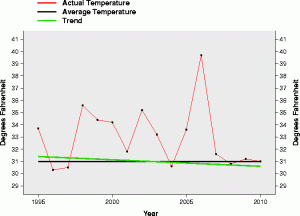
Mean continetal temp 95-10

Mean continetal temp 95-10

Let’s talk a bit more about global warming and climate change.  The majority of the American population now thinks that global warming probably doesn’t exist.  Part of that is the huge amount of money which has been spent on propaganda, but part of it is that one of the only major areas not experiencing higher temperatures is the continental USA.  If you want to be a climate change denialist, America is a great place to live.

It is also true that the speed of global warming has slowed down.  This is primarily due to two factors:

1) The sunspot cycle.  Solar radiation is currently at its lowest level in some time.  Less heat equals, well, less heat.

2) The icecap and glacial dump.  The polar icepack being dumped into the oceans has had a cooling effect.

The sunspot cycle can change pretty much any time it wants.  Probably we’ve got a decade or so at lower heat levels, but that’s not a sure thing.  As for the icecap and glacier dump: well, once the ice is gone, it’s gone.

The bottom line is that we are going to see things get worse, more slowly, in terms of temperature rises.  We will, however, keep getting crazy weather, changes to weather patterns are an early sign of climate change.

Once the mitigating factors are gone the pace of global warming will pick up again, and it will pick up fiercely.

Now, as for fixing it—there are two main problems.  The first is the will to do something.  While there may be technical solutions which would reduce the amount of carbon we are dumping into the atmosphere, there is no will to deploy them on a wide enough scale to matter.  This is as true in China as it in the US, and without China and the developing world coming on board, what the US does, assuming it does anything, will not be sufficient (and the US will not do anything, the propaganda campaign claiming there is no Global Warming has been successful.)

The second is that there will come a point where global warming becomes a self reinforcing cycle.  With no glacial caps and with the methane released from Siberia, even radical decreases in human CO2 dumping will probably not be sufficient to stop the cycle.

Add to this the severe water shortages we can expect, which will hit large parts of African, a huge swathe of China, much of India and a big chunk of the US, as aquifers are drained down to effectively zero, and you have a recipe for huge loss of life and destabilizing migratory movements.

It is also entirely possible that large parts of the tropics will become effectively uninhabitable, the combination of humidity and temperature will be so high that it will literally be lethal to be outside air conditioningfor any length of time for much of the year.

If world population is only reduced by a billion, I will be amazed.  I also expect some serious wars.  Our civilization will not go quietly into that long long night.

Climate Change: A fighting retreat

I don’t usually write about climate change, because as dire as my views are on economics, they’re even more dire on global warming.  As I understand the science it’s already too late—we’re going to get hit with runaway temperature increases over the next century, and they are going to make a good chunk of the globe essentially uninhabitable.

Huge climate change events are the sort of events which end civilizations. While it is always possible that something I can’t forsee could occur, of course, it seems to me that we’re on the glide path for disaster. With the best will in the world, and a great deal of competence, we might keep the deaths under a billion or so.

I hope we get that level of competence. Unfortunately, my guess is that by the time we do, by the time things are taken seriously, it will be so far past too late that all we can do is mitigate.

That mitigation, of course, is important, as is every little bit people can do now to mitigate. Every .1 degree centigrade the world’s temperature doesn’t rise by date X is some people who live, some people who live better, some more time to get out act together.

Sometimes our role in life isn’t even “to hold the line” it’s to engage in a fighting retreat, to buy time for others. For most of us alive today, that may be our job. It’s not glorious, it’s not fun, but it is necessary.

[Written as commentary on Sara Robinson’s excellent article on possible futures.]

Page 15 of 16

Powered by WordPress & Theme by Anders Norén