The horizon is not so far as we can see, but as far as we can imagine

Category: Environment Page 14 of 16

Circles of Belonging

Fractals and CirclesI’ve recently been reading about some Hollywood folks who are very concerned with how women are treated.  One of them, the director Lexi Alexander, tweeted the following:

A crew guy just said that he follows me on Twitter & wanted to thank me because he has 2 daughters. Will it always take daughters to care?

This is the fundamental problem suggested by my article on ethics vs. morals, and discussed by more philosopher and social scientists than one could possibly list. What does it take to care about people we don’t and will never know?

I care about how women are treated because they’re humans.  Why wouldn’t I care?

But why stop there? The murder of dolphins and whales, who are sentient, offends me greatly as well. Why prioritize human intelligence?

Where does the circle of belonging, of inclusion, stop?  Where do we say “That person’s problems are not my problem?”

It’s perfectly natural to care about our families, our loved ones, and especially our children, more than we care for others.  We are responsible to them to an extent we aren’t responsible to someone who lives half the world away—responsible for feeding them, housing them, clothing them, and indeed providing love to them, a need that virtually all sentient creatures have. (Remove whales or dolphins from their mothers and they are profoundly effected; while elephants clearly mourn their dead.)

At the same time, to overly prioritize those we know is to become monsters.  To say “my child is worth a hundred other children’s lives” is to have crossed over the abyss and descended into hell. The hells created by those in the “I’ve got mine, screw you, Mack” crowd are legion.


(Today is the last day of the fundraising drive.  How much I raise will determine how much I write. If you value my writing, please consider donating.)


The history of human civilization can be read as expanded circles of belonging—from bands (not families, bands) to tribes, to kingdoms and empires and on to nations.  The national impulse, responsible for so much evil, also saw the rise of benefits like pensions and unemployment insurance and universal healthcare.  Those who belonged to my nation deserved such things.  They were “one of us.”

For the longest time much of this was done through religion: The Zeus cult allowed those who belonged to it to not be strangers. People who belonged to the cult, even if of different polis or tribe, could trade together, because they were members of the same cult. If they did not treat each other properly, they believed Zeus would punish them.

Powerful, self-identifying groups of this nature, from followers of Confucius to Christians, from secular humanists to enlightenment thinkers, have brought people together and forged bonds of trust, duty, and belonging that crossed barriers of tribal, local, or even other religious circles.  The humanist claims a duty to all of humanity, believing that everyone has certain rights, including to food, shelter and fair law (justice).

There are those who go further, giving rights to non-human sentients and even animals that are traditionally our food animals.

One can make a full ethical case for all of this, but one can also make a pragmatic argument. Healthy, happy people are better to live around. Economic cripples don’t contribute to civic or economic life nearly as much as they could; the poverty of others, whether material, spiritual, or ethical impoverishes me, because I lack whatever they could have given to the world, were they able.

The same is true of the larger web of life. As animals and plants die, what they contributed to the ecosphere is lost and that loss diminishes the world in ways that will effect me, whether through loss of seafood, loss of oxygen, loss of key nutrients, or loss of potential scientific discoveries, now impossible. Every dead species is lost genetic code, code which may have held secrets to make us much richer: medicines, chemicals, genetic modifications, and so on.  We are killing the web of life which supports us and killing the wealth that nature has created for us.

The pragmatic argument is important, but pragmatics alone are never enough: Without an ethical argument, many people will violate the norms as soon as it is convenient to them; while without the pragmatic argument others will violate the norm because it makes no sense to them. (Why not kill if it’s in my interest?  Sure as heck the people who lead us have no qualms about doing so.)

To manage an ecosphere, and to manage a world full of sentients, requires valuing them intrinsically, as well as functionally—both for what they do for us and for themselves, irrespective of their utilitarian value. Until we create an ethics which does this, not only will we be far less happy and prosperous than we could be, but we will lurch from ecological disaster to ecological disaster.

The creation of an ethics of inclusion, a broad circle including all life and much that is not alive, is one of the key tasks before us.

We Know What Our Problems Are and We Do Nothing or Make Them Worse

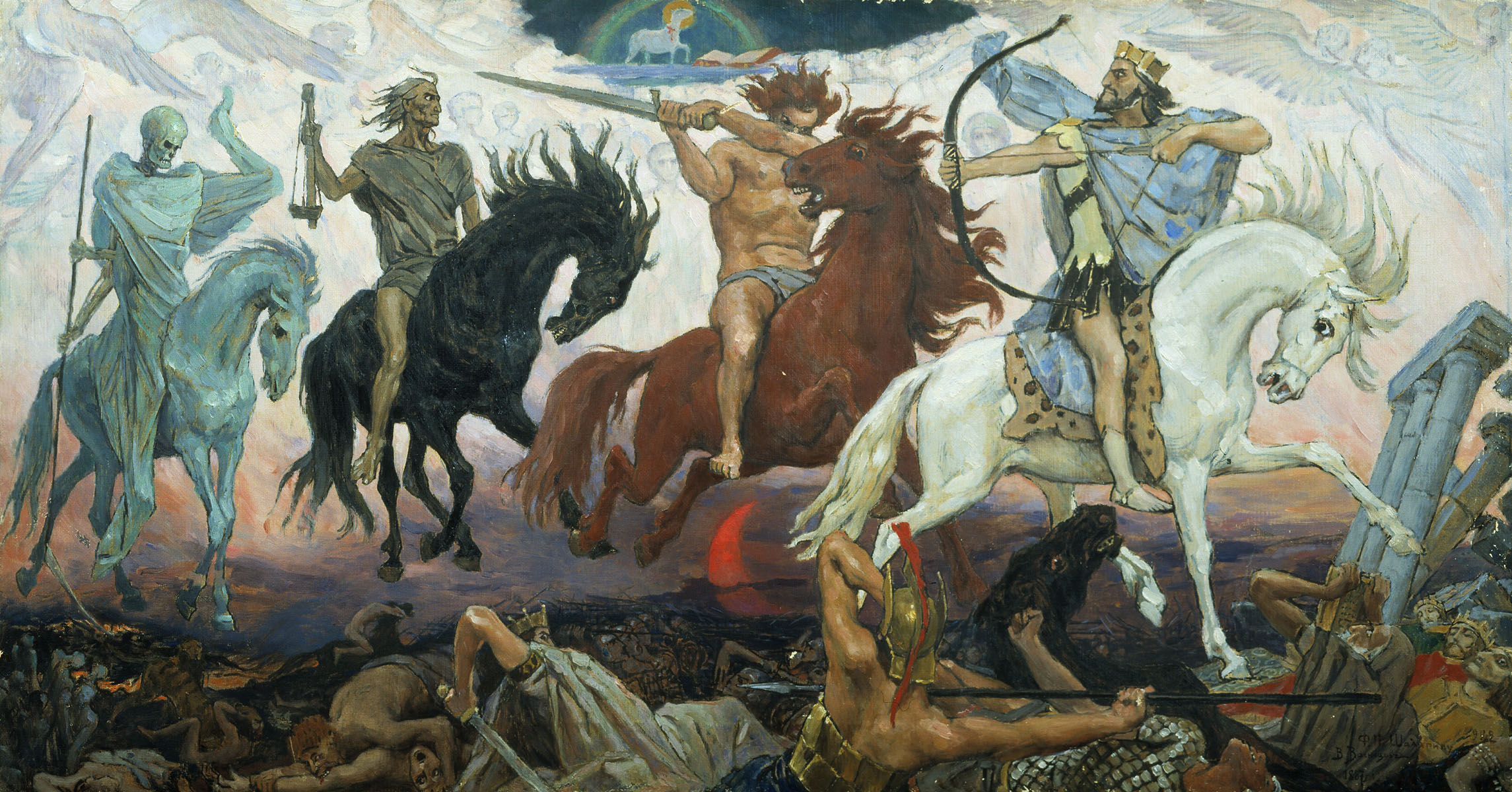
Vasnetov's Four Horsemen of the Apocalypse

Vasnetov’s Four Horsemen of the Apocalypse

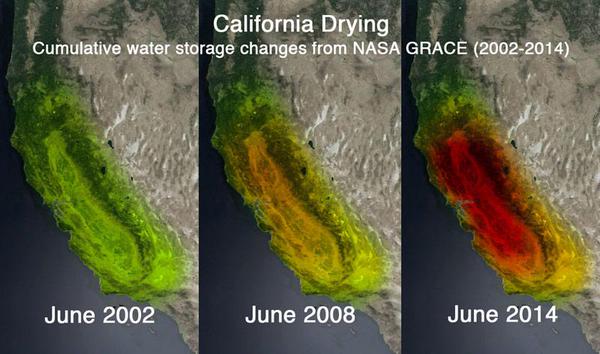
I’m cranky today. A friend asked me about California’s water problems, and I said: “We’ve known for years, and we’ve done essentially nothing.” The problem in California is agriculture. Every Californian could stop drinking and watering their lawns tomorrow, and California still wouldn’t have enough water. California is draining its aquifers, and wells are going dry. Water which took  millions of years to accumulate is being drained in years.

Much of California is a desert, and yet we insist on growing food there with water we don’t have. The Colorado river is drained to a trickle feeding California. It’s not that California couldn’t grow food, but much of the food it grows (almonds, for example) requires huge amounts of water.

So this is a problem about which we have known for decades, in one sense; I first read the of California’s drought vulnerability as a child, in a book published in the 1950s. In another sense, it’s come quickly, due to climate change, another problem we’ve known about for decades and done nothing of any significance to stop. In fact, we have accelerated climate change with our policies—neo-liberalism was about shipping production from areas that produced less carbon (advanced industrial nations) to areas that would produce the same goods with more carbon. (Production in China is more carbon intensive than the same production was in the US.)

Everywhere I look, I see problems we know exist which we refuse to fix. Our actual actions often make them worse.


(I am fundraising to determine how much I’ll write this year.  If you value my writing, and want more of it, please consider donating.)


In the field of foreign affairs, Western actions since the 1950s, things like overthrowing democratically elected governments, favoring autocracies, funding nasty people like the Taliban, hostility to Nasser, and on and on, reaped the expected result: Democracy, westernization, and modernization has failed in most of the Middle East, and they’ve turned to far nastier ways of running their societies.

In economics, the failures of neo-liberalism were predicted at the time the policies were put into place. I remember the Reagan-Thatcher years, and if you think anyone with sense didn’t know they were about wealth transfers to the rich you are entirely wrong. I read my first “Oh shit, inequality is going to reach Gilded Era levels!” book in 1986. It took longer than the early predictions thought, but it has ground, inevitably, on.

As for resource stagnation, the “Limits To Growth” book was published in 1972. Its baseline exhaustion of limited resources scenario is essentially on track, its larger point that a limited world can’t treat resources as unlimited is also true. Substitution only goes so far. There are two obvious solutions to that problem:

  • Planned use of resources, with intense recycling and heavy dependence on management of renewable resources, or;
  • Getting into space in a big way to expand the resource pool and put off much of the problem for centuries (at which point, hopefully, we figure out a better solution, or go to the stars).

Ideally you’d go with a combination of these two, but we haven’t pursued either one vigorously. Neo-Luddites on the left constantly sneer at any serious idea of exploiting space while “I’ve got mine, there is no future” douchebags on the right oppose both space exploration and sensible stewardship of the Earth’s resources.

This isn’t a “green” issue, this is a common sense, “we have limited resources” issue. The idea that substitutions can be found for anything is merest faith, an example of the fact that ideologies are far more powerful than mere “reality.” (Until they aren’t, a point usually proved through body counts in the millions, and soon in the billions.)

These are just a few of the “big” items. One could probably list a hundred with ease, starting with the warming and acidification of the oceans, the collapse of ocean stocks, and the great-die-off.

The complete inability of our society to deal with obvious consequences of our actions is what has doomed it. This society will not survive. The questions are only “How many people will it kill going down?” and “What will the next society look like in the ashes of the world left to us by this one?”

Whatever it looks like, it will be very different. I have some thoughts along those lines, which I’ll get to in other articles, but the new society won’t be about the immediate capitalistic gratification of needs that don’t actually exist. If it turns back into that, eventually, I doubt oxygen-based life on Earth will survive, and humanity will only survive if it develops self-sustaining colonies not on Earth.

Little of what is going to happen over the next hundred years will be anything humanity has not done to itself. Our fate was, and still is, in our own hands, and we will reap as we have sowed.


The complete inability to manage obvious problems: California Drought Edition

California DryingSo, California has about a year’s worth of water supplies, and groundwater is being depleted so fast wells are going dry.

This problem has been coming for years.  There should have been rationing, at the last, last year and probably before, since climate models indicated the strong possibility of the drought continuing.  Moreover farmers should have been forced to move over to less water intensive crops (subsidize the move.)

The total inability to manage obvious problems is one of the hallmarks of our age.  Everyone with any sense knows there’s a problem, everyone with any sense knows at least part of the solution, and we don’t even do the obvious things to fix the obvious problems.


(I am fundraising to determine how much I’ll write this year.  If you value my writing, and want more of it, please consider donating.)


Until a new generation comes of political age or absolute catastrophe wipes out the political class, this will not change.  It’s not quite true that old dogs can’t learn new tricks, but few politicians, senior civil servants or corporate executives are capable of acting in ways different from those that brought them to power.  As with science, the graveyard makes the conversions.

Are you going to be thirsty or hungry in the future?

As I’ve warned before, aquifers are being massively depleted, and it’s happening in places that grow food.  California, which is in drought, is now draining its aquifers especially fast.  Note also that fracking uses immense amounts of water.

This is also a problem in other nations, most notably India, where some farmers are already losing their farms due to aquifer depletion.

Expect to move to massive desalination, and attempts are on to find cheaper ways to desalinate water.  Combined with cheap solar, this may be feasible for some areas.  Interior continental areas, however, may not find it so useful.  Still, we can expect project to build desalination plants and massive canals driving the water into the interior.

The question with this, assuming it is done, will be who does it: public or private, and how regulated they are.  Even if water is theoretically available, it may be much more expensive than it is now, and we can expect that to make food even more expensive.


If you enjoyed this article, and want me to write more, please DONATE or SUBSCRIBE.

How To Stop Deliberate Fouling of Aquifers by Frackers

Yup:

Industry illegally injected about 3 billion gallons of fracking wastewater into central California drinking-water and farm-irrigation aquifers, the state found after the US Environmental Protection Agency ordered a review of possible contamination.

According to documents obtained by the Center for Biological Diversity, the California State Water Resources Board found that at least nine of the 11 hydraulic fracturing, or fracking, wastewater injection sites that were shut down in July upon suspicion of contamination were in fact riddled with toxic fluids used to unleash energy reserves deep underground. The aquifers, protected by state law and the federal Safe Water Drinking Act, supply quality water in a state currently suffering unprecedented drought.

Now.  Will anyone go to jail for this?

No.

Did they save a lot of money doing this, and therefore make money?

Yes.

Will they continue doing it?

Yes.

What will stop this sort of thing from happening?

Sending senior executives, CEOs and board members to maximum security prisons, after impounding all their assets under criminal forefeiture laws, thus forcing them to rely on public defenders.  Prosecute them under RICO statutes to make sure you sweep the executive suite.)

(No, I don’t approve of criminal forfeiture laws as they exist right now (seizure before guilt is proved), nor do I approve of RICO.  But if they’re being used against ordinary people, they should be used against the executive class.  Best way to get them repealed, too.)


If you enjoyed this article, and want me to write more, please DONATE or SUBSCRIBE.

The Ongoing Wildlife Holocaust

We are in immense amounts of trouble:

The world populations of fish, birds, mammals, amphibians and reptiles fell overall by 52 per cent between 1970 and 2010, far faster than previously thought, the World Wildlife Fund said on Tuesday.
If we survive the next two hundred years, this is another thing our descendents will curse us for, because the genome of other species will be more valuable than gold, oil or any other substance you can think of: design material for the real biotech revolution which is just beginning.
The real risk is not in the higher animals, though, it is in phytoplankton in the sea (also crashing precipitously) and in trees, which are responsible for much of our oxygen cycle.  If we screw those up, well, we’re dead.  And evidence is strong that we are screwing them up.
The second angel poured out his bowl into the sea, and it became blood like that of a dead man; and every living thing in the sea died.
It is not God who will destroy us, of course, but ourselves.  And we will do it because our ideology tells us to do so. Preparatory to series of articles on technology, please take the time to read this collation of articles on ideology, character, why we are destroying ourselves, and how it can change.

If you enjoyed this article, and want me to write more, please DONATE or SUBSCRIBE.

The Role of Violence and Coercion in Saving the World

It will be impossible to save the world from climate change without coercion.  The problem of climate change is a problem of common sinks and limited resources: the atmosphere can only absorb so much carbon, the seas only have so many fish and can only withstand us dumping so much plastic and other pollutants into them.  The world has only so many forests, and so on.

These are genuinely limited resources.  Dumping into them, or chopping them down, or overfishing them is an advantage to whoever does it: they can burn dirty (cheap) fuels, they can use plastic packaging consumers like, they can have fish to eat now.

It is rational, in the sense that you receive a benefit, to destroy the world. It is especially rational to do so if you expect to be dead before the costs come to bear, or if you think you can use your money to avoid the worst of climate change.

We have an additional problem: no one has jurisdiction over all of the atmosphere, all of the seas, all of the forests.  If country A decides not to pollute or dump or cut down forests, someone else can do more of that and gain a short term benefit.  And by short term benefit I mean “some of the decision makers and their friends will personally get rich.  Filthy, stinking, rich.”  (This is also one  problem with refusing to have high marginal taxation, capital taxes, estate taxes and corporate taxes.  People are less interested in destroying the world when they’ll only make a little bit off it.  The calculus does change somewhat.)

So how do you ensure that Brazil doesn’t destroy the rest of the Amazon, that Japan doesn’t radically overfish, or that the US doesn’t dump obscene amounts of carbon into the air per capita?

There are three essential approaches.  The first is bribery: we’ll pay you not to do this.  Up to a certain point this is necessary: if Brazilians can make more money chopping down jungle than keeping it around, why wouldn’t they? But everyone has the ability to do destroy the world, everyone can hold you hostage, and once people start, they don’t stop.  Bribery only works if it is short term, if it becomes “we’ll pay for you to transition to a different economic model, but no more than that.”

The second is incentives.  Why are the Brazilians chopping down the jungle?  Because Americans want to eat beef.  If Americans change how they eat, much less reason for the jungles to be chopped down.  If we don’t want plastic to destroy the Oceans maybe we should just forbid most plastic packaging?  It can be done, I grew up with paper bags and glass bottles, for example.  I grew up in a culture where every food worker didn’t wear disposable plastic gloves.  I survived, I guarantee you will too, no  matter how much of a germphobe you are.

The third is coercion.  You will not do this, and if you do we will do bad things to you.  Lock you up, sink your ships, and if it comes to it, kill you.

Now let’s be clear, coercion underlies virtually all social relations.  You pay taxes because if you don’t, somebody with a gun will come along and throw you in jail.  You have property because men with guns enforce your property rights.  You go to school, because if you don’t… well, you get the picture.  No society has EVER existed that did not have some form of coercion available to it.  In many hunter-gatherer societies that coercion was the simplest of all: expulsion.  If you didn’t obey the rules, they kicked you out, and that meant death because no, most people cannot survive alone, and most people don’t want to.

Because there is an advantage to unilateral betrayal: to dumping your pollution on other people and letting them pay the cost, there will always be people who want to do it, and it’s not always worth trying to use incentives to get them not to: it swiftly becomes too expensive.  The best approach is often to unilaterally take certain actions off the table: none of us will unilaterally take each others stuff.  None of us will dump poisons into the air that kill other people we don’t know.  None of us will, on net, allow forests to decrease.  None of us will use plastic packaging.

This is the problem of collective action: if none of us do these things, we’re all better off.  But if one of us or a few of us do it, we have an advantage over other people, and if other people are doing it, we need to do it to keep up.

This brings us to my comment, in my 44 Points Post about needing an armed force to protect the Oceans, a comment which caused much screaming, since people thought it violated my point about not wanting large standing armies.

An army and a police force are not the same thing.  An international “Ocean Guard” is not a navy, it does not need destroyers with depth charges and nuclear submarines with missiles and Aircraft Carriers.  It needs ships capable of find trawlers and boarding them.  Police force.

But the key problem here is jurisdiction: no one has jurisdiction.  No one can say to the US or China or India or Japan, “you will not do this!”

We must create institutions which have the authority to say “you will not pollute, you will not destroy the environment.”  More than that, because we have gone too far, we are going to need institutions which can say “and you will also work to fix the environment.”  Again, countries will want to not contribute, because if someone else does it, and you don’t, you get most of the benefits without the costs.

Now we can create a world economy which is not harmful to the environment and in which everyone is fed, clothed, has shelter and has a meaningful life with a good chance at happiness.  We are going to have to, because people who are unhappy, who do not love, and are not loved, who are frightened, will do whatever they feel they must.  We must drain the swamp of true need, of hunger, of great fear.

But that’s the end point: that’s where we must commit to go.  Along the way, however, bad actors will have to be forced to stop what they are doing coercively.

Failure to do so means death and suffering.  More death and suffering than is caused by coercively, say, sinking Trawlers or trade embargoing countries which won’t stop using plastic containers.  We are in a situation where the median death estimate from climate change is probably a billion people.

We cannot entirely bribe and incentivize ourselves our way out of this problem, some coercion will be necessary.  How much money would you have to pay Wall Street, for example, to stop doing what they do?  As much, or more than they make doing what they do.  How much to stop Big Oil?  Same answer.  We can’t afford it, that money, those resources, must be spent fixing the problem and taking care of ordinary people.  So we must criminalize certain behaviour, on a world scale and then enforce it.

That is policing, if done right, not military action.

There are great big reasons to be scared of anything that looks like a world state.  I have a preference for nations, because a world state that turns totalitarian is a nightmare, and a world state is also likely to lead to stagnation.  My suggestion is to try federalization: specific bodies with specific enforcement, but they must have transnational police powers.  There is no reason these bodies can’t be run by democratic methods, no reasons the courts they run can’t be fair and open. Our current transnational bodies aren’t democratic, indeed are anti-democratic, precisely because our elites don’t want them to be, but that is, again, a social choice.

We figure this problem out, or we fry.  We need institutions for transnational action, institutions with police power, courts and which are democratically constituted.  This isn’t an insoluble problem, either in general, or specific, except that it challenges the people who currently have power and who are currently getting filthy rich by destroying the environment, and in so doing likely killing a billion or more people, and conceivably, risking the future existence of humanity entirely.

Given the stakes, we’d best grow up.  There is only one world, and until we get off it, it is a single point of failure. It must be dealt with as such.


Incentives

44 Explicit Points on Creating a Better World

1) Ideology is key.  If you like (or were horrified by) my Baseline Predictions post, understand that the next two posts on ideology were about the solution.  Our decisions about what to do are virtually always ideological.  You cannot think about any complex subject without ideology, without idea structures mediating.  You cannot decide what to do without making judgments that are mediated through you world-view.

2) We know much of what must be done.  We know we need to do it.  We have not done it.  That suggests this is not a “practical” problem.

3) The structure of everyday life (job work, regimented schooling for children, passive entertainment, consumer “choice” that isn’t real choice) produces our world-view, our ideology.  We are left passive and accepting of social arrangement, unable to see that there are different ways to live.  We accept the world as it is, and accept systematic injustice, even injustice that directly and clearly injures us.

4) The problem of collective action is one part belief: people must believe they should do things differently.

5) Any social structure, including social structures which seek to change the dominant culture, if it can be bought out, will lose.

6) Any new social structure must throw off surplus that people can live on, and that surplus must not be able to be bought up by the old system, which will seek to do so.  The ban against selling out/being bought out must be irrational and ideological.  Rational people sell out.

7) The forms of the old world must be gotten rid of, and must be seen as anathema. You cannot save the world and keep American style suburbia as it is now.  You cannot change the world so people are happy and healthy and prosperous and keep wage labor as your primary method of distributing surplus value to the commons.

8) You cannot keep profit, aka. greed as the primary driver of social decision making.  Eating is for living, living is not for eating, to paraphrase Socrates.

9) Greed as primary driver leads to sociopathic behaviour being rewarded (read Barkin’s “The Corporation”).  This means you select, systematically, people who act sociopathically or pyschopathically as your leaders.  You get the behavior your reward, and right now our system rewards people for doing whatever it takes to make money, no matter what the costs to other people, to the environment or the future.

10) Most profits today are extracted value, they are not actual surplus value.  Instead they represent destruction of actual economic productivity.  Every cent the financial sector “earned” from 2000 to 2007 was destroyed, ten times over, in the crisis and the depression after the crisis.

11) Actual value is not rewarded.  A janitor or a garbageman or a teacher or a nurse or an assembly line worker or an engineer produces real value.  If the CEO does not come in tomorrow, so what?  If the janitor doesn’t, everyone is complaining immediately.  The people we call value creators today are mostly value extractors: their job is to squeeze hard, to monetize, not to create new products which are genuinely beneficial to the world, not to create workers who are well paid and thus able to provide demand, not to create better paying work, but worse paying work.

12) If you need a job to survive, you are always at the mercy of people who provide jobs.

13) The wage you are paid is based on the tightness of the labor market and how protected  you are by government. It has virtually nothing to do with your personal skillset, except to the extent that skillset is in short supply.  As programmers found out, corporations and government will do everything they can to make sure any specific labor shortage is reduced as quickly as possible.

14) You have power, as an ordinary individual, only if you act as a group and in solidarity.  If you can be bribed to betray other ordinary people, they will play you off against each other.

15) Jobs aren’t a good way to distribute surplus, but if that is how you do it, you will only get surplus in a tight labor market.  Central banks, the rich, corporations and government today all work systematically to make sure that there is no tight labor market.  If there is no tight labor market, you can and will be replaced.  If you can be easily replaced, there is no reason to give you any extra money, even if you are producing more than you did in the past. It is for this reason that for over 30 years now NONE of the productivity gains have gone to ordinary workers on aggregate.

16) The economy must be completely electrified.  Energy must be made, to the largest extent possible, a capital good, this is a specific instance of the next point:

17) Supply bottlenecks cannot be allowed.  Ever.  Whenever one starts to form, it must be broken.  Failure to do so is why the post-war liberal order failed and was replaced with neo-liberalism.

18) You cannot use up sinks (like carbon storage in the atmosphere) faster than they can be regenerated.  Period.

19) You cannot allow degradation of food or environment.  These are major causes of the degenerative and chronic diseases which are epidemic in our society.

20) You cannot allow significant unproductive consumption to be a major part of your economy.  Suburbia, for example, is essentially pure consumption.  All bans on productive work, agriculture, etc… in suburbia must be removed.

21) You cannot allow public goods, like education or health care, to be rationed based on ability to pay.  Paying for schools through property taxes creates an education system which wastes the human potential of millions of people in an attempt to replicate class privilege.  Ironically, the middle class is failing anyway, as the economic value of education has been destroyed.

22) The most important rule of all is this: your elites must experience the same life as ordinary people.  They must go to the same shitty schools (no private schools, no enriched schools, no Ivy League).  They must fly on the same planes and go through the same security (they don’t), they must use the same healthcare and stew in the same wards in the same rooms as the poorest of the citizens.  They must eat the same food, rather than being able to buy high quality food the poor can’t.  If they don’t experience what you experience, they will not care what is happening to you.  And they don’t.  Why should they when they’re the richest riches the world has ever known. The world is great, to the rich and powerful.

23) You have power to the degree you have solidarity, control your own government, and have the ability to support yourself without a job.  If you cannot walk, if you have no ability to say “screw you”, then you are a slave, the only question is who you are a slave to.  The people we feel worst for today are the unemployed who can’t even find a master.

24) People who actually create value must be allowed to keep enough of it.  Right now they aren’t.  Google takes almost all the value created by the people who actually make the web, for example.  Wal-mart crushes its suppliers into the dust.  A few key  pipelines like App Stores, Amazon, and so on take almost all of the surplus value.  Anyone who thinks 30% is a reasonable charge for an app store wants to see failure (this doesn’t mean no taxation, proper taxation takes away unneeded surplus, not needed surplus.)

25) A regular rate of return of 5% is reasonable.  A world in which you have to make 15% or 30%+ to be viable is a world in which most businesses are not viable, and in which millions sit idle with nothing to do because there is nothing to do that can make those sort of returns.

26) Returns of 15% or more can only be made through fraud, exploitation or oligopolistic practices.  Bad or fraudulent profits drive out real profits and real value creation.

27) The network effect is not something which should be rewarded with a 30% commission.  Neither is the railroad effect “nice product you got there, son, but it doesn’t get to market if you don’t pay us our vig.”

28) We can all be prosperous, but we can’t all be rich.  Having hundreds of billionaires is exactly why you haven’t had a real raise in 30 years.

29) Concentrations of wealth are used to protect that wealth and buy up the system.  That is why they can’t be allowed.  The first thing someone does who wins the market, is buy the market, and that means buying the government.

30) Government is either your worst enemy, or you best friend, depending on whether it is controlled by the public, by private interests or running rogue.  But government is also the only major organization which can work for ordinary people.  Every other organization has another purpose.  As such, you must control government if you want prosperity.

31) Government, under whatever name, is needed to do things we must do together for the greater good.  When it does not exist, you get Somalia.  Great cell phone service, but your daughters get pulled out shacks at 2 am and raped, or you buy your safety by submitting to an oppressive set of relgous laws.

32) You cannot have large standing armies and keep liberty.  Period.

33) You cannot give private entities the right to print money without extremely strict limits and not expect unreasonable concentration of money, which means power, which means the government gets bought out and you lose both your liberty and your freedom.

34) Biodiversity is wealth, it is where the great biochemical advances and products of the future will come from. Every time we kill a species, we impoverish our future.

35) We are going to require a transnational body with armed forces to enforce environmental controls.

36) Fines no longer work to control economic activity, we will require outright criminal bans and tough enforcement to stop rapacious corporate behaviour.

37) If you must have the cheapest devices, you are requiring a woman in the Congo to be raped and rivers in China to be polluted.  Fixing this is not an individual action, it is a collective action problem, it can only be fixed by government and by terrible things like, oh “tariffs”.

38) Free Trade is meaningless if you don’t have full employment.  It is a rounding error at best, harmful at worst.

39) Capital flows cannot be allowed to move faster than trade flows and really shouldn’t be much faster than labor flows.

40) The functionless rich cannot be allowed to keep the money they have.  Use it for actual new production, or lose it.

41) Inflation is not a bad thing below about 10% or so.  There is no good evidence it reduces growth, and it does break up concentrations of wealth.  We are terrified of inflation because we know our wages aren’t rising faster than it is.

42) People who make a bad loan, should lose their money.  There is no such thing as free money, and bondholders need to learn that.  Concomittent, bankruptcy must be easy to get: economic cripples, unable to discharge debts are not in our economic interest.  It is especially abhorrent that bankruptcy cannot discharge student loans.

43) An economy in which people are free to do what they love, free of fear of losing everything, is far more economically productive than one in which people are forced to do things they hate to make ends meet.

44) The right thing to do, ethically, is usually the right thing to do economically. Helping the distressed is good for the economy.  Universal healthcare that doesn’t give extra money to insurance companies is good for the economy.  Believe it or not, not dumping pollution into air and not poisoning food… is good for the economy.  Feeding the poor is… good for the economy.

If you’re ever not sure what the right economic policy is ask yourself what the kind thing to do is.  You’ll be right nine times out ten, and the remaining one time you’ll still be doing something good.

 

Page 14 of 16

Powered by WordPress & Theme by Anders Norén