The horizon is not so far as we can see, but as far as we can imagine

Category: Electoral Politics

What Japan’s Change In Government Means for the US

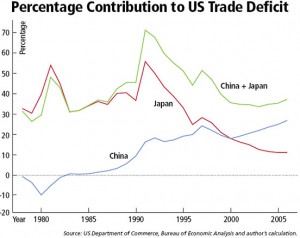
US China Japan Trade Deficit

US China Japan Trade Deficit

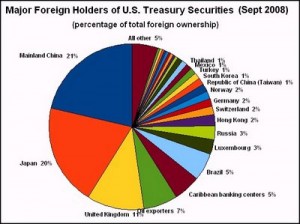
The new government has indicated it will move towards economic integration in the far east, and away from close economic integration with the US.  These two charts  tell you why, and what it’ll mean for the US.

Japan has spent a lot of money keeping the Yeb low against the dollar in order to export to the US.  Think Japan believes its getting its money worth, when China is eating its lunch on exports to the US?  The strategy worked for decades, but it isn’t working any more, indeed this year the Japanese had their first annual trade deficit in 28 years.  But unlike last time, this one comes when the “keep the Yuan low and export to the US” strategy has been in a multi year decline.

china-us-national-debt-holdings-by-lillith-newsJapan is going to be a lot less willing to finance US deficits and consumer spending than in the past, and economically it is going to be looking much more to other Asian nations.

In the long run this isn’t bad for the US.  In the short run, it’s going to hurt.

Republicans pull nearly even on Congressional vote numbers

Brilliant!

A compilation of major polling resources shows that republicans have nearly closed the gap with democrats in a generic congressional vote. This is a poll where voters are asked, without naming any specific names, if they are likely to republicans or democrats in the upcoming 2010 midterm elections. Democrats now lead by only 1.5% after the gap had been well into double digits at the time President Obama took office.

The village consensus on this is going to be that if only Democrats had been more bipartisan that the numbers would be better.  Debunking such nonsense is a waste of my time and your brain cells.  There are two main reasons why these numbers are where they are:

Republicans understand opposition politics: when you’re in the opposition, you don’t smile bipartisanly, you gnaw at the ankles of the ruling party.  Nothing they do is right, everything they do is wrong.  You talk about how their policies are going to fail, so that if they do, you are the opposition (Democrats did not understand this when in opposition).

Continuation of ineffective Bush policies.  Not to put too fine a point on it, but in too many cases Obama and the new Congress are pursuing Bush lite policies.

  • Escalate in Afghanistan
  • Spend more money on the military
  • Get out of Iraq around about the time Bush wanted to anyway
  • Continue the Bush/Paulson financial policies
  • A stimulus bill which was 40% tax cuts (granted, not tax cuts for the rich, but still tax cuts)

Americans voted for Democrats because they were sick of Bush and Bush era policies.  And here Congress is repeatedly voting for Bush era policies.  Congressional numbers are melting down faster than presidential ones because people know that Obama’s their only hope. It may not be much of a hope, but if he can’t fix things, they’ve got to wait most of 4 years for a chance at someone who does.

Proper governance liberal style works like this.  Pass effective bills even if it requires not being bipartisan.  When those effective bills create good effects (a good economy, everyone having good health care) reap the benefits of voters being happy with good jobs and not going bankrupt over health care.

Congress’s stimulus bill was crap.  Congress’s cap and trade bill is crap.  Every indication is that the health care bill is likely to be… crap.

Why would people be happy with this?

It’s the economy stupid.  By choosing to bail out financial companies instead of the real economy Obama and Congress cast their die.  It has not lead to a recovery in the real economy, and by the time the next recession happens my prediction and that of many others is that jobs will still not have recovered to pre-recession levels.  This is not something unknown to the Obama administration, they are well aware of it.  Their hopes of winning the next election are based on two things: Republican disarray, and the financial sector continuing to give much more money to Democrats.  Neither is a sure thing.

Good policy creates a country in which people are doing better than in the past.  People who feel they are doing better vote for the incumbent more than not.  Congress and Obama seem to have forgotten this basic electoral reality. The will reap as they have sowed.

Obama Bypassed the A-List Rather Than Co-Opting It

I love me some Anglachel, in many respects.  In her review of Eric Boehlert’s book Bloggers on the Bus, she notes that it’s missing some important precursors of the blogosphere, such as the Daily Howler and Media Whores.  But she also goes on and on about how the Netroots was run by the Obama campaign and became part of the media circle, whose job it was to elect Obama.  Since Anglachel was and is a complete Clinton partisan, her objection isn’t to partisanship, it is to partisanship for Obama despite the fact that Clinton was better on a number of domestic issues (such as healthcare).

I was managing editor of the Agonist during the primaries, and managing editor of FDL after the primaries and during the campaign proper.  Here’s the deal: with a couple of exceptions (such as Americablog), the A-list was not primarily for Obama in the primaries.  As much as it was for anyone, its preference was John Edwards, though for various reasons it never fully got on board his campaign (something which displeased me at the time, and spare me the “he was cheating” amateur quarterbacking, since no one I knew believed it during the primary).

What Obama did wasn’t to manage the A-listers, he cut past the A-listers with direct outreach to their readers and captured their base from them.  The Netroots didn’t turn pro-Obama from the top down, it turned pro-Obama from the bottom up.  I saw this both at the Agonist and FDL.  I saw it other places.  Clinton was never that popular online, and when it became clear that Edwards wasn’t going to win, the majority of readers turned to Obama.

The A-listers did not lead on this.  As with the old joke about political leadership, they saw where the crowd was running, and they ran to the front of the pack and pretended to lead.  There were exceptions, such as MyDD, where Jerome Armstrong remained pro-Clinton.  And there were honorable cases of this.  Jane Hamsher at FDL was very clear, for example, that FDL would support whoever the Democratic nominee was.  If it had been Clinton or Edwards or Kucinich, I can guarantee FDL would have supported that person.  Hard.  I think the same is true of most other A-listers though there’s no question that some made threats of not supporting Clinton.  The majority of such articles however, however, were written not by A-listers themselves, but diarists.

In Democratic party politics you have power if you can either deliver an identifiable block of voters, or if you can deliver money. Barack Obama bypassed the blogs on both counts, getting the voters and the money without needing the Netroots.  If the Lieberman primary was a bow shot across the establishment by the Netroots, the presidential election of 2008 was a demonstration of the limits of Netroots power and of the fact that with enough money and smart operatives the A-listers were gatekeepers who could be bypassed.

That doesn’t mean that Anglachel isn’t partially correct that the A-list has been partially co-opted.  Parts of it have, without question.  But to think that the A-list has become part of the Village is incorrect.  The Village doesn’t need the A-list, and knows it.  Barack Obama proved it.

Page 31 of 31

Powered by WordPress & Theme by Anders Norén