The horizon is not so far as we can see, but as far as we can imagine

Category: China Page 2 of 15

American and Chinese Elites Both Achieved Their Goals

Chinese and American flags

The period around 1980 was pivotal to the fate of nations. In the West Thatcher and Reagan came to power and finished the destruction of the post-world War II order, setting the West on a new path. This process had been ongoing since 1968, but the form of the new consensus was not clear until Reagan’s victory: financialization, crushing workers, destroying the middle class, asset bubbles and so on.

In 1978 Deng came to power in China and instituted reforms, especially market ones. This coincided with the West, and especially America, wanting to offshore and outsource their industry. This increased profits and impoverished the working and middle class. It financialized the economy: you could have the profits without the production and without dealing with uppity and powerful workers.

Reagan went after unions hard, Thatcher broke the miner’s union, the most powerful in Britain. The Federal Reserve started a long term policy of raising interest rates every time wages rose faster than inflation, meaning that over a period of decades wages rose less than inflation, and thus were reduced in real terms. The BLS moved towards understating inflation systematically, to undercut things like pensions with cost of live adjustments and to help “boil the frog”. Every change in how inflation was measured, for decades, which I am aware of, reduced the measured inflation rate. That doesn’t happen randomly or if your goal is the accurate measure of inflation.

Deng lucked into a geopolitical moment, and knew exactly how to take advantage of it. “Tired of dealing with uppity workers? Hate environmental regulations? Want more profits without the work of production? Move your production to China and we’ll make you rich!”

Deng exactly spotted the West’s weakness and knew how to take advantage of it. He also delivered: offshoring and outsourcing did make the West’s elites, and especially US and British elites filthy rich.

In exchange China got the industry and with the industry came the know-how and the technology. The technological lead always (always) moves to the country with the factory floor, and so it did in this case. It took quite a while for this to become obvious, so people could fool themselves, but the movement was inexorable. The same thing had happened when the industrial base moved from Britain to America (with tons of British financing). It took about 30 years for the tech lead to follow the industrial base. In this case it seems to have been about 20 years from China taking the industrial lead to tech supremacy, but the movement was the same.

American elites, wanting to be rich without real work and to destroy their internal enemies, those pesky workers who wanted a cut, got what they wanted. In exchange they destroyed their empire, because the real basis of the American empire was industry and technology.

The Chinese got what they wanted: China became the world’s leading industrial and technological power and a billion people were lifted out poverty.

The Gods often grant want we desire, if we’re willing to work for it. American elites got their wish. So did the Chinese.

Welcome to the Chinese century.

This site is only viable due to reader donations. If you value it and can, please subscribe or donate.

Just How High Can Silver Really Go?

~by Sean Paul Kelley

Everyone is talking about gold topping $5k an ounce. The yellow metal is captivating and big moves by it tend to suck all the oxygen out of the media space regarding other metals. In 2025 gold rose a whopping 64% against all comers, i.e the dollar, the S&P 500, oil, Bitcoin and on and on.

Gold’s meteoric rise last year is a fucking piker compared to what silver did. Silver was the best performing asset of 2025 rising an astonishing 147%. Yeah you read that right. 147% from January 1, 2025 to December 31, 2025. This raises some important questions, such as why did silver, after decades of disappointing performance, blow past every asset this planet has to offer and consequently how high can it go? Does silver have a ceiling?

So, questions asked, let’s now examine the known and/or knowable variables affecting silver prices at present.

First, what’s silver’s all time inflation adjusted high? This depends on who you ask and how you measure inflation. By our current CPI measurement silver’s all time, inflation adjusted high was roughly $150 an ounce. This was in February 1980 when the Hunt Brother’s tried to corner the silver market. Now, as most of you know, Ian and I both distrust current inflation measures, like the CPI, because it overweights consumer goods with stable or falling prices, using accounting legerdemain like hedonic pricing which equates increasing computer chip power and/or efficiency as disinflationary. At the same time the CPI underweights prices of goods that are rising, like food and other non-durables.

Seriously, I defy anyone to tell me food prices are stable or falling: you can’t do it. The CPI does this primarily to avoid COLA adjustments on entitlements, cheating retirees.

Other measures of inflation, indices, weighting using purchasing power parity or other yardsticks, delivers an all time silver high closer to $190. So, I’m going to channel King Solomon and split the baby in half and call the all time high at $170. But however you measure inflation it’s clear silver isn’t even close to its 1980 Hunt Brother’s high.

Second, price moves in gold and silver are not coupled and have not been for at least 150 years. They don’t correlate. Gold is considered a safe-haven against fiat currency hyper-inflation or economic collapse. Silver, on the other hand, is essential to modern electronic manufacturing. So gold had a nice run last year, but silver was number one by a very, very wide margin, outperforming gold, the way Shohei Ohtani outclasses everyone else on a baseball diamond. Even as silver and gold have been decoupled since the late 19th century evidence is mounting that last year’s silver move might have been the opening act of their long awaited re-coupling.

Perhaps a précis on how and why they decoupled and what a re-coupling would look like is in order.

The first question is to ask, “how long were gold and silver coupled?” Well, from ancient times—yes, fucking Greeks and Romans ancient times—until the 19th century silver and gold traded at a 15:1 ratio.

Don’t believe me?

Consider then how the 1792 US Coinage Act established a 15:1 ratio between the two in our newly constituted republic. That said, during the next century—the 19th—a handful of rare developments coalesced to break the two thousand year old linkage between the two royal metals, thereby widening the ratio nearly exponentially.

First, the gold standard for measuring currency values between nations was established. It soon became the, well, gold standard for all international trade.

Second, the conventional wisdom prophesied the end of America’s silver boom—never mind that the aggregate value of silver mined in Arizona and Nevada had a notional dollar value greater than the California, Yukon, Deadwood, Montana and Alaska gold rushes combined. Gold’s price during the 19th century, due in large part by its merciless acquisition by European banks, blew out the ratio, decoupling the two metals for a century and a half. The ratio between the newly decoupled metals had widened from 15:1 to 50:1 by the turn of the 20th century. By the turn of the 21st the gap was nearly 100:1, in large part due to US government manipulation of silver prices. The US government sheltered a rentiers market in silver bullion for decades. Wholesalers got silver at spot prices. They then charged retail buyers high premiums and pocketed the sizable difference. This cozy arrangement, due to silver’s recent price moves is breaking down, and fast. Good I say.

That said, I argue, based on a reasonable man’s assumption, that the spread, now roughly 50:1, will continue narrowing and sometime in the next few years complete a reversion to its 2,000 year historical mean. That puts a potential price of an ounce of silver at $320 an ounce and might even overshoot a little bit, as reversions are wont to do at times. Overcorrections are a real thing. Hitting the Hunt Brother’s high of $170 an ounce is just a mental milestone, nothing more. The silver bugs are getting their revenge and how.

Now, my assumption is based on a single premise, a reversion to the mean/norm. Not a bad premise to base an assumption on, but not enough for intellectual coherence and honesty. So, let’s explore another variable: silver’s supply versus demand forecast.

What is the global supply versus demand picture like? In short, extremely unbalanced. The numbers are staggering. Aggregate global demand per year is 1.3 billion ounces. Annual global mining supply maxes out at roughly 850 million ounces. Let’s be generous and toss in recycling raising global supply to 1 billion ounces of silver a year available for industrial purposes.

The maths paints a grim supply picture: a whopping 23% gap between supply and demand. Because silver is the single most important industrial metal—it is in every electronic we own— demand is not going down any time soon. A single tomahawk missile requires 500 ounces of .999 grade silver. Yes, 500 ounces. See where I’m headed with this demand equation?

Why is it in everything? It’s the goldilocks of metals. Silver might not be as conductive as some but it’s less resistant than most. It doesn’t overheat like some and burn through plastic coating, but its best left exposed and uninsulated. It’s place in the bell curve of the electrical performance of all metals is right before the big bulge grows. Most of the time we want things good and fast. In reality, however, we must choose between good or fast, but silver? Well, silver gives you good and fast together. Goldilocks!
One big variable exists concerning global silver supply that has no easy short or even medium term fix. It’s physically impossible for global mining companies to ramp up mining production enough to even begin closing a 23% gap between supply and demand in any time frame less than 2-3 years. And this assumes no economic growth leading to increased global demand. That is some wicked nasty inelastic demand for silver and it has zero supply side answers, except very high prices that lead to retail silver owners cashing out. Central banks would have to print precisely three metric shit-tons of fiat currency to induce silver bugs to sell. I know some of them—they make rabid dogs seem like puppies—and they are adamant: no selling until the ratio reverts to 15:1. Until they get their ring there will be no huggy or kissy.

Another fundamental we ought mention are draconian export controls on bullion instituted by the Chinese central government. Note: China is the world’s leading consumer of industrial silver. It also has an extremely long and complex history using silver as its monetary base. Much, much less so with gold. If you want a book recommendation on the subject just ask.

Then there is our southern neighbor, Mexico, our number one supplier of silver to this day, is considering retaliatory tariffs on silver for United States because of Trumpian fuckery. Much fuckery there and I applaud Mexico’s president for sticking to her guns.

Consider as well dollar weakness and potential QE. Both point directly towards higher silver prices. Add to all this a wildcard fundamental hiding in plain sight: the magic price point that compels the addition of physical silver to the portfolios of Central, Commercial and Investment Banks around the globe. It’s a simple equation: storage costs fall as prices rise. At $40 an ounce there is no reason to hold silver in a vault. At $170? We’re getting close. At $300? Bingo! You’re goddamned right there is a reason. Such a development would spike demand by an order of magnitude as it would reinforce the powerful upward trend already in place. This is the dynamic that could at long last force the reversion of the gold to silver ratio back towards 15:1. Gold’s present price of $5000 an ounce implies a target of $333 per ounce of silver. In my opinion, and this is not investment advice, this is where we are heading. Right now. It may take 18-24 months, but it’s going to happen.

These are just some of the fundamentals. I can’t cover them all. If you think I missed an important one, add it in the comments, please.

Let’s talk about some technicals followed by sentiment.

Late in 2025 silver achieved a triple top breakout. Triple top breakouts are very rare in any asset. But when they occur they are an extremely bullish signal, conveying that there is no predictable upper limit to the assets potential advance. This is silver today. Silver hit $50 in October, backed down to the low $40s, made another run in November to try and overcome $50 and didn’t make it. But then in late November and all of December during the Santa Claus Rally silver blew through $50 and ended the year at $72.05. Market observers I respect, all unsure but all equally intuitive, explained the triple top breakout as the result of a handful of factors coalescing in the short term, such as Chinese export control tightening, high retail demand, Mexico threatening tariffs on silver, and a short squeeze on the Comex. This confluence makes sense to me.

The underlying technicals that lead to triple top breakouts are usually either a short squeeze or a gamma squeeze. In late 2025 silver underwent a short squeeze. But in early 2026 led by a bank frenzy to cover what were in essence some very large naked shorts in the SLV and PSLV ETFs, coupled by a bizarre change in margin requirements—from a straight percentage to one based on the notional value of the contracts (I mean, WTF?)—backfired spectacularly, leading to the rarest of rare technical developments, one I’ve only seen once in my life as an investor—the mythical unicorn, the gamma squeeze.

In short, a gamma squeeze “is a rapid [asset] price surge from [futures] trading, where heavy retail (read: investment banks, spk) call buying forces market makers to buy shares to hedge risk, creating a feedback loop that pushes the price even higher.” A gamma squeeze can be viewed as one powerful force intent on creating and sustaining an upwardly positive feedback loop “[where the] cycle escalates because as the [asset] price rises, market makers must buy more [futures or the hard asset] to cover their increasing delta risk, driving prices up further and attracting more call buying, often in low-float, i.e. low-volume [assets].” Silver is now, for all intents and purposes, in a virtuous rising feedback loop, leading to higher prices which force more buying to cover expected demand thus leading to higher prices. When it comes to shorting a gamma squeeze FAFO. You will lose your ass.

These developments all serve to reinforce my call late last year that silver is not on a cyclical bull run. It is engaged in a secular bull stampede.

Cyclical trends last between 3-5 years, represent basic price discovery and a market composed of two healthy opposing forces: supply and demand. Cyclical bull or bear runs tend to predict the business cycle as well, serving as a leading economic indicator.

Secular trends, however, are a different animal altogether. Like Earl Campbell, that human rhinoceros, running over middle linebackers like they were children, a secular bull or bear is powerful, based on large scale structural economic rearrangements, demographic realignments, and/or crushing but ‘unforeseeable’ externalities—like the Arab Oil Embargo of the 1970s or losing wars like Vietnam, Iraq, and Afghanistan——that leave robust long-term consequences, like inflation, busted supply chains, broken armies, revanchist politicians, rising internal violence and other variables, in their wake. Secular bulls or bears last decades, some as long as 40 years.

Now a word on sentiment. Sentiment is a fickle bitch, much like the muse. Nothing can bankrupt an investor with more rapidity and totality than a sudden turn in sentiment. Two forces, ultimately rule investing: fear and greed. Beware the latter and respect the former, said my mentor at Morgan Stanley.

Right now silver is flying under the radar. Everyone is talking about gold. It’s gold, why the hell not? Gold makes people febrile. I’ve literally seen it with my own eyes. I’ve felt my forehead warm up and my fingers get a sudden subtle itch when I’ve held certain gold coins in my life. I had a Julius Caesar gold aureus in the palm of my hand once. Wow! So I get why silver remains the red headed step-child of the metals market. And the lack of commentary on silver reinforces my conviction of silver’s inevitable rise to $250-$300. As I used to say when I worked on Wall Street, “buy the rumor, sell the news.”

It worked every time. And right now silver is hardly a whisper much less a rumor.

So, realistically at what price would I begin selling my silver?

$275-$300 an ounce.

I’m patient.

And certain.

Government As Helper vs. Government As Regulator

Stumbled across this story about how a Chinese province quickly built a facility based on tech discovered in Europe:

So a *European* startup called IB2 announced *in the US* the invention of an amazing new technology to upgrade low-grade bauxite – previously discarded as waste – into high-grade, which makes it usable to make aluminum and extract critical minerals like gallium, lithium, and rare earths in the process.

In the current context you’d think either Europe or the US would be all over it, right? Wrong. Somehow the first facility that startup ended up building is in Shanxi, China – built in 10 months flat (which, as you can guess, is almost impossibly fast)…

How? Why? Speed and efficiency. According to the founder and CEO of IB2, Romain Girbal, they received “massive support” from the Shanxi government and were able to move at insane speed. As he puts it: “You could never go that quick anywhere else in the world – only in China. It is unique.”

And no, they didn’t do it by trampling on environmental regulations which, contrary to popular belief, are now actually quite drastic in China. As Girbal puts it: “Building a unit in China is very regulated – environmental and dangerous materials [are subject to] heavier regulation. Of course we followed everything but we had the support from the Shanxi province to help us move forward. Sometimes, being a foreign company, things can be slow with communication issues. When there were sometimes slowdowns, they were here to help and to push.”

The difference here is simple. China has regulations, and the government helps companies meet them. The government wanted this facility so they helped WITHOUT breaking the laws. Here in the West, we’d give them a tax break, and maybe we’d say “it’s OK to break the law this time.” That’s not what Shanxi did.

I am reminded of how US tax authorities built an auto-filing system which filled out tax forms for people, and helped them thru the process where it couldn’t fill them out. Unfortunately there’s a big business doing that already, so Congress, this year, forced the IRS to shut it down.

What the IRS was doing is helping people obey the law, but that threatened TurboTax’s profits, so…

This is how the Russians were able to ramp up weapons production so fast (or part of it.) They made it a priority and the government helped firms.

Safety and environmental regulations exist for good reasons. Most firms will cut every corner they can to make a profit, and those few with ethics will lose to those who say “who cares how many kids die of asthma due to pollution?”

BUT a properly run government doesn’t just make regulations, it helps firms meet those regulations. They aren’t, or shouldn’t be, meant to slow things down, but to make sure corners aren’t cut which will hurt consumers, workers or just the general population.

In most of the West regulators exist to say “no” and to ask for another report. They don’t much care if the business succeeds or not. In China (and, actually, in America before 1980 or so) governments want business to succeed so they help, but they also don’t want businesses to shove their negative externalities onto workers or citizens, so they also make sure they can meet the regulations intended to protect people.

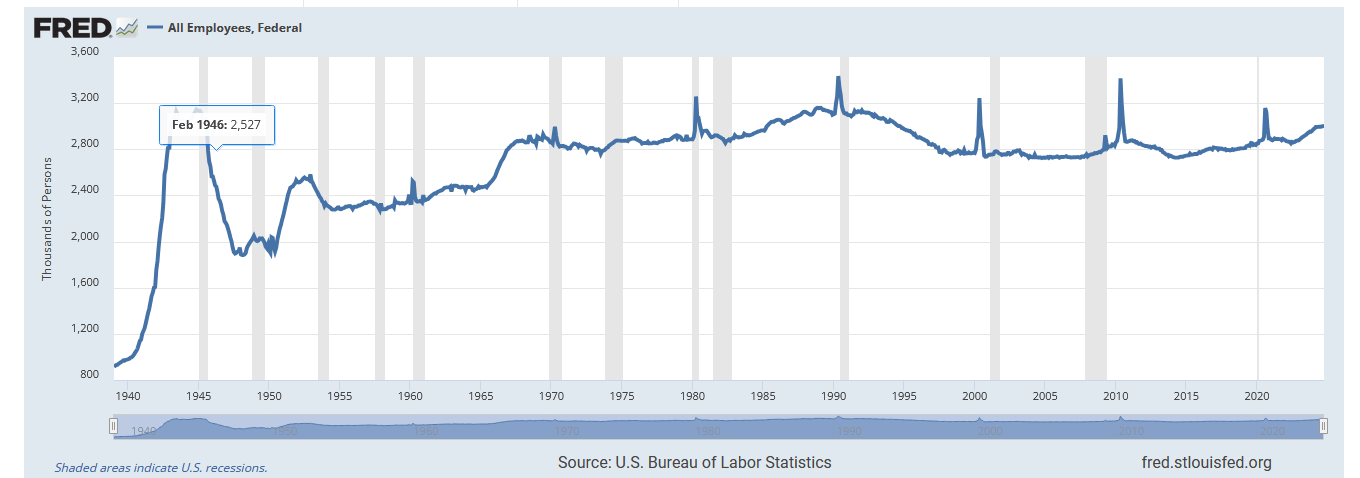
As we’ve noted before, the US couldn’t do this if it wanted to, because contrary to propaganda, the US doesn’t have a ton of federal bureaucrats:

When you consider how much the American population has grown, you can see that the number of bureaucrats per capita has actually dropped significantly. In 1970 (which had about the same number of federal workers) the population was 205 million. Today it is 343 million. Most of that has been outsourced to contractors. Contractors who, of course, cost more than just doing it in house.

A friend of mine is in his early 80s, and he once told me how after Reagan came into office, the local Small Business Administration office, which had been very helpful to him in running his small accountancy business, got rid of half its employees and those who remained were no longer allowed to help as much.

Properly run nations want business to succeed and help them, but they don’t do it by letting them dodge regulations or cutting them for them, they help them by guiding them thru the process of meeting the regulations, and provide other aid as necessary to get the business going.

Once that was us. No more.

This site is only viable due to reader donations. If you value it and can, please subscribe or donate.

JOIN OUR NEWSLETTER
And get new posts emailed to you once a day.

Too Big To Fail Fails In China

Roughly speaking there are two types of corporations in China. State owned (SOE) and private. During the policy driven real-estate bust, the countries biggest builder, Evergrande, went under.

But there was an assumption that the government would bail out real-estate SOEs.

Well the largest one, Vanke, is going under, and the central government is going to let it. Moreover, Shenzen’s (China’s Silicon Valley, but on steroids) has repeatedly bailed it out and that means that not only is the central government not bailing out a SOE, they’re letting a municipal government (arguably the most important in the country) take a huge hit. That will send a message to all other municipal and provincial governments.

The biggest mistake of the US financial collapse was the bailout of participants. Every firm which had financialized should have been allowed to go under. The few that were truly necessary should have been put back on their feet AFTER the shareholders and bondholders took their hits, and after being broken up. Collateral damage (those companies not responsible, but simply getting hit by the backwash, such as GM, could receive bailouts in exchange for a government stake.)

Capitalism has issues even when run properly, but it is a simple proposition at heart: people who allocate resources well should be rewarded with more resources to manage, and those who allocate resources badly should lose their ability to allocate resources. Every participant in over-financialization had made bad allocations of resources. For the American economy to operate, they needed to no longer be participants.

Take over the banks and brokerages, and either shut them down, or break them up. That included the bond rating agencies like Moodys.

The failure to do this meant that decision makers know (or believe) they can make risky bets that cause systemic economic issues, bets that damage the economy as a whole and expect to be bailed out rather than be required to take their lumps. (And, ideally, be investigated for fraud, which most of them were guilty of.)

An economy where economic decision makers are incentivized to take big risks which hold the entire economy hostage (because they might not be bailed out if the risk isn’t systemic) cannot work and doesn’t. The US economy requires a backstop that amounts to the full expectation that the Fed will print trillions on demand to bail out bad actors. (The current main bad actors are the AI cartel.)

China is, oddly, the only major economy in the world that runs markets more or less right. (Though they let their own real estate casino run for too long.)

This site is only viable due to reader donations. If you value it and can, please subscribe or donate.

Trade Is Not The Primary Driver of Currency Rates

The misunderstandings packed into this little bit of writing are stupendous:

Over the past few years, China has been in deflation, while the US has been in inflation. Yet despite this stark divergence, the CNH has still depreciated more than 10% against the US dollar. This combination — falling relative prices in China and a weaker currency — has made Chinese goods and services extraordinarily cheap in global terms. A vivid example: a night at the Four Seasons Beijing costs roughly $250, compared with more than $1,160 in New York

First, a 10% drop does not make a hotel room cost one quarter as much in Beijing as in New York. That’s ridiculous on the face. Almost everything costs less in China than in America. America has an economy optimized to drive prices high to extract maximum profit. China has economy with actual competitive markets: if you raise prices someone else will come in underneath you. Almost all of America is operating in or as if it is in an oligopoly. There is little actual price competition because even when there are competitors they figure that competing on price is stupid: it hurts both of them. Why not both raise prices to usurious heights? Win/Win.

This doesn’t happen in China because it has competitive markets and it has competitive markets in large part because China will throw executives in prison or execute them if they engage in this sort of price collusion, whereas in the US, though ostensibly illegal based on the laws on the book, such collusion has been made legal by decades of court decisions and prosecutorial decisions. (Prosecutors mostly don’t, and when they do courts almost always refuse to convict.)

China also has lots and lots of firms and genuine low barriers to entry. If you try to collude, someone from outside your industry will enter and undercut you, and often this will be someone with deep enough pockets that you can’t win a price war with them.

Second, currency values outside of hyperinflation are driven primarily by demand for currency. That isn’t primarily about trade, it’s about investors and financial carry trade. China unquestionably has a more dynamic and larger economy than any Western nation, but it isn’t financialized: Chinese companies don’t produce the sort of returns that American companies have over the last 50 years. This is deliberate policy: if they did, then China’s economy would suck for ordinary people, like Western economies suck for ordinary people because prices would be much higher. (See that Hilton room, though it cascades thru the entire economy, with rent and food at the low end much cheaper in China too.)

It is also pretty hard to invest in China as a foreigner, while the US is set up for foreign investors. Even if you want “China exposure” it’s hard to get.

So the Yuan isn’t in massive demand, because there aren’t bullshit over-sized returns like the AI bubble. The central bank doesn’t run its policies based on “the stock market must always go up.” America has spent 50 years burning down its real economy to produce outsize “profits” due to asset pumping. China keeps asset prices under control, and when a bubble does occur, as it did in real-estate, they deliberately deflate it, bearing the cost.

None of this is particularly unique, by the way. It’s basically the way the US economy was mostly run from the 30s thru the mid 70s or so. The policy details, the ways things are done are different, but American policies were meant to encourage real economic growth and if you look at a stock market graph you’ll see it traded sideways. No 50 year bull market. Asset bubbles were discouraged. You can’t have a good economy with high real-estate prices, just can’t be done and the stock market is a secondary market, not a primary one. Emphasizing it is sheerest insanity.

There is very little that China has done which is genuinely unique, despite jingoistic assertions otherwise. The playbook they have run is the same one almost every successful industrializing nation after Britain used, and very similar to the Japanese model. What is different are two things. First, the scale, when 1.4 billion people industrialize and modernize, it shakes the world. Second, a genuine desire to help the poor, which is extremely rare during industrialization, though not unheard of. (The Gilded Age did not care about the poor. Britain’s industrialization period was driven by hurting the poor as much, or more, than they could bear. They were far better off as peasants than in factories.)

Anyway, countries can be real rich (lots of genuine productive capacity with low prices and dynamic markets) or they can be fake-rich, with financialized markets that squeeze the last penny out of consumers and immiserate workers, leading to non-competitive markets and oligarchy. China is rich. America is fake-rich.


This site is only viable due to reader donations. If you value it and can, please subscribe or donate.

By The People? For the People?

The simplest measure of a government’s legitimacy is whether or not it works for the benefit of the people. Democrats also believe the government should be selected by the people.

America does not meet either criterion at this time. Yes, there are elections, but the duopoly means that voters tend to choose from a small slate, pre-selected by others. The most visible occasion of this was when Obama had every Democratic presidential nominee candidate drop out so that Biden could defeat Bernie Sanders. Year in, year out, most of the candidates put up for election are those chosen by party insiders.

This is not always true, of course. It is less true on the Republican side, where primarying incumbents often works and where a vocal but grassroots minority does have significant power in choosing candidates. On the Democratic side it’s mostly true, but some candidates do slip thru: Mamdani for New York City mayor being the most recent example.

Still, overall, it’s questionable that Americans really choose their own government, and that’s true in most Western countries. In Romania, for example, the unacceptable candidate who was going to win was simply arrested and banned from running and there is a movement to make Germany’s AfD illegal. In Canada the party leaders simply refuse to allow pro-Palestine candidates, even those who are selected as candidate by their riding, to run.

The more accurate view is that political parties in most ostensibly democratic countries are political oligarchies. How much this is true varies. First past the post system tend to have very strong oligopolies, while proportional representation countries allow more flexibility.

Perhaps worse when outsider candidates do break thru and win they usually don’t wind up voting for and doing what they ran on. You can see this (though it’s a bit of a stretch to call him an outsider) with Trump. It’s visible with AOC, the darling of the left who has voted for almost all Israeli aid packages and who has clearly decided to become an insider.

So first there’s a huge barrier to electing people who support outsider views, then most of them are co-opted. If there’s a real threat of an outsider taking the top seat, the establishment works hard against them. We saw that with Corbyn, where one academic study found that about 80% of all news stories lied about his policies.

It’s fair to say that most Western countries don’t really have “government by the people.” The mechanisms still, partially, exist. The form is there, but the reality isn’t. They’re political oligarchies. (The EU is worse than the US.)

And we all know that most Western governments aren’t “for the people.” For fifty years they’ve been immiserating their own people, becoming rich themselves and forcing money upwards, creating a financial oligopoly on top of the political oligopoly. I often say that for most Westerners their most dangerous enemies are their own politicians. Putin isn’t a danger to you as a EU member or America. But Macron or Von Der Leyen are. They’re the ones destroying your standard of living and piecemeal destroying social supports. This is even more the case in Britain, where there hasn’t been a Prime Minister whose primary legacy wasn’t hurting most Britons since the 70s. (Well, maybe Tony Blair had that as his secondary goal, his primary goal being hurting Iraqis to toady to America.)

Great systems are judged by their great opponents. For much of the 20th century that was the USSR and it is not entirely a coincidence that when the USSR was strong, Western governments treated their people well. Of course that isn’t all there is to it, there were the oil shocks, Vietnam, etc… But the West was ideologically scared of communism and when it seemed to work, they felt they had to make capitalism work.

These days the great opponent is China, and the one party communist state running a hybrid capitalist/socialist economy. And the problem for the West is that China’s government, while not “by the people” is definitely “for the people”. They’ve brought more people out of poverty than anyone else ever has. They keep rent and housing and health care prices low, as deliberate policy. Incomes are lower than in the West, but costs are much lower. You can buy enough food to feed someone for a week for $50 in most of China, with ease.

They also create the future: high speed trains, for example. They build real public infrastructure. I was very impressed when they built rest and relaxation places for delivery workers: they cared that such workers were miserable and exploited. And they build things like this:

Now it’s fair to say that this isn’t precisely “socialism” vs. “capitalism”. There was a time when the West built lots of public parks and so on. It’s the difference between a real rich society and a financialized society. One has plenty of excess capacity, the other has plenty of money but very little actual ability to build and create and no desire to do so if someone can’t make an unfair profit from it.

The problem for the West is simple: China is better governed than almost any (perhaps actually any) Western country. And that governance shows plenty of signs of being in the interests of the vast majority of Chinese, whose lives it has vastly improved. Democracy itself is in danger. If it doesn’t produce better results for ordinary people, and if it’s basically fake anyway, why keep it?

The risk here is that the anti-democratic forces in the West aren’t the CPC, they’re billionaires who think the problem with the current government is that it still does some things for ordinary people which aren’t primarily about benefiting billionaires. They’re fascists, at best.

Democracy, if it wants to survive as a major force in the world, needs real reform (all so-called reforms in the West over the past 50 years have been about hurting ordinary people to benefit rich people). If it isn’t re-aligned to work for the majority, its day as a major force in the world faces a bloody sunset.

This site is only viable due to reader donations. If you value it and can, please subscribe or donate.


Is China Going To Win The Humanoid Robot Race & End Capitalism As We Know It?

Elevated from Comments. Piece by KT Chong

China is now entering the next phase of its economic-growth engine — humanoid robots.

And just like with EVs, the shift is happening fast, quietly, and with the same pattern: Chinese companies industrialize before Western analysts even realize it’s begun.

UBTech, Unitree, XPeng — they’ve all started mass-producing and delivering humanoid robots. This is not “prototype hype” or “lab demo” stuff anymore. It’s real machines getting shipped to real factories, hospitals, and even homes. China’s humanoid sector is going to be the next multi-hundred-billion-dollar growth curve, and the West is, once again, completely oblivious.

Frankly, IMO it’s already too late for the West to catch up.

Anyway, my point here today is… the Unitree G1 Ecosystem.

While reading deeper, I found something much more important: a lot of these new humanoid startups aren’t building from scratch. Instead, they’re standing on the Unitree G1 frame and layering their own proprietary AI on top. That means Unitree has quietly become the default hardware platform for China’s humanoid boom — like the Android of robot bodies.

A few examples:

1. A-Bots Robotics (Shenzhen, 2024)

• Focus: precision assembly, modular SDK

• AI layer: Baidu Ernie-ViLM for object manipulation

• Notes: 150+ units in Foxconn trials; ~$22k package; tuned for fragile electronics

2. HPDrones Tech (Guangzhou, 2023)

• Focus: warehouse logistics + drone hand-off automation

• AI layer: proprietary SLAM + multi-floor routing

• Notes: partnered with Unitree; 500-unit rollout for e-commerce warehouses in Q1 2026

3. LeRobot Labs (Beijing, 2024)

• Focus: open-source robotics + reinforcement learning

• AI layer: embodied datasets, tool-use improvisation

• Notes: hacked 20+ G1s for universities; GitHub repo exploded; expanding to eldercare

4. Weston Intelligence (Hangzhou, 2023)

• Focus: healthcare — vitals scanning, bedside conversations

• AI layer: Tencent Hunyuan conversational model

• Notes: deployed in Shanghai hospitals; sub-$20k price; measurable patient-compliance benefits

5. DexAI Dynamics (Shenzhen, 2024)

• Focus: dexterity — folding fabric, micro-adjustments, teleop self-supervision

• Notes: $80M raised; 100 units deployed in garment factories; arguably the best hands in China now

And then there’s MindOn — the one that caught my eye earlier — using the G1 frame to build a full butler/housekeeping robot (“MindOne”). One of their engineers even said they eventually want their own frame, but that’s the point: everyone is starting on Unitree first.

Unitree has locked down the humanoid robot ecosystem

All these startups — even if they eventually design their own skeletons — are still tying their early models to:

• Unitree’s frames

• Unitree’s actuator supply chain

• Unitree’s low-cost motor ecosystem

• Unitree’s software layer and APIs

Once you build your first few generations on someone else’s chassis + firmware, you’re effectively locked into their ecosystem. Switching costs explode. You’d have to rewrite half your AI stack.

So Unitree has already achieved what Western robotics companies wish they could do:

Become the default hardware substrate for an entire national robotics industry.

This is exactly how China overtook the West in EVs — standardized hardware, cheap mass manufacturing, and dozens of startups building on top of the same base.

Unitree is still a private company.

Given everything above, the most obvious question becomes: When does Unitree IPO?

On 15–16 November 2025 (literally this weekend), Unitree completed its pre-IPO regulatory tutoring with CITIC Securities — an unusually fast four-month process that normally takes 6–12 months.

The company publicly stated in September that it expects to submit the formal prospectus and listing application to the Shanghai STAR Market between October and December 2025.

Market sources still quote a targeted valuation of up to US$7 billion (≈50 billion RMB).

Once the prospectus is accepted (usually 2–4 rounds of CSRC questions), the actual listing can happen remarkably quickly in a hot sector — sometimes inside 3–6 months. A Q1/Q2 2026 listing is the base case, but a very late-2025 listing is still possible if the regulator fast-tracks it the way they have the tutoring.

What About America?

Meanwhile… America’s Great White Hope Elon Musk is already behind.

Elon Musk promised that the U.S. would lead the humanoid robot race with Tesla Optimus — but the timelines have slipped, and the window has basically closed. By the time Musk’s robot is actually ready for real-world deployment — 2 years from now? 3? — China’s robotics companies will already be deep into mass production, with tens of thousands of units deployed across factories, warehouses, homes, hospitals, and service industries.

And let’s be real — we all already know this:

Tesla will NOT be cost-competitive. Not even close.

China has already hit the sub–$20k price point for serious humanoids. Several G1-derived platforms will likely break below $15k. Meanwhile, Tesla Optimus — if it gets out of prototype limbo — will land somewhere between $20k–$40k+, before customization, localization, or integration costs. It’s the exact same pattern we saw with EVs, solar panels, drones, lithium batteries, telecom gear — the U.S. builds one expensive proof-of-concept; China builds ten factories and ships globally.

So yes, Tesla’s robot may survive inside the U.S., but only through:

• tariffs,

• import bans,

• national-security excuses,

and whatever industrial-policy tool Washington can wield.

It won’t survive on merit. It will survive on protectionism.

But step outside the U.S.?

Why would any ASEAN, Middle Eastern, African, or Latin American country buy a Tesla robot when Unitree, UBTech, XPeng, and others are offering machines that are:

• cheaper,

• and available now — not in 2027,

• generations ahead and more advanced by 2027.

You think Indonesia, Malaysia, Brazil, Mexico, Turkey, or Saudi Arabia is going to pay double the price for a worse robot just to keep Washington happy? You think they’re going to turn down a $12k Unitree or $16k UBTech because Trump tries to bully them into paying for a $35k American robot instead?

The U.S. will absolutely try to pressure, coerce, or outright threaten developing countries into “buying American” — the same way it pressures them on telecom, semiconductors, energy infrastructure, ports, and industrial policy. But this time I don’t think most countries will obey.

They have options now.

By the time the U.S. finally ships its first commercially deployable humanoids in 2–3 years, the rest of the world will already be locked into the Chinese robotic ecosystem — Unitree frames, Chinese actuators, Chinese SDKs, Chinese AI integration, Chinese supply chains.

The EU, Australia, Japan, South Korea, and Taiwan — effectively U.S. satellites — may follow Washington’s orders and switch to American robots. Maybe. If their economies in two years can still afford it.

Everyone else?

Forget it.

Forcing U.S. factories and businesses to buy “American-only” humanoid robots — which will be more expensive and less advanced — will cripple U.S. competitiveness across the board.

If American companies are stuck paying $30k–$40k per unit for less capable Tesla or U.S.-made robots, while factories in China, Malaysia, Indonesia, Brazil, Vietnam, Mexico, Turkey, and everywhere across the Global South are deploying $12k–$18k Chinese robots at scale, the cost gap between U.S. and foreign manufacturing will explode. And it won’t stop at robotics — it will cascade downstream into every single sector that depends on automation:

• logistics
• warehousing
• construction
• agriculture
• textiles
• electronics assembly
• packaging
• even retail, service, and hospitality

If U.S. firms are locked into a high-cost, low-capability robotic ecosystem while the rest of the world uses cheaper, better, faster machines, then every American industry that relies on automation gets structurally handicapped. That’s not just a disadvantage — that’s YUGE and permanent.

So Trump’s protectionism will actually accelerate the decline of U.S. manufacturing competitiveness. Because the battlefield is no longer labor cost — the battlefield is automation cost.

And China will win that fight by orders of magnitude.

This is also why I doubt even America’s closest aligned countries will follow U.S. orders when Washington eventually demands they drop Chinese robots and buy American ones. Unless they’ve developed a death wish for their own industries, they simply can’t afford to sabotage themselves like that — especially when their economies will likely be in even worse shape two years from now.

Except Europe. Europe will probably obey, because their heads are shoved so far up America’s arse they can’t even think straight — and then there’s that incessant, obnoxious demand of theirs: “You must stop be friend with Russia first or we won’t play with you!”

In my opinion China will eventually move toward some form of universal income or redistribution. Once robots replace most human labor, the state will simply “tax” robotic productivity — in whatever form it chooses — and channel that output back to the population. China can do that because the government actually has the authority, the ideology, and the political structure to redistribute.

After all, that’s the logical endgame of communism, isn’t it? A fully automated productive base supporting human welfare.

America? No such luck.

In the U.S., the elites — the top 5%, or really the top 1% — will own the robots. They’ll own the factories, the logistics chains, the land, the means of production, and the automated labor force. Everyone else below them will get… nothing. No jobs, no prospects, no future, nada. Just a growing underclass structurally locked out of the new automated economy, where human labor is obsolete and redundant.

And unlike China, the U.S. government can’t — and won’t — redistribute. It won’t tax robots because it won’t tax the ultra-rich. It won’t implement a universal income. It won’t structurally rebalance anything. The millions displaced by automation will simply be left to rot — not because the technology is bad, but because the political system is incapable of adapting to it.

And if there’s one thing I’ve learned comparing Americans and Chinese: Americans are astonishingly ideologically rigid, stubbornly wedded to outdated principles even when reality punishes them. The Chinese, by contrast, are pragmatic — willing to bend, adapt, and change. That adaptability will matter a lot when robots replace human labor and make capitalism, as we know it, obsolete.

That’s why America is panicking. They know they can’t adapt.


Ian Comments: again, China is ahead in most technologies and they have an unparalleled ability to scale. Once they scale, no one else can compete. You either find a place where you’re ahead and concentrate on staying ahead, or you find a niche. It used to be that China didn’t feel the need to be ahead in everything, but Trump, in his first time, with his sanctions, changed that. The Chinese realized they had to own full stack of everything.

One side effect of this is that Musk isn’t going to get his one trillion dollar payday. It’s based on him hitting targets, including in humanoid robots which he won’t be able to make, because Tesla’s too far behind and lacks the ability to scale.

More on the transition away from labor-distribution capitalism soon.

And great piece by KT. Thanks for letting me post it.

The New Cold War Is Taking Form

We’re near the end of our fundraiser, and now about $1,100 out from our fundraising target. If you read regularly and value the site and have the money to spare, please consider subscribing or donating. Over 10k people read this site every day, and it’s free, but it and Ian do take money to run. Huge thanks to all who have given so far, a number which is now slightly over 100 people.

This speech by Russian Secretary of State Glazyev is important, and underlines how the days of dollar hegemony are close to an end:

“The easiest way to stop the arms race is by ceasing the use of NATO countries’ currencies,” he stated unequivocally. “Because to the extent that we use the dollar, euro, and pound, we finance their defense expenses.”

He provided a staggering figure: “The total volume of [Western] monetary issuance last year was five trillion dollars. Of this, two and a half trillion dollars is what the Eurasian states, among others, have taken on. If we stop using these currencies… we will practically halve the financial potential of the global hybrid war.”

“In the US, their satellites have completely destroyed international law… The World Trade Organization is not functioning, the norms of the global financial system are violated, and the generally accepted norms of business ethics are ignored,” he said, endorsing the Belarusian-led “Charter of Multipolarity and Diversity” as the ethical alternative.

He announced concrete steps to build this new system, revealing that work is “already underway to create a large social network that would unite hundreds of millions, maybe billions of citizens, who are ready to adhere to traditional norms, ethics, and follow their commitments.”

But it’s not just about money. For example the Power of Siberia pipeline means more than a hundred billion cubic meters of natural gas, which once went to Europe, will now go to China. Europe gets to buy much more expensive American natural gas. African countries are kicking France and the US out, ending their base leases, at an increasing rate, and from Japan I read:

Japan must stop importing liquefied natural gas from Russia. It means developing alternative energy sources, including the restarting of nuclear power plants.

Even as the G7 countries are stepping up sanctions against Russia, Japan finds itself in the position where it is now procuring just under 10% of its LNG from Russia.

However, there is a chance that Japan will not be treated as an exception. US Secretary of the Treasury Scott Bessent has said that he is “expecting” Japan to cease energy imports from Russia.

Japan’s public and private sectors need to prepare to ensure that LNG availability is not disrupted.

Japan does roughly equal trade with the West, and with BRICS, with about a 2% edge to BRICS. This is a terrible position to be in, though I’d suggest that going with the rising powers rather than the falling ones is the way to go.

The problem is that America is forcing nations to choose. Playing both sides: trading with both, may not be possible going forward. There will be two payment systems, so simple financial sanctions won’t work, but other types of market controls like tariffs and import/export controls have come roaring back into use.

Trade that can be cut off or curtailed at any point, apparently arbitrarily, can’t be counted on. When one looks at America and China’s strategy, China’s is mostly “punch back”. They rarely initiate sanctions except in cases where a country chooses to side with Taiwan. America, on the other hand, is… erratic. One can’t make plans, because one never knows when the rules of trade may change.

This is another reason why I think joining BRICS and that trade bloc is the sensible move. The old “rules based order” as Glazyev has pointed out, no longer exists in practice: the rules change at a whim and aren’t fairly enforced. While this was always true to some extent (Canadians remember how the US just ignored rulings against it on softwood lumber) it has become so common that the rule is now “whatever the US wants, and who knows what that will be tomorrow?”

America is trying to force a clean split into two blocs. But the other bloc is richer, more trustworthy and arguably stronger. And if it isn’t stronger yet, it will be in a decade, guaranteed.

This also relates to America’s actions in South America, an attempt to try and keep the America’s “American”, which is bound to fail. But as the declining power America wants to use its military force while it still has local superiority and before China and Russia can sell or give local nations enough weapons to become effectively immune to US force.

This process is the culmination of one of the major themes of my writing for almost a quarter century. The US era of sole supremacy has now ended. It can no longer force China to do what it wants, and it can’t even keep the sea lanes open, as Yemen has proved.

The old era is dead. There will be a brief period of co-equality, then America and Europe will fade into has-beens. I thought at one point we might have a new real cold war. We will, but not for very long. America isn’t going to be as strong as the old USSR, it won’t be able to hold up its end, and its current policy is to bleed its vassals, especially Europe, white. That will make them virtually worthless as vassals and will most likely lead to a revolt sometime between ten and fifteen years from now, as the European standard of living collapses under de-industrialization and without its sub-vassals selling it under-priced resources.

Centuries of Western rule of the world are coming to an end, and the Middle Kingdom is resuming its accustomed role as the most important country in the world. It’s a fascinating change-over to live thru, if not much fun if one lives among the Golden billion, who are being demoted  to the Bronze or perhaps Copper billion.

Page 2 of 15

Powered by WordPress & Theme by Anders Norén