The horizon is not so far as we can see, but as far as we can imagine

Category: Jeremy Corbyn Page 2 of 3

Seven MPs Quit Britain’s Labour Party

Per the BBC:

Chuka Umunna, Luciana Berger, Chris Leslie, Angela Smith, Mike Gapes, Gavin Shuker and Ann Coffey.

They claim it’s due to anti-semitism and Corbyn’s approach to Brexit. (The anti-semitism charges are, to my mind, essentially bogus. There is no more anti-semitism in Labour today than under Blair—-unless, of course, one thinks that criticizing Israel is anti-semitic.)

What’s interesting to me is simply that there are only seven and they aren’t starting a new party, but sitting as independents.

That means, frankly, that they’re almost certainly done: They’ll sit until the next election, when they will be replaced.

A LOT more than seven MPs supported the coup against Corbyn a year after he was first elected. A good two-thirds of Labour MPs did.

That this group could only find seven willing to leave the party means MP opposition to Corbyn, while it still exists, is no longer particularly serious. There was a point where people thought 30 MPs might leave. (Though I wouldn’t be surprised if they have a couple more leave, held back to extend news cycles.)

This makes headlines, but I think it’s more of a good thing than a bad one. These people were constantly attacking Corbyn, having them out of the party is good, and their replacements will almost certainly be loyal.

Whether Corbyn can win the next election remains to be seen. As for Brexit: He doesn’t have enough MPs to force anything. However, Europe has consistently said that it likes Labour’s ideas and would be willing to re-negotiate with it. Whether they’ll do so after Brexit, I don’t know, but there’s a better chance of Corbyn fixing things than May.

A good day’s work.


The results of the work I do, like this article, are free, but food isn’t, so if you value my work, please DONATE or SUBSCRIBE.


What May’s Brexit Deal Tells Us About the EU and Britain’s Future

So, May has a Brexit deal. It’s a terrible deal, which makes the UK subject to many EU laws, and which doesn’t allow Britain to withdraw from the deal if the EU doesn’t want it to.

This has caused ministerial resignations, and Corbyn has come out against it.

But the interesting part is what the EU and May have negotiated. This clause, for example:
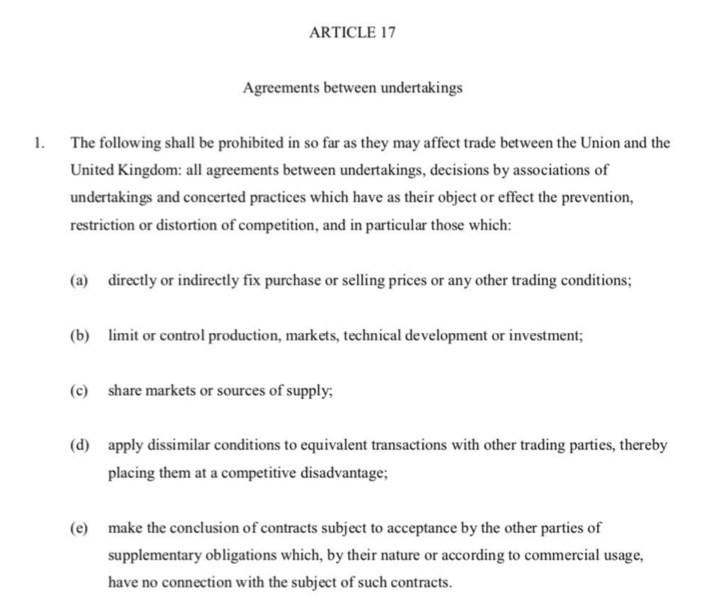
Corbyn’s policies include straight up re-nationalization of the railways, regulation of housing prices, and the government outright building vast numbers of flats, among many other similar policies.

In other words, Corbyn’s policies interfere with liberal market rules. They are, actually, forbidden by the EU–but on occasion exceptions are made.

Of course, retaining privileged access to the EU market was going to require some rule taking, but May has chosen to take more rules that are “no socialism” and less rules that are “treat your people decently.”

What May has done is negotiate a deal which ties Corbyn’s hands: He can’t implement his policies if he becomes Prime Minister, and he can’t leave the deal. (Well, in theory, and perhaps in practice.)

Of course, Britain can still leave the deal: Parliament is supreme, and one parliament cannot tie the hands of another parliament. Nonetheless, leaving the deal would be damaging to Britain’s relationship with the EU, to put it mildly.

These sorts of efforts to tie future government’s hands so that are forced to preserve neoliberal policies are common. The now-dead Canadian Chinese trade deal had a clause which required a 20-year withdrawal notice, for example. The Canadian-EU free trade deal forbids the Canadian government from many of the same sorts of policies that May rejected as well.

This is the great problem with the neoliberal world order: It is set up to force countries into a specific sort of economy, and to punish them if they resist or refuse. That would be somewhat okay–but only somewhat–if neoliberal economics worked, but they don’t.

What neoliberal economics does, instead, is impoverish large minorities, even pluralities, in the countries which adopt its policies. Those pluralities then become demagogue bait. (Hello, Trump!)

Meanwhile Macron has proposed an EU military, and Germany’s Merkel has said she supports the idea.

EU elites are absolutely convinced their way is best, and that anyone who is against it is wrong. They are not primarily concerned with democracy (the EU is run primarily by un-elected bureaucrats), and do not consider democratic legitimacy as primary. If people vote for the “wrong” thing, EU elites feel they have the right to override that. They have overseen what amount to coups in both Greece and Italy in the past ten years.

The funny thing is that orthodox neoliberal economic theory admits there will be losers to neoliberal policies and states that they must be compensated. The problem is that this has never been done, and indeed, with accelerating austerity, they’ve done just the opposite: At the same time as a plurality is impoverished, the social supports have been kicked out from under them.

Macron has been particularly pointed in this, gutting labor rights in the name of “labor market flexibility.”

Neoliberalism, in other words, creates the conditions of its own failure. It is failing around the world: In the US, (Trump does not believe in the multilateral, neoliberal order), in Europe, and so on.

Even in countries that “support” the EU, there are substantial minorities, pushing into plurality status, which don’t support neoliberalism.

So Europe needs an army. Because Eurocrats know best, and since neoliberalism isn’t working for enough people that things like Brexit happen; that Italy is ignoring rules, that the East is boiling over with right-wing xenophobia, well, force is going to be needed. A European military, with French nukes, is the core of a great power military. And soon countries won’t be able to leave.

That, at any rate, is where things are headed. We’ll see if the EU cracks up first.

In the meantime, May’s Brexit deal really is worse than no deal, and in no way should be passed. In fact, if I’m Corbyn, and it’s been passed, if I became PM, I’d get rid of it. Because it either goes or he’ll have to substantially break all of his most important electoral promises.

The EU is loathsome. I won’t say it’s done no good, but it’s now doing more harm than good (indeed it has been for at least a decade). As with the US, because the EU is misusing its power, it needs to lose it. That process will be ugly, as a lot of those who are rising to challenge it are right-wing assholes (because the left has abandoned sovereignty).

You simply can’t fail pluralities of your population and stay stable without being a police state and holding yourself together with brutal force.

Those are the EU’s two most likely futures: brutal police state or crackup.

Pity, but that’s what EUcrats, with their insistence on neoliberal rules and hatred of democracy have made damn near inevitable.


The results of the work I do, like this article, are free, but food isn’t, so if you value my work, please DONATE or SUBSCRIBE.

Britain’s Conservative Government on Verge of Breakup

So, the expected has happened. Prime Minister May’s minority government has been unable to deliver a Brexit which keeps her MPs happy. Two senior ministers have resigned, and should there be a confidence vote over Brexit, it is likely that May will not muster a majority and her government will fall.
The figures who have jumped ship are hard Brexiteers, but the tightrope for May is that many of her own MPs want a soft Brexit. With almost no margin in the commons, she cannot please everyone, and likely cannot stand.

If the UK government falls, there will be a new election. Its outcome is uncertain. Both Labour and the Conservatives are pro-Brexit, with only the Lib-Dems as anti-Brexit, but the Lib-Dems, after their coalition government with the Conservatives, are unpopular and distrusted.

Brexit has been bungled from the beginning: May’s third option was never going to fly, neither enough of her party nor the EU want it. There are only two real options: Something close to Norway’s arrangement, in which Britain will have to pay for access to the common market, or a hard Brexit and reliance on World Trade Organization norms and enforcement.

I personally hope Corbyn wins. I believe he is the best chance for Britain. Various claims otherwise, being in the EU does compromise what an actual left-wing government can do in terms of unions, re-nationalization, and many other issues. The European Union, as it is right now, is a neoliberal organization and its laws and regulations enshrine neoliberal economic relations. That it is also socially liberal obscures this point.

We’ll see how this plays out, but it’s important. Remember that the current world order started in Britain, not the US, with the election of Thatcher. Britain is a bellwether for the Anglo world.


The results of the work I do, like this article, are free, but food isn’t, so if you value my work, please DONATE or SUBSCRIBE.

The Left-wing Case for Brexit

Jacobin recently had an excellent article on left-wing Brexit, which I suggest you read. But this is the graf I want to focus on:

for a Corbyn-led Labour government, not being a member of the European Union “solves more problems than it creates,” as Weeks notes. He is referring to the fact that many aspects of Corbyn’s manifesto — such as the renationalization of mail, rail, and energy firms and developmental support to specific companies — or other policies that a future Labour government may decide to implement, such as the adoption of capital controls, would be hard to implement under EU law and would almost certainly be challenged by the European Commission and European Court of Justice. After all, the EU was created with the precise intention of permanently outlawing such “radical” policies.

That is why Corbyn must resist the pressure from all quarters — first and foremost within his own party — to back a “soft Brexit.”

This is the issue. As Jacobin’s European editor wrote:

I have pointed this out multiple times before. The European Union, in its current form (post-Maastricht) is neoliberal at its core. The Euro (which Britain at least did not adopt) was also intended to break local labor power and gut wages.

Watching the EU break Greece upon the wheel to bail out German bankers indirectly, so that they wouldn’t be seen to directly bail them out ought to have been the corpse on everyone’s doorstep that alerted people to the fact that the people running the EU, are, in certain ways, really, really bad people.

The main reason to fear Brexit isn’t “economic apocalypse,” it’s that the EU elites will do everything they can to make Britain pay to send a message.

In other words, mafia logic: “Once you’re part of the family, you don’t ever leave.”

I agree with Jacobin: Britain’s best hope of an economy which works for most Britons is Jeremy Corbyn becoming Prime Minister and instituting the policies he has said he would. Moreover, having this work is the best hope for the left in a world where all major multinational institutions and treaties are coercively neoliberal–intended to take economic decision-making out of the hands of voters and to enable free movement of capital above all other considerations.

None of this is to say that Brexit will be without some dangers and costs, but those dangers are mostly of the “save us from ourselves” variety: Tories and Blairite Labour MPs are even nastier than EU elites. And the loss of the ability to work freely on the continent, or for continentals to work freely in Britain is also a loss (though one that need not be inevitable).

But equally, the EU makes it impossible to pursue a lot of actual left-wing policies.

You can have the EU, or you can move to the left.

It’s that simple.


The results of the work I do, like this article, are free, but food isn’t, so if you value my work, please DONATE or SUBSCRIBE.

The Left Improves Control of Britain’s Labour Party

Picture of Jeremy Corbyn

Picture of Jeremy Corbyn

Three new seats on Labour’s National Executive Committee (NEC) were created and filled through voting of members. All three went to Corbyn-supporting members of Momentum, a grassroots organization created after Corbyn was elected leader.

They then replaced the chair of the disputes committee, Ann Black, with Christine Showcroft, another Momentum member.

Black, the replaced chair, had ruled that 130,000 Labor members who had joined for five pounds couldn’t vote in the last leadership election (the one called to unseat Corbyn), but had to pay another 25 pounds. This ruling was clearly anti-Corbyn. There were also a lot of purges of members throughout that campaign, purges which virtually all seemed to hit Corbyn supporters.

Corbyn’s margin of control of the Labor party’s adminstrative apparatus is still scant, but it exists.

The next step appears to be a review of whether or not all Labor Members of Parliament should be subject to mandatory re-selection: i.e., whether they have to win the right to represent Labor in their riding. Most MPs strongly opposed Corbyn during the leadership challenge, and party members feel that those MPs do not represent them.

I believe this should be done, or Corbyn is likely to be hamstrung if he does win election as Prime Minister.

All of this may seem very insider baseball, but control of major parties is vitally important in democracies. Thatcher said that her most important victory was Tony Blair’s election: Because Tony Blair, as a “third way” politician, would not undo what she had done. He agreed with her on the deep questions of how Britain should be run, even if there were differences at the margin.

With the two main parties both neoliberal, there now truly was “no alternative”. Corbyn’s victory, and the left gaining control over Labour, now means that there is an alternative.


The results of the work I do, like this article, are free, but food isn’t, so if you value my work, please DONATE or SUBSCRIBE.

Corbyn Wants to Destroy the Current Economic System

Take it right to them:

Responding to Hammond’s warning in his speech at this month’s Conservative conference, Corbyn will say the chancellor is “absolutely right” to say that Labour is threatening to destroy the current economic model, adding that the current system “allows homelessness to double, 4 million children to live in poverty and over a million older people not getting the care they need”.

Picture of Jeremy Corbyn

Jeremy Corbyn

The reason the establishment hates him is that he threatens them. He will re-nationalize power and railways, institute rent controls and ownership limits on multiple homes and overseas owners, and build new council housing.

And there’s this:

Corbyn will say Labour is not opposed to technological advancement, but digital giants such as Uber and Deliveroo have built their success not on their technological advantage, but by “establishing a monopoly in their marketplaces and using that to drive wages and conditions down.”

“Imagine an Uber run co-operatively by their drivers, collectively controlling their futures, agreeing their own pay and conditions, with profits shared or re-invested,” he will say.

“The biggest obstacle to this is not technological, but a rigged economic system that favours wealth extractors, not wealth creators.”

This, by the way, is basic economic theory. Markets work for the benefit of most when they are competitive, and bounded by safety nets and regulations. They do not work for the benefit of all when they form monopolies or oligopolies. The latter have to be regulated to the max, broken up, or turned into public utilities.


(I am fundraising to determine how much I’ll write this year. If you value my writing and want more of it, please consider donating.)


Or, perhaps, to change who owns them.

The current economic system is not good capitalism: It is not competitive or regulated or bounded by proper safety nets and guaranteed minimums, let alone proper high-end taxation.

To make capitalism, or rather, markets, work, requires strong government intervention and always has. Thatcher and Reagan were just wrong, and it shows up in virtually all the numbers.

Corbyn is the actual realist here, not those who celebrate the current mode of “capitalism.”

And this is going to be fun to watch.


If you enjoyed this article, and want me to write more, please DONATE or SUBSCRIBE.

You Can’t Stay in the EU or Single Market And Be For Labour’s Manifesto

So, 30 Labour MPs have signed a letter calling for Corbyn to stay in the EU’s single market as a member.

This is not possible IF Labour’s manifesto is meant seriously. EU single market law is explicitly neoliberal, it does not allow for things that Labour wants to do, like nationization.

Access to the single market is one thing, being a member is another. Corbyn cannot do it and keep his promises, it is that simple.

The EU is a barrier against horrible things the Tories want to do, but it is a roadblock against basic social-democratic policies that Corbyn wants.


The results of the work I do, like this article, are free, but food isn’t, so if you value my work, please DONATE or SUBSCRIBE.

The Hung UK Parliament

The final results are 318 for the Conservatives, 262 for Labour, 35 for the SNP (Scottish), 12 for the Liberal Democrats, 10 for DUP (Democratic Unionist) and 13 “Other.”

There are 650 seats total, meaning 326 are needed for a majority.

DUP is who the Conservatives will govern with, and they are the Protestant Unionists in Northern Ireland. Not very nice people and associated with violence carried out on behalf of staying in the UK.

Labour will not be forming the government, odds are, but this is a victory for Labour in that the Conservatives’ majority is reduced to a minority.

72 percent of 18-24 year olds voted, which is unprecedented to my knowledge.

The takeaway is simple: Left-wing neoliberalism is dying (and with luck is dead), in England. A straight up message of nationalizing railroads and energy, of free tuition, of building homes, did far better than the neoliberals have done in years.

This was a two party election–third parties shed followers.

Corbyn outperformed massively, which is the risk of demonizing one’s enemies. Having screamed about how terrible he was, Blairites are reduced to saying, “Anyone else would have done better, May was awful.” After they’ve lost two elections to Corbyn and been wrong about him three times, this sounds weak.

Center-right parties are dying or reinventing themselves. There is no appetite for mealy-mouthed neoliberalism. Go all right, or go what passes these days for hard-left. The demographics are 100 percent on the left’s side: The younger people are, the more left-wing they are, and now, they’re even voting when offered politics which appeal to them.

I mean, given the university loans crisis, it seems like basic, no-brainer politics to offer them debt-forgiveness and free tuition.

In more immediate terms, the question is whether May will survive. Boris Johnson is likely sharpening his knife collection as we speak: She didn’t have to call this election and she lost her majority in it, after a terrible personal performance in which she appeared scared to be in the same room as Corbyn.

The second issue is when the next election will be. Is a coalition with the DUP in the works? Is it a strong coalition? It wouldn’t take much for the Conservatives to lose a vote of no-confidence and be back at the polling booths, though other parties will be reluctant to knock them out–and with good reason, fearing that Britons will punish them for having to go back to the polls so immediately.

A new election may be necessary, soon, and accepted as such, if the Conservatives find themselves unable to effectively negotiate Brexit.

I shall be interested to see if Labour MPs, who still hate Corbyn, launch another attack. There have been gestures of peace, but many will never give Corbyn credit for anything, and genuinely do disagree with his politics. I assume, however, that they will at least wait a while, while continuing to snipe and leak in hopes of weakening him.

We shall see.

Overall, I’m very happy with this result. I expect(ed) the realignment to take till 2020/24 for demographic reasons, but this is an early earthquake sign of better politics to come.


The results of the work I do, like this article, are free, but food isn’t, so if you value my work, please DONATE or SUBSCRIBE.

Page 2 of 3

Powered by WordPress & Theme by Anders Norén