The horizon is not so far as we can see, but as far as we can imagine

Author: Ian Welsh Page 154 of 437

Who Deserves the Good Things in Life?

On Wall Street, they have sayings. One of them is that they “eat what they kill.”

They mean this in a good way — that they earn their money by making the right bets or by landing the big clients. That money is theirs: They went and got it.

Of course, one could see it in another way: All the businesses, Private Equity, for example, has destroyed, buy buying them, paying themselves, loading the businesses up with the debt, and then letting them go under.

They earned that money by killing. ToysRUs for example, which was making a profit until they loaded it up with debt to pay for their takeover and the bonuses they gave themselves.

Or, say, causing the 2008 financial crisis, which had a bill that has to be at least 100 trillion and involved millions of people losing their jobs, homes, livelihoods, and in many cases, lives.

Finance, that is to say, demonstrably does more damage to everyone else than it does good, but it pays very very well, especially now that they own every government, so central banks are willing to print trillions of dollars to socialize their losses, while letting them keep the money they stole.

They don’t even actually win bets: If, in 2008, they had taken their losses, they would have all gone out of business.

It’s just a scam; a matter of brute force. They can print money and borrow money at rates ordinary people will never see and government makes sure they never take real losses and that markets go up no matter what is happening to the economy.

Then, there are the studies that show that the more money someone has, the worse their behaviour — the more sociopathic and less generous. Poorer people give more to charity as a percentage of income or wealth than rich people, which makes sense, as most rich people are rich because they care about money more than anything else.

The simple fact is that people like nurses, teachers, janitors, garbage pick up, farm workers, and factory floor workers are who create most value. On the intellectual and creative side, the designers, engineers, scientists, and other creators are the ones who create value, not the suits. In fact, suits often reduce value: It isn’t engineers and designers who wanted planned obsolesence (19th century engineers fought it bitterly) or to remove the right to repair.

Most financiers don’t even finance creation any more; they finance destruction. Most managers are, at best, a wash, any random person would do about as well and maybe better (management literature shows this clearly, it isn’t in dispute). As for CEOs, higher compensation correlates to worse performance, and during the 40s through the 70s, before the massive rise in CEO compensation, had far more growth than our era. CEOs eat what they kill, is all. They control who gets paid what, so they pay themselves the most. It has nothing to do with merit, except if merit means “you deserve whatever you get.”

“You deserve whatever you get.”

That’s really what we mean by merit, today, isn’t it?

Not, “you contributed to society,” or even, often enough, “you contributed to your organization,” but “whatever you have the power to seize, at whatever cost to anyone else, is what you deserve.”

It’s not even about “whatever you can get legally.” Wall Street’s entire 2000s run was based on extensive fraud, they then, with the help of Obama, stole millions of houses using fradulently signed statements. Wall Street currently makes huge amounts of money by front-running investors, simply paying to get faster access and information.

So much for deserve, as we use it.

My personal take is that there are awards that should definitely be merit based. Medals, titles, and so on. A lot of positions should only go to those who have shown they “deserve” them, though our ideas of what that means are really warped when the entire media weeps about how Hillary Clinton was “the most qualified candidate in history,” when she had displayed both terrible judgment (Iraq, Libya, pushing Trump) and incompetence (losing two campaigns as front runner, bungling Hilary-care.)

But I am heterodox. I don’t like incentives. I don’t think people should get more for doing more, because I think incentives usually warp behaviour in horrible ways.

Instead, in a surplus society, we should just ensure everyone has good quality of what they need: housing, healthcare, food. Take the fear and greed away, and send them to work without the whip of hunger. In such a world, oddly, by not doing what we do now, you’d see some of what orthodox economics says should happen, happen. For example, picking up garbage would be highly paid, because it’s not fun (though it is useful).

Let money buy anything that doesn’t matter: A fancy vacation, a TV so high-definition it looks like reality, a set of five-million thread count sheets so smooth you barely feel them, or an animatronic bear that loves you, really.

Deserve, in a surplus society, is really about FEAR. People who spend their entire lives operating from fear do not create good societies.

No one needs or deserves to be a billionaire (and if anyone ever did, it’s someone like Jonas Salk, not Bill Gates or Jeff Bezos.) Having such people costs far more than money, as Bill Gates has proven by restricting vaccines.

Forget deserve. Give everyone a good life, and see what world people who aren’t scared create.

We’ve tried everything else. Maybe it’s time to try and run a society not based on fear.


(The more people subscribe or donate the more I write.)
The Most Radical Statement I’ve Ever Read

From Dr. Robert Tabash, in Bethlehem:

The poorest deserve the best.

I stared, stunned at this for a while, because it’s absolutely 180 degrees from how we do things. To do this would be a complete repudiation of our entire society, and every society of which I am aware.

I stumbled across it in the replies to this tweet, on the same general theme.

It’s hard to say much about this, because it’s almost impossible to imagine a world in which we do this.

Of course, this comes from Christians, and it’s why I have contempt for most modern Christians, especially evangelicals.

Christ was a radical. Unbelievably radical. “As you have done to these, the least of mine…” and telling the rich to sell all their possessions and give them to the poor. Real Christianity, the path of Jesus, not all the crap accreted about Christianity, is perhaps the most radical, and hardest, in the world.

This is why most “Christians” don’t follow Jesus’s clear instructions: Doing so is hard. That’s fine, I don’t either. But I also don’t call myself a Christian.

But put the Christianity aside, if you can, and marvel just in the idea of a world completely topsy turvy to the one in which we live, where those who are poorest; those who are weakest, get the best, because they are the ones who need it most, and we care for each other.


(Writers eat and pay rent, so subscriptions and donations help.)

Open Thread

Use the comments to discuss topic unrelated to recent posts.

Commentary on Biden’s Speech

Biden’s turning out better than I expected on domestic economic issues, though that isn’t a high bar. This speech (full transcript) is very interesting, though the question of how much he can get through Congress remains. My telegraphic thoughts on reading it.


The IMF predicting six percent growth isn’t that impressive, just because after Covid there was always going to be a boom.

Getting rid of all lead pipes is really good and has needed to be done for decades.

Getting high-speed internet to every home is good. Hope there’s some price controls in there, because the ISPs definitely rip people off (I’ve seen profit numbers as high as 97 percent.) They also need to be sure it actually gets built; money has been given to providers to build before, and they haven’t bothered.

Upgrading the power grid is absolutely necessary. We’ll see what the details are. It needs to be done in a way that forces proper maintainance. PG&E has let literally thousands of fires happen because they’d rather pay dividends than fix their infrastructure.

The green plan is pretty good. Insufficient, but better than anyone else has done. Half a million charge stations, more energy efficient buildings, planting over crops and some industrial policy to create green machinery in the US. Someone has finally got it through their thick skull that most of the jobs required in upgrading buildings and so on can’t be offshored and outsourced, something I and others have been arguing for decades. Happy about this.

Some stuff about $15/minimum. Doubt Manchin will let it through, but if I were Biden, I’d use it as a cudgel for 2022 to get a majority he can use. Really, even $15 is stupid. It should be about $22 and indexed, ideally to the increase in CEO compensation.

A lot more money for research. Excellent.

Universal pre-school. I think it’s a terrible idea, but I know most experts disagree. Have to take the kids from the parents and soon as possible and train them to be obedient workers.

Two years of free community college; give workers slightly better, but non-elite jobs.

Some ACA fixes, none of which will make it good or people not hate it, because insurance companies controlling what you can get and whether it gets paid for is always going to suck.

Allowing Medicare to negotiate drug prices. See if Congress lets it through, but a good thing.

Top bracket for those earning 400K or more up to 39.6 percent. No way Machin lets this through, but a good market for a start. It should be 90 percent, of course.

The fixes to capital gains are great, and something America (and most other countries) have needed for ages. Taxing capital gains less than income was always ridiculous and unfair.

Lots of red meat rhetoric against CEOs and execs. Nice.

China cold war still on: China must play by American rules, and the US military will stay in the East. (More on this in future pieces, this is important.)

Red meat on Russia. Self congratulation on Afghanistan (earned, but continuing drone bombing it is bad.)

Gun control talk: wants the loopholes closed and background checks on everyone (I doubt this can get past Congress. If it does, the Supremes will veto it.)

Immigration: don’t blame me, I sent a bill and Congress won’t pass it. Also we should help nations where we’re getting a lot of refugees from so they don’t need to flee to  us.

Call back to FDR. They clearly want to make Biden the next FDR. He ain’t that, but domestically he’s the start of the end of neoliberalism, perhaps, and if so, that’s enough and more than I expected. None of this stuff is exactly radical, or sufficient BUT it is a reversal of trend, and that matters.


(Writers need dental care, so subscriptions and donations help.)

Why Progress Always Required Space Travel

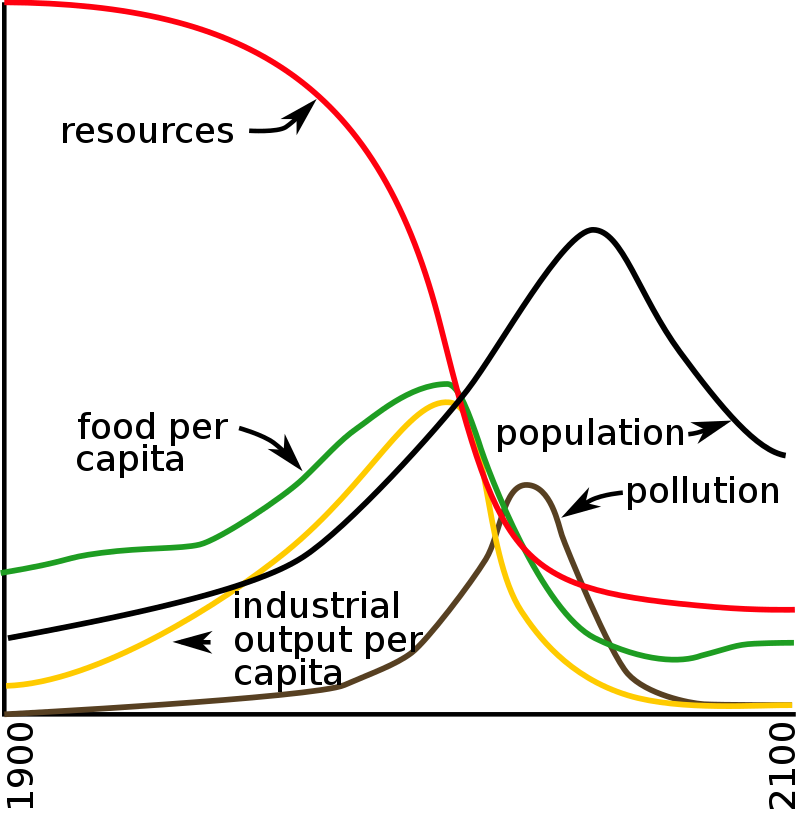
When  I was a teenager I read The Club of Rome’s “Limits To Growth.” The Club ran consumption, pollution and population numbers thru some simple models to see what would happen. The model misses climate change, so we’re worse off than they expect (much worse off) and some other factors, but the stuff it models has been coming in approximately as expected.

The standard model of progress, often assailed by thinkers like John Michael Greer, assumes that there aren’t significant limits to growth that we can’t substitute out of. Run out of oil? Switch to solar? Run out lithium, figure out another way to make batteries? Run out of water, mass-desalinization? Run out of soil, make soil or grow plankton in water. Run out of fish? Fish farms.

Etc…

But the people who created the model, who championed it, aren’t as optimistic and stupid as their opponents often indicate: the standard future model of people who believe in progress requires space exploitation precisely because we can’t assume we can always find a substitute on Earth for what we lack.

If you want, in other words, to keep GROWTH you must exploit space. Send out the space miners! Harvest solar above the atmosphere. Explore, exploit, grow!

You don’t necessarily have to colonize space in any meaningful way to do this, though the earlier imagineers thought we would: this can be done by robots and telepresence mostly, with a very few actual humans in space.

Note that this side-cuts most of the standard complaints about space colonization: other planets nearby all suck, and are worse for life than Earth (even shitty places on Earth like Antarctica) and space itself is full of deadly radiation and other problems we don’t know  how to fully mitigate.

Doesn’t matter if you’re just sending out robots to get stuff (lithium, say) and bring it back.

BUT none of this matters in a larger sense because the real problem isn’t running out of lithium or copper or helium or any other simple substance like that.

It’s destroying the biosphere, climate and ecosphere

Earth’s true wealth is an intricate web of life, from creatures simpler than bacteria all the way up to blue whales, including plants and fungi and insects and a wild variety of creatures we don’t understand or haven’t even discovered.

That, along with Earth’s climate, is what you can only get on Earth, at least within the solar system. That’s what we’re destroying.

So… space exploitation? Why not. It may help deal with some bottlenecks. But it still won’t let us continue GROWTH and the standard progress model, because the real limit to growth is simply that if we go past the Earth’s carrying capacity — which I will say, despite some disagreeing with me — we unequivocally have, we then start destroying that carrying capacity and all the things we must have that only Earth supplies.

Earth is the Jewel, the most important place in the universe for humans, right now. We cannot do without it and what is important about it is not copper or lithium, it is precisely climate and LIFE (ecosystems). Our destruction of those two things is what makes the standard model of progress impossible.

We’ve got a limited resource, created by processes of evolution which take millions of years to work. We are so ignorant we cannot even create a self-sustaining biosphere; we cannot fix what we are breaking.

Anyone and any system destroying the Earth’s climate and ecosphere is thus, then, doing the greatest wrong possible for the future of humanity, and of much life on Earth. Our mass genocide of other species is a slow form of strangling ourselves.

Space can help, but it won’t get us around the real issues. Only true respect for the genuine non-renewable resources we MUST have and which exist only on Earth can create a positive future for humanity and for all the species we have held hostage and not yet murdered, who are unfortunate enough to be trapped on Earth with us.


(Writers need dental care, so subscriptions and donations help.)

All the Futures that Will Not Happen

I’m often amused and saddened by the techno-optimists among us and their fantasies of great futures. Or even the woke folks who think that color and gender and whatnot are the great political frontier.

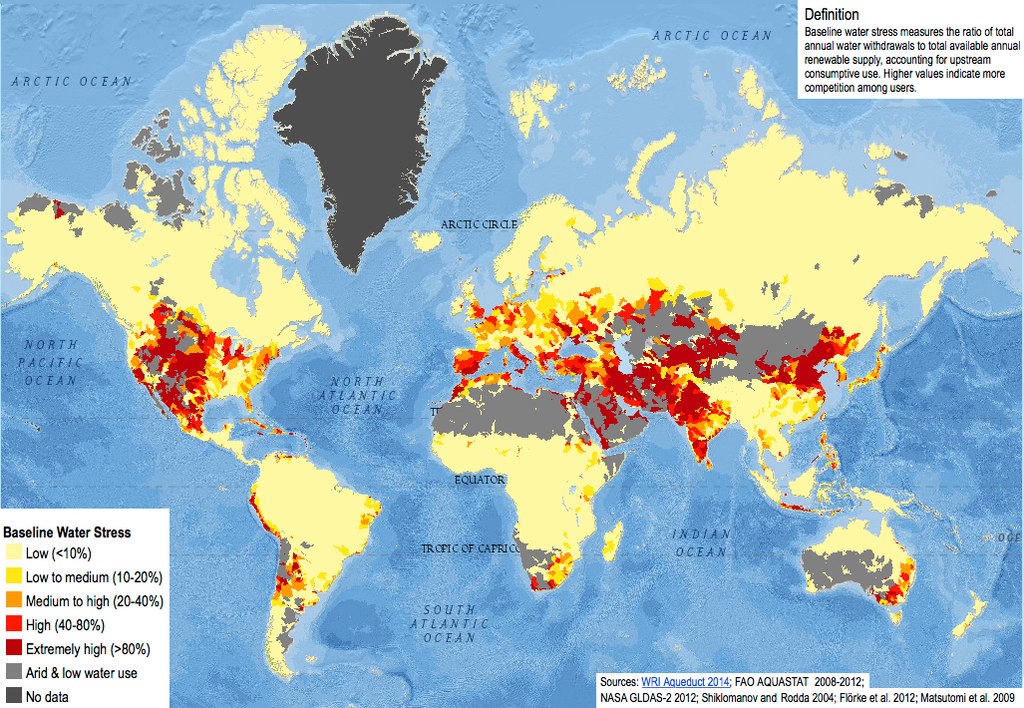
Let’s run through this. Water.

Baseline Water Stress

To put some numbers on it:

New modeling of the world’s groundwater levels finds aquifers — the soil or porous rocks that hold groundwater — in the Upper Ganges Basin area of India, southern Spain, and Italy could be depleted between 2040 and 2060.

In the US, aquifers in California’s Central Valley, Tulare Basin, and southern San Joaquin Valley, could be depleted within the 2030s. Aquifers in the southern High Plains, which supply groundwater to parts of Texas, Oklahoma, and New Mexico, could reach their limits between the 2050s and 2070s, according to the new research.

The thing to understand about this is that it doesn’t show permanent aquifer damage. If you overdraw aquifers, they lose the ability to hold as much water; that reduction is permanent.

Then there is fracking and other forms of poisoning groundwater, though how much is difficult to determine. (It’s not small.)

Meanwhile, the next thing is that important rivers tend to be driven by snowpack runoff and glaciers, but snowpack is becoming less and less and glaciers are receding. We’re talking about rivers like the GANGES and the Yangtse, not to mention all the European rivers which start in the Alps.

So we have groundwater depletion, some of it permanent. We have poisoned groundwater, and we have a reasonable expectation of reduced water in rivers, which in some cases will dry up entirely.

Let’s move on to more fun stuff: ecosystem collapse.

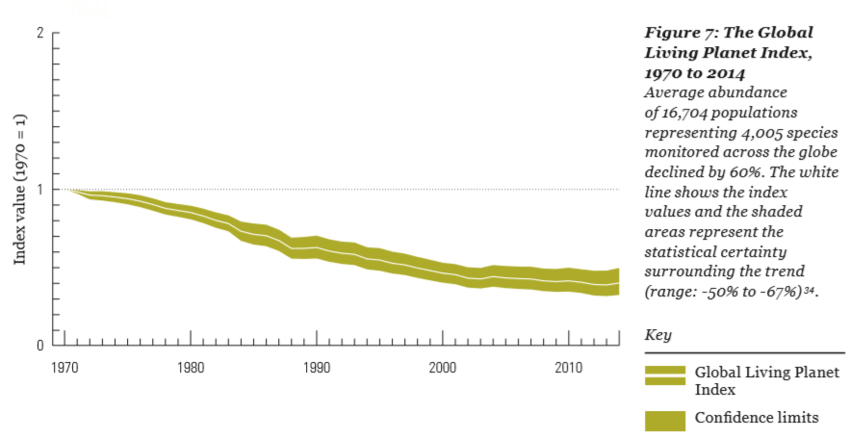
Wildlife Reduction

This number is from 1970, which was already very reduced. You can read accounts of what the Grand Banks were like originally: They could literally dip a pail into the ocean and come up with fish. We’ve massively reduced wildlife everywhere, insect populations are collapsing, and so on. Recent estimates are that the Amazon is no longer a net producer of oxygen, but now produces Carbon Dioxide.

Phytoplankton produce half the world’s oxygen. From 1950 to 2010, the population of phytoplankton dropped 40 percent. We can safely assume losses were not even, but are accelerating.

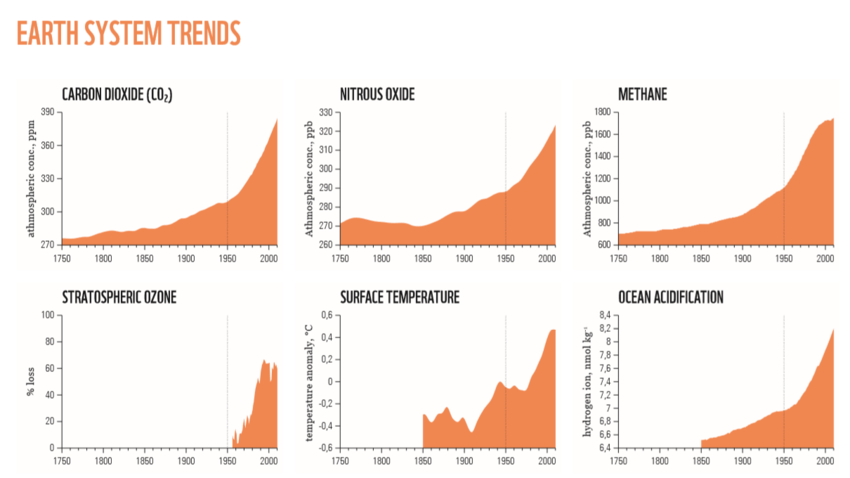
The general picture in terms of climate change is all bad:

Climate Dashboard 2018

Note that first graph very carefully. There is NO sign in the actual numbers that we are doing anything of importance to stop this trend. Kyoto and Paris have achieved nothing, which is to be expected, since they were voluntary.

Let’s put this all together: massively rising temperatures; more extreme weather events; changes in climate, including rainfall patterns; massive depletion of aquifers at the same time as we can expect many rivers to lose volume or dry up; no effective political action.

One thing that India’s Covid crisis clarified for me is that India won’t be able to handle climate change, so let’s make some predictions.

India breaks up within 20 to 30 years. It dies amid great famines which kill two hundred million or more people. Bangladesh, of course, will go oven sooner, and unleash a tsunami of over 150 million refugees which India does not want, as they are mostly Muslim.

China breaks up 30 to 45 years from now and descends into warlordism. Prior to the breakup, there is a better-than-even chance of war with Russia for Siberia. Again, hundreds of millions of deaths.

The US is going to hurt worse than is obvious: Core areas will hit depletion, and many rivers will dry up. Large chunks of the Southwest will become completely uninhabitable. California’s population carrying capacity will drop massively, unless it moves to mass de-salinization (a dicey prospect).

We’ve just had ourselves a lesson in what exponential growth looks like. There is every reason to expect that at least some parts of ecosystem collapse and climate change will act that way: When break points are reached, they will accelerate, and nothing we can do will stop them. Worst case scenario is a hothouse Earth in which humanity goes extinct, but entirely plausible scenarios see the Earth losing half or more of its carrying capacity. The process will involve a lot of death, suffering, and war.

There’s a decent chance we get a marine inundation event. Rather than water rising by small amounts every year, at some point it rises very quickly, and large amounts of the coast flood permanently.

Remember that the “moderate” estimates have almost all been wrong. The “worst case” scenarios, for decades now, have been coming in correctly.

All of which is to say, whatever future you think you’re going to have, you need to run it past this lens. Does it survive this? Does society spend resources on whatever it is in the face of hundreds of millions of deaths and billions of refugees?

So, no, your future, whatever it is, unless you can instantiate it in the next two decades, probably isn’t going to happen.

The clock is ticking, we are running out of time to do whatever it is we want to do, and it is very likely that we are past the point of no return; that even if we were to go all-out to stop climate change and environmental collapse (we won’t), we could — at best — limit it to “losing half the population.”

lf you’re old enough, none of this matters, of course. But we are now at the point where, if you aren’t 60 and in poor health, or 70 and in good health, you’re probably going to get see at least the start of the really bad times.

We’ll come back to what this means in more depth later, but for now, just make your plans based on this understanding of what the future holds.


(Writers eat and pay rent, so subscriptions and donations help.)

Open Thread

Use comments to discuss topics unrelated to recent posts.

The Catastrophic Covid Crisis in India

I follow a fair bit of Indian media, as a lot of it is English language, and the last few days in India have unveiled a Covid situation far worse than the stats suggested. People are scrambling for oxygen in particular, with patients in hospitals dying because of its lack. There isn’t enough medicine and bodies of Covid victims are being burned in vast numbers.

At the start of the Covid crisis, I figured that India, with its vast population, inadequate health infrastructure, corruption and idiotic leadership in the form of Modi would be a fiasco. It seemed like it wasn’t so bad, and I couldn’t figure out why, but decided that since I haven’t been  there in decades there was a factor I was missing.

Turns out the main factor was probably under-counting Covid cases.

Meanwhile, where I live in Ontario, Canada, the situation is also dire, though not as bad as in India, with ICUs in the largest metropolitan center so full, they’ve had to move patients in large numbers out.

Worse, the Premier had non-ICU Covid patients moved to long-term care homes — exactly the move that New York governor Cuomo made that caused New York’s LTC disaster and which amounted to him committing mass manslaughter, for which he should go to prison.

Again, Ontario is a place where, at the start of the pandemic, I figured it would be a catastrophe because Doug Ford, the Premier, is a noted incompetent who’s also probably a sociopath or psychopath. In his youth, he was a drug dealer who allegedly enjoyed beating people  up.

But Covid seemed to be going better than I expected, until it wasn’t.

It turns out that bad leadership (Cuomo is also a psychopathic incompetent) is a good predictor for who did catastrophically bad with Covid.

In India, Modi is the fool who demonitized India, getting rid of large bills in an effort to crush corruption, but instead massively damaging the informal cash economy which most Indians live in. Any idiot knew that India, of all countries in the world, was one of the least candidates to move hard towards more e-cash, but Modi is an idiot’s idiot, enamoured both with right-wing Hindutva religious ideology and with neoliberalism, because Indian socialism didn’t work well, so the solution is obviously to do the opposite form of stupdity.

I don’t really have a moral here, except the obvious: that leadership does matter, and that one’s initial impression of competence is usually right. Modi’s incompetent. Cuomo’s incompetent. Trump was incompetent. Ford is incompetent. All of them are also malign: They don’t care about what happens to other people. Ford famously stole money from his brother’s widow, so he isn’t even in the Biden class of at least being good to his own family.

Probably, electing evil, incompetent people is a bad idea, and we should do less of it.

If I wind up dead from Covid, feel free to blame Ford, with a sidecar of blame for Canadian Prime Minister Justin Trudeau, who has refused to treat Canada as a country and take charge of Covid efforts in provinces, where the Premiers are incompetent.

As for India, the Indians have my deepest sympathies, and if you don’t care about them, remember that India has the world’s largest vaccine industry, and those vaccines will not be leaving India until Covid is under control there, which means catastrophe in India will hurt many countries, allow even more variants to be created, and kill a hell of a lot more people, far from India.

Turns out that electing an evil moron like Modi effects countries far from India, just as electing Trump, Obama, or Bush effected countries far from the US. Leaders of powerful countries, and India is powerful, matter beyond their borders.

Good luck to everyone led by shitty leaders, Indian, Canadian, and other. In the future, let us remember that mean assholes are usually also incompetent, and to stop electing them.


(All the content here is free but food and rent aren’t, so subscriptions and donations do help.)

Page 154 of 437

Powered by WordPress & Theme by Anders Norén