The horizon is not so far as we can see, but as far as we can imagine

Author: Ian Welsh Page 105 of 437

Part III Of My Interview: Twitter and Reasons For Hope

Last of three parts.

(I am fundraising to determine how much I’ll write this year. If you value my writing and want more of it, please consider donating.)


It’s Not Just About Climate Change, It’s About Ecological Collapse

Earthworm Edition:

…they estimated a decline in earthworm abundance of between 33% and 41% in the last quarter of a century, the period for which the best data was available…

Dr Matt Shardlow, of the charity Buglife, said earthworms were essential to healthy soils and productive ecosystems and the decline in UK earthworm populations – at a rate of about 15% per decade since 1960 – was “deeply alarming”.

“Devastated earthworm populations in arable soils are to be expected due to the widespread use of toxic pesticides,” he said. “But declines in broadleaved woodlands and pasture indicate that climate change and growing levels of animal-wormer pollution in soils are likely to be also driving this insidious facet of biodiversity loss.”

This always gets called “biodiversity loss”, but if you lose key species, you can have ecological collapse. For example, in the oceans, the most likely future scenario is that jellyfish become the dominant species.

Notice that we don’t really know how long this has been going on, and how deep it is. The “normal” gets set to people’s childhood, as with bug splat. For those too young to remember, it used to be that insects were so thick in the air in rural and wilderness areas that when you drove through them your windscreen would be covered with their dead bodies.

Not anymore.

(I am fundraising to determine how much I’ll write this year. If you value my writing and want more of it, please consider donating or subscribing. )

The Grand Banks off Newfoundland were once so rich with fish that you’d drop in a bucket and it would come up full. The passenger pigeon (not dodo as I wrote earlier) was so prolific that flocks would literally blot out the sun. My Uncle Jack told me that when he was a youth in the 20s and 30s in Northwest BC, he would take a line and an earthworm just out of the town of Prince George, and have a salmon in 10 minutes or less. Another Uncle, who had a small trawler, told me similar stories of decline, back in the 80s.

As with climate change, we’re screwing with systems we don’t really understand, but we do know that we are reliant on their proper functioning for food, water and breathable air. Rain water is no longer safe to drink, for the first time in human history. Major aquifers are drying up and being permanently damaged and many of them are polluted.

The scale of the damage we are doing the environment is staggering, and we are, like it or not, part of the environment. We understand so little that we can’t even create a close environment capable of supporting life more advanced than slimes. If we fuck this up, we can make it so bad we won’t know how to fix it.

And earthworms, as every gardener knows, are gold for soil fertility.

Amazing.

Donate or Subscribe To My 2022 Fundraiser


Consequences Of The End of Zero Covid In China

Back in November I wrote that China’s Zero Covid policy was the right thing done the wrong way. Briefly after, consequent to some protests against Zero-Covid, China basically abandoned the policy.

The main problem is the same that exists in almost every country: even the most competent elites in the world today are, when not graded on a scale, incompetent buffoons incapable of running anything properly. Zero-Covid should have been about making necessary infrastructure changes to clean air so that over time restrictions could be eased.

This does not mean Zero-Covid did not have benefits: by shifting the oncoming wave downstream, China has significantly decreased mortality. Current protocols mean that Covid is much less deadly than if they’d given up early. A lot more people are vaccinated and the protocols for treating Covid are much better than earlier.

But massive public health measures should have been an opportunity, again, for improving infrastructure.

In the short term I would suggest that this will cause a supply shock, not make one less likely. If you need things made in China, stock up with a two to three month supply.


(I am fundraising to determine how much I’ll write this year. If you value my writing and want more of it, please consider donating. Alas, I’m neither God nor Beast.)


There will obviously be a wave of hospitalizations in China. Their hospital capacity per capita is much lower than most of the West’s. They do have the ability build temporary hospitals fast, but the choke-point isn’t facilities, it is trained staff. The CCP has plenty of warm bodies they can throw at low skill hospital jobs, but no great surplus of doctors and nurses.

The longer term consequence is the same as the longer-term consequence in the West. The best reason to do Zero-Covid was never about short term deaths, it was about avoiding Long Covid and a population which gets infected over and over again by a virus which screws up immune systems and damages organs, including the brain. The population level effects of Long Covid will be massive. The UK and US already have about 2% of their workforce disabled because of it.

China is a decade out from the start of a demographic crisis, with an aging workforce. Their dependency ratio (the number of people working / number of people not working but who must be supported) will rise and keep rising.

Long Covid will have a devastating effect on the population. There is no particular reason to expect Covid to miraculously disappear. We’ve had chronic serious diseases that lasted for centuries or millennia and the damage Long Covid does is not a serious enough evolutionary disadvantage for there to be significant pressure for its reduction. Indeed, if, as seems to be the case, much of it is related to immune dis-regulation, it’s likely to be selected for.

China’s elites policy was the right one, but public health measures at massive scale are what you do to buy time to clean up the water/air/find a cure. Since no cure has been found for Covid, and there is no cure on the horizon, well, infrastructure needed to be changed.

China isn’t worse about this than most other places. There has been no mass refitting of ventilation infrastructure in almost any major country (Japan seems to be a partial exception).

But it is tragic to see incompetence and short-sightedness destroy the last major uninfected pool of people in the post-Covid world.

China will pay a grave price for this, and Western triumphalism at the end of Zero-Covid is like cheering when the last stronghold falls to an invader. “It was so embarassing that they were holding out when we surrendered so easily.”

Pathetic and sad.

Life In The Absence of Coercion

On Friday I wrote an article which asked two questions: one about what you’d do if you couldn’t be easily coerced with violence:

Imagine that if you chose no physical object could affect you. Bullets don’t work, fists don’t work, no one can grab you or put you in handcuffs, and that’s true of everyone.

The second was:

What if you didn’t need to eat or drink and you cold and heat didn’t bother you or harm you and you didn’t get sick? You might still want shelter or a home or objects like books or computers, and objects like cosmetics would exist, but not medicine. But you would need nothing.

I didn’t write very much about these because I wanted people to think it thru on their own first. If you haven’t done so, please spend some time thinking about it now before you proceed.

I’ll suggest that applying it to yourself first is a good idea before you move on to society. Absent the possibility of violence against you and with your basic needs met would you still work at the job you’re doing now? Would you pay your taxes? Would you live where you are? Would you have kept going to school?

What would you do, or have done instead?

The point here is how much of what we do is because of fear or need, with fear of not having one’s needs met being what need is really about. Marx called this “the whip of hunger”, pointing out that people had to take terrible jobs because the option of not doing so was starving to death. You didn’t need physical whips and chains, you just needed to ensure that people couldn’t meet their needs without doing what those with power wanted.

This is what the closure of the commons, among other things, was about: removing people’s ability to support themselves. Closure of the commons was done legally, but backed by force.

I will gently suggest that most people wouldn’t be doing what they’re doing if they weren’t scared of the consequences of not doing it and that they would do very different things if fear of privation and violence were taken out of the equation.

This is important personally because it speaks to something close to who you really are or would be, and lets you know what you’re doing out of fear.

It’s not the same thing as being really rich, because money is the ability to command other people’s labor and the results of their labor. If I buy a tomato at the supermarket, a lot of labor went into growing that and getting it to the supermarket.


(I am fundraising to determine how much I’ll write this year. If you value my writing and want more of it, please consider donating. Alas, I’m neither God nor Beast.)


What it does tell you is who you would be without fear.

At the social level it asks the question of what a society would look like where social ties were fundamentally voluntary. Where you were a minor God and could live without society?

Obviously you still wouldn’t live as well without society: no internet, no supermarkets, no books, no whatever. But you could do it.

This isn’t about finding holes in the specific questions: it’s not about whether you could find a way to hurt someone without touching them or what do about some jerk following you around and screaming and you can’t use violence to shut him up, though those are worthwhile questions too, because they lead to the question “is some ability to coerce good? Under what circumstances?”

Imagine having a fire department, say. If some people didn’t want to contribute, you couldn’t make them, but a fire in their house can still spread to yours.  Garbage would still need to be picked up and pollution dealt with and so on.

But if someone didn’t want to do something, there would be no way of making them.

So society would have to work without coercion.

Is that even imaginable? What would it look like? What things we do today just wouldn’t happen, or exist? A government run by people who couldn’t coerce anyone would look very, very different from what we have today or almost anything we’ve ever had.

Now this goes a bit further, in that you don’t even need to eat so there’s no “if you don’t work, you don’t eat”, but we can imagine an abundance society where there is such surplus that we have more than we need even without these hypotheticals. In a sense we almost had it: for most of the last 80 years there’s been far more food produced than is needed, and yet people still went hungry and there were famines.

But the fundamental point of these questions is simply to point out what you do because of fear of violence; fear of lack, or both.

Then, should anything which exists only because of coercion exist? Is coercion a good thing in small does even if it’s not required to protect people from the violence of other people or to distribute basic necessities?

I’m pretty sure there’d still be society, for what that’s worth: people would still need to cooperate to create certain things they want. But what would society be like if people would only cooperate to get what they wanted, in the absence of fear or violence, starvation or homelessness?

This is a genuinely hard question to think about. We’ve never existed in such a society, and no such society has ever existed. As long as we’re human, it won’t exist, though some transhumanist futures might create something close to such a world.

We think about such possibilities to show ourselves the extreme, and then consider if we should work to get closer to it, even if we can’t reach the end-state.

There are other hypotheticals, perhaps better. For example, what if association was always voluntary: you can’t even hear or see or touch someone without their consent?

Think thru these questions and you’ll see both where the constraints of being humans form you, and where they form society.


Open Thread

Use the comments to discuss topics unrelated to the week’s posts.

(I am fundraising to determine how much I’ll write this year. If you value my writing and want more of it, please consider donating. )

Imagine A World Where Violence Or Need Are Impossible

There are two main types of coercion in the world.

The first is violence. If you don’t do what someone else wants, they will do something physical to you.

So, imagine if that was impossible. Imagine that if you chose no physical object could affect you. Bullets don’t work, fists don’t work, no one can grab you or put you in handcuffs, and that’s true of everyone.

What would change about society if this were true? What would change about how individuals act?

The second is need. What if you didn’t need to eat or drink and you cold and heat didn’t bother you or harm you and you didn’t get sick? You might still want shelter or a home or objects like books or computers, and objects like cosmetics would exist, but not medicine. But you would need nothing.

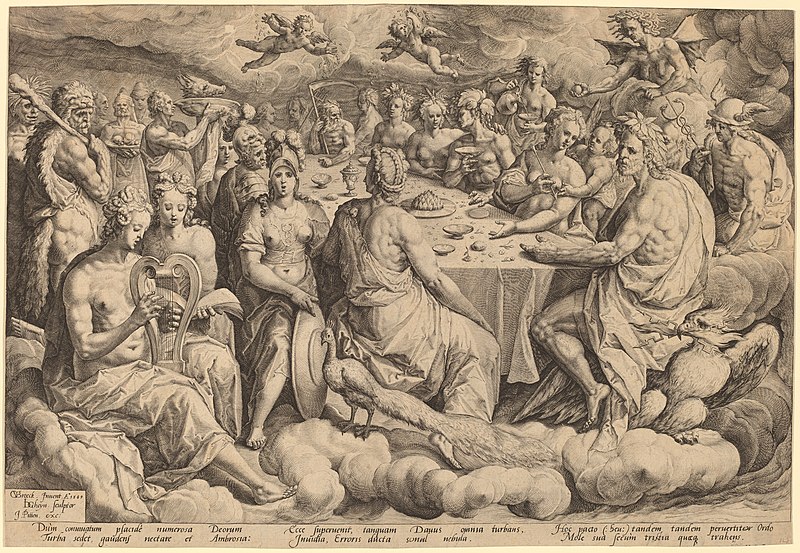
(This is half the conception of a pagan God: they can be harmed, even killed, but they don’t need anything. Except they can also, usually, create what they need without other Gods or people.)

Banquet of the Gods by Jacques de Gheyn II

What would you be like, and what would the world be like if you; if people, didn’t need anything?

These are serious questions. Think about them.

Now, question 3 is what if both of these things were true?

These questions matter because they tell you what you put up with because of need and fear. They tell you what other people; what society does that it couldn’t do if people weren’t, in effect, vulnerable.


(I am fundraising to determine how much I’ll write this year. If you value my writing and want more of it, please consider donating. Alas, I’m neither God nor Beast.)


It’s also important to do them separately. The first is about violence, in effect, and that’s not the same as the human need for cooperation, which is much (but not all) of what the second question is about.

This is what what Donne was getting at with “no man is an island.” It is also what is related to Aristotle’s observation “But he who is unable to live in society, or who has no need because he is sufficient for himself, must be either a beast or a god…”

There are things I want to say about these questions, but I’m not going to do so in this article. Instead I want you to think about them. Think about them in general and in particular: think about what you would and wouldn’t do in these three cases.


Interview on Climate Change, the New Cold War and the Rise of China

I did an interview few weeks ago with Chris Oestereich, which he’s putting up in three parts. I listened to part three today and, while I rarely say this, I thought it was quite good and if you’re interested in any of these topics, probably worth your while. It clocks it at under 24 minutes.


(I am fundraising to determine how much I’ll write this year. If you value my writing and want more of it, please consider donating.)

Listen to the podcast here.

The Long Term Effects of Covid On the Economy Are Going To Be Devastating

An estimate, but…

2 million to 4 million full-time workers are out of the labor force due to long Covid. (To be counted in the labor force, an individual must have a job or be actively looking for work.)

The midpoint of her estimate — 3 million workers — accounts for 1.8% of the entire U.S. civilian labor force. The figure may “sound unbelievably high” but is consistent with the impact in other major economies like the United Kingdom, Bach wrote in an August report. The figures are also likely conservative, since they exclude workers over age 65, she said.

As she says, this correlates to estimates elsewhere.

I want to be as clear as possible about this: the effect of Long Covid on the economy is going to dwarf that of closures or of  Covid TrueZero (a policy of cleaning up our air with filters and UV light, while using proper N95 masks, travel bans and other public health measures in the meantime.) Remember, Long Covid is still going on. It could go on for years, or even decades. There is no guarantee it mutates into a form which does not cause immunity and organ damage.

Further, the effect of Covid on people over 50 is going to be massive, and that means you if you’re under 50 when you get to being over 50, because the evidence coming in is that Covid damages the immune system: depletes t-cells and disorganizes recognition of pathogens.

That effect becomes more pronounced as you get older, and the tipping point is somewhere around the age of 50. This is going to lead to a further significant decline in lifespans if we can’t find a cure, but don’t assume we will: we’ve spent trillions and not found a cure for cancer and our society has passed its tipping point and is now in decline (this is true globally.)


(I am fundraising to determine how much I’ll write this year. If you value my writing and want more of it, please consider donating.)


China did ZeroCovid STUPID, as a number of people have pointed out, and have now reduced their efforts. We’ll see if they stay reduced after the Chinese population discovers what happens when you “let’er rip”, but if China continues, that’s the end of one of the last major population blocs which wasn’t riddled with Covid. Remember, again, that Covid can do significant damage which you don’t notice, that has no symptoms now. But it will later.

China’s Zero Covid policy was the right policy, done wrong, and when you do the right thing the wrong way, you discredit it. China’s anti-Covid policies took longer to be discredited than Western ones because while stupid they weren’t as stupid as ours, but they still overly relied on lockdowns rather than infrastructure improvement and refused to use n95 masks.

So, globally, this is going to lead to long term economic issues, both in lack of workers and supporting unhealthy people, or just letting them suffer and die, which will still have economic effects. (It’s obvious that en-masse we don’t really care about the morality of it).

And you, personally, will probably live less years and be less healthy. The more times you get infected, the more true this will be.


Page 105 of 437

Powered by WordPress & Theme by Anders Norén