
Use to discuss topics unrelated to recent posts.
Author: Ian Welsh Page 100 of 437
We’re all familiar with the myth: Prometheus steals fire from the Gods and gives it to man and is cruelly punished for it.
I’ve considered writing a story in which Prometheus is freed by Zeus and returned to Earth to judge the results of his action.
We’ve gone over the problems of industrialization and agriculture many times and that isn’t what this post is about, but as a brief summary: most people’s lives got worse about two thousand years after agriculture, and in some ways immediately after. Rotten teeth, more disease, reduced lifespan and narrow hips in women leading to more deaths in childbirth and harder live childbirths, then the rise of the kings and all the evil that came with them. As for industrialization, it came with capitalism and required stealing people’s property rights and forcing them to take wage jobs that up until the middle of the 20th century were worse than staying on the land. Then climate change and ecological collapse, without which technological triumphalism might have something of a point
But the bitterness of the fruit (and the fall from Eden is a related myth) is the bitterness that knowledge has turned in our hands and struck us. We learned to do amazing things: to grow our own plants; to domesticate animals; to make a vast variety of items; to use river and wind and coil and oil and the sun itself for power; to look at our own DNA and change it and so on and so forth.
The triumphalism in some circles: the joy at human ingenuity, is largely justified. What we have learned and invented as a species is amazing and we should, collectively, be proud.
The issue isn’t human ingenuity, it’s demonstrated instead that every time something new is discovered or invented, instead of thinking “what great things will we do with this”, many of us think “oh fuck, how is this going to be misused?” The recent AI crap is instructive, but I’m old enough and was online enough in the 90s to remember the initial predictions from futurists about how the internet itself was going to change the world. A lot of it was right, but way too much of it was wrong: far too optimistic.
My favorite example is that every study I know of (there may be a few exceptions) find that the more you engage with social media the more unhappy you are. There are countless other examples, insert your own.
So the pattern, and this is a pattern that has gone on for somewhere between eight to ten thousand years, depending on whether you look at agriculture or the rise of kings as the watershed, is that we figure out something amazing and then, more often than not the balance between how much it makes life worse and how much it makes life better is in favor of “oh crap.”
Debates about capitalism, communism, anarchism, Christianity, Buddhism, Islam and so on are debates about a way out of this trap, these original sins—these stories of taking fire or knowledge from the Gods and then burning ourselves more than helping ourselves. They are attempts to find a way to get more of the good and less of the bad, to tilt the field solidly towards the good.
Most major attempts have been sincere in their inception, much like the glee of of most discoverers of new knowledge. Then they have gone wrong, some more than others.
Some solutions have done significant good, especially at first. Others have had the opposite pattern. The same is true of specific inventions. The printing press in Europe (not China) probably did far more evil than good for about 200 years (say hello, wars of religion.)
We’re going to spend time teasing this apart over the next few months or maybe year or two because this is important. If there is a way out of this trap, it lies partially in understanding what we’ve tried in the past, and how it both worked and failed.
In the meantime, the simplest understanding is this: we are in a trap. As a species we created this trap ourselves. We forged our own chains and our own torture instruments, then used them on ourselves and keep doing so, in large part because we imagine them to be ourselves.
There is blame here, sort of, but really the blame/responsibility distinction is more important. We were born into societies that were already fucked up and that are immensely powerful, far more powerful than we are. Our collective might and the weight of the chains we have forged for ourselves over millennia is like Sisyphus’s boulder. It’s too much and every attempt to push it to the top of the hill has failed.
But the Gods haven’t said we must suffer forever from our own discoveries and inventions: only that we must learn to use these inventions with consistent kindness and wisdom.
Our task, then, is to figure out how to use knowledge and power with wisdom and kindness, in a sustained way, over not just a few decades or a century or two, which seems to be our best record so far, but over millennia, in a stable solution set.
Let’s get to it.
The results of the work I do, like this article, are free, but food isn’t, so if you value my work, please DONATE or SUBSCRIBE.
Eric Anderson wrote an excellent post on how late-stage capitalism engenders mental illness. I thought I’d follow it up with a simple post on capitalism.
As the name implies, capitalism is the accumulation of capital. This doesn’t mean money, primarily, that’s not what the early theorists meant by capital: they meant the means of production: land, workers, resources and capital goods: machinery in particular.
Capital is the ability to make and grow items. Because of economy of scale, if you concentrate capital it is easy to increase how much you make: Adam Smith’s famous pin factory.
But to concentrate capital you have to take it from a large number of people and put it in the hands of the few. This has been covered by a number of authors, and it involves taking away the commons rights of people in Europe (their right to use the land, which had existed for about a thousand years or so). We demonize serfs and peasants, and they had to engage in demeaning acts of servility, but they had strictly defined obligations to their lords for a certain amount of work, crops and animals and once that was taken care of they were able to spend their time as they pleased and they could grow crops on land they had right to; pasture their animals and so on.
Economists call the concentration of capital “primitive accumulation” but what it was was taking away property rights from people so they couldn’t support themselves. This forced them to go to cities and work in factories and so on, where they lived shorter lives, worked a hell of a lot harder (6 1/2 12 hour days were pretty common) and were sick a lot more often. The freedom of capitalism is the right to sell your labor, not the right to control how you spend your day. Unlike serfs and peasants, who were tied to the land, you could choose your master, but for most of the population, that’s what it was, a choice of masters, at least when there weren’t enough workers.
In the rest of the world European capitalism was about conquering land and into the 19th century, about taking slaves. The only thing better than workers who are desperate being workers who you didn’t even have to pay.
Capitalism, again, is about concentrating the means of production, capital, in the hands of the few. It is justified by the idea that concentrated capital is more effecient and therefore everyone has more. There’s a lot of arguments about whether that’s true and we now know, for example, that land clearances didn’t increase agricultural productivity much more than on communal lands, and in the case of some crops, communal lands were more efficient.
But it’s hard to make the case for the path not taken. Perhaps communal forms could have worked, I think they could have, and would have produced more prosperity in time, since they didn’t involve impoverishing people and two-thirds of the non-European globe, but… the water is passed and the argument is important not for what might have been, but for what might be in the future.
But all systems are made up of means and ends. Capitalism justifies removing the ability of most people to support themselves without working for others beyond what amounts to taxation by the violent authorities (that’s all governments. Don’t pay your taxes and eventually the big men with guns will show up, just like the knights did when a peasant didn’t meet his feudal contract.)
The means of capitalism in the modern world amount to “wage slavery,” something well understood by they yeoman farmers who were being forced off their land in the 1800s, and who seem to have coined the phase. You will have a master and if you can’t find one, you will starve.
It’s important to separate “capitalism” and “industrialization”. Because we industrialized under capitalism we think of the two as the same thing, or perhaps as co-joined siamese twins, but it’s not hard to imagine industrializing, which is about machines and assembly lines, in different ways: perhaps with communal organizations co-owning the means of production. This is distinct from Soviet communism, in which the government effectively owned everything, leading to the normal problems of totalitarian organization. Plurality and capitalism and synonyms.
This is something you need to think through; to imagine, for yourself. Try and come up with different ways industrialization and technology could have advanced, and don’t be caught up in historical inevitability. If you think that the past could not have been any different, then you effectively believe the future is determined.
This is one of the issues of Marxism: historical determinism. When it turned out (at least so far) that the historical dialectic didn’t work out how Marx and Engels envisaged, well, the house of cards collapsed. You have to give up inevitability to have choice and the ability to adapt.
We have plenty of options for the future and do not have to make the mistakes of the past. The first principle is that if your means are bad, no matter how good your ends, your society is going to have huge problems. You can’t routinely do evil, day in and day out, and expect the some invisible hand to lead to a good world for all.
The results of the work I do, like this article, are free, but food isn’t, so if you value my work, please DONATE or SUBSCRIBE.
Is just “all our lives will be good, or yours won’t be.”
Since there’s always some idiot who reads these posts and thinks they’re smart, no this doesn’t mean everything turns out identical or that some people won’t get cancer.
It means everyone gets enough if society has it, and gets treated fairly. It means that if a rich or powerful person gets cancer they get the exact same treatment the poorest and weakest person in society does. It means money and power can’t get you anything that actually matters: not education, not health care, not food when other people are going hungry.
“No one gets seconds until everyone has had firsts.” And no one gets thirds till everyone who wants them has had seconds.
The job of actual class struggle is to make it so that the rich and powerful can’t enjoy their wealth and power until everyone is taken care of and treated the same.
This is why the gays got Obama to support gay marriage by the way. It seems to be forgotten by Obama was an anti gay marriage bigot who recorded a call against gay marriage and whose chaplain for his inauguration was anti-gay marriage. So the gays, a lot of whom had carried water for him during the election did two things: they cut off the donations, hard, and they went after his wife: broke into a fundraising party and made her life miserable.
Oh, the squeals. The hand-wringing.
But it was pretty mild, she gets to be famous and rich because of her husband and she carried his water, for sure. She can take a little screaming and if she can’t, too bad.
But as I said, this is mild. Things will be serious when people start saying “if you make one of us dead or homeless, we make one of you dead or homeless.”
We’re all in the same life raft, or we aren’t and if we aren’t, then the only solution is to put us in the same raft and make the powerful bail and drown with the rest of us.
The results of the work I do, like this article, are free, but food isn’t, so if you value my work, please DONATE or SUBSCRIBE.
So, there are different measures of creativity. One of them is divergent thinking, the ability to come up with lots of different ideas. George Land created a famous test for NASA, then applied it to children. Test-takers were given a problem and then had to come up with many different ways to tackle it.
Land’s dead now but before he died he gave a Ted talk. Generally loathe them, but this one is interesting.
As for the results of his test…
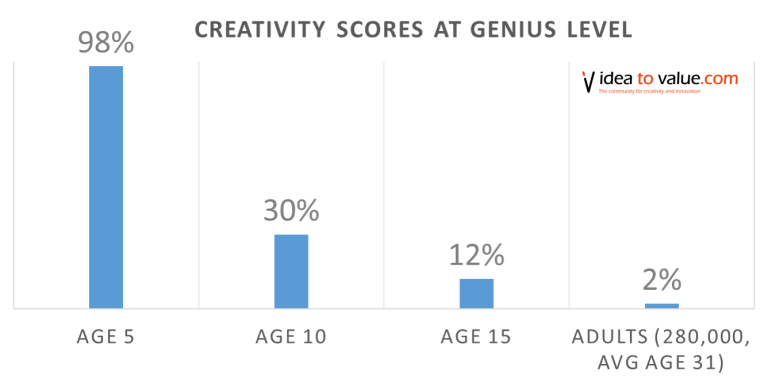
Yeah. Woops. The reason for this is simple (and I can hear some regular readers eyes rolling, since this is a subject I’ve talked about a lot.) School is about coming up with the “right” answer the “right” way. There aren’t 50 right ways. I have many memories of coming up with the right answer in math, for example, using different methods than the teacher and being downgraded for it.
In math there’s often a “right” answer but in other disciplines, there isn’t one. What caused the French revolution or World War I? There isn’t a right answer.
Now, perhaps you’re thinking “but the social sciences and humanities are different.”
Oh, somewhat.
Back in the 90s I used to tutor university students. I’d tell them I could teach them to consistently get a B, but not an A, because the extra step from B to A was knowing the person who is marking your tests and essays, and both working them so they like and respect you and tailoring your answers to their prejudices. It’s actually harder to get get an A in the humanities and social sciences than in the sciences and in math. I’ve gotten 100% on a chemistry or physics test. I have never done so on a paper or non multiple choice test in the humanities or social sciences because there isn’t a correct answer.
But you will get higher grades if you learn to give the marker about what they want.
In the sciences it’s about getting the right answer the right way. In the humanities and social sciences it’s a social game of “please the market” or in very rigid standardized tests of “please the test designer.”
In realm of the real world this leads to the something called “best practices”, which I loathe. There are no such things as best practices. That doesn’t mean you can’t teach workers what is known to work, but if you enforce “best practices” then they can’t innovate. If you tell people “how” to do something, rather than say “I need you to accomplish X” you shut down learning and creativity and you also strangle advancement.
People have to be free to try new things. There are degrees of this, of course, in some cases the task still needs to get done. But mandating how and not what stiffles progress and creativity faster than almost anything else.
What we do to children and adults is psychologically cripple them. It’s better, in our society, to be wrong with the pack or in the approved fashion than to be right against the pack or using non-standard methods.
Very, very much better. In the pack, wrong with the pack, or more accurately wrong in the way leader-teacher wants you to be, you’re safe.
But get it right the wrong way, or get it wrong trying something new, and you’re toast.
We all know this, but many of us refuse to admit it and this is especially true with regards to school. We spent more awake time in school for twelve to sixteen or more years than we did anywhere else, except in some cases home. That creates strong identification. We either want to believe school is good, or we rebel against it, but very few people can remain neutral. If something “must” be then it must be good.
But school teaches (eye-roll time) us to be a bunch of conformists, giving teacher what they want in the way they want, sitting down and not even talking or using the bathroom without permission.
That’s school and denying that is what school is is rank stupidity.
It’s also most workplaces. You replace teacher with boss.
And then you think you’re free when you’ve spent most of your life doing what you were told, the way you were told to do it.
(By the way, one corollary of Land’s test is that you started out as a creative genius. Perhaps you can be one again? It’s not nature that made you un-creative. Nature started you as a genius.)
The results of the work I do, like this article, are free, but food isn’t, so if you value my work, please DONATE or SUBSCRIBE.
I mean, I feel kind of lame for even posting about this because unless you were stupid (or on the payroll) you knew it was either the US or an ally, and if an ally the US was involved.
Turns out it was the US and Norway. Seymour Hersh.
Of course he had to post this on his substack because not a single mainstream outlet will publish it.
A Dalek commented how surprising the CIA’s competence was in this operation, but what I find interesting is how effective media control is now: if no one will cover it, did it even happen? The level of control over the media is astounding, and the majority of it is tacit, I doubt the CIA had to call outlets and say “don’t publish Hersh”, the people in charge know what their job is and do it without any threats, then see themselves on the same side as the CIA and if a truth is too inconvenient, well, it isn’t important.
It really does remind me of the early post 9/11 and Iraq War period, where you just couldn’t tell the truth and be heard on anything mainstream, and trying was a career death sentence.
And yeah, I do think this is worse than it was in the past. The old media was corrupt and often complicit, too often, but it wasn’t this bad. A combination of almost every media asset being owned by just a few companies and the Ivy League takeover of journalism jobs, which used to be working class, has made the vast majority of the media little more than collaborators with the powers that be.
I’m a bit of a broken record on this, but I still find it extraordinary that they lied about Corbyn about 80% of the time. Amazing.
Anyway, Norway (who made 40 billion more a year from taking sales from Russia) and the US who has also made a mint selling Europe natural gas, turn out to be the nations responsible for destroying Nord Stream, which I’d say was an act of war. Turns out the nations with the most to gain were the criminals. What a surprise. (Though I did think Poland might have been involved, as they had other things to gain. Turns out greed was the primary factor, not ideology.)
Dog bites man. It is tedious that this had to be proved. The amount of cycles wasted by intelligent people proving what is obvious to anyone who isn’t a moron or dishonest is pathetic. (And this nonsense is why I rarely bother proving the obvious any more. It’s just meant to waste cycles and anyone asking for proof of the obvious is not an honest interlocutor.)
Note: corrected “cover” to “publish”, which was my original intent.
The results of the work I do, like this article, are free, but food isn’t, so if you value my work, please DONATE or SUBSCRIBE.